
A complete issue · 20 pages · 1907
Life — December 12, 1907
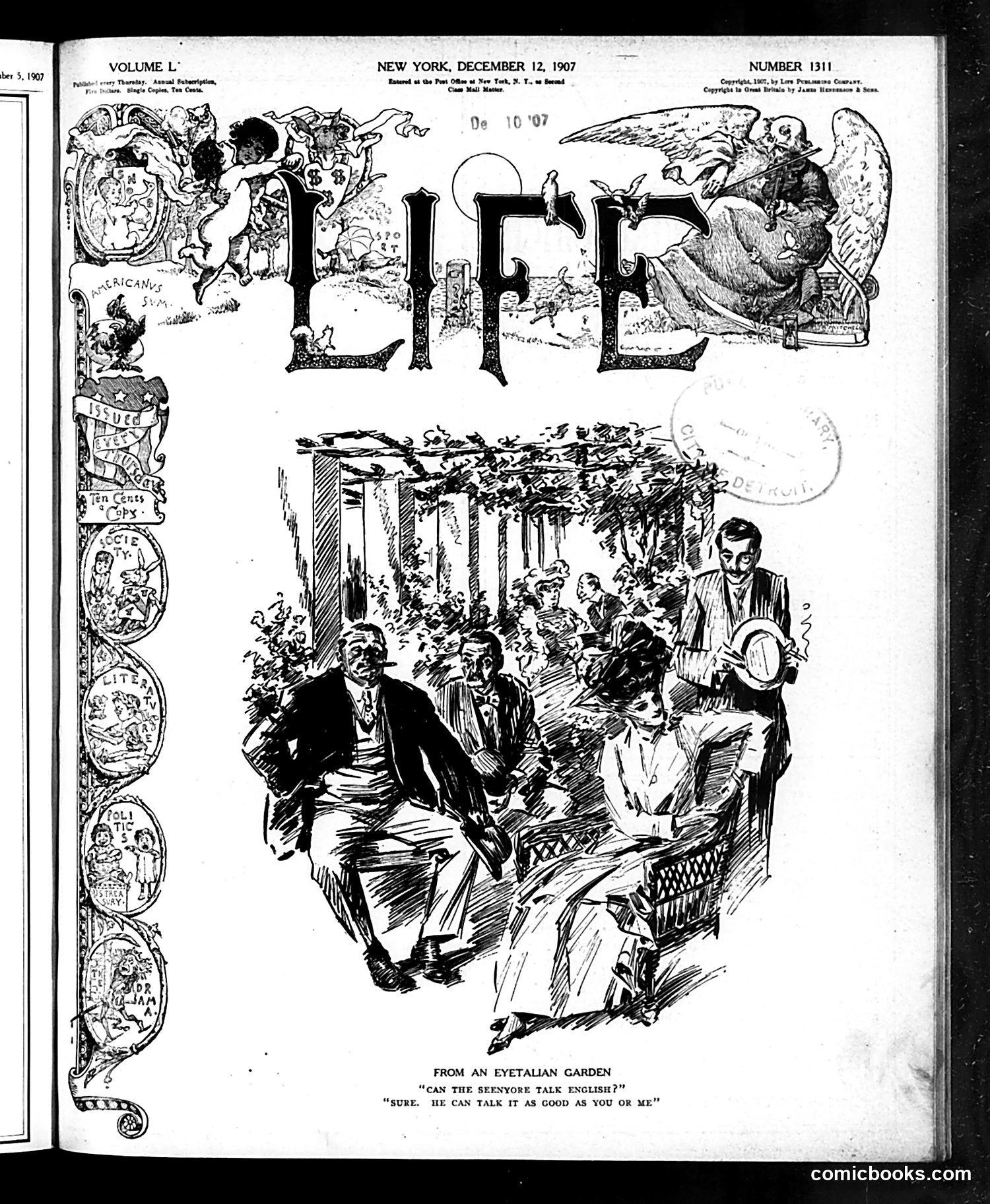
This page features a satirical cartoon titled "From an Eyetalian Garden" with the subtitle "Can the Seenyore talk English?" / "Sure, he can talk it as good as you or me." The cartoon depicts well-dressed men in what appears to be a garden setting, seemingly mocking Italian immigrants' English-language abilities. The phrase "Eyetalian" is a derogatory ethnic phonetic spelling of "Italian" common in early 20th-century American humor. The satire targets nativist attitudes toward Italian immigration—a major demographic wave during this period. The cartoon implies Italian immigrants claim English fluency while the very phrasing of the joke questions their actual competence, reflecting widespread xenophobic stereotyping of the era. The ornate decorative border and elaborate header design are typical of Life's sophisticated visual presentation.
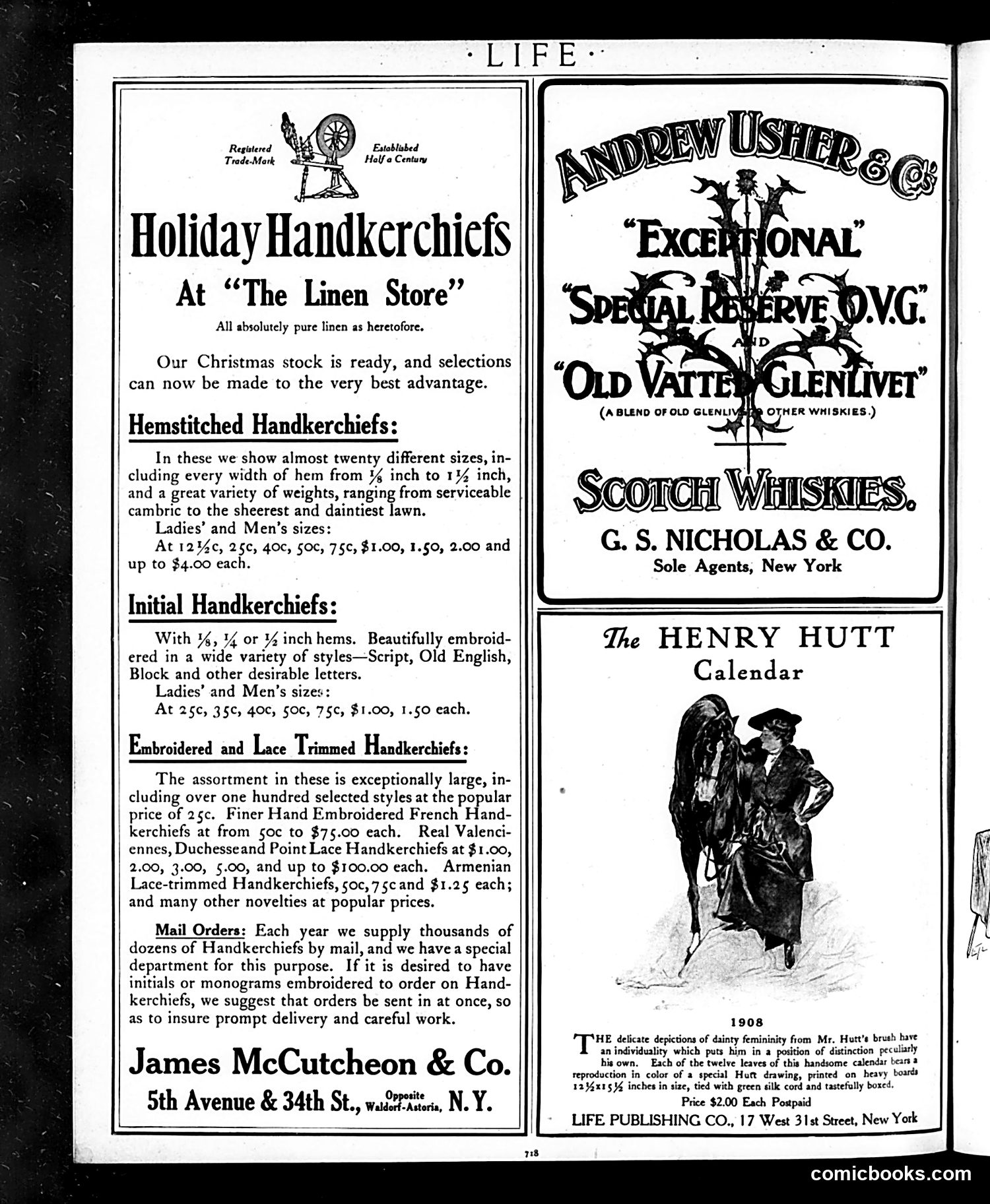
This page contains **primarily advertisements**, not political satire or editorial cartoons. The left side advertises handkerchiefs from James McCutcheon & Co., offering hemstitched, initial, and lace-trimmed options at various price points—typical holiday merchandise advertising. The right side features two ads: one for Andrew Usher & Co. Scotch whiskies (marketed through G.S. Nicholas & Co. in New York), and below it, an advertisement for "The Henry Hutt Calendar" (1908), priced at $2.00. The calendar illustration shows two figures in period dress, apparently depicting a romantic or sentimental scene characteristic of early 1900s calendar art. There is **no political commentary or satirical content** visible on this page—it represents standard commercial advertising from Life magazine's revenue model.
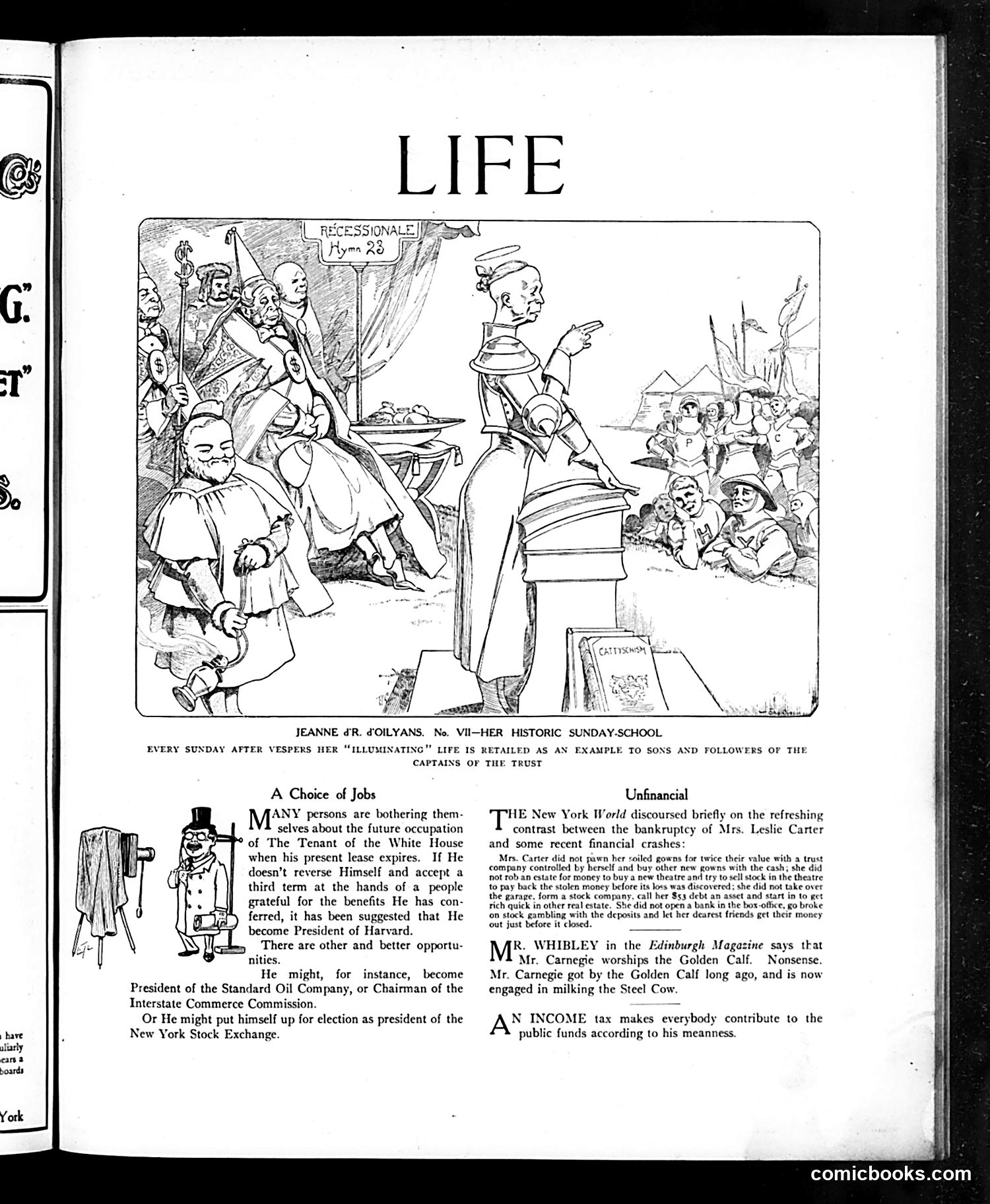
This page satirizes wealth and privilege through multiple pieces: **Main Cartoon**: Titled "Jeanne d'Orleans," it depicts a religious procession where a nun teaches children about "Life" using historical examples. The setting appears to mock how the wealthy sanitize their histories for public consumption. **"A Choice of Jobs"**: Satirizes the absurdity of career expectations for wealthy men. The text suggests someone could become President of Harvard, Standard Oil, or the Stock Exchange—implying these positions are interchangeable rewards for the privileged rather than merit-based achievements. **"Unfinancial" Section**: Brief satirical notes mocking the wealthy (Carnegie's business practices, Mrs. Carter's financial naivety) and income taxation as wealth-redistribution. The overall theme critiques how the elite manage their public image and assumed entitlements.
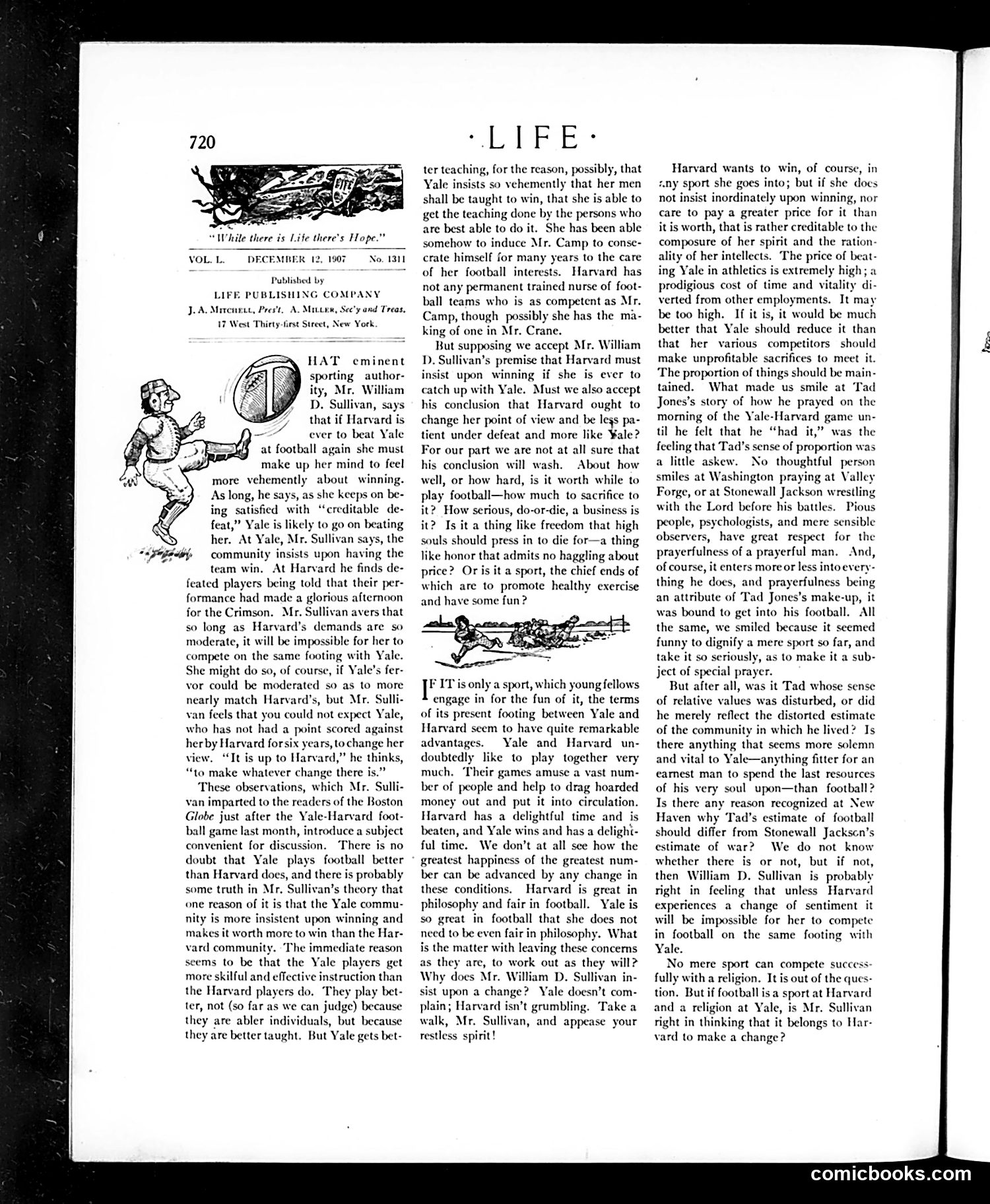
The page contains an editorial debate about Harvard-Yale football rivalry, with a small cartoon illustration of a cherubic figure kicking a football. **The Cartoon's Context:** The illustration appears to satirize the intense sporting rivalry between these prestigious universities. The cherub-like figure suggests innocence contrasted with the competitive fervor surrounding the game. **The Main Argument:** The editorial, titled "What Is Life there's Hope," critiques William D. Sullivan's claim that Harvard should prioritize winning over Yale. The author questions whether football—a mere sport—deserves the serious sacrifices both institutions make for victory, asking whether such competitive obsession reflects appropriate values for educational institutions. **The Satire's Point:** The piece mocks the disproportionate cultural and institutional weight placed on college athletics, suggesting the universities' rivalry has become absurdly inflated beyond the sport's actual importance.
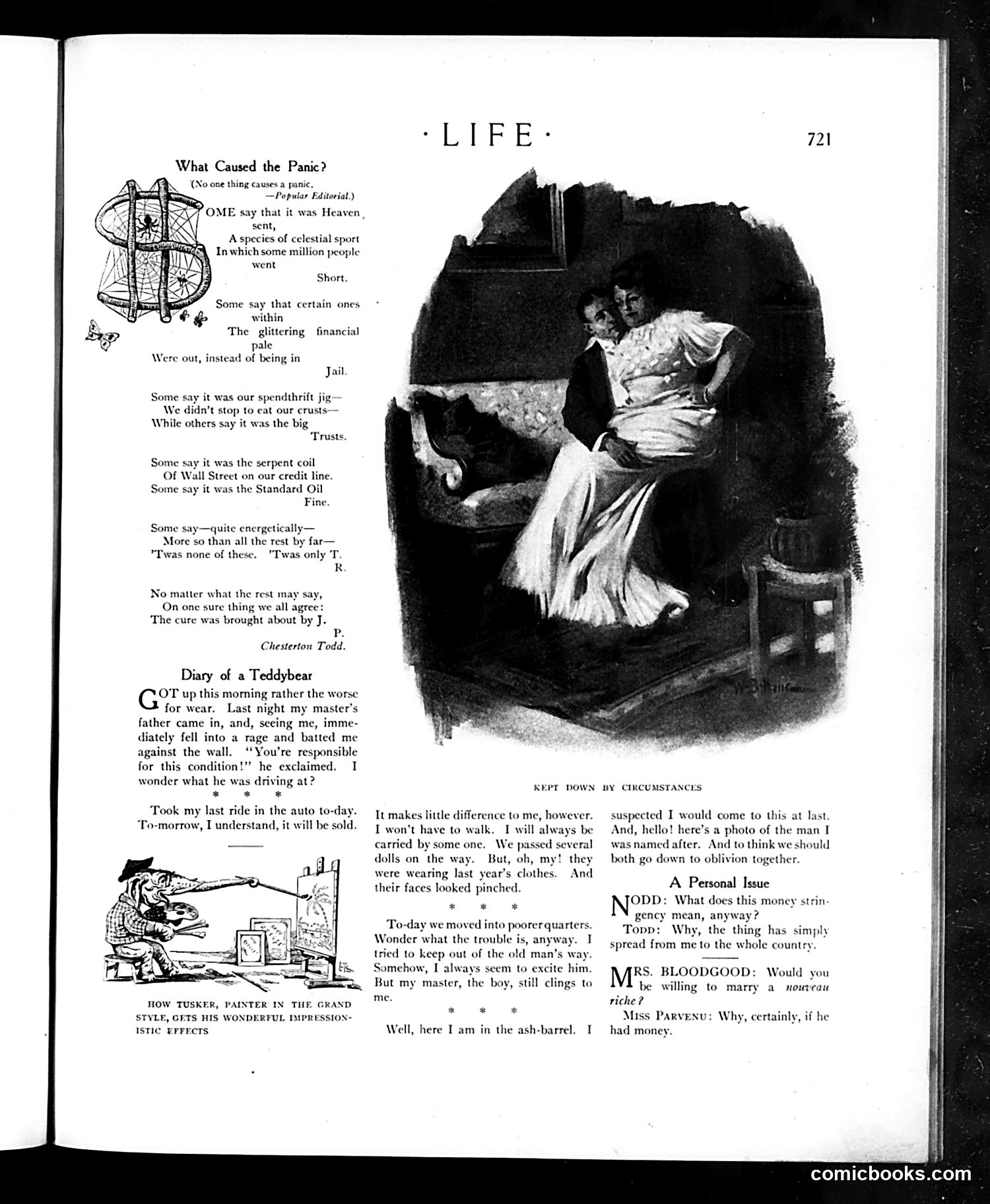
The page contains two main satirical pieces: **"What Caused the Panic?"** is a poem by Chesterton Todd that humorously catalogs competing explanations for an economic panic—blaming Heaven, financial speculation, excessive spending, Wall Street trusts, Standard Oil, and T.R. (Theodore Roosevelt). The joke is that everyone blames something different, making the actual cause unclear. **"Diary of a Teddybear"** is a satirical piece where a teddy bear describes hard times—being abused by a master's angry father, taking a final auto ride before being sold, and moving to poor quarters. The humor lies in personifying a child's toy experiencing economic hardship, likely reflecting early-1900s recession anxieties through an absurdist lens. Both pieces use humor to address financial crisis and economic anxiety.
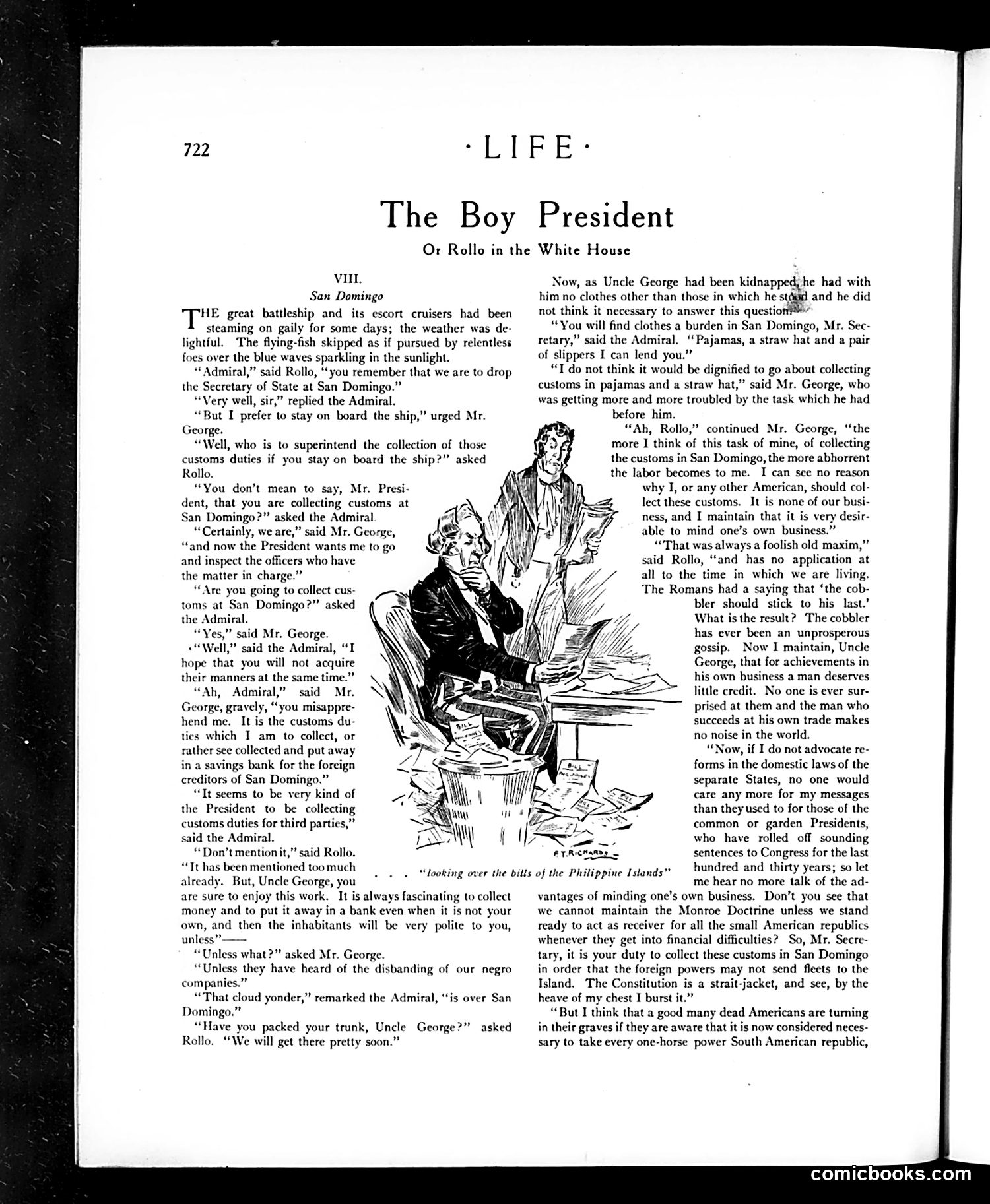
This satirical piece mocks a young U.S. President (identity unclear from image alone) through the character "Rollo," a naive boy-figure. The cartoon depicts Rollo collecting customs duties in San Domingo (Dominican Republic), which he views as personal profit rather than official responsibility. The satire targets the President's immaturity and self-interest: he treats government duties like a child's game, pocketing money that should benefit the nation. References to "the Monroe Doctrine" and American republics suggest this concerns early 20th-century Caribbean/Latin American interventionism. The joke is that the "Boy President" cannot distinguish between public office and personal business—he's literally too childish to govern responsibly, reducing serious foreign policy to childish treasure-collecting.
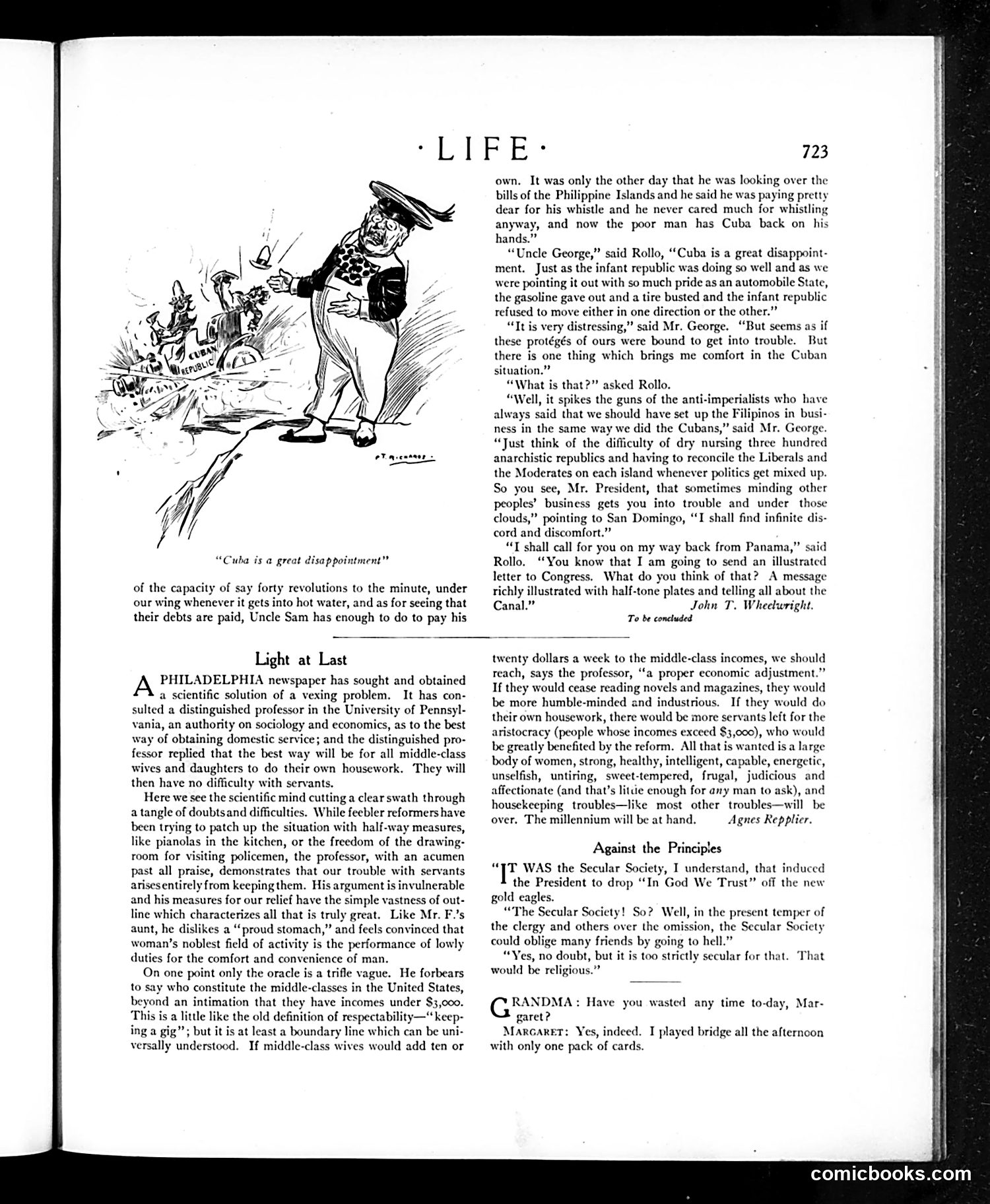
The cartoon depicts Uncle Sam (the U.S. personified) examining a broken toy labeled "Cuba" with disappointment. The accompanying dialogue reveals the satire's context: the speaker laments that Cuba, recently acquired by America, has become troublesome—factions constantly bicker, requiring the U.S. to mediate disputes between "Liberals and Moderates" on the island. The joke mocks American imperial ambitions: the U.S. expected to simply possess Cuba like a working toy, but instead faces ongoing political instability and factional conflict requiring constant intervention. The broken, malfunctioning toy metaphor criticizes America's naive assumption that territorial acquisition would be easy—instead, governing Cuba proves frustratingly complex.
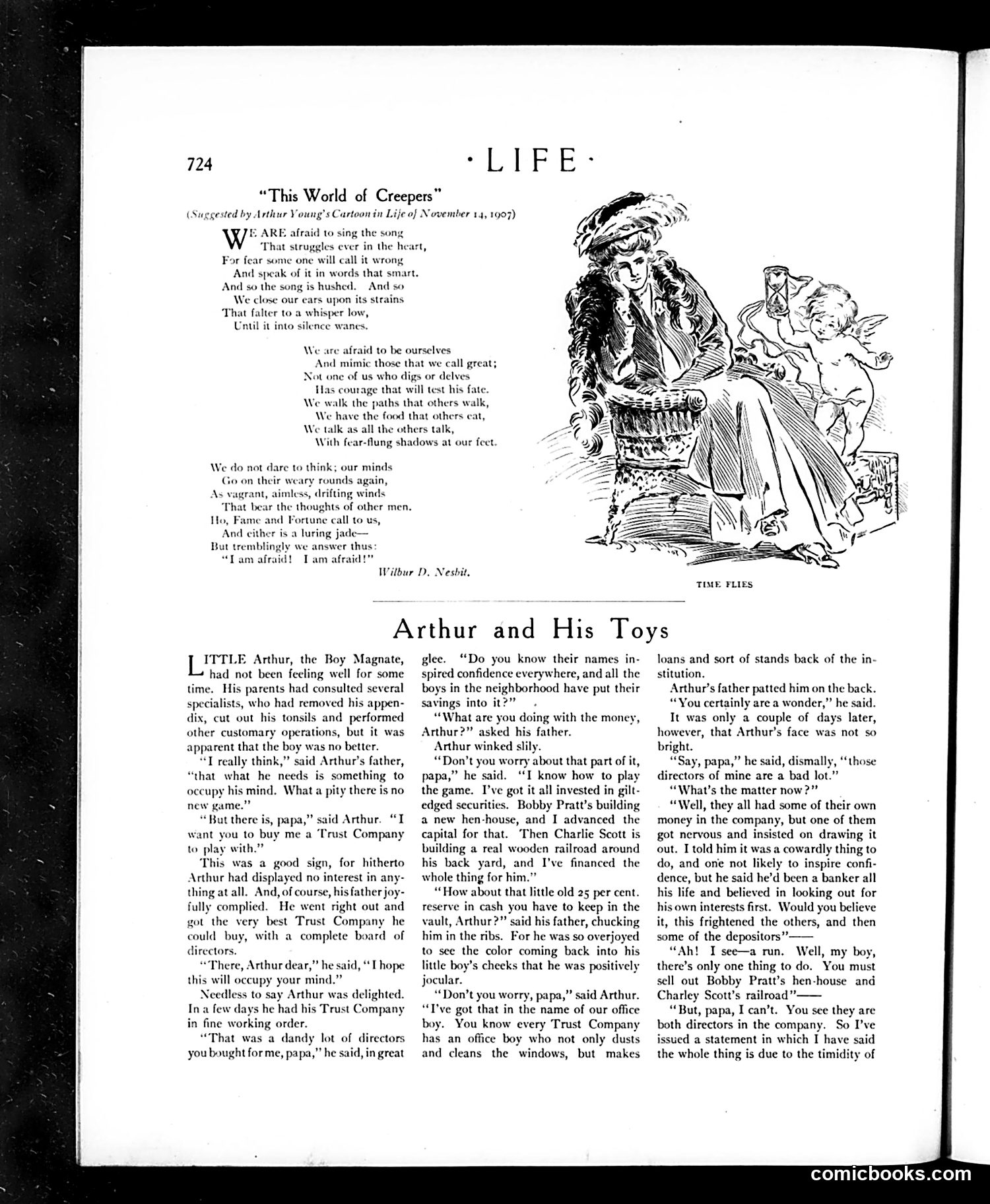
**Top Section - "This World of Creepers"** This is a poem (attributed to Wilbur D. Nesbit) about social conformity and fear. It critiques people who suppress their authentic thoughts and feelings to avoid judgment, instead mimicking others' behavior and opinions. The accompanying illustration shows a fashionable woman with a cherub, labeled "TIME FLIES"—likely a visual metaphor for fleeting youth or vanity. **Bottom Section - "Arthur and His Toys"** This is a satirical story about Little Arthur, a wealthy boy whose father indulges his financial schemes. The narrative mocks both the boy's naive business ventures (a Trust Company, a hen-house, a railroad) and his father's enabling parenting. The humor targets early-1900s corporate culture and the notion of children playing at adult financial institutions.
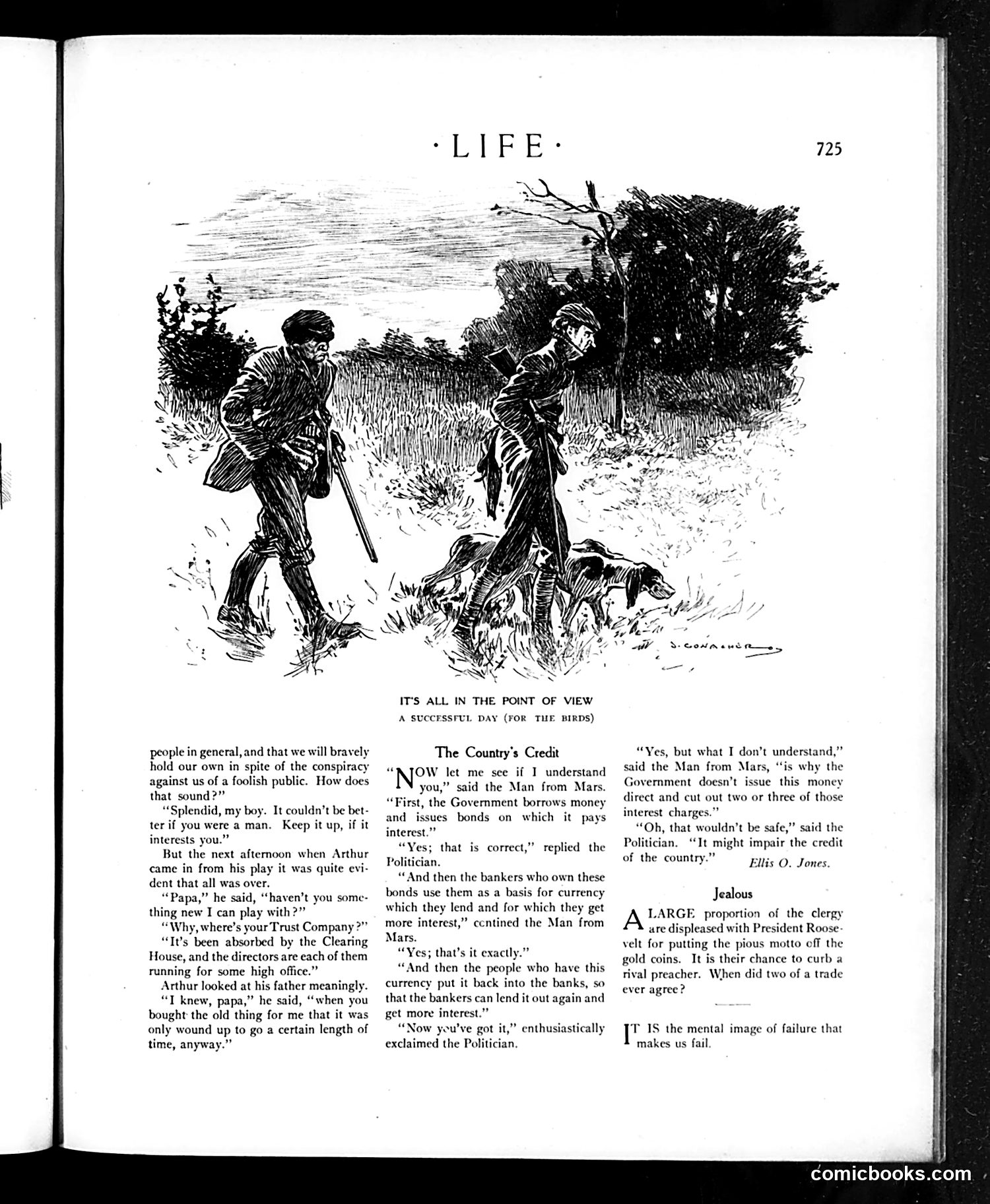
The main illustration depicts two hunters in a field with a dog, titled "It's All in the Point of View: A Successful Day (for the Birds)." This appears to be visual irony—the hunters consider their outing successful, but from the birds' perspective (those they're hunting), it's a disaster. The text below presents a political dialogue between "the Man from Mars" and "the Politician" discussing government borrowing, bonds, and banking practices. The Man from Mars questions the logic of the system: the government borrows money, issues bonds, and banks profit through interest charges. The Politician defends the practice, while the Martian visitor finds it baffling—highlighting how absurd or circular the financial system appears to an outsider's perspective.
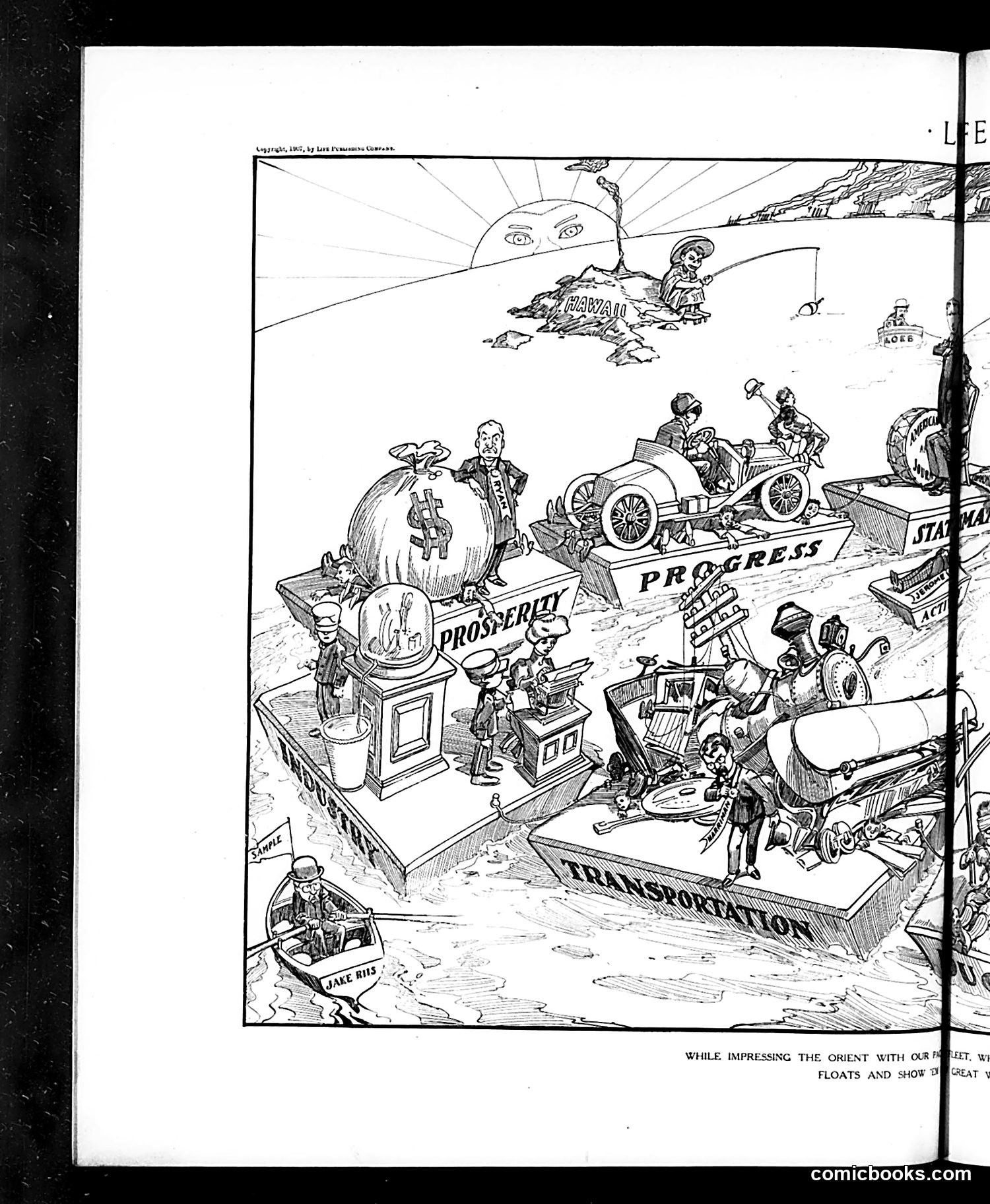
This appears to be an early 20th-century satirical cartoon depicting American industrial and commercial progress. The illustration shows multiple allegorical floats or platforms labeled "PROSPERITY," "PROGRESS," and "TRANSPORTATION," moving across a landscape under a rising sun. The central figure appears to be a wealthy businessman or capitalist (the man in formal dress near the money bag marked with dollar signs). Various industrial symbols surround him—automobiles, machinery, and workers—suggesting commentary on American capitalism and technological advancement. The caption fragment references "impressing the Orient with our fleet," suggesting this may comment on American imperial ambitions or trade expansion in Asia during the early 1900s. The overall tone appears satirical toward American economic boosterism and expansionist ideology of the era.
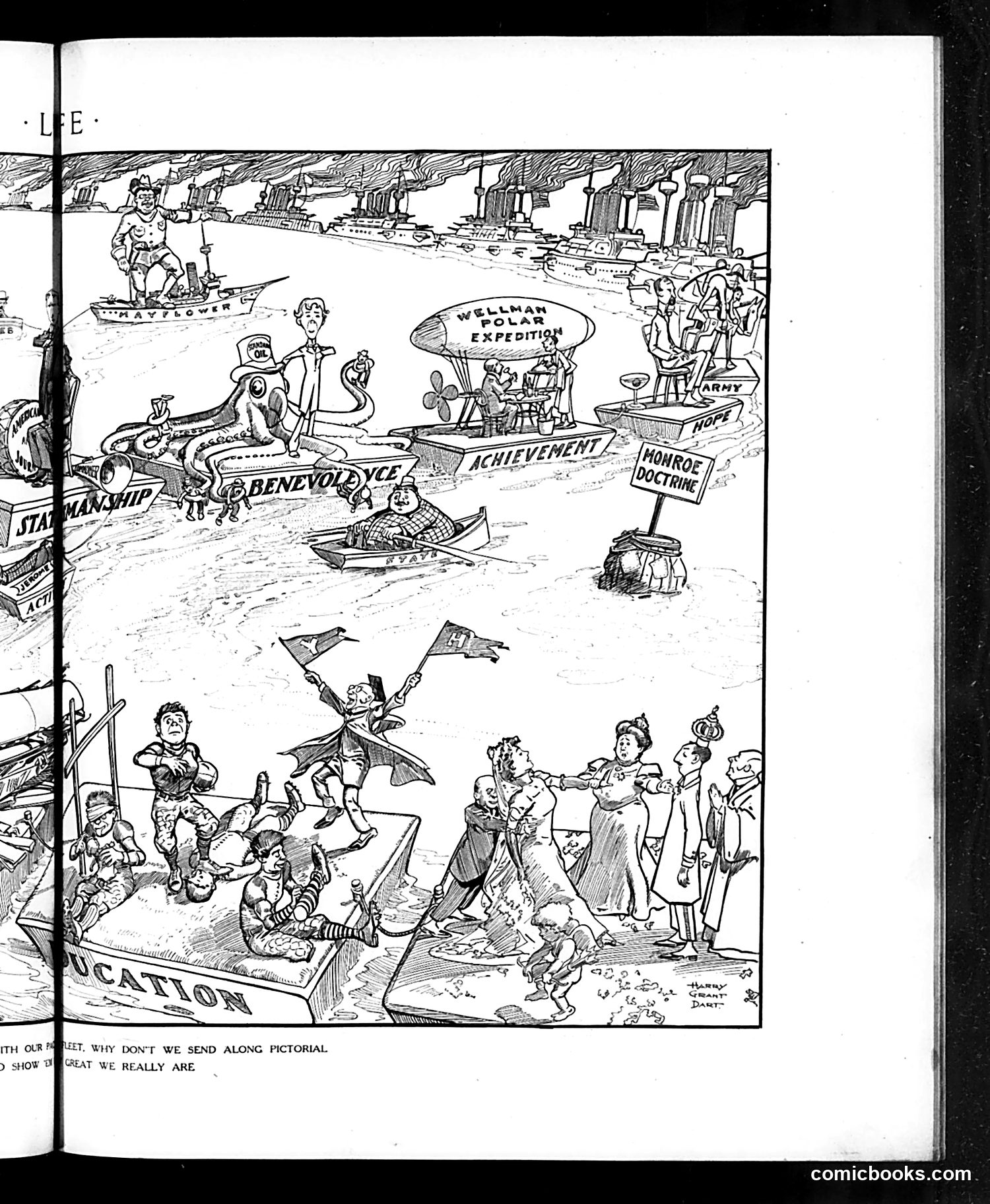
This satirical cartoon depicts American foreign policy aspirations as various competing vessels and expeditions on water. Several labeled efforts are visible: - "Wellman Polar Expedition" (center) - "Monroe Doctrine" (right, on a small island) - "Benevolence" (left) - "Achievement" and "Hope" (labeled boats) - "Statesmanship" (partially visible, left edge) The cartoon critiques America's multiple simultaneous international ventures and claims. The chaotic scene—with various ships, figures, and competing priorities—suggests the difficulty of managing these overlapping initiatives. At bottom, text reads: "WITH OUR FLEET, WHY DON'T WE SEND ALONG PICTORIAL / TO SHOW JUST WHAT WE REALLY ARE." The satire appears to mock American self-promotion and the contradictions between stated ideals (benevolence, achievement) and actual imperial/military interests, suggesting America cannot coherently present itself while pursuing so many conflicting goals.
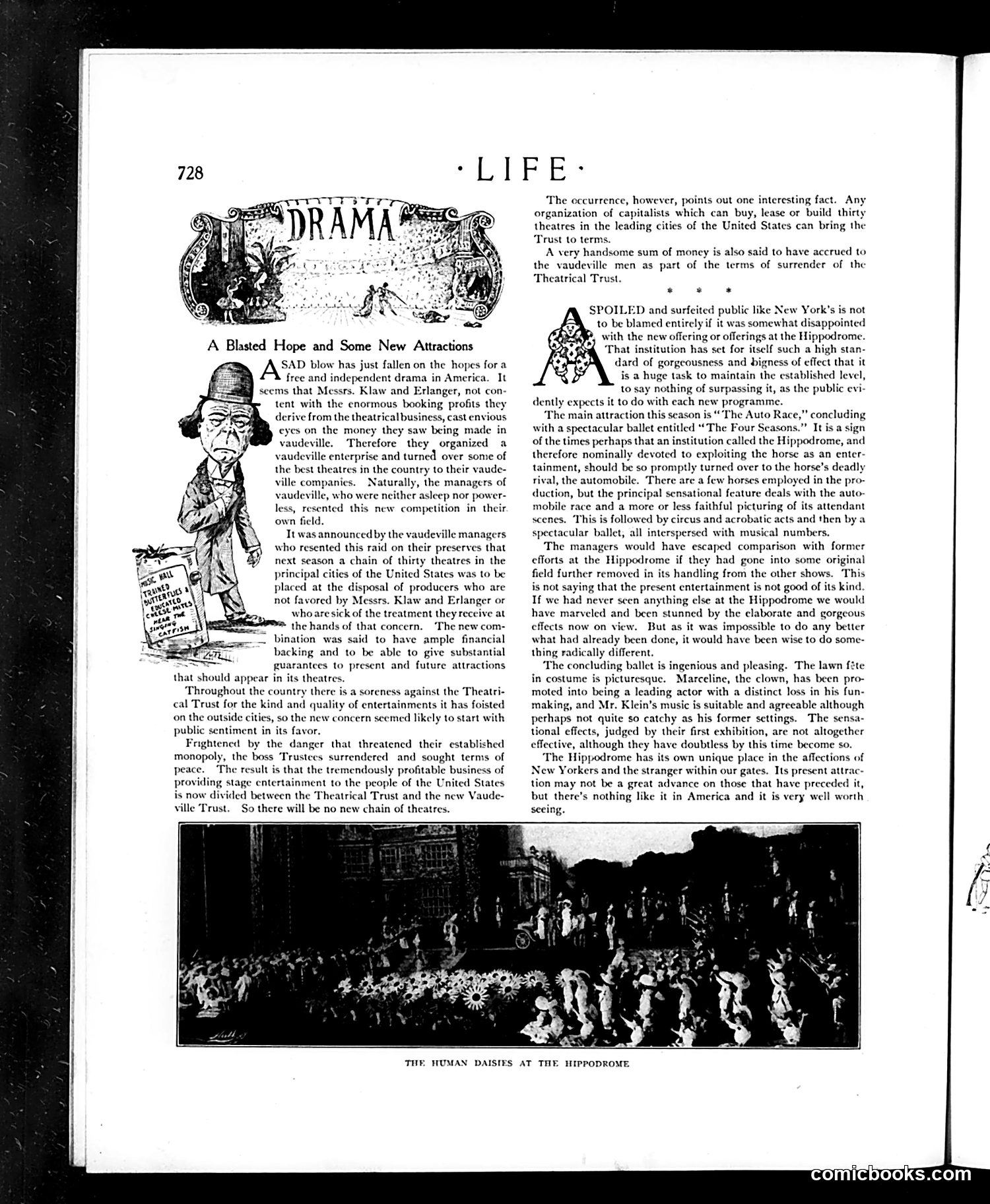
This page satirizes competition between theatrical entertainment venues in early 20th-century America. The cartoon depicts a disheveled figure (likely representing vaudeville theater managers) lamenting the rise of the Hippodrome theatre and its new attractions—particularly a horse-centered spectacle called "The Four Seasons" and "The Human Daisies." The satire critiques how established vaudeville theaters felt threatened by the Hippodrome's lavish, innovative productions featuring horses, automobiles, and elaborate musical numbers. The text suggests vaudeville managers initially tried creating a chain of competing theaters but ultimately lost ground to this newer, more spectacular entertainment form. The joke is on traditional theatre's struggle against increasingly extravagant competition.
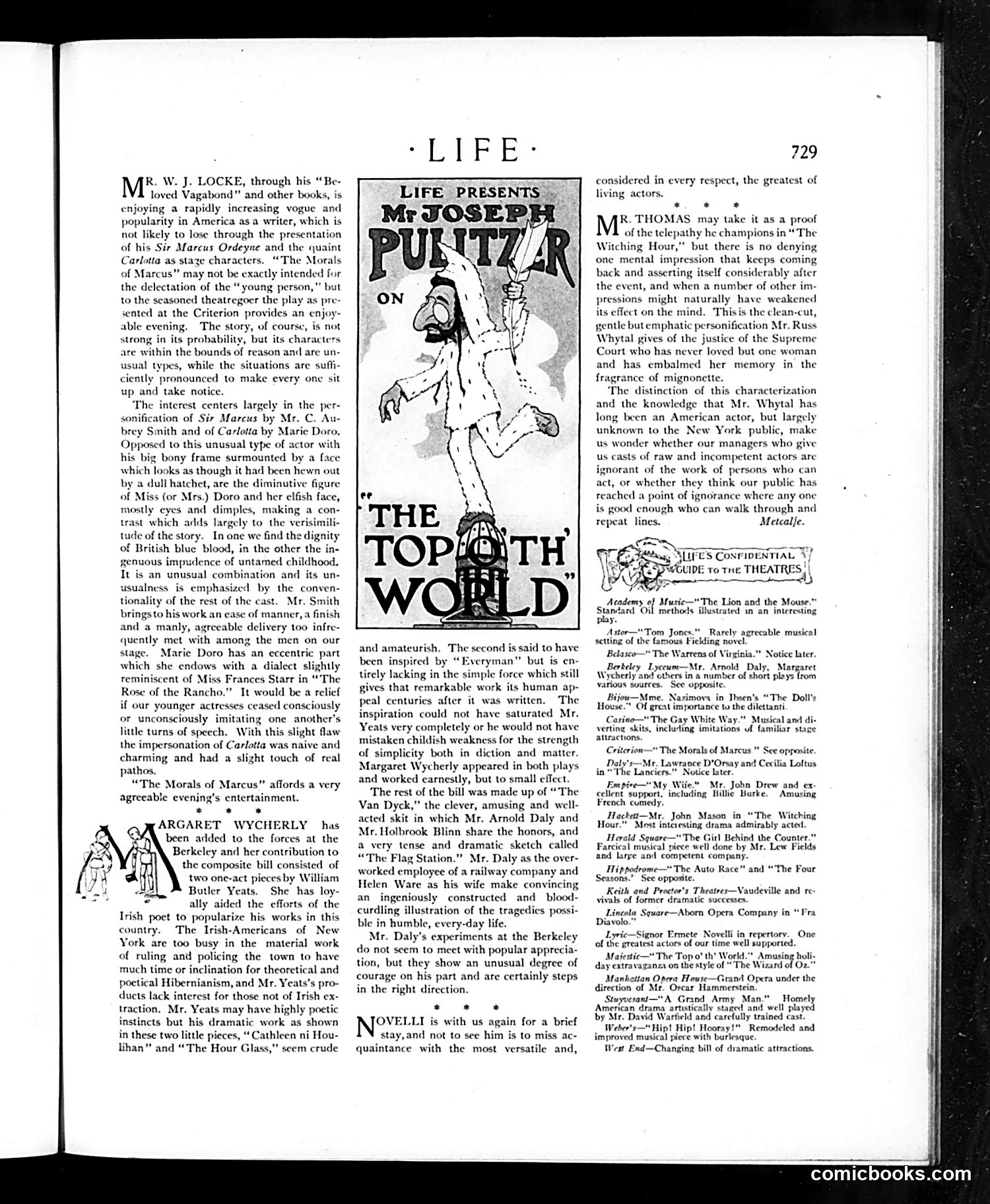
This page features a Life magazine review of theatrical productions. The prominent cartoon advertises "The Topnotch World," presented by Joseph Pulitzer (the famous newspaper publisher). The illustration shows a caricatured figure in exaggerated pose, likely satirizing Pulitzer himself or the theatrical production's quality. The review text criticizes various theatrical performances and actors of the era, noting weak characterizations and amateurish acting. The broader satire appears to mock Pulitzer's involvement in theater production—suggesting his newspaper empire didn't translate to theatrical competence. The "topnotch world" title may be ironic, mocking pretensions to quality in what the reviewer considers mediocre entertainment.
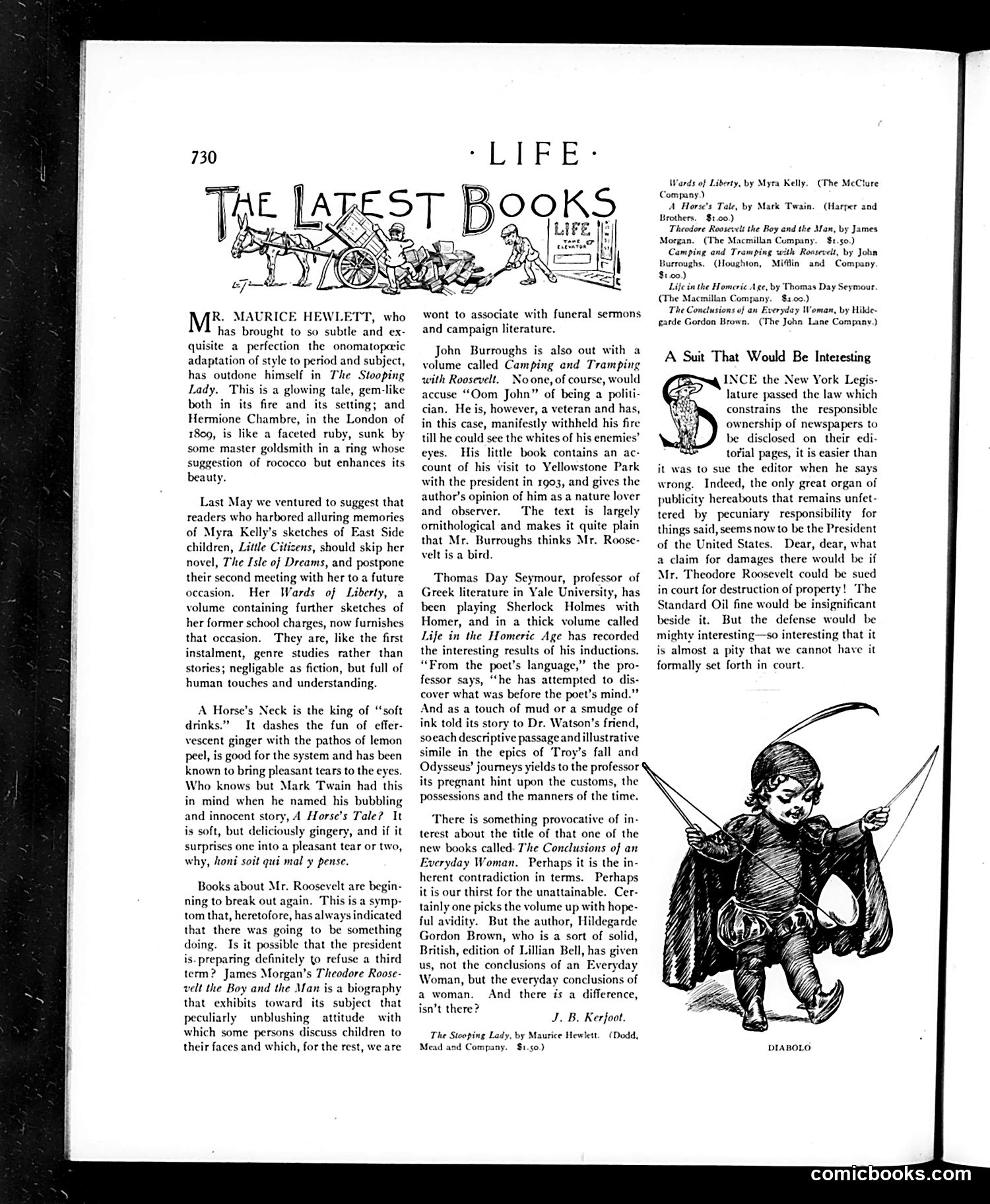
This is a book review section from Life magazine featuring Maurice Hewlett's *The Stooping Lady* and works about President Theodore Roosevelt. The key satirical content concerns Roosevelt. The page mocks the proliferation of adulatory Roosevelt biographies, noting these books "wont to associate with funeral sermons and campaign literature"—implying excessive praise bordering on hagiography. The reviewer sardonically suggests James Morgan's *Theodore Roosevelt the Boy and the Man* exhibits an "unblushing attitude" typically reserved for discussing children patronizingly. The most pointed satire targets John Burroughs's *Camping and Tramping with Roosevelt*: the reviewer notes Burroughs "withheld his fire till he could see the whites of his enemies' eyes" and concludes that Burroughs thinks Roosevelt "is a bird"—a backhanded compliment suggesting Roosevelt's vanity and the book's fawning nature. The cartoon labeled "Diabolo" (right) depicts a child playing with a spinning top toy, unrelated to the text.
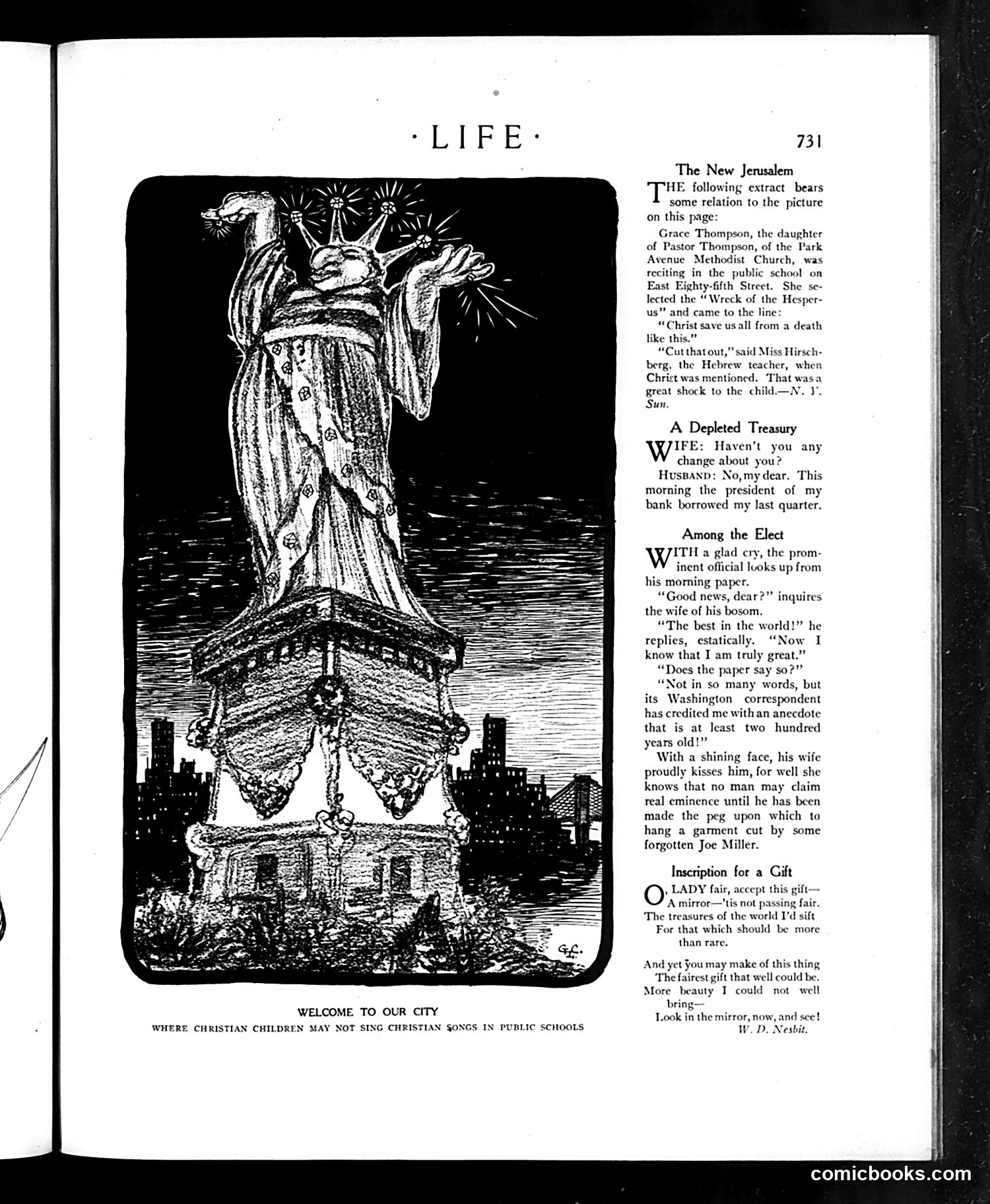
The main cartoon depicts the Statue of Liberty inverted upside-down, with her torch pointing downward and the New York skyline below. The caption reads: "WELCOME TO OUR CITY / WHERE CHRISTIAN CHILDREN MAY NOT SING CHRISTIAN SONGS IN PUBLIC SCHOOLS." This satirizes a real controversy: a Hebrew teacher (Miss Hirschberg) allegedly censored a Christian student (Grace Thompson) from reciting "Christ save us all" from "The Wreck of the Hesperus" during a public school recitation—an incident reported in the New York Sun. The inverted Liberty Statue symbolizes American values turned upside-down by religious censorship in public institutions. The satire mocks the perceived threat to Christian expression in secular schools, presenting it as un-American. The accompanying humorous anecdotes about financial hardship and vanity undercut the seriousness, suggesting Life magazine found the religious controversy both earnest and somewhat ridiculous.
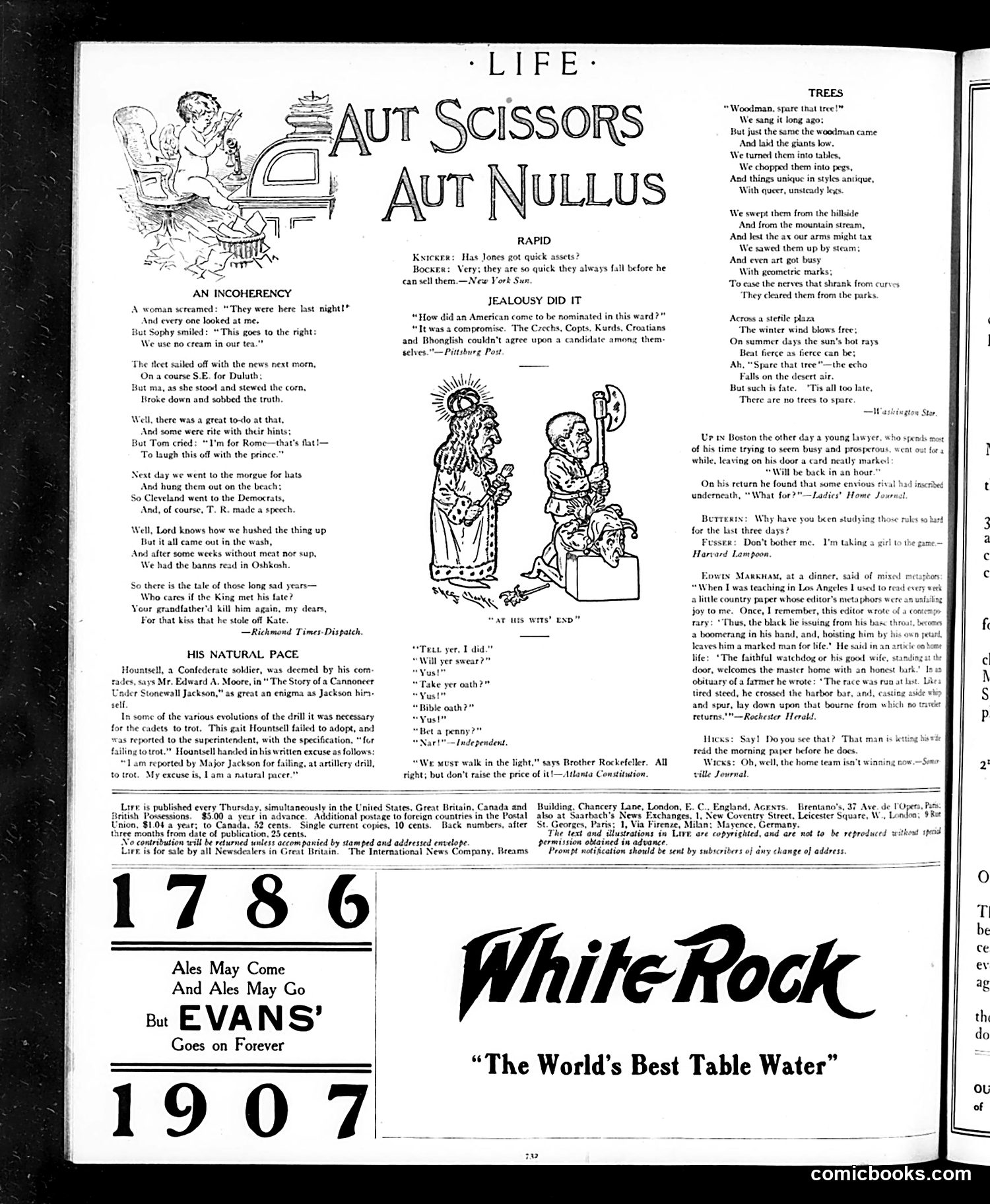
This page from *Life* magazine contains several short humorous pieces and satirical items typical of early 20th-century American humor: **"An Incoherency"** is intentionally nonsensical verse—a parody of absurdist or poorly-constructed poetry, where random plot elements (a fleet sailing to Duluth, trips to the morgue for hats, Cleveland politics, Cleveland going to Democrats, Theodore Roosevelt making a speech) are strung together without logical connection. The joke is the humor of confusion itself. **"His Natural Pace"** recounts a Confederate soldier's excuse for failing to trot during drills—he claims to be "a natural pacer," playing on the double meaning (a horse's gait versus the soldier's natural walking speed). It's gentle Civil War-era humor. **Other items** include short joke exchanges about quick assets, immigrant political compromises, and deforestation. The "Trees" poem nostalgically laments logging's destruction of forests. The page mixes light verse, anecdotes, and advertising (Evans' ale, White Rock water). This reflects *Life*'s format as a humor and satire magazine blending social commentary with wordplay and gentle mockery of contemporary American life.
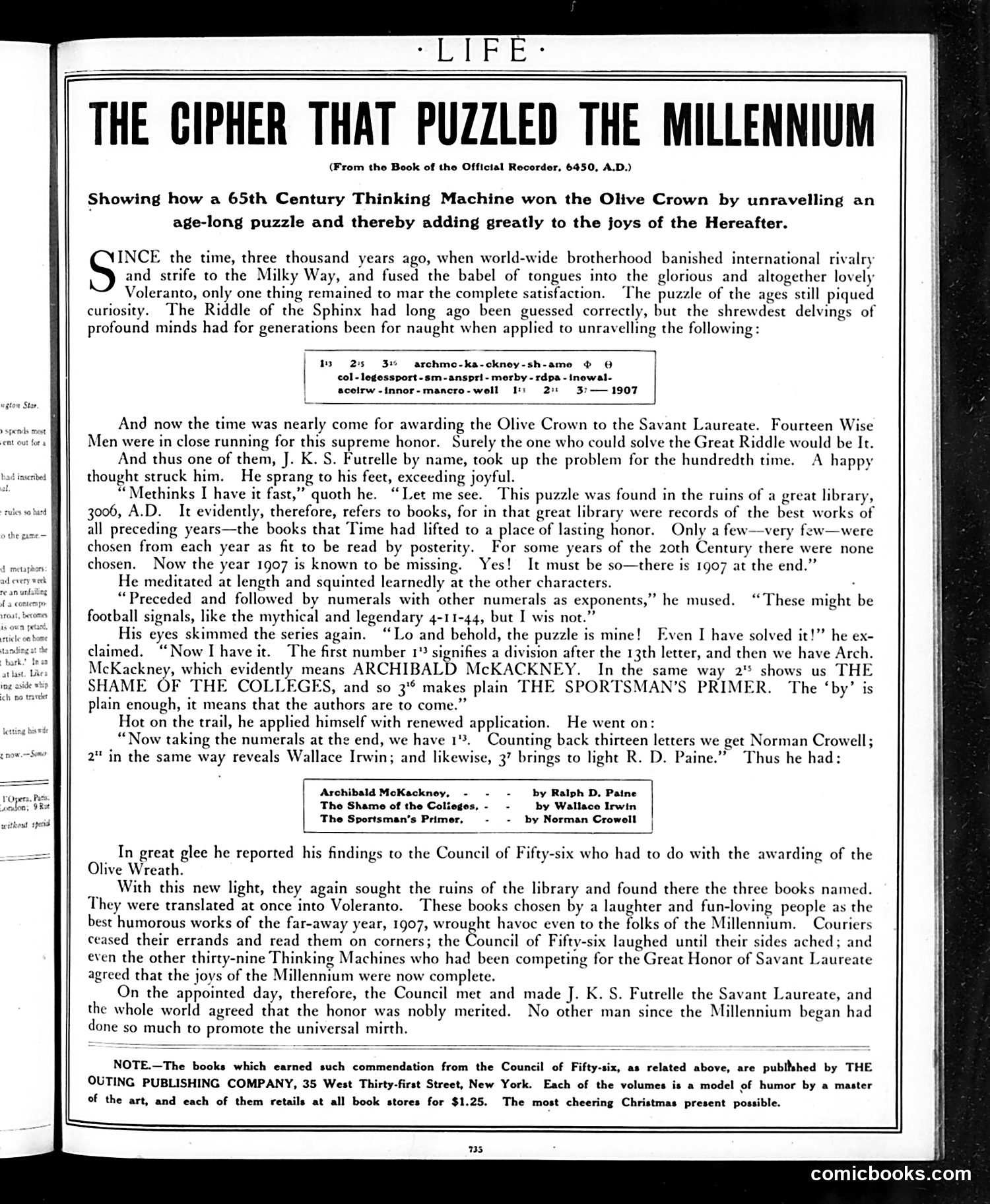
This is a satirical science fiction piece set in the year 6450 A.D., imagining a future where humanity has achieved peace and created a universal language called "Voleranto." The humor comes from a "Thinking Machine" (essentially an AI) solving an ancient cipher to identify three books from 1907 as humanity's greatest achievements. The joke is that the three books—*Archibald McKackney*, *The Shame of the Colleges*, and *The Sportsman's Primer*—are actually satirical works by contemporary humorists (Ralph D. Paine, Wallace Irwin, and Norman Crowell). Life magazine is playfully suggesting that early 20th-century humor and social satire are so timeless and perfect that a future civilization would treasure them as pinnacle literature. The underlying satire mocks both technological utopianism and intellectual pretension—the idea that advanced future machines would need to decode what is essentially popular comedy. It's also gentle mockery of Life's own contributors' importance.
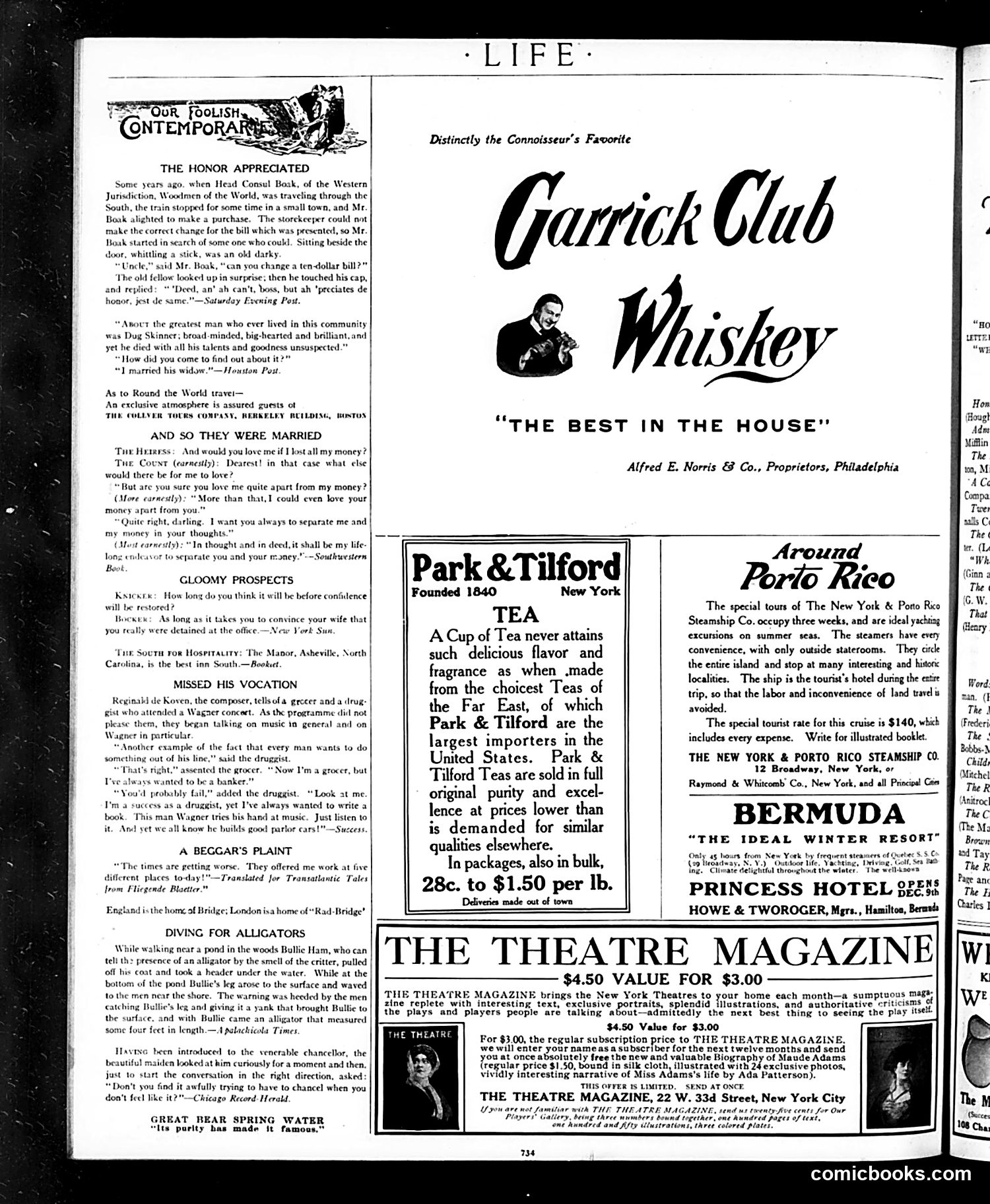
This page from *Life* magazine consists primarily of **humorous anecdotes and advertisements** rather than political cartoons. The left column contains brief jokes and stories, mostly relying on wordplay and social observation typical of early 20th-century humor. Notable examples include: a story about a Black man's humble politeness when unable to make change (reflecting period racial dynamics); domestic comedy about a wealthy woman separating herself from her money in a suitor's mind; and a composer's lament that everyone wishes to do something other than their current work. The right side features **advertisements** for Garrick Club Whiskey ("The Best in the House"), Park & Tilford tea, cruise ships, Bermuda resorts, and *The Theatre Magazine*. There are no identifiable political figures or caricatures. The humor reflects general social themes—class differences, marriage economics, and occupational dissatisfaction—without targeting specific events or individuals. This appears to be a lighter, society-focused issue rather than one emphasizing political satire.
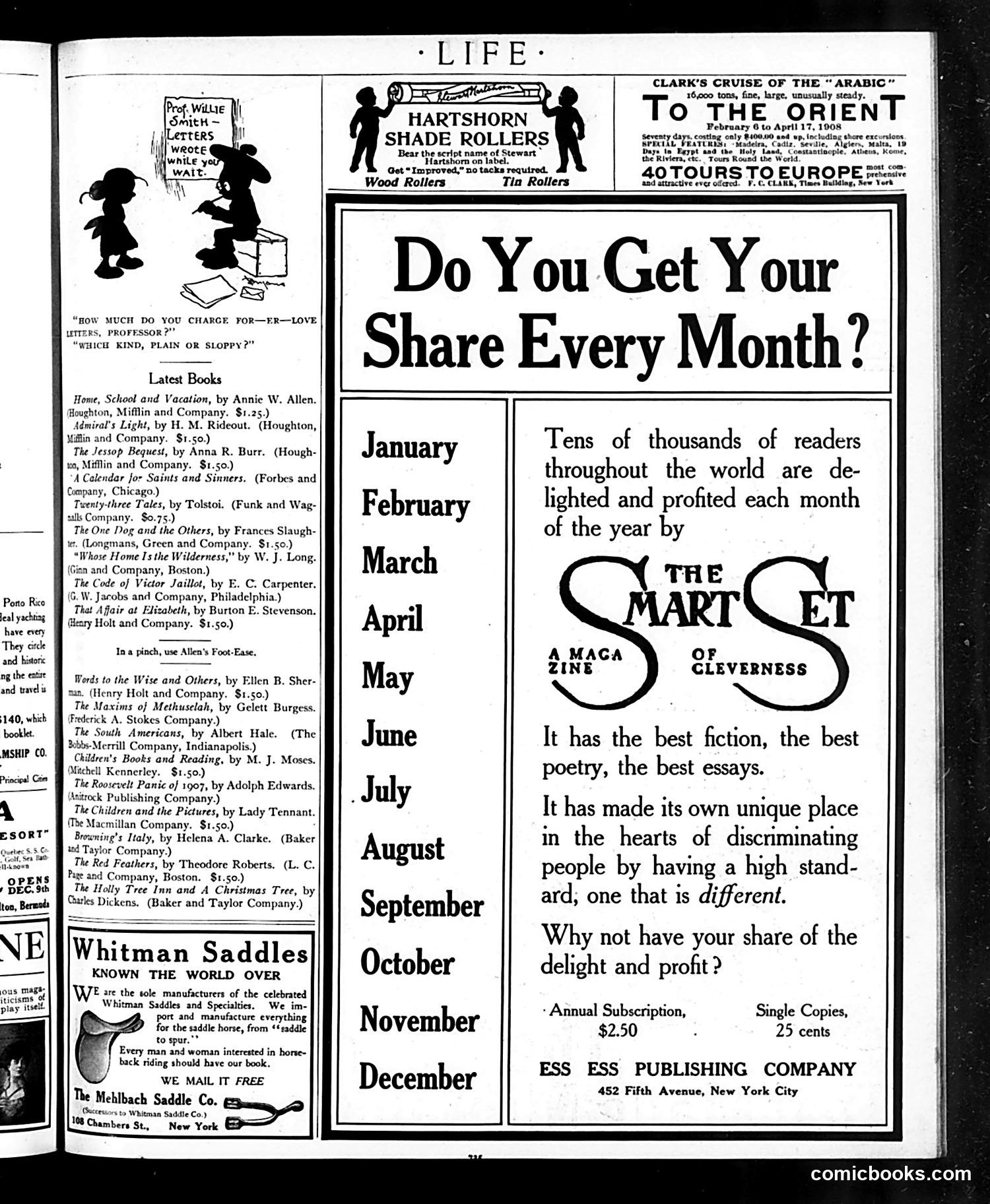
This is primarily an **advertising page** from Life magazine (circa 1908, based on dates visible). The content is a mix of book listings and paid advertisements. **The cartoon** (top left) is a small satirical joke: a man asks a "Professor" how much he charges for writing love letters, requesting to know the price difference between "plain or sloppy" versions. The humor relies on the idea that love letters could be mass-produced by professionals—a commentary on the commercialization of romance and the absurdity of outsourcing intimate correspondence. **The main advertisement** promotes *The Smart Set*, a magazine described as offering "the best fiction, the best poetry, the best essays" with "a high standard, one that is different." This appeals to educated, "discriminating people"—marketing it as sophisticated reading for the elite. **Other ads** include travel tours to Europe and the Orient, Hartshorn shade rollers, Whitman saddles, and book recommendations—typical early-1900s consumer products targeting middle and upper-class readers of Life magazine. The page reflects early 20th-century American consumer culture and the growing market for leisure reading and travel.
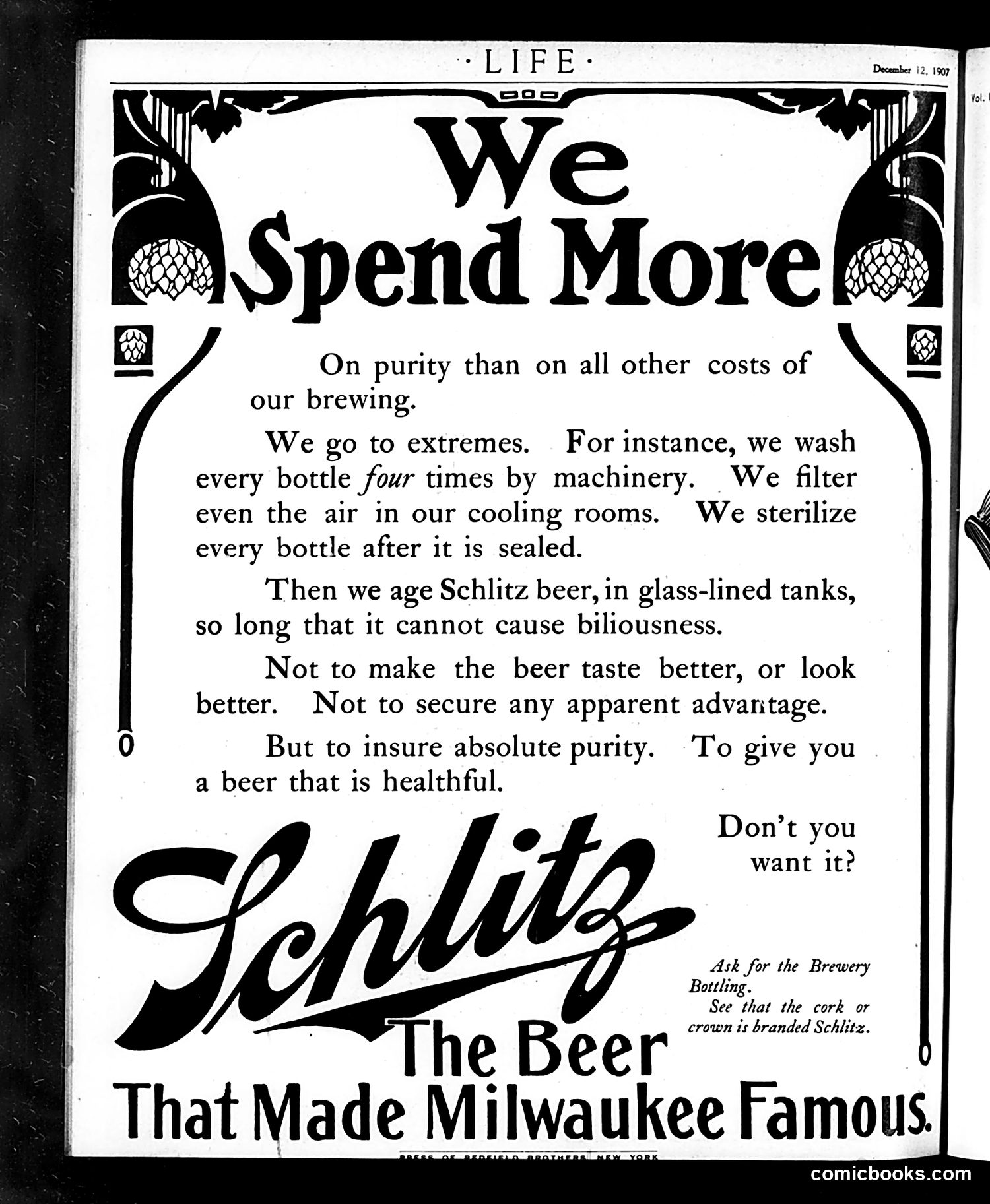
This is a **Schlitz brewery advertisement** from December 12, 1907, not a political cartoon or satire. The page promotes Schlitz beer by emphasizing manufacturing purity and hygiene. The ad's key claims include: bottles washed four times by machinery, filtered air in cooling rooms, sterilization after sealing, and extended aging in glass-lined tanks to prevent "biliousness" (digestive upset). The text explicitly states these measures aren't for taste or appearance, but to ensure "absolute purity" and health. The decorative hop illustrations frame the message. The slogan "The Beer That Made Milwaukee Famous" anchors the brand identity. For modern readers: this reflects early 20th-century anxieties about food and beverage safety—before FDA regulation—when breweries competed by claiming superior sanitation. The emphasis on health-consciousness shows how beer was marketed as wholesome rather than intoxicating, a common advertising strategy of the era.