
Life, 1907-12-12 · page 12 of 20
Life — December 12, 1907 — page 12: what you’re looking at
What you’re looking at
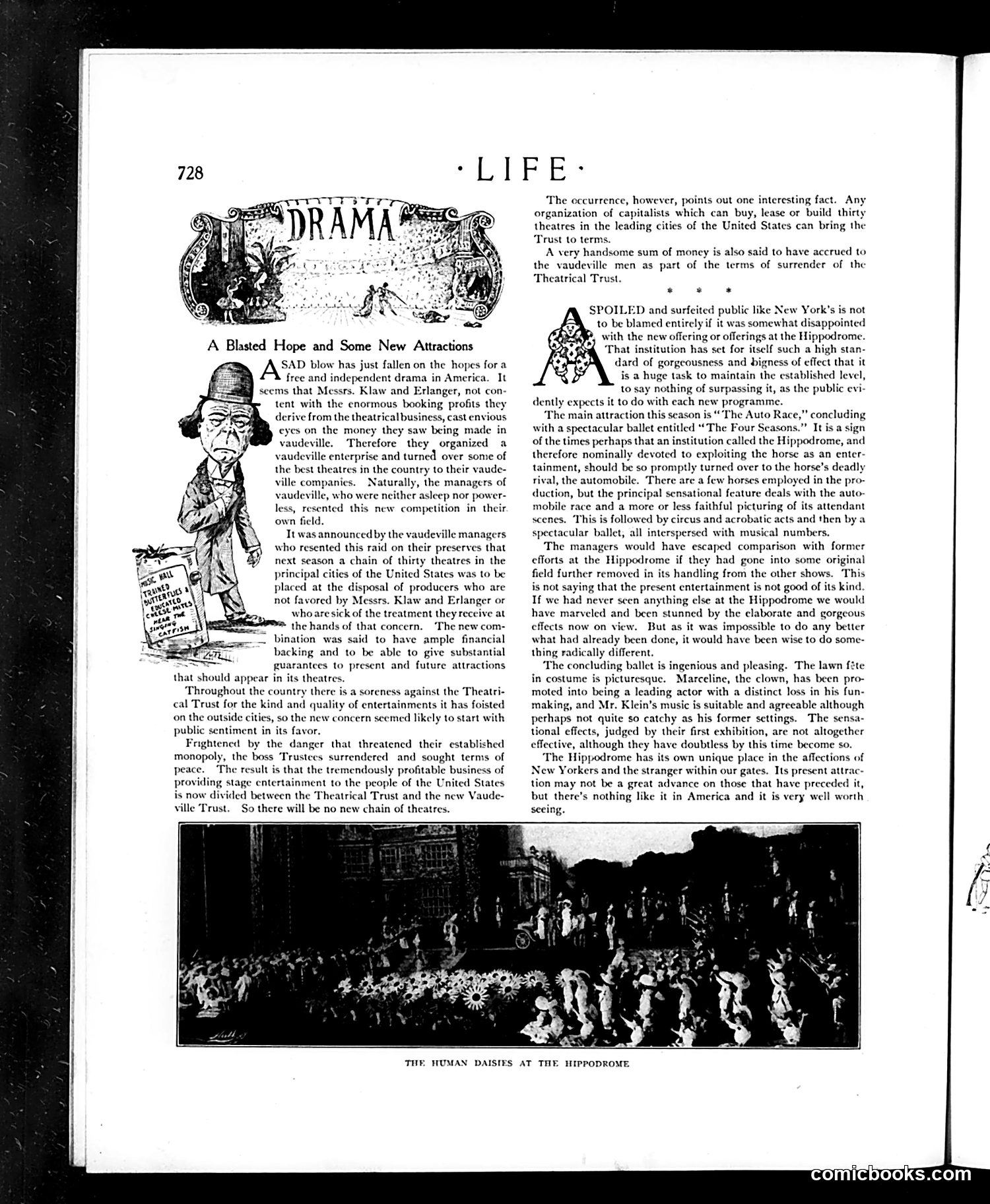
This page satirizes competition between theatrical entertainment venues in early 20th-century America. The cartoon depicts a disheveled figure (likely representing vaudeville theater managers) lamenting the rise of the Hippodrome theatre and its new attractions—particularly a horse-centered spectacle called "The Four Seasons" and "The Human Daisies." The satire critiques how established vaudeville theaters felt threatened by the Hippodrome's lavish, innovative productions featuring horses, automobiles, and elaborate musical numbers. The text suggests vaudeville managers initially tried creating a chain of competing theaters but ultimately lost ground to this newer, more spectacular entertainment form. The joke is on traditional theatre's struggle against increasingly extravagant competition.
📄 Transcribed text from this page (OCR, searchable)
Machine-transcribed from the original scan — historical spelling and the odd misread are preserved.
“LIF E* A Blasted Hope and Some New Attractions SAD blow has just fallen on the hopes for a free and independent drama in America. It seems that Messrs. Klaw and Erlanger, not con- tent with the enormous booking profits they derive from the theatrical business, cast envious eyes on the money they saw being made in vaudeville. Therefore they organized a audeville enterprise and turned over some of the best theatres in the country to their vaude- ville companies. Naturally, the managers of vaudeville, who were neither asleep nor power- less, resented this new competition in their own field. It was announced by the vaudeville managers who resented this raid on their preserves that next season a chain of thirty theatres in the principal cities of the United States was to be placed at the disposal of producers who are not favored by Messrs. Klaw and Erlanger or whoare sick of the treatment they receive at the hands of that concern. ‘The new com- bination was said to have ample financ backing and to be able to give substantia er guarantees to present and future attractions that should appear in its theatres. ‘Throughout the country there is a soreness against the Theatri- cal Trust for the kind and quality of entertainments it has foisted on the outside cities, so the new concern seemed likely to start with public sentiment in its favor. Frightened by the danger that threatened their established monopoly, the boss ‘Trustees surrendered and sought terms of peace. ‘The result is that the tremendously profitable business of providing stage entertainment to the people of the United States is now divided between the Theatrical Trust and the new Vaude- ville Trust. So there will be no new chain of theatres. ‘The occurrence, however, points out one interesting fact. Any organization of capitalists which can buy, lease or build thirty theatres in the leading cities of the United States can bring the Trust to terms. A very handsome sum of money is also said to have accrued to the vaudeville men as part of the terms of surrender of the Theatrical Tru * 8 « SPOILED and surfeited public like New York's to be blamed entirely if it was somewhat disappointed with the new offering or offerings at the Hippodrome. ‘That institution has set for itself such a high stan- dard of gorgcousness and bigness of effect that it is a huge task to maintain the established level to say nothing of surpassing it, as the public evi- dently expects it to do with each new programme. ‘The main attraction this season is “The Auto Race,” concluding with a spectacular ballet entitled “The Four Seasons.” It is a sign of the times perhaps that an institution called the Hippodrome, and therefore nominally devoted to exploiting the horse as an enter- tainment, should be so promptly turned over to the horse’s deadly rival, the automobile. There are a few horses employed in the pro- duction, but the principal sensational feature deals with the auto- mobile race and a more or less faithful picturing of its attendant scenes. ‘This is followed by circus and acrobatic acts and then by a spectacular ballet, all interspersed with musical numbers The managers would have escaped comparison with former efforts at the Hippodrome if they had gone into some original field further removed in its handling from the other shows. This is not saying that the present entertainment is not good of its kind. If we had never seen anything else at the Hippodrome we would have marveled and been stunned by the elaborate and gorgeous effects now on view. But as it was impossible to do any better what had already been done, it would have been wise to do some- thing radically different. ‘The concluding ballet is ingenious and pleasing. The lawn fete in costume is picturesque. Marceline, the clown, has been pro- moted into being a leading actor with a distinct loss in his fun- making, and Mr. Klein’s music is suitable and agreeable although perhaps not quite so catchy as his former settings. The sensa- tional effects, judged by their first exhibition, are not altogether effective, although they have doubtless by this time become so. ‘The Hippodrome has its own unique place in the affections of New Yorkers and the stranger within our gates. Ils present attrac- tion may not be a great advance on those that have preceded it, but there's nothing like it in America and it is very well worth THE HUMAN DAISIES AT THE HIPPODROME. Comicbooks.com