
Life, 1907-12-12 · page 7 of 20
Life — December 12, 1907 — page 7: what you’re looking at
What you’re looking at
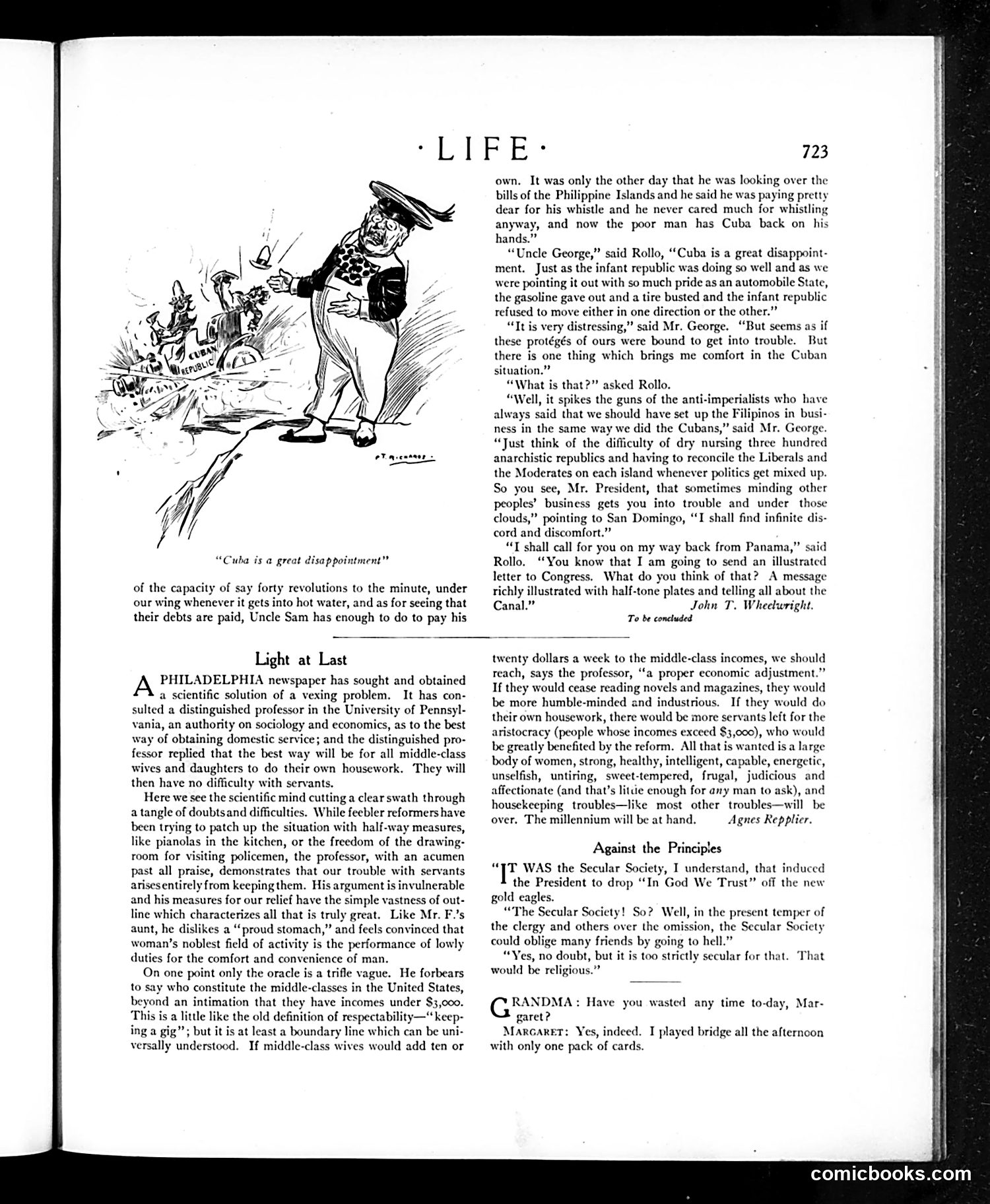
The cartoon depicts Uncle Sam (the U.S. personified) examining a broken toy labeled "Cuba" with disappointment. The accompanying dialogue reveals the satire's context: the speaker laments that Cuba, recently acquired by America, has become troublesome—factions constantly bicker, requiring the U.S. to mediate disputes between "Liberals and Moderates" on the island. The joke mocks American imperial ambitions: the U.S. expected to simply possess Cuba like a working toy, but instead faces ongoing political instability and factional conflict requiring constant intervention. The broken, malfunctioning toy metaphor criticizes America's naive assumption that territorial acquisition would be easy—instead, governing Cuba proves frustratingly complex.
📄 Transcribed text from this page (OCR, searchable)
Machine-transcribed from the original scan — historical spelling and the odd misread are preserved.
*-LIFE: 723 “Cuba is a great disappointment” of the capacity of say forty revolutions to the minute, under our wing whenever it gets into hot water, and as for seeing that their debts are paid, Uncle Sam has enough to do to pay his own. It was only the other day that he was looking over the bills of the Philippine Islands and he said he was paying pretty dear for his whistle and he never cared much for whistling anyway, and now the poor man has Cuba back on his hands.” “Uncle George,” said Rollo, “Cuba is a great disappoint- ment. Just as the infant republic was doing so well and as we were pointing it out with so much pride as an automobile State, the gasoline gave out and a tire busted and the infant republic refused to move either in one direction or the other.” “Tt is very distressing,” said Mr. George. “But seems as if these protégés of ours were bound to get into trouble. But there is one thing which brings me comfort in the Cuban situation.” “What is that?” asked Rollo. “Well, it spikes the guns of the anti-imperialists who have always said that we should have set up the Filipinos in busi- ness in the same way we did the Cubans,” said Mr. George. “Just think of the difficulty of dry nursing three hundred anarchistic republics and having to reconcile the Liberals and the Moderates on each island whenever politics get mixed up. So you see, Mr. President, that sometimes minding other peoples’ business gets you into trouble and under those clouds,” pointing to San Domingo, ‘‘I shall find infinite dis- cord and discomfort.” “T shall call for you on my way back from Panama,” said Rollo, ‘You know that I am going to send an illustrated letter to Congress. What do you think of that? A message richly illustrated with half-tone plates and telling all about the Canal.” John T, Wheelwright. To be concluded Light at Last PHILADELPHIA newspaper has sought and obtained a scientific solution of a vexing problem. It has con- sulted a distinguished professor in the University of Pennsyl- vania, an authority on sociology and economics, as to the best way of obtaining domestic service; and the distinguished pro- fessor replied that the best way will be for all middle-class wives and daughters to do their own housework. They will then have no difficulty with servants. Here we see the scientific mind cutting a clear swath through a tangle of doubtsand difficulties. While feebler reformers have been trying to patch up the situation with half-way measures, like pianolas in the kitchen, or the freedom of the drawing- room for visiting policemen, the professor, with an acumen past all praise, demonstrates that our trouble with servants arisesentirely from keeping them. His argument is invulnerable and his measures for our relief have the simple vastness of out- line which characterizes all that is truly great. Like Mr. F.’s aunt, he dislikes a “proud stomach,” and feels convinced that woman’s noblest field of activity is the performance of lowly duties for the comfort and convenience of man. On one point only the oracle is a trifle vague. He forbears to say who constitute the middle-classes in the United States, beyond an intimation that they have incomes under $3,000. This is a little like the old definition of respectability—“ keep- ing a gig”; but it is at least a boundary line which can be uni- versally understood. If middle-class wives would add ten or twenty dollars a week to the middle-class incomes, we should reach, says the professor, “‘a proper economic adjustment.” If they would cease reading novels and magazines, they would be more humble-minded and industrious. If they would do their own housework, there would be more servants left for the aristocracy (people whose incomes exceed $3,000), who would be greatly benefited by the reform. All that is wanted is a large body of women, strong, healthy, intelligent, capable, energetic, unselfish, untiring, sweet-tempered, frugal, judicious and affectionate (and that’s lite enough for any man to ask), and housekeeping troubles—like most other troubles—will be over, The millennium will be at hand. Agnes Repplier. Against the Principles “TT WAS the Secular Society, I understand, that induced the President to drop “In God We Trust” off the new gold eagles. “The Secular Society! So? Well, in the present temper of the clergy and others over the omission, the Secular Society could oblige many friends by going to hell.” “Yes, no doubt, but it is too strictly secular for that. That would be religious.” RANDMA: Have you wasted any time to-day, Mar- garet? Marcaret: Yes, indeed. I played bridge all the afternoon with only one pack of cards. comicbooks.com