
Life, 1907-12-12 · page 13 of 20
Life — December 12, 1907 — page 13: what you’re looking at
What you’re looking at
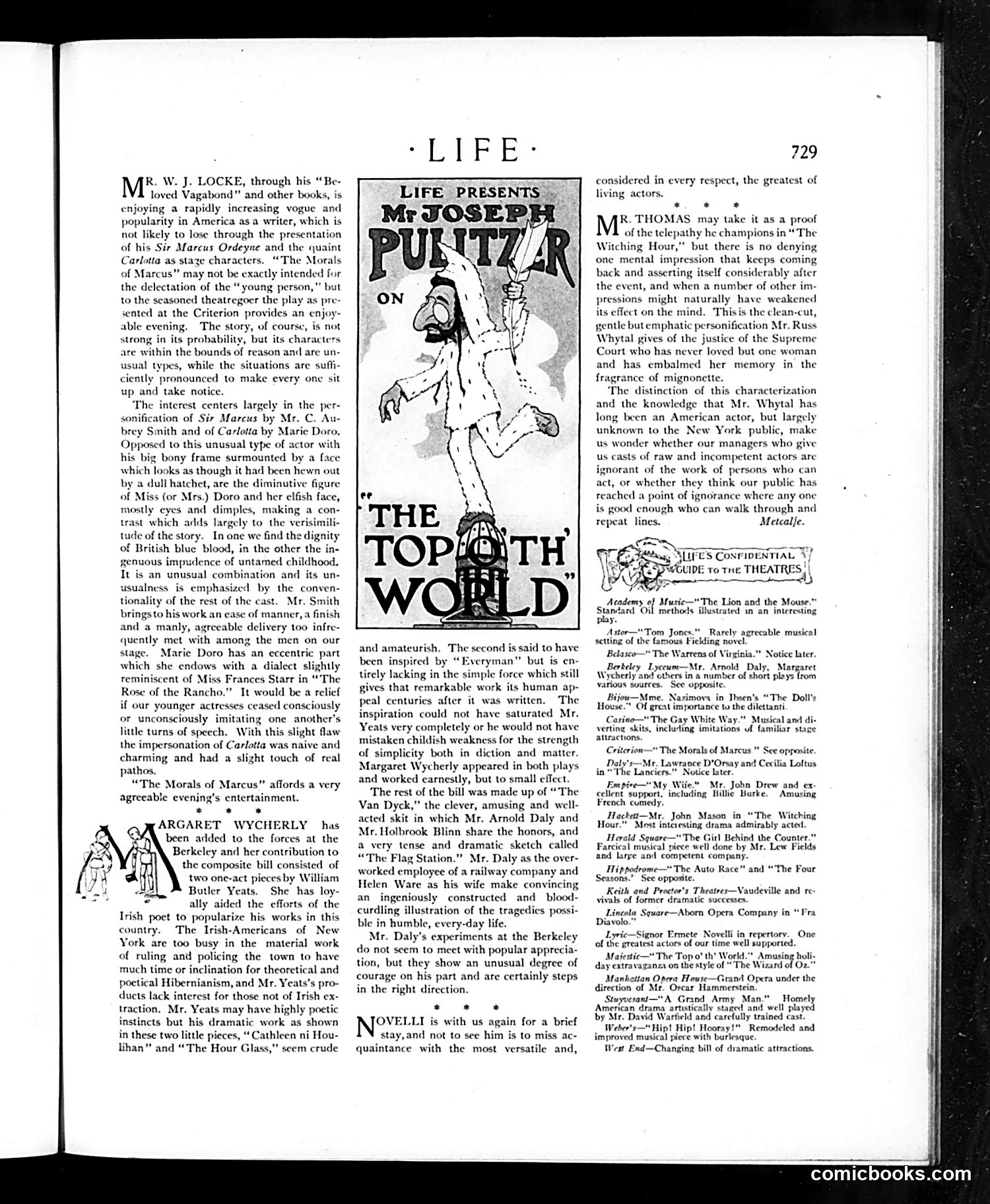
This page features a Life magazine review of theatrical productions. The prominent cartoon advertises "The Topnotch World," presented by Joseph Pulitzer (the famous newspaper publisher). The illustration shows a caricatured figure in exaggerated pose, likely satirizing Pulitzer himself or the theatrical production's quality. The review text criticizes various theatrical performances and actors of the era, noting weak characterizations and amateurish acting. The broader satire appears to mock Pulitzer's involvement in theater production—suggesting his newspaper empire didn't translate to theatrical competence. The "topnotch world" title may be ironic, mocking pretensions to quality in what the reviewer considers mediocre entertainment.
📄 Transcribed text from this page (OCR, searchable)
Machine-transcribed from the original scan — historical spelling and the odd misread are preserved.
R. W. J. LOCKE, through his “Be- loved Vagabond” and other books, is enjoying a rapidly increasing vogue and popularity in America asa writer, which is not likely to lose through the presentation of his Sir Marcus Ordeyne and the quaint Carlotta as staze characters. “The Morals of Marcus” may not be exactly intended for the delectation of the “young person,” but to the seasoned theatregoer the play as pre- sented at the Criterion provides an enjoy- able evening. The story, of course, is not strong in its probability, but its characters re within the bounds of reason and are un- usual types, while the situations are sufi- ciently pronounced to make every one sit up and take notice. ‘The interest centers largely in the per- sonification of Sir Marcus by Mr. C. Au- brey Smith and of Carlotta by Marie Doro. Opposed to this unusual type of actor with his big bony frame surmounted by a face which looks as though it had been hewn out by a dull hatchet, are the diminutive figure of Miss (or Mrs.) Doro and her elfish face, mostly eyes and dimples, making a con- trast which adds largely to the verisimili- tude of the story. In one we find the dignity of British blue blood, in the other the in genuous impudence of untamed childhood. It is an unusual combination and its un- usualness is emphasized by the conven- tionality of the rest of the cast. Mr. Smith bringsto his work an ease of manner, a finish and a manly, agreeable delivery too infre- quently met with among the men on our stage. Marie Doro has an eccentric part which she endows with a dialect slightly reminiscent of Miss Frances Starr in “The Rose of the Rancho.” It would be a relief if our younger actresses ceased consciously or unconsciously imitating one another's little turns of speech. With this slight flaw the impersonation of Carlotta was naive and charming and had a slight touch of real pathos. “The Morals of Marcus” affords a very agreeable evening’s entertainment. . + 8 ARGARET WYCHERLY has been added to the forces at the Berkeley and her contribution to the composite bill consisted of two one-act pieces by William Butler Yeats. She has loy- ally aided the efforts of the Irish poet to popularize his works in this country. The Irish-Americans of New York are too busy in the material work of ruling and policing the town to have much time or inclination for theoretical and poetical Hibernianism, and Mr. Yeats’s pro- ducts lack interest for those not of Irish ex- traction. Mr. Yeats may have highly poetic stincts but his dramatic work as shown in these two little pieces, “Cathleen ni Hou- lihan” and “The Hour Glass," seem crude and amateurish, The second is said to have been inspired by “Everyman” but is en- tirely lacking in the simple force which still gives that remarkable work its human ap- peal centuries after it was written. The inspiration could not have saturated Mr. Yeats very completely or he would not have mistaken childish weakness for the strength of simplicity both in diction and matter. Margaret Wycherly appeared in both plays and worked earnestly, but to small effect. The rest of the bill was made up of “The Van Dyck,” the clever, amusing and well- acted skit in which Mr. Arnold Daly and Mr. Holbrook Blinn share the honors, and a very tense and dramatic sketch called “The Flag Station.” Mr. Daly as the over- worked employee of a railway company and Helen Ware as his wife make convincing an ingeniously constructed and blood- curdling illustration of the tragedies possi- ble in humble, every-day life. Mr. Daly’s experiments at the Berkeley do not seem to meet with popular apprecia- tion, but they show an unusual degree of courage on his part and are certainly steps in the right direction. * 8 6 OVELLI is with us again for a brief stay,and not to see him is to miss ac- quaintance with the most versatile and, 729 considered in every respect, the greatest of living actors. * 68 8 R. THOMAS may take it as a proof of the telepathy he champions in “The Witching Hour,” but there is no denying one mental impression that keeps coming back and asserting itself considerably after the event, and when a number of other im- pressions might naturally ned its effect on the mind. Thisis the clean-cut, gentle but emphatic personification Mr. Russ Whytal gives of the justice of the Supreme Court who has never loved but one woman and has embalmed her memory in the fragrance of mignonette. ‘The distinction of this characterization and the knowledge that Mr. Whytal has long been an American actor, but largely unknown to the New York public, make us wonder whether our managers who give us casts of raw and incompetent actors arc ignorant of the work of persons who can act, or whether they think our public has reached a point of ignorance where any one is good cnough who can walk through and repeat lines. Metcalfe. IFES CONFIDENTIAL \/ SGUIDE vo THe THEATRES || Academy of Music" The Lion and the Mouse.” Standard Oi ply. Astor—"Tom Jones." Rarely agrecable musical setting of the famous Fielding novel. Belasco—" The Warrens of Virginia.” Notice later. Berkeley Lyceum—Mr. Arnold Daly, Margaret Wycherly and others in a number of short pleys from various sources. See opposite. Bijou—Mme. Nazimova in Ibsen's “The Doll's Howse.” Of great importance to the dilettanti Casino—"The Gay White Way.” Musical and di- verting skits, including imitations uf familiar stage attractions. Criterion—" The Morals of Marcus " See opranite. __ Daly's—Mr. Lawrance D'Oray and Cecilia Loftus in“ The Lanciers.” Notice later. Empire—" My Wife” Mr. John Drew and ex. cellent support, including Billie Burke. Amusing French cumedy. Hacket—Mr. John Mason in “The Witching Hour.” Most intctesting drama admirably acted. Herald Square—" The Git! Behind the Counter.” Farcical musical piece well done by Mr. Lew Fields and large and competent company. Hippodrome—"The Auto Race” and “The Four Seasons.’ See opposite. Keith end Proctor's Theatres—Vaudeville and re vivals of former dramatic successes. Lincoln Square—Abom Opera Company in "Fra Diavolo.” Lyric—Signor Ermete Novelli in repertory. One of the greatest actors of our time well supported. Majestic—" The Top o' th’ World.” Amusing boli day extravaganza on the style of " The Wizard of Oz. Manhettan Opera House—Grand Opera under the direction of Mr. Oscar Hammerstein, Stuyvesant—"A Grand Army Man." Homely American drama artistically staged and well played by Mr. David Warfield and carefully trained cast. Weber’s—"Hip! Hip! Hooray!” Remodeled and improved musical piece with burlesque. West End—Changing bill of dramatic attractions. methods illustrated in an interesting comicbooks.com