
Life, 1907-12-12 · page 14 of 20
Life — December 12, 1907 — page 14: what you’re looking at
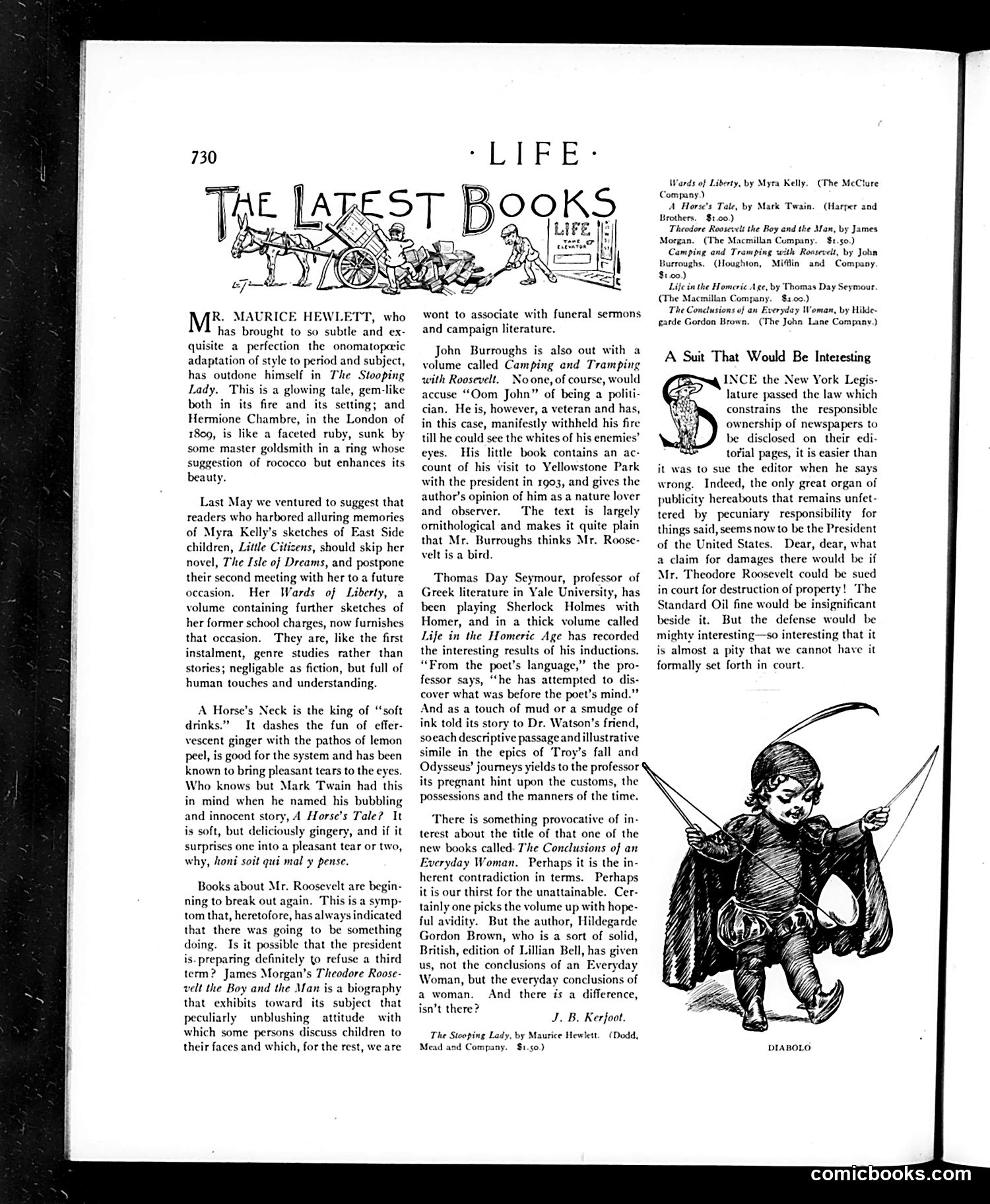
What you’re looking at
This is a book review section from Life magazine featuring Maurice Hewlett's *The Stooping Lady* and works about President Theodore Roosevelt. The key satirical content concerns Roosevelt. The page mocks the proliferation of adulatory Roosevelt biographies, noting these books "wont to associate with funeral sermons and campaign literature"—implying excessive praise bordering on hagiography. The reviewer sardonically suggests James Morgan's *Theodore Roosevelt the Boy and the Man* exhibits an "unblushing attitude" typically reserved for discussing children patronizingly. The most pointed satire targets John Burroughs's *Camping and Tramping with Roosevelt*: the reviewer notes Burroughs "withheld his fire till he could see the whites of his enemies' eyes" and concludes that Burroughs thinks Roosevelt "is a bird"—a backhanded compliment suggesting Roosevelt's vanity and the book's fawning nature. The cartoon labeled "Diabolo" (right) depicts a child playing with a spinning top toy, unrelated to the text.
📄 Transcribed text from this page (OCR, searchable)
Machine-transcribed from the original scan — historical spelling and the odd misread are preserved.
R. MAURICE HEWLETT, who has brought to so subtle and ex- quisite a perfection the onomatopacic adaptation of style to period and subject, has outdone himself in The Stooping Lady. This is a glowing tale, gem-like both in its fire and its setting; and Hermione Chambre, in the London of 1809, is like a faceted ruby, sunk by some master goldsmith in a ring whose suggestion of rococco but enhances its beauty. Last May we ventured to suggest that readers who harbored alluring memories of Myra Kelly's sketches of East Side children, Little Citizens, should skip her novel, The Isle of Dreams, and postpone their second meeting with her to a future occasion. Her Wards of Liberty, a volume containing further sketches of her former school charges, now furnishes that occasion. They are, like the first instalment, genre studies rather than stories; negligable as fiction, but full of human touches and understanding. A Horse’s Neck is the king of ‘‘soft drinks.” It dashes the fun of effer- vescent ginger with the pathos of lemon peel, is good for the system and has been known to bring pleasant tears to the Who knows but Mark Twain had thi: in mind when he named his bubbling and innocent story, A Horse’s Tale? It is soft, but deliciously gingery, and if it surprises one into a pleasant tear or two, why, honi soit qui mal y pense. Books about Mr. Roosevelt are begin- ning to break out a: tom that, heretofore, has always ind that there was going to be something doing. Is it possible that the president is. preparing definitely to refuse a third term? James Morgan’s Theodore Roose- velt the Boy and the Man is a biography that exhibits toward its subject that peculiarly unblushing attitude with which some persons discuss children to their faces and which, for the rest, we are wont to associate with funeral sermons and campaign literature. John Burroughs is also out with a volume called Camping and Tramping with Roosevelt. Noone, of course, would accuse “Oom John” of being a politi- cian. He is, however, a veteran and has, in this case, manifestly withheld his fire till he could see the whites of his enemies’ His little book contains an ac- count of it to Yellowstone Park ident in 1903, and gives the ion of him as a nature lover and observer. ‘The text is largely omithological and makes it quite plain that Mr. Burroughs thinks Mr. Roose- velt is a bird. Thomas Day Seymour, professor of Greek literature in Yale University, has been playing Sherlock Holmes with Homer, and in a thick volume called Life in the Homeric Age has recorded the interesting Its of his inductions. “From the poct’s language,” the pro- fessor says, ‘‘he has attempted to dis- cover what was before the poet’s mind.” And as a touch of mud or a smudge of ink told its story to Dr. Watson’s friend, soeach descriptive passage and illustrative simile in the epics of Troy’s fall and Odysseus’ journeys yields to the professor § its pregnant hint upon the customs, the possessions and the manners of the time. There is something provocative of in- terest about the title of that one of the new books called: The Conclusions of an Everyday Woman. Perhaps it is the in- herent contradiction in terms. Perhaps it is our thirst for the unattainable. Cer- tainly one picks the volume up with hope- ful avidity. But the author, Hildegarde Gordon Brown, who is a sort of solid, British, edition of Lillian Bell, has given us, not the conclusions of an Everyday Woman, but the everyday conclusions of a woman. And there is a difference, sent ? isn’t there? J.B. Kerjoot. The Stooping Lady, by Maurice Hewlett. (Dodd, Mead and Company. $1.50.) Wards of Liberty, by Myra Kelly. (The McClure Company.) A Horse's Tale, by Mark Twain. Brothers. $1.00.) Theodore Roosevelt the Boy and the Man, by James Morgan. (The Macmillan Company. $t.s0.) Camping and Tramping with Roosevelt, by John Burroughs. (Houghton, Miflin and Company. $1.00) Lijein the Homeric Age, by Thomas Day Seymour, (The Macmillan Company. $1.00.) The Conclusions of an Everyday Woman, by Hilde garde Gordon Brown. (The John Lane Commay.) (Harper and A Suit That Would Be Intetesting INCE the New York Legis- lature passed the law which constrains the responsible ownership of newspapers to be disclosed on their edi- torial pages, it is easier than it was to sue the editor when he says wrong. Indeed, the only great organ of publicity hereabouts that remains unfet- tered by pecuniary responsibility for things said, seems now to be the President of the United States. Dear, dear, what a claim for damages there would be if Mr. Theodore Roosevelt could be sued in court for destruction of property! ‘The ndard Oil fine would be insignificant it. But the defense would be mighty interesting—so interesting that it is almost a pity that we cannot have it formally set forth in court. DIABOLO comicbooks.com