
Life, 1907-12-12 · page 4 of 20
Life — December 12, 1907 — page 4: what you’re looking at
What you’re looking at
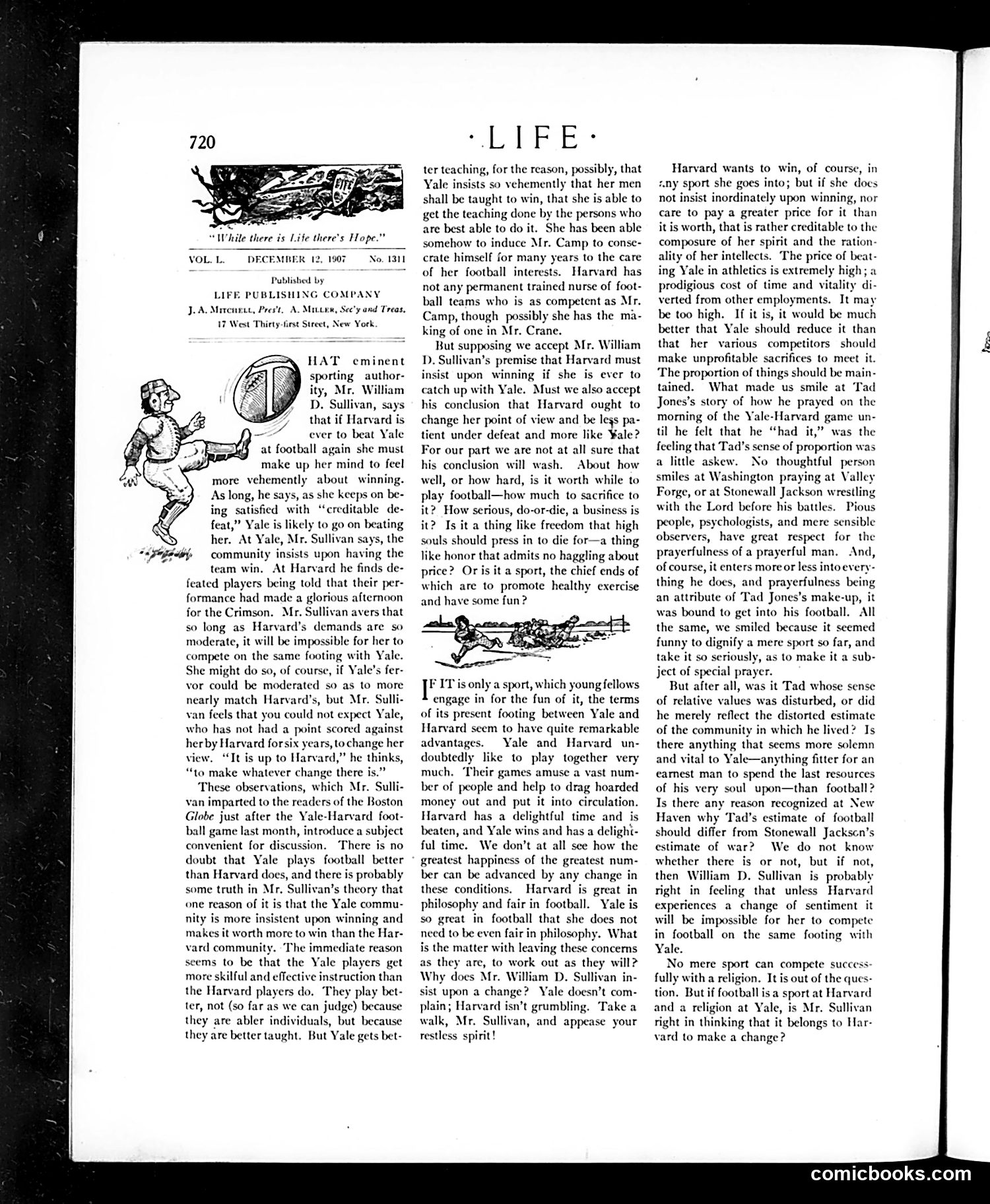
The page contains an editorial debate about Harvard-Yale football rivalry, with a small cartoon illustration of a cherubic figure kicking a football. **The Cartoon's Context:** The illustration appears to satirize the intense sporting rivalry between these prestigious universities. The cherub-like figure suggests innocence contrasted with the competitive fervor surrounding the game. **The Main Argument:** The editorial, titled "What Is Life there's Hope," critiques William D. Sullivan's claim that Harvard should prioritize winning over Yale. The author questions whether football—a mere sport—deserves the serious sacrifices both institutions make for victory, asking whether such competitive obsession reflects appropriate values for educational institutions. **The Satire's Point:** The piece mocks the disproportionate cultural and institutional weight placed on college athletics, suggesting the universities' rivalry has become absurdly inflated beyond the sport's actual importance.
📄 Transcribed text from this page (OCR, searchable)
Machine-transcribed from the original scan — historical spelling and the odd misread are preserved.
“While there is Li there's Hope. VOL.L. DECEMBER 12, 1907 No. 1311 Published by LIFE PUBLISHING COMPANY J.A. Mircurit, Pres't, A. Mittrn, Sec’y and Treas, 17 West Thirty-first Street, HAT eminent sporting author- ity, Mr. William D. Sullivan, says that if Harvard is ever to beat Yale at football again she must make up her mind to feel more vehemently about winning. As long, he says, as she keeps on be- ing satisfied with “creditable de- feat,” Yale is likely to go on beating her. At Yale, Mr. Sullivan says, the community insists upon having the team win, At Harvard he finds de- feated players being told that their per- formance had made a glorious afternoon for the Crimson. Mr. Sullivan avers that so long as Harvard’s demands are so moderate, it will be impossible for her to compete on the same footing with Yale. She might do so, of course, if Yale’s fer- vor could be moderated so as to more nearly match Harvard’s, but Mr. Sulli- van feels that you could not expect Yale, who has not had a point scored against herby Harvard forsix years, to change her view. “It is up to Harvard,” he thinks “to make whatever change there is.” These observations, which Mr. Sulli- van imparted to the readers of the Boston Globe just after the Yale-Harvard foot- ball game last month, introduce a subject convenient for discussion. There is no doubt that Yale plays football better than Harvard does, and there is probably some truth in Mr. Sullivan’s theory that one reason of it is that the Yale commu- nity is more insistent upon winning and makes it worth more to win than the Har- vard community. The immediate reason seems to be that the Yale players get mote skilful and effective instruction than the Harvard players do. They play bet- ter, not (so far as we can judge) because they are abler individuals, but because they are better taught. But Yale gets bet- “LIP E* ter teaching, for the reason, possibly, that Yale insists so vehemently that her men shall be taught to win, that she is able to get the teaching done by the persons who are best able to do it. She has been able somehow to induce Mr. Camp to conse- crate himself for many years to the care of her football interests. Harvard has not any permanent trained nurse of foot- ball teams who is as competent as Mr. Camp, though possibly she has the ma- king of one in Mr. Crane. But supposing we accept Mr. William ullivan’s premise that Harvard must insist upon winning if she is ever to catch up with Yale. Must we also accept his conclusion that Harvard ought to change her point of view and be legs pa- tient under defeat and more like ¥ale? For our part we are not at all sure that his conclusion will wash. About how well, or how hard, is it worth while to play football—how much to sacrifice to it? How serious, do-or-die, a business is it? Is it a thing like freedom that high souls should press in to die for—a thing like honor that admits no haggling about price? Oris it a sport, the chief ends of which are to promote healthy exercise and have some fun? I IT is only a sport, which young fellows engage in for the fun of it, the terms of its present footing between Yale and Harvard seem to have quite remarkable advantages. Yale and Harvard un- doubtedly like to play together very much. Their games amuse a vast num- ber of people and help to drag hoarded money out and put it into circulation. Harvard has a delightful time and is beaten, and Yale wins and has a delight- ful time. We don’t at all sce how the greatest happiness of the greatest num- ber can be advanced by any change in these conditions. Harvard is great in philosophy and fair in football. Yale is so great in football that she does not need to be even fair in philosophy. What is the matter with leaving these concerns as they are, to work out as they will? Why does Mr. William D. Sullivan in- sist upon a change? Yale doesn’t com- plain; Harvard isn’t grumbling. 1 walk, Mr. Sullivan, and appea restless spirit! Harvard wants to win, of course, in ny sport she goes into; but if she docs not insist inordinately upon winning, nor care to pay a greater price for it than itis worth, that is rather creditable to the composure of her spirit and the ration- ality of her intellects. The price of beat- ing Yale in athletics is extremely high; prodigious cost of time and vitality di- verted from other employments. It may be too high. If it is, it would be much better that Yale should reduce it than that her various competitors should make unprofitable sacrifices to meet it. ‘The proportion of things should be main- tained. What made us smile at Tad Jones's story of how he prayed on the morning of the Yale-Harvard game un- til he felt that he “had it,” was the feeling that Tad’s sense of proportion was a little askew. No thoughtful person smiles at Washington praying at Valley Forge, or at Stonewall Jackson wrestling with the Lord before his battles. Pious people, psychologists, and mere sensible observers, have great respect for the prayerfulness of a prayerful man. And, of course, it enters more or less into every- thing he docs, and prayerfulness being an attribute of Tad Jones's make-up, it was bound to get into his football. All the same, we smiled because it seemed funny to dignify a mere sport so far, and take it so seriously, as to make it a sub- ject of special prayer. But after all, was it Tad whose sense of relative values was disturbed, or did he merely reflect the distorted estimate of the community in which he lived? Is there anything that seems more solemn and vital to Yale—anything fitter for an eamest man to spend the last resources of his very soul upon—than football? Is there any reason recognized at New Haven why Tad’s estimate of football should differ from Stonewall Jackscn’s estimate of war? We do not know whether there is or not, but if not, then William D. Sullivan is probably right in feeling that unless Harvard experiences a change of sentiment it will be impossible for her to compete in football on the same footing with Yale. No mere sport can compete success fully with a religion. It is out of the ques- tion. But if football isa sport at Harvard and a religion at Yale, is Mr. Sullivan right in thinking that it belongs to Har- vard to make a change? comicbooks.com