
Life, 1907-12-12 · page 8 of 20
Life — December 12, 1907 — page 8: what you’re looking at
What you’re looking at
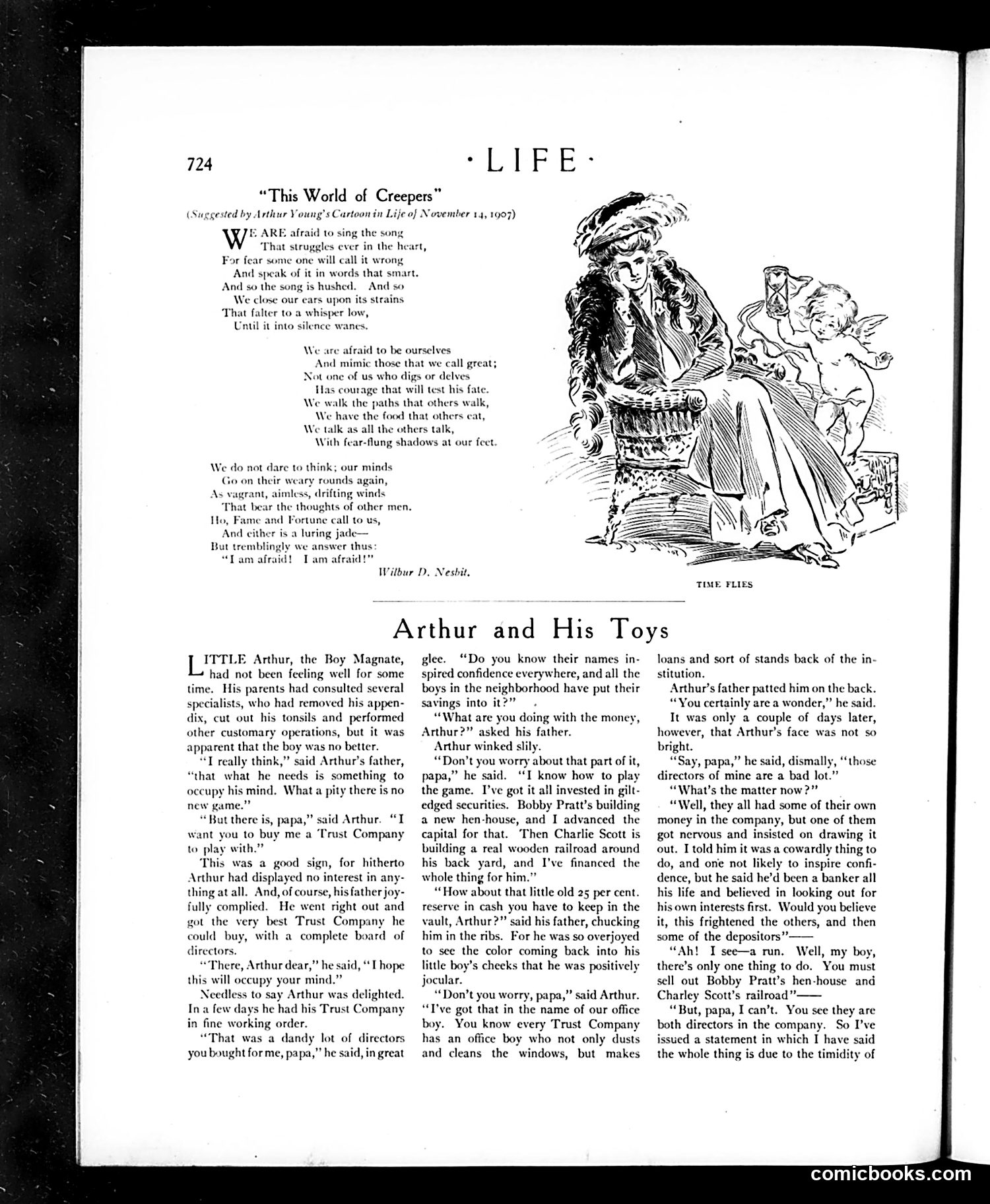
**Top Section - "This World of Creepers"** This is a poem (attributed to Wilbur D. Nesbit) about social conformity and fear. It critiques people who suppress their authentic thoughts and feelings to avoid judgment, instead mimicking others' behavior and opinions. The accompanying illustration shows a fashionable woman with a cherub, labeled "TIME FLIES"—likely a visual metaphor for fleeting youth or vanity. **Bottom Section - "Arthur and His Toys"** This is a satirical story about Little Arthur, a wealthy boy whose father indulges his financial schemes. The narrative mocks both the boy's naive business ventures (a Trust Company, a hen-house, a railroad) and his father's enabling parenting. The humor targets early-1900s corporate culture and the notion of children playing at adult financial institutions.
📄 Transcribed text from this page (OCR, searchable)
Machine-transcribed from the original scan — historical spelling and the odd misread are preserved.
-LIFE- “This World of Creepers” egested by Arthur Voung’s Cartoon in Life of November 14,1907) ARE afraid to sing the song W For fear some one will call it wrong And speak of it in words that smart. And so the song is hushed. And so We close our ears upon its strains falter to a whisper low, Until it into silence wanes, That struggles ever in the heart, We are afraid to be ourselves And mimic those that we call great; Not one of us who digs or delves Has courage that will test his fate. We walk the paths that others walk, We have the food that others cat, Wet k as all the others talk, With fear-flung shadows at our feet. We do not dare to think; our minds Go on their weary rounds again, As vagrant, aimless, drifting winds ‘That bear the thoughts of other men. Ifo, Fame and Fortune call to us, And cither is a luring jade— But trembh: We answer thus. Tam afraid!” Wilbur D, Nesbit. TIME FLIES Arthur and His Toys ITTLE Arthur, the Boy Magnate, had not been feeling well for some His parents had consulted several ists, who had removed his appen- dix, cut out his tonsil other customary operations, but it was time. special arent that the boy was no better. I really think,” said Arthur's father, “that what he needs occupy his mind. What new game.” “But there is, papa,” said Arthur. “I want you to buy me a Trust Company to play with.” This was a good sign, for hitherto Arthur had displayed no interest in any: thing at all. And, of course, his father joy fully complied. He went right out and got the very best Trust Company he could buy, with a complete board of directors. “There, Arthur dear,” he said, “I hope this will occupy your mind.” Needless to say Arthur was delighted. In a few days he had his Trust Company in fine working order. “That was a dandy lot of directors you bought forme, papa,” he said, in great pity there is no glee. “Do you know their names in- spired confidence everywhere, and all the boys in the neighborhood have put their savings into it?” . “What are you doing with the money, Arthur?” asked his father. Arthur winked slil: “Don’t you worry about that part of it, papa,” he said. “I know how to play the game. I’ve got it all invested in gilt- edged securities. Bobby Pratt’s building a new hen-house, and I advanced the capital for that. ‘Then Charlie Scot building a real wooden railroad around his back yard, and I’ve financed the whole thing for “How about that little old 25 per cent. reserve in cash you have to keep in the vault, Arthur?” said his father, chucking him in the ribs. For he was so ov to see the color coming back into his little boy’s cheeks that he was positively jocular. “Don’t you worry, papa,” said Arthur. “T've got that in the name of our office boy. You know every Trust Company has an office boy who not only dusts and cleans the windows, but makes loans and sort of stands back of the in- stitution. Arthur’s father patted him on the back. “You certainly are a wonder,” he said. It was only a couple of days later, however, that Arthur’s face was not so bright. “Say, papa,” he said, dismally, “those directors of mine are a bad lot.” “What's the matter now?” “Well, they all had some of their own money in the company, but one of them got nervous and insisted on drawing it out. I told him it was a cowardly thing to do, and one not likely to inspire confi- ce, but he said he’d been a banker all life and believed in looking out for his own interests first. Would you believe it, this frightened the others, and then some of the depositors” —— “Ah! I see—a run, Well, my boy, there’s only one thing to do. You must sell out Bobby Pratt’s hen-house and Charley Scott’s railroad ””—— “But, papa, I can’t. You both directors in the company. issued a statement in which I have said the whole thing is due to the timidity of comicbooks.com