
Life, 1907-12-12 · page 6 of 20
Life — December 12, 1907 — page 6: what you’re looking at
What you’re looking at
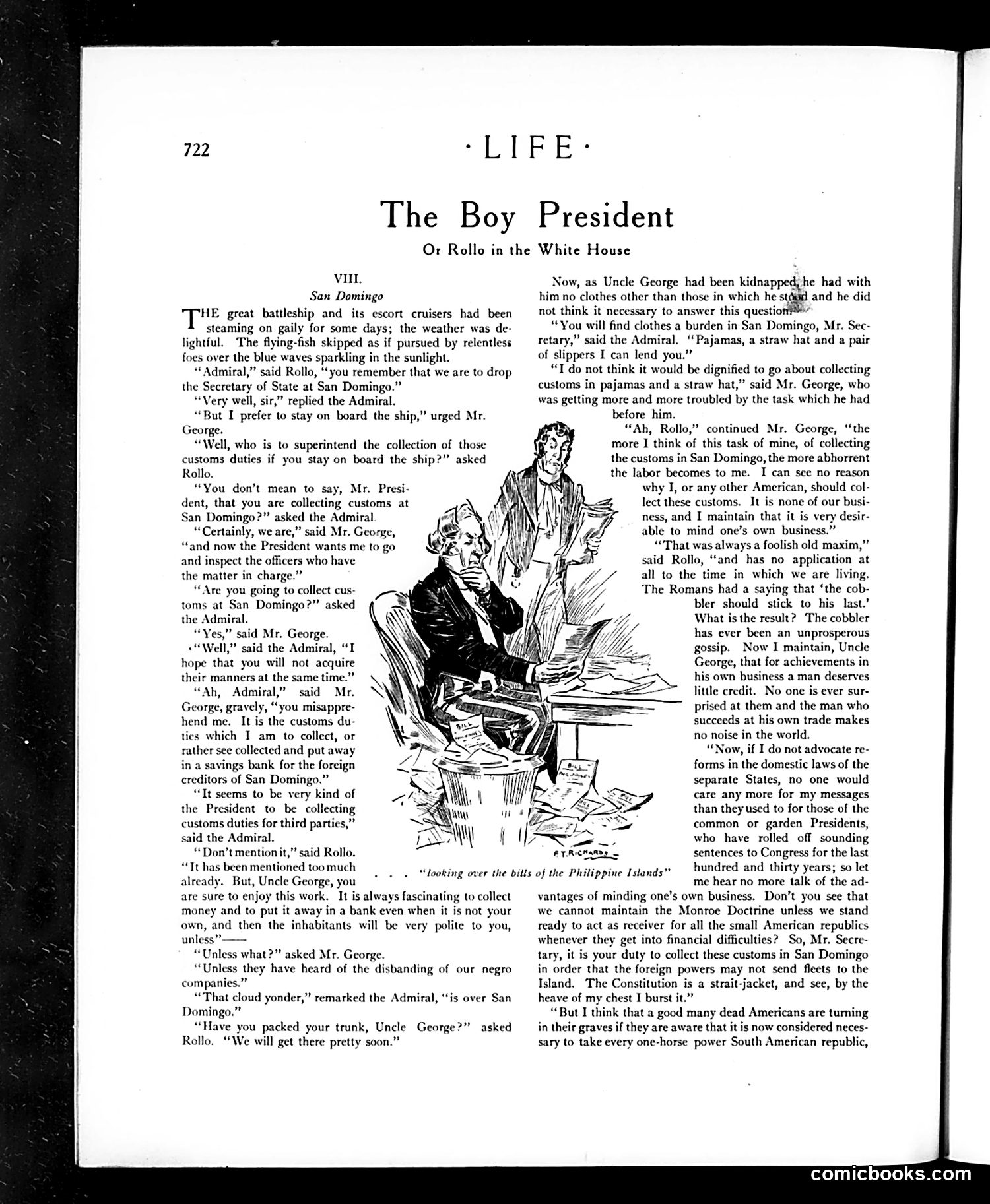
This satirical piece mocks a young U.S. President (identity unclear from image alone) through the character "Rollo," a naive boy-figure. The cartoon depicts Rollo collecting customs duties in San Domingo (Dominican Republic), which he views as personal profit rather than official responsibility. The satire targets the President's immaturity and self-interest: he treats government duties like a child's game, pocketing money that should benefit the nation. References to "the Monroe Doctrine" and American republics suggest this concerns early 20th-century Caribbean/Latin American interventionism. The joke is that the "Boy President" cannot distinguish between public office and personal business—he's literally too childish to govern responsibly, reducing serious foreign policy to childish treasure-collecting.
📄 Transcribed text from this page (OCR, searchable)
Machine-transcribed from the original scan — historical spelling and the odd misread are preserved.
*LIFE> The Boy President Or Rollo in the White House VII. San Domingo "THE great battleship and its escort cruisers had been steaming on gaily for some days; the weather was de- lightful. The flying-fish skipped as if pursued by relentless foes over the blue waves sparkling in the sunlight. “Admiral,” said Rollo, ‘“‘you remember that we are to drop the Secretary of State at San Domingo.” “Very well, sir,” replied the Admiral. “But I prefer to stay on board the ship,” urged Mr. George. “Well, who is to superintend the collection of those customs duties if you stay on board the ship?” asked Rollo, “You don’t mean to say, Mr. Presi- dent, that you are collecting customs at San Domingo?” asked the Admiral. “Certainly, we are,” said Mr. George, “and now the President wants me to go and inspect the officers who have the matter in charge.” “Are you going to collect cus- toms at San Domingo?” asked the Admiral. “Yes,” said Mr. George. +“Well,” said the Admiral, “TI hope that you will not acquire their manners at the same time.” “Ah, Admiral,” said Mr. George, gravely, “you misappre- hend me. It is the customs du- ties which I am to collect, or rather sec collected and put away in a savings bank for the foreign creditors of San Domingo.” “It seems to be very kind of the President to be collecting customs duties for third parties,” said the Admiral. “Don’t mention it,” said Rollo. “Tt has been mentioned too much already. But, Uncle George, you are sure to enjoy this work. It is always fascinating to collect money and to put it away in a bank even when it is not your own, and then the inhabitants will be y polite to you, unless””—— “Unless what?” asked Mr. George. “Unless they have heard of the disbanding of our negro companies.” “That cloud yonder,” remarked the Admiral, “is over San Domingo.” “H uu packed your trunk, Uncle George?” asked Rollo. “We will get there pretty soon.” “looking over the bills of the Philippine Islands” Now, as Uncle George had been kidnapped;:he had with him no clothes other than those in which he and he did not think it necessary to answer this questi of “You will find clothes a burden in San Domingo, Mr. Sec- retary,” said the Admiral. ‘Pajamas, a straw hat and a pair of slippers I can lend you.” “T do not think it would be dignified to go about collecting customs in pajamas and a straw hat,” said Mr. George, who was getting more and more troubled by the task which he had before him. “Ah, Rollo,” continued Mr. George, “the more I think of this task of mine, of collecting the customs in San Domingo, the more abhorrent the labor becomes to me. I can see no reason why I, or any other American, should col- lect these customs. It is none of our busi- ness, and I maintain that it is very desir- able to mind one’s own business.” “That was always a foolish old maxim,” said Rollo, “and has no application at all to the time in which we are living. The Romans had a saying that ‘the cob- bler should stick to his last.’ What is the result? The cobbler has ever been an unprosperous gossip. Now I maintain, Uncle George, that for achievements in his own business a man deserves little credit. No one is ever sur- prised at them and the man who succeeds at his own trade makes no noise in the world. “Now, if I do not advocate re- forms in the domestic laws of the separate States, no one would care any more for my messages than they used to for those of the common or garden Presidents, who have rolled off sounding sentences to Congress for the last hundred and thirty years; so let me hear no more talk of the ad- vantages of minding one’s own business. Don’t you see that we cannot maintain the Monroe Doctrine unless we stand ready to act as receiver for all the small American republics whenever they get into financial difficulties? So, Mr. Secre- tary, it is your duty to collect these customs in San Domingo in order that the foreign powers may not send fleets to the Island. The Constitution is a strait-jacket, and see, by the heave of my chest I burst it.” “But I think that a good many dead Americans are tuming in their graves if they are aware that it is now considered neces- sary to take every one-horse power South American republic, A TRCMARDy comicbooks.com