
A complete issue · 24 pages · 1907
Life — September 19, 1907
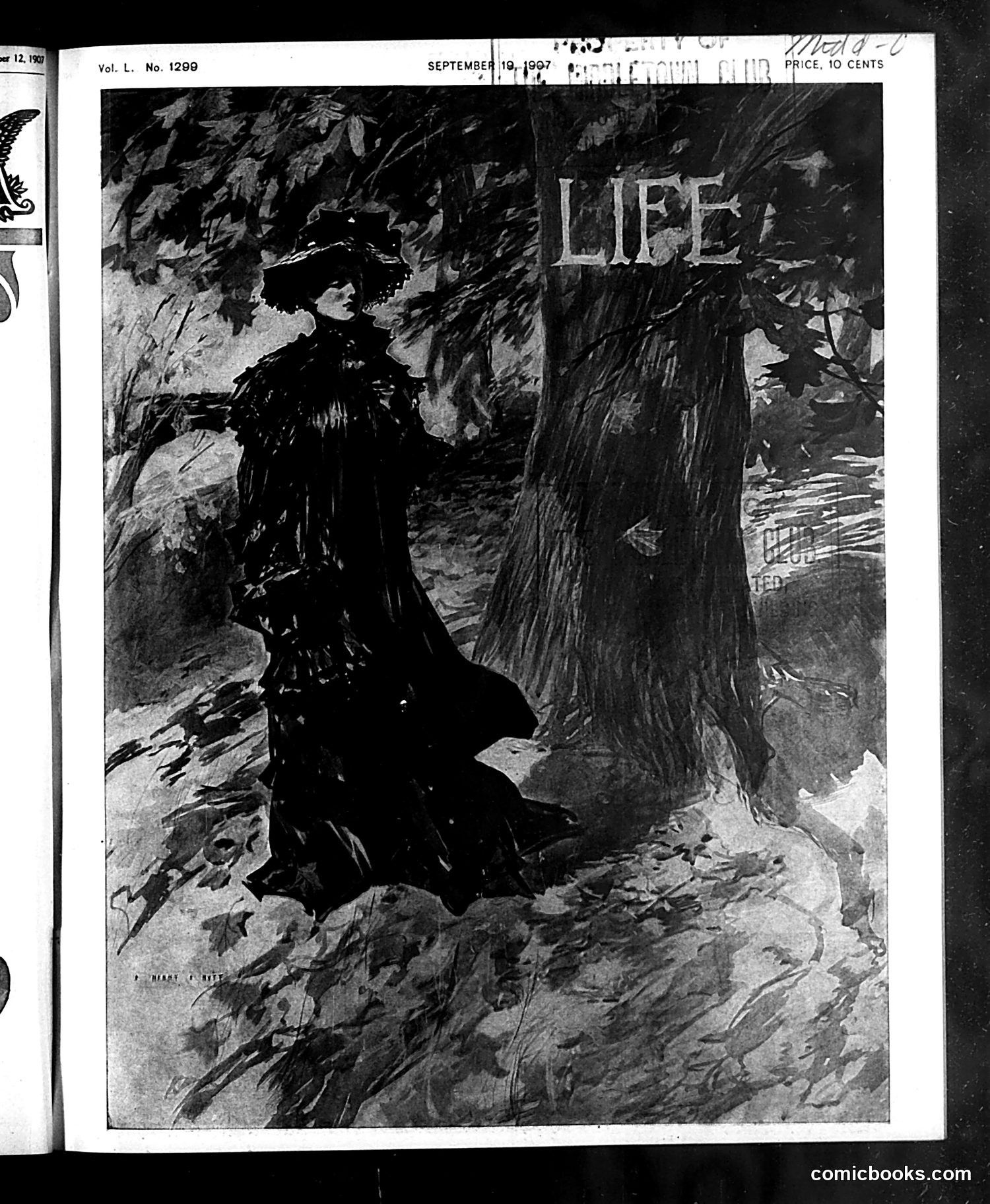
This is the cover of *Life* magazine from September 19, 1907 (Vol. L, No. 1290). The image shows a silhouetted female figure in dark clothing standing in a forest or wooded area near a large tree trunk, gazing upward or into the distance. Without additional text on this page identifying the specific subject, the exact satirical meaning is unclear. However, the romantic, contemplative pose and woodland setting suggest this may be referencing either a literary character, a contemporary social figure, or perhaps satirizing sentimental attitudes toward nature common in Edwardian-era popular culture. The dramatic silhouette technique was typical of *Life*'s artistic covers from this period. The specific political or social commentary cannot be determined from the image alone without accompanying article text.
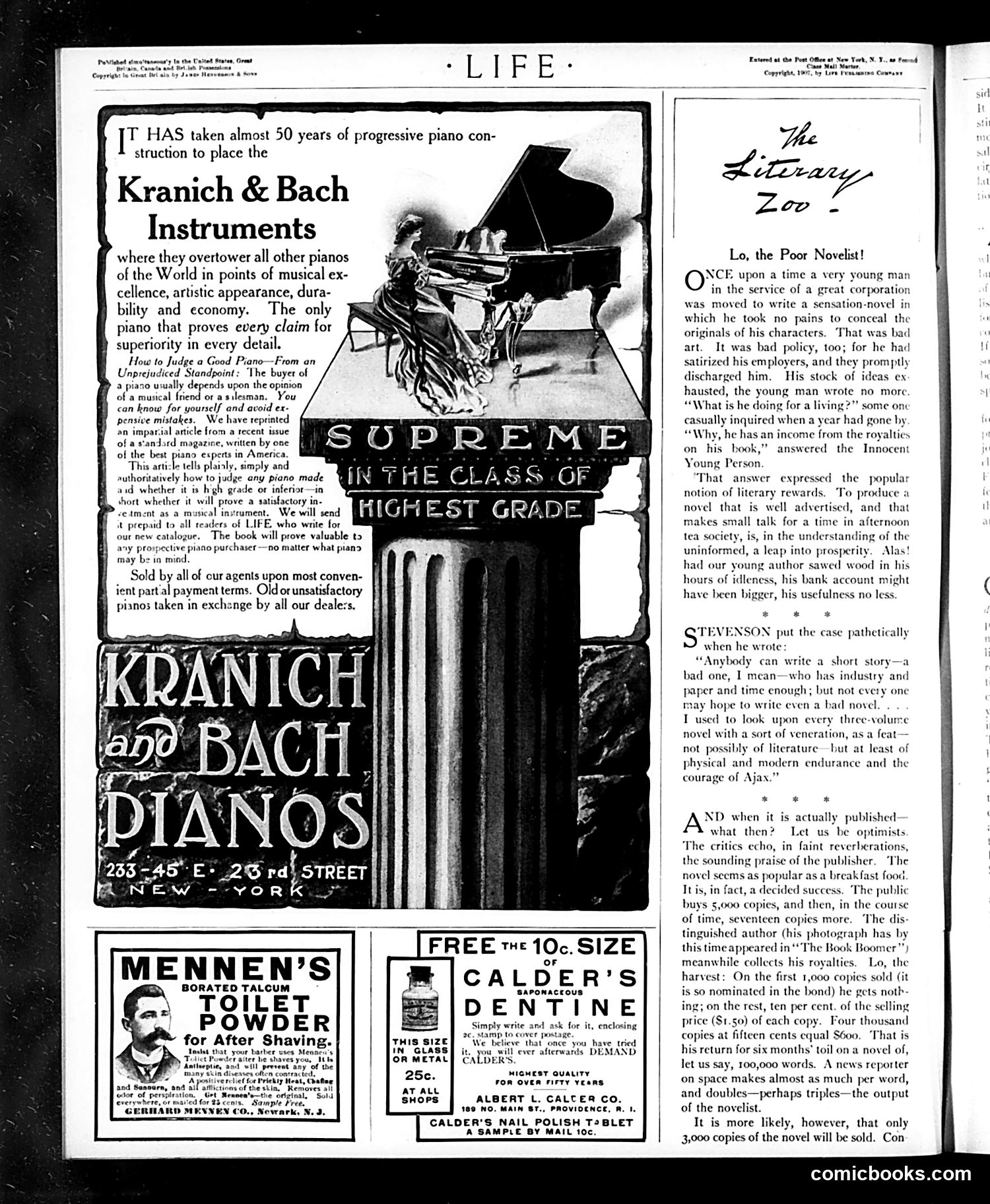
This page is primarily **advertising and editorial content rather than political satire**. The left side features an advertisement for Kranich & Bach pianos, claiming 50 years of progressive instruction established their superiority in "musical excellence, artistic appearance, durability and economy." The ad includes testimonial language about the piano's quality. The right side contains "The Literary Zoo," a brief essay about novelists and literary success. It discusses an unnamed young writer employed by a corporation who attempted writing sensation novels, was fired, but eventually achieved literary success. The piece appears to critique both commercial literary markets and the romanticization of the struggling artist. The bottom contains standard period advertisements for talcum powder and dentine products—typical mass-market goods for early 20th-century consumers.
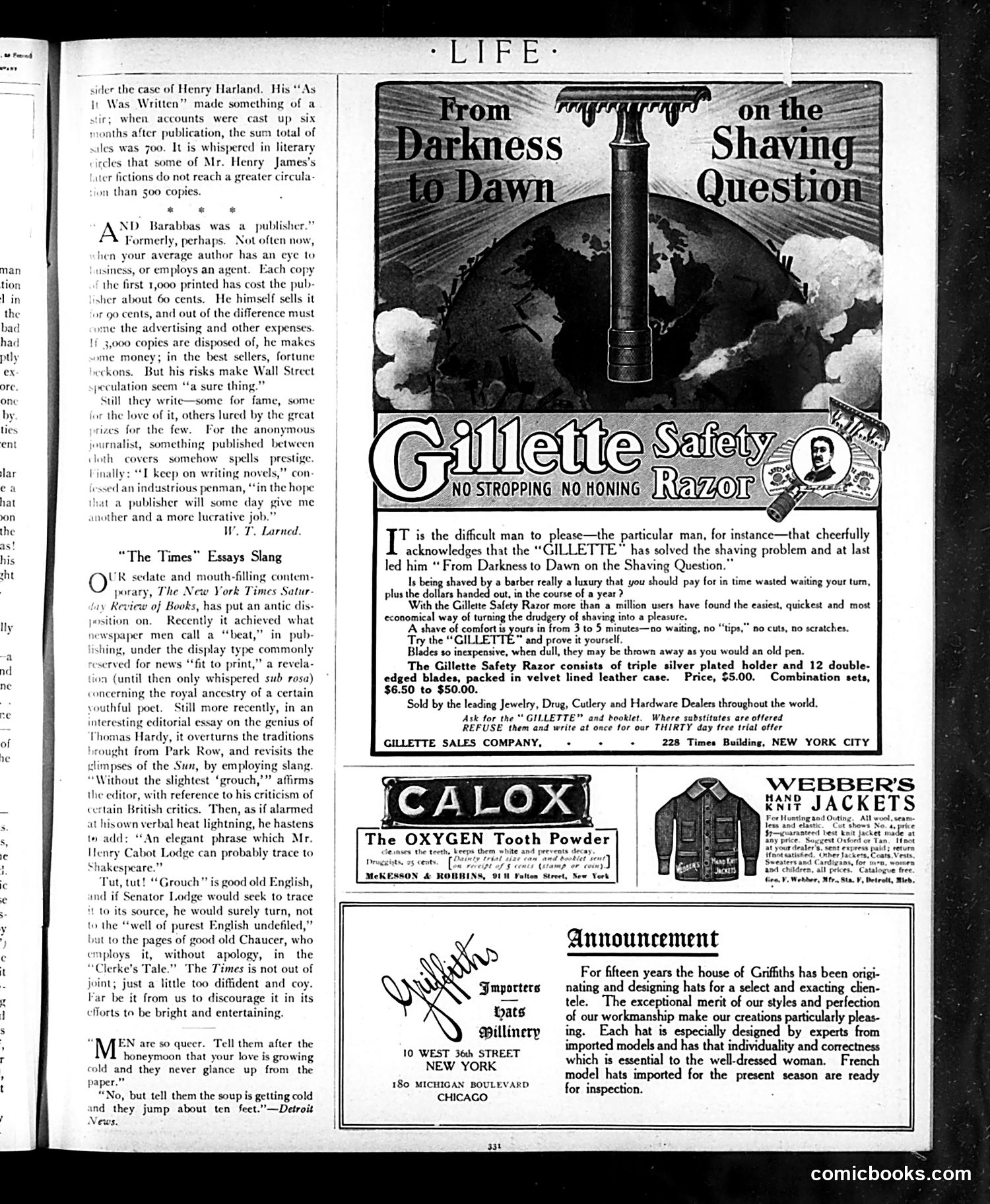
This page is primarily **advertising**, not satire or political commentary. The dominant feature is a large **Gillette Safety Razor advertisement** depicting a man shaving at dawn, with the headline "From Darkness to Dawn on the Shaving Question." The ad addresses a genuine consumer concern of the era: making shaving easier and more pleasant. It emphasizes the razor's efficiency ("no stropping, no honing") and comfort ("no nips, no cuts, no scratches"). Below are smaller ads for **Calox Tooth Powder** and **Webber's Jackets**, plus a fashion announcement from **Griffith Importers** in New York and Chicago. The left column contains literary commentary unrelated to the advertisements. This was typical Life magazine format: editorial content mixed with revenue-generating ads.
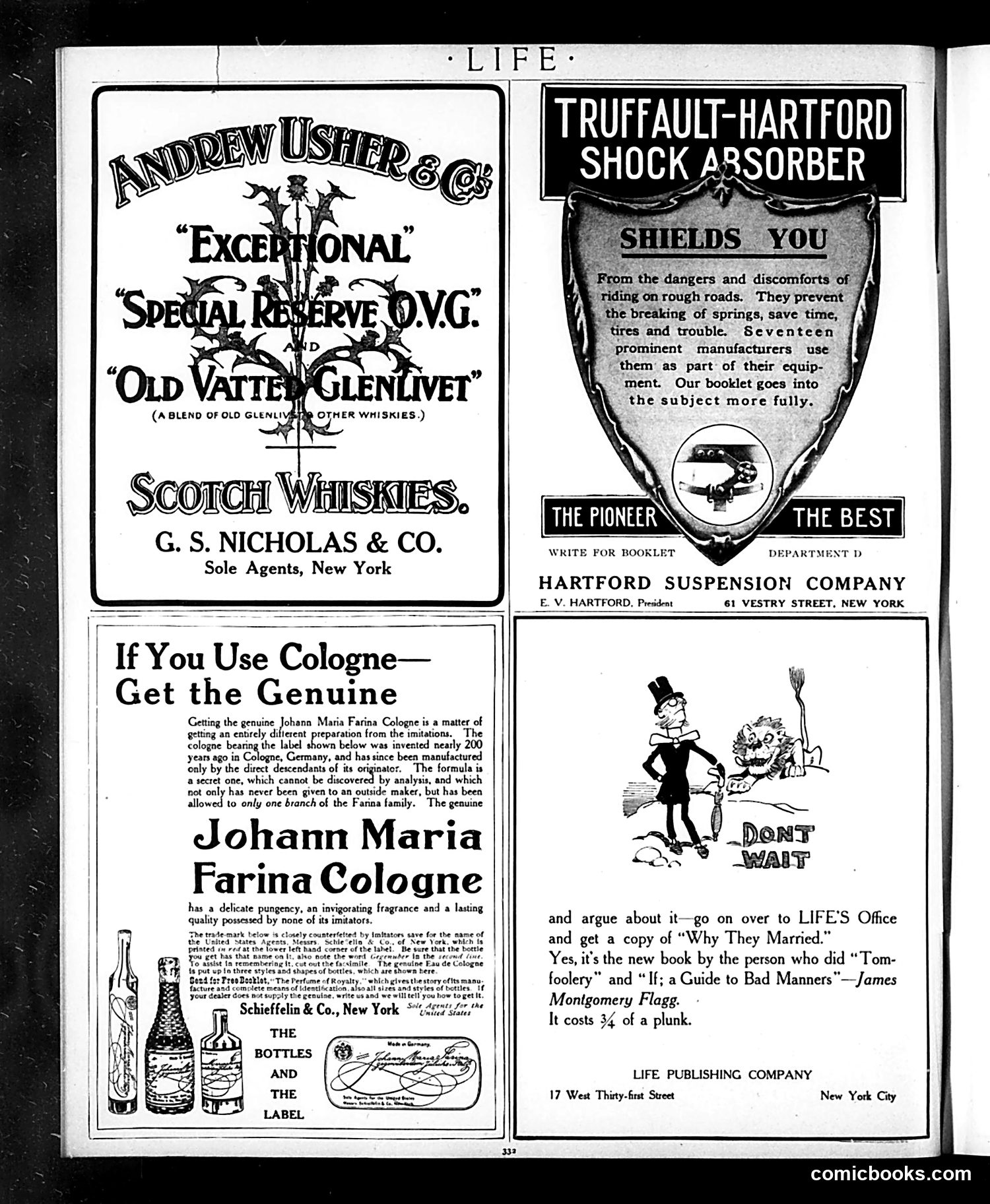
This page is **primarily advertising** from the early 20th century, containing four distinct ads: 1. **Andrew Usher Scotch Whisky** - promoting blended Scotch brands 2. **Truffault-Hartford Shock Absorber** - automobile suspension equipment 3. **Johann Maria Farina Cologne** - emphasizing authenticity against imitations 4. **"Why They Married"** - a humorous book advertisement The only cartoon appears in the lower right: a simple illustration of a man and woman arguing, captioned "DON'T WAIT," promoting a Life Publishing Company book about marriage by James Montgomery Flagg (author of "Tomfoolery" and etiquette guides). The joke is light domestic humor—don't delay getting advice before marital disputes arise. The page reflects early 20th-century consumer advertising more than political satire.
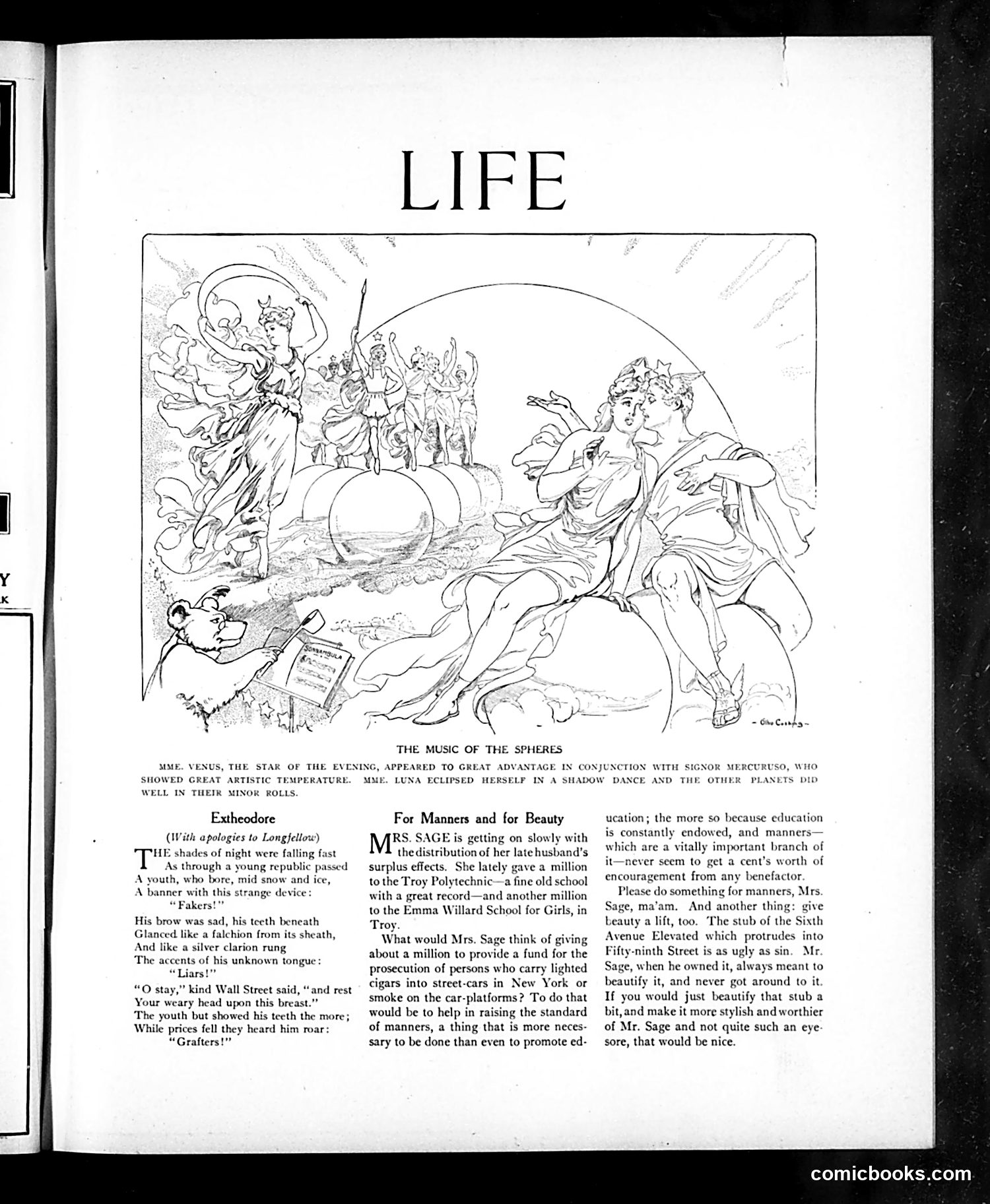
The illustration depicts classical/mythological figures in a satirical scene. The caption references "Mme. Venus, the Star of the Evening" and "Signor Mercuruso," personifying planets as operatic performers. A small figure (possibly representing a critic or observer) sits with a notebook at lower left. The accompanying text discusses "Euthedore" and focuses on Mrs. Sage's philanthropic activities—particularly her million-dollar donations to Troy Polytechnic and the Emma Willard School for Girls. The article mocks Wall Street's crude materialism ("O stay, kind Wall Street said, 'and rest / Your weary head upon this breast'"). The satire juxtaposes refined classical imagery with American commercialism, critiquing both wealthy benefactors and financial culture through allegorical comparison.
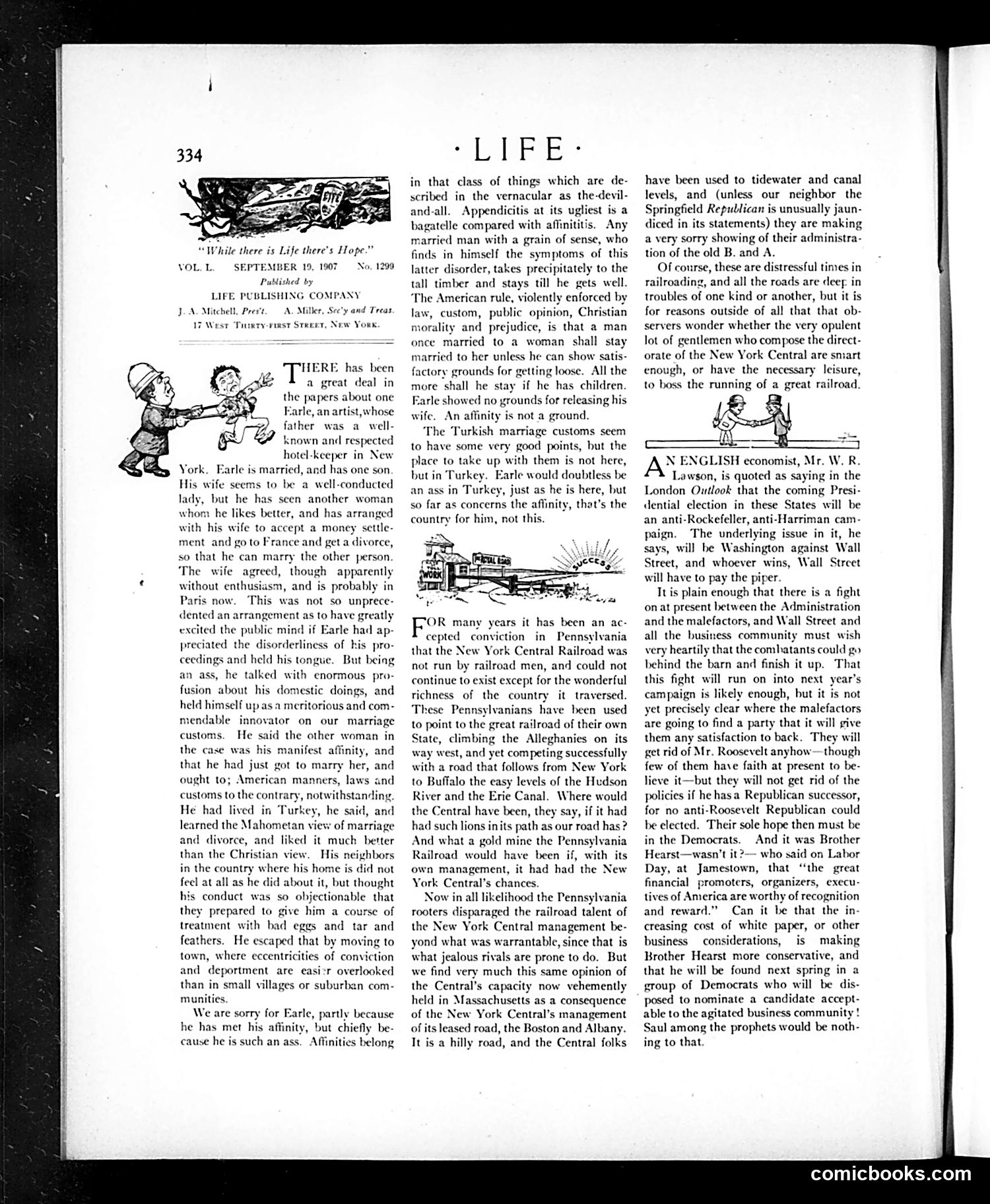
This page contains two distinct satirical pieces: 1. **Left illustration**: A small cartoon showing a man and woman, accompanying text mocking a man named Earle who married a woman to escape marital troubles. The satire suggests his strategy backfired—he arranged a "friendly settlement" allowing him to marry another woman in France, but his first wife agreed too readily, implying she was equally eager to be rid of him. 2. **Right section**: Commentary on the 1912 Presidential election, discussing Wall Street's political influence. The text references Washington versus Wall Street as the underlying campaign issue, and mentions Republican successor prospects, suggesting this was written during Theodore Roosevelt's presidency or the transition period. Both pieces employ satirical commentary on contemporary social and political matters.
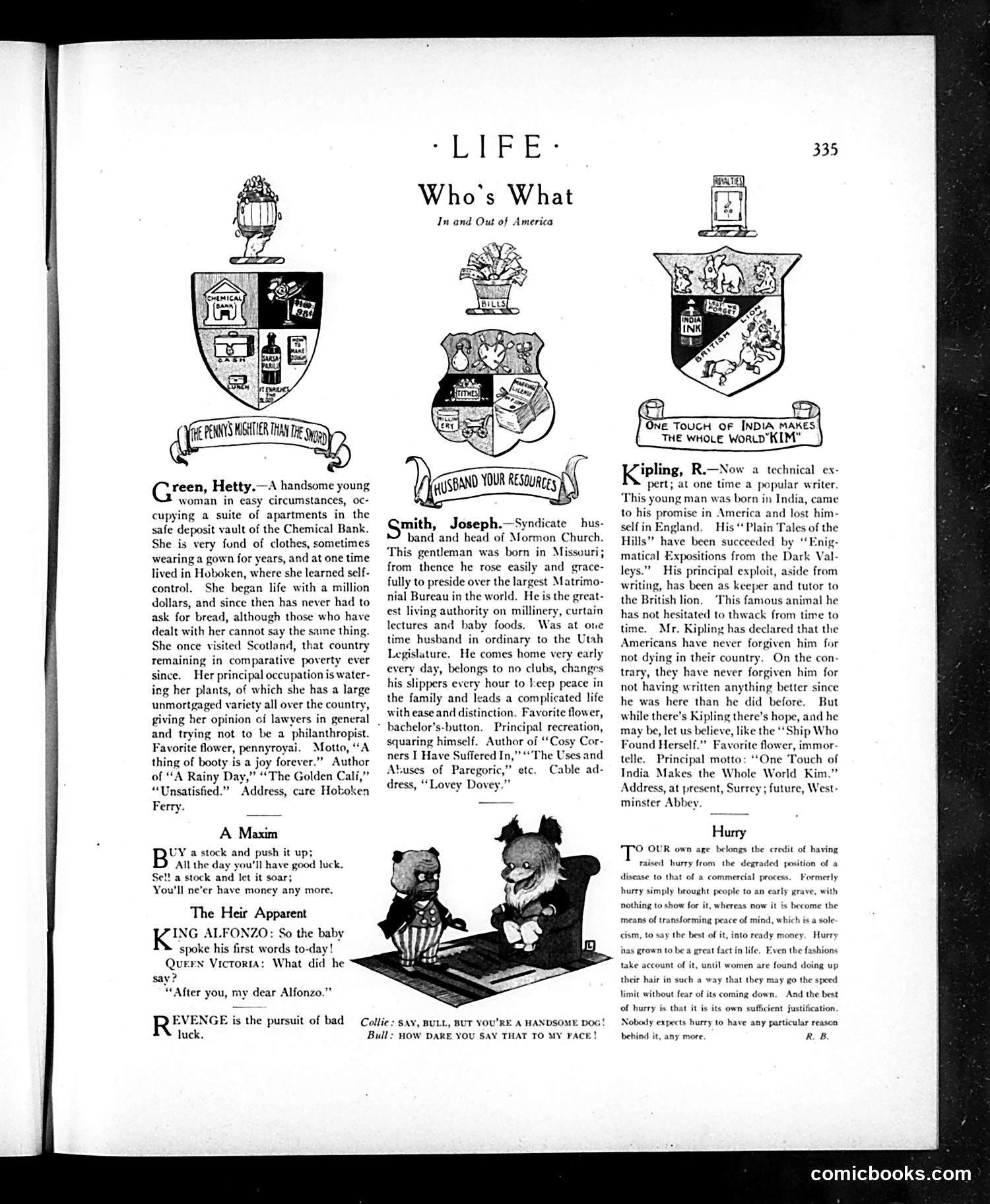
This page from *Life* magazine presents satirical biographical sketches of notable Americans. Three coats-of-arms style illustrations accompany entries on: - **Hetty Green**: A wealthy woman criticized for hoarding money despite being extremely rich, contradicting her philanthropic image. - **Joseph Smith**: Leader of the Mormon Church, described as controlling a large matrimonial bureau (referencing polygamy practiced by early Mormons). - **Rudyard Kipling**: The famous British writer now living in America, depicted as having lost his English identity. The page also includes humorous aphorisms and a cartoon dialogue between King Alfonzo and Queen Victoria about an heir. The satire targets wealth, religious hypocrisy, and celebrity pretension typical of *Life*'s irreverent editorial voice.
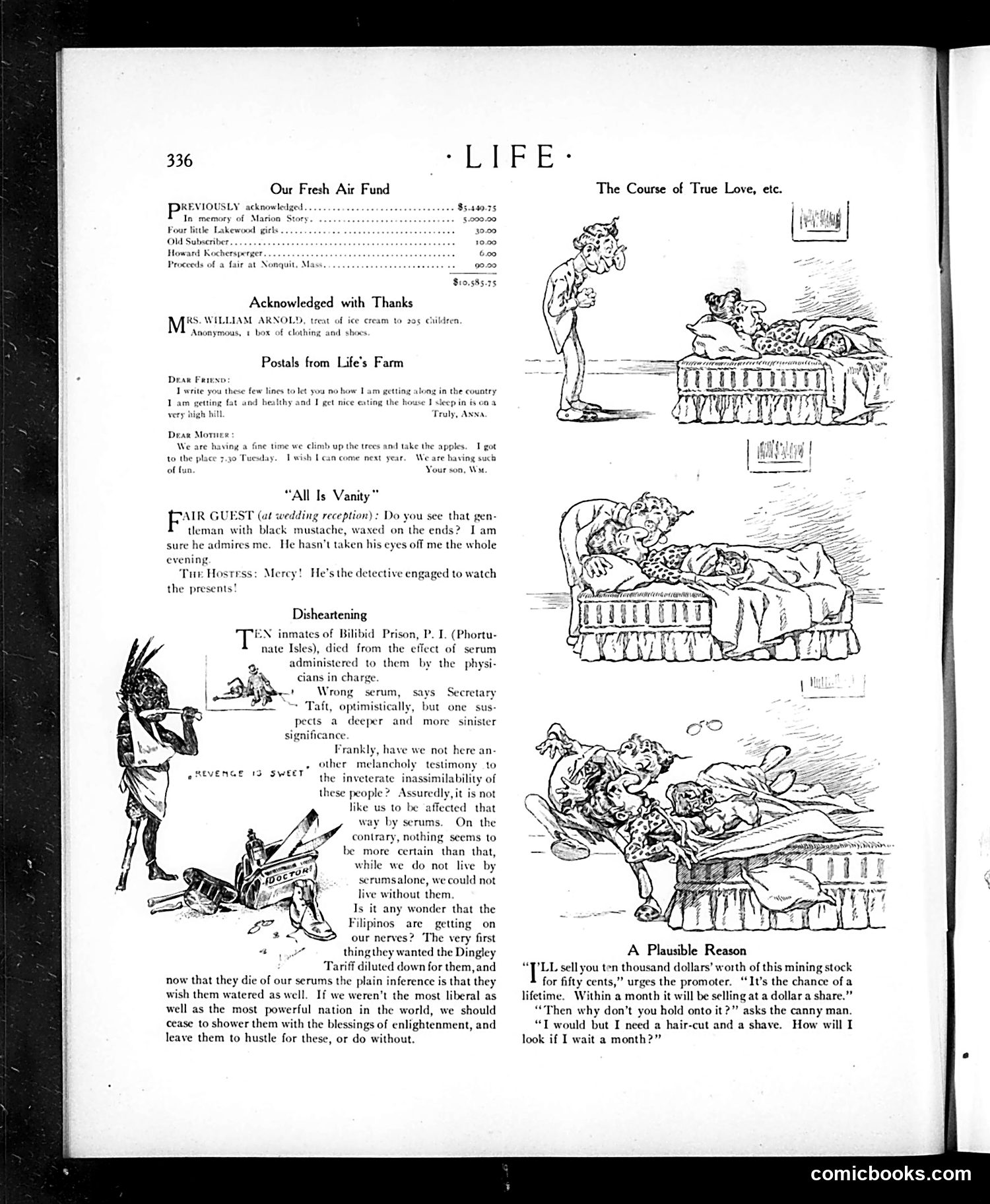
This page contains several satirical pieces typical of Life's early 20th-century humor: **"The Course of True Love"** (right side): A series of cartoon panels depicting courtship and marriage progression—a common Life trope mocking romantic expectations versus domestic reality. **"All Is Vanity"**: A brief joke about a wedding reception where a guest notices a man with a waxed mustache, implying the "detective" hired to watch presents is actually the groom in disguise—satirizing wealthy guests' concerns about theft and social pretension. **"Disheartening"**: A darker piece about serum deaths in the Philippines, critiquing colonial medicine and American colonial policy's human cost. The editorial commentary suggests irony about American claims of benevolence while indigenous populations suffer from experimental treatments. **"A Plausible Reason"**: A stock-promotion scam joke about mining stocks—mocking investment fraud common in the era.
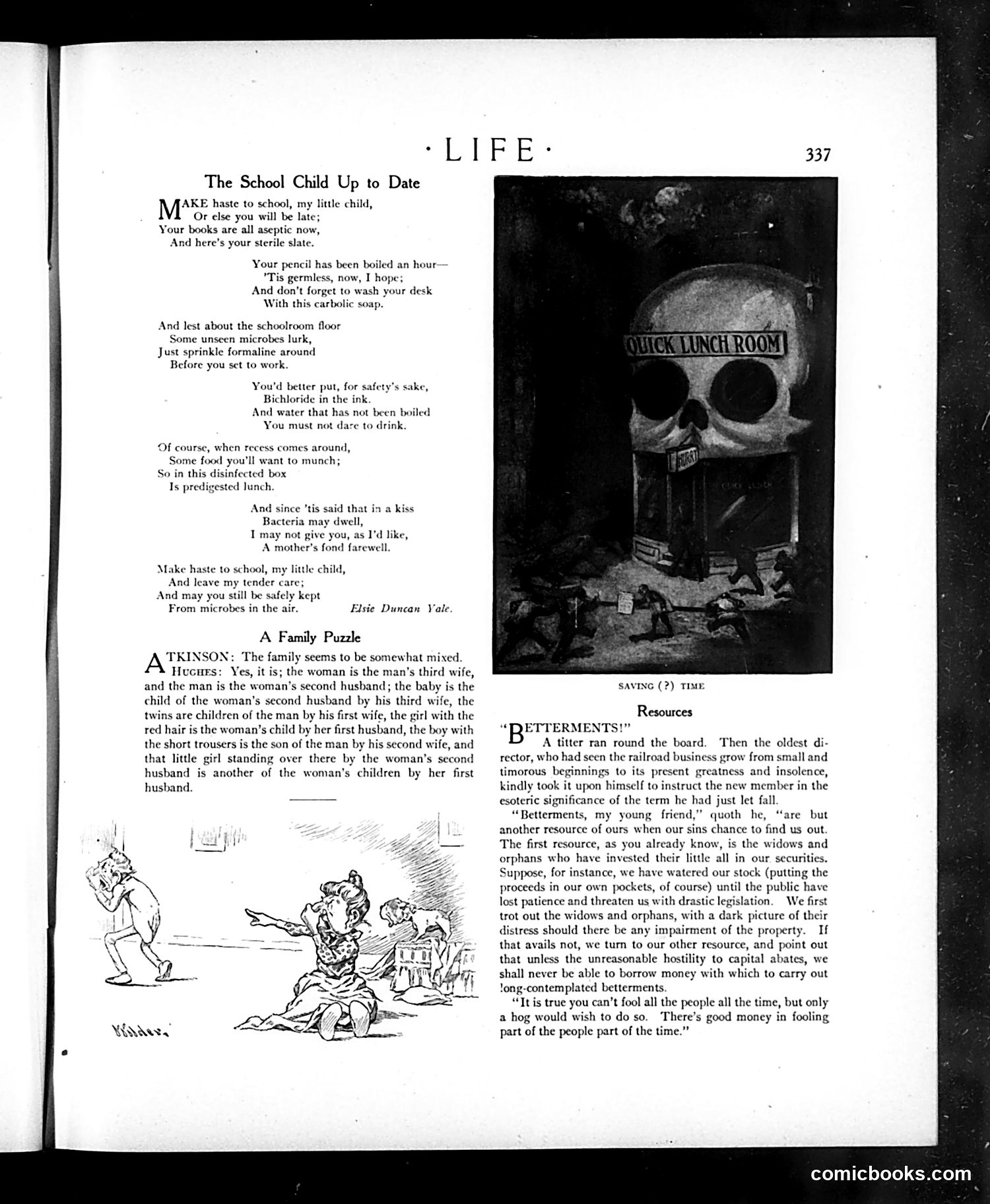
This page contains three distinct sections: **"The School Child Up to Date"** (poem by Elsie Duncan Yale): A humorous cautionary poem warning children about hygiene and safety at school—boiled pencils, sterilized slates, carbolic soap, avoiding microbes, and disinfected lunch boxes. It satirizes early 20th-century obsessions with germ theory and antiseptic precautions. **"A Family Puzzle"** (small illustration): A comedic logic puzzle presenting an intentionally confusing family relationship riddle, likely meant to entertain readers. **"Resources"** (article with illustration): Discusses railroad stocks and widows/orphans as financial investors. The piece appears satirical, suggesting "there's good money in fooling part of the people part of the time"—likely critiquing how financial schemes exploit vulnerable populations or gullible investors. The tone throughout is satirical social commentary typical of Life magazine's era.
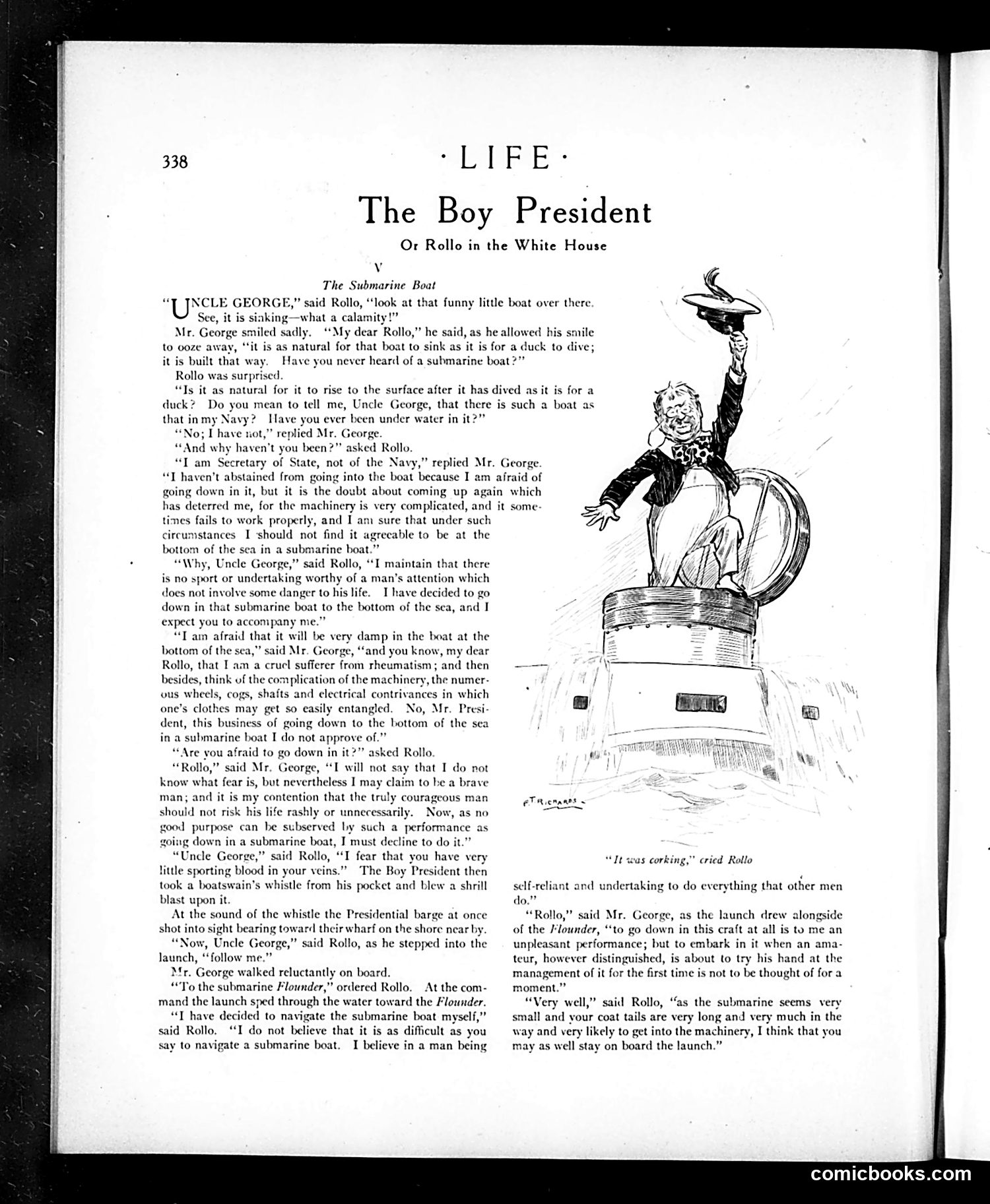
This satirical piece mocks a young, inexperienced political figure (referred to as "the Boy President" and "Mr. President") through a dialogue with "Uncle George" about a submarine boat. The satire works through the boy's naive eagerness to undertake dangerous tasks he doesn't understand—he insists on piloting a submarine despite legitimate safety concerns about underwater pressure, machinery complexity, and risk of drowning. The illustration shows a boy confidently gesturing from atop submarine equipment, embodying youthful overconfidence. The joke satirizes the president's inexperience and recklessness in handling serious matters of state—comparing his willingness to engage in perilous submarine navigation to his unqualified approach to governing. "Uncle George" represents cautious, experienced wisdom being dismissed by youthful arrogance.
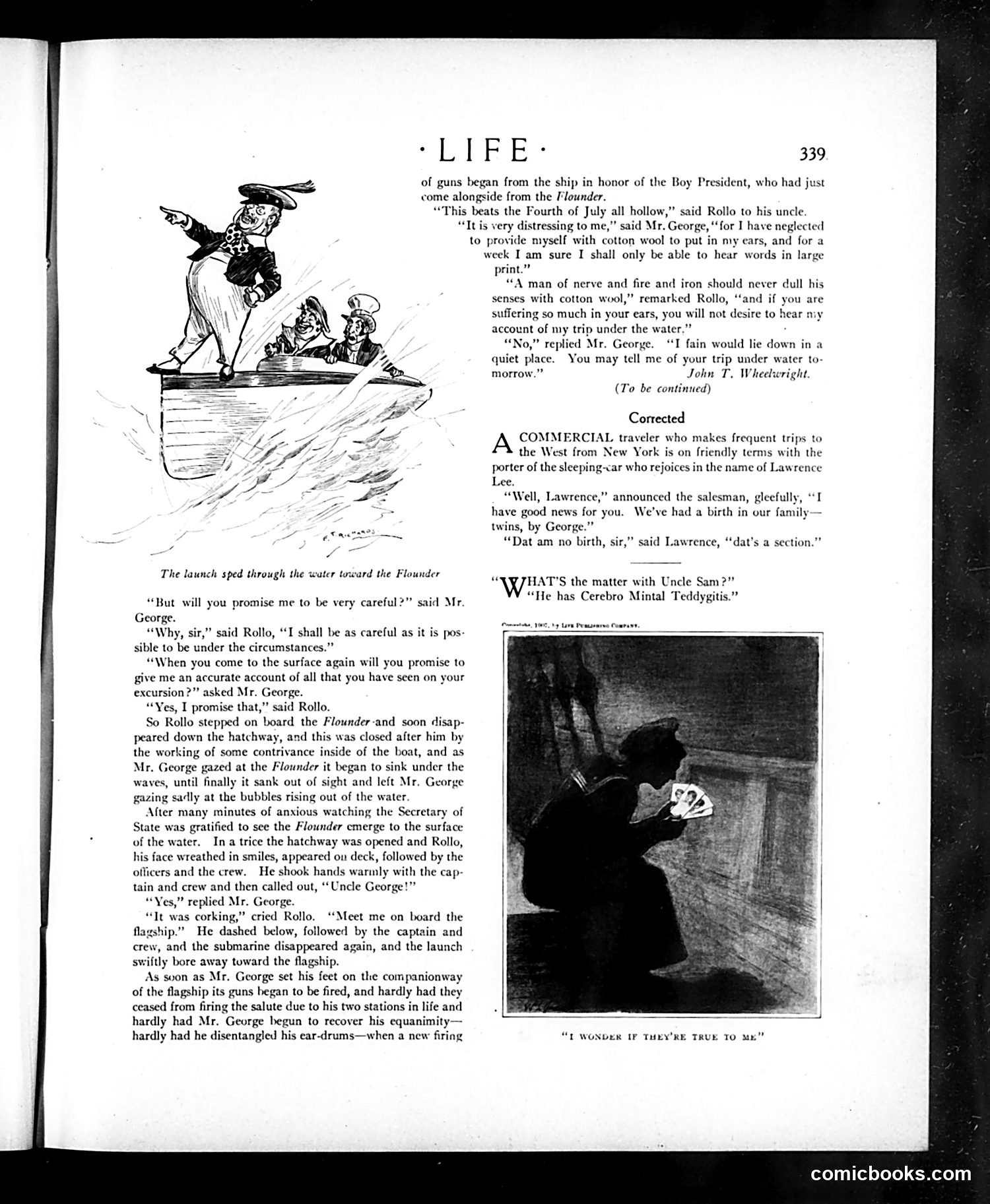
This page contains a fictional narrative titled "Corrected" about a commercial traveler and a porter named Lawrence who works on a sleeping car. The story is a gentle joke about miscommunication: the salesman announces "twins, by George" (a birth in the family), but Lawrence misunderstands, thinking he said "dat am no birth, sir; dat's a section"—confusing "birth" (a baby) with "berth" (a sleeping compartment on a train). The accompanying illustration shows an underwater submarine scene with the caption "I wonder if they're true to me," likely from an unrelated story. The humor relies on wordplay and the contrast between the salesman's enthusiasm and the porter's literal, practical interpretation of his announcement.
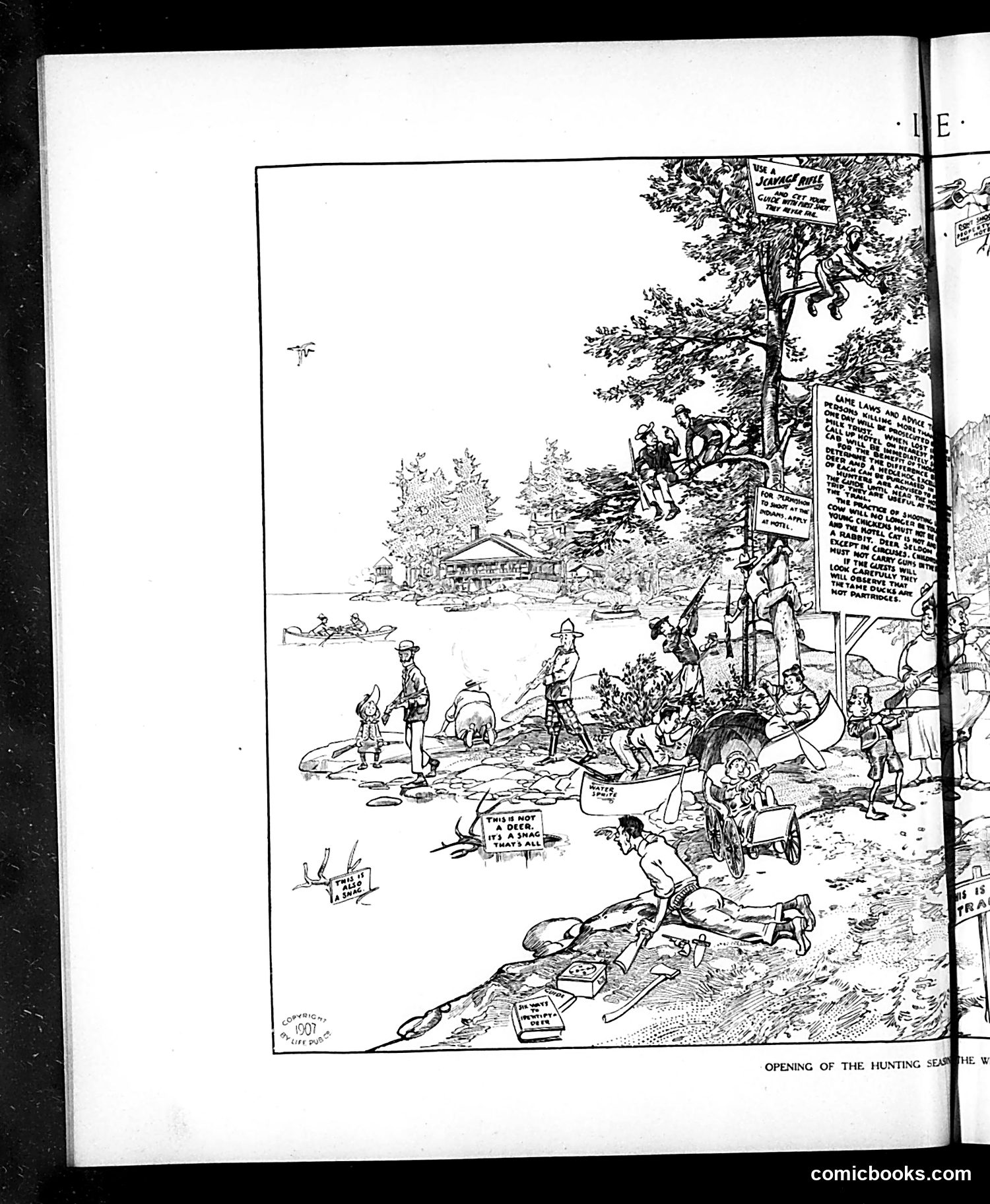
This satirical cartoon depicts a chaotic lakeside camping scene labeled "Opening of the Hunting Season." The illustration shows numerous figures engaged in hunting and fishing activities, with some visible speech bubbles containing critical commentary (though text is difficult to read at this resolution). The satire appears to mock the disorganization, overcrowding, and potential dangers of opening day hunting season—a traditionally anticipated event in American outdoor culture. Multiple hunters and fishermen are shown in close quarters, suggesting satire about the competitive scramble and lack of proper regulation during the season's start. The detailed, busy composition emphasizes the chaos and possibly unsafe conditions, likely critiquing either poor game management or the behavior of overeager sportsmen.
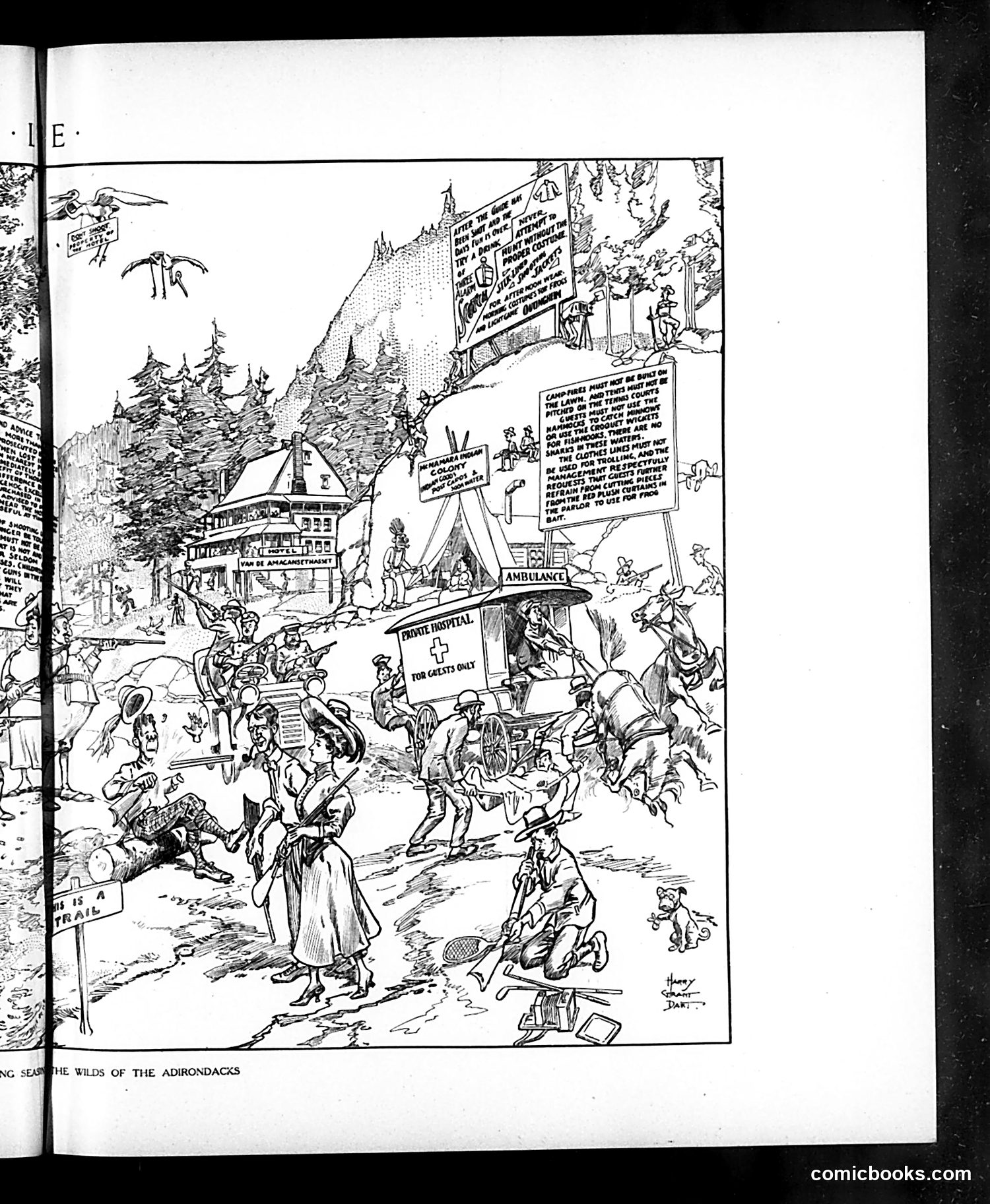
This is a satirical illustration titled "In the Wilds of the Adirondacks," depicting a chaotic summer camp or resort scene. The cartoon shows numerous figures engaged in various activities—some appear injured or distressed, an ambulance is present, and there's a "Rescue Hospital For Casts Only" sign. The large billboard contains text listing camp regulations and rules. The satire appears to critique overly regimented summer camps with excessive rules and safety restrictions, suggesting the camps are accident-prone or poorly managed despite their regulations. The cartoon portrays camp life as inherently dangerous and comedic, with the abundance of rules, ambulances, and casualties implying the rules themselves may be inadequate or ridiculous. This likely resonated with early 20th-century readers familiar with fashionable but often chaotic Adirondack resort culture.
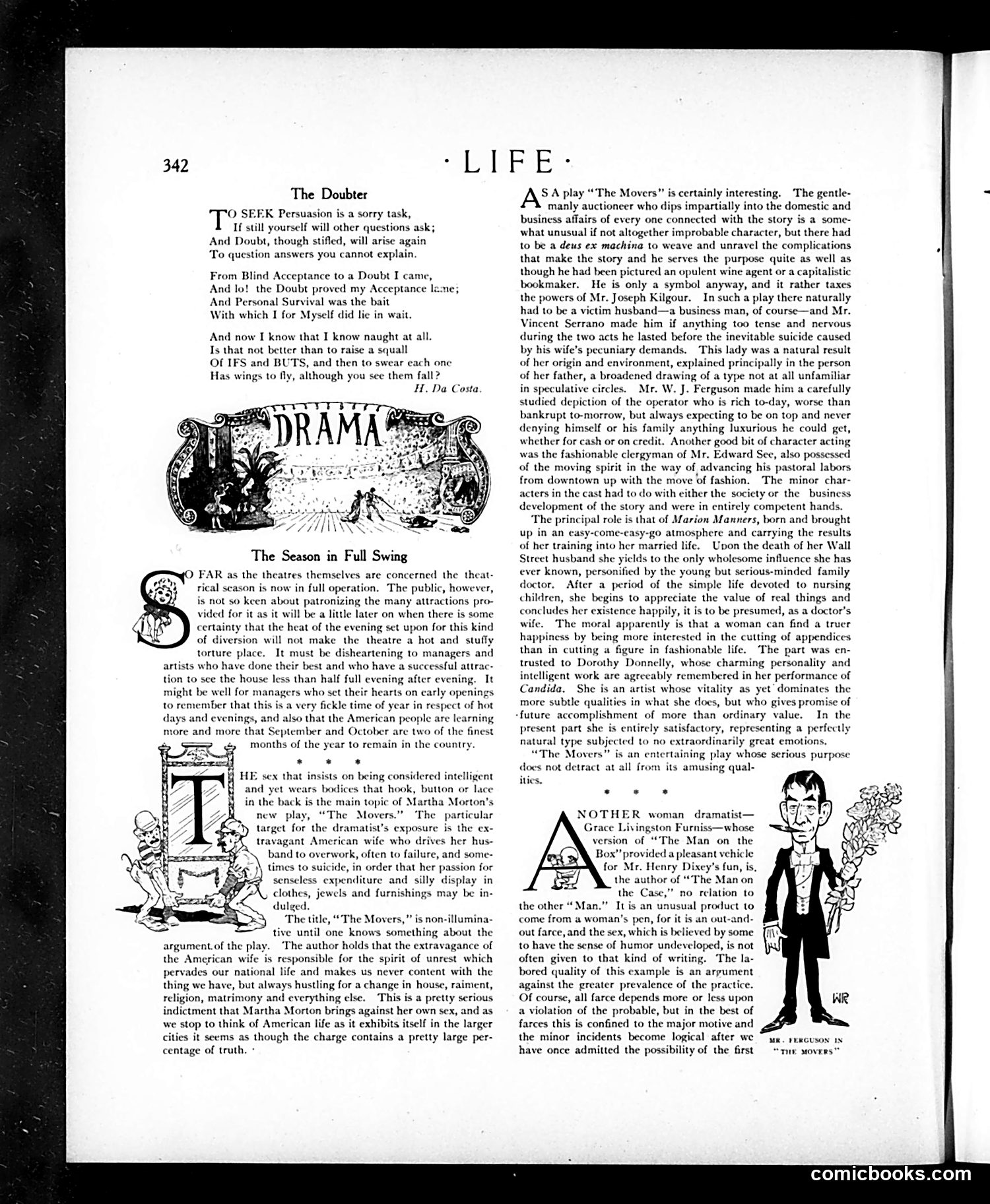
This page contains theatrical reviews and social commentary typical of Life's satirical approach. The main cartoons and content critique American society, particularly women's behavior. **"The Doubter"**: A philosophical poem questioning the value of certainty versus doubt—likely reflecting early 20th-century intellectual debates about knowledge and faith. **"The Season in Full Swing"**: Reviews two Broadway plays. "The Movers" by Martha Morton is the focus—a play attacking American wives' extravagance and materialism. The reviewer agrees with Morton's thesis that women's wasteful spending and constant desire for new possessions (houses, clothes, jewelry) drives husbands to overwork and financial ruin, fueling national discontent. **The Social Critique**: The page reflects period anxieties about female consumerism and changing gender roles. Life frames wives' spending as a serious social problem contributing to male desperation—even suicide in the play's plot. The illustration of a well-dressed man (likely Mr. Ferguson in "The Movers") accompanies this gender-focused critique typical of pre-1920s satire.
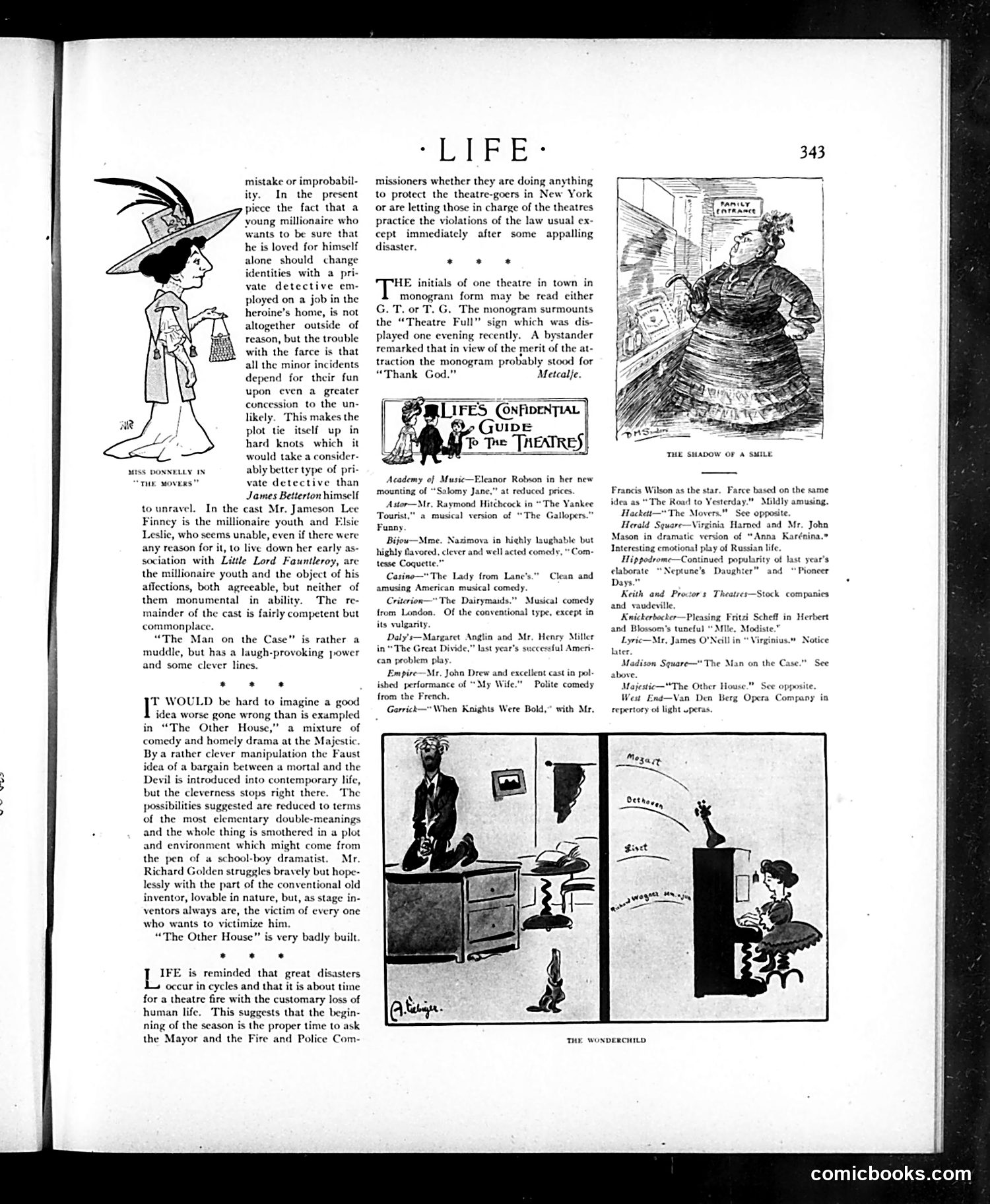
This page contains theatre reviews and satirical commentary from an early 20th-century issue of *Life* magazine. The main cartoons and text address: **"The Shadow of a Smile"** (top right illustration): Shows a theatre interior with "Family Circles" visible—likely satirizing theatre seating arrangements or audience demographics of the era. **"The Wonderchild"** (bottom cartoon): A multi-panel comic showing various labeled scenes ("Mirth," "Pathos," "Between," "Exit," etc.), appears to be satirizing theatrical melodrama or contrived emotional manipulation in stage productions. **Theatre Safety Commentary**: The text includes sharp social criticism about theatre fire safety, sarcastically suggesting city officials only enforce safety codes *after* disasters occur—a reference to real theatre fires that killed many in this period. **Monogram Joke**: One brief satire mocks a theatre displaying "G.T." or "T.G." initials above a "Theatre Full" sign, joking the letters actually stand for "Thank God" (implying the show is so bad audiences are relieved it's full and they can't attend). The reviews critique specific productions as poorly constructed despite decent casts, particularly targeting artificial plots and contrived comedy.
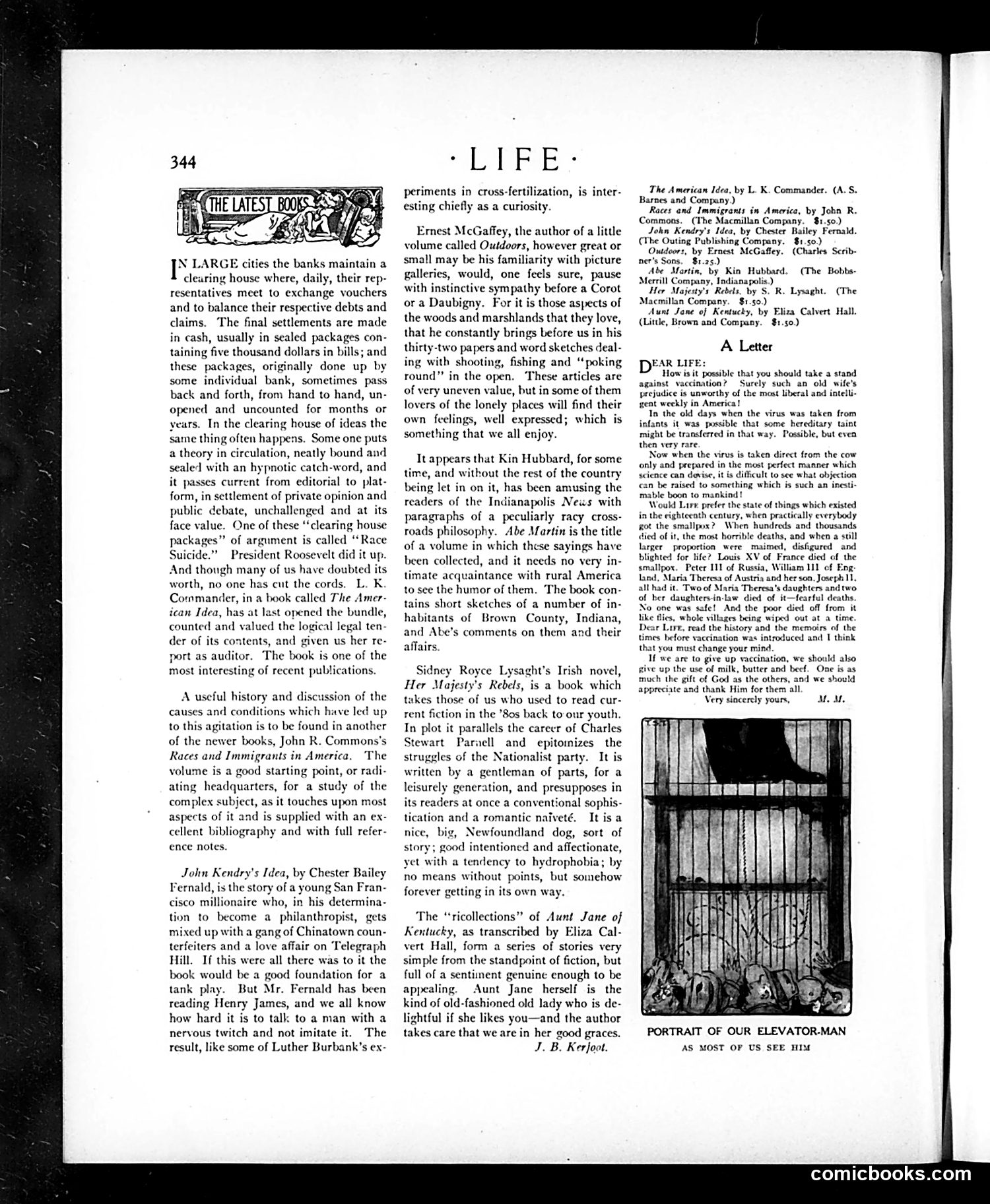
This page is primarily a book review section from *Life* magazine. The single cartoon at bottom right, captioned "PORTRAIT OF OUR ELEVATOR-MAN / AS MOST OF US SEE HIM," shows an elevator operator viewed through the metal lattice gate of an elevator shaft—a tall, narrow vertical composition. The satire appears to be about class perception: the elevator operator is literally and figuratively *framed* by the machinery of urban commercial life, visible only in fragmented glimpses through the metal bars. The joke suggests that urban dwellers see service workers like elevator operators as dehumanized fixtures of the building infrastructure rather than as full people—reduced to their functional role by the perspective of their "betters." The surrounding text reviews books including Roosevelt's "Race Suicide" theory, immigration studies, and fiction, establishing *Life*'s focus on contemporary social commentary.
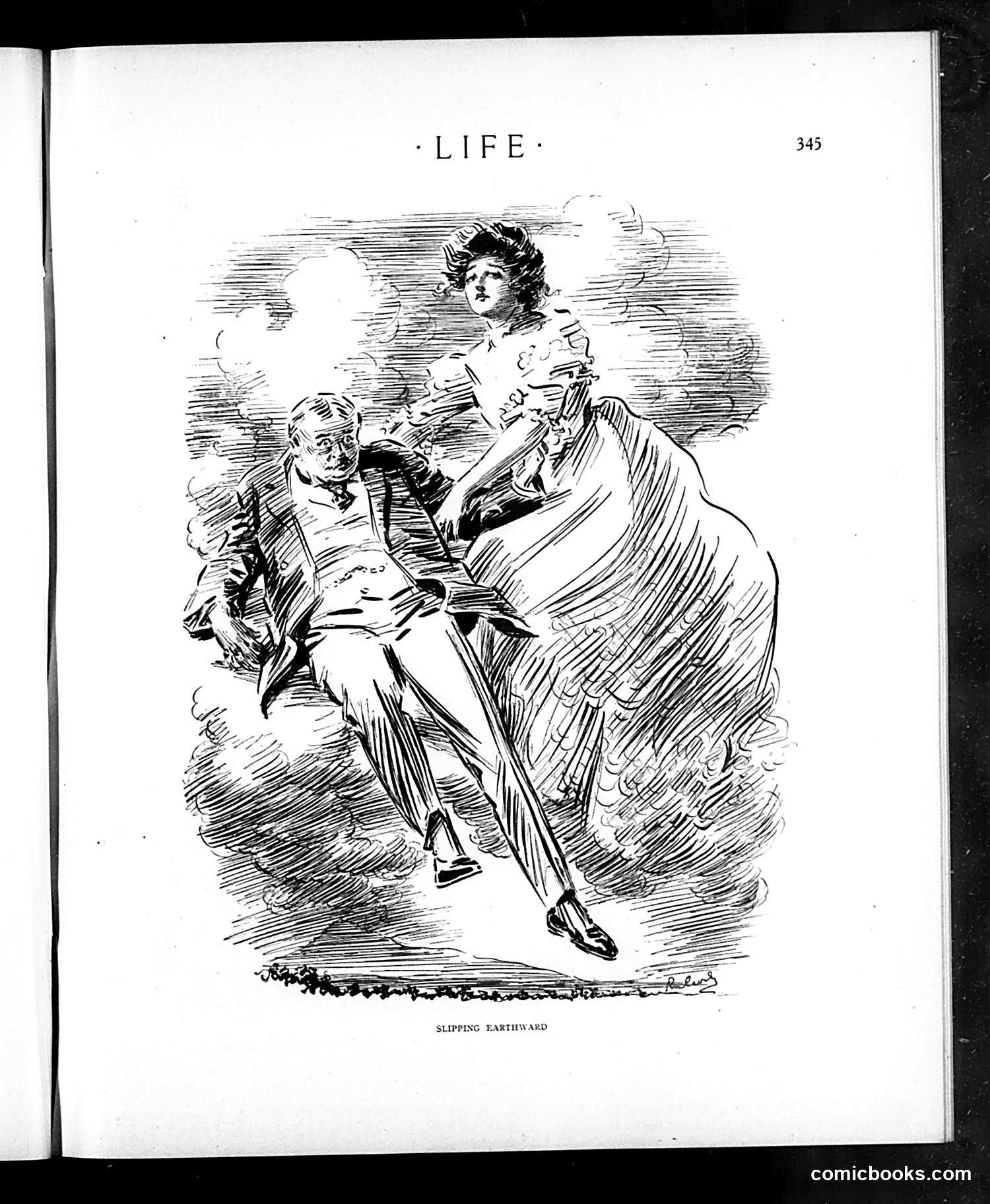
This satirical sketch depicts a man in formal attire (top hat, tailcoat) appearing to fall or slip downward, while a woman in an elaborate dress gestures dramatically above him. The title "Slipping Earthward" suggests a commentary on social decline or loss of status. The cartoon likely satirizes a figure of contemporary prominence (to Life magazine's early 20th-century readership) experiencing a fall from grace or fortune. The woman's theatrical pose suggests she may represent either a spurned romantic interest or society itself witnessing his downfall. The artistic style—an elegant ink sketch—was typical of Life's satirical illustrations during this era, targeting public figures and social pretensions. Without additional context identifying the specific individuals, the exact political or personal scandal remains unclear.
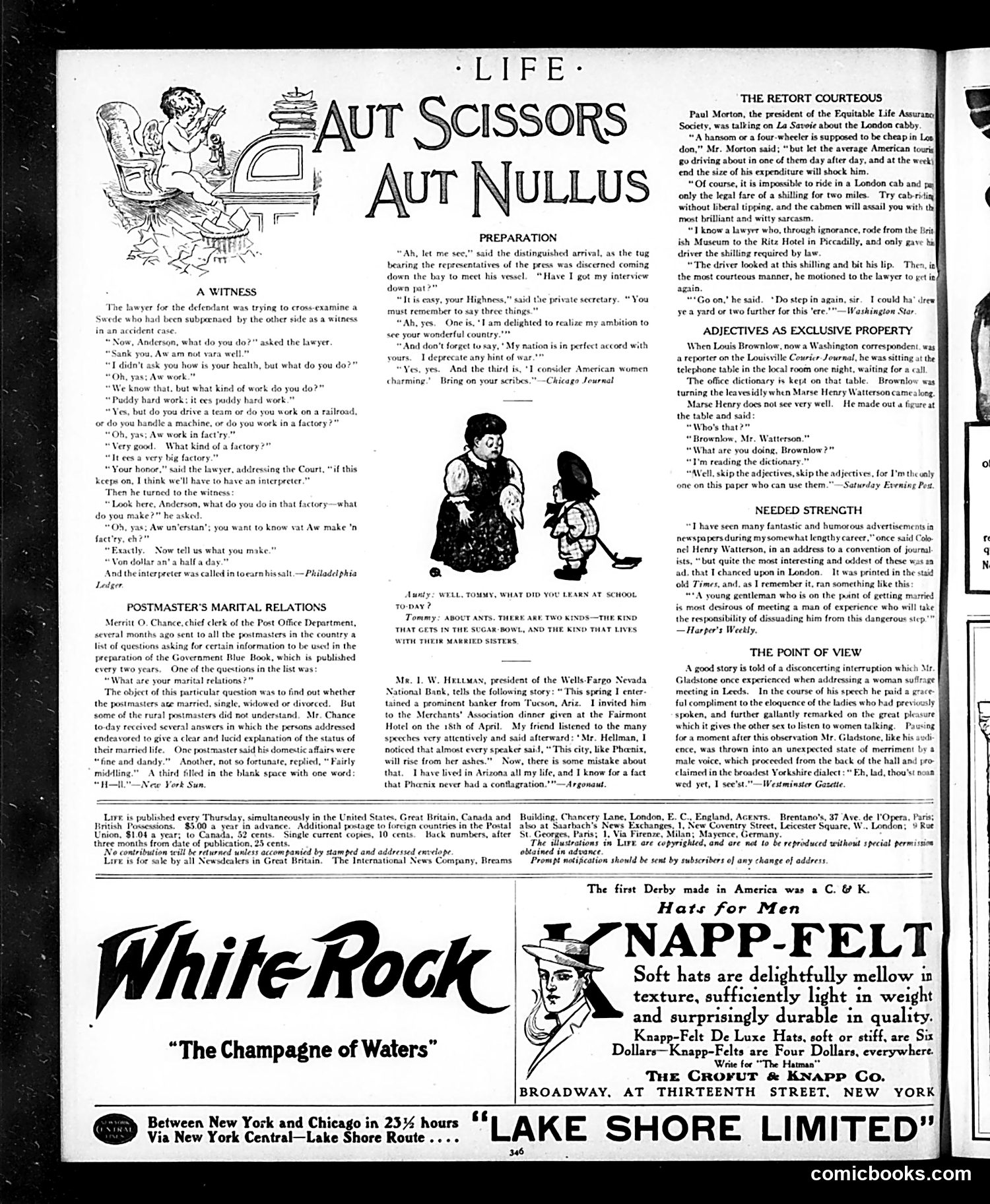
This page contains several short humorous pieces satirizing American society circa early 1900s: **"A Witness"** mocks a Swedish immigrant's difficulty understanding English during cross-examination. The lawyer's frustration—needing an interpreter when the Swede answers "one dollar and a half a day" to "what do you make?"—plays on anti-immigrant stereotypes and language-barrier humor common to the era. **"Postmaster's Marital Relations"** ridicules rural postmasters who misunderstood a government questionnaire about "marital relations," interpreting it as asking for marital *advice* rather than marital *status*. **"Aut Nullus"** satirizes a visiting dignitary (likely royalty or ambassador) who receives canned talking points from his secretary—highlighting how diplomatic visits involve rehearsed platitudes about admiring the country and American women. The remaining pieces use children's observations and anecdotes to satirize marriage and urban life. The tone is gentle mockery of bureaucratic confusion, immigrant experiences, and diplomatic pretense.
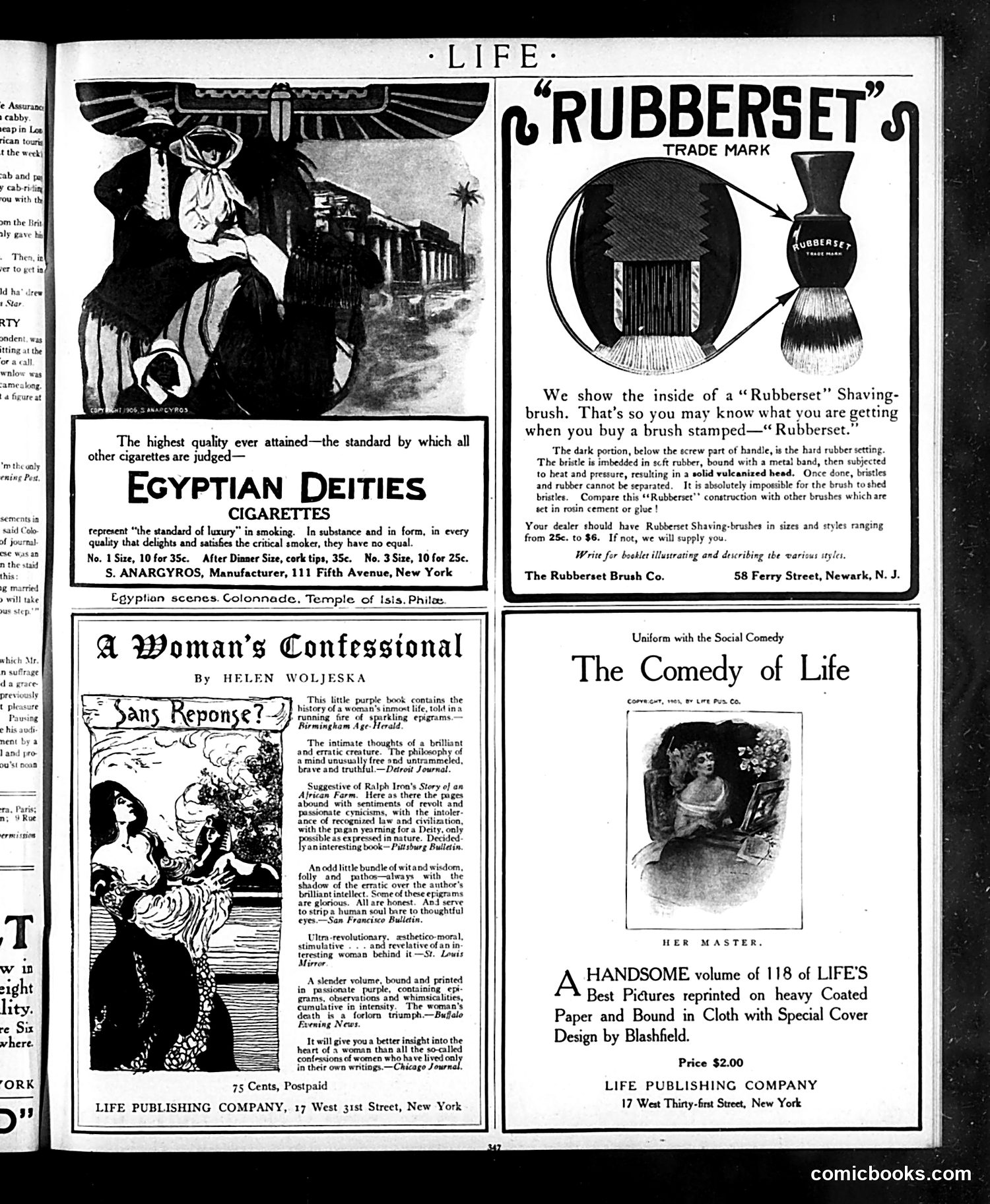
This page is primarily **advertising and book promotion**, not political satire. It contains four distinct advertisements: 1. **Egyptian Deities Cigarettes**: Appeals to luxury consumers with Egyptian imagery and claims of superior quality. 2. **Rubberset Shaving Brushes**: A technical product ad explaining the superior vulcanized rubber construction of their brushes versus competitors' inferior cement-set alternatives. 3. **"A Woman's Confessional" by Helen Woljeska**: A book of philosophical epigrams and observations about women's inner lives. The quoted reviews emphasize its revolutionary, honest, and psychologically revealing nature—apparently appealing to readers interested in emerging modernist literature and feminist perspectives. 4. **"The Comedy of Life"**: A Life Publishing collection of 118 pictures, priced at $2.00. The page reflects early 1900s consumer culture and emerging modernist/progressive literature. There is no political cartoon or satire present—this is a straightforward advertising page from Life magazine.
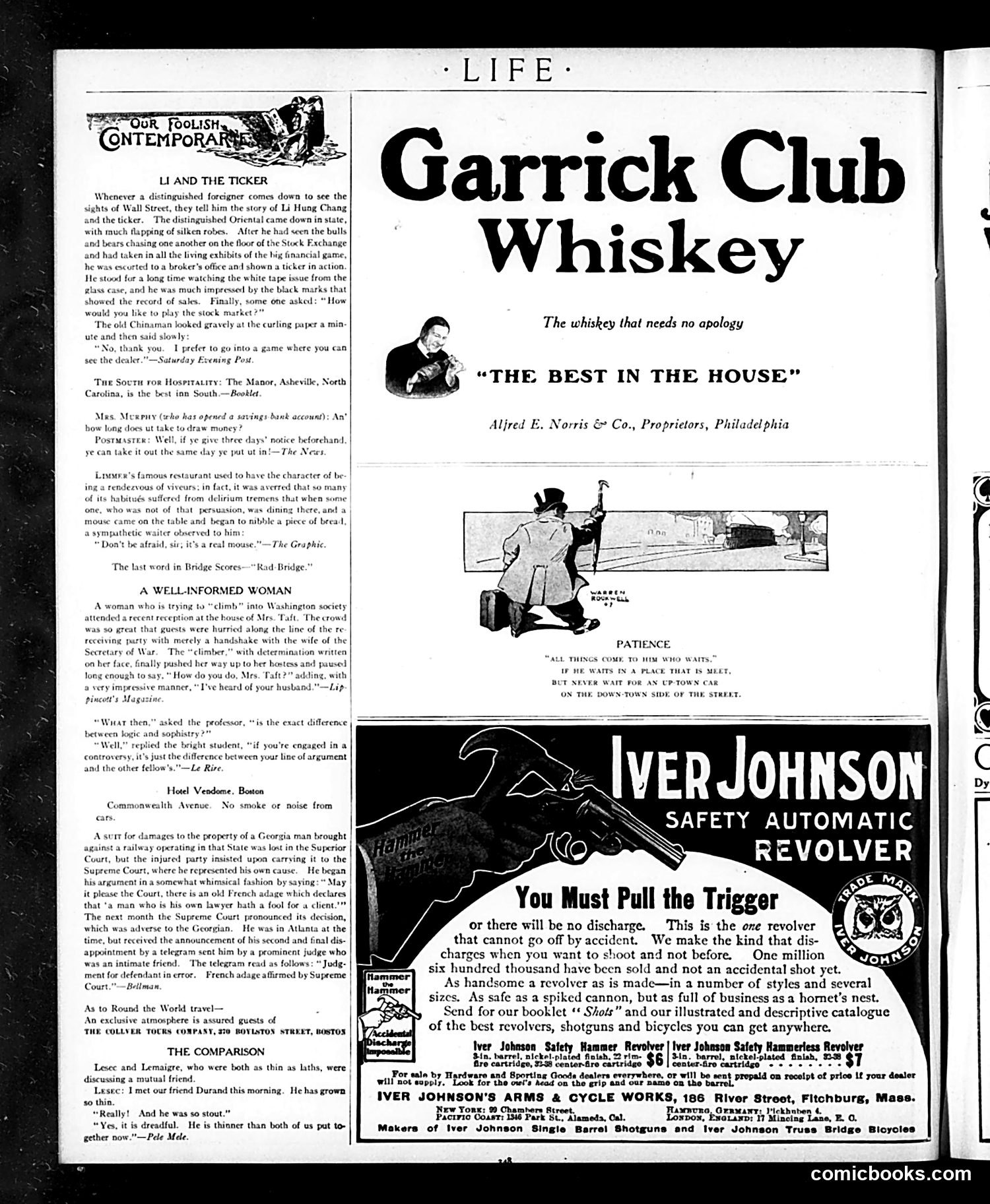
This page combines satirical commentary with advertising. The left column features "Our Foolish Contemporaries"—a recurring Life feature mocking absurdities in contemporary society and journalism. The main satirical content includes anecdotes ridiculing pretension and social climbing: Li Hung Chang (a real Chinese diplomat) supposedly preferring honest gambling to the stock market; a woman desperately "climbing" Washington society but only receiving a handshake from Mrs. Taft; and a Georgia lawyer representing himself in court, then receiving a telegram reminding him of the French proverb "a man who is his own lawyer hath a fool for a client." These jokes target financial speculation, social aspiration, and legal hubris—common Life targets during the Progressive Era. The right side features advertisements for Garrick Club Whiskey and an Iver Johnson Safety Automatic Revolver, typical for early 20th-century magazines. The page is primarily satirical commentary rather than political cartooning.
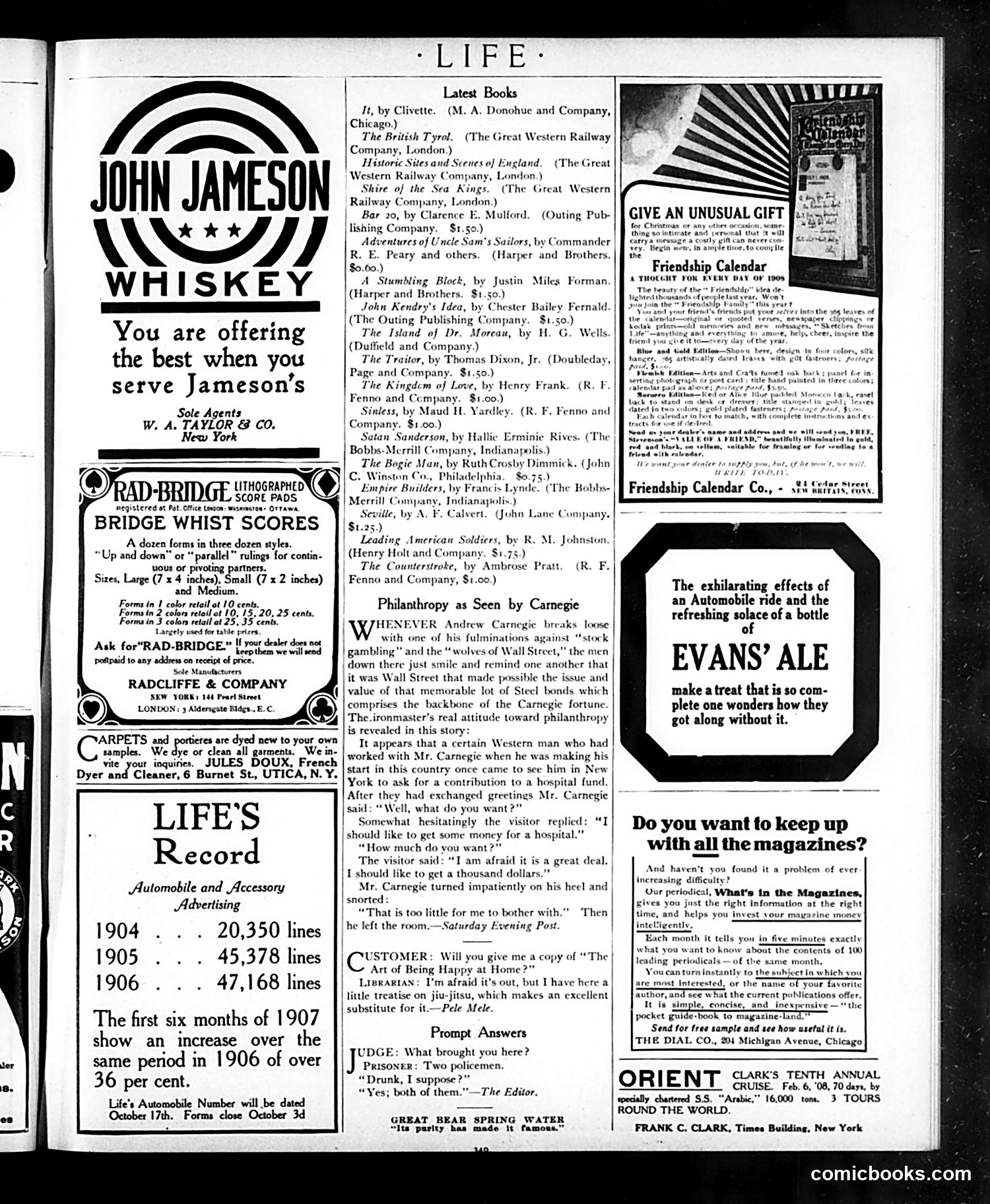
This page is primarily **advertising and book reviews**, not political satire. The dominant content includes: **Book Reviews Section**: Lists recent publications from 1907, ranging from adventure novels (*The Island of Dr. Moreau*) to military histories (*Leading American Soldiers*). **Carnegie Anecdote**: A brief satirical story mocking industrialist Andrew Carnegie's philanthropy. It depicts Carnegie as miserly—when a Westerner requests $1,000 for a hospital, Carnegie dismissively refuses, calling it "too little for me to bother with." The satire suggests Carnegie's public image as a philanthropist masks his actual stinginess. **Advertisements**: Multiple product ads (John Jameson Whiskey, Bridge Whist score cards, Evans' Ale, Orient cruise lines, etc.) **"Life's Record"**: An automobile advertising metric showing magazine growth from 1904-1907. The Carnegie piece is the only satirical content—a mild jab at the wealthy industrialist's contradictory stance between denouncing Wall Street greed while benefiting from it, and his reluctance to give charitably.
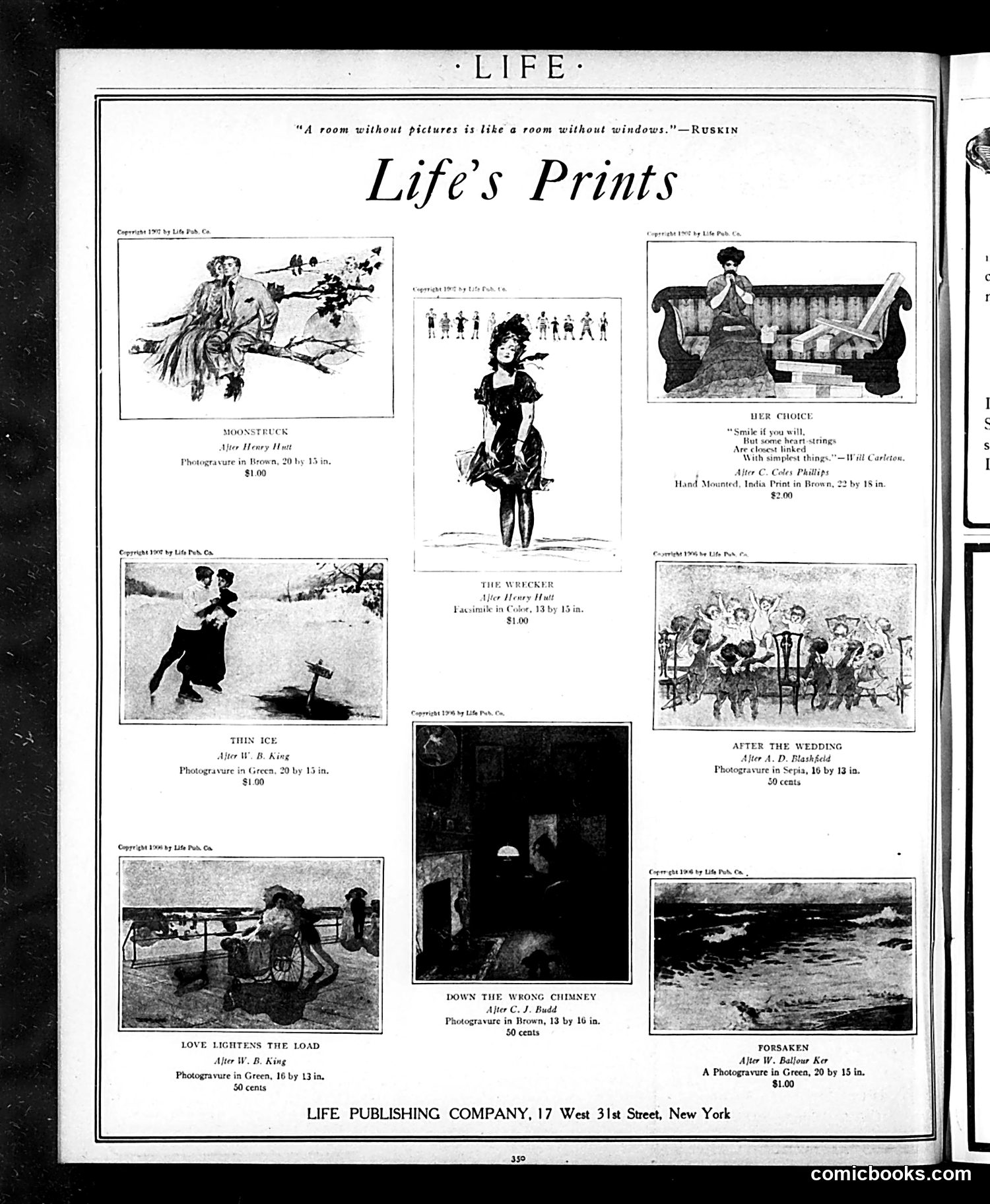
This is a catalog page advertising art prints sold by Life Publishing Company. Rather than political cartoons, these are reproductions of illustrations and paintings—likely from Life magazine itself—available for home purchase. The titles and themes reveal popular subject matter of the era: romantic scenes ("Her Choice," "Thin Ice," "Forsaken"), domestic humor ("Moonstruck," "Down the Wrong Chimney," "After the Wedding"), and sentimental narratives ("Love Lightens the Load"). The page reflects Victorian/Edwardian tastes: genteel romance, courtship drama, and idealized domesticity. Prices range from 50 cents to $2.00, making them affordable middle-class decoration. The epigraph from Ruskin emphasizes pictures as essential home furnishings—a marketing appeal to buyers wanting cultured interiors. This represents Life magazine's dual role: satirical publication *and* commercial art distributor.
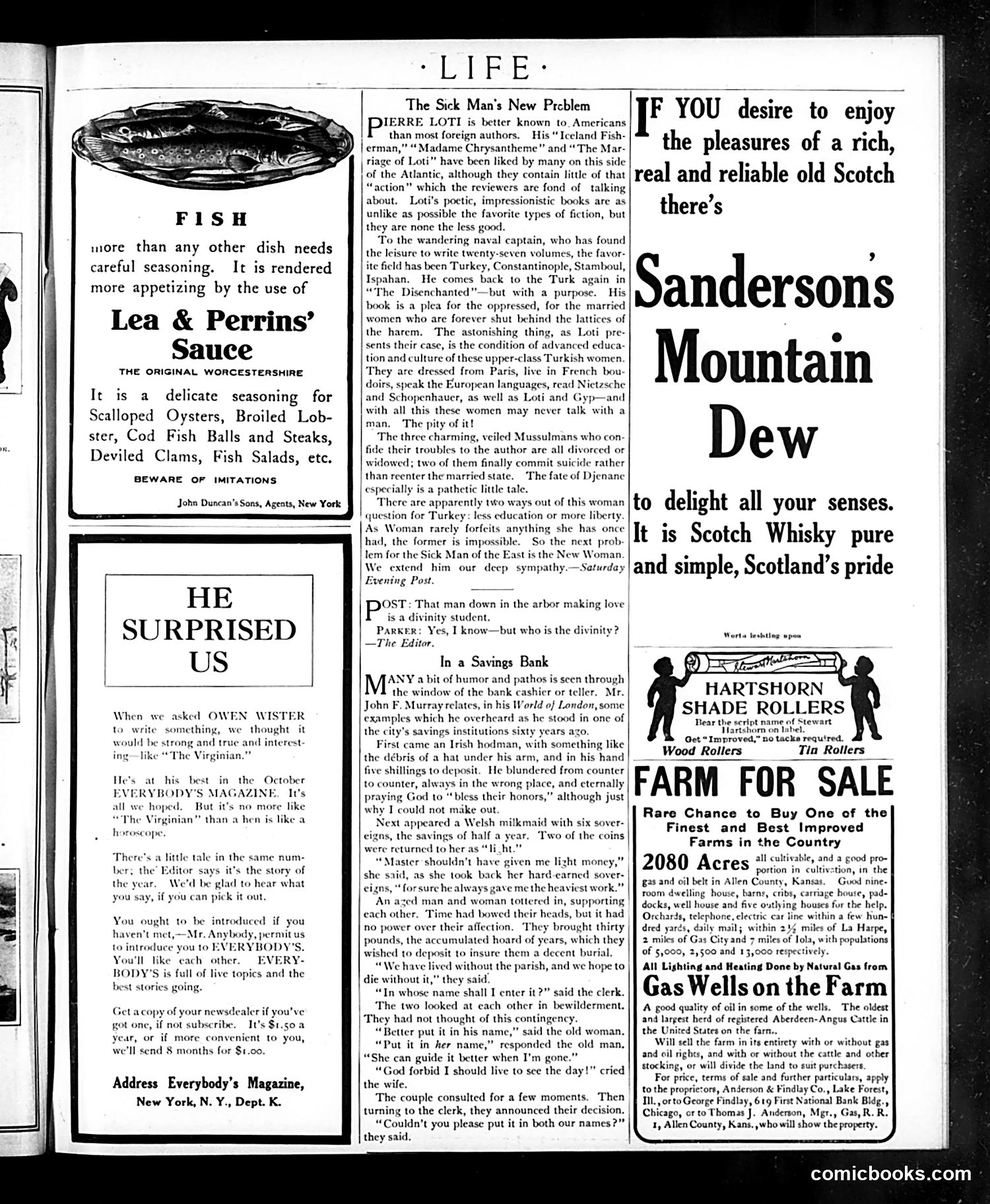
This page is primarily **advertisements and literary promotion** rather than political satire. The main content includes: **"He Surprised Us"**: A promotional piece for *Everybody's Magazine*, promoting Owen Wister's serialized novel "The Virginian" and encouraging subscriptions. **"The Sick Man's New Problem"**: A book review of Pierre Loti's *The Disenchanted*, discussing the French author's novel about oppressed Turkish women—specifically educated, Paris-dressed upper-class women confined behind harems despite their intellectual sophistication. Loti apparently argues for their liberation. **"In a Savings Bank"**: Anecdotal humor about working-class and elderly people depositing small amounts in savings banks, emphasizing class and cultural differences. The page also contains advertisements for Lea & Perrins Sauce, Sanderson's Mountain Dew Scotch whisky, Hartshorn Shade Rollers, and farm sales. The satirical content is minimal—mostly gentle social observation rather than sharp political commentary.
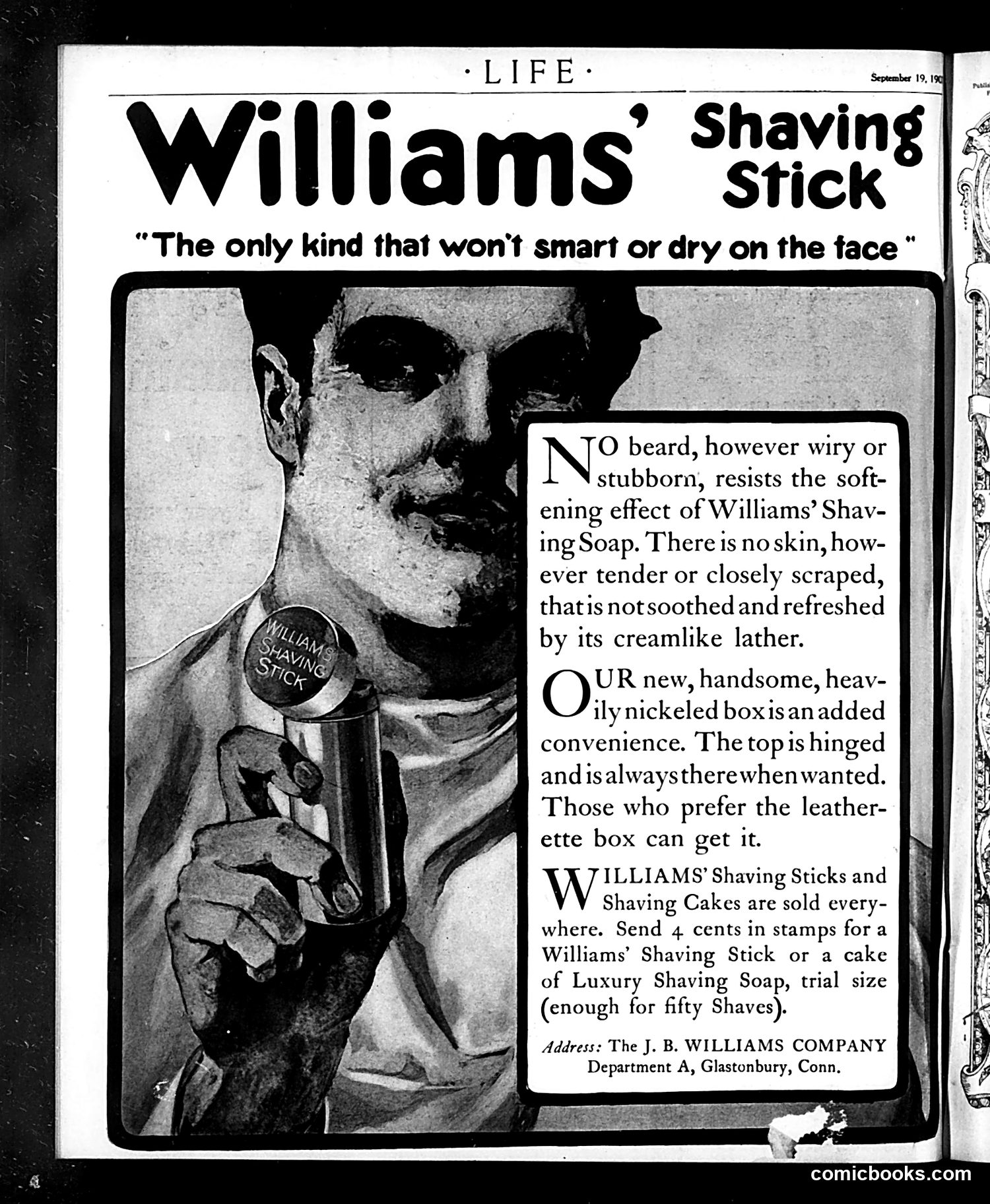
This is a **product advertisement**, not satire or political commentary. It promotes Williams' Shaving Stick, a grooming product from the J.B. Williams Company of Connecticut. The ad features a photograph of a man demonstrating the shaving stick with text claiming it won't "smart or dry on the face"—addressing common complaints about shaving products of that era. The copy emphasizes the product's creamy lather that soothes even sensitive or closely-shaved skin. A modern reader should note: this advertises a solid stick form of shaving soap (predecessor to modern shaving cream tubes). The ad offers a trial size for 4 cents in stamps and mentions packaging options including a "heavily nickeled box" with hinged top—details highlighting the product's convenient, durable design as a selling point for early 20th-century consumers.