
Life, 1907-09-19 · page 14 of 24
Life — September 19, 1907 — page 14: what you’re looking at
What you’re looking at
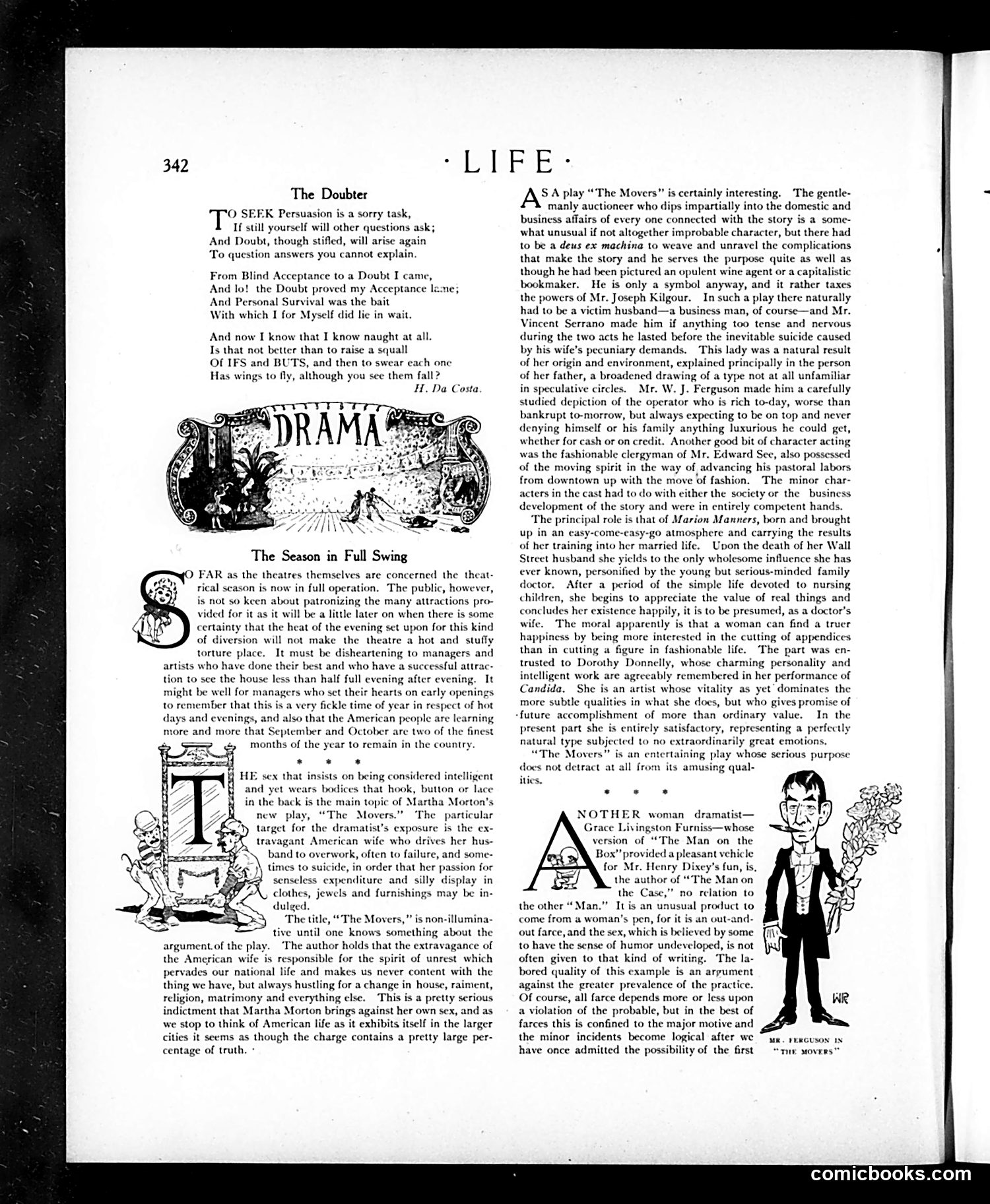
This page contains theatrical reviews and social commentary typical of Life's satirical approach. The main cartoons and content critique American society, particularly women's behavior. **"The Doubter"**: A philosophical poem questioning the value of certainty versus doubt—likely reflecting early 20th-century intellectual debates about knowledge and faith. **"The Season in Full Swing"**: Reviews two Broadway plays. "The Movers" by Martha Morton is the focus—a play attacking American wives' extravagance and materialism. The reviewer agrees with Morton's thesis that women's wasteful spending and constant desire for new possessions (houses, clothes, jewelry) drives husbands to overwork and financial ruin, fueling national discontent. **The Social Critique**: The page reflects period anxieties about female consumerism and changing gender roles. Life frames wives' spending as a serious social problem contributing to male desperation—even suicide in the play's plot. The illustration of a well-dressed man (likely Mr. Ferguson in "The Movers") accompanies this gender-focused critique typical of pre-1920s satire.
📄 Transcribed text from this page (OCR, searchable)
Machine-transcribed from the original scan — historical spelling and the odd misread are preserved.
ENE aB The Doubter ‘O SEEK Persuasion sorry task, If still yourself will other questions ask; And Doubt, though stifled, will arise again ‘To question answers you cannot explain. From Blind Acceptance to a Doubt I came, And lo! the Doubt proved my Acceptance And Personal Survival was the bait With which I for Myself did lie in wait. And now I know that I know naught at all. Is that not better than to raise a squall Of IFS and BUTS, and then to swear each one Has wings to fly, although you sce them fall ? H. Da Costa The Season in Full Swing ) FAR as the theatres themselves are concerned the theat- rical scason is now in full operation, The public, however, is not so keen about patronizing the many attractions pro- vided for it as it will be a little later on when there is some certainty that the heat of the evening set upon for this kind of diversion will not make the theatre a hot and. stufly torture place. It must be disheartening to managers and artists who have done their best and who have a successful attrac- tion to see the house less than half full evening after evening. It might be well for managers who set their hearts on carly openings to remember that this is a very fickle time of year in respect of hot days and evenings, and also that the American people are learning more and more that September and October arc two of the finest months of the year to remain in the country. * 8 8 HE sex that insists on being considered intelligent and yet wears bodices that hook, button or lace in the back is the main topic of Martha Morton's new play, “The Movers.” ‘The particular target for the dramatist’s exposure is the ex- travagant American wife who drives her hus- band to overwork, often to failure, and some- RB senseless expenditure and silly display in 2A, clothes, jewels and furnishings may be in- x dulge SS _ The title, “The Movers,” is non-illumina- tive until one knows something about the argumentof the play. ‘The author holds that the extravagance of the American wife is responsible for the spirit of unrest which pervades our national life and makes us never content with the thing we have, but always hustling for a change in house, raiment, religion, matrimony and everything clse. This is a pretty serious indictment that Martha Morton brings against her own sex, and as we stop to think of American life as it exhibits itself in the larger cities it seems as though the charge contains a pretty large per- centage of truth. « oe to suicide, in order that her passion for -future accomplishment of more than ordinary value. ASA play “The Movers” is certainly interesting. ‘The gentle. manly auctioneer who dips impartially into the domestic and business affairs of every one connected with the story is a some- what unusual if not altogether improbable character, but there had to be a deus ex machina to weave and unravel the complications that make the story and he serves the purpose quite as well as though he had been pictured an opulent wine agent or a capitalistic bookmaker. He is only a symbol anyway, and it rather taxes the powers of Mr. Joseph Kilgour. In such a play there naturally had to be a victim husband—a business man, of course—and Mr. Vincent Serrano made him if anything too tense and nervous during the two acts he lasted before the inevitable suicide caused by his wife’s pecuniary demands. ‘This lady was a natural result of her origin and environment, explained principally in the person of her father, a broadened drawing of a type not at all unfamiliar in speculative circles. Mr. W. J. Ferguson made him a carefully studied depiction of the operator who is rich to-day, worse than bankrupt to-morrow, but always expecting to be on top and never denying himself or his family anything luxurious he could get, whether for cash or on credit. Another good bit of character acting was the fashionable clergyman of Mr. Edward See, also possessed of the moving spirit in the way of advancing his pastoral labors from downtown up with the move of fashion. The minor char- acters in the cast had to do with either the society or the busine: development of the story and were in entirely competent hands. The principal role is that of Marion Manners, born and brought up in an casy-come-easy-go atmosphere and carrying the results of her training into her married life. Upon the death of her Wall Street husband she yields to the only wholesome influence she has ever known, personified by the young but serious-minded family doctor, After a period of the simple life devoted to nursing children, she begins to appreciate the value of real things and concludes her existence happily, it is to be presumed, as a doctor's wife. The moral apparently is that a woman can find a truce happiness by being more interested in the cutting of appendices than in cutting a figure in fashionable life. The part was en- trusted to Dorothy Donnelly, whose charming personality and intelligent work are agreeably remembered in her performance of Candida. She is an artist whose vitality as yet’ dominates the more subtle qualities in what she does, but who gives promise of In the present part she is entirely satisfactory, representing a perfectly natural type subjected to no extraordinarily great emotions. “The Movers” is an entertaining play whose serious purpose docs not detract at all from its amusing qual- ities. * 2 8 NOTHER woman dramatist— Grace Livingston Furniss—whose version of “The Man on the Box” provided a pleasant vehicle for Mr. Henry Dixey’s fun, is, the author of “The Man on the Case,” no relation to the other “Man.” It is an unusual product to come from a woman's pen, for it is an out-and- out farce, and the sex, which is believed by some to have the sense of humor undeveloped, is not often given to that kind of writing. The la- bored quality of this example is an argument against the greater prevalence of the practice. Of course, all farce depends more or less upon a violation of the probable, but in the best of farces this is confined to the major motive and the minor incidents become logical after we have once admitted the possibility of the first RGUSON IN Te sovers” comicbooks.com