
Life, 1907-09-19 · page 16 of 24
Life — September 19, 1907 — page 16: what you’re looking at
What you’re looking at
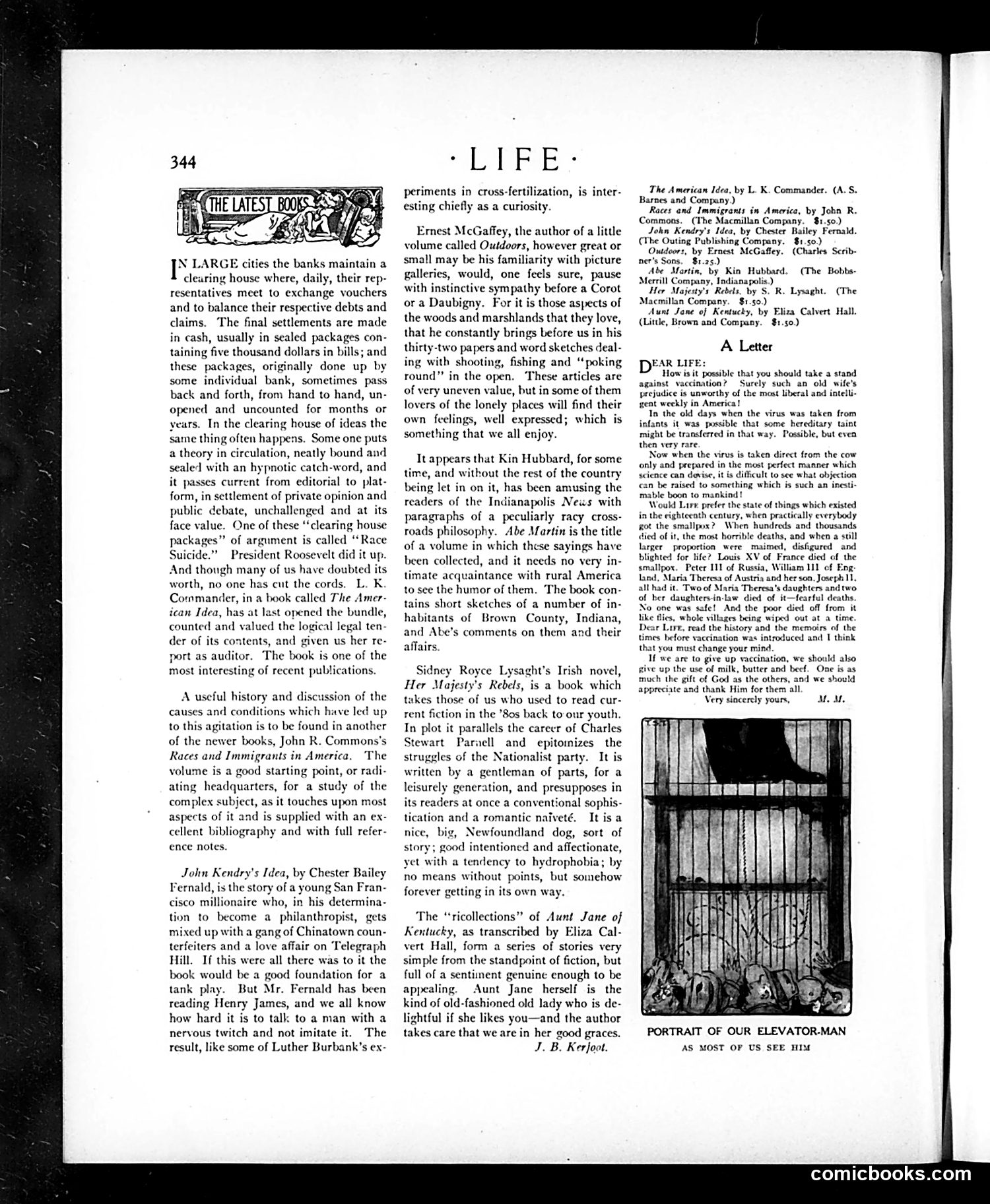
This page is primarily a book review section from *Life* magazine. The single cartoon at bottom right, captioned "PORTRAIT OF OUR ELEVATOR-MAN / AS MOST OF US SEE HIM," shows an elevator operator viewed through the metal lattice gate of an elevator shaft—a tall, narrow vertical composition. The satire appears to be about class perception: the elevator operator is literally and figuratively *framed* by the machinery of urban commercial life, visible only in fragmented glimpses through the metal bars. The joke suggests that urban dwellers see service workers like elevator operators as dehumanized fixtures of the building infrastructure rather than as full people—reduced to their functional role by the perspective of their "betters." The surrounding text reviews books including Roosevelt's "Race Suicide" theory, immigration studies, and fiction, establishing *Life*'s focus on contemporary social commentary.
📄 Transcribed text from this page (OCR, searchable)
Machine-transcribed from the original scan — historical spelling and the odd misread are preserved.
‘ LARGE cities the banks maintain a clearing house where, daily, their rep- resentatives meet to exchange vouchers and to balance their respective debts and claims. The final settlements are made in cash, usually in sealed packages con- taining five thousand dollars in bills; and these packages, originally done up t some individual bank, sometimes pass back and forth, from hand to hand, un- opened and uncounted for months or years, In the clearing house of ideas the same thing often happens. Some one puts a theory in circulation, neatly bound and sealed with an hypnotic catch-word, and passes current from editorial to plat- form, in settlement of private opinion and public debate, unchallenged and at its face value. One of these “clearing house packages” of argument is called “Race Suicide.” President Roosevelt did it up. And though many of us have doubted its worth, no one has cut the cords. L. K Commander, in a book called The Amer- ican Idea, has at last opened the bundle, counted and valued the logical legal ten der of its contents, and given us her re- port as auditor. The book is one of the most interesting of recent publications. A useful history and discussion of the causes and conditions which have led up to this agitation is to be found in another of the newer books, John R. Commons's Races and Immigrants in America. The volume is a good starting point, or radi ating headquarters, for a study of the complex subject, as it touches upon most aspects of it and is supplied with an ex cellent bibliography and with full refer- ence notes. John Kendry's Idea, by Chester Bailey Fernald, is the story of a young San Fran- cisco millionaire who, in his determina- tion to become a philanthropist, gets mixed up with a gang of Chinatown coun- terfeiters and a love affair on Telegraph Hill. If this were all there was to it the book would be a good foundation for a tank play. But Mr. Fernald has been reading Henry James, and we all know how hard it is to talk to a man with a nervous twitch and not imitate it. The result, like some of Luther Burbank’s e iL PAE periments in cross-fertilization, is inter- esting chiefly as a curiosity. Ernest McGaffey, the author of a litle volume called Outdoors, however great or small may be his familiarity with picture galleries, would, one feels sure, pause with instinctive sympathy before a Corot or a Daubigny. For it is those aspects of the woods and marshlands that they love, that he constantly brings before us in his thirty-two papers and word sketches deal- ing with shooting, fishing and “poking round” in the open. These articles are of very uneven value, but in some of them lovers of the lonely places will find their own feelings, well expressed; which is something that we all enjoy It appears that Kin Hubbard, for some time, and without the rest of the country being let in on it, has been amusing the readers of the Indianapolis News with paragraphs of a peculiarly racy cross- roads philosophy. Abe Martin is the title of a volume in which these sayings have been collected, and it needs no very in- timate acquaintance with rural America to see the humor of them. The book con- tains short sketches of a number of in- habitants of Brown County, Indiana, and Abe’s comments on them and their affairs. Sidney Royce Lysaght’s Irish novel, Her Majesty's Rebels, is a book which takes those of us who used to read cur- rent fiction in the ’80s back to our youth, In plot it parallels the career of Charles Stewart Parnell and epitomizes the struggles of the Nationalist party. It is written by a gentleman of parts, for a leisurely generation, and presupposes in its readers at once a conventional sophis- tication and a romantic naiveté. It is a . big, Newfoundland dog, sort of good intentioned and affectionate, yet with a tendency to hydrophobia ; by no means without points, but somehow forever getting in its own way, The “ricollections” of Aunt Jane of Kentucky, as transcribed by Eliza Cal- vert Hall, form a series of stories very simple from the standpoint of fiction, but full of a sentiment genuine enough to be appealing. Aunt Jane herself is the kind of old-fashioned old lady who is de- lightful if she likes you—and the author takes care that we are in her good graces. J.B. Kerjoot. The American Idea, by L. K. Commander. (A. S. Barnes and Company.) Races and Immigrants in America, by Jobn R. Commons. (The Macmillan Company. $1.50.) John Kendry's Idea, by Chester Bailey Fernald. (The Outing Publishing Company. $1.50.) Outdoors, by Ernest McGafley. (Charles Scrib- ner’s Sons. $1.25.) Abe Martin, by Kin Hubbard. Merrill Company, Indianapolis.) Her Majesty's Rebels. by S. R. Lysaght. Macmillan Company. $1.50.) Aunt Jane of Kentucky, by Eliza Calvert Hall. (Little, Brown and Company. $1.50.) A Letter (The Bobbs- (The EAR LIFE: How is it possible that you should take a stand against vaccination? Surely such an old wife's prejudice is unworthy of the most liberal and intelli- gent weekly in America! In the old days when the virus was taken from infants it was possible that some hereditary taint might be transferred in that way. Possible, but even then very rare. Now when the virus is taken direct from the cow only and prepared in the most perfect manner which science can devise ficult to see what objection can be raised to something which is such an inesti- mable boon to mankind! Would Lire prefer the state of things which existed in the eighteenth century, when practically everybody got the smallpox? When hundreds and thousands ied of i, the most horrible deaths, and when a still larger proportion were maimed, disfigured and blighted for life? Louis XV of France died of the smallpox. Peter 111 of Russia, William 11 of Eng: land, Maria Theresa of Austria and her soa, Joseph 11, all had it. Twoof Maria Theresa's daughters andtwo of ber daughters-in-law died of it—fearful deaths No one was safe! And the poor died off from it like fics, whole villages being wiped out at a time. Dear Lire, read the history and the memoirs of the times before vaccination was introduced and 1 think that you must change your mind. If we are to give up vaccination, we should also ive up the use of milk, butter and beef. One is as much the gift of God as the others, and we shoul appreciate and thank Him for them all Very sincerely yours, Pst TT) ele tag) PB: } att Lied athe MM. See oy PORTRAIT OF OUR ELEVATOR-MAN AS MOST OF US SEE HIM comicbooks.com