
Life, 1907-09-19 · page 7 of 24
Life — September 19, 1907 — page 7: what you’re looking at
What you’re looking at
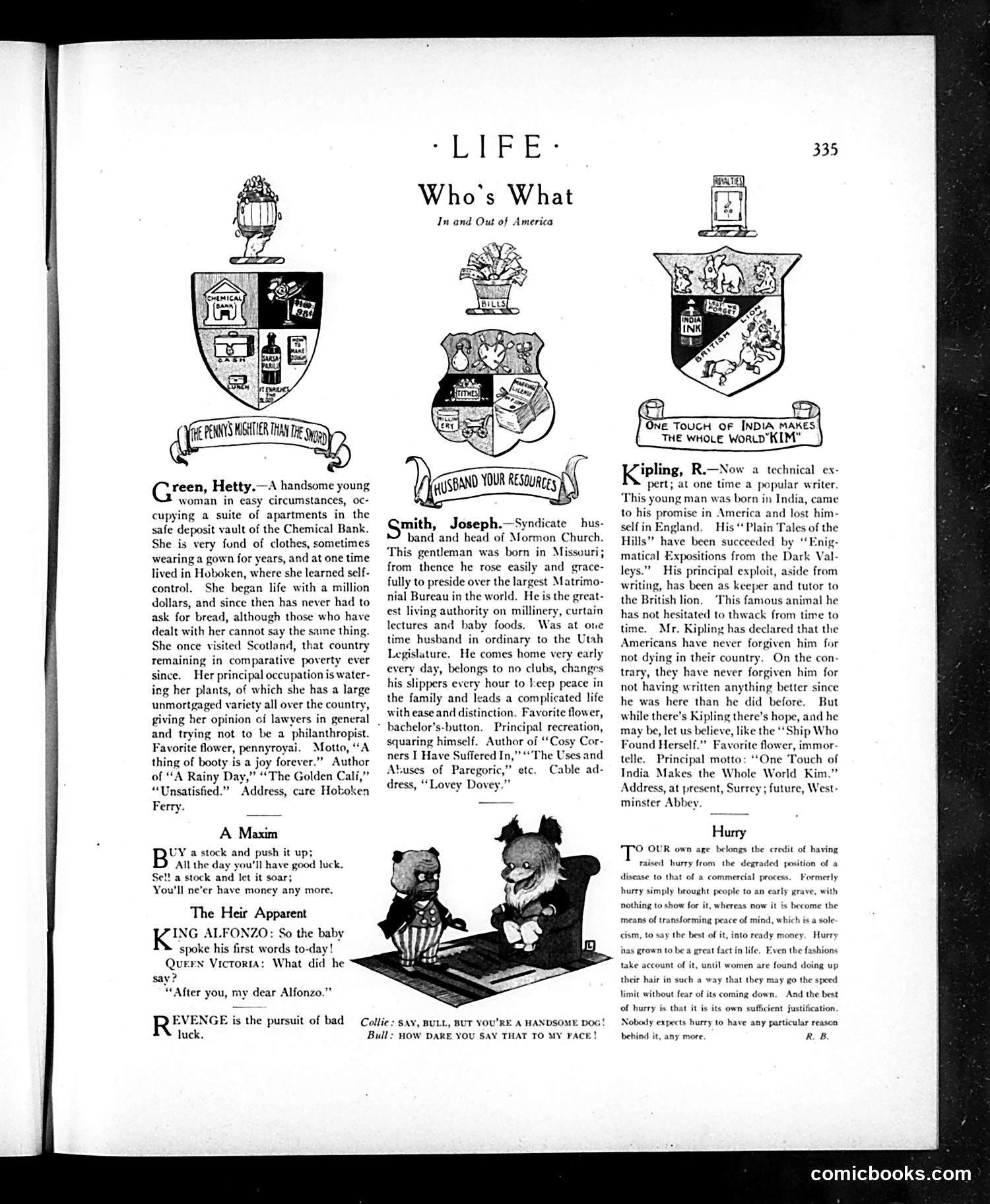
This page from *Life* magazine presents satirical biographical sketches of notable Americans. Three coats-of-arms style illustrations accompany entries on: - **Hetty Green**: A wealthy woman criticized for hoarding money despite being extremely rich, contradicting her philanthropic image. - **Joseph Smith**: Leader of the Mormon Church, described as controlling a large matrimonial bureau (referencing polygamy practiced by early Mormons). - **Rudyard Kipling**: The famous British writer now living in America, depicted as having lost his English identity. The page also includes humorous aphorisms and a cartoon dialogue between King Alfonzo and Queen Victoria about an heir. The satire targets wealth, religious hypocrisy, and celebrity pretension typical of *Life*'s irreverent editorial voice.
📄 Transcribed text from this page (OCR, searchable)
Machine-transcribed from the original scan — historical spelling and the odd misread are preserved.
RAN MER TT reen, Hetty.—A handsome young woman in easy circumstances, oc- cupying a suite of apartments in the safe deposit vault of the Chemical Bank. She is very fund of clothes, sometimes wearing a gown for years, and at one time lived in Hoboken, where she learned self- control. She began life with a million dollars, and since then has never had to ask for bread, although those who have dealt with her cannot say the same thing. She once visited Scotland, that country remaining in comparative poverty ever since. Her principal occupation is water- ing her plants, of which she has a large unmortgaged variety all over the country, giving her opinion of lawyers in general and trying not to be a philanthropist. Favorite flower, pennyroyai. Motto, “A thing of booty is a joy forever.” Author of “A Rainy Day,” “The Golden Cali,” “Unsatisfied.” Address, care Hotoken Ferry. A Maxim a stock and push it up; All the day you'll have good luck. Sel! a stock and let it soar; You'll ne'er have money any more. The Heir Apparent ING ALFONZO: So the baby spoke his first words to-day Queen Victoria: What did he say? “After you, my dear Alfonzo.” EVENGE is the pursuit of bad luck. LTE. - Who's What In and Out of America BAND YOUR RESOuRcE: [sono nen Smith, Joseph.—Syndicate hus- band and head of Mormon Church. This gentleman was born in Missouri; from thence he rose easily and grace- fully to preside over the largest Matrimo- nial Bureau in the world. He is the great- est living authority on millinery, curtain lectures and baby foods. Was at one time husband in ordinary to the Utah Legislature. He comes home very early every day, belongs to no clubs, changes his slippers every hour to keep peace in the family and leads a complicated life with ease and distinction. Favorite flower, bachelor’s-button. Principal recreation, squaring himself. Author of “Cosy Cor- ners I Have Suffered In,” “The Uses and Abuses of Paregoric,” etc. Cable ad- dress, “Lovey Dovey.” Collie : SAY, BULL, BUT YOU'RE A HANDSOME DOG! Bull: HOW DARE YOU SAY THAT TO MY FACE! ow a technical ex- pert; at one time a popular writer. This young man born in India, came to his promise in America and h selfin England. His ‘‘ Plain Tales Hil have been succeeded by ‘‘Enig- matical Expositions from the Dark Val- leys.” His principal exploit, aside from writing, has been as keeper and tutor to the British lion, This famous animal he has not hesitated to thwack from time to time. Mr. Kipling has declared that the Americans have never forgiven him for not dying in their country. On the con trary, they have never forgiven him for not having written anything better since he was here than he did before. But while there’s Kipling there’s hope, and he may be, let us believe, like the “Ship Who Found Herself.” Favorite flower, immor- telle. Principal motto: ‘One Touch of India Makes the Whole World Kim.” Address, at present, Surrey; future, West- minster Abbey Hurry ‘O OUR own age belongs the credit of having raised hurry from the degraded position of a disease to th of a commercial process. Formerly hurry simply brought pe oan early grave, with nothing to show for it, whereas now it is become the means of transforming peace of mind, which is a sole: cism, to say the best of it, into ready money. Hurry ‘has grown to be a great fact in life, Even the fashions take account of it, until women are found doing up their hair in such a way that they may go the speed limit without fear of its coming down. And the best of hurry is that it is its own sufficient justification. Nobody expects hurry to have any particular reason behind it RB. ¥ more. comicbooks.com