
Life, 1907-09-19 · page 6 of 24
Life — September 19, 1907 — page 6: what you’re looking at
What you’re looking at
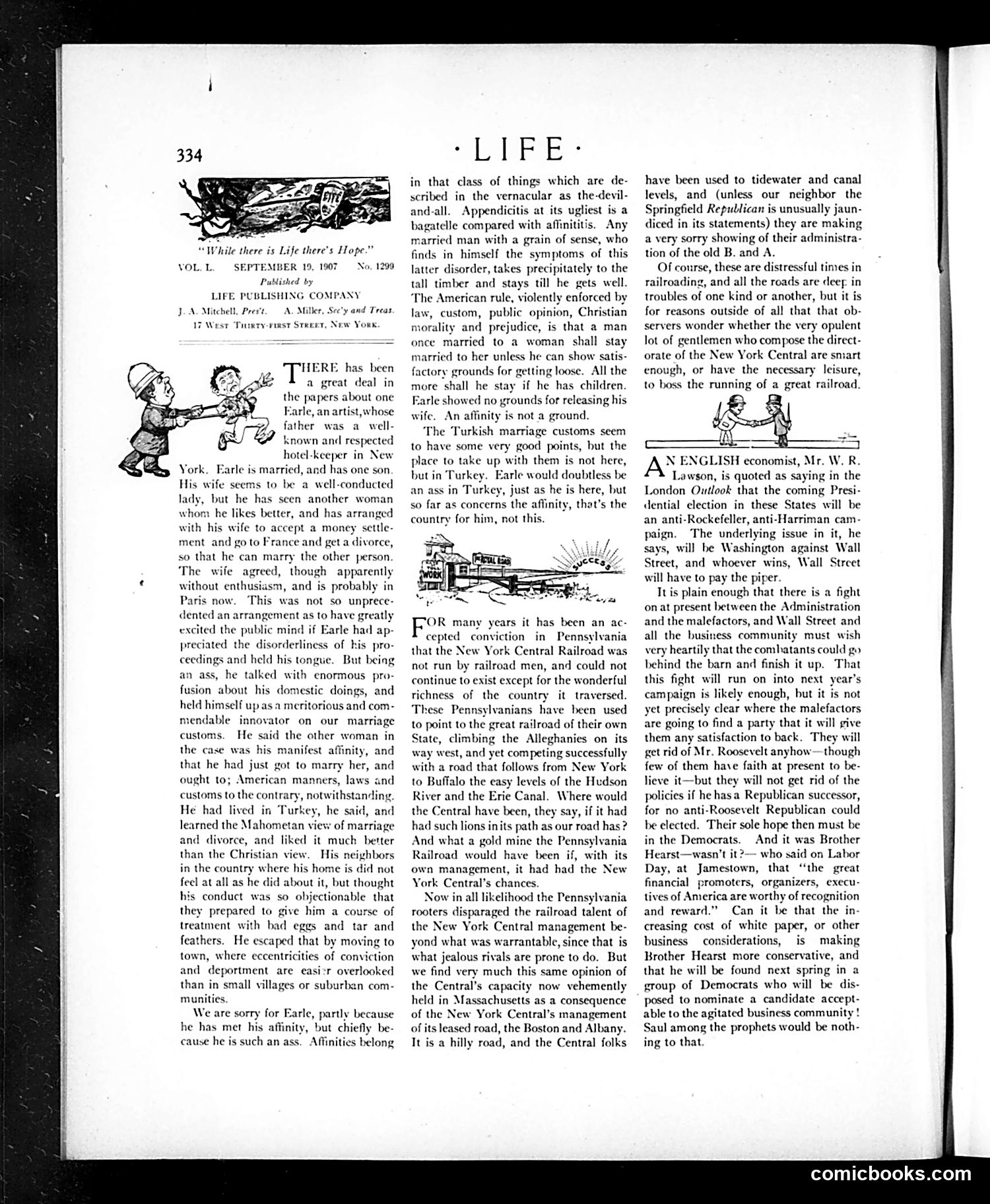
This page contains two distinct satirical pieces: 1. **Left illustration**: A small cartoon showing a man and woman, accompanying text mocking a man named Earle who married a woman to escape marital troubles. The satire suggests his strategy backfired—he arranged a "friendly settlement" allowing him to marry another woman in France, but his first wife agreed too readily, implying she was equally eager to be rid of him. 2. **Right section**: Commentary on the 1912 Presidential election, discussing Wall Street's political influence. The text references Washington versus Wall Street as the underlying campaign issue, and mentions Republican successor prospects, suggesting this was written during Theodore Roosevelt's presidency or the transition period. Both pieces employ satirical commentary on contemporary social and political matters.
📄 Transcribed text from this page (OCR, searchable)
Machine-transcribed from the original scan — historical spelling and the odd misread are preserved.
“While there is Life there's Hope.” EMBER 19, 1 No, 1299 Published by LIFE PUBLISHING COMPANY JA. Mitchell, Pres't, A. Miller, Sec'y and Treas. risst Street, New York. HERE has been a great deal in the papers about one Farle, an artist, whose father was a well- known and respected hotel-keeper in New York. Earle is married, and has one son. His wife seems to be a well-conducted lady, but he has scen another woman whom he likes better, and has arranged with his wife to accept a money settle- ment and go to France and get a divorce, so that he can marry the other person The wife agreed, though apparent! without enthusiasm, and is probably in Paris This was not so unprece- dented an arrangement as to have greatly excited the public mind if Earle had ap- preciated the disorderliness of kis pro- now. ceedings and held his tongue. But being an ass, he talked with enormous pro- fusion about his domestic doings, and held himself up asa meritorious and com- mendable innovator on our marriage customs. He said the other woman in the case was his manifest affinity, and that he had just got to marry her, and ought to; American manners, laws and customs to the contrary, notwithstanding. He had lived in Turkey, he said, and learned the Mahometan view of marriage and divorce, and liked it much better than the Christian view. His neighbors in the country where his home is did not feel at all as he did about it, but thought conduct was so objectionable that they prepared to give him a course of treatment with bad eggs and tar and feathers. He escaped that by moving to town, where eccentricities of conviction and deportment are easi:r overlooked than in small villages or suburban com- munities. We are sorry for Earle, partly because he has met his affinity, but chiefly be- cause he is such an ass. Affinities belong ieee in that class of things which are de- scribed in the vernacular as the-devil- and-all. Appendicitis at its ugliest is a bagatelle compared with aflinititis. Any married man with a grain of sense, who finds in himself the symptoms of this latter disorder, takes precipitately to the tall timber and stays till he gets well he American rule, violently enforced by law, custom, public opinion, Christian morality and prejudice, is that a man once married to a woman shall stay married to her unless he can show satis- factory grounds for getting loose. All the more shall he stay if he has children. Farle showed no grounds fot releasing his wife. An affinity is not a ground. The Turkish marriage customs seem to have some very good points, but the up with them is not here, Earle would doubtless be just as he is here, but place to t but in Turkey, an ass in Turkey so far as concerns the affinity, that’s the country for him, not this. cepted conviction in| Pennsylvania that the New York Central Railroad was not run by railroad men, and could not continue to exist except for the wonderful richness of the country it traversed. These Pennsylvanians have been used to point to the great railroad of their own State, climbing the Alleghanies on its way west, and yet competing successfully with a road that follows from New York to Buffalo the easy levels of the Hudson River and the Erie Canal. Where would the Central have been, they say, if it had had such lions inits path as our road has? And what a gold mine the Pennsylvania Railroad would have been if, with its own management, it had had the New York Central’s chances. Now in all likelihood the Pennsylvania rooters disparaged the railroad talent of the New York Central management be- yond what was warrantable, since that is what jealous rivals are prone to do. But we find very much this same opinion of the Central’s capacity now vehemently held in Massachusetts as a consequence of the New York Central’s management of its leased road, the Boston and Albany. It is a hilly road, and the Central folks have been used to tidewater and canal levels, and (unless our neighbor the Springfield Republican is unusually jaun- diced in its statements) they are making a very sorry showing of their administra- tion of the old B. and A. Of course, these are distressful tines in railroading, and all the roads are deer. in troubles of one kind or another, but it is for reasons outside of all that that ob- servers wonder whether the very opulent lot of gentlemen who compose the direct- orate of the New York Central are smart enough, or have the necessary leisure, to boss the running of a great railroad. N ENGLISH economist, Mr. W. R. Lawson, is quoted as saying in the London Outlook that the coming Presi- dential election in these States will be an anti-Rockefeller, anti-Harriman cam- paign. The underlying issue in it, he says, will be Washington against Wall Street, and whoever wins, Wall Street will have to pay the piper Itis plain enough that there is a fight onat present between the Administration and the malefactors, and Wall Street and all the business community must wish very heartily that the comhatants could go behind the barn and finish it up. That this fight will run on into next year’s campaign is likely enough, but it is not yet precisely clear where the malefactors are going to find a party that it will give them any satisfaction to back. They will get rid of Mr. Roosevelt anyhow—though few of them have faith at present to be- lieve it—but they will not get rid of the policies if he hasa Republican successor, for no anti-Roosevelt Republican could be elected. Their sole hope then must be in the Democrats. And it was Brother Hearst—wasn’t it?— who said on Labor Day, at Jamestown, that “the great financial promoters, organizers, execu- tives of America are worthy of recognition and reward.” Can it be that the in- creasing cost of white paper, or other business considerations, is making Brother Hearst more conservative, and that he will be found next spring in a group of Democrats who will be di: posed to nominate a candidate accept- able to the agitated business community ! Saul among the prophets would be noth- ing to that. comicbooks.com