
Life, 1907-09-19 · page 15 of 24
Life — September 19, 1907 — page 15: what you’re looking at
What you’re looking at
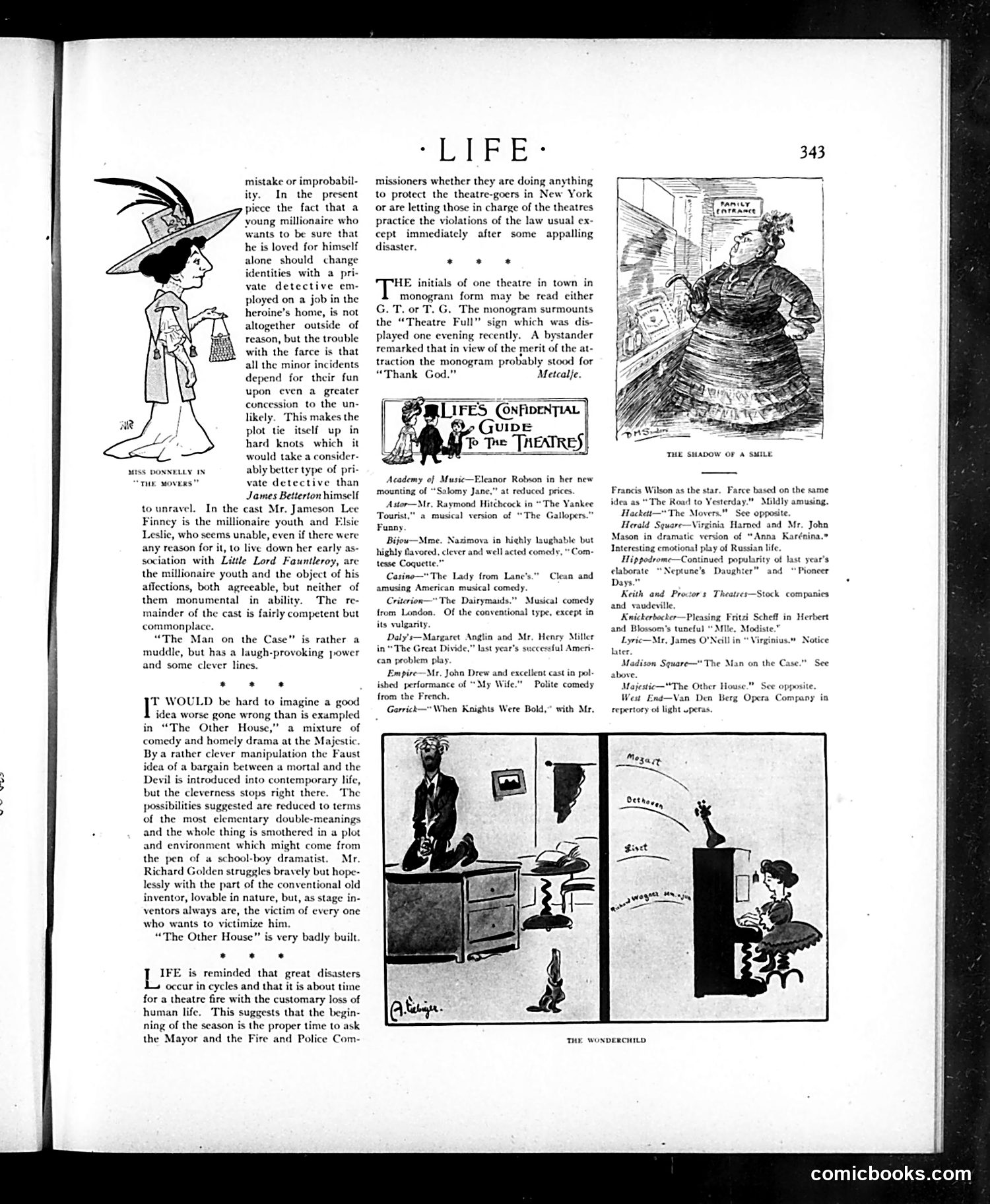
This page contains theatre reviews and satirical commentary from an early 20th-century issue of *Life* magazine. The main cartoons and text address: **"The Shadow of a Smile"** (top right illustration): Shows a theatre interior with "Family Circles" visible—likely satirizing theatre seating arrangements or audience demographics of the era. **"The Wonderchild"** (bottom cartoon): A multi-panel comic showing various labeled scenes ("Mirth," "Pathos," "Between," "Exit," etc.), appears to be satirizing theatrical melodrama or contrived emotional manipulation in stage productions. **Theatre Safety Commentary**: The text includes sharp social criticism about theatre fire safety, sarcastically suggesting city officials only enforce safety codes *after* disasters occur—a reference to real theatre fires that killed many in this period. **Monogram Joke**: One brief satire mocks a theatre displaying "G.T." or "T.G." initials above a "Theatre Full" sign, joking the letters actually stand for "Thank God" (implying the show is so bad audiences are relieved it's full and they can't attend). The reviews critique specific productions as poorly constructed despite decent casts, particularly targeting artificial plots and contrived comedy.
📄 Transcribed text from this page (OCR, searchable)
Machine-transcribed from the original scan — historical spelling and the odd misread are preserved.
mistake or improbabil- ity. In the present piece the fact that a young millionaire who wants to be sure that he is loved for himself alone should change identities with a pri- vate detective em- ployed on a job in the heroine’s home, is not altogether outside of reason, but the trouble with the farce is that all the minor incidents depend for their fun upon even a greater concession to the un- likely. This makes the plot tie itself up. in hard knots which it would take a consider- ably better type of pri- vate detective than James Betterton himself to unravel. In the cast Mr, Jameson Lee Finncy is the millionaire youth and Elsie Leslie, who seems unable, even if there were any reason for it, to live down her early as- sociation with Little Lord Fauntleroy, are the millionaire youth and the object of his affections, both agreeable, but neither of them monumental in ability. The re- mainder of the cast is fairly competent but commonplace. “The Man on the Case" is rather a muddle, but has a laugh-provoking power and some clever lines. MISS DONNELLY IN “TH overs”? * 8 8 ie WOULD be hard to imagine a good idea worse gone wrong than is exampled in “The Other House,” a mixture of comedy and homely drama at the Majestic. By a rather clever manipulation the Faust idea of a bargain between a mortal and the Devil is introduced into contemporary life, but the cleverness stops right there. ‘The possibilities suggested are reduced to terms of the most elementary double-meanings and the whole thing is smothered in a plot and environment which might come from the pen of « school-boy dramatist. Mr Richard Golden struggles bravely but hope- lessly with the part of the conventional old inventor, lovable in nature, but, as stage in- ventors always are, the victim of every one who wants to victimize him. “The Other House” is very badly built IFE is reminded that great disasters occur in cycles and that it is about time for a theatre fire with the customary loss of human life. This suggests that the begin- ning of the season is the proper time to ask the Mayor and the Fire and Police Com- “THRE missioners whether they are doing anything to protect the theatre-goers in New York or are letting those in charge of the theatres practice the violations of the law usual ex- cept. immediately after some appalling disaster. s+ 8 HE initials of one theatre in town in monogrant form may be read cither G. T. or T. G. The monogram surmounts the “Theatre Full” sign which was dis- played one evening recently. A bystander remarked that in view of the merit of the at- traction the monogram probably stood for “Thank God.” Metcalfe. LIFES @xfivenpu } 6 GUIDE ‘Tae THEATRES Bijou—Mme. Nazimova in highly laughable but highly favored, clever and well acted comedy, " Com- tesse Coquette.” Casino—""The Lady from Lane’s.”” amusing American musical comedy Clean and Criterion—" The Dairymaids.” Musical comedy from London. Of the conventional type, except in its vulgarity Daly's—Margaret Anglin and Mr, Henry Miller in" The Great Divide,” last year's successful Ameri- can problem play Empire—Mr. John Drew and excellent cast in pol- ished performance of “My Wife." Polite comedy from the French. Gerrick—" When Knights Were Bold,” with Mr, TUE SUADOW OF A SALE Francis Wilson as the star. Farce based on the same idea as “The Road to Yesterday." Mildly amusing. Hackett—"The Movers." See opposite. Herald Square—Virginia Harned and Mr. John Mason in dramatic version of “Anna K: Interestin, Hippodrome—Continued popularity of last year’s claborate “Neptune's Daughter” and “Pioneer Days.” Keith and Proctor: Theatres—Stock companies and vaudeville Knickerbocker—Pleasing Fritzi Schefl in Herbert and Blossom’s tuneful " Mlle, Modiste.” Lyric—Mr, James O'Ne later. Madison Square—"The Man on the Ca: above. Majestic—"The Other House.” West End—Van Den Berg Opera Company in repertory of light operas. emotional play of Russian life. n" Virginius. Notice See See opposite, aeteyt Sig aeapeess amr woxperciito comicbooks.com