
Life, 1907-09-19 · page 2 of 24
Life — September 19, 1907 — page 2: what you’re looking at
What you’re looking at
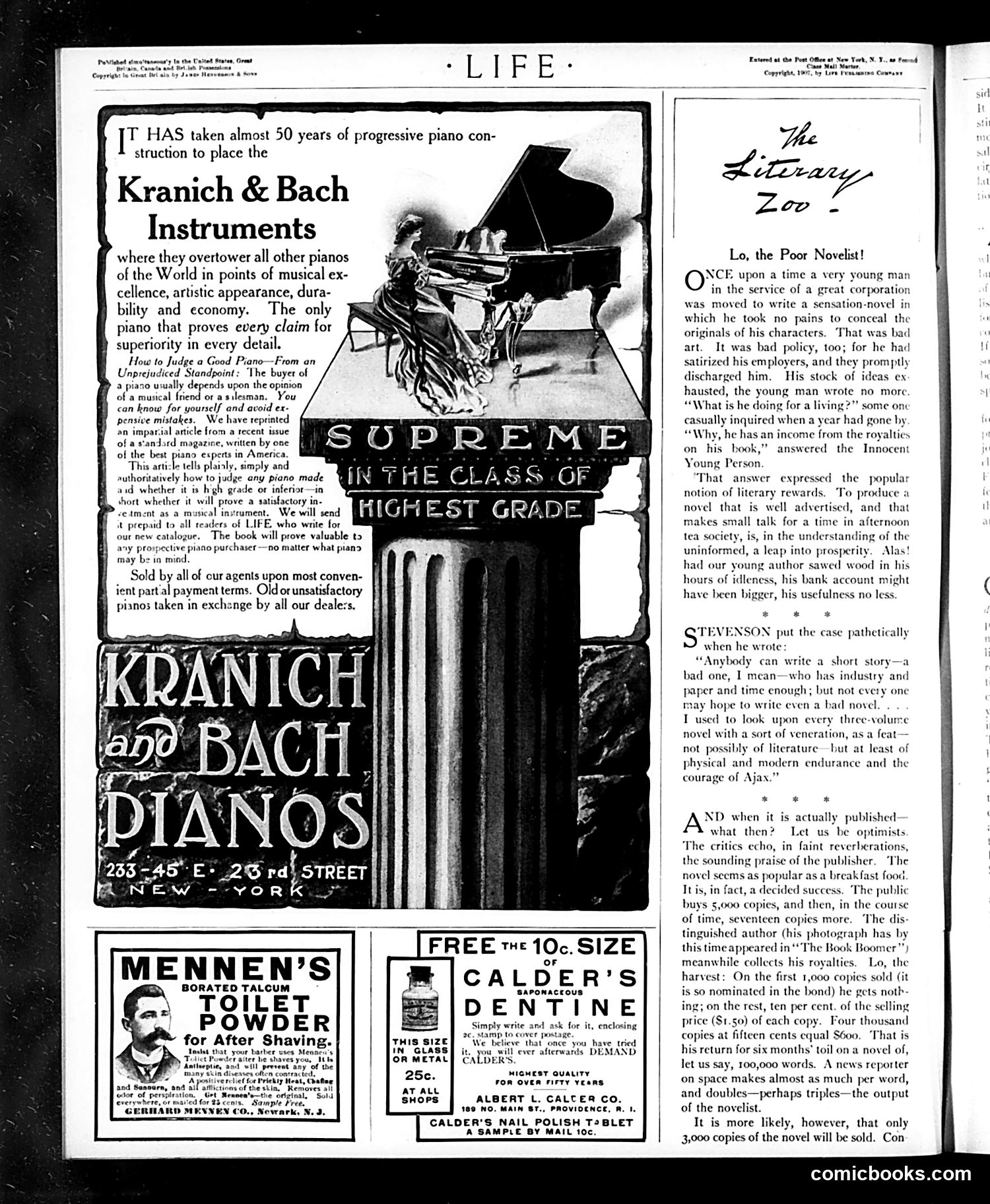
This page is primarily **advertising and editorial content rather than political satire**. The left side features an advertisement for Kranich & Bach pianos, claiming 50 years of progressive instruction established their superiority in "musical excellence, artistic appearance, durability and economy." The ad includes testimonial language about the piano's quality. The right side contains "The Literary Zoo," a brief essay about novelists and literary success. It discusses an unnamed young writer employed by a corporation who attempted writing sensation novels, was fired, but eventually achieved literary success. The piece appears to critique both commercial literary markets and the romanticization of the struggling artist. The bottom contains standard period advertisements for talcum powder and dentine products—typical mass-market goods for early 20th-century consumers.
📄 Transcribed text from this page (OCR, searchable)
Machine-transcribed from the original scan — historical spelling and the odd misread are preserved.
Eatered at tha Post Ofice at New York, N. 3.40 Formed "Chae Mat! Sarter Copyright, 1005, by Lore Venusamina Convene [" HAS taken almost 50 years of progressive piano con- struction to place the Kranich & Bach Instruments where they overtower all other pianos of the World in points of musical ex- cellence, artistic appearance, dura- bility and economy. The only piano that proves every claim for superiority in every detail. How to Judge a Good Piano—From an Unprejudiced Standpoint: ‘The buyer of a pisno ually depends upon the opinion of a musical friend or a silesman. You can know for yourself and avoid ex- pensive mistakes, We have tepeinted an imparial anicle from a recent issue if a susedard magazine. written by coe of the best piano experts in America This article tlls plainly, simply and nuthornatively how to'judge any plano:made aad ‘whether it i high grado or ialerioe—ta short whether it will prove a satisfactory in- etment as a musical instrument. We will send { prepaid to all readers of LIFE. who write for our new estalogues ‘The: book’ will prove valuable ts any: prospective plano purchase? -—no matler what plans may beta mind: Sold by all of cur agents upon most conven- ient partial payment terms. Old or unsatisfactory pianos taken in exchenge by all our deale:s. -45'E* 26 { Pes) pphin Bo MENNEN’S CALDER’S BORATED TALCUM SAPOMACCOUS: TOILET POWDER DENTINE for After Shaving. eve you have tried Tostst th ‘ it, you will ever afterwards DEMAND 7 CALDER’, miewesy auauiry rom oven rirty yeans ALBERT L. CALTER CO. 100 NO. MAIN ST., PROVIDENCE, R. 1. CALDER'S NAIL POLISH T>BLET A SAMPLE BY MAIL toc. Yhe Lo, the Poor Novelist! NCE upon a time a very young man in the service of a great corporation s moved to write a sensation-novel in which he took no pains to conceal the originals of his characters. That was bad art. It bad policy, too; for he had satirized his employers, and they promptly discharged him. His stock of ideas ex hausted, the young man wrote no more “What is he doing for a living?” some onc casually inquired when a year had gone by “Why, he has an income from the royalties on his book,” answered the Innocent Young Person That answer expressed the popular notion of literary rewards. To produce a novel that is well advertised, and that makes small talk for a time in afternoon tea society, is, in the understanding of the uninformed, a leap into prosperity. Alas! had our young author sawed wood in his hours of idleness, his bank account might have been bigger, his usefulness no less. * & + TEVENSON put the case pathetically when he wrote “Anybody can write a short story—a bad one, 1 mean—who has industry and paper and time enough; but not every one may hope to write even a bad nove T used to look upon every three-volume novel with a sort of veneration, as a feat— not possibly of literature—but at least of physical and modern endurance and the courage of Ajax.” * # # ND when it is actually published what then? Let us be optimists. The critics echo, in faint reverberations, the sounding praise of the publisher. The novel seems as popular as a breakfast food It is, in fact, a decided success. The public buys 5,000 copies, and then, in the course of time, seventeen copies more. ‘The dis tinguished author (his photograph has by this time appeared in‘ The Book Boomer meanwhile collects his royalties. Lo, the harvest: On the first 1,000 copies sold (it so nominated in the bond) he gets noth- ing; on the rest, ten per cent. of the selling price ($1.50) of cach copy. Four thousand copies at fifteen cents equal S600. ‘That is his return for six months’ toil on a novel of, let us say, 100,000 words. A news reporter on space makes almost as much per word, and doubles—perhaps triples—the output of the novelist. It is more likely, however, that only 3,000 copies of the novel will be sold. Con comicbooks.com