
A complete issue · 24 pages · 1907
Life — January 10, 1907
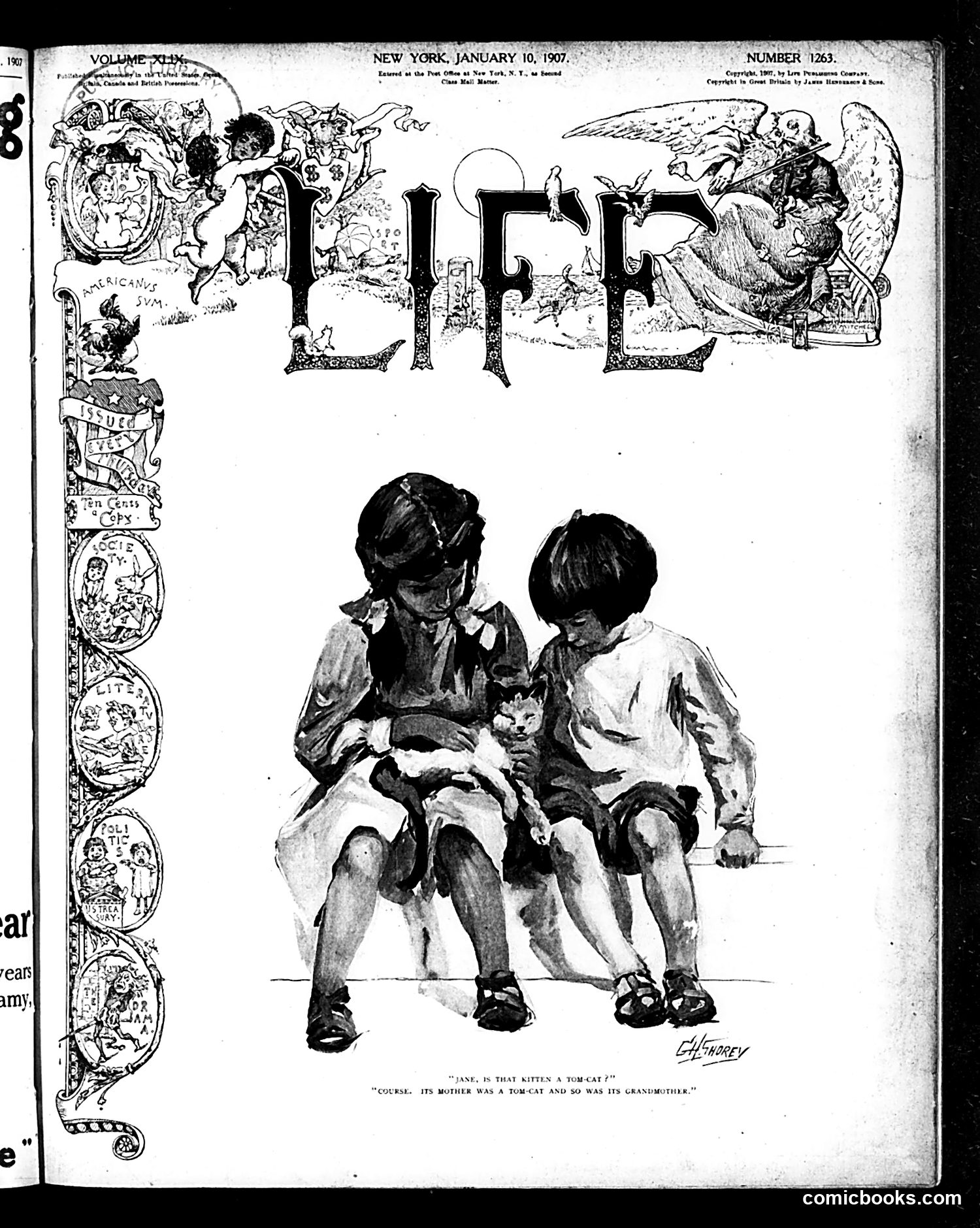
The main illustration shows two children examining a kitten, with the caption: "Jane, is that kitten's a tom-cat?" / "Course. Its mother was a tom-cat and so was its grandmother." This is a children's humor piece playing on innocent misunderstanding of animal biology. The joke relies on the child's confused logic—conflating the mother and grandmother's sex with the offspring's sex, suggesting a humorous lack of understanding about heredity and gender. The ornate left border contains decorative vignettes typical of Life's aesthetic design. The elaborate header typography and Art Nouveau styling were characteristic of the magazine's early 1900s visual approach to satire and comedy.
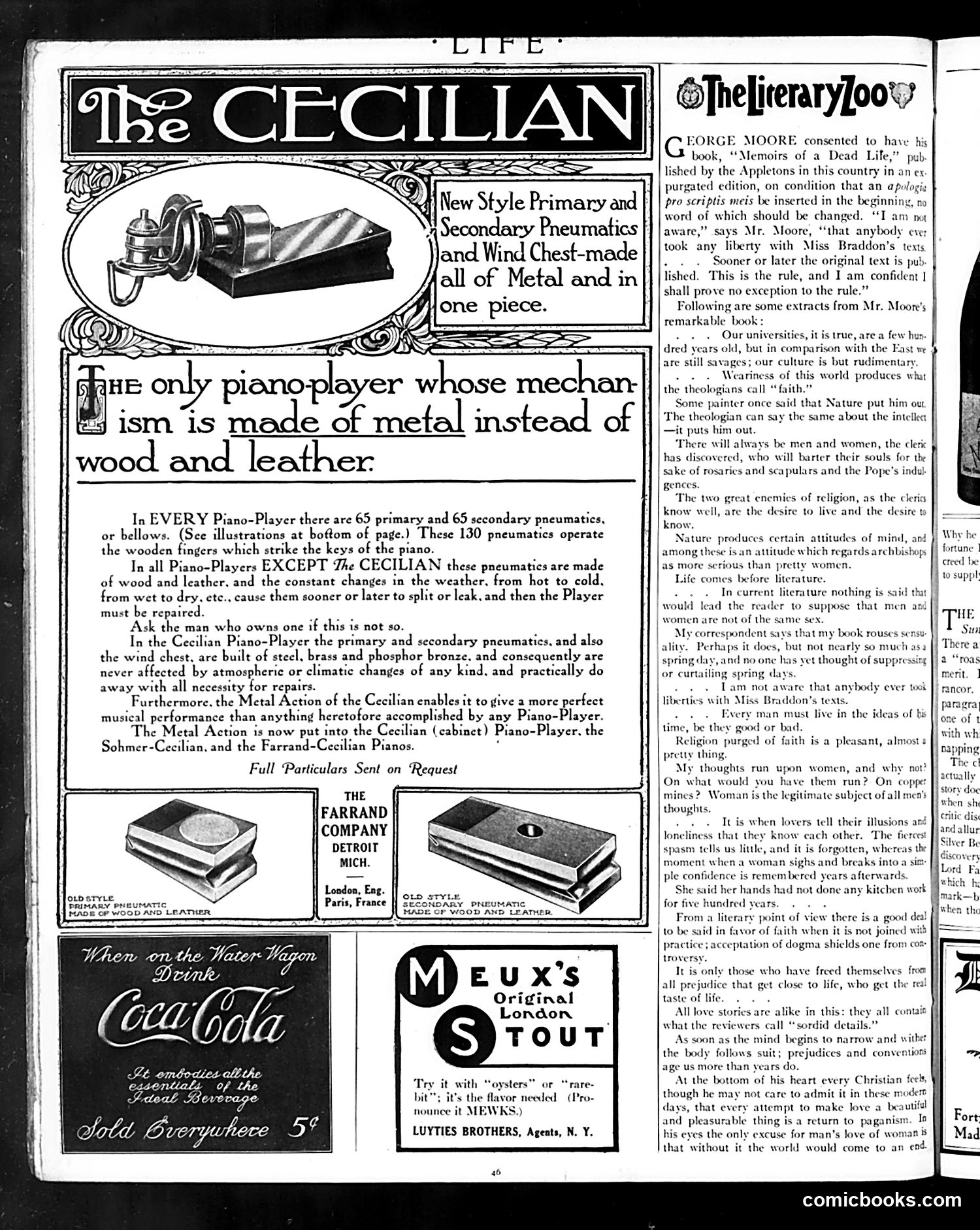
This page is primarily **advertising and product promotion** rather than political satire. The main content features "The Cecilian" piano-player—a mechanical device with an all-metal action mechanism (rather than traditional wood and leather). The advertisement emphasizes its durability and resistance to atmospheric and climatic damage, positioning it as superior to competitors. The right side contains "The Itinerary Zoo," which appears to be a literary column discussing George Moore's memoirs and making satirical observations about human nature, religion, and relationships—standard essay fare for Life magazine rather than visual satire. Below are period advertisements for Coca-Cola and Meuk's Stout beer. **No identifiable political cartoons appear on this page.**
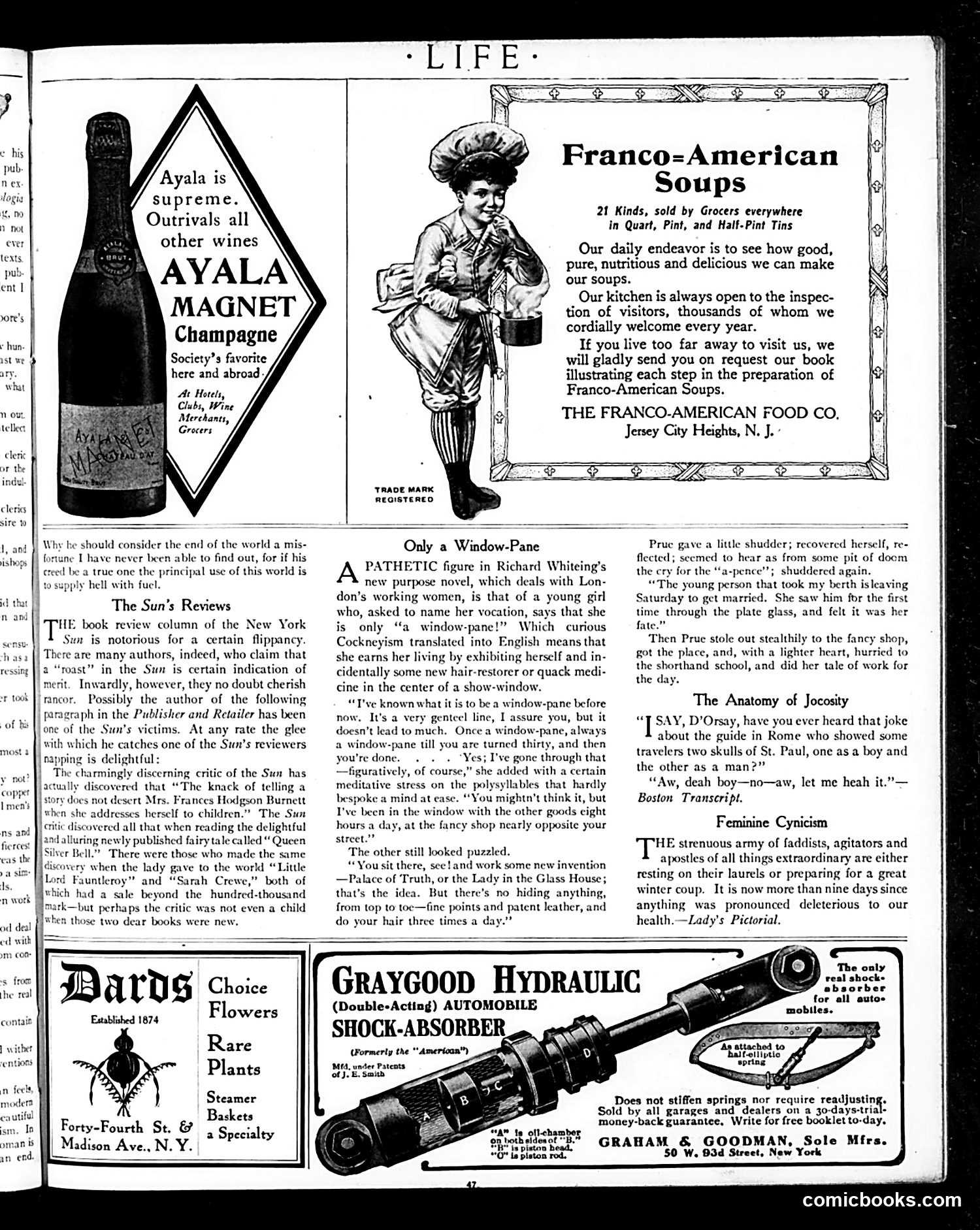
This page is primarily **advertising and book reviews** rather than political satire. The main content includes: **Advertisements:** - Ayala Magnet Champagne (left) - Franco-American Soups (top right) - Dardos Choice Flowers (bottom left) - Graygood Hydraulic Automobile Shock Absorber (bottom right) **Articles:** Three short pieces: "The Sun's Reviews" (book criticism), "Only a Window-Pane" (a story review about a working woman's difficult life situation), "The Anatomy of Jocosity" (humor analysis), and "Feminine Cynicism" (commentary on female activists and health movements). The page reflects early 20th-century Life magazine's mixture of consumer products, literary criticism, and light social commentary rather than hard-hitting political cartoons.
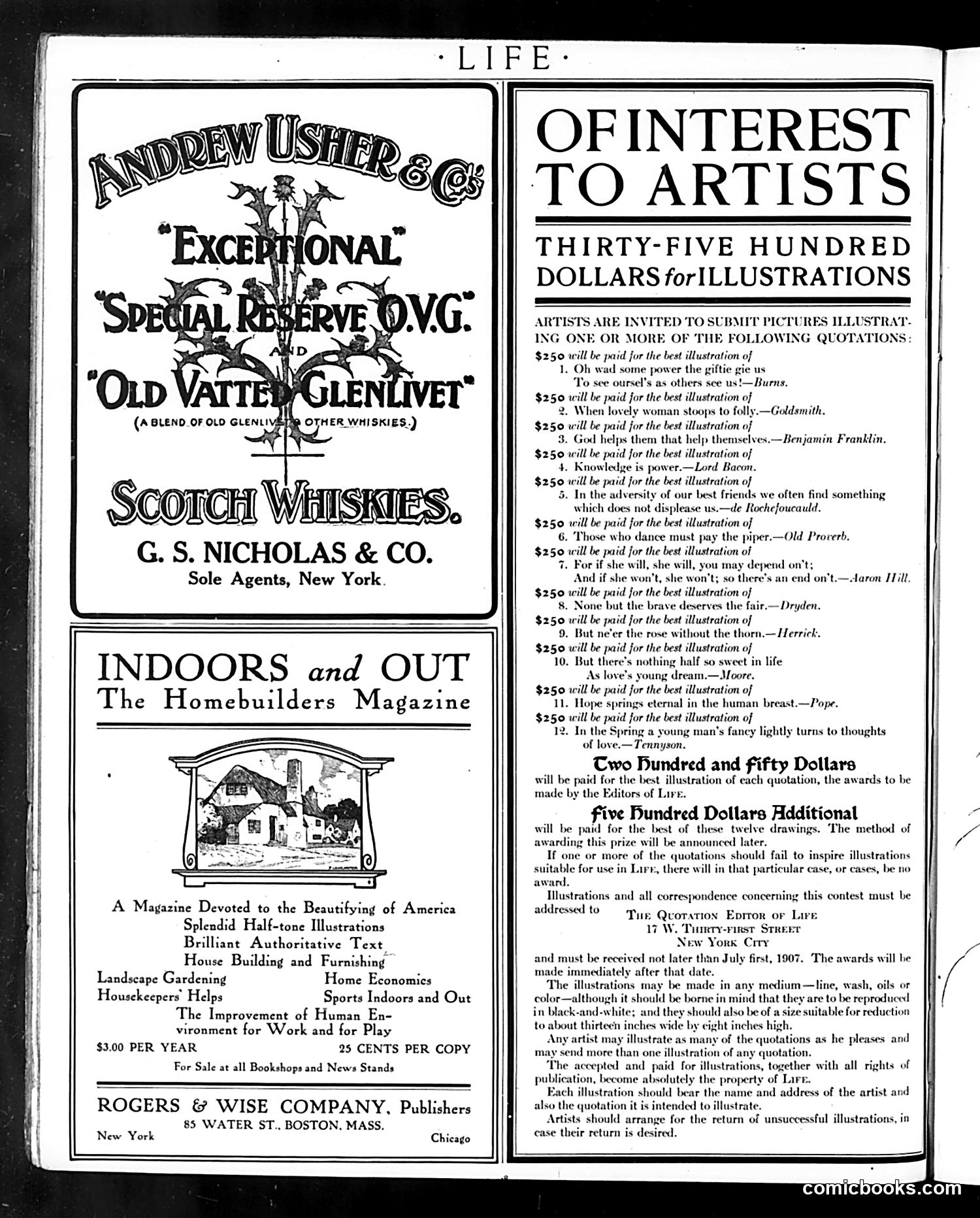
This page consists primarily of **advertisements and a contest announcement**, not political cartoons. The left side features ads for Andrew Usher scotch whisky and "Indoors and Out" homebuilders magazine. The right side announces a major illustration contest sponsored by *Life* magazine offering $3,500 total in prizes ($250 per quotation illustrated). The contest invites artists to submit illustrations of twelve famous quotations from historical figures like Benjamin Franklin, Lord Bacon, and Tennyson. Winners will be selected by *Life*'s editors, with submissions due by July 1, 1907. This reflects the magazine's dual function: satirical journalism combined with commercial publishing ventures and patronage of visual arts—common for early-twentieth-century periodicals.
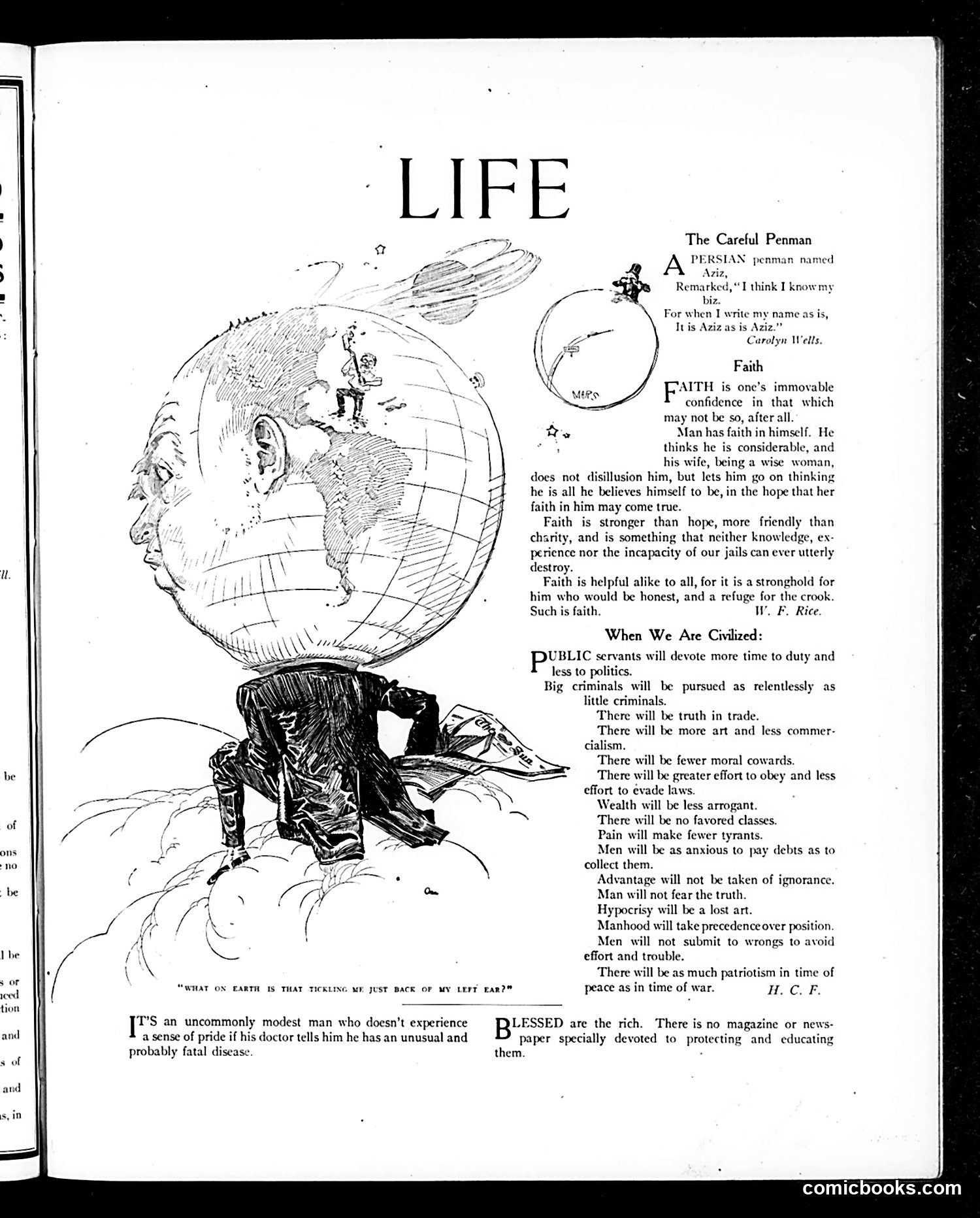
The main cartoon depicts a globe with a human ear prominently featured, accompanied by the caption "WHAT ON EARTH IS THAT TICKLING WE JUST BACK OF MY LEFT EAR?" Below sits a hunched, distressed figure. The satire appears to comment on **anxiety or unease about something unseen but felt**—likely reflecting early 20th-century concerns about emerging threats (possibly war, economic instability, or social upheaval). The ear as the sensitive point suggests heightened awareness or worry. The accompanying text essays ("Faith," "When We Are Civilized," "Blessed are the rich") discuss idealism, social progress, and class privilege in cynical, prescriptive tones. Without more specific dating or historical context, the exact contemporary reference remains unclear, but the overall tone expresses satirical skepticism about social progress and human nature.
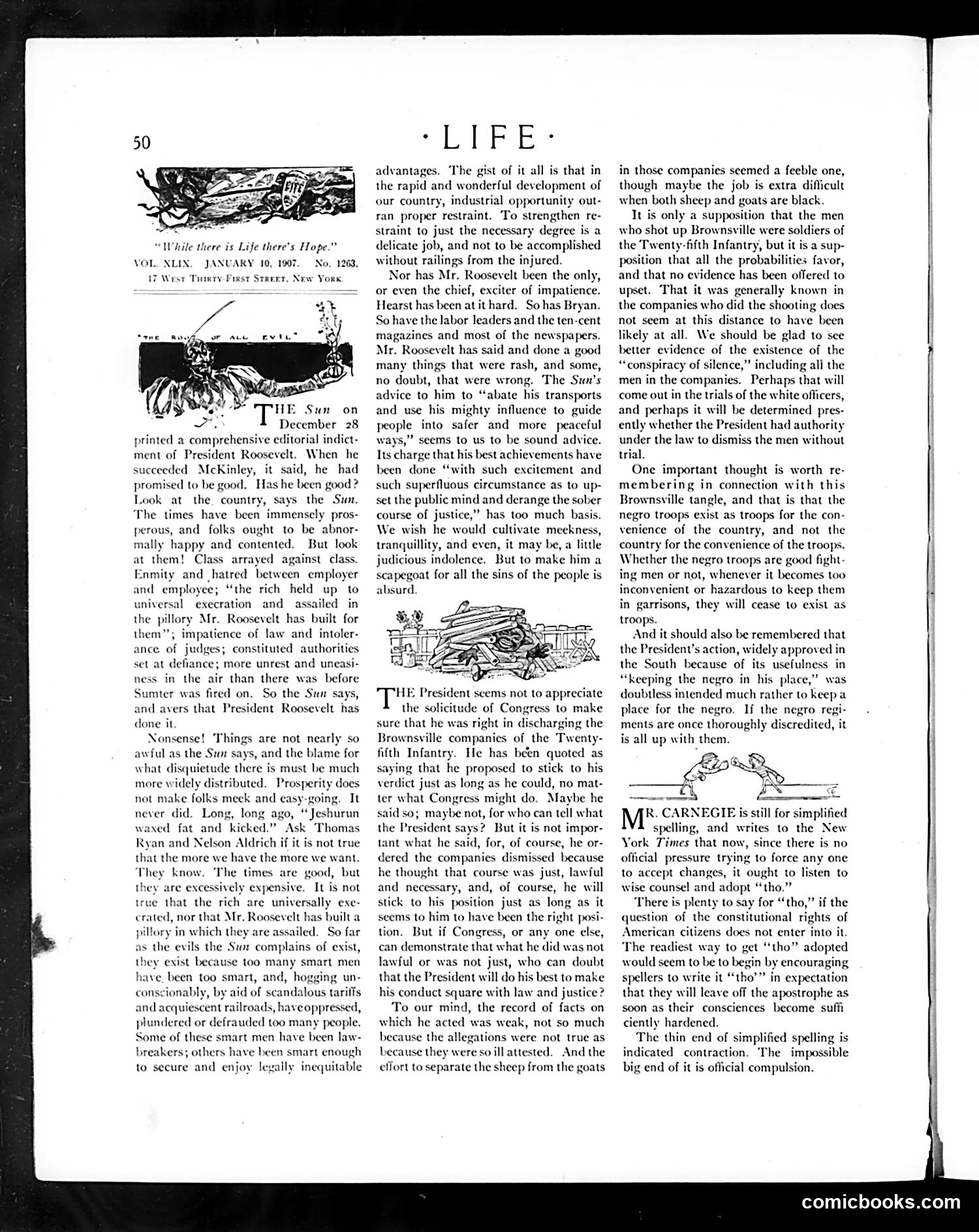
This page contains editorial commentary on President Theodore Roosevelt's handling of labor disputes and racial tensions. The text discusses Roosevelt's intervention in labor matters and his decision regarding the Brownsville companies of the Twenty-fifth Infantry—an apparent reference to the Brownsville Raid incident. The cartoons (though small and not entirely clear) appear to depict industrial/labor conflict scenes. The editorial tone is critical of Roosevelt's actions, arguing he has been inconsistent—sometimes too harsh on labor, sometimes too lenient. The piece defends the President's authority while questioning the wisdom of his decisions regarding both labor unrest and racial matters, criticizing simplified approaches to complex social problems. The overall message critiques Roosevelt's executive overreach and inconsistent moral reasoning.
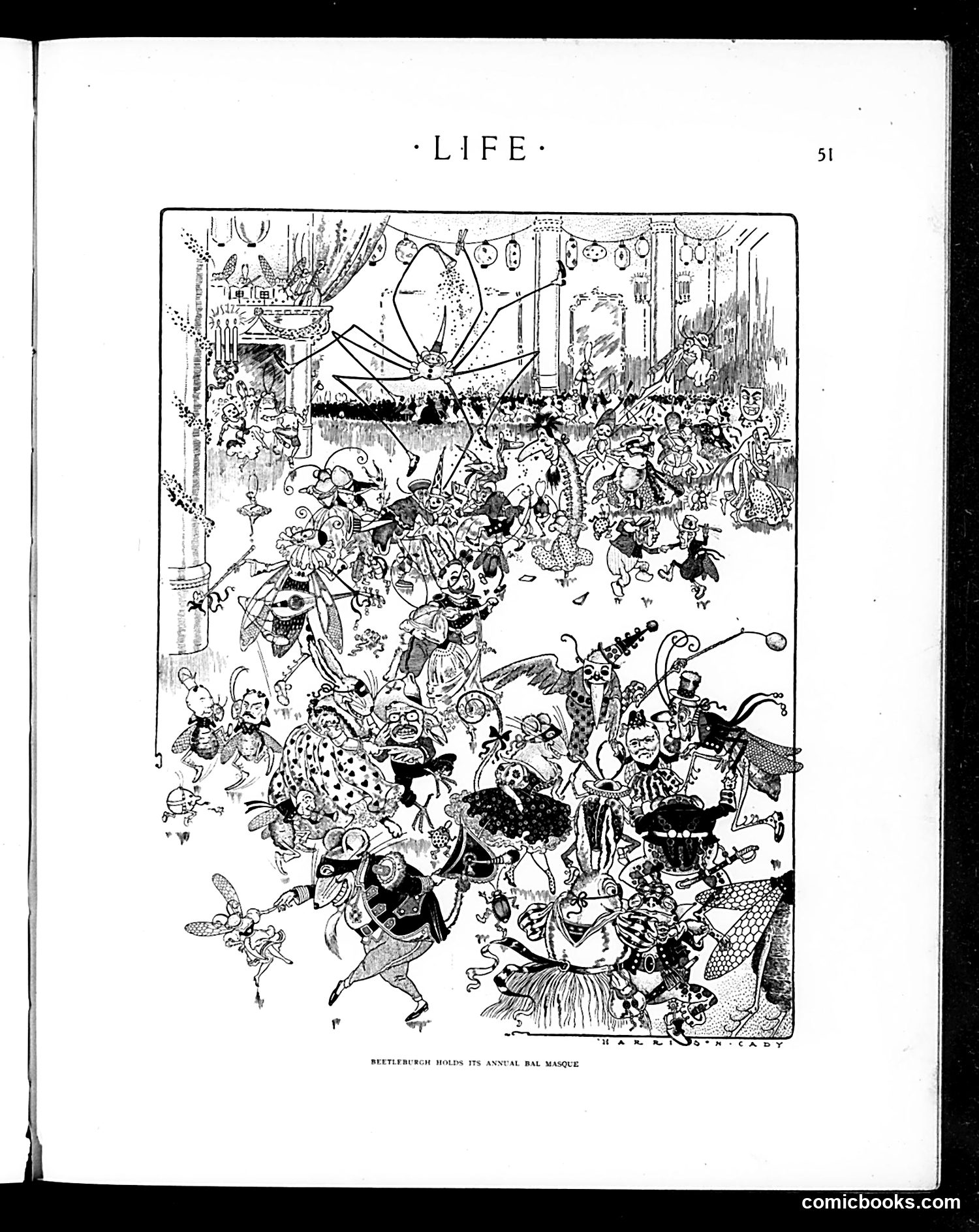
This is a satirical illustration titled "Pittsburgh Holds Its Annual Bal Masque" (Ball Masquerade), signed by what appears to be "Harry Cady." The cartoon depicts a chaotic, fantastical party scene with elaborately costumed figures—including people in elaborate masks, period costumes, and theatrical dress—mingling in an ornate interior setting. The satire appears to target Pittsburgh's wealthy elite and their pretentious masquerade balls. The exaggerated, grotesque character designs and crowded composition mock the artificiality and excess of high-society social events. The "bal masque" tradition allowed attendees to wear masks and costumes, which the cartoonist uses metaphorically to critique the hypocrisy and hidden nature of the city's upper class. The wild, almost demonic quality of the figures suggests mockery of their pretensions to refinement.
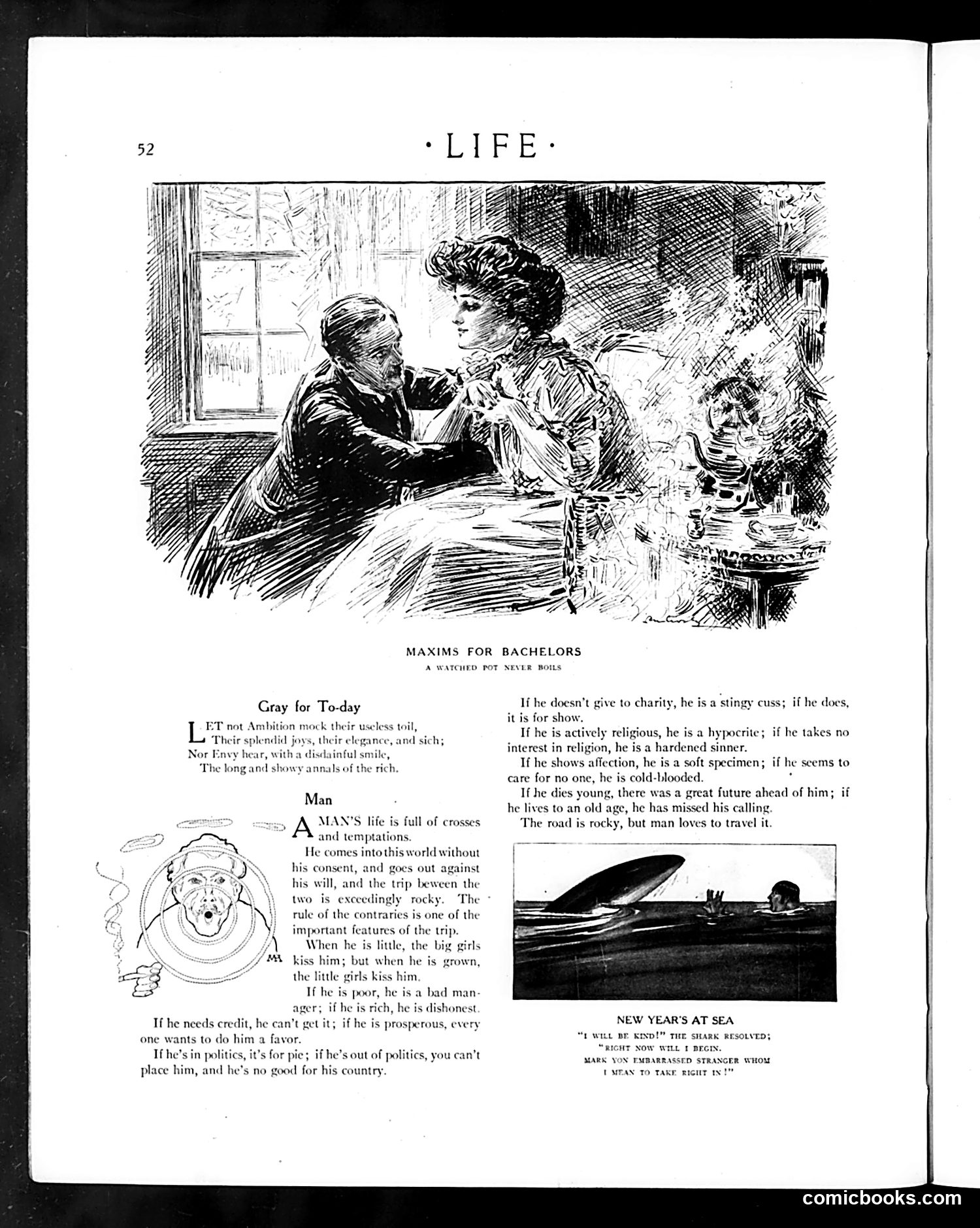
This page satirizes bachelor life through two pieces: **"Maxims for Bachelors"** presents cynical observations about unmarried men. The text mocks male hypocrisy—if a bachelor is religious, he's a hypocrite; if charitable, he's showing off; if affectionate, he's weak. The accompanying caricature of a man's face suggests these are universal male faults. **"Man"** expands this theme, describing how men navigate life's "crosses and perplexities." It humorously tracks male relationships: big girls kiss him as a child, but grown women won't once he matures. The satire critiques male financial instability and political unreliability, suggesting bachelors are fundamentally compromised figures—poor managers, dishonest when wealthy, and useless to their country. The page's humor relies on Victorian-era anxieties about unmarried men.
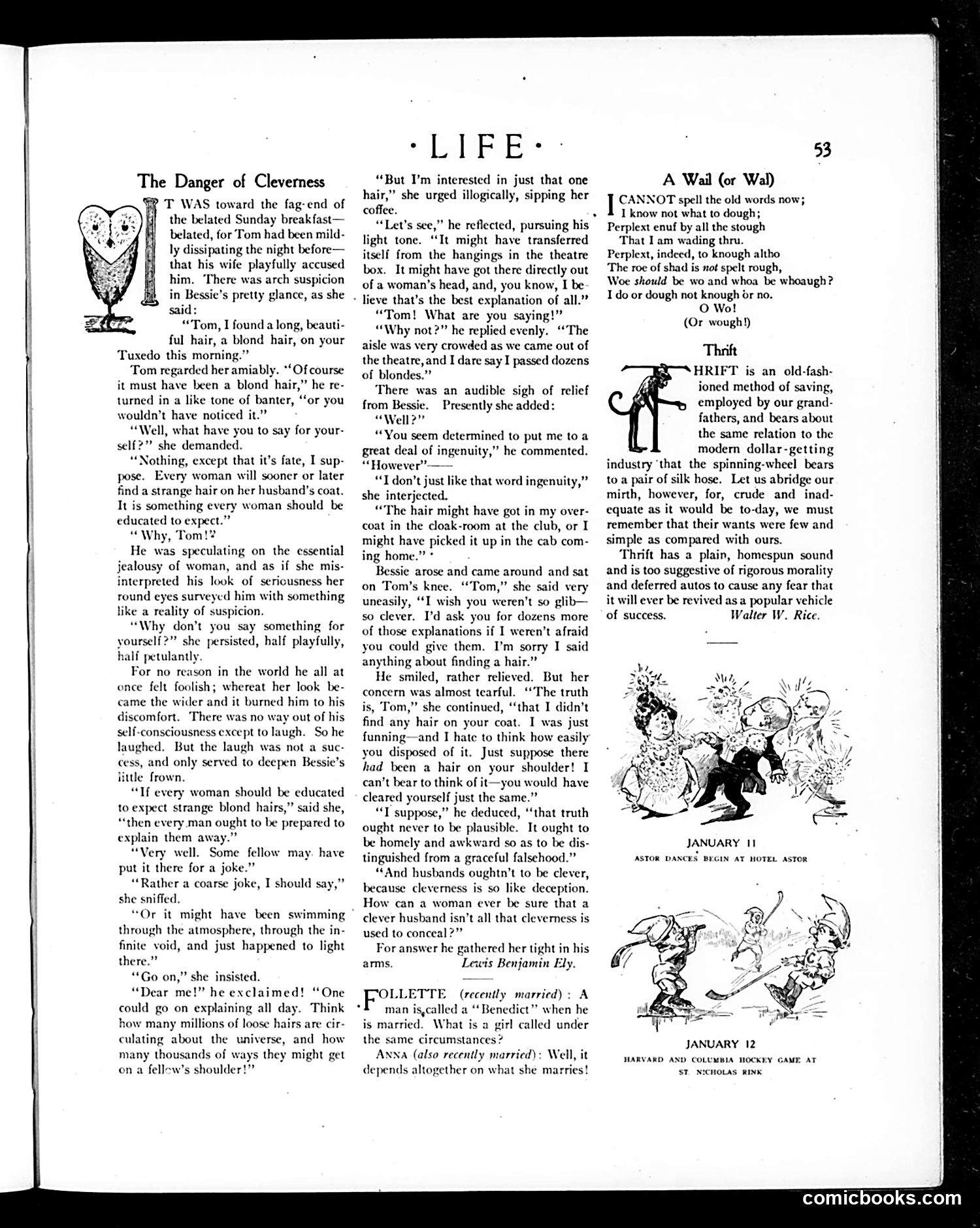
This page from *Life* magazine contains three distinct pieces of satirical writing and illustration: 1. **"The Danger of Cleverness"**: A dialogue between Tom and Bessie about a blonde hair found on Tom's coat. The satire targets husbands who use elaborate explanations to cover infidelity—mocking masculine "cleverness" as transparent deception. The piece argues women should be educated to recognize such lies. 2. **"A Wail (or Wal)"**: A brief humorous complaint about the word "dough" in modern slang, presented as archaic concern about language degradation. 3. **"Thrift"**: Walter W. Rice critiques the term "thrift" as outdated moral language applied to modern penny-pinching, comparing it unfavorably to contemporary "dollar-getting" practices. The bottom illustrations appear to be captioned January 11-12 events at hotels/sporting venues. The satire throughout targets pretension, linguistic hypocrisy, and gaps between traditional morality and modern behavior.
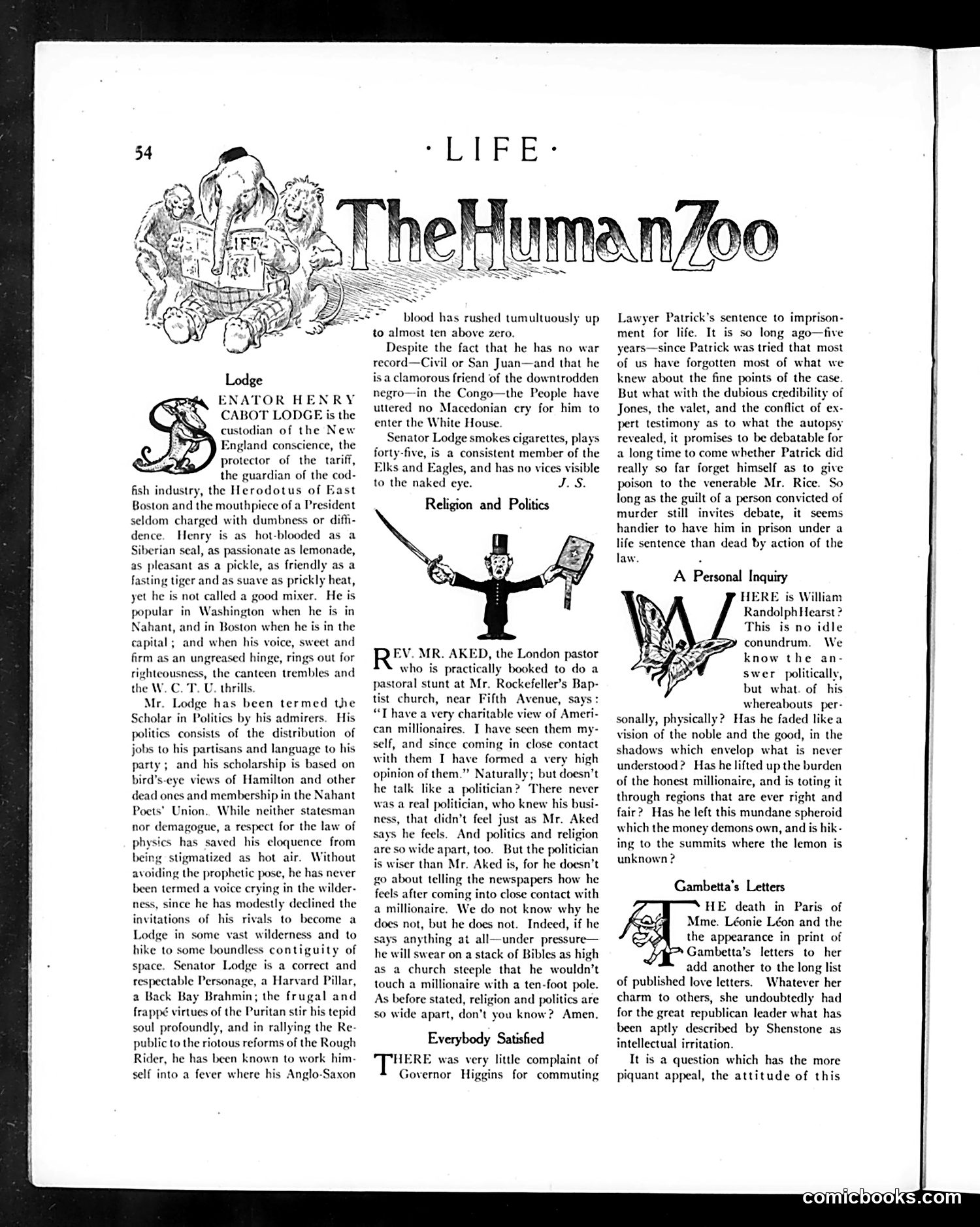
This page critiques American political and social figures through satirical commentary. The main section profiles **Senator Henry Cabot Lodge**, described as a powerful but self-righteous figure controlling New England politics—depicted as hot-blooded, arrogant, and prone to declining invitations, suggesting aristocratic aloofness. The "Religion and Politics" section mocks **Reverend Mr. Aked**, a London pastor, comparing politicians and millionaires. The satire suggests both groups are equally self-serving and hypocritical, with politicians reluctant to admit their materialistic nature. "A Personal Inquiry" questions whether William Randolph Hearst is truly the noble, visionary figure he claims—implying he hides selfish motives behind philanthropic rhetoric. **Gambetta's Letters** discusses Mme. Léonie Léon's published love letters, questioning their political significance. The overall tone: establishment figures are fraudulent.
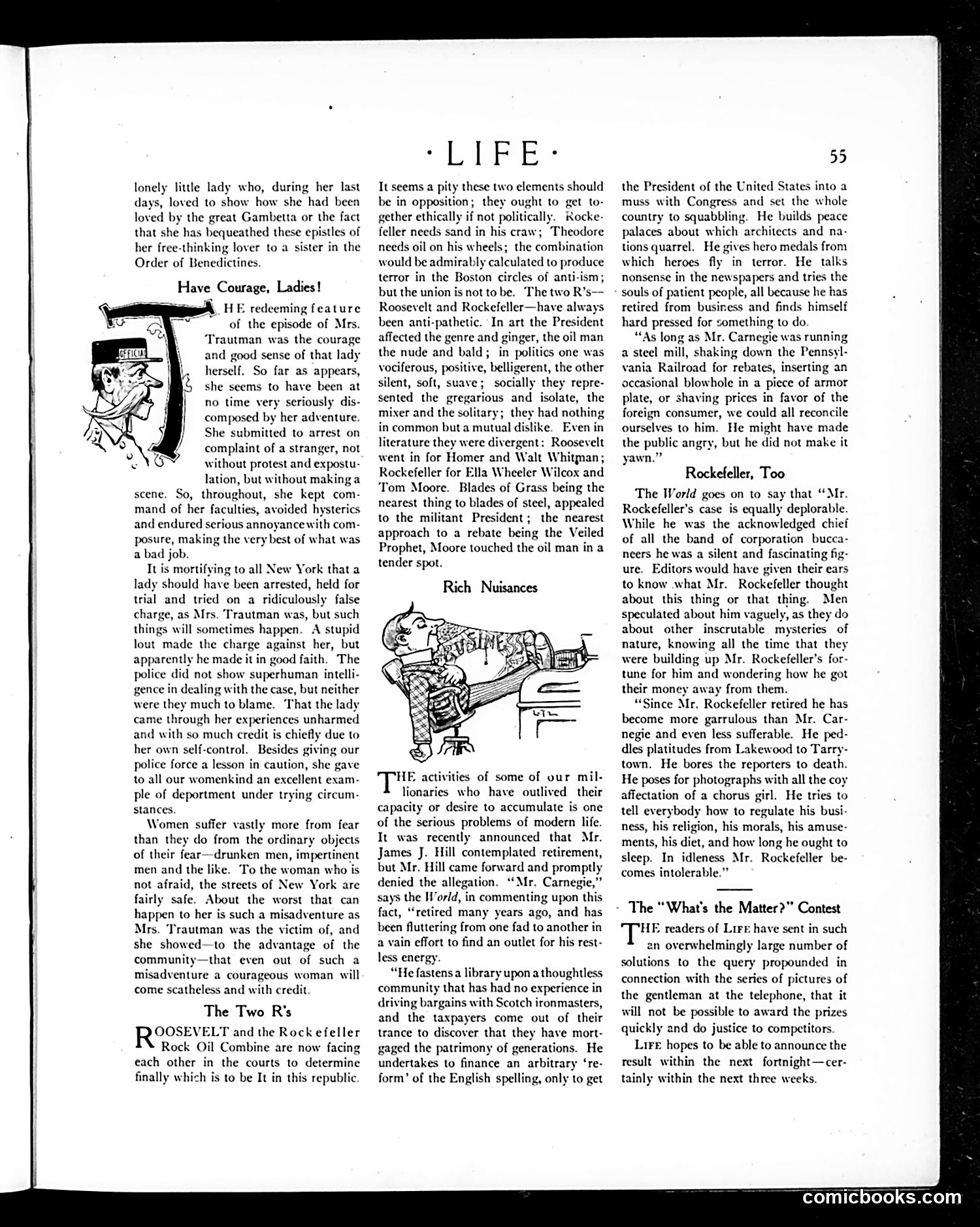
This page contains three satirical commentary sections critiquing prominent figures: **"The Two R's"** compares Roosevelt and Rockefeller, suggesting they're locked in legal conflict over oil interests. The cartoon shows a rotund figure lounging, likely caricaturing wealth and excess. **"Rockefeller, Too"** mocks John D. Rockefeller's retirement, describing him as increasingly "garrulous" and unbearable—pestering reporters with unsolicited advice about business, religion, and personal habits. The satire suggests his wealth has made him insufferably self-important. **"Have Courage, Ladies!"** discusses Mrs. Trautman, a woman falsely accused of crime but exonerated. The piece criticizes how fear and misinformation damage women's reputations, while praising her composure during her ordeal. The page reflects early-20th-century concerns about corporate power, wealth, and social justice.
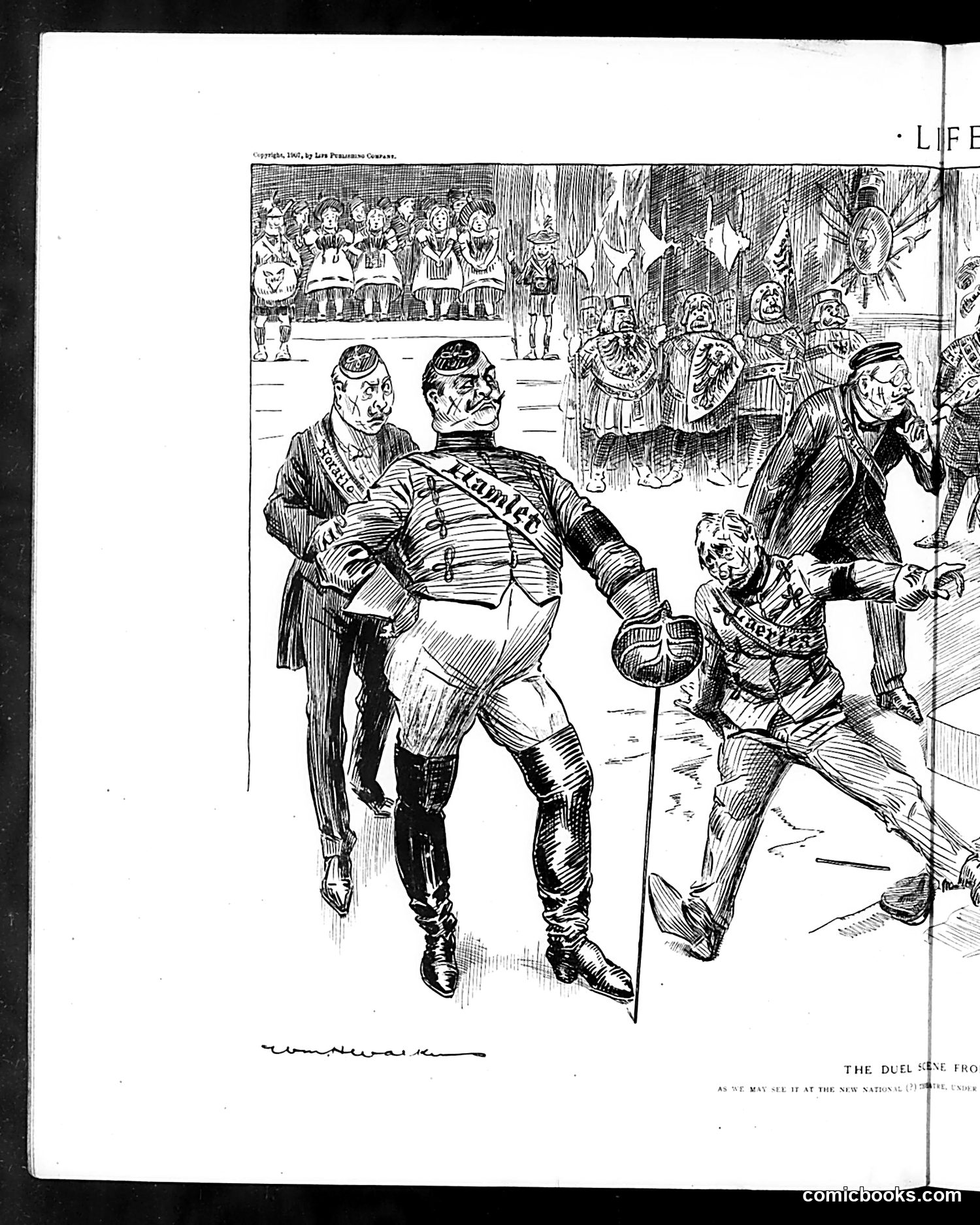
This satirical illustration depicts a formal duel between two military officers in elaborate uniforms with decorative braiding and medals. The scene is presented as theatrical, with an audience of onlookers and what appears to be clergy or officials in the background, suggesting an organized ceremonial event rather than a serious confrontation. The cartoon likely satirizes European military culture and the tradition of dueling among officers to settle disputes—a practice still occurring in early 20th-century Europe despite being outlawed in many places. By presenting the duel as staged entertainment with spectators, the artist mocks both the absurdity of this "honor-based" violence and the pageantry surrounding military hierarchy. The specific military figures remain unclear from visible details alone.
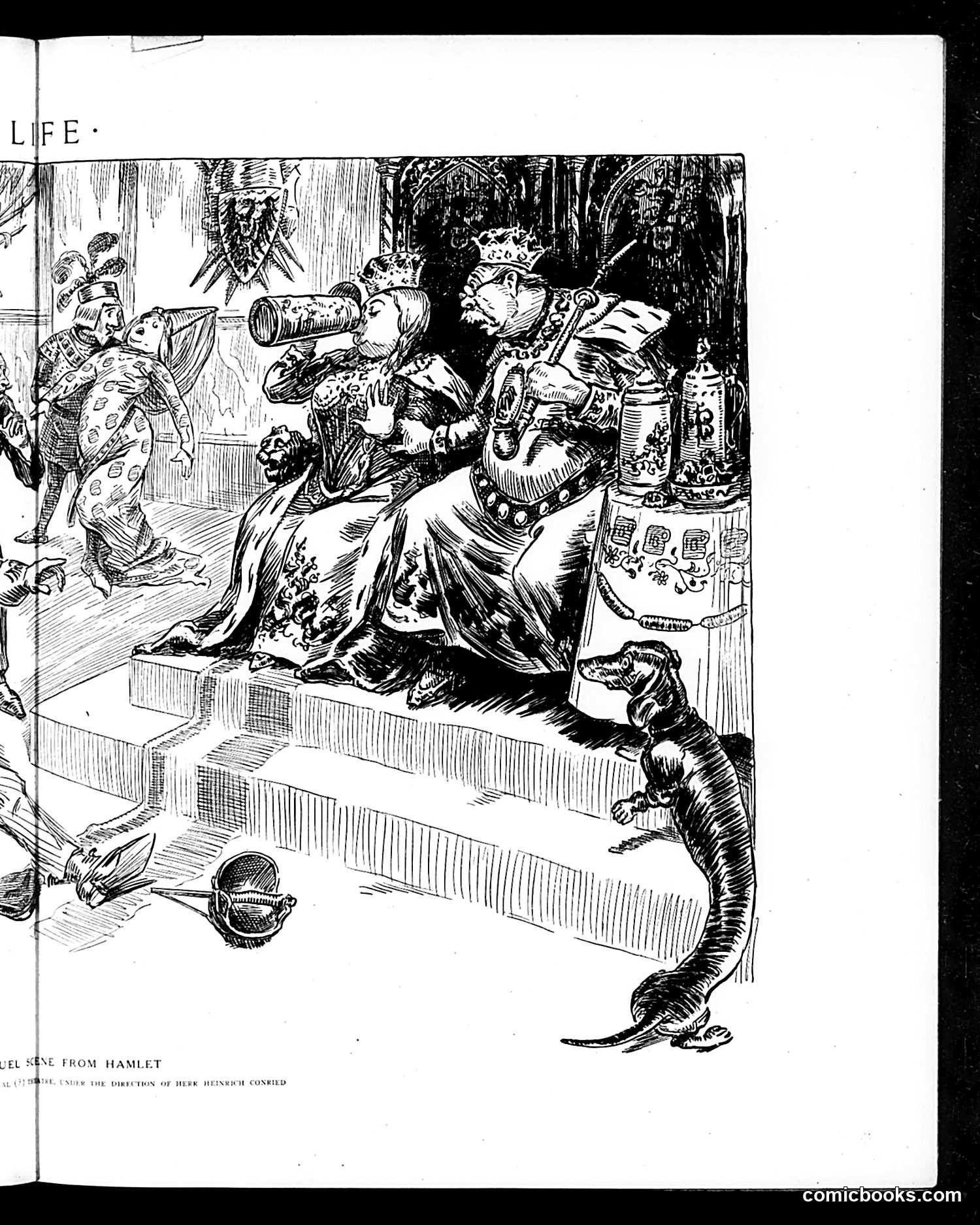
This appears to be a scene from Shakespeare's *Hamlet*, as indicated by the caption reference "FROM HAMLET." The illustration shows what seems to be a royal court scene with elaborately dressed figures seated on a platform or throne, wearing crowns and period costume with decorative robes. The satire likely uses the Shakespearean scene as a vehicle for political commentary, a common practice in *Life* magazine. The exaggerated, caricatured style and the presence of what appears to be an animal figure (possibly a rat or similar creature) at the bottom suggests mockery of contemporary political figures or situations through theatrical allegory. Without clearer identification of the specific figures or date, the exact political target remains unclear, but the approach uses classic literature to critique modern power dynamics.
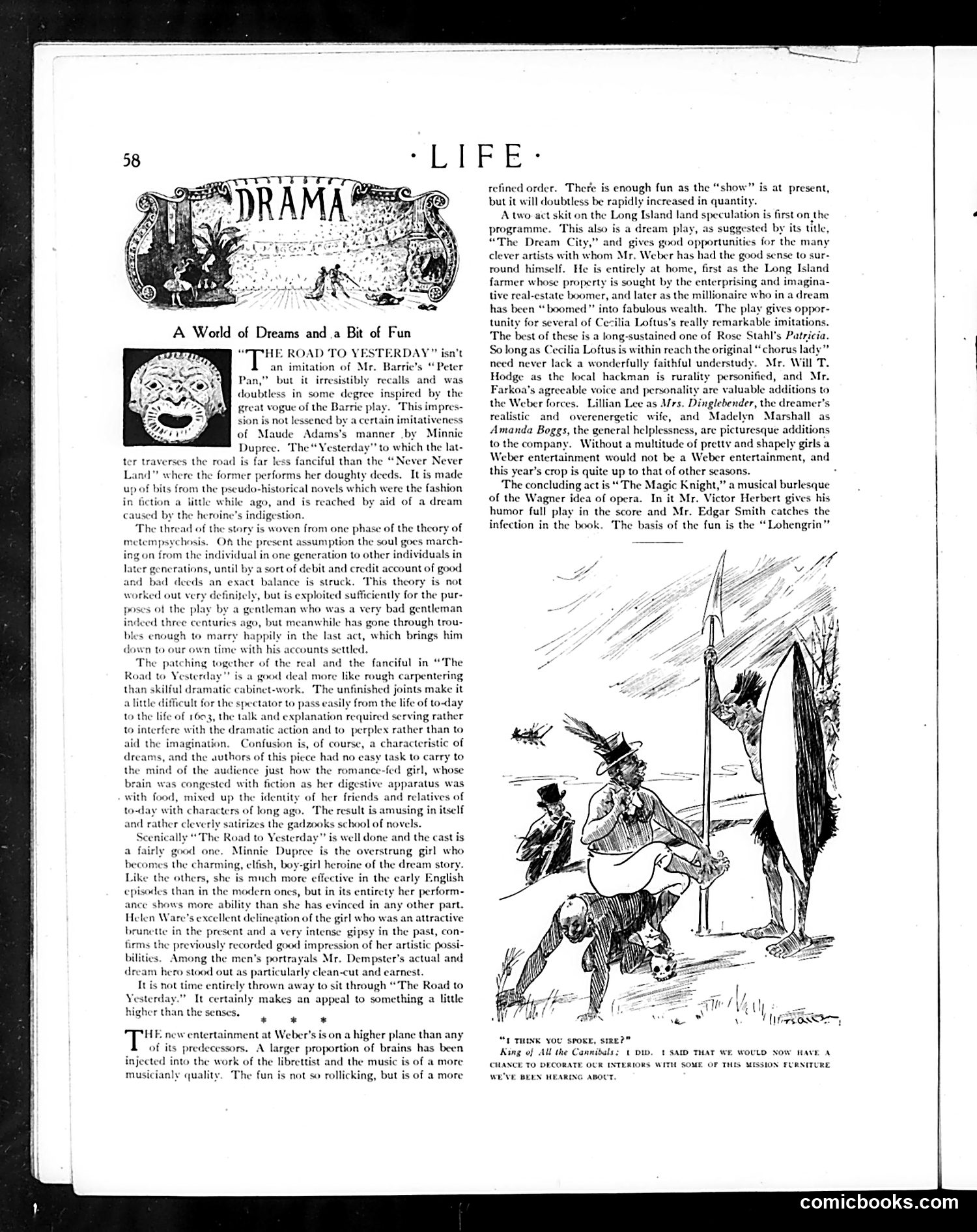
This page reviews a Broadway play imitating J.M. Barrie's *Peter Pan*. The central satire targets pseudo-historical fiction that was fashionable in early 1900s literature—the "gadzooks school of novels" referenced in the text. The plot involves a woman with indigestion who dreams herself into 1603, where she encounters reincarnated characters from her present life, based on metempsychosis (transmigration of souls). The reviewer criticizes the play's awkward construction—it clumsily stitches together modern and historical elements, making it hard to follow. The sketch at bottom right illustrates this dream-journey confusion, showing fantastical figures in a dreamscape. The review finds merit in Minnie Dupree's performance but notes the overall work is "rough carpentry" dramatically, though it offers some intellectual appeal beyond mere entertainment.
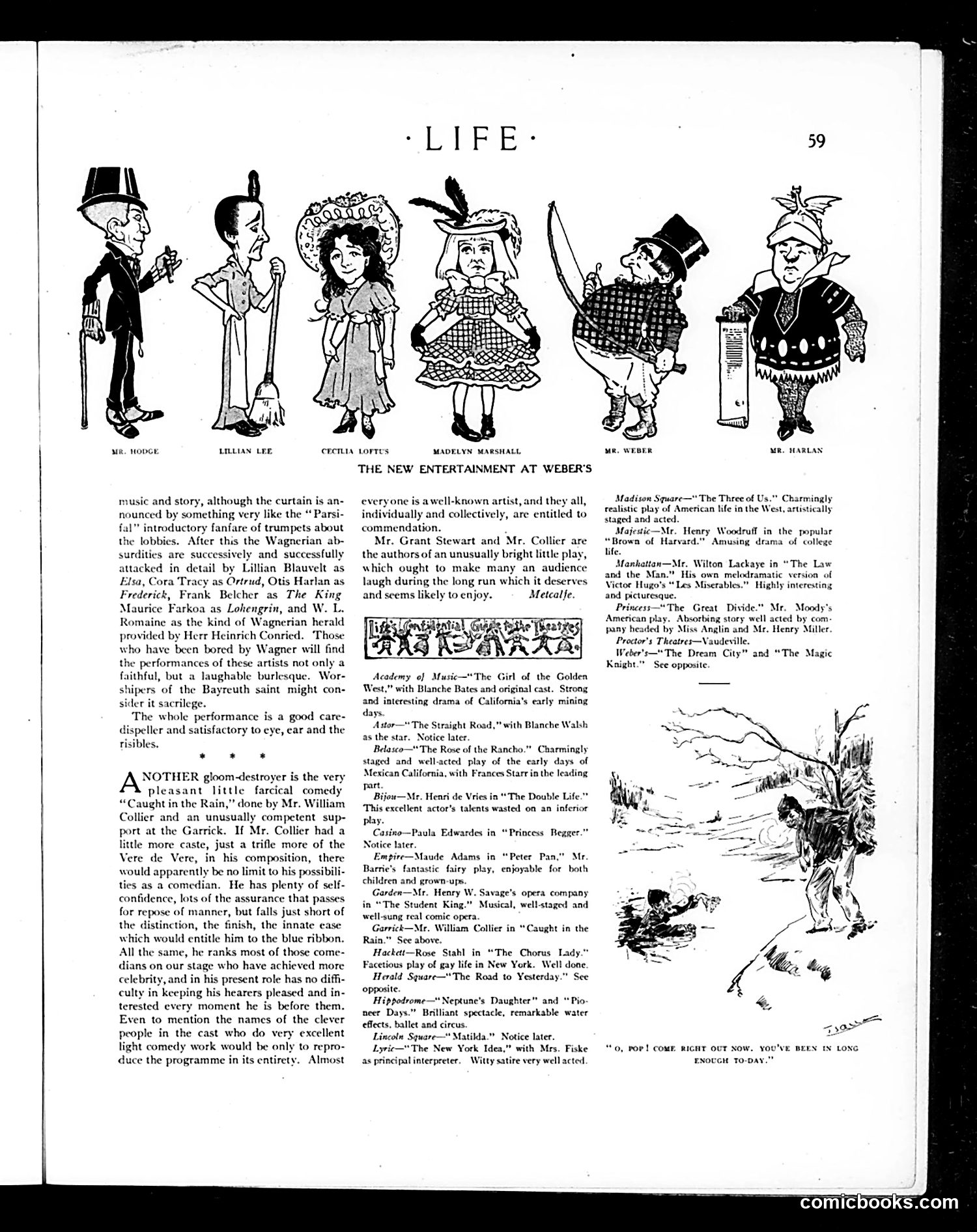
This page from *Life* magazine reviews current Broadway productions circa early 1900s. The top illustration shows six character caricatures representing entertainers at Weber's Theater—likely performers in a popular entertainment venue of the era. The text discusses theatrical productions with satirical commentary. Most notably, it reviews a Wagner opera parody ("Caught in the Rain"), noting that Wagner devotees might find it "sacrilege" but it's entertaining for general audiences. The reviewer critiques actor William Collier, praising his comedy timing while suggesting he lacks the refined "distinction" and upper-class bearing ("Vere de Vere") of truly elite performers—a social class distinction important to the period. The page includes a theater listings section reviewing multiple Broadway shows, from serious drama to musical comedy and spectacle productions. The small illustration on the right appears unrelated to the reviews.
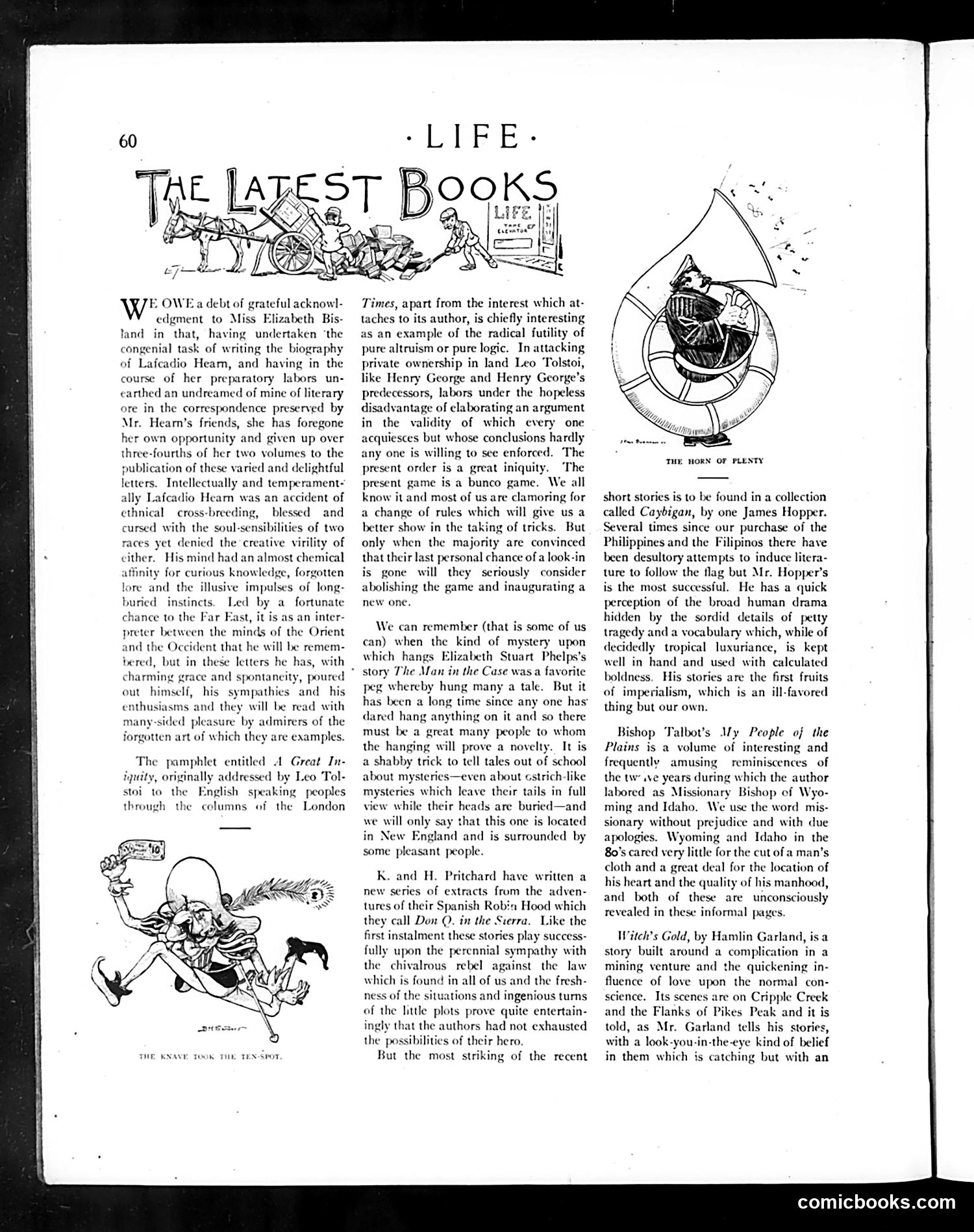
This is a book review section from Life magazine discussing recent publications. The page includes two cartoon illustrations satirizing literary themes rather than political figures. The left cartoon (captioned "The Knave Book The Ten Spot") appears to be a humorous illustration related to card games or trickery—likely mocking one of the books discussed. The right illustration titled "The Horn of Plenty" depicts a cornucopia-style horn overflowing with goods, presumably commenting on abundance or prosperity themes in literature. The text reviews several books including works by Lafcadio Hearn, Leo Tolstoy's political tract on land ownership, Elizabeth Stuart Phelps's mystery novel, and adventure stories featuring "Don Q" (a Spanish Robin Hood character). The reviews discuss these works' literary merit and social relevance rather than contemporary politics. The page's satire is literary rather than political—mocking writing conventions and publishing trends of the era.
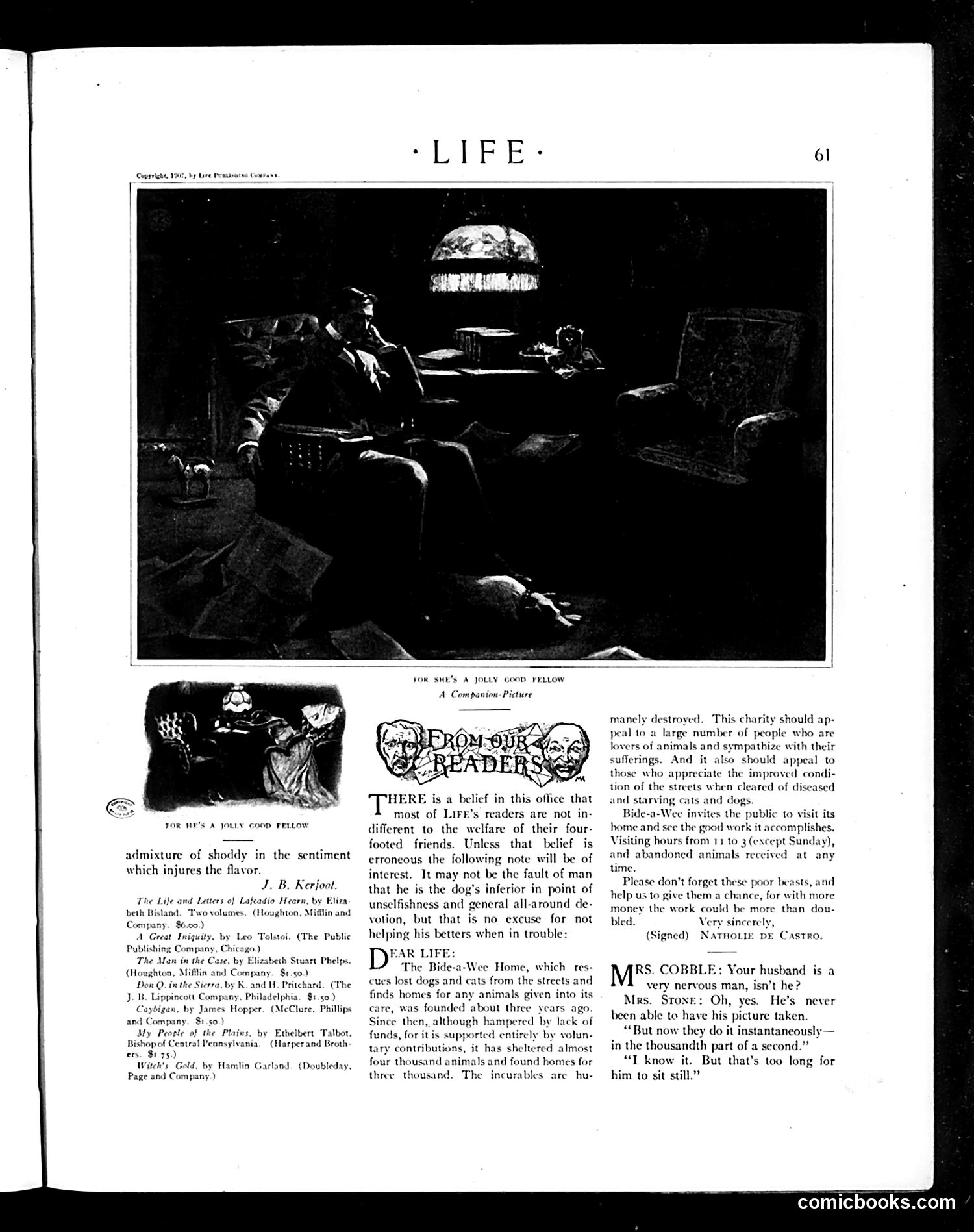
This page from *Life* magazine combines a serious charitable appeal with humorous domestic commentary. **Main Content:** The featured cartoon pair—"For He's a Jolly Good Fellow" and "For She's a Jolly Good Fellow"—illustrates contrasting gender roles. The male version shows a man relaxed in a chair being served; the female shows a woman in similar leisure (a "companion picture" suggesting gender equality). This gentle satire critiques traditional domestic hierarchies. **Charitable Notice:** The bulk of the page promotes the Bide-a-Wee Home, an animal rescue organization. The letter from Natalie de Castro describes sheltering 4,000 animals and rehoming 3,000 over three years. This reflects *Life's* stated belief that readers care about animal welfare—typical Progressive-era concern for urban animal suffering. **Humor Section:** The Mrs. Cobble dialogue jokes about photography technology: her nervous husband cannot sit still even for instantaneous photography, mocking both masculine anxiety and the era's rapid technological advancement. The page targets educated, philanthropically-minded urban readers.
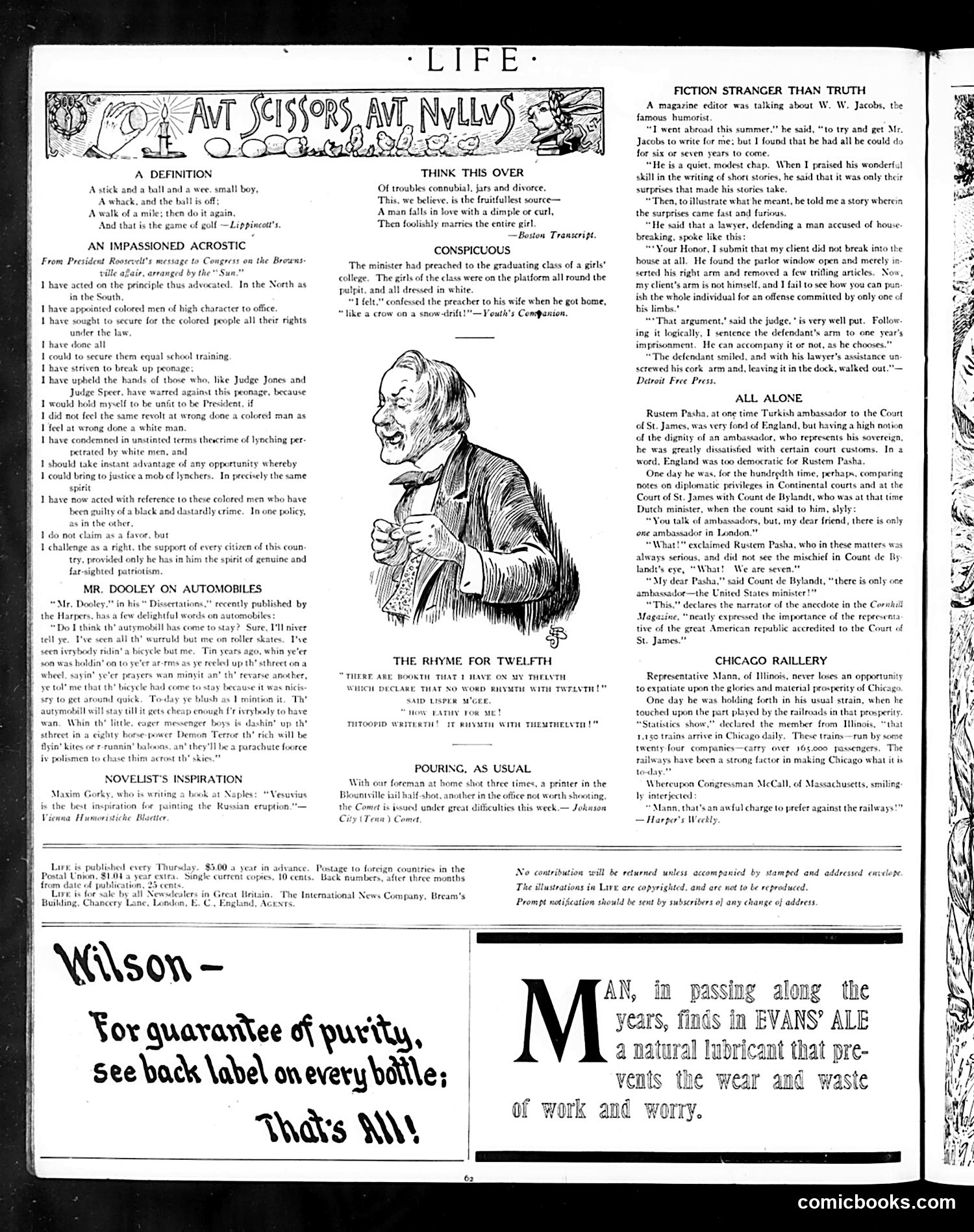
This is a satirical page from *Life* magazine featuring political and social commentary typical of early 20th-century American humor. **The main political content** is an "Impassioned Acrostic" quoting President Theodore Roosevelt's message to Congress on the Brownsville affair—a controversy involving Black soldiers. Roosevelt defends appointing Black officials and condemning lynching, claiming he treats wrongdoing by colored and white men equally. **The satire's point**: The acrostic format and lengthy justifications suggest Roosevelt is *protesting too much*—the very structure implies defensiveness about his racial policies rather than genuine conviction. **Other content** includes lighter pieces: a definition of golf, Mr. Dooley's comic commentary on automobiles, a novelist's inspiration anecdote about Maxim Gorky, and humorous short observations (like a preacher feeling "like a crow on a snow-drift" among white-dressed girls). The page mixes political critique with general humor—typical of *Life*'s approach to American public affairs and society.
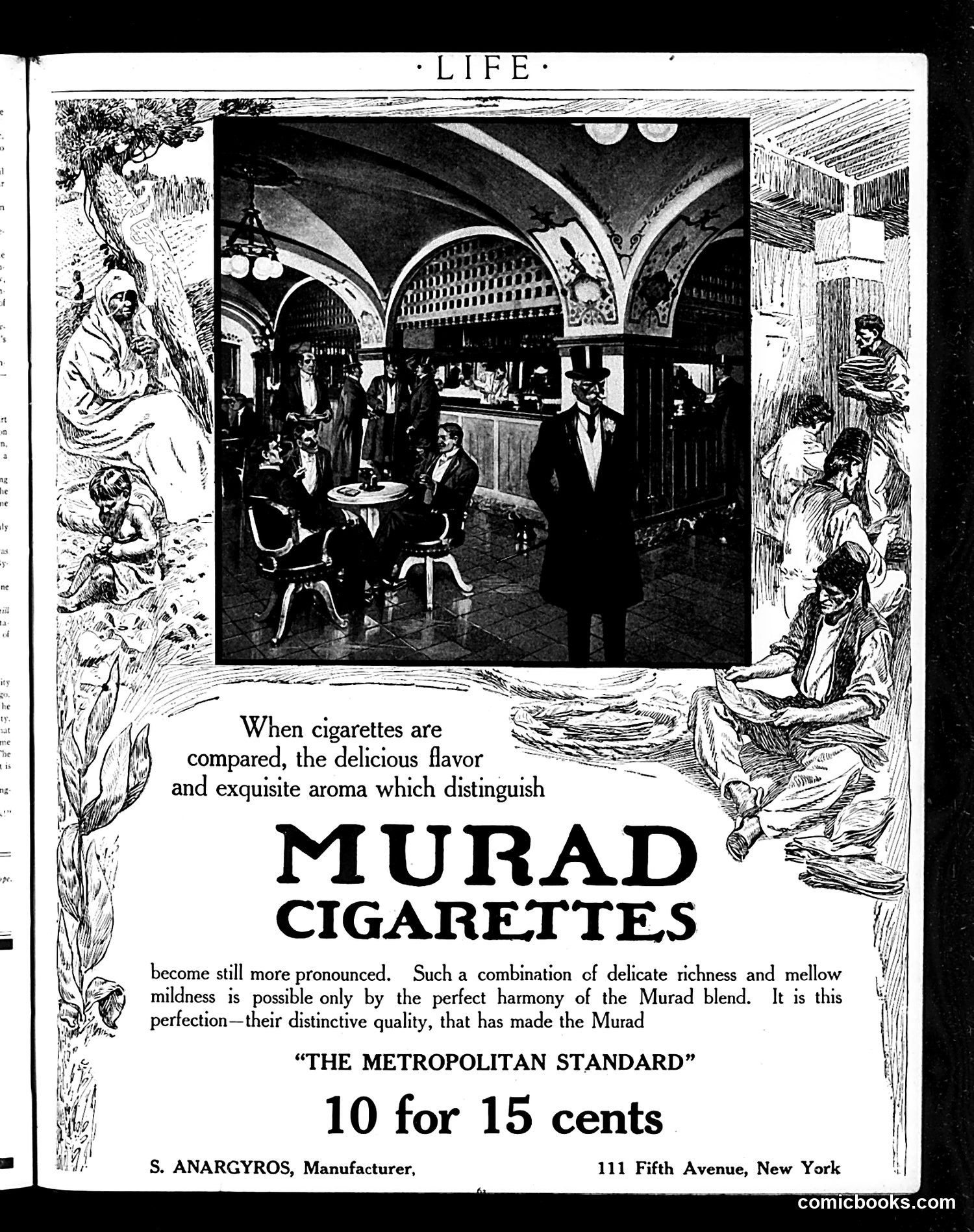
This page is primarily a **cigarette advertisement**, not political satire. The central image shows an elegant indoor social scene—what appears to be a sophisticated lounge or hotel with well-dressed patrons in formal attire and a uniformed attendant. The ornamental borders feature classical artistic figures. The ad copy claims that Murad cigarettes possess superior "delicious flavor and exquisite aroma" due to their "perfect blend," positioning them as "the metropolitan standard" at an affordable price (10 for 15 cents). There is **no apparent political cartoon or social satire** on this page. It's straightforward early 20th-century luxury product marketing emphasizing elegance and refinement to appeal to affluent consumers. The manufacturer was S. Anargyros of New York.
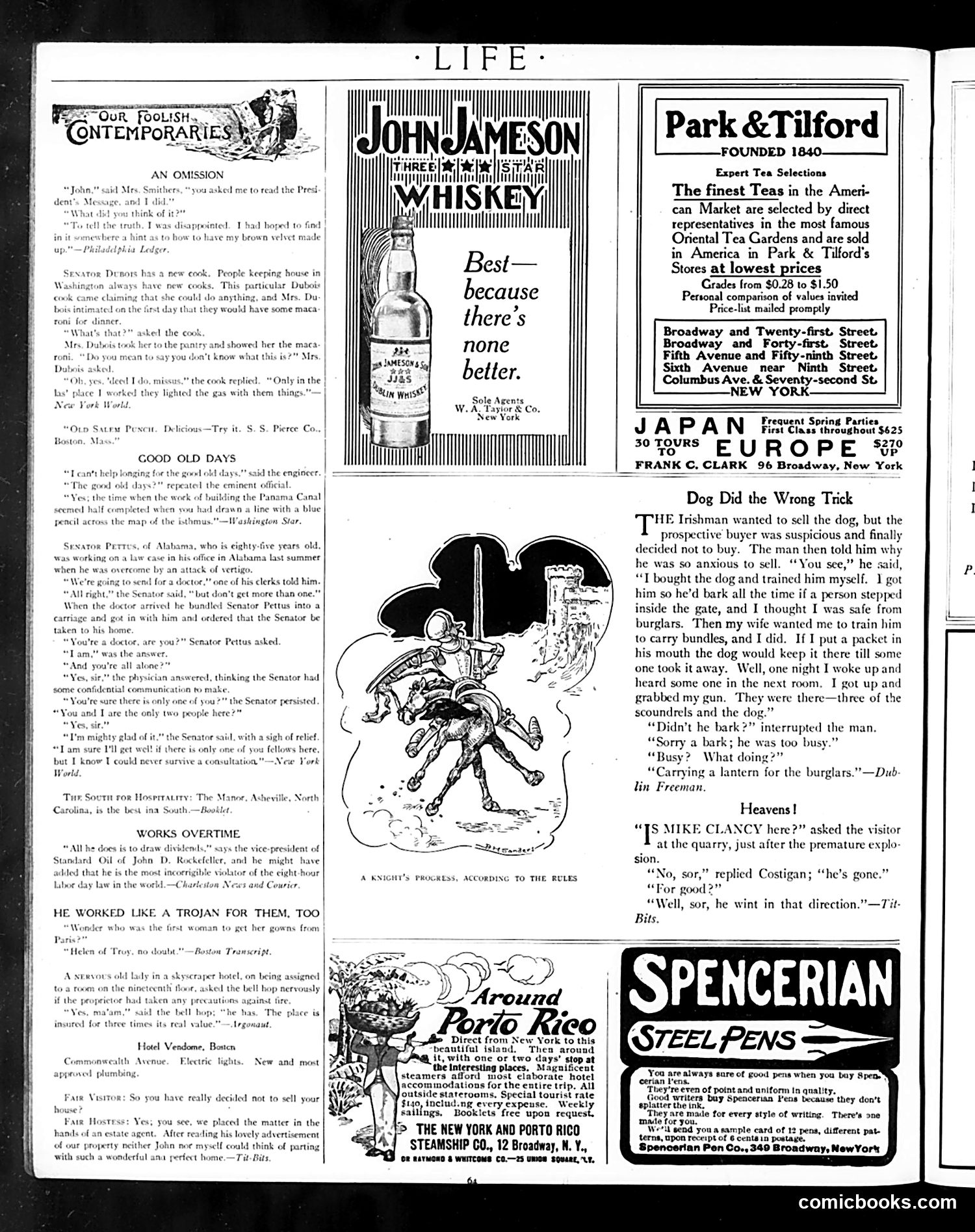
This page from *Life* magazine (a satirical American publication) features primarily **humorous anecdotes and advertisements** rather than political cartoons. The main illustrated cartoon depicts "A Knight's Progress, According to the Rules"—a visual joke showing a medieval knight on horseback in an awkward, tumbling position, satirizing the gap between romantic ideals of chivalry and clumsy reality. The page's humor pieces are genteel, domestic jokes: a story about an Irishman trying to sell a dog that won't bark during a burglary (because it's busy carrying the thieves' lantern), and a brief exchange about a quarry worker named Mike Clancy who was killed in an explosion. **The advertisements**—for John Jameson Whiskey, Park & Tilford tea, Spencerian Steel Pens, and steamship travel to Puerto Rico—reflect early 20th-century consumer culture targeting middle and upper-class readers. Overall, this is a **lifestyle and entertainment page** mixing light comedy with luxury product marketing, not political satire.
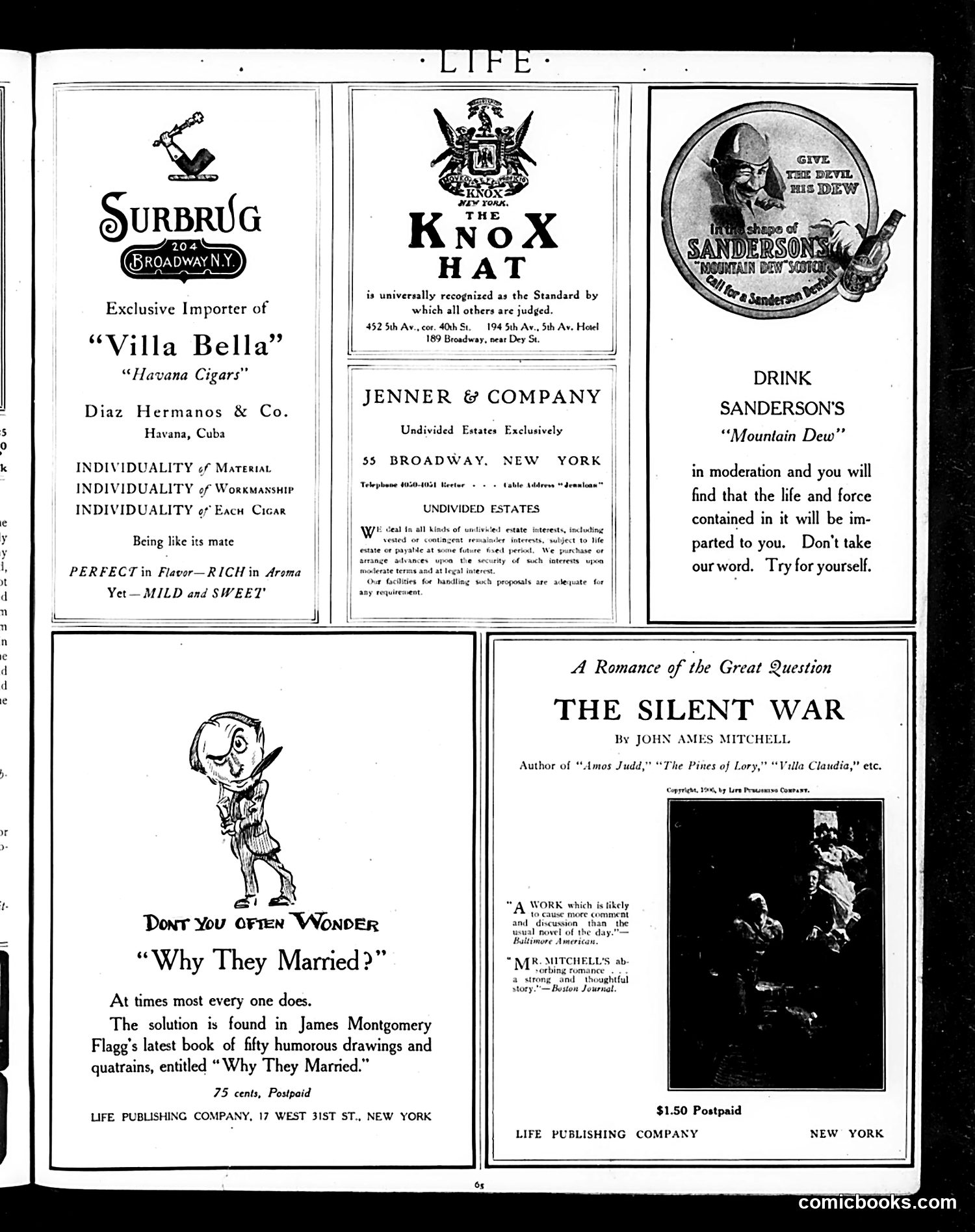
This page is primarily **advertising and promotional content** from Life magazine, not editorial satire or political commentary. The ads showcase period products: Villa Bella cigars from Cuba, Knox hats (positioned as the standard by which other hats are judged), Sanderson's Mountain Dew whiskey, and books published by Life Publishing Company. The one cartoon element—a caricatured figure asking "Why They Married?"—promotes James Montgomery Flagg's humorous book of drawings and quatrains on marriage, suggesting the absurdity of matrimonial decisions ("At times most every one does"). This is mild domestic satire rather than political commentary. The main feature advertised is "The Silent War," a romance novel by John Ames Mitchell. Overall, this is a commercial page mixing product advertisements with book promotions typical of early 20th-century magazine publishing.
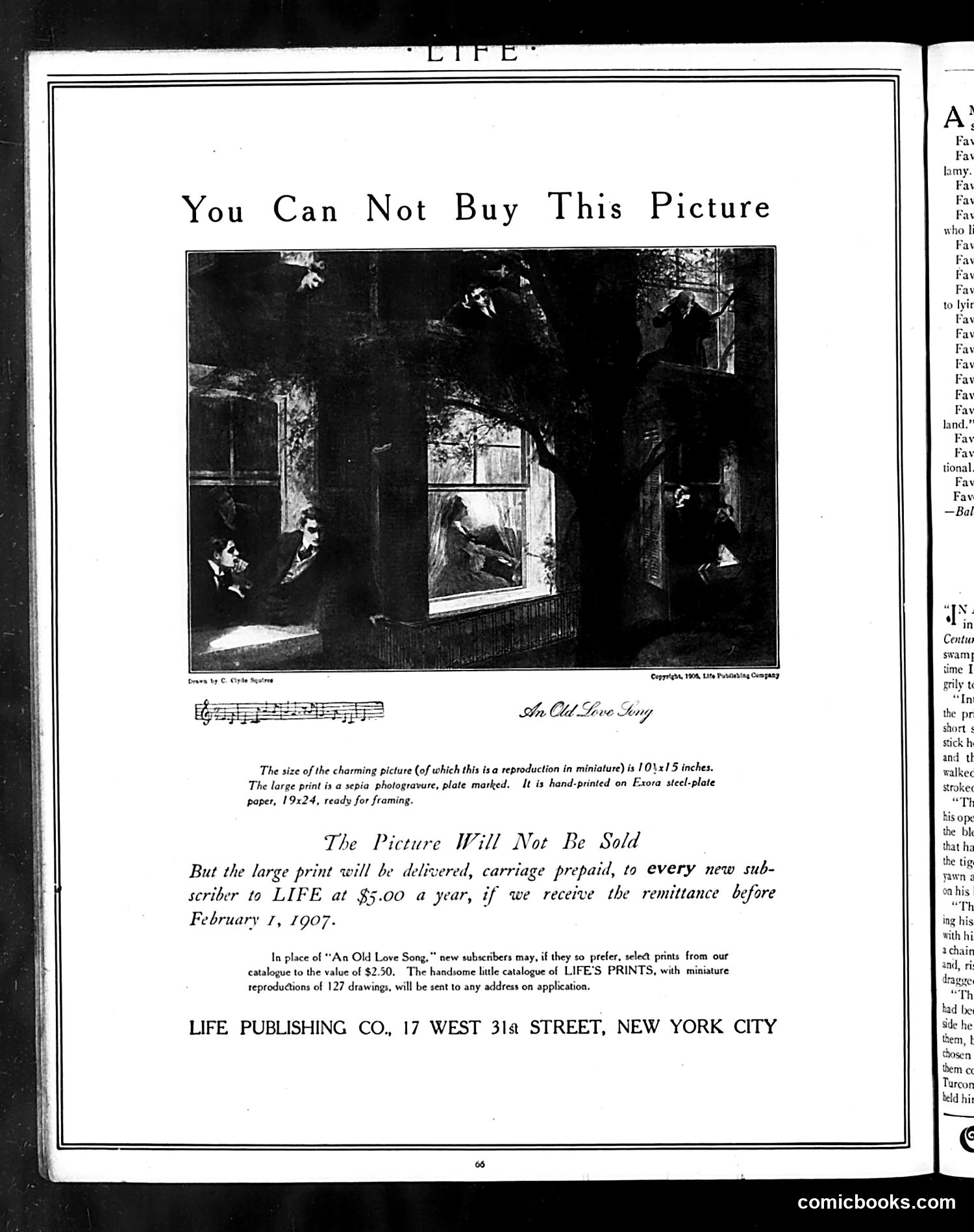
This is primarily a **subscription advertisement**, not a political cartoon. Life Publishing Company is promoting a sepia photogravure print titled "An Old Love Song" by artist C. Cipple Seetnee as an incentive for new annual subscribers ($5.00/year). The image shows a **sentimental scene**: figures in an interior, with a couple visible through a window, suggesting a romantic or nostalgic moment—typical of early 1900s popular imagery. **The hook**: The actual artwork will *not* be sold separately. Instead, it's offered exclusively as a premium to new subscribers who pay before February 1, 1907. The large hand-printed version (19x24 inches) was meant for framing as home decoration. This reflects Gilded Age marketing strategy: *Life* magazine used attractive artwork as a collector's incentive to build subscription revenue. Subscribers could alternatively select from 127 other prints in their catalog worth $2.50.
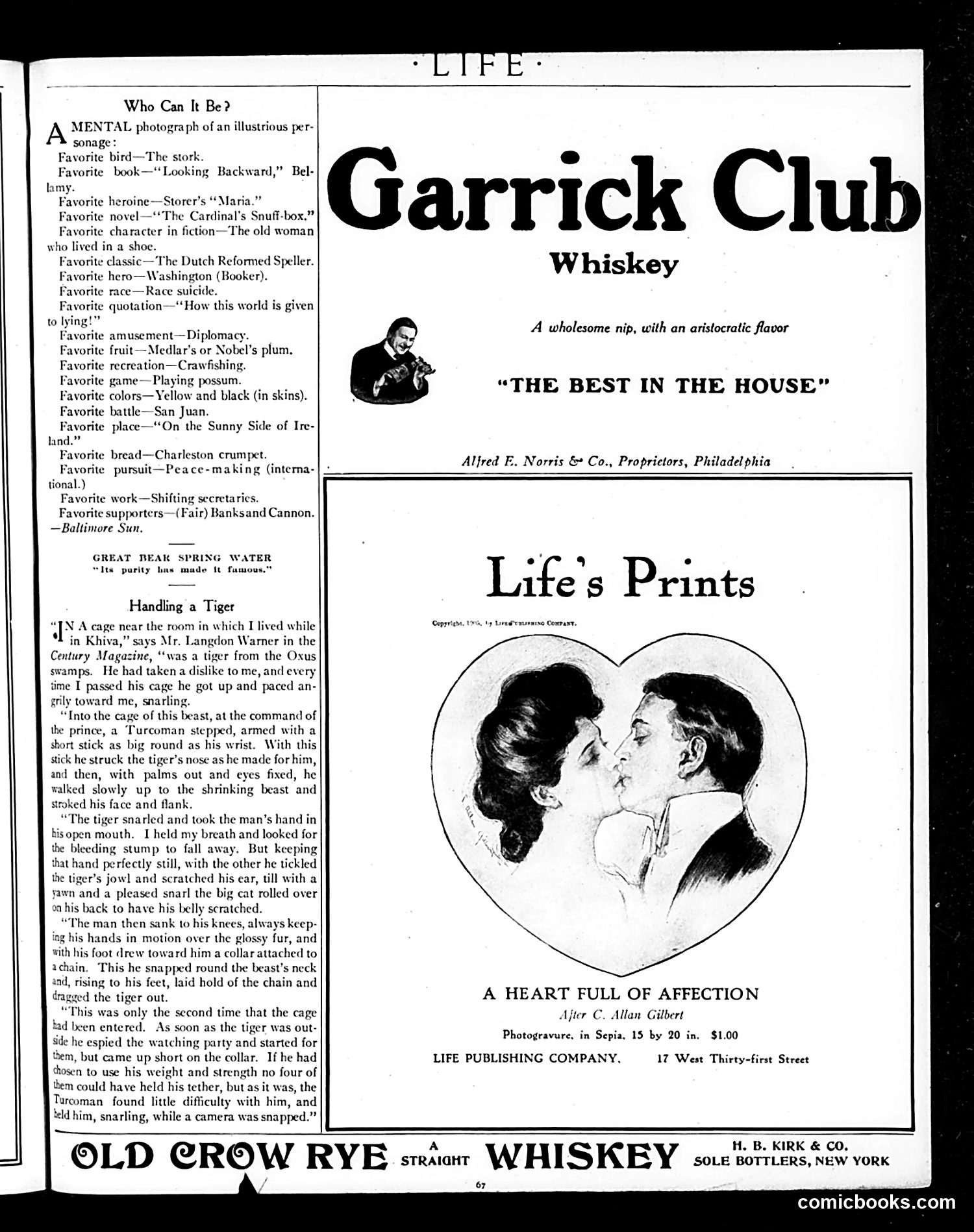
This page contains primarily **advertising and light entertainment** rather than political satire. The "Who Can It Be?" section is a **personality guessing game** where clues about an unnamed person's preferences are given ("favorite bird—The stork," "favorite race—Race suicide," etc.). Readers would identify the figure from these hints. The references suggest someone involved in diplomacy and politics, but the specific identity isn't labeled here. "Handling a Tiger" is a **narrative anecdote** from Century Magazine describing how a Turcoman handler subdues an aggressive tiger through calm physical contact and psychological manipulation—presented as an example of exotic adventure and skill. The advertisements include **Garrick Club Whiskey** ("the best in the house") and **Old Crow Rye Whiskey**, plus **Life's Prints**, offering a photogravure artwork by C. Allan Gilbert titled "A Heart Full of Affection" showing an intimate couple portrait. This is essentially a **magazine contents page** mixing editorial content with commercial advertisements—typical of early 20th-century publications.
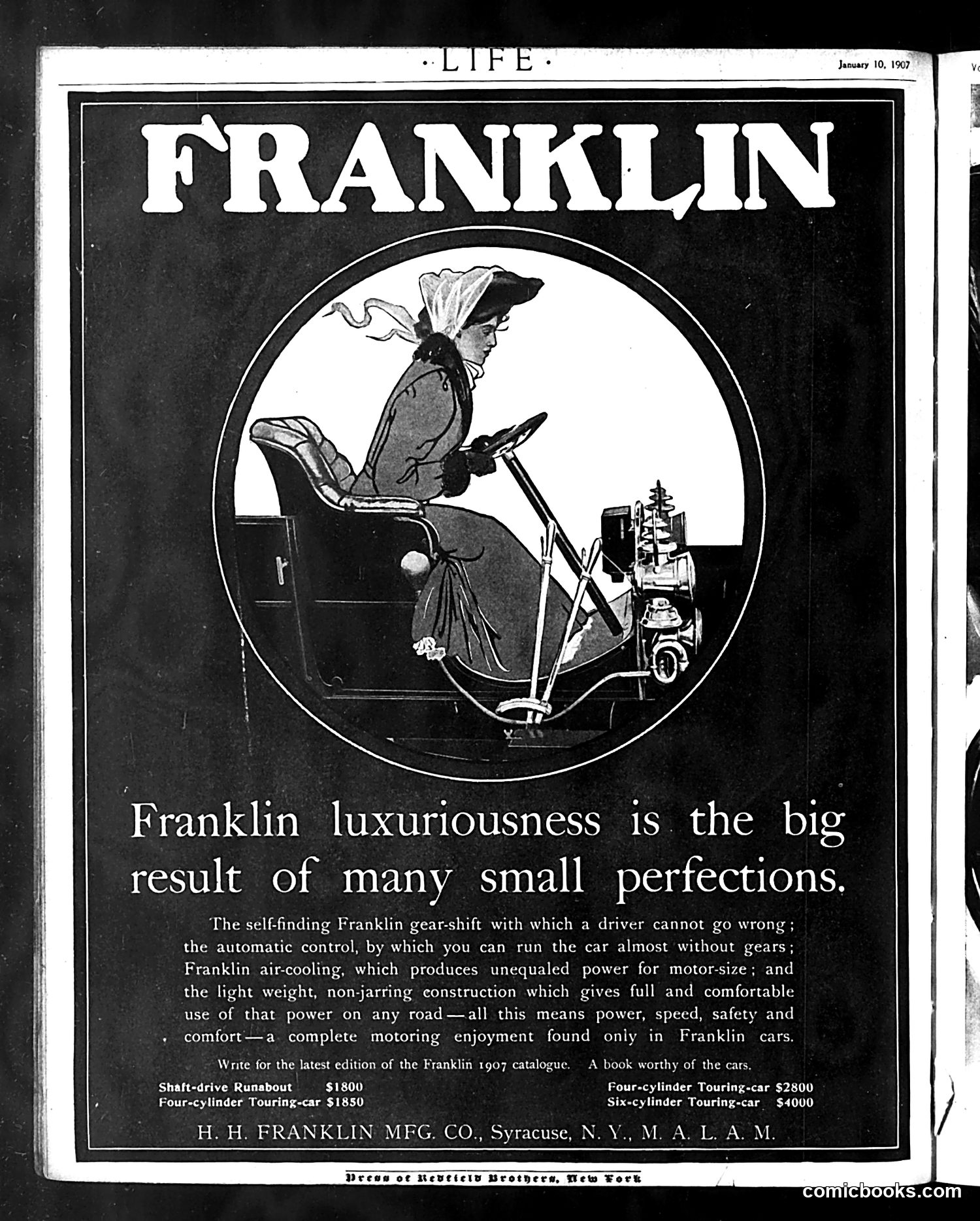
This is a full-page advertisement, not political satire. It promotes Franklin automobiles, manufactured in Syracuse, New York. The illustration depicts an elegantly dressed woman operating a Franklin car, emphasizing the vehicle's luxury and ease of use—key selling points for early 1900s automobiles, which were still novel and often difficult to operate. The ad's tagline, "Franklin luxuriousness is the big result of many small perfections," highlights specific technical innovations: a self-finding gear-shift, automatic control, air-cooling (rather than water-cooling, common then), and lightweight construction. These features promised "power, speed, safety and comfort." The price range ($1,800–$4,000) targeted wealthy consumers. The woman driver was notable imagery for 1907, subtly suggesting the Franklin's accessibility even to female operators—still relatively progressive for the era.