
Life, 1907-01-10 · page 10 of 24
Life — January 10, 1907 — page 10: what you’re looking at
What you’re looking at
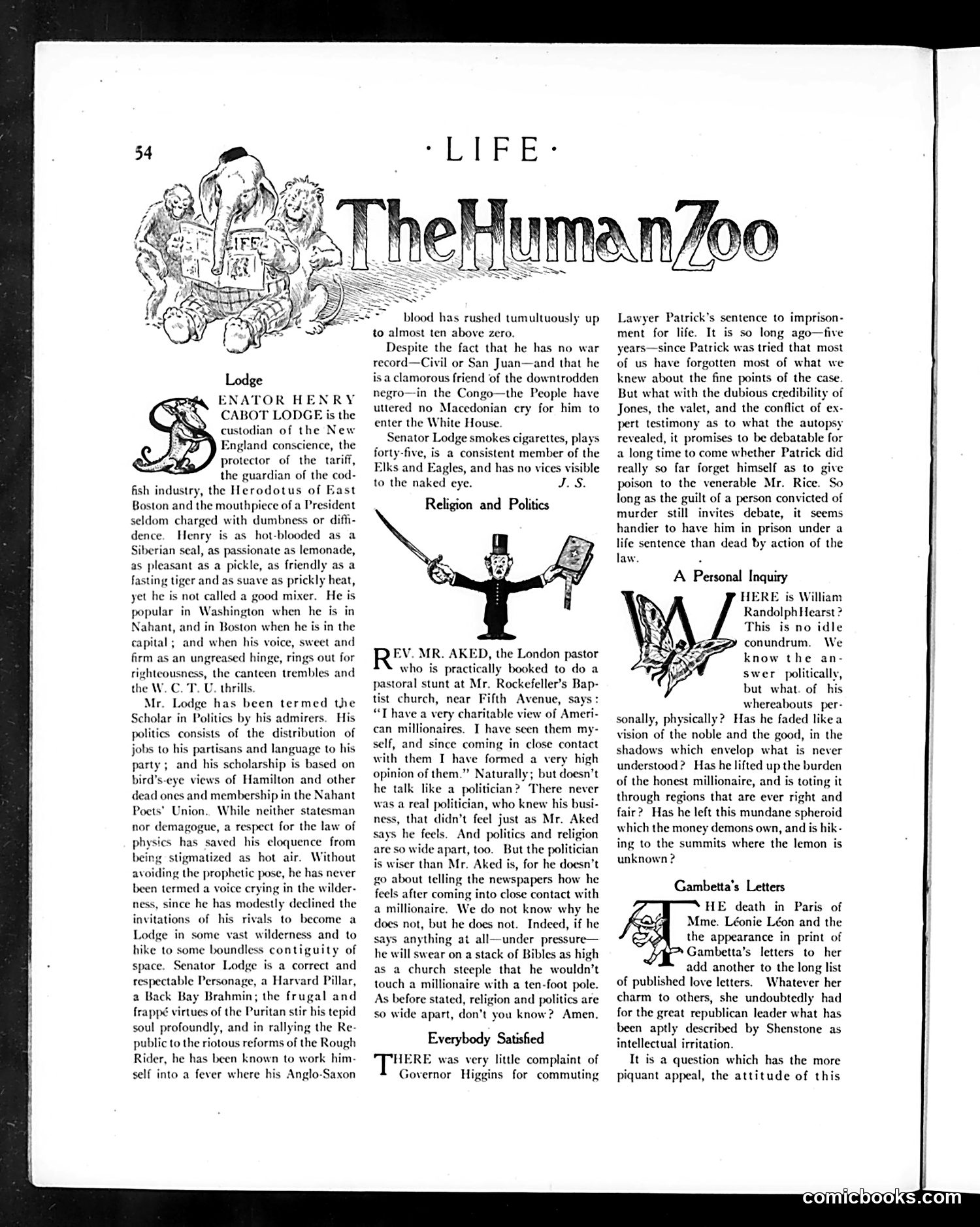
This page critiques American political and social figures through satirical commentary. The main section profiles **Senator Henry Cabot Lodge**, described as a powerful but self-righteous figure controlling New England politics—depicted as hot-blooded, arrogant, and prone to declining invitations, suggesting aristocratic aloofness. The "Religion and Politics" section mocks **Reverend Mr. Aked**, a London pastor, comparing politicians and millionaires. The satire suggests both groups are equally self-serving and hypocritical, with politicians reluctant to admit their materialistic nature. "A Personal Inquiry" questions whether William Randolph Hearst is truly the noble, visionary figure he claims—implying he hides selfish motives behind philanthropic rhetoric. **Gambetta's Letters** discusses Mme. Léonie Léon's published love letters, questioning their political significance. The overall tone: establishment figures are fraudulent.
📄 Transcribed text from this page (OCR, searchable)
Machine-transcribed from the original scan — historical spelling and the odd misread are preserved.
ENATOR HENRY CABOT LODGE is the custodian of the New gland conscience, the protector of the tariff, the guardian of the cod- fish industry, the Herodotus of East Boston and the mouthpiece of a President seldom charged with dumbness or diffi- dence. Henry is as hot-blooded as a Siberian seal, as passionate as lemonade, as pleasant as a pickle, as friendly as a fasting tiger and as suave as prickly heat, yet he is not called a good mixer. He is popular in Washington when he is in Nahant, and in Boston when he is in the capital ; and when his voice, sweet and firm as an ungreased hinge, rings out for righteousness, the canteen trembles and the W. C. T. U, thrills. Mr. Lodge has been termed the Scholar in Politics by his admirers. His politics consists of the distribution of jobs to his partisans and language to his y; and his scholarship is based on ye views of Hamilton and other dead ones and membership in the Nahant Poets’ Union. While neither statesman nor demagogue, a respect for the law of physics has saved his eloquence from being stigmatized as hot Without avoiding the prophetic pose, he has never been termed a voice crying in the wilder- nce he has modestly declined the invitations of his rivals to become a Lodge in some vast wilderness and to hike to some boundless contiguity of space. Senator Lodge is a correct and respectable Personage, a Harvard Pillar, a Back Bay Brahmin; the frugal and frappé virtues of the Puritan stir his tepid soul profoundly, and in rallying the Re: public to the riotous reforms of the Rough Rider, he has been known to work him- self into a fever where his Anglo-Saxon LIFE blood has rushed tumultuously up to almost ten above zero. Despite the fact that he has no war record—Civil or San Juan—and that he is a clamorous friend of the downtrodden negro—in the Congo—the People have uttered no Macedonian cry for him to enter the White House. Senator Lodge smokes cigarettes, plays forty-five, is a consistent member of the Elks and Eagles, and has no vices visible to the naked eye. IS. Religion and Politics VV. MR. AKED, the London pastor who is practically booked to do a pastoral stunt at Mr. Rockefeller’s Bap- tist church, near Fifth Avenue, i “Thave a very charitable view of Ameri- can millionaires. I have scen them my- self, and since coming in close contact with them I have formed a very high opinion of them.” Naturally; but doesn’t he talk like a politician? There never was a real politician, who knew his busi- ness, that didn’t feel just as Mr. Aked says he feels. And politics and religion are so wide apart, too. But the politician is wiser than Mr. Aked is, for he doesn’t go about telling the newspapers how he feels after coming into close contact with a millionaire. We do not know why he does not, but he does not. Indeed, if he says anything at all—under pressure— he will swear on a stack of Bibles as high as a church steeple that he wouldn’t touch a millionaire with a ten-foot pole. As before stated, religion and politics are so wide apart, don’t you know? Amen, Everybody Satisfied T! E was very little complaint of Governor Higgins for commuting Lawyer Patrick's sentence to imprison- ment for life. It is so long ago—tive years—since Patrick was tried that most of us have forgotten most of what we knew about the fine points of the case. But what with the dubious credibility of Jones, the valet, and the conflict of ex- pert testimony as to what the autopsy revealed, it promises to be debatable for a long time to come whether Patrick did really so far forget himself as to give poison to the venerable Mr. Rice. So long as the guilt of a person convicted of murder still invites debate, it seems handier to have him in prison under a life sentence than dead by action of the law. . A Personal Inquiry HERE is William Randolph Hearst ? This is no idle conundrum. We know the an- swer_politicall but what. of his whereabouts per- sonally, physically? Has he faded like a vision of the noble and the good, in the shadows which envelop what is never understood? Has he lifted up the burden of the honest millionaire, and is toting it through regions that are ever right and fair? Has he left this mundane spheroid which the money demons own, and is hik- ing to the summits where the lemon is unknown? Gambetta’s Letters HE death in Paris of Mme. Léonie Léon and the the appearance in print of Gambetta’s letters to her add another to the long list of published love letters. Whatever her charm to others, she undoubtedly had for the great republican leader what has been aptly described by Shenstone as intellectual irritation. It is a question which has the more piquant appeal, the attitude of this