
Life, 1907-01-10 · page 16 of 24
Life — January 10, 1907 — page 16: what you’re looking at
What you’re looking at
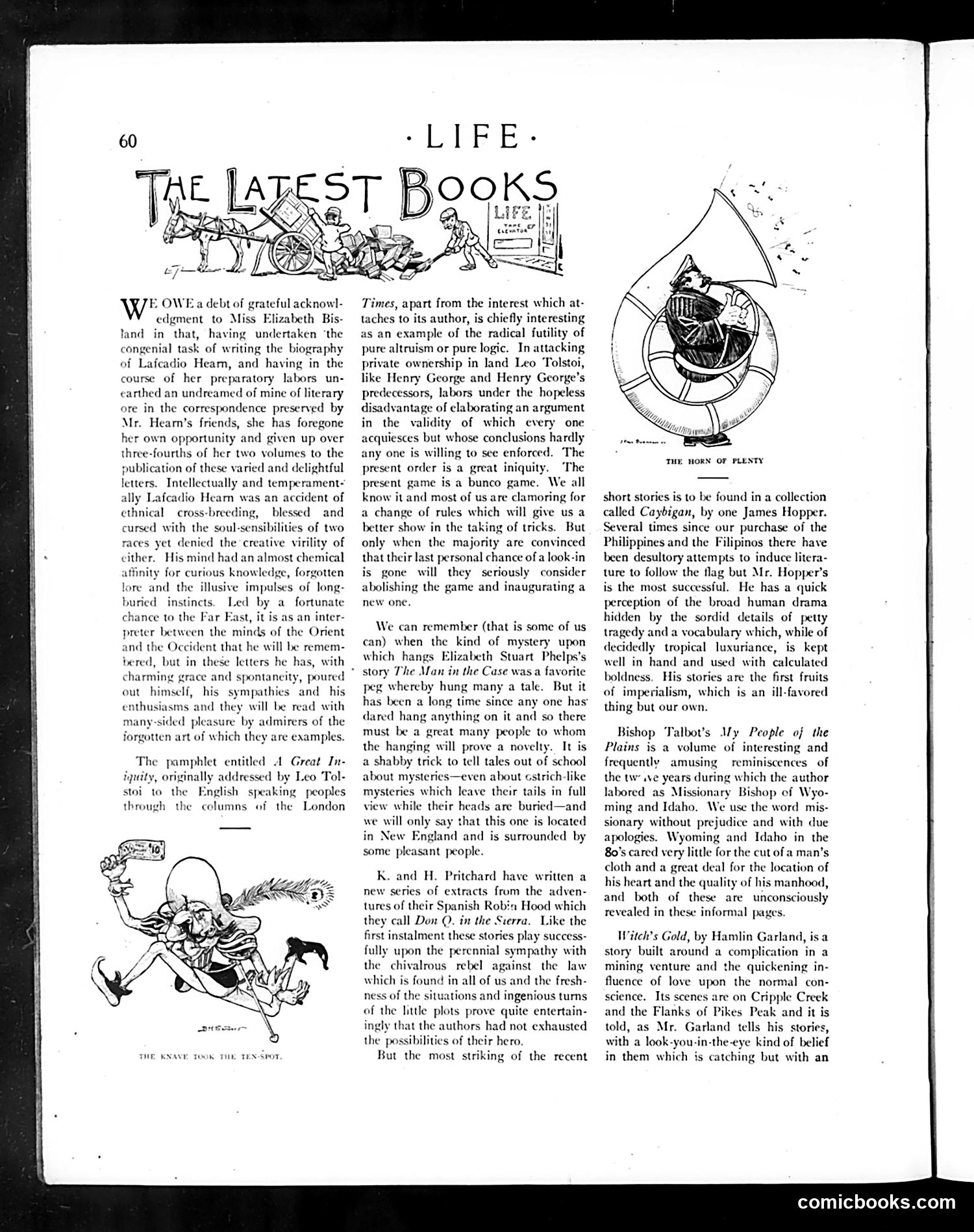
This is a book review section from Life magazine discussing recent publications. The page includes two cartoon illustrations satirizing literary themes rather than political figures. The left cartoon (captioned "The Knave Book The Ten Spot") appears to be a humorous illustration related to card games or trickery—likely mocking one of the books discussed. The right illustration titled "The Horn of Plenty" depicts a cornucopia-style horn overflowing with goods, presumably commenting on abundance or prosperity themes in literature. The text reviews several books including works by Lafcadio Hearn, Leo Tolstoy's political tract on land ownership, Elizabeth Stuart Phelps's mystery novel, and adventure stories featuring "Don Q" (a Spanish Robin Hood character). The reviews discuss these works' literary merit and social relevance rather than contemporary politics. The page's satire is literary rather than political—mocking writing conventions and publishing trends of the era.
📄 Transcribed text from this page (OCR, searchable)
Machine-transcribed from the original scan — historical spelling and the odd misread are preserved.
a debt of grateful acknowl- edgment to Miss Elizabeth Bis- land in that, having undertaken ‘the congenial task of writing the biography of Lafcadio Hea, and having in the course of her preparatory labors un- earthed an undreamed of mine of literary ore in the correspondence preserved by Mr. Hearn’s friends, she has foregone her own opportunity and given up over three-fourths of her two volumes to the publication of these varied and delightful letters. Intellectually and temperament- ally Lafcadio Heam was an accident of ethnical cross-breeding, blessed and cursed with the soul-sensibilities of two races yet denied the creative virility of cither. His mind had an almost chemica affinity for curious knowledge, forgotten lore and the illusive impulses of long- buried instincts. Led by a fortunate chance to the Far East, it i: an inter- preter between the minds of the Orient and the Occident that he will be remem- bered, but in these letters he has, with charming grace and spontaneity, poured out himself, his sympathies and his enthusiasms and they will be read with many-sided pleasure by admirers of the forgotten art of which they are examples. The pamphlet entitled A Great In- iguity, originally addressed by Leo Tol- stoi to the English speaking peoples through the columns of the London Times, apart from the interest which at- taches to its author, is chiefly interesting an example of the radical futility of pure altruism or pure logic. In attacking ‘ivate ownership in land Leo Tolstoi, like Henry George and Henry George’s predecessors, labors under the hopeless disadvantage of elaborating an argument validity of which every one acquiesces but whose conclusions hardly any one is willing to enforced. The present order is a great iniquity. ‘The present game is a bunco game. We all know it and most of us are clamoring for a change of rules which will give us a better show in the taking of tricks. But only when the majority are convinced that their last personal chance of a look-in is gone will they seriously consider abolishing the game and inaugurating a new one. We can remember (that is some of us can) when the kind of mystery upon which hangs Elizabeth Stuart Phelps’s The Man in the Case was a favorite whereby hung many a tale. But it as been a long time since any one has dared hang anything on it and so there must be a great many people to whom the hanging will prove a novelty. It is a shabby trick to tell tales out of school about mysteries—even about cstrich-like mysteries which leave their tails in full view while their heads are buried—and we will only say that this one is located in New England and is surrounded by some pleasant people. Kk. and H. Pritchard have written a new series of extracts from the adven- tures of their Spanish Robin Hood which they call Don Q. in the Sterra. Like the first instalment these stories play succe: fully upon the perennial sympathy with the chivalrous rebel against the law which is found in all of us and the fresh- ness of the situations and ingenious tums of the little plots prove quite entertain- ingly that the authors had not exhausted the possibilities of their hero. But the most striking of the recent THY, HORN OF PLENTY short stories is to be found in a collection called Caybigan, by one James Hopper. veral times since our purchase of the Philippines and the Filipinos there have been desultory attempts to induce litera- ture to follow the flag but Mr. Hopper’s is the most successful. He has a quick perception of the broad human drama hidden by the sordid details of petty tragedy and a vocabulary which, while of decidedly tropical luxuriance, is kept well in hand and used with calculated boldness. His stories are the first fruits of imperialism, which is an ill-favored thing but our own. Bishop Talbot’s My People of the Plains is a volume of interesting and frequentl nusing reminiscences of the tw’ ave years during which the author Missionary Bishop of Wyo- ming and Idaho. We use the word mis- sionary without prejudice and with due apologies. Wyoming and Idaho in the 80's cared very little for the cut of a man’s cloth and a great deal for the location of his heart and the quality of his manhood, and both of these are unconsciously revealed in these informal pages. Witch's Gold, by Hamlin Garland, is a story built around a complication in a mining venture and the quickening in- fluence of love upon the normal con- science. Its scenes are on Cripple Creek and the Flanks of Pikes Peak and it is told, as Mr. Garland tells his stories, with a look-you-in-the-eye kind of belief in them which atching but with an comicbooks.com