
Life, 1907-01-10 · page 11 of 24
Life — January 10, 1907 — page 11: what you’re looking at
What you’re looking at
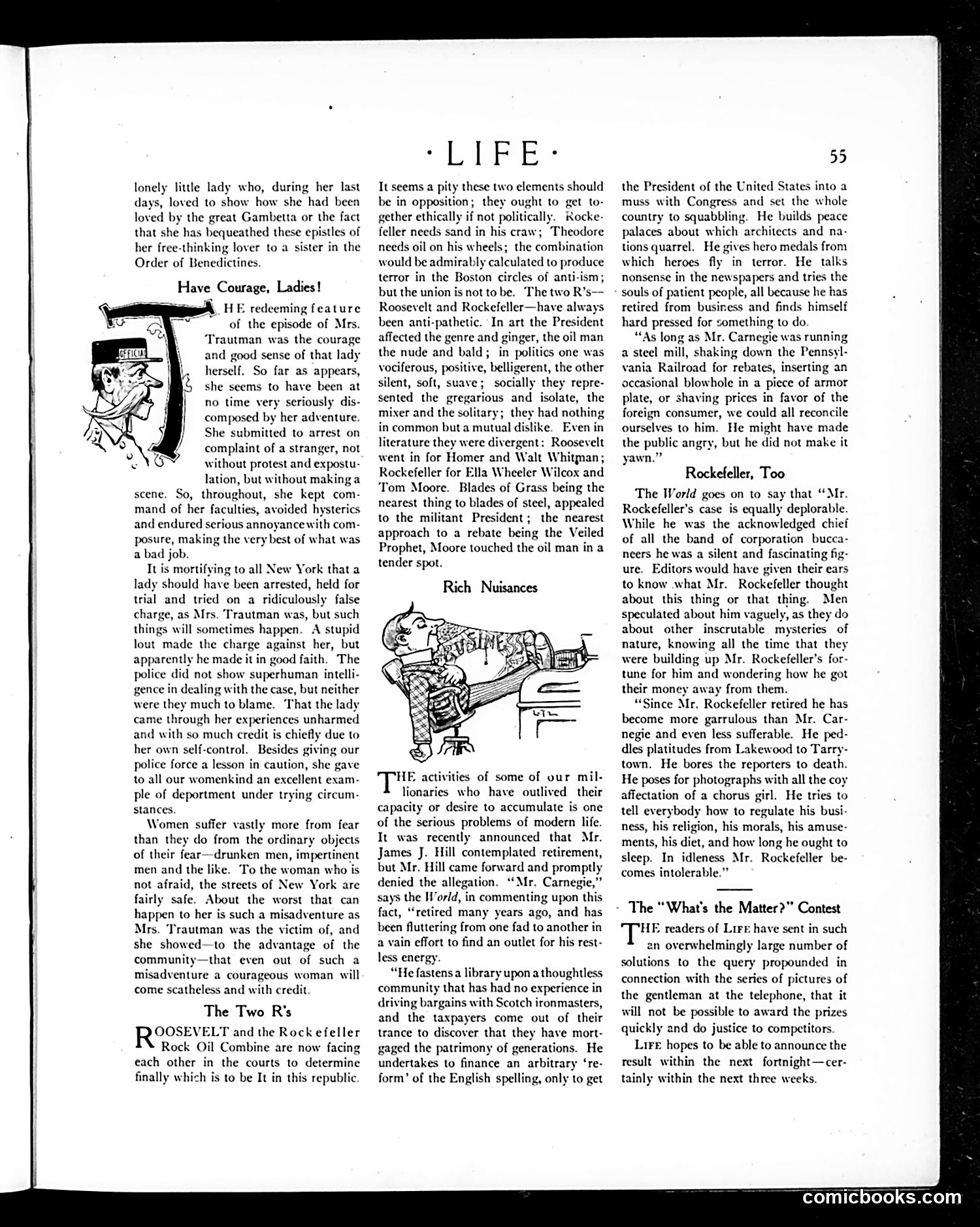
This page contains three satirical commentary sections critiquing prominent figures: **"The Two R's"** compares Roosevelt and Rockefeller, suggesting they're locked in legal conflict over oil interests. The cartoon shows a rotund figure lounging, likely caricaturing wealth and excess. **"Rockefeller, Too"** mocks John D. Rockefeller's retirement, describing him as increasingly "garrulous" and unbearable—pestering reporters with unsolicited advice about business, religion, and personal habits. The satire suggests his wealth has made him insufferably self-important. **"Have Courage, Ladies!"** discusses Mrs. Trautman, a woman falsely accused of crime but exonerated. The piece criticizes how fear and misinformation damage women's reputations, while praising her composure during her ordeal. The page reflects early-20th-century concerns about corporate power, wealth, and social justice.
📄 Transcribed text from this page (OCR, searchable)
Machine-transcribed from the original scan — historical spelling and the odd misread are preserved.
lonely little lady who, during her last days, loved to show how she had been loved by the great Gambetta or the fact that she has bequeathed these epistles of her free-thinking lover to a sister in the Order of Benedictines. Have Courage, Ladies! mp HE redeeming feature of the episode of Mrs. ‘rautman was the courage and good sense of that lady herself. So far as appears, she seems to have been at no time very seriously dis- composed by her adventure. She submitted to arrest on complaint of a stranger, not without protest and expostu- lation, but without making a scene. So, throughout, she kept com- mand of her faculties, avoided hysterics and endured serious annoyance with com- posure, making the very best of what was. a bad job. It is mortifying to all New York that a lady should have been arrested, held for trial and tried on a ridiculously false charge, as Mrs. Trautman was, but such things will sometimes happen. A stupid lout made the charge against her, but apparently he made it in good faith. The police did not show superhuman intelli- gence in dealing with the case, but neither were they much to blame. ‘That the lady came through her experiences unharmed and with so much credit is chiefly due to her own self-control. Besides giving our police force a lesson in caution, she gave to all our womenkind an excellent exam- ple of deportment under trying circum- stances. Women suffer vastly more from fear than they do from the ordinary objects of their fear—drunken men, impertinent men and the like. To the woman who is not afraid, the streets of New York are fairly safe. About the worst that can happen to her is such a misadventure as Mrs. Trautman was the victim of, and she showed—to the advantage of the community—that even out of such a misadventure a courageous woman will come scatheless and with credit The Two R's OOSEVELT and the Rock efeller Rock Oil Combine are now facing each other in the courts to determine finally which is to be It in this republic. ‘LUPE « It seems a pity these two elements should be in opposition; they ought to get to- gether ethically if not politically. Rocke- feller needs sand in his craw; Theodore needs oil on his wheels; the combination would be admirably calculated to produce terror in the Boston circles of anti-ism; but the union is not to be. The two R’s— Roosevelt and Rockefeller—have always been anti-pathetic. In art the President affected the genre and ginger, the oil man the nude and bald; in politics one was vociferous, positive, belligerent, the other silent, soft, suave; socially they repre- sented the gregarious and isolate, the mixer and the solitary; they had nothing in common but a mutual dislike. Even in literature they were divergent: Roosevelt went in for Homer and Walt Whitman; Rockefeller for Ella Wheeler Wilcox and Tom Moore. Blades of Grass being the nearest thing to blades of steel, appealed to the militant President; the nearest approach to a rebate being the Veiled Prophet, Moore touched the oil man in a tender spot. Rich Nuisances ties of some of our mil- lionaries who have outlived their capacity or desire to accumulate is one of the serious problems of modern life. It was recently announced that Mr. James J. Hill contemplated retirement, but Mr. Hill came forward and promptly denied the allegation. “Mr. Carnegie,” says the H’orld, in commenting upon this fact, “retired many years ago, and has been fluttering from one fad to another in a vain effort to find an outlet for his rest- less energy. “He fastensa library upon thoughtless community that has had no experience in driving bargains with Scotch ironmasters, and the taxpayers come out of their trance to discover that they have mort- gaged the patrimony of generations. He undertakes to finance an arbitrary ‘re- form’ of the English spelling, only to get 55 the President of the United States into a muss with Congress and set the whole country to squabbling. He builds peace palaces about which architects and na- tions quarrel. He gives hero medals from which heroes fly in terror. He talks nonsense in the newspapers and tries the souls of patient people, all because he has retired from business and finds himself hard pressed for something to do. “As long as Mr. Carnegie was running a steel mill, shaking down the Pennsyl- vania Railroad for rebates, inserting an occasional blowhole in a piece of armor plate, or shaving prices in favor of the foreign consumer, we could all reconcile ourselves to him. He might have made the public angry, but he did not make it yawn.” Rockefeller, Too The World goes on to say that “Mr. Rockefeller’s case is equally deplorable. While he was the acknowledged chief of all the band of corporation bucca- neers he was a silent and fascinating fig- ure. Editors would have given their ears to know what Mr. Rockefeller thought about this thing or that thing. Men speculated about him vaguely, as they do about other inscrutable mysteries of nature, knowing all the time that they were building up Mr. Rockefeller’s for- tune for him and wondering how he got their money away from them. “Since Mr. Rockefeller retired he has become more garrulous than Mr. Car- negie and even less sufferable. He ped- dles platitudes from Lakewood to Tarry- town. He bores the reporters to death. He poses for photographs with all the coy affectation of a chorus girl. He tries to tell everybody how to regulate his busi- ness, his religion, his morals, his amuse- ments, his diet, and how long he ought to sleep. In idleness Mr. Rockefeller be- comes intolerable.” The “What's the Matter?” Contest HE readers of Lire have sent in such an overwhelmingly large number of solutions to the query propounded in connection with the series of pictures of the gentleman at the telephone, that it will not be possible to award the prizes quickly and do justice to competitors. Lire hopes to be able to announce the result within the next fortnight—cer- tainly within the next three weeks. ~ comicbooks.com