
Life, 1907-01-10 · page 14 of 24
Life — January 10, 1907 — page 14: what you’re looking at
What you’re looking at
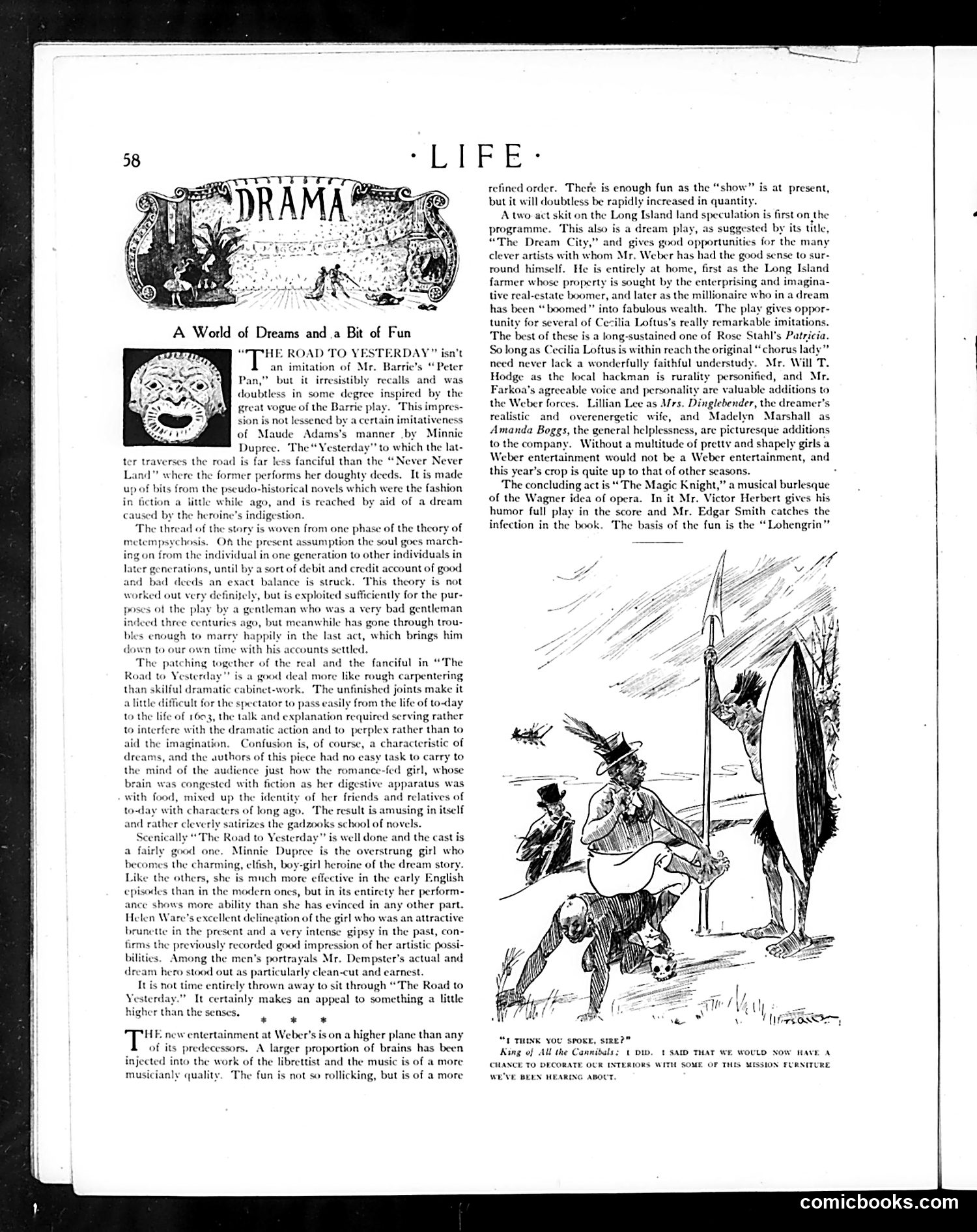
This page reviews a Broadway play imitating J.M. Barrie's *Peter Pan*. The central satire targets pseudo-historical fiction that was fashionable in early 1900s literature—the "gadzooks school of novels" referenced in the text. The plot involves a woman with indigestion who dreams herself into 1603, where she encounters reincarnated characters from her present life, based on metempsychosis (transmigration of souls). The reviewer criticizes the play's awkward construction—it clumsily stitches together modern and historical elements, making it hard to follow. The sketch at bottom right illustrates this dream-journey confusion, showing fantastical figures in a dreamscape. The review finds merit in Minnie Dupree's performance but notes the overall work is "rough carpentry" dramatically, though it offers some intellectual appeal beyond mere entertainment.
📄 Transcribed text from this page (OCR, searchable)
Machine-transcribed from the original scan — historical spelling and the odd misread are preserved.
A World of Dreams anda Bit of Fun “PCHE ROAD TO YESTERDAY an imitation of Mr. Barrie's “Peter Pan,” but it irresistibly recalls and was doubtless in some degree inspired by the great vogue of the Barrie play. ‘This impres- sion is not lessened by a certain imitativeness of Maude Adams’s manner .by Minnic Dupree. ‘The “Yesterday” to which the lat- ter traverses the road is far less fanciful than the “Never Never Land" where the former performs her doughty deeds. It is made up of bits from the pseudo-historical novels which were the fashion n fiction a little while ago, and is reached by aid of a dream caused by the heroine's indigestion. ‘The thread of the story is woven from one phase of the theory of ent assumption the soul goes march- on from the individual in one generation to other individuals in r generations, until by a sort of debit and credit account of good d bad deeds an exact balance is struck. This theory is not out very definitely, but is exploited sufficiently for the pur- play by a gentleman who was a very bad gentleman © centuries ago, but meanwhile has gone through trou- ugh to marry happily in the last act, which brings him down to our own time with his accounts settled. The patching together of the real and the fanciful in “The Road to Yesterday” is a good deal more like rough carpentering et-work. The unfinished joints make it alittle difficult for the spectator to pass easily from the life of to-day to the life of 1603, the talk and explanation required serving rather to interfere with the dramatic action and to. perplex rather than to aid the imagination. Confusion is, of course, a characteristic of dreams, and the authors of this piece had no easy task to carry to the mind of the audience just how the romance-fed girl, whose t apparatus was with food, mixed up the identity of her friends and relatives of to-d. musing in itself and rather cleverly satirizes the gadzooks school of novels. Scenically “The Road to Yesterday” is well done and the cast is a fairly good one. Minnie Dupree is the overstrung girl who s the charming, elfish, boy-girl heroine of the dream story. Like the others, she is much more effective in the carly English episodes than in the modern ones, but in its entirety her perform- ance shows more ability than she has evinced in any other part. Helen Ware's excellent delineation of the girl who was an attractive brunette in the present and a very intense gipsy in the past, con- firms the previously recorded good impression of her artistic possi- bilities. Among the men’s portrayals Mr. Dempster’s actual and dream hero stood out as particularly clean-cut and earnest. It is not time entirely thrown away to sit through “The Road to Yesterday.” It certainly makes an appeal to something a little higher than the senses. isn’t metempsychosis. On the pre: ing worke poses ot th indeed th bles en than skilful dramatic cabi rain was congested with fiction as her digestive with characters of long ago. ‘The result is becon + *# # HE new entertainment at Weber's ison a higher plane than any of its predecessors. A larger proportion of brains has been injected into the work of the librettist and the music is of a more musicianly quality. ‘The fun is not so rollicking, but is of a more *LEFE* refined order. There is enough fun as the “show but it will doubtless be rapidly increased in quantity. A two act skit on the Long Island land speculation is first on the programme. This also is a dream play, as suggested by its title, “The Dream City,” and gives good opportunities for the many clever artists with whom Mr. Weber has had the good sense to sur- round himself. He is entirely at home, first as the Long Island farmer whose property is sought by the enterprising and imagina- tive real-estate boomer, and later as the millionaire who in a dream has been “boomed” into fabulous wealth. ‘The play gives oppor- tunity for several of C a Loftus’s really remarkable imitations. ‘The best of these is a long-sustained one of Rose Stahl's Patricia. So long as Cecilia Loftus is within reach the original “chorus lady” need never lack a wonderfully faithful understud Mr. Will T. Hodge as the local hackman is rurality personified, and Mr. Farkoa’s agreeable voice and personality are valuable additions to the Weber forces. Lillian Lee as Mrs. Dinglebender, the dreamer’s. realistic and overenergetic wife, and Madelyn Marshall as Amanda Boggs, the general helplessness, are picturesque additions to the company. Without a multitude of pretty and shapely girls a Weber entertainment would not be a Weber entertainment, and this year’s crop is quite up to that of other seasons. The concluding act is “The Magic Knight,” a musical burlesque of the Wagner idea of ope In it Mr. Victor Herbert gives his humor full play in the score and Mr. Edgar Smith catches the infection in the book. The basis of the fun is the “Lohengrin” s at present, ORO, “1 THINK YOU sPoKE, sire?” King of All the Cannibals: { Dw. 1 SAID THAT WE WOULD Now HAVE A CHANCE TO DECORATE OUR INTERIORS WITH SOME OF THES MISSION FURNITURE WE'VE BEEN HEARING ABOUT, comicbooks.com