
Life, 1907-01-10 · page 6 of 24
Life — January 10, 1907 — page 6: what you’re looking at
What you’re looking at
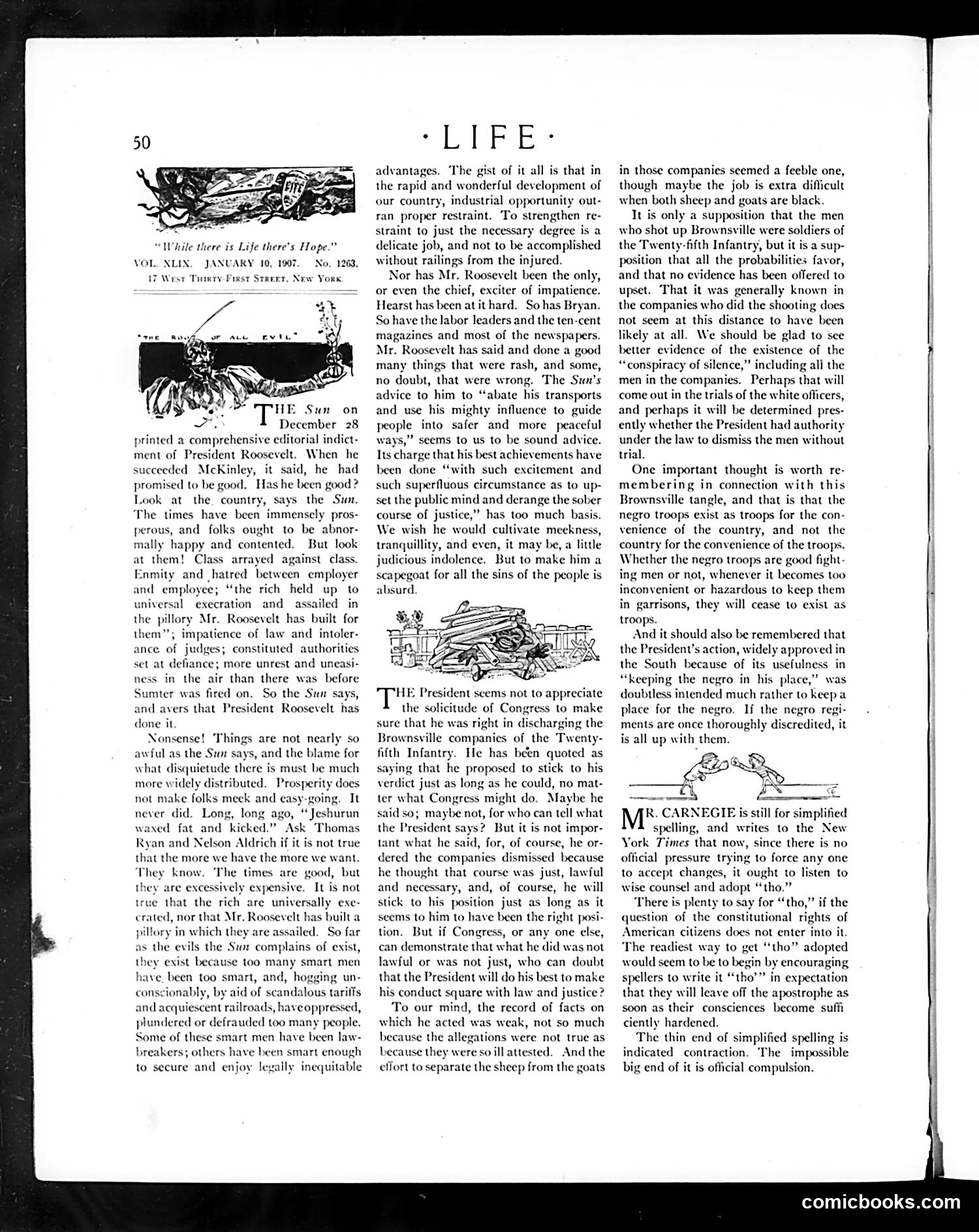
This page contains editorial commentary on President Theodore Roosevelt's handling of labor disputes and racial tensions. The text discusses Roosevelt's intervention in labor matters and his decision regarding the Brownsville companies of the Twenty-fifth Infantry—an apparent reference to the Brownsville Raid incident. The cartoons (though small and not entirely clear) appear to depict industrial/labor conflict scenes. The editorial tone is critical of Roosevelt's actions, arguing he has been inconsistent—sometimes too harsh on labor, sometimes too lenient. The piece defends the President's authority while questioning the wisdom of his decisions regarding both labor unrest and racial matters, criticizing simplified approaches to complex social problems. The overall message critiques Roosevelt's executive overreach and inconsistent moral reasoning.
📄 Transcribed text from this page (OCR, searchable)
Machine-transcribed from the original scan — historical spelling and the odd misread are preserved.
“While there is Life there's Hope.” VOL. XLIX. JANUARY 10, 1907. No. 1263, 17 West Tuirty. First Street, New York. HE Sun on December 28 printed a comprehensive editorial indict- ment of President Roosevelt. When he succeeded McKinley, said, he had promised to be good. Has he been good ? Look at the country, says the Sun. The times have been immensely pros- perous, and folks ought to be abnor- mally happy and contented. But look at them! Class arrayed against class. Enmity and hatred between employer and employee; “the rich held up to universal execration and assailed in the pillory Mr. Roosevelt has built for them”; impatience of law and intoler- ance of judges; constituted authorities set at defiance; more unrest and une ness in the air than there was before Sumter was fired on, So the Suz says, and avers that President Roosevelt has done it Nonsense! Things are not nearly so awful as the Sw says, and the blame for what disquietude there is must be much more widely distributed. Prosperity does not make folks meek and easy-going. It never did. Long, long ago, “Jeshurun waxed fat and kicked.” Ask Thomas Ryan and Nelson Aldrich if it is not true that the more we have the more we want. They know. ‘The times are good, but are excessively expensive. It is not true that the rich are universally exe- crated, nor that Mr. Roosevelt has built a Hory in which they are assailed. So far as the evils the Sw complains of exist, they exist because too many smart men have, been too smart, and, hogging un- inably, by aid of scandalous tariffs and acquiescent railroads, haveoppressed, plundered or defrauded too many people. Some of these smart men have been law- breakers; others have been smart enough to secure and enjoy legally inequitable conse *LIPE: advantages. The gist of it all is that in the rapid and wonderful development of our country, industrial opportunity out- ran proper restraint. To strengthen re- straint to just the necessary degree is a delicate job, and not to be accomplished without railings from the injured. Nor has Mr. Roosevelt been the only, or even the chief, exciter of impatience. Hearst has been at it hard. So has Bryan. So have the labor leaders and the ten-cent magazines and most of the newspapers. Mr. Roosevelt has said and done a good many things that were rash, and some, no doubt, that were wrong. The Sun’s advice to him to “abate his transports and use his mighty influence to guide people into safer and more peaceful .”? seems to us to be sound advice. Its charge that his best achievements have been done “with such excitement and uch superfluous circumstance as to up- set the public mind and derange the sober course of justice,” has too much basis. We wish he would cultivate meekness, tranquillity, and even, it may be, a litle judicious indolence. But to make him a scapegoat for all the sins of the people is absurd. HE President s eems not to appreciate the solicitude of Congress to make sure that he was right in discharging the Brownsville companies of the Twenty- fifth Infantry. He has been quoted as saying that he proposed to stick to his verdict just as long as he could, no mat- ter what Congress might do. Maybe he said so; maybe not, for who can tell what the President says? But it is not impor- tant what he said, for, of course, he or- dered the companies dismissed because he thought that course was just, lawful and necessary, and, of course, he will stick to his position just as long as it seems to him to have been the right posi tion. But if Congress, or y one else, can demonstrate that what he did was not lawful or was not just, who can doubt that the President will do his best to make his conduct square with law and justice? To our mind, the record of facts on which he acted was weak, not so much because the allegations were not true as because they were so ill attested. And the effort to separate the sheep from the goats in those companies seemed a feeble one, though maybe the job is extra difficult when both sheep and goats are black. It is only a supposition that the men who shot up Brownsville were soldiers of the y-fifth Infantry, but it is a sup- position that all the probabilities favor, and that no evidence has been offered to upset. That it was generally known in the companies who did the shooting does not seem at this distance to have been likely at all. We should be glad to see better evidence of the existence of the “conspiracy of silence,” including all the men in the companies. Perhaps that will come out in the trials of the white officers, and perhaps it will be determined pres- ently whether the President had authority under the law to dismiss the men without trial. One important thought is worth re- membering in connection with this Brownsville tangle, and that is that the negro troops exist as troops for the con- venience of the country, and not the country for the convenience of the troops. Whether the negro troops are good fight- ing men or not, whenever it becomes too inconvenient or hazardous to keep them in garrisons, they will cease to exist as troops. And it should also be remembered that the President’s action, widely approved in the South because of its usefulness in “keeping the negro in his place,” was doubtless intended much rather to keep a place for the negro. If the negro regi ments are once thoroughly discredited, it is all up with them. cs R. CARNEGIE is still for simplified spelling, and writes to the New York Times that now, since there is no official pressure trying to force any one to accept changes, it ought to listen to wise counsel and adopt “tho.” There is plenty to say for “tho,” if the question of the constitutional rights of American citizens does not enter into it. ‘The readiest way to get “tho” adopted would seem to be to begin by encouraging spellers to write it “tho’” in expectation that they will leave off the apostrophe as soon as their consciences become suffi ciently hardened. The thin end of simplified spelling is indicated contraction, The impossible big end of it is official compulsion. comicbooks.com |