
A complete issue · 28 pages · 1906
Life — November 29, 1906
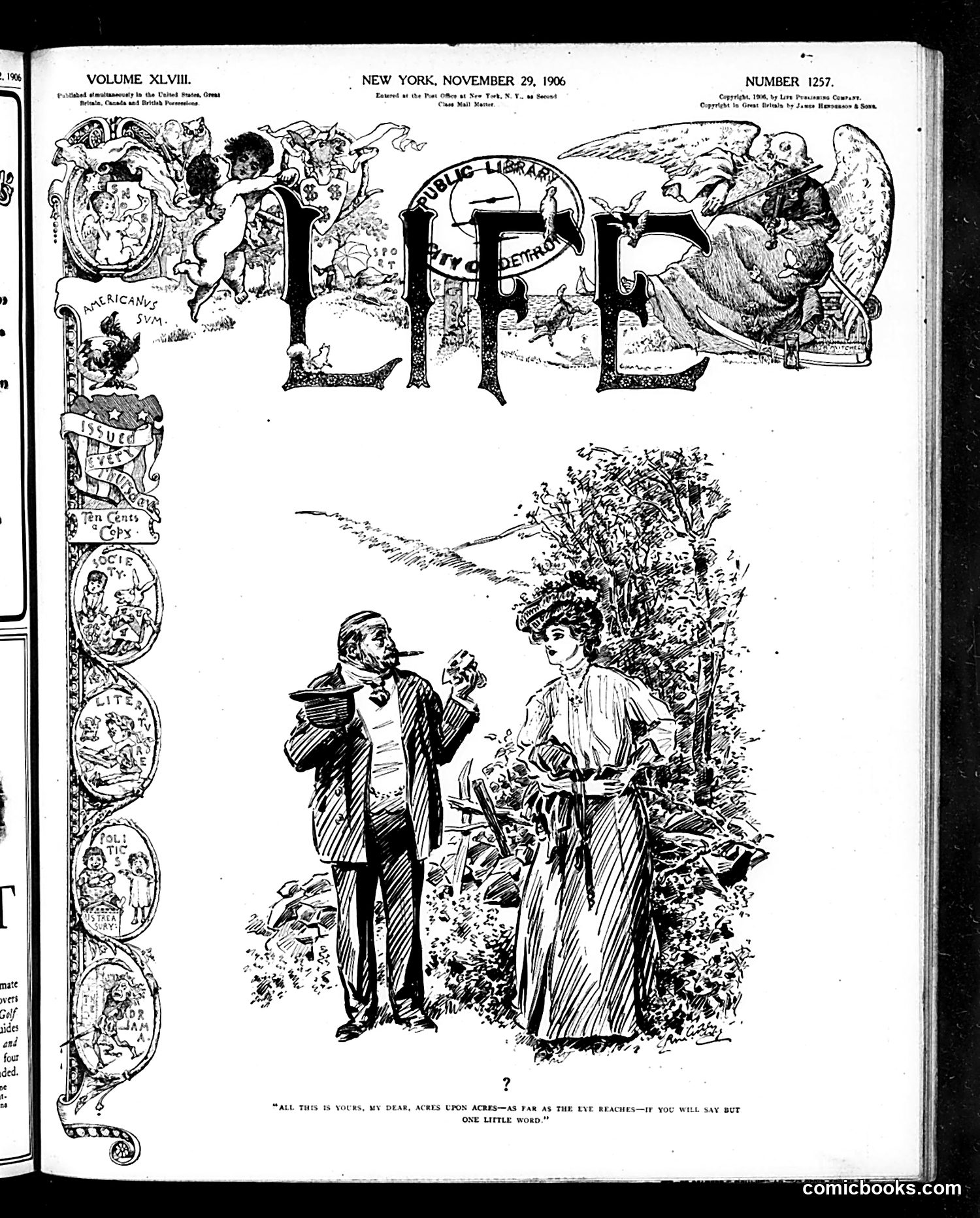
This page contains decorative header artwork and a single illustration showing a man and woman in a garden setting. The man, dressed formally, appears to be proposing or making a romantic declaration. The woman responds with the caption: "All this is yours, my dear, acres upon acres—as far as the eye reaches—if you will say but one little word." The joke appears to be a romantic reversal: typically a man would offer wealth and property to win a woman's hand in marriage, but here the woman is the property owner making the proposal. This satirizes either female property ownership (still relatively uncommon in 1906) or the changing dynamics of courtship and gender roles in the early 20th century. The humor relies on subverting conventional marriage proposal expectations.
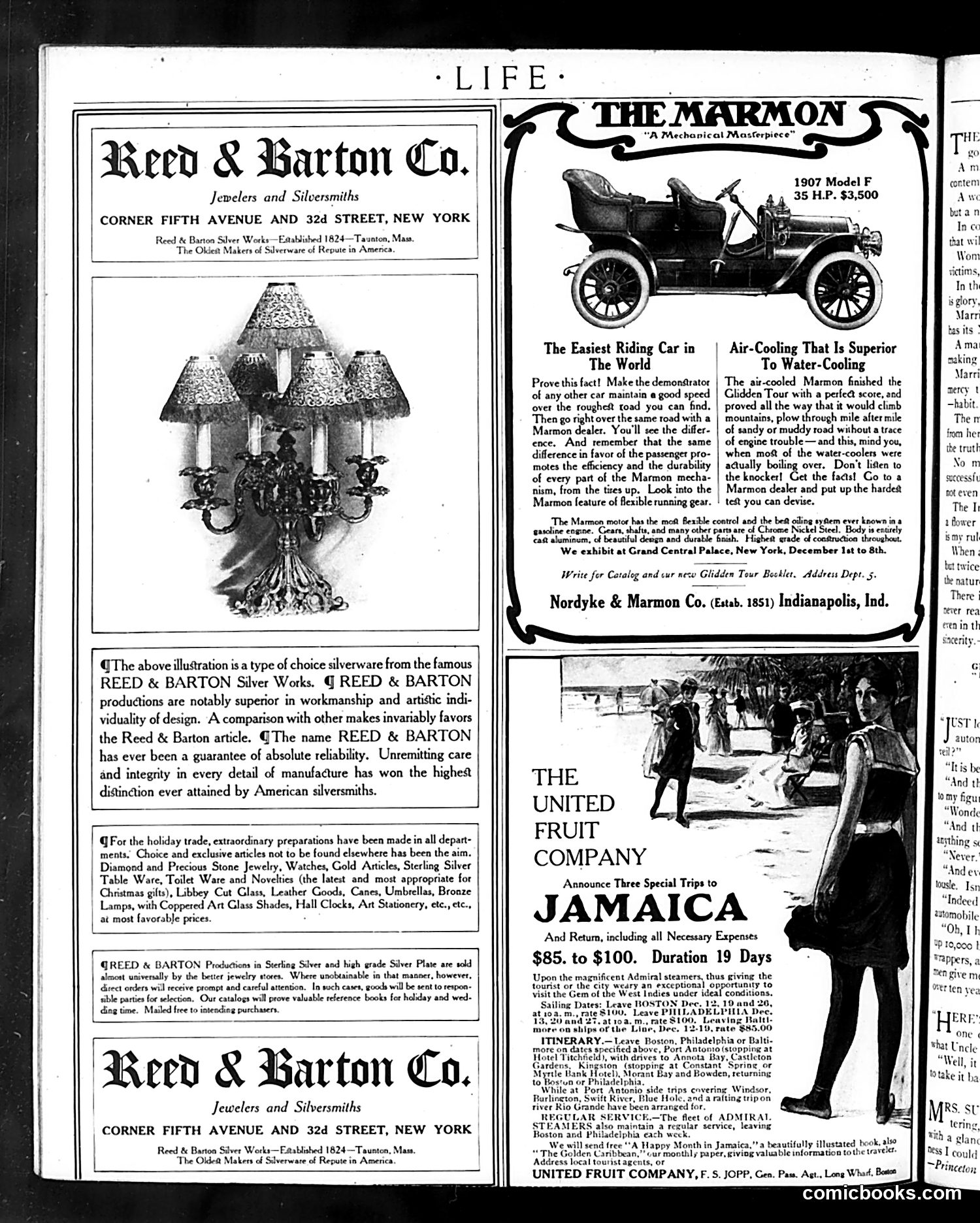
This page contains **primarily advertisements** rather than political cartoons or satirical content. The main ads feature: 1. **Reed & Barton Co.** - silverware/jewelry advertisements highlighting their craftsmanship and holiday offerings 2. **The Marmon** - a 1907 automobile advertisement emphasizing its air-cooling system as superior to water-cooling, marketed as "The Easiest Riding Car in The World" 3. **United Fruit Company** - promoting tourist trips to Jamaica for $85-$100, lasting 19 days These are standard commercial advertisements typical of early 1900s magazines. There is **no apparent political satire or social commentary** on this particular page. The Marmon ad includes product claims but no satirical intent; similarly, the Jamaica tourism ad simply promotes travel opportunities available to wealthy Americans of the era.
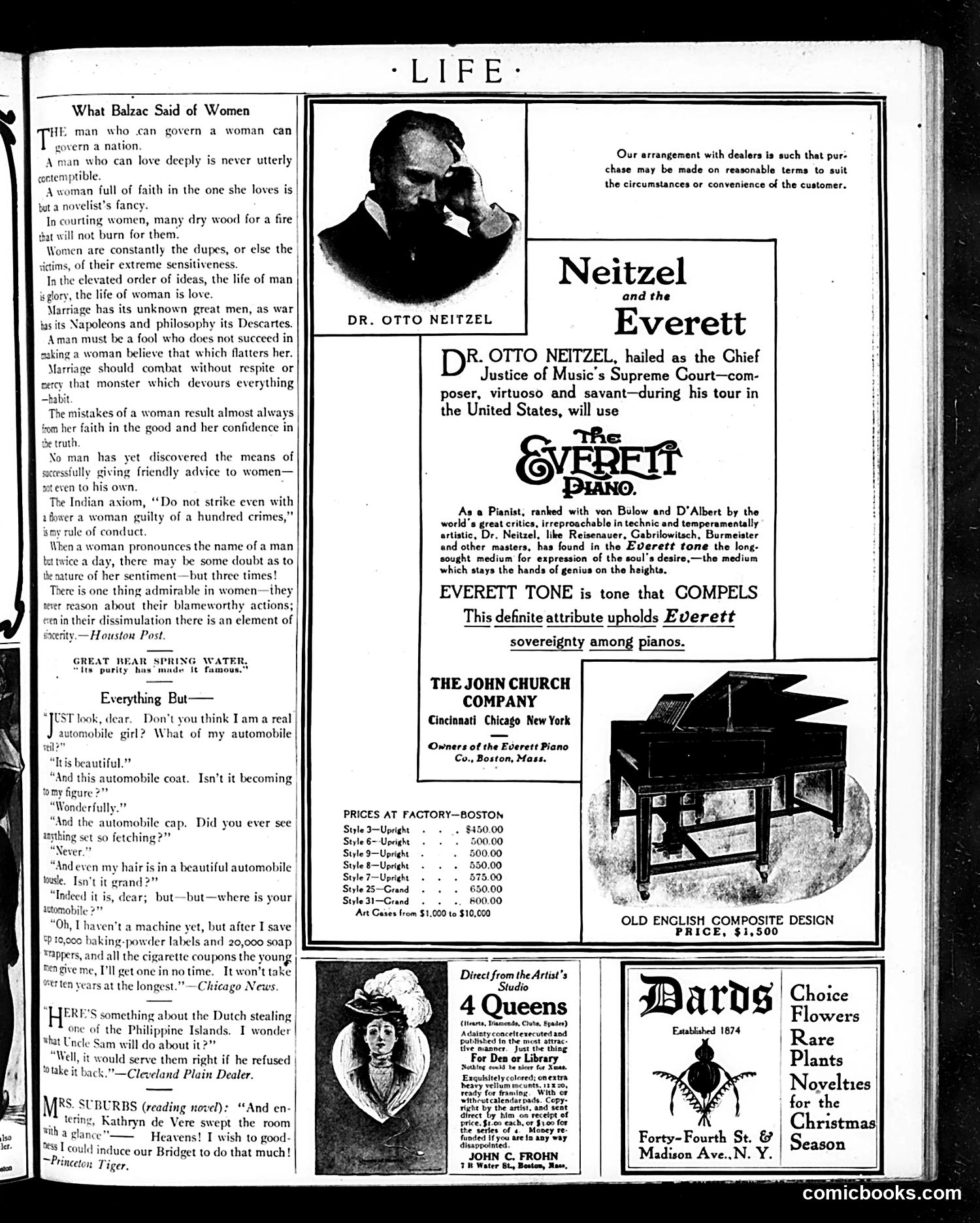
This page is primarily **advertising and humorous filler content** rather than political satire. The left column contains a quote attributed to Balzac about women's nature, followed by a comedic dialogue ("Everything But—") mocking automobile enthusiasm—a woman boasts about her car's accessories but admits she lacks the actual automobile. This reflects early 1900s car culture humor. The right side features advertisements: Dr. Otto Neitzel endorsing the Everett piano, The John Church Company promoting piano prices, and ads for "4 Queens" artwork and Dard's flowers. The only potentially satirical element is the Balzac quote section, which gently mocks romantic idealization of women—typical of Life's era. However, this appears to be **general social commentary rather than targeted political satire**, making it primarily a product-advertisement page with light humor.
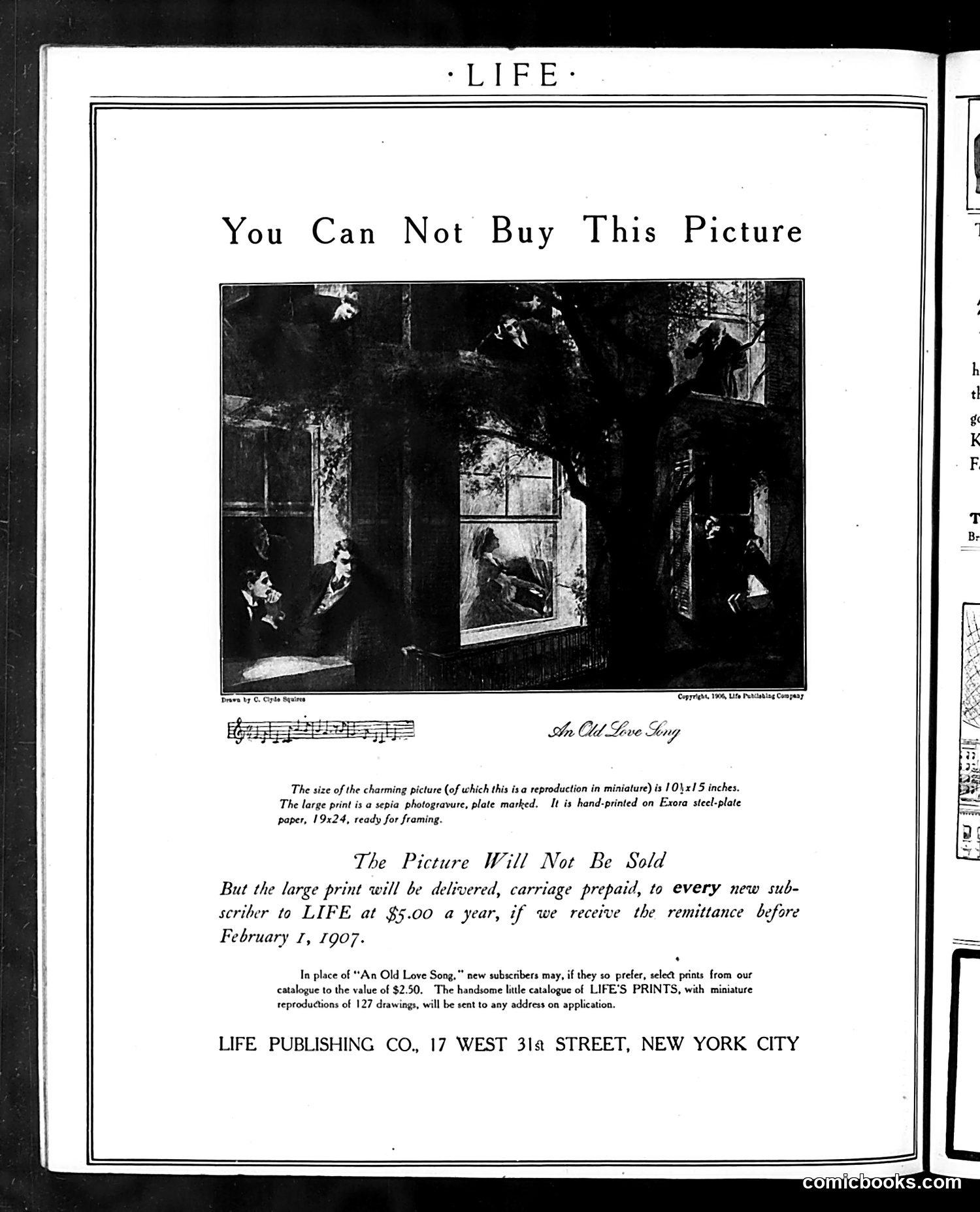
This page is primarily **advertising content**, not editorial satire. Life Publishing Company is promoting an art print titled "An Old Love Song," drawn by C. Crale Opsimus, offered as a subscription incentive. The advertisement uses the paradoxical headline "You Can Not Buy This Picture" to create intrigue. The actual offer: new subscribers paying $5.00 annually (with payment received by February 1, 1907) would receive a large reproduction of this romantic scene—depicting figures in what appears to be a moonlit interior or garden setting. The marketing strategy emphasizes exclusivity and value: the print is hand-printed on quality paper, framed-ready, and unavailable through regular commercial channels. Subscribers could alternatively select other prints valued at $2.50 from Life's catalog.
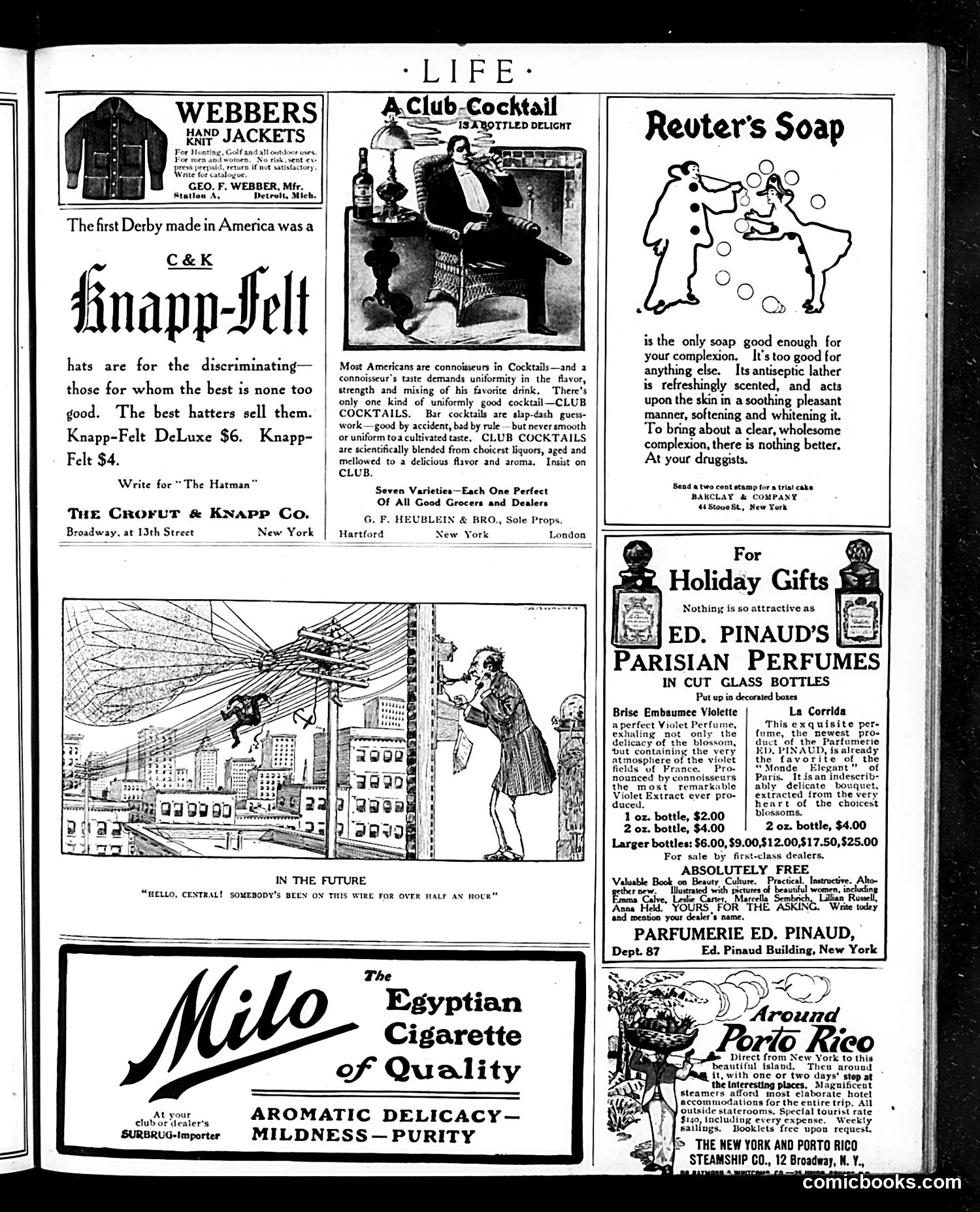
This page is primarily **advertising**, not satire or political commentary. It contains product ads for: - **Webbers Hand Jacket** (clothing) - **Knapp-Felt** (hats) - **Club Cocktail** (alcoholic beverage) - **Reuter's Soap** - **Ed. Pinaud's Parisian Perfumes** - **Milo Egyptian Cigarettes** - **Around Porto Rico** (steamship travel) The one cartoon—"In the Future"—depicts a futuristic cityscape with flying machines and a woman, captioned about someone being "on this wire for over half an hour." This appears to be a joke about telephone technology becoming commonplace, reflecting early 20th-century fascination with modern invention. The page reflects 1920s consumer culture and leisure activities rather than political satire.
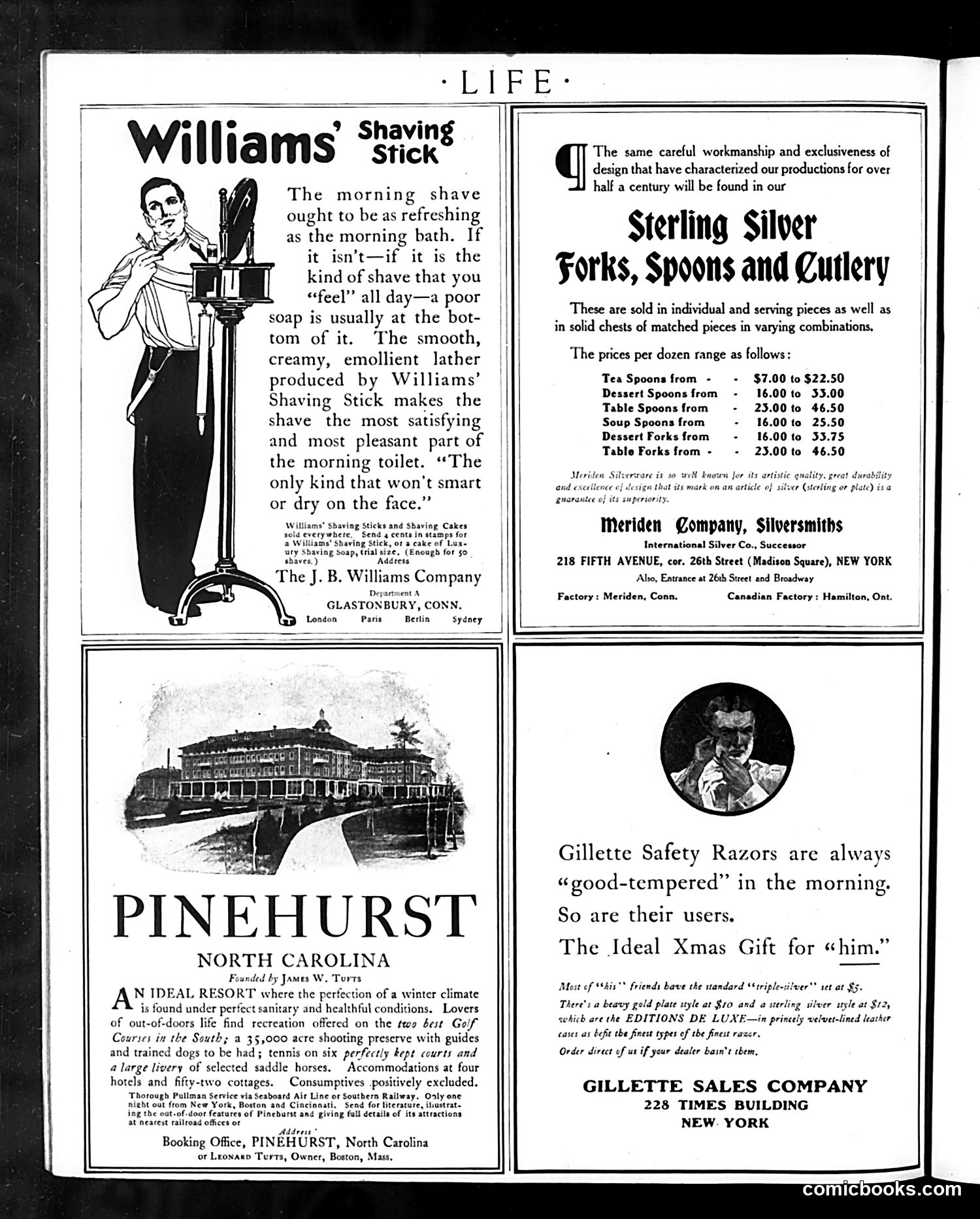
This page is **primarily advertising** rather than satirical content. It contains four ads: 1. **Williams' Shaving Stick** - A straightforward product advertisement emphasizing the quality of the lather and shaving experience. 2. **Meriden Sterling Silver** - Promoting flatware and cutlery with price listings for various pieces. 3. **Pinehurst, North Carolina** - A resort advertisement describing it as an "ideal resort" with shooting, golf, and comfortable accommodations, appealing to wealthy tourists. 4. **Gillette Safety Razors** - A gift advertisement suggesting razors as Christmas presents, with copy playing on the phrase "good-tempered." There is **no political satire or social commentary** visible. This appears to be a standard early 20th-century magazine page designed for advertising luxury consumer goods and leisure activities.
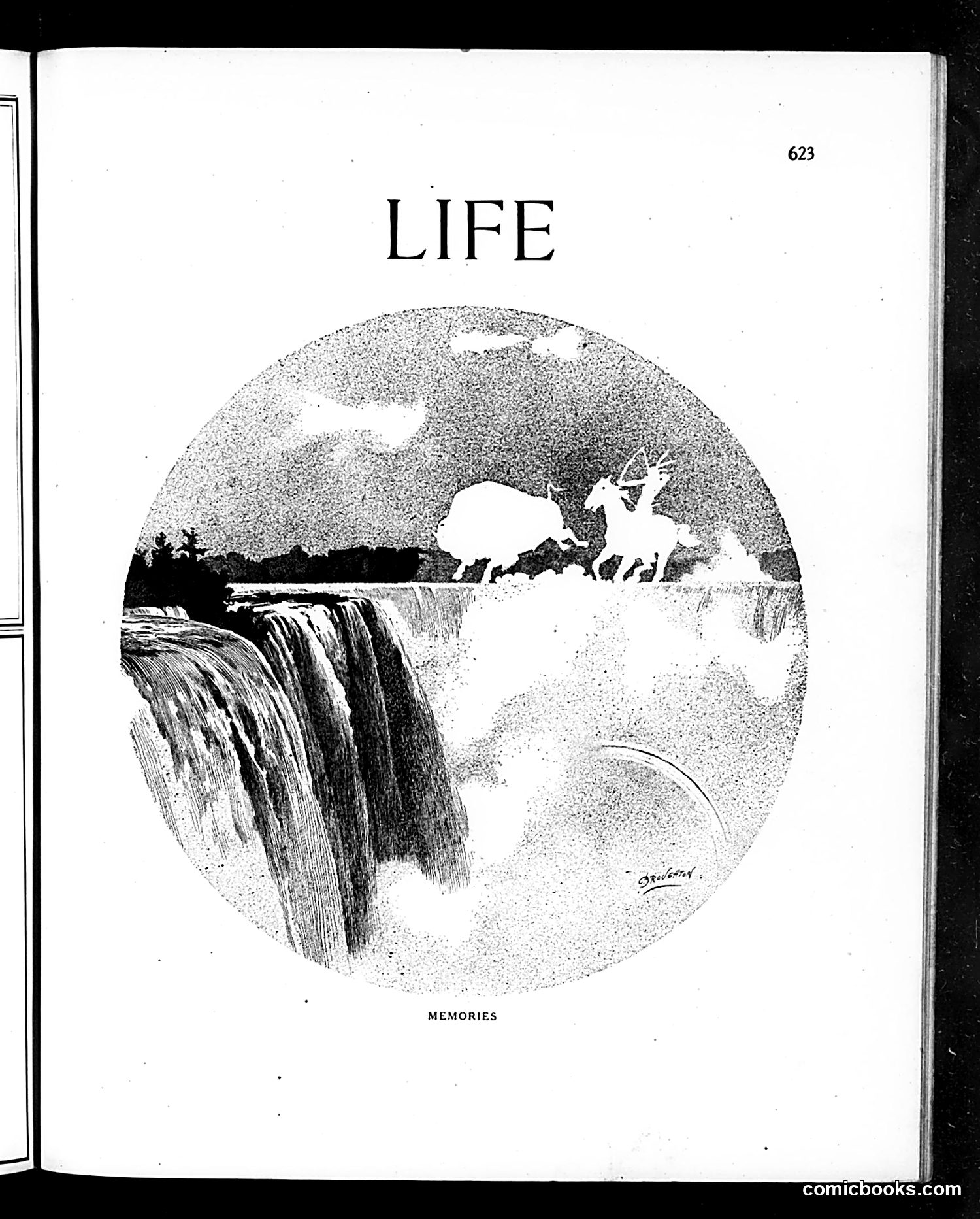
This is a title page for a section called "Life: Memoirs" (page 623). The circular illustration depicts a dramatic natural scene: a waterfall on the left, with what appears to be a deer or similar animal on elevated terrain to the right, set against a dotted/stippled sky suggesting atmosphere or vastness. Without additional context from surrounding pages, the specific satirical meaning is unclear. However, given *Life* magazine's tradition of social commentary, this likely introduces a satirical memoir or commentary on American life, nature, or society. The romantic landscape imagery may ironically frame memoirs about contemporary life—a common *Life* magazine technique contrasting idealized nature with modern reality. The artist's signature is visible in the lower right.
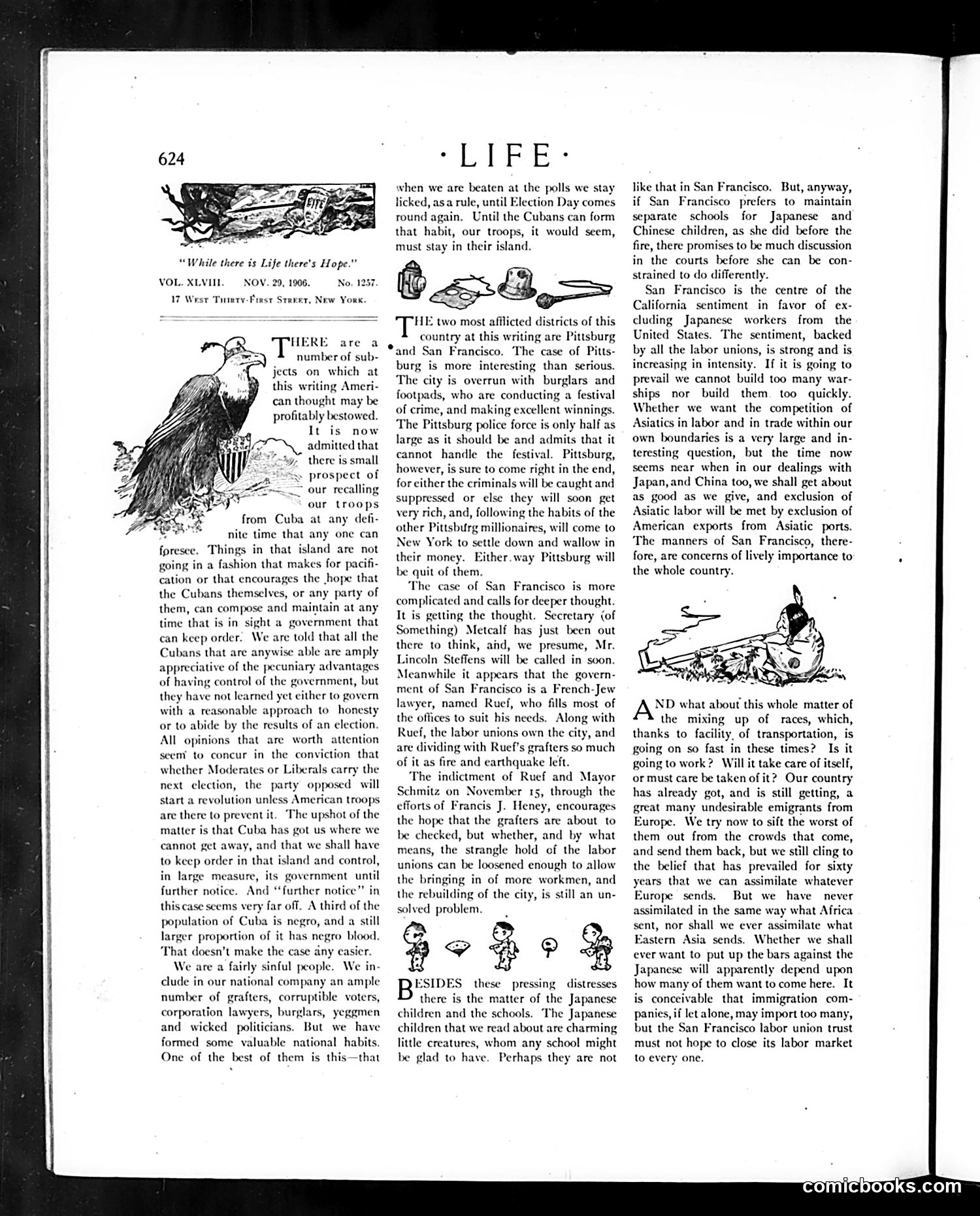
This page discusses two major political crises: the Pittsburg (sic) crime wave and San Francisco's Japanese exclusion movement following the 1906 earthquake. The **Pittsburg segment** satirizes civic disorder—burglars and criminals operating freely while the understaffed police force struggles to maintain control. The text suggests either criminals will be caught or they'll become wealthy enough to settle in New York, mocking both the city's inability to govern and criminals' predictable behavior. The **San Francisco section** addresses labor union opposition to Japanese immigration and school segregation. The satire criticizes how San Francisco's French-Jewish lawyer-mayor and labor unions exploit anti-Japanese sentiment, while warning that America risks its moral standing by discriminating against Asian workers—especially given America's historical failure to assimilate other immigrant groups justly. The cartoons (small illustrations visible) appear to reinforce these themes of civic disorder and ethnic conflict.
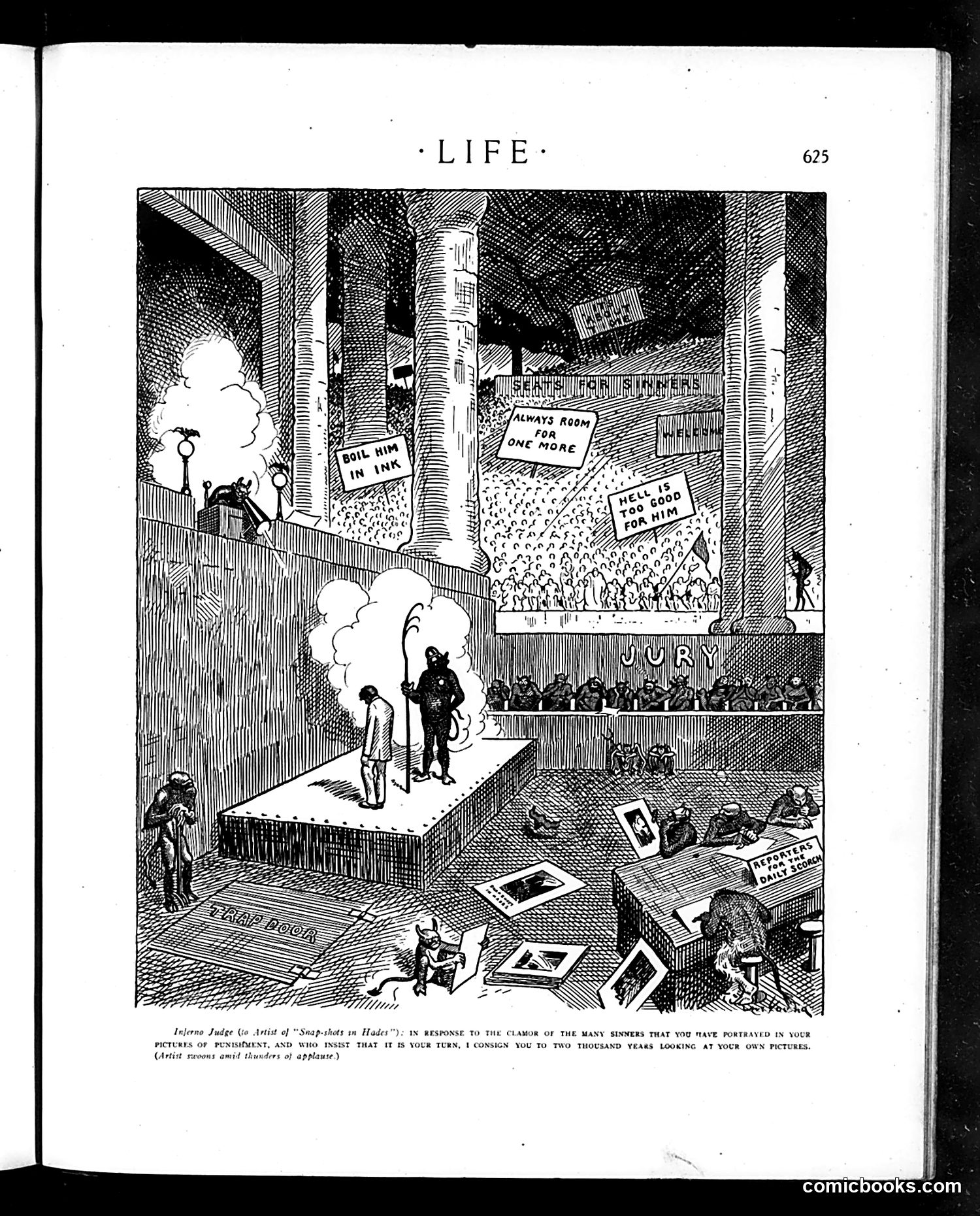
This is an allegorical courtroom scene satirizing media sensationalism and public voyeurism. The cartoon depicts an infernal trial ("JURY" visible in the background) where judges and crowds eagerly consume lurid "pictures of punishment." Signs reading "BOIL HIM IN," "ALWAYS ROOM FOR ONE MORE," and "HELL IS TOO GOOD FOR HIM" suggest the public's bloodthirsty demand for extreme punishment coverage. The scattered photographs and newspapers labeled "DAILY" at bottom indicate how sensational press imagery fuels this appetite for violence. The caption references "Sinners" and condemning people based on published pictures—critiquing how illustrated newspapers and magazines commercially exploit criminal cases and public outrage. The satire targets both media exploitation and the audience complicit in demanding such graphic content.
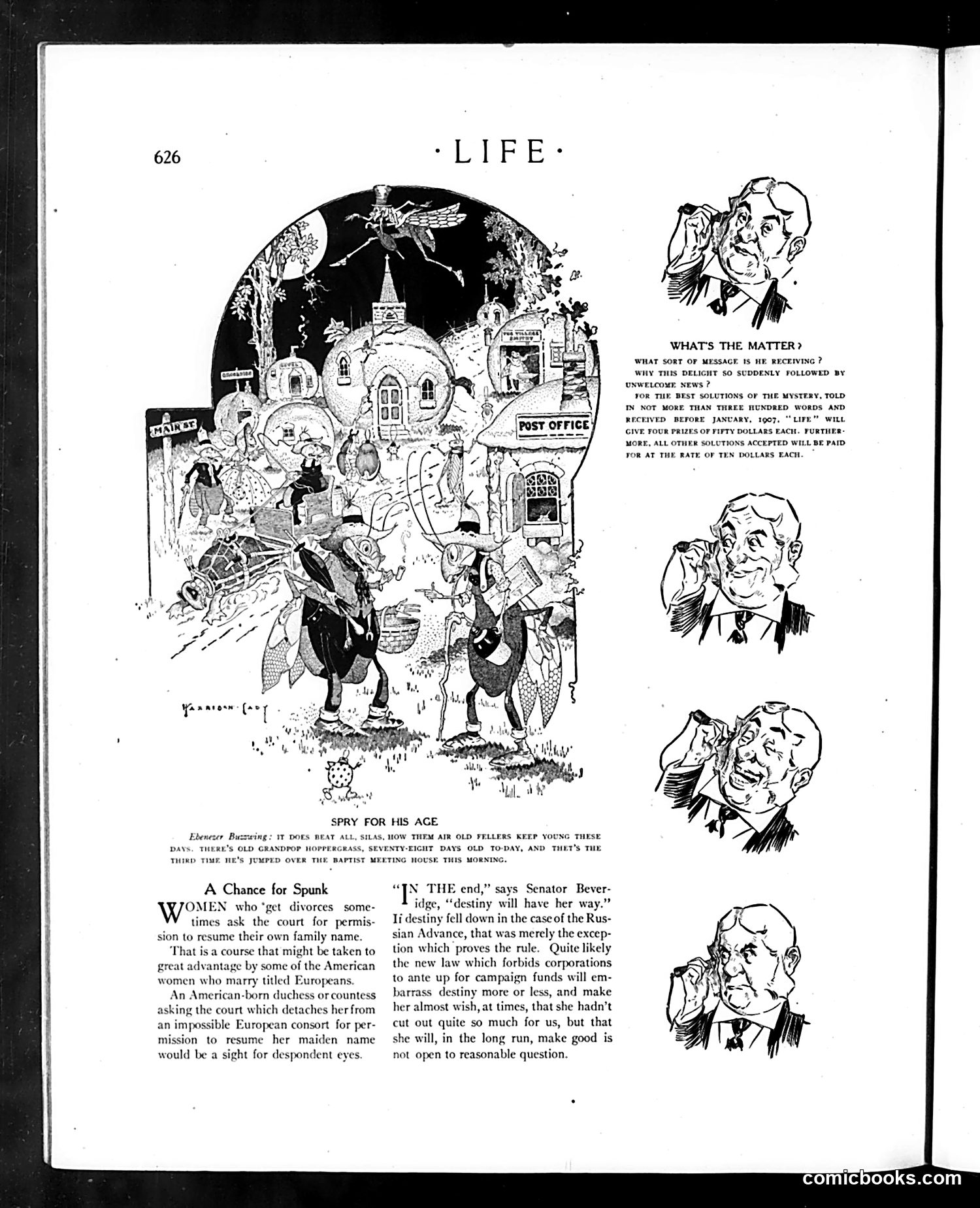
This page contains two distinct satirical pieces: **"Spry for His Age"** (left): An elaborate whimsical illustration depicting an fantastical town scene with mushroom-shaped buildings and a Post Office. The caption references an elderly man ("seventy-eight days old to-day") who supposedly still attends meetings—the satire appearing to mock either political longevity or absurdly extended public service. **"A Chance for Spunk"** (right): Text discussing women divorcing and resuming maiden names. The satire targets American-born nobility marrying titled Europeans, suggesting women should reclaim independence rather than adopt foreign titles. Senator Beveridge is quoted, discussing "destiny" and corporate campaign finance restrictions—likely referencing early-20th-century Progressive Era debates about women's rights and corporate political influence. The cartoon faces on the right appear designed to illustrate different reactions to these social controversies.
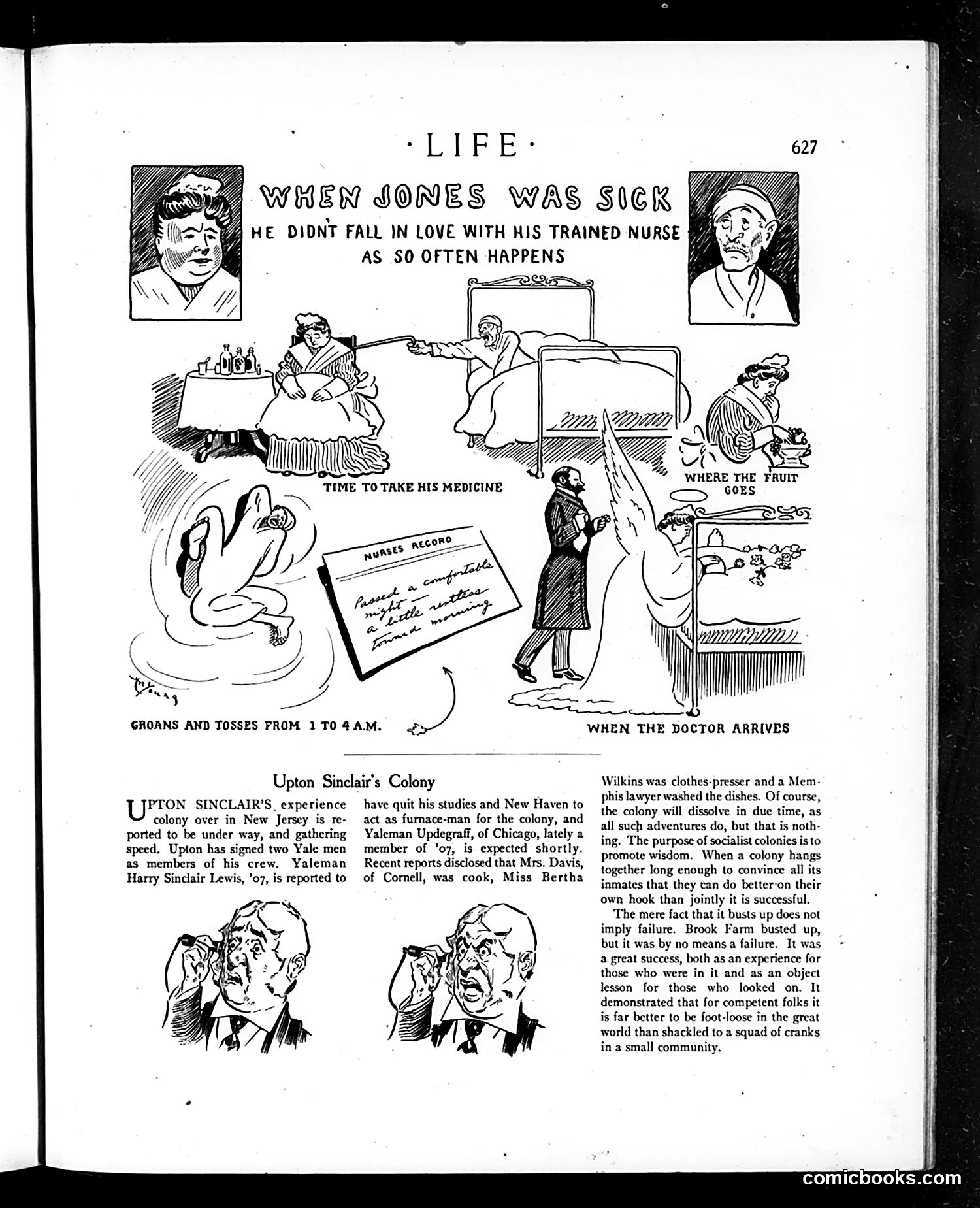
This page from *Life* magazine contains two distinct pieces: **Top: "When Jones Was Sick"** is a humorous comic strip about a man's experience during illness. The joke subverts the romantic cliché that sick men fall for their nurses—instead, Jones remains unromantic, complaining about medicine, groaning at night, and dismissing his nurse's care. The satire mocks sentimental fiction tropes by showing realistic, unglamorous illness behavior. **Bottom: "Upon Sinclair's Colony"** reports on Upton Sinclair's socialist utopian community experiment in New Jersey. The text describes the colony's practical challenges (hiring staff, housing arrangements) and includes skeptical commentary about such communes' viability. Two caricatured faces appear, likely depicting Sinclair or colony figures, though specific identities aren't labeled. The overall tone suggests mild mockery of idealistic socialist ventures.
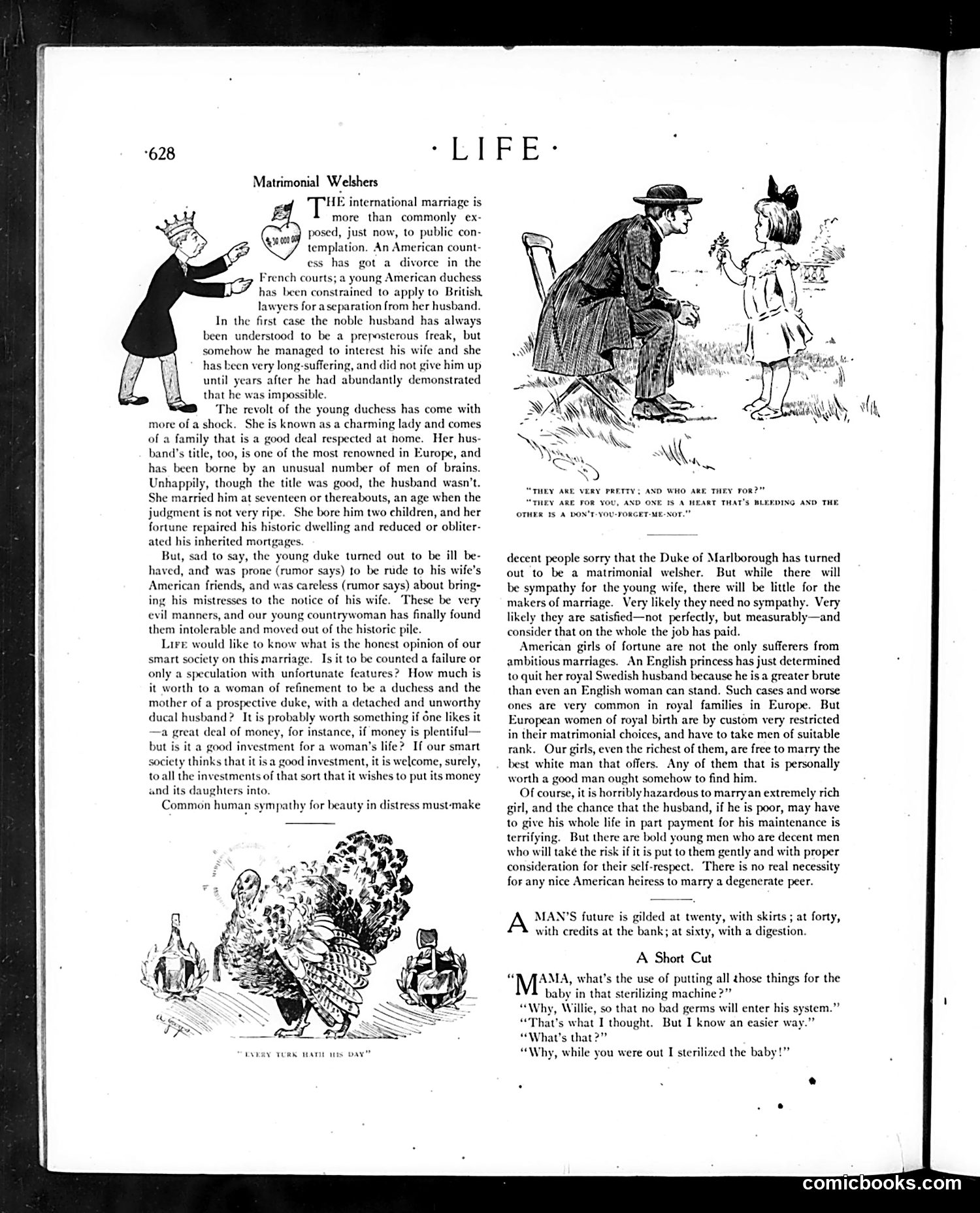
This page satirizes international marriages, particularly between American heiresses and European nobility. The main cartoon depicts a shabby, older European gentleman with a young girl—illustrating the article's theme that wealthy American women marry titled but impoverished European men. The text critiques this practice, noting that while European aristocrats may have prestigious titles, many lack character or financial stability. The article argues American women shouldn't marry merely for titles, especially when unsuitable matches occur. A secondary joke, "A Short Cut," depicts a woman sterilizing baby bottles as her husband suggests this prevents germs from entering the baby—misunderstanding the actual purpose. The satire targets both the superficiality of transatlantic matrimonial arrangements and gender-based assumptions about women's knowledge.
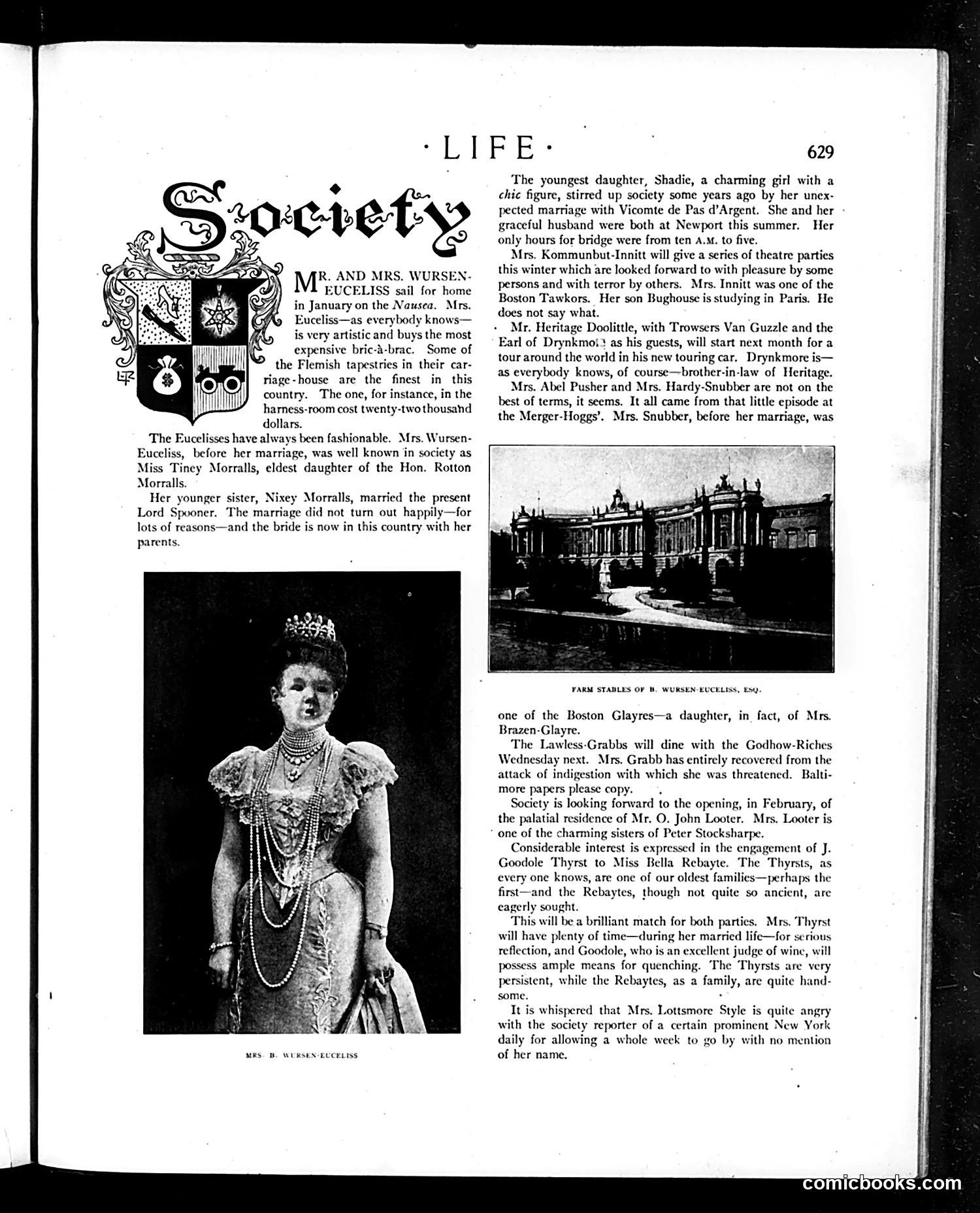
This is a **society gossip column**, not political satire. The page reports on wealthy New York families' social activities circa early 1900s. The content includes: - **Mrs. D. Wursen-Eucceliss** (photographed in formal dress with tiara and jewelry) and her family's travels and social standing - Notes on various engagements, dinners, and upcoming events among prominent families (Spouers, Glayres, Grabbs, Thyrsts, Rebaytes) - A photograph of **Farm Stables of B. Wursen Eucceliss, Esq.** The satire appears subtle—the exaggerated, flowery prose about trivial social movements ("a whole week to go by with no mention of her name") gently mocks high-society's preoccupations. This represents Life magazine's tradition of satirizing the leisure class through deadpan documentation of their self-important social calendars.
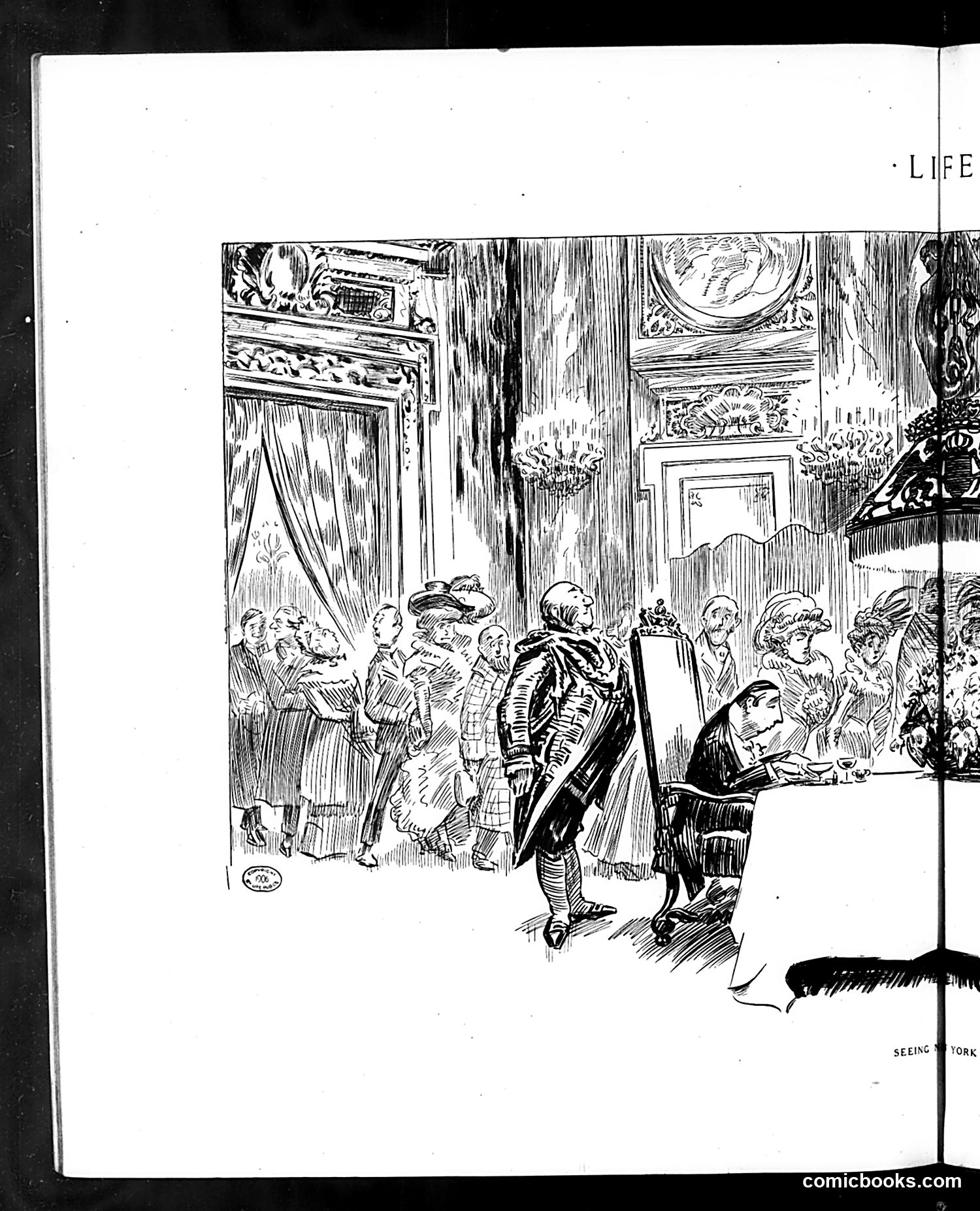
This is a satirical ink illustration depicting an elegant European salon or reception room. A military officer in a decorated uniform and cape stands prominently in the center, surrounded by well-dressed attendees in an ornate interior with elaborate wall decorations and drapery. The caption fragment "SEEING NEW YORK" suggests this depicts a social scene being observed or toured. Without the complete text or artist attribution visible, the specific satire is unclear—it may be mocking aristocratic pretension, military pomposity, or the social climbing of wealthy New Yorkers imitating European refinement. The composition emphasizes the contrast between the grand officer and the gathered crowd, but the precise political or social target remains uncertain without additional context.
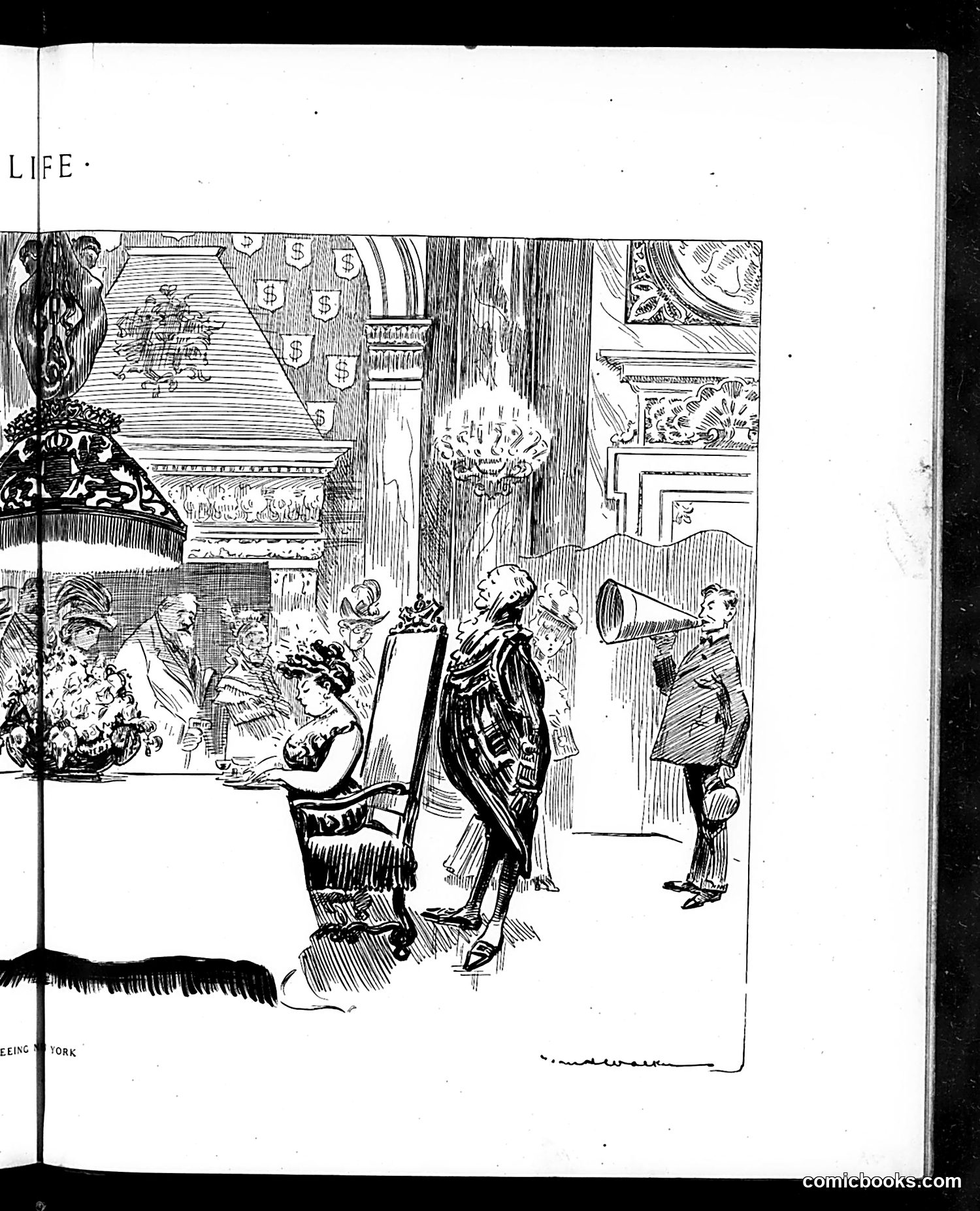
This page from *Life* magazine shows a satirical drawing of what appears to be a formal diplomatic or royal reception scene. The central figure is a formally dressed woman being presented to or greeting dignitaries in an ornate interior setting with classical architectural details. A military or uniformed officer on the right holds what appears to be a megaphone, suggesting he's announcing or promoting the woman. The satire likely targets either a society figure's social ambitions, diplomatic pretensions, or possibly commentary on American attitudes toward European nobility or aristocracy. The theatrical staging and the megaphone suggest mockery of grandiose self-promotion or inflated social importance. Without additional context or visible text identifying the specific figures, the exact satirical target remains unclear, though the composition suggests critique of social climbing or ceremonial pretension.
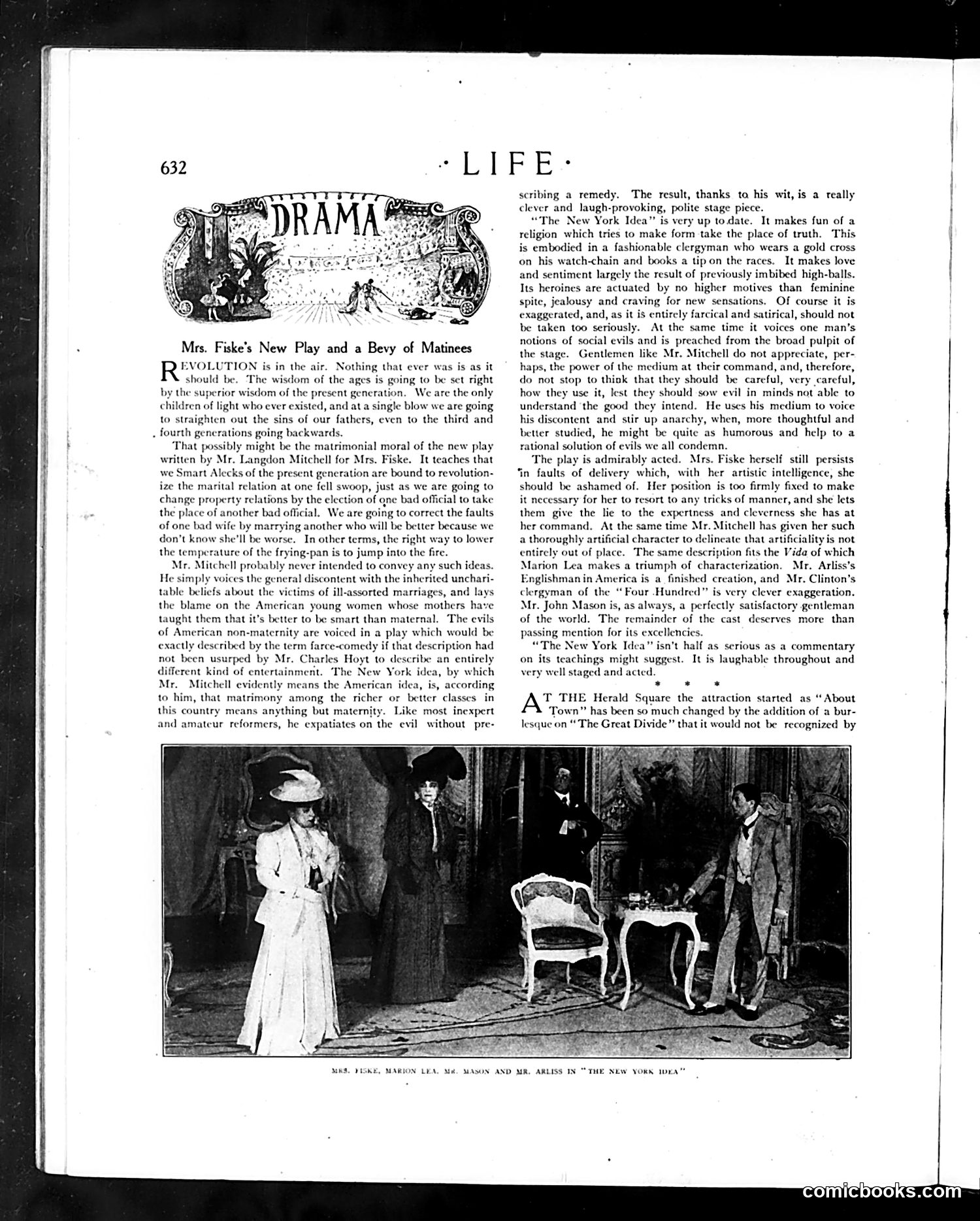
This page reviews playwright Langdon Mitchell's play "The New York Idea," starring Mrs. Fiske (a prominent actress of the era). The critic uses the review to discuss what he sees as the play's central problem: it critiques modern American marriage practices—particularly wealthy women prioritizing social sophistication over motherhood—but does so through farce without offering serious solutions. The satire targets the play's attack on contemporary marriage as meaningless formality, clerical hypocrisy (a fashionable minister who bets on horses), and women motivated by "spite, jealousy and craving for new sensations." The critic worries Mitchell wields his theatrical platform irresponsibly, "sow[ing] evil in minds not able to understand the good." He praises the acting while criticizing Mrs. Fiske's affected delivery. The photograph shows a scene from the production.
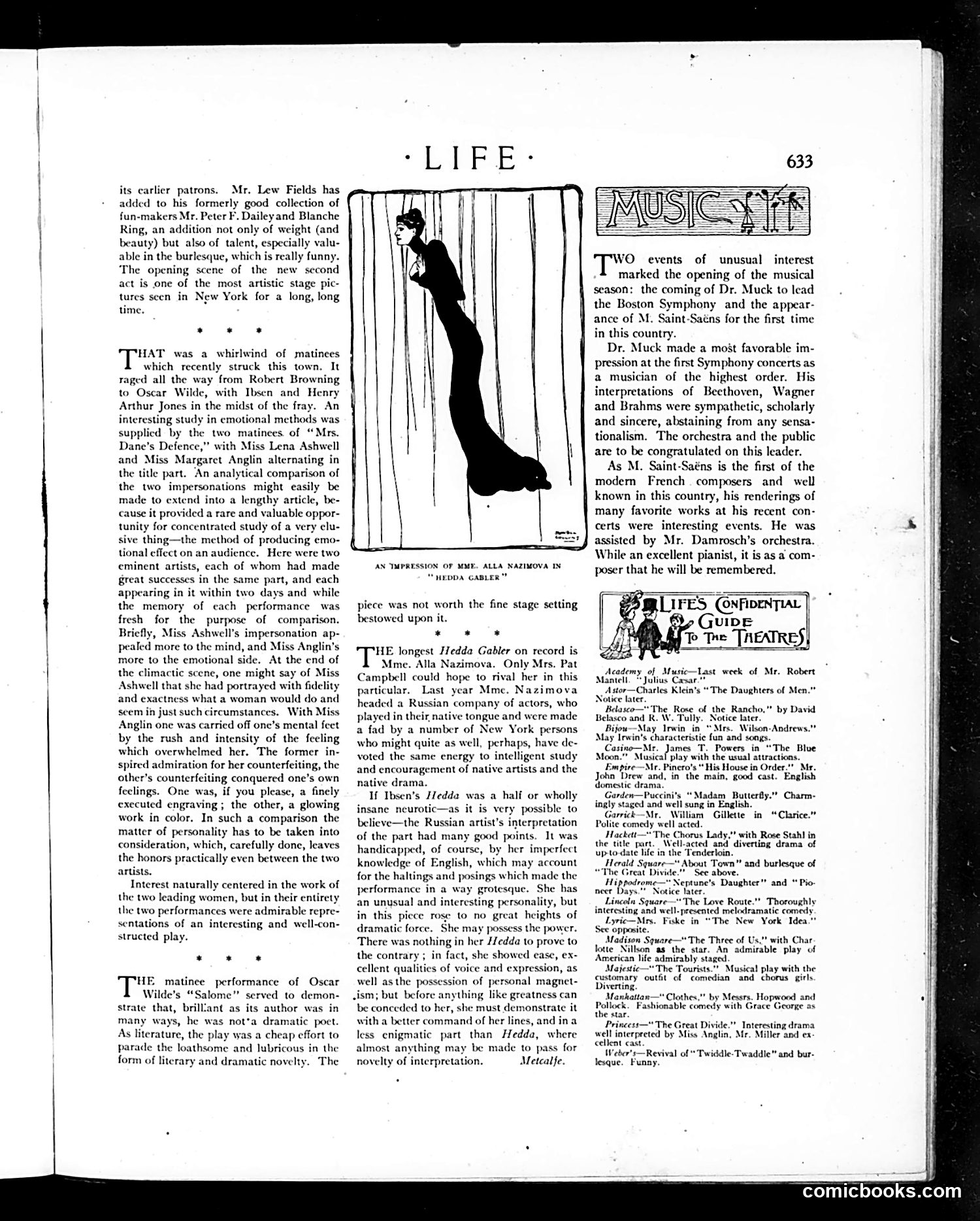
This page from *Life* magazine reviews recent theatrical performances in New York. The main illustration shows actress Alla Nazimova in a dramatic pose from Ibsen's *Hedda Gabler*. The critic discusses competing matinee performances, particularly comparing two actresses (Lena Ashwell and Margaret Anglin) playing the same role in "Mrs. Dane's Defence"—one appealing more to intellect, the other to emotion. Regarding Nazimova: the review acknowledges her "unusual and interesting personality" but criticizes her *Hedda Gabler* performance as somewhat grotesque, partly attributing this to her imperfect English. The critic notes she led a Russian company that became fashionable among New York audiences, suggesting they should instead support native American drama and artists. The page also dismisses Oscar Wilde's *Salome* as literature disguised as drama—"cheap effort" lacking genuine dramatic merit despite fine staging.
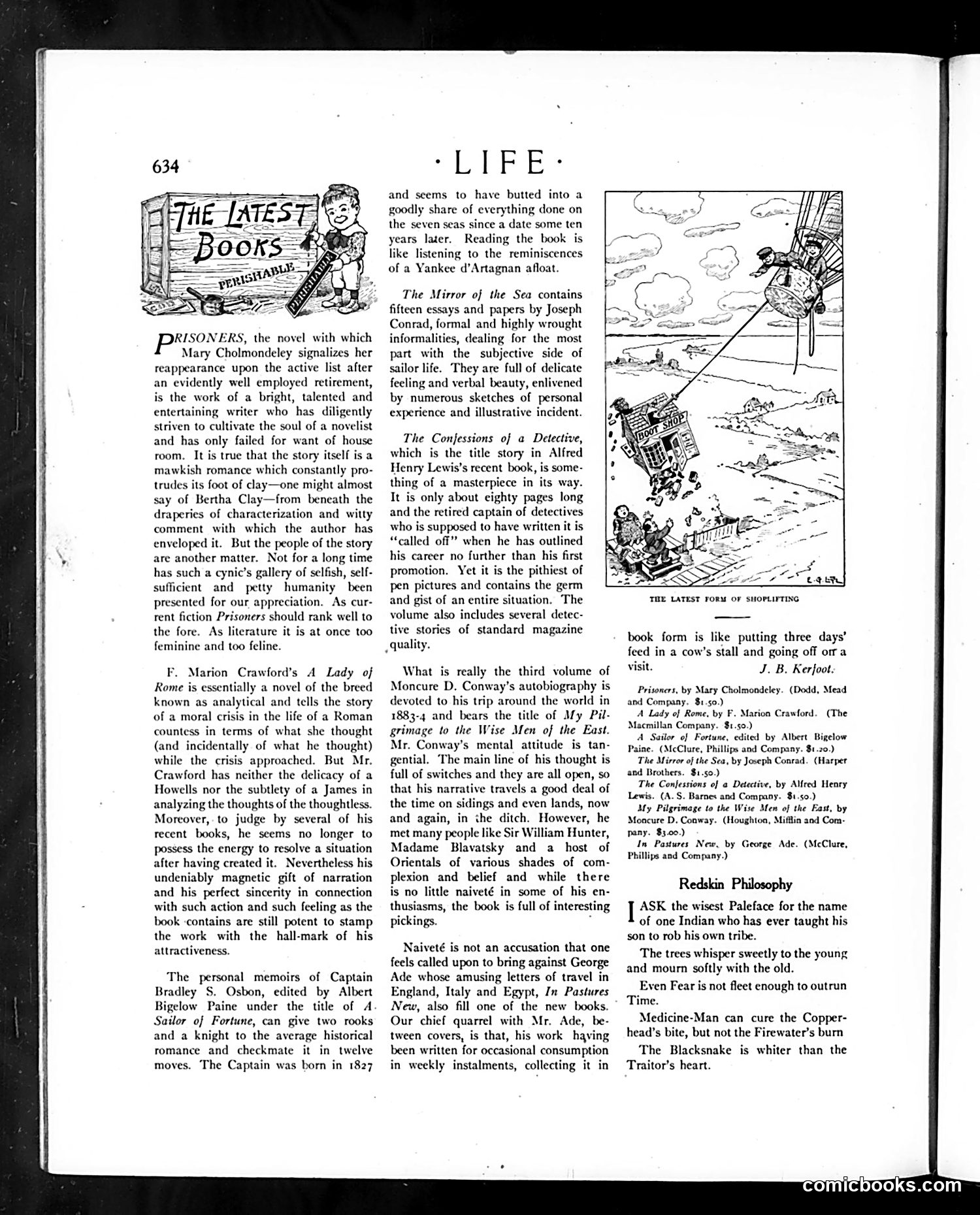
This page contains literary reviews of contemporary novels, not political cartoons. The small illustration labeled "THE LATEST FORM OF SHOPLIFTING" shows a figure being lowered by rope from a ship to steal from a house below—a humorous visual joke about creative theft methods. The reviews discuss new books by authors including Mary Cholmondeley (*Prisoners*), F. Marion Crawford (*A Lady of Rome*), Joseph Conrad (*The Mirror of the Sea*), and others. The critic praises characterization in some works while criticizing others for lacking subtlety or energy. A separate section titled "Redkin Philosophy" presents brief Native American proverbs or sayings. The page reflects early 20th-century literary criticism standards, emphasizing psychological realism, narrative sincerity, and refined prose style as markers of quality fiction.
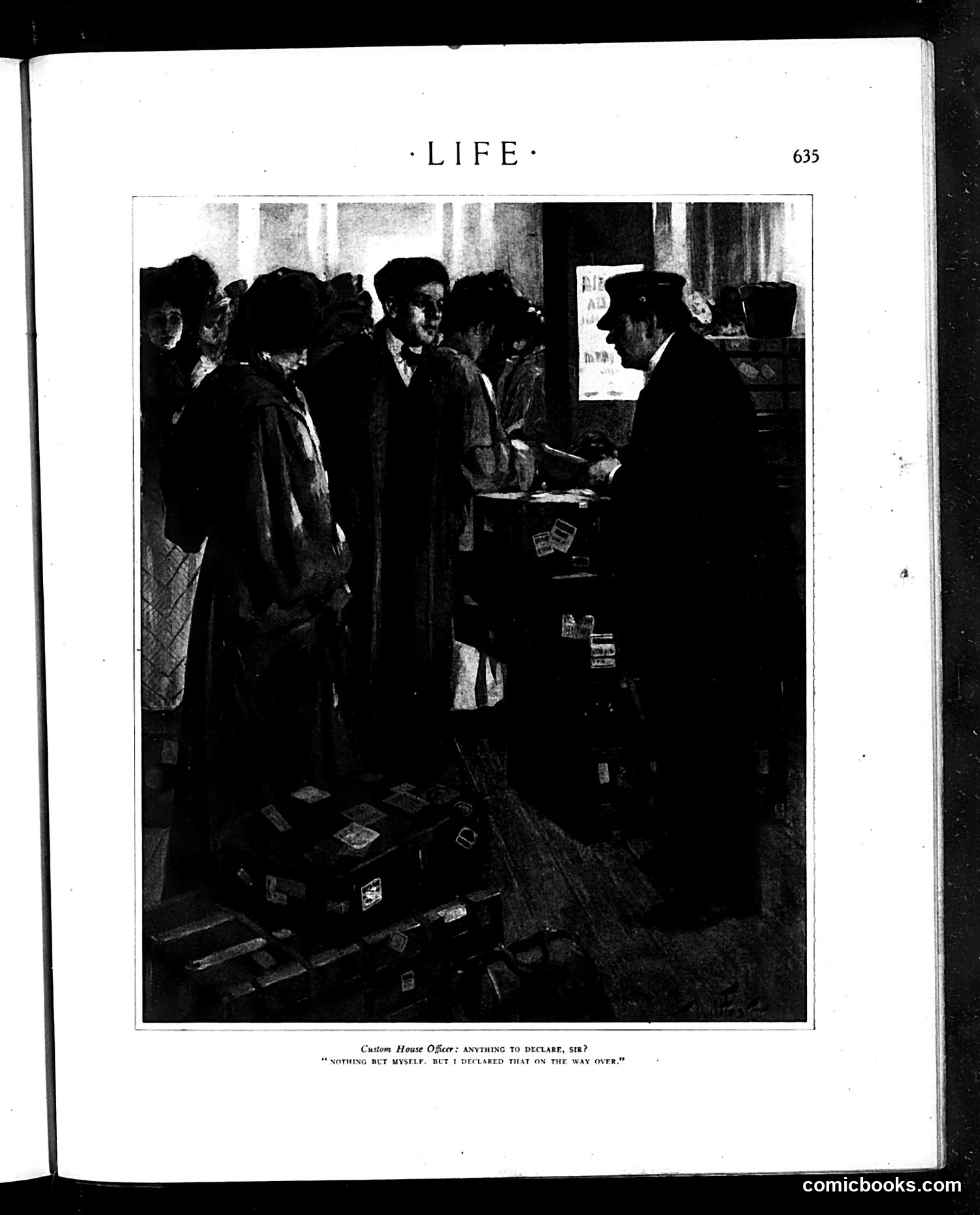
This illustration depicts a customs inspection scene at what appears to be a U.S. port of entry. A customs official questions a traveler about their luggage and declarations, with the caption reading: "Anything to declare, sir? 'Nothing but myself. But I declared that on the way over.'" The satire targets the repetitive nature of customs procedures—the traveler has already declared themselves once and finds it absurd to do so again. This likely comments on either the inefficiency of bureaucratic processes or the irony of thorough customs inspections that seem redundant. The crowd of waiting passengers suggests the volume of travelers enduring these procedures, making the point about bureaucratic tedium and frustration relatable to readers familiar with international travel.
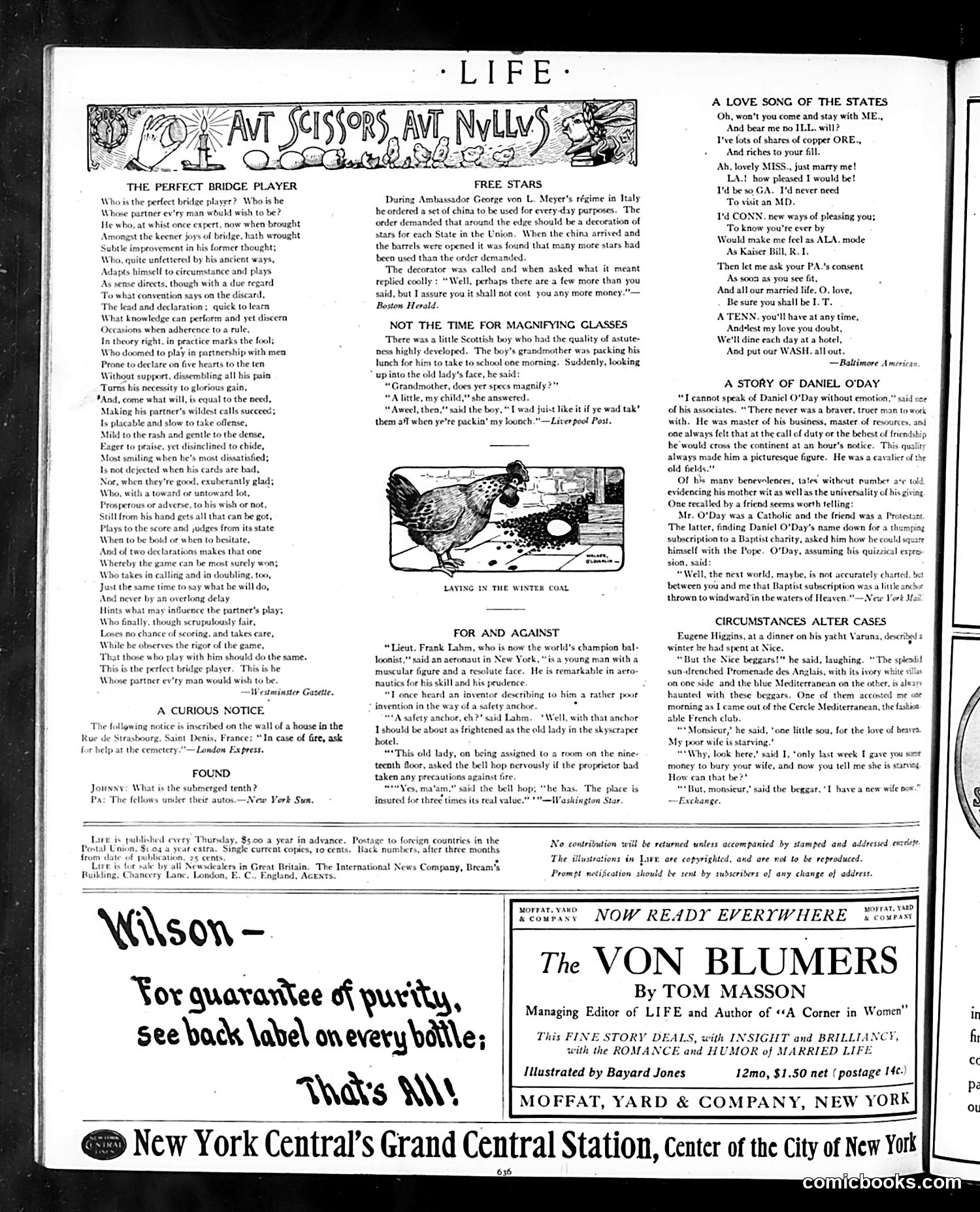
This page from *Life* magazine contains several humorous pieces rather than political cartoons: **"The Perfect Bridge Player"** is a lengthy poem satirizing bridge etiquette and player psychology—mocking both rigid adherence to rules and their violation, while praising composure and adaptability. **"Free Stars"** jokes about Ambassador George von L. Meyer's china order for the State Department in Italy, where the decorator included extra stars (presumably for non-states or duplicates) but assured no additional cost would be charged—poking fun at both bureaucratic oversight and the decorator's casual attitude. **"Not the Time for Magnifying Glasses"** presents a Scottish boy's wordplay: asking his grandmother if her spectacles magnify, implying her face appears larger through them. **"For and Against"** compares balloonist Frank Lahm's prudence with an elderly hotel guest's irrational fears about fire safety on the nineteenth floor. The page is primarily light humor and social commentary rather than political satire—typical of *Life's* approach during this era.
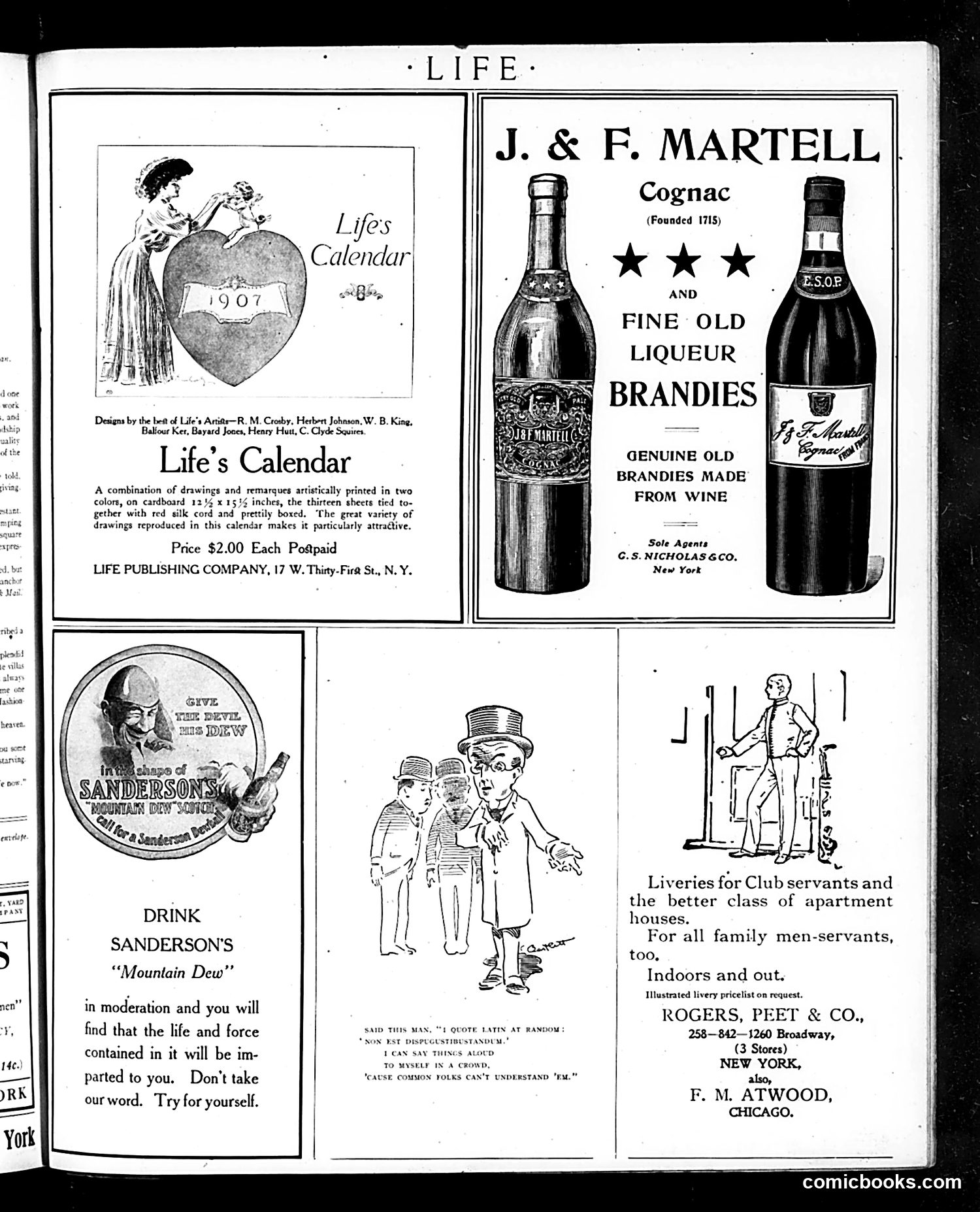
This page is primarily **advertising**, not satire or political commentary. It contains four distinct advertisements from circa 1907: 1. **Life's Calendar (1907)**: A product advertisement for an illustrated desk calendar priced at $2.00, featuring artwork by Life magazine's staff artists. 2. **J. & F. Martell Cognac**: A liquor advertisement highlighting three-star and V.S.O.P. brandies, with sole agents listed in New York. 3. **Sanderson's Mountain Dew**: A beverage advertisement claiming the drink imparts "life and force" when consumed "in moderation." 4. **Rogers, Peet & Co.**: An advertisement for livery uniforms for servants and apartment building staff, with locations in New York and Chicago. The small cartoon in the center (with Latin text) appears unrelated to the surrounding ads—its specific meaning is unclear without context. Overall, this represents typical early 20th-century magazine advertising targeting upper-class consumers.
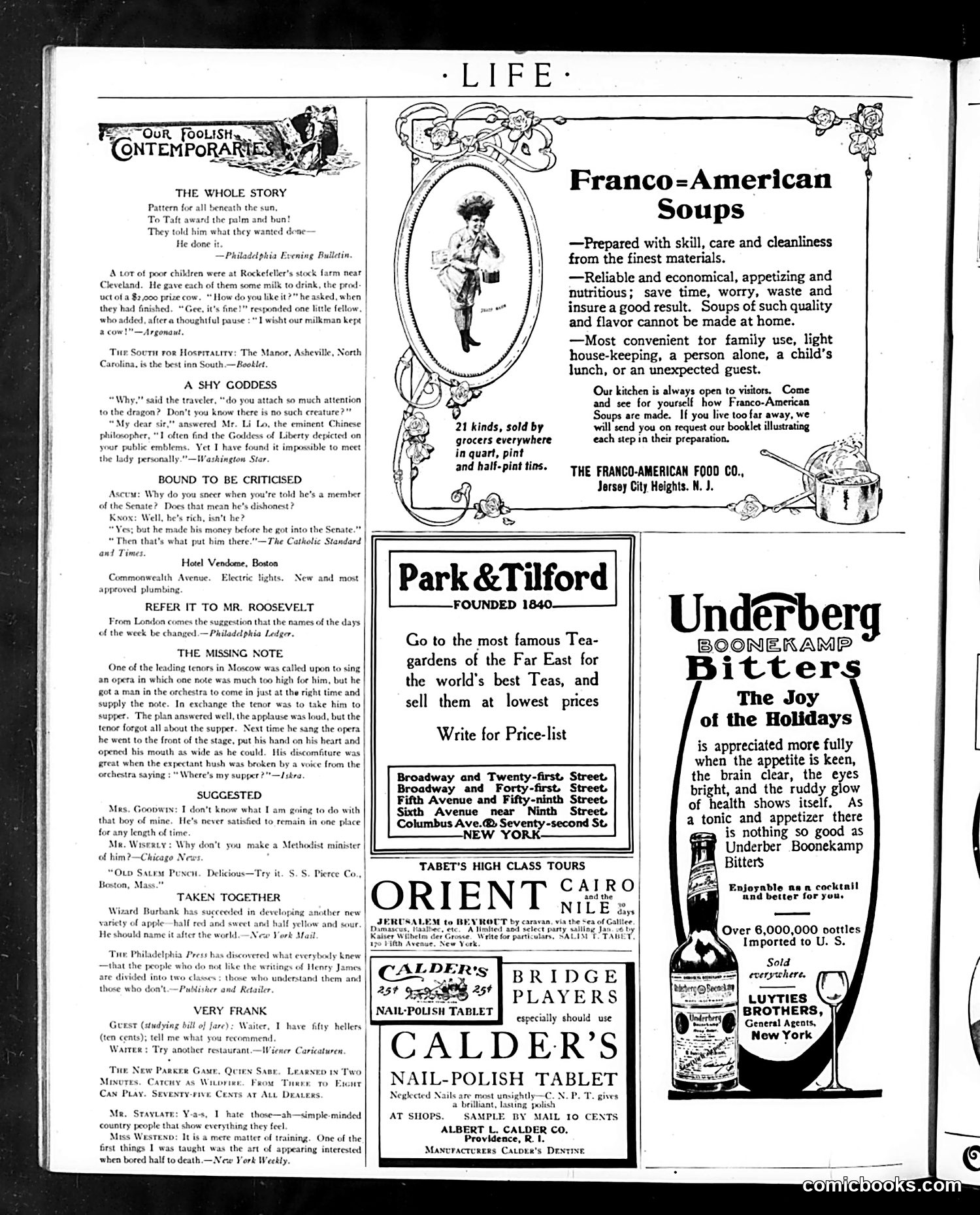
This page from *Life* magazine (a satirical publication) combines several short humorous anecdotes with period advertisements. The content satirizes American social figures and contemporary issues circa early 1900s. **Key satirical content:** - **"The Whole Story"**: A joke about President Taft, suggesting he simply does whatever others want him to do—a jab at his perceived weakness compared to his predecessor Theodore Roosevelt. - **Rockefeller anecdote**: Mocks wealthy industrialist John D. Rockefeller's attempt at philanthropy, showing a poor child ungrateful for expensive milk because their own milkman is worse—satirizing the gap between rich charitable gestures and actual poverty. - **"A Shy Goddess"**: A clever comparison between the mythical Goddess of Liberty depicted on public emblems and actual Lady Liberty—implying the nation's ideals don't match reality. - **Senator joke**: Suggests a politician made his dishonest money *before* entering the Senate, implying the Senate itself corrupts. The rest consists mostly of period advertisements (soups, nail polish, tours, bitters) typical of the era's *Life* magazine format.
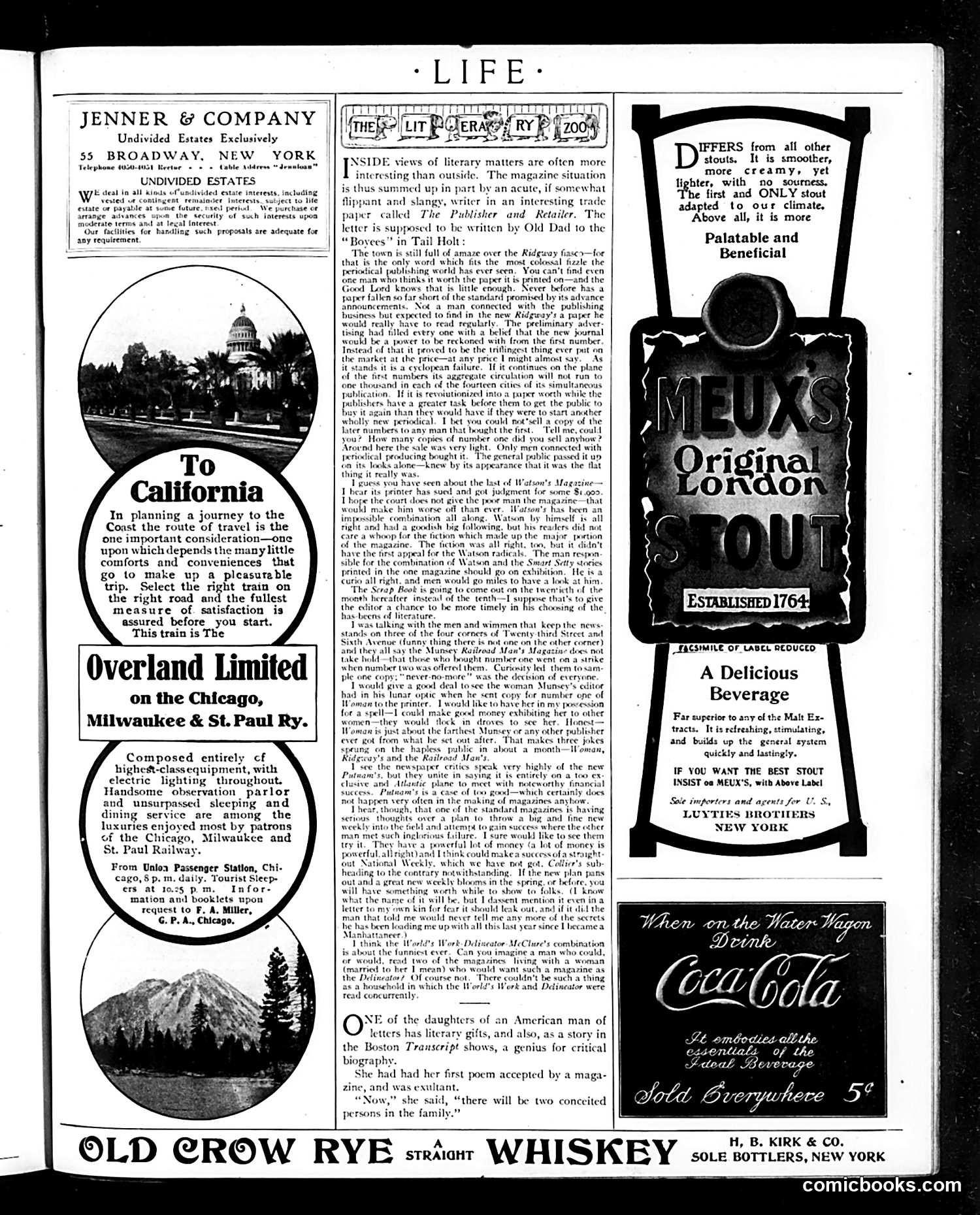
This page is primarily **advertisements and industry commentary**, not political satire. The main content includes: **Advertisements:** Jenner & Company (real estate), Chicago, Milwaukee & St. Paul Railway's "Overland Limited" train service to California, Mellin's Original London beverage, and Old Crow Rye whiskey. **Editorial commentary:** A lengthy column (titled "The Publisher and Retailer") critiques the failed launch of *Ridgway's* magazine. The author—presented as "Old Dad"—mocks the publication's collapse despite heavy advance promotion. He notes the magazine failed to meet expectations, predicting poor circulation and comparing its failure to *Watson's Magazine* and *Smart Set*. The piece uses sarcastic humor about magazine publishing failures. The satire here targets **failed business ventures and inflated advertising claims** rather than political figures. It reflects early 20th-century concerns about magazine industry competitiveness and the gap between promotional hype and actual product quality.
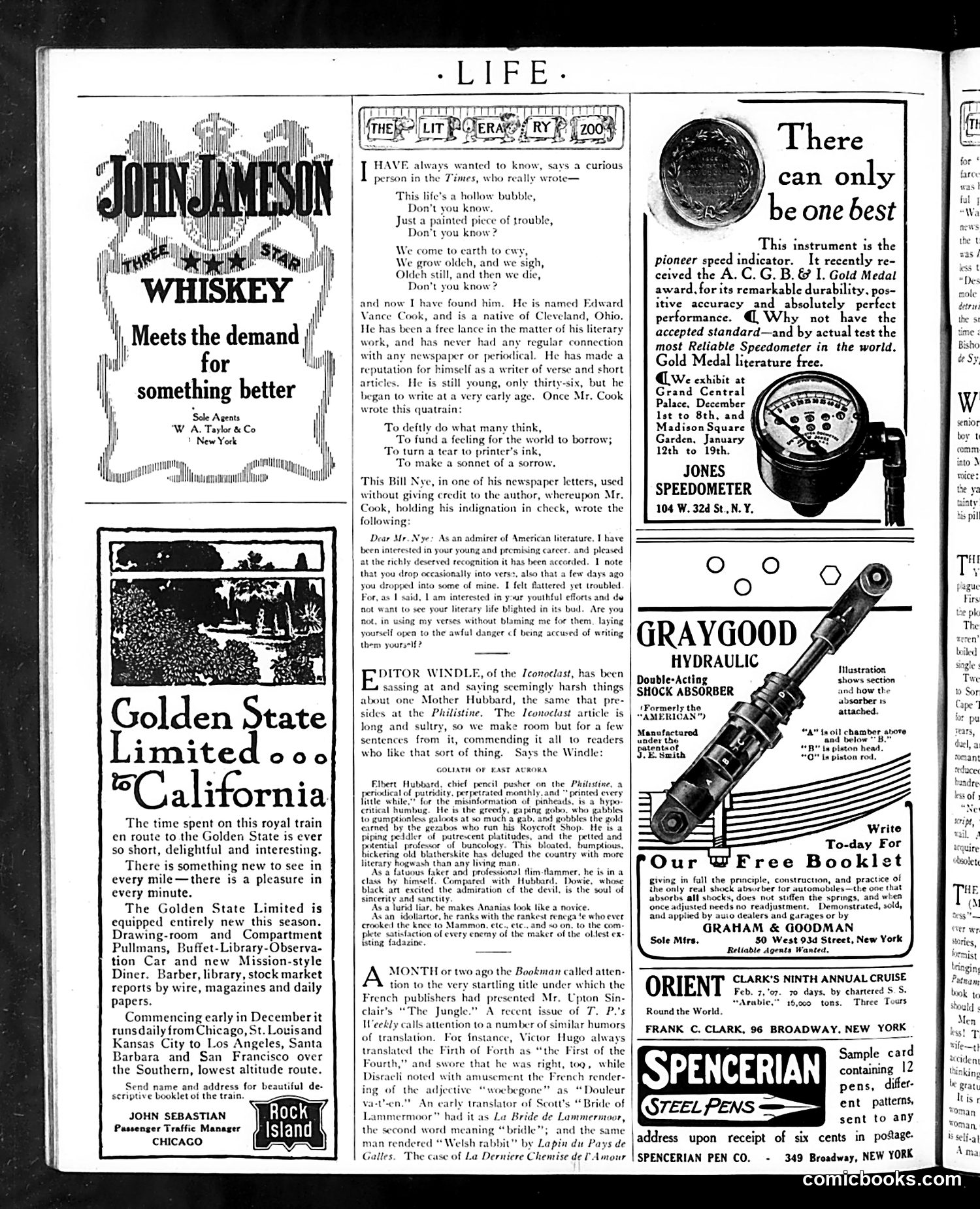
This page is primarily **advertisements and literary gossip**, not political satire. The main content concerns **Edward Vance Cook**, a Cleveland writer whose poetry was used without attribution by humorist **Bill Nye**. Cook wrote a pointed but genteel letter confronting Nye about the plagiarism, essentially shaming him into proper credit. This reflects late 19th/early 20th-century concerns about literary theft and professional courtesy. A secondary item attacks **Elbert Hubbard**, editor of *The Philistine* magazine, using harsh mockery ("Goliath of Fast Aurora") for his self-promotional writing and pretentiousness—a common target of *Life's* satire during this era. The page otherwise consists of advertisements for John Jameson whiskey, the Golden State Limited train, a speedometer, and writing instruments—typical of the magazine's mixed editorial-advertising format.
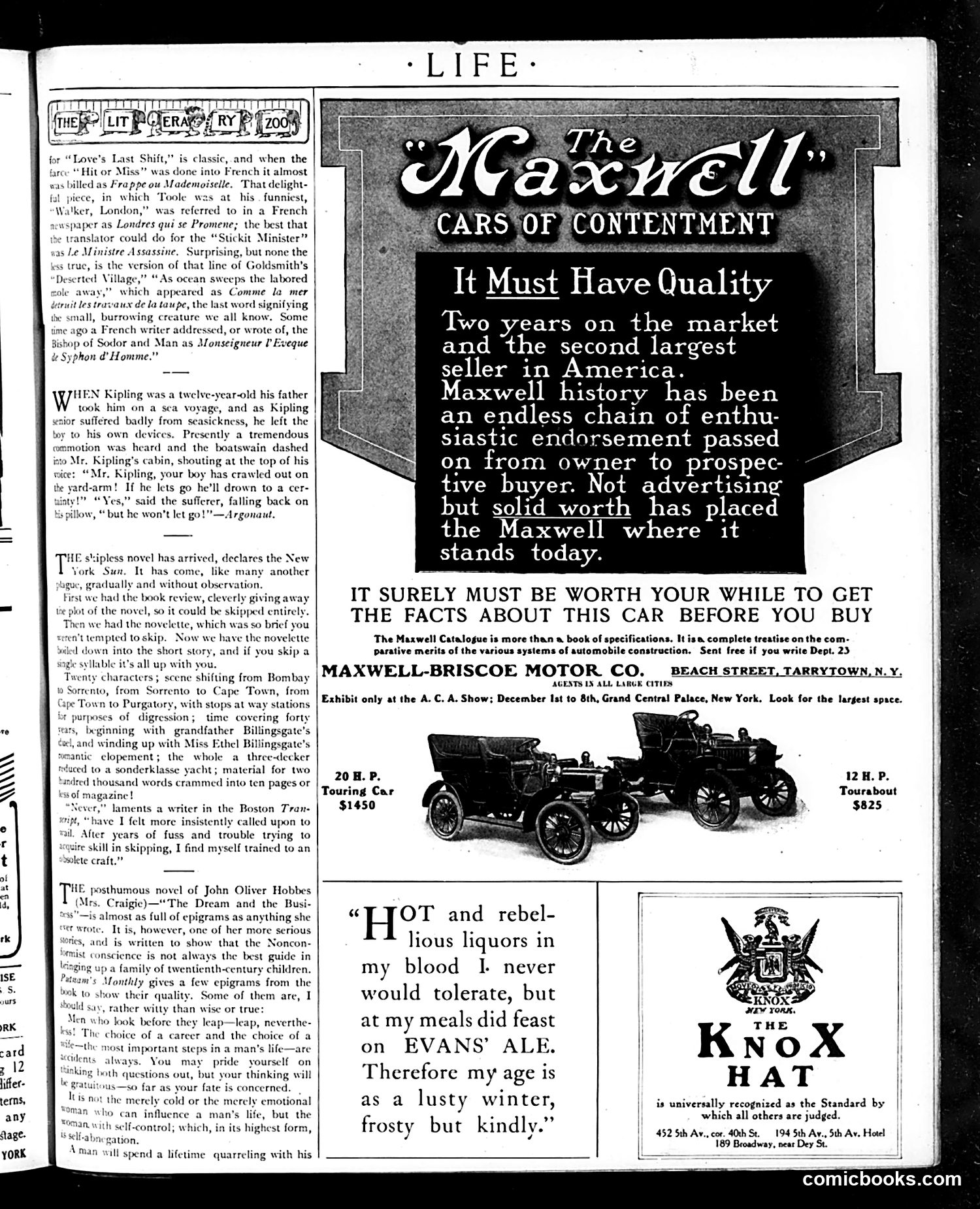
This page is primarily **advertising and literary content**, not political satire. The dominant feature is a large advertisement for the **Maxwell automobile**, emphasizing its reliability and market success ("second largest seller in America"). Two Maxwell car models are pictured with prices ($1,450 and $825). The page also contains **literary discussion** in the left column, including anecdotes about writers like Kipling and reviews of novels by John Oliver Hobbes. These are cultural commentary rather than political satire. Additionally, there are advertisements for **Evans' Ale** (featuring a quote about "lusty winter") and the **Knox Hat** (marketed as the standard hat for "gentlemen of refined taste"). The content reflects **early 1900s consumer culture** and demonstrates how Life magazine blended satirical commentary with sophisticated advertising for automobiles, alcohol, and fashion—targeting an educated, affluent audience.
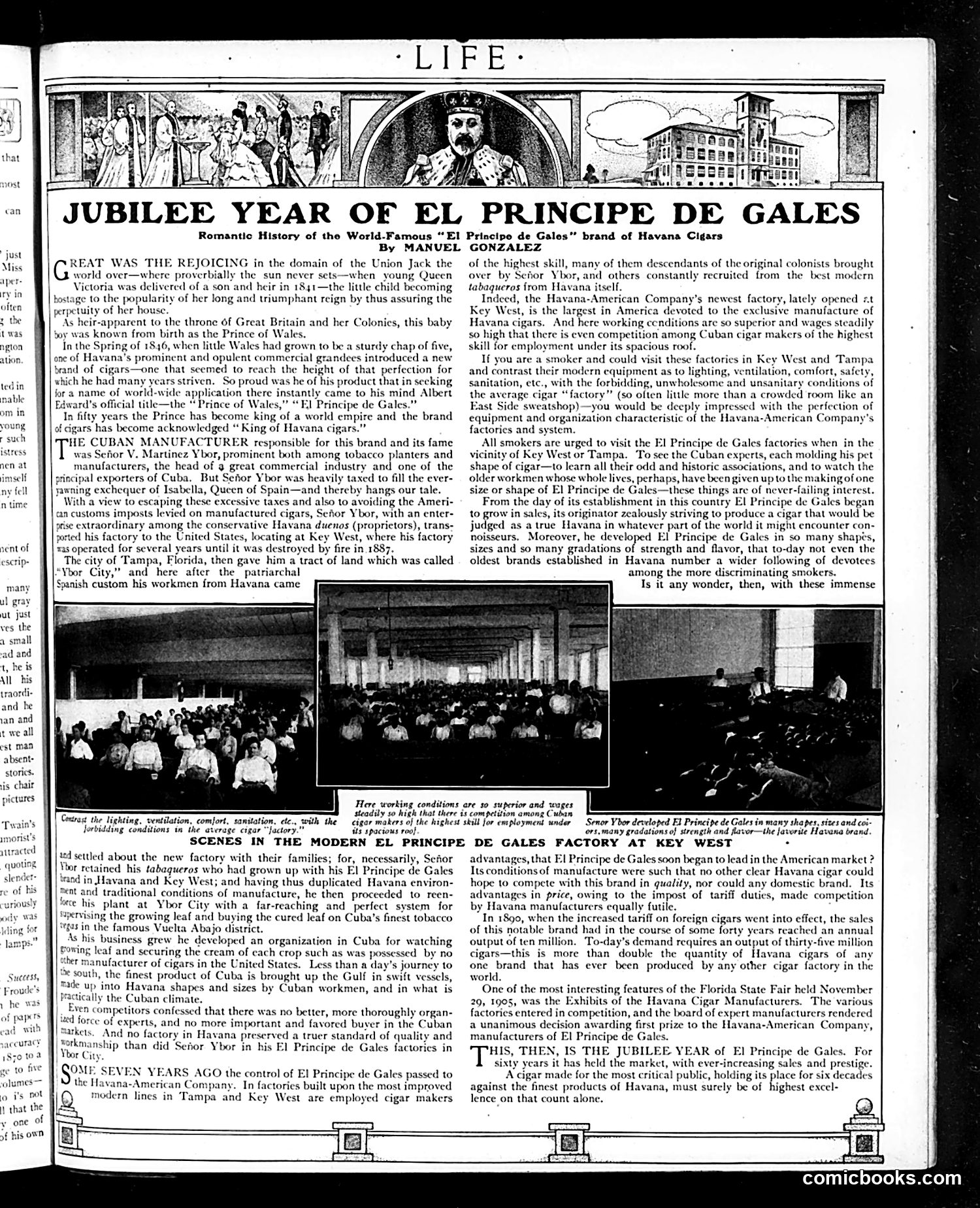
This is **advertising content**, not satire. The page promotes El Principe de Gales cigars through a romanticized historical narrative. The article traces the cigar brand's origin to 1841, when Cuban manufacturer Señor V. Martinez Ybor named it after Prince Albert Edward (future King Edward VII), whose birth that year made him heir to the British throne. The text claims the brand became the "King of Havana cigars." The narrative emphasizes Ybor's entrepreneurial migration: fleeing Spanish taxes and American tariffs, he relocated his factory from Cuba to Key West (1850s), then to Tampa's "Ybor City" (1880s). The accompanying photographs show modern factory floors with workers—presented as evidence of superior working conditions compared to typical cigar sweatshops. This is essentially a **branded origin story** designed to associate the product with prestige (royalty, quality craftsmanship, and progressive American manufacturing practices). Modern readers would recognize this as early 20th-century corporate mythmaking.
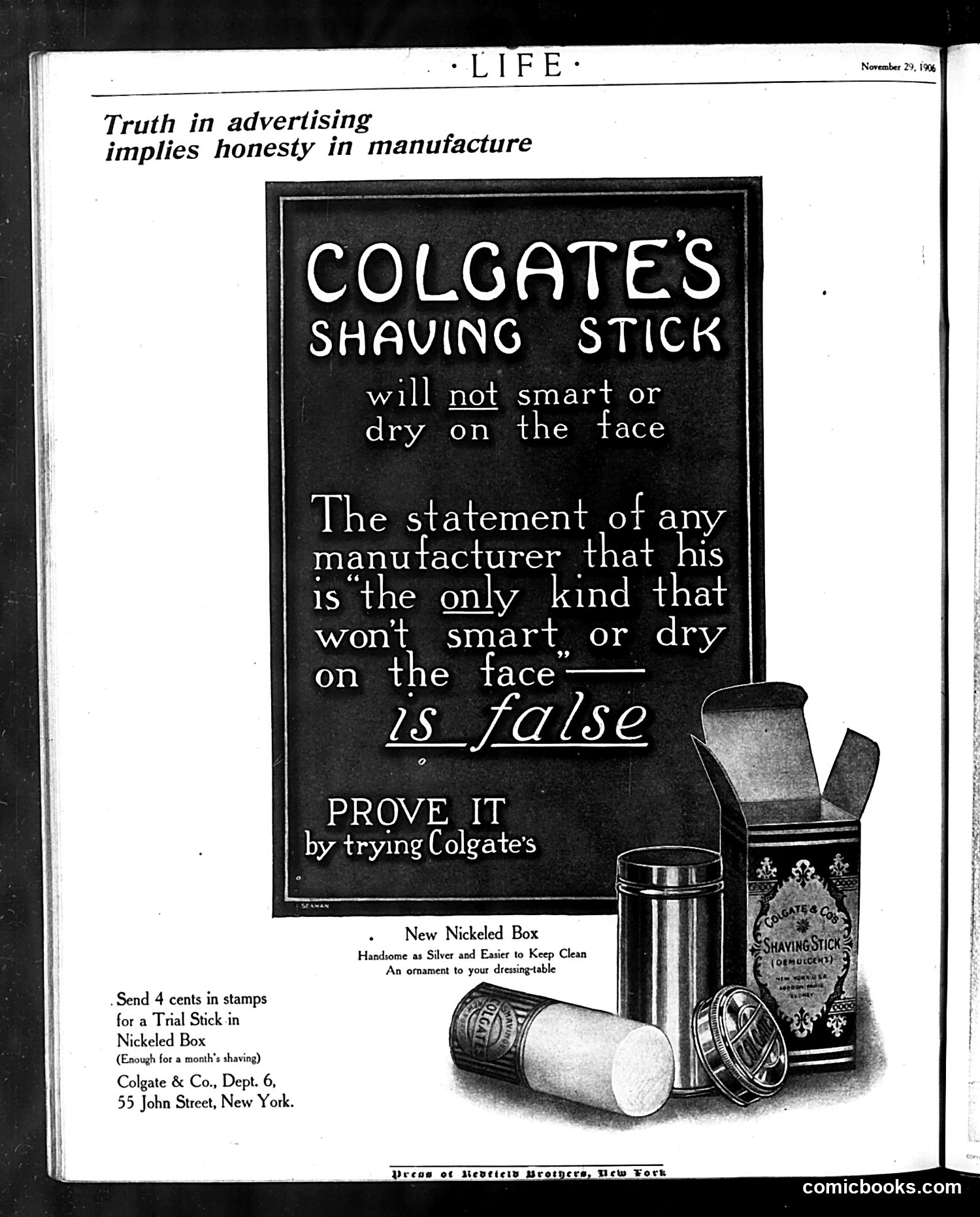
This is a **Colgate's shaving stick advertisement**, not political satire. The page exemplifies early 1900s advertising strategy by using a "truth in advertising" argument. The ad claims Colgate's shaving stick "will not smart or dry on the face," then directly attacks competitors by stating their claims to be "the only kind that won't smart or dry" are **false**. This is aggressive comparative advertising—essentially calling rival manufacturers liars. The satire is subtle: the headline "Truth in advertising implies honesty in manufacture" ironically suggests Colgate itself practices honest advertising, while simultaneously accusing competitors of deception. The call to "PROVE IT by trying Colgate's" challenges readers to test the product themselves. The "New Nickeled Box" is marketed as a decorative dresser accessory, appealing to vanity. A trial stick cost 4 cents in stamps—a common early mail-order promotional tactic. The joke is the contradiction: claiming to embody truth while making unverifiable superiority claims typical of the era's often-deceptive patent medicine and grooming product advertising.