
Life, 1906-11-29 · page 17 of 28
Life — November 29, 1906 — page 17: what you’re looking at
What you’re looking at
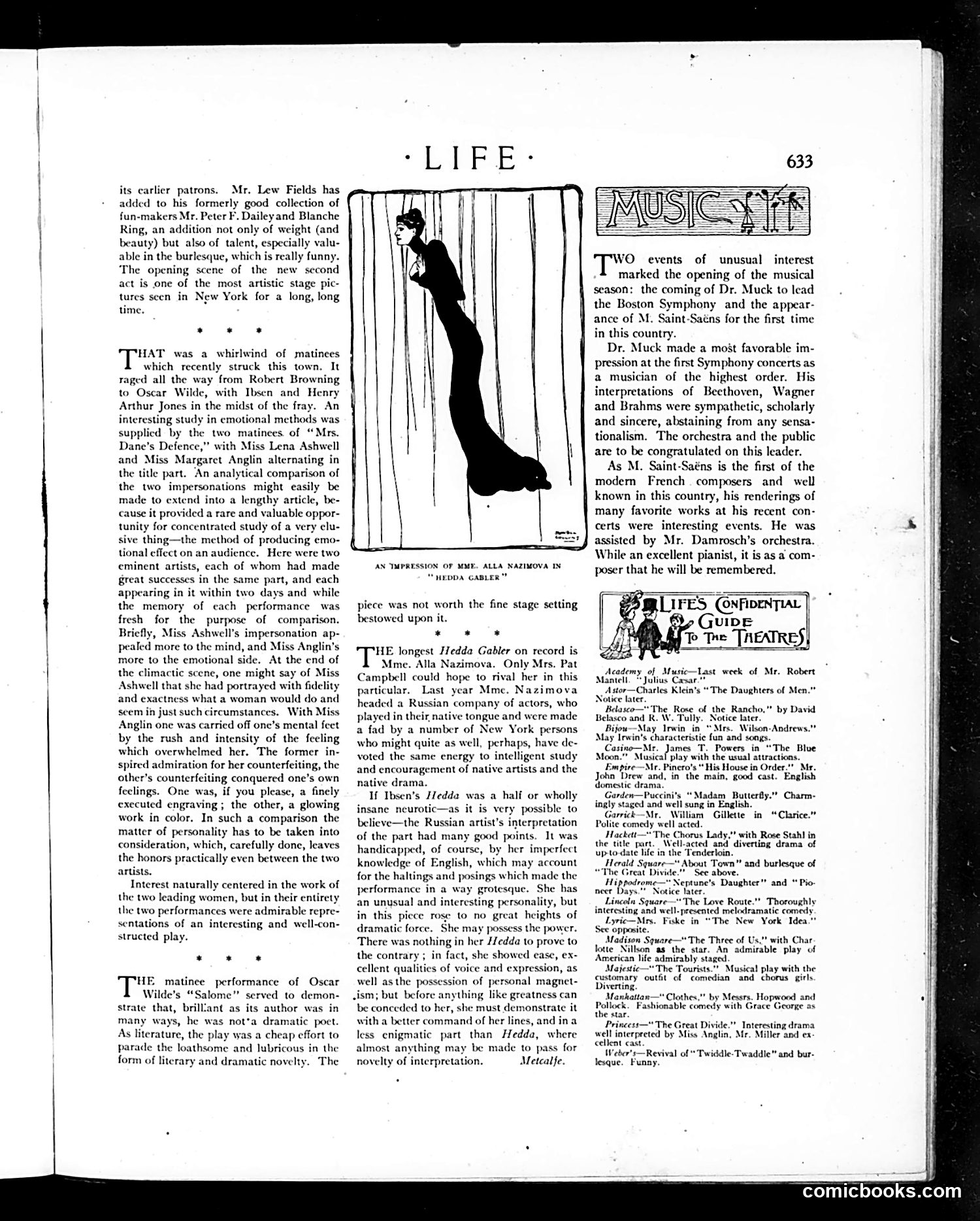
This page from *Life* magazine reviews recent theatrical performances in New York. The main illustration shows actress Alla Nazimova in a dramatic pose from Ibsen's *Hedda Gabler*. The critic discusses competing matinee performances, particularly comparing two actresses (Lena Ashwell and Margaret Anglin) playing the same role in "Mrs. Dane's Defence"—one appealing more to intellect, the other to emotion. Regarding Nazimova: the review acknowledges her "unusual and interesting personality" but criticizes her *Hedda Gabler* performance as somewhat grotesque, partly attributing this to her imperfect English. The critic notes she led a Russian company that became fashionable among New York audiences, suggesting they should instead support native American drama and artists. The page also dismisses Oscar Wilde's *Salome* as literature disguised as drama—"cheap effort" lacking genuine dramatic merit despite fine staging.
📄 Transcribed text from this page (OCR, searchable)
Machine-transcribed from the original scan — historical spelling and the odd misread are preserved.
its carlier patrons. Mr. Lew Fields has added to his formerly good collection of fun-makers Mr. Peter F. Daileyand Blanche Ring, an addition not only of weight (and beauty) but also of talent, especially valu- able in the burlesque, which is really funny. The opening scene of the new second act is one of the most artistic stage pic- tures seen in New York for a long, long time. + *# 8 HAT was a whirlwind of matinees which recently struck this town, It raged all the way from Robert Browning to Oscar Wilde, with Ibsen and Henry Arthur Jones in the midst of the fray. An interesting study in emotional methods wa: supplied by the two matinees of “Mrs. Dane’s Defence,” with Miss Lena Ashwell and Miss Margaret Anglin alternating in the title part. ‘An analytical comparison of the two impersonations might easily be made to extend into a lengthy article, be- cause it provided a rare and valuable oppor- tunity for concentrated study of a very clu- sive thing—the method of producing emo- tional effect on an audience. Here were two eminent artists, each of whom had made Great successes in the same part, and each appearing in it within two days and while the memory of each performance was fresh for the purpose of comparison. Briefly, Miss Ashwell’s impersonation ap- pealed more to the mind, and Miss Anglin’s more to the emotional side, At the end of the climactic scene, one might say of Miss Ashwell that she had portrayed with fidelity and exactness what a woman would do and seem in just such circumstances. With Miss Anglin one was carried off one’s mental feet by the rush and intensity of the feeling which overwhelmed her, The former in- spired admiration for her counterfeiting, the other’s counterfeiting conquered one’s own feelings. One was, if you please, a finely executed engraving ; the other, a glowing work in color. In such a comparison the matter of personality has to be taken into consideration, which, carefully done, leaves the honors practically even between the two artists. Interest naturally centered in the work of the two leading women, but in their entirety the two performances were admirable repre- sentations of an interesting and well-con- structed play. * 8 « = matinee performance of Oscar Wilde’s “Salome” served to demon- strate that, brilliant as its author was in many ways, he was nota dramatic poct. As literature, the play was a cheap effort to parade the loathsome and lubricous in the form of literary and dramatic novelty. The AN TMPRESSION OF MME. ALLA NAZIMOVA IN “EDDA GABLER" piece was not worth the fine stage setting bestowed upon it. * 8 8 HE longest Hedda Gabler on record is Mme. Alla Nazimova. Only Mrs. Pat Campbell could hope to rival her in this particular. Last year Mme, Nazimova headed a Russian company of actors, who played in their native tongue and were made a fad by a number of New York persons who might quite as well, perhaps, have de- voted the same energy to intelligent study and encouragement of native artists and the native drama. If Ibsen's Hedda was a half or wholly insane neurotic—as it is very possible to believe—the Russian artist’s interpretation of the part had many good points. It was handicapped, of course, by her imperfect knowledge of English, which may account for the haltings and posings which made the performance in a way grotesque. She has an unusual and interesting personality, but in this picce rose to no great heights of dramatic force. She may possess the power. There was nothing in her Hedda to prove to the contrary ; in fact, she showed ease, ex- cellent qualities of voice and expression, as well asthe possession of personal magnet- ism; but before anything like greatness can be conceded to her, she must demonstrate it with a better command of her lines, and in a less enigmatic part than Hedda, where almost anything may be made to pass for ty of interpre Metcalfe. Tee events of unusual interest marked the opening of the musical season: the coming of Dr. Muck to lead the Boston Symphony and the appear- ance of M. Saint-Saéns for the first time in this country. Dr. Muck made a moist favorable im- pression at the first Symphony concerts as a musician of the highest order. His interpretations of Beethoven, Wagner and Brahms were sympathetic, scholarly and sincere, abstaining from any sensa- tionalism. The orchestra and the public are to be congratulated on this leader. As M. Saint-Saéns is the first of the modem French composers and well known in this country, his renderings of many favorite works at his recent con- certs were interesting events. He was assisted by Mr. Damrosch’s orchestra. While an excellent pianist, it is as a com- poser that he will be remembered. Academy of Music—Last week of Mr. Robert Mantel. "Julius Cxsar A stor—Charles Klein’s “The Daughters of Men.” Notice later. Belasco—" The Rose of the Rancho. Belasco and R. W. Tully. Notice later. Bijou—May Irwin in “Mrs. Wilson-Andrews. May Inwin's characteristic fun and songs. casino Mr. James T. Powers in “The Blve Joon.” Musical play with the usual attractions. Em pire—Mr. Pinero's John Drew and, in the main, good cast. domestic drama. Garden—Puccini's “Madam Buttery.” Charm- ingly staged and well sung in English. Garrick—Mr. William Gillette in “Clarice.” Polite comedy well acted Hackett—" The Chorus Lady,” with Rose Stahl in the title part. Well-acted and’ diverting drama of uptodate life in the Tenderloin. Herald Square—" About Town" and burlesque of by David 's His House in Order." Mr. English “The Great Div See above. Hippodrome—" Neptune's Daughter" and “ Pio- neer Days." Notice later. Lincoln Square—" The Love Rout Thoroughly interesting and well-presented melodramatic comedy _ Lyric—Mrs. Fiske in “The New York Idea.” See opposite. Madison Square—“ The Three of Us,"" with Char lotte Nillson as the star. An admirable play of American life admirably staged Majestic—" The Tourists." Musical play with the customary outfit of comedian and chorus girls Diverting. Manhattan—" Clothes," by Messrs. Hopwood and Pollock. Fashionable comedy with Grace George 3s the star. Princess—" The Great Divide.” Interesting drama well interpreted by Miss Anglin, Mr. Miller and ex: cellent cast. Weber’s—Revival of * Twiddle- Twaddle" and bur- lesque. Funny