
Life, 1906-11-29 · page 16 of 28
Life — November 29, 1906 — page 16: what you’re looking at
What you’re looking at
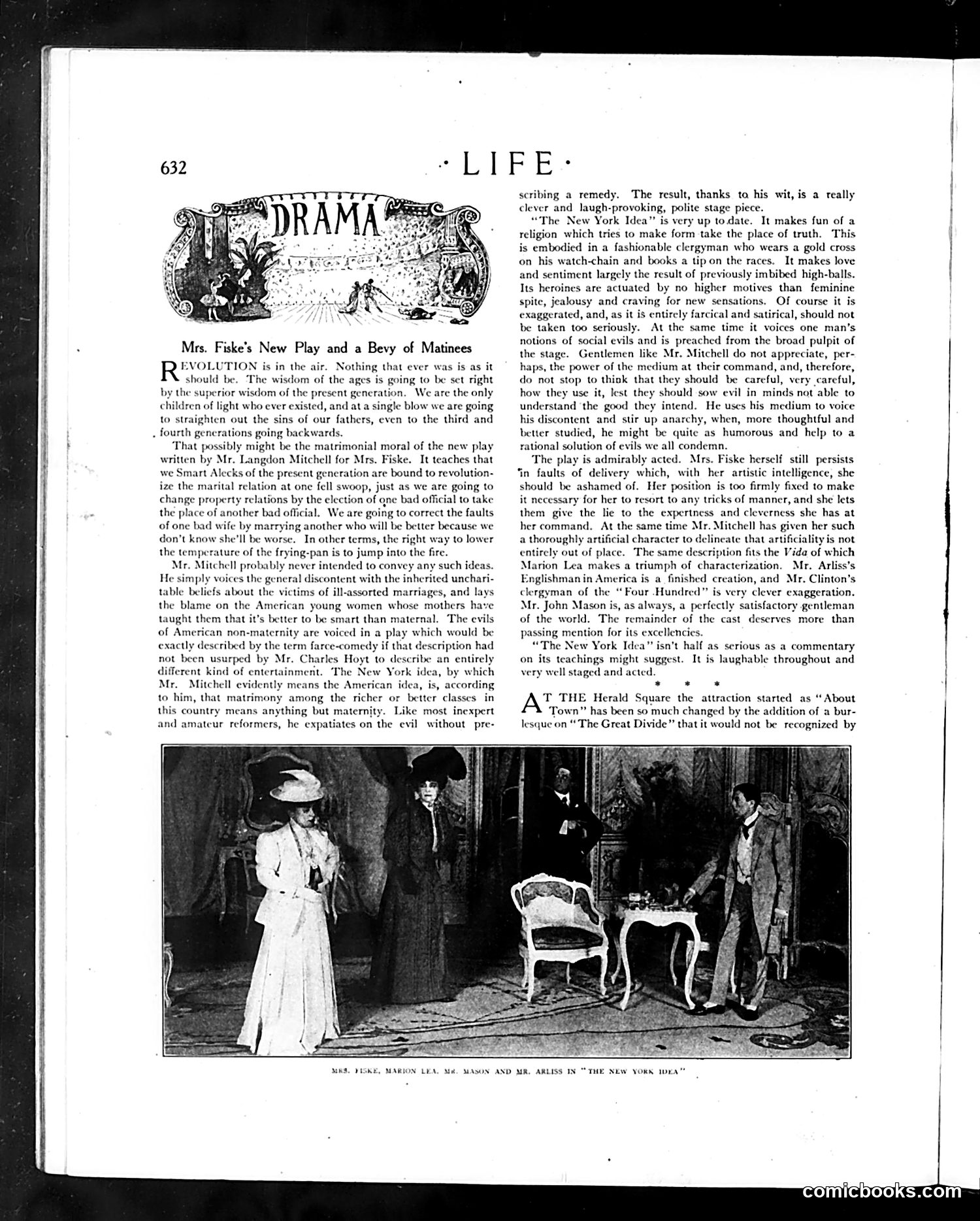
This page reviews playwright Langdon Mitchell's play "The New York Idea," starring Mrs. Fiske (a prominent actress of the era). The critic uses the review to discuss what he sees as the play's central problem: it critiques modern American marriage practices—particularly wealthy women prioritizing social sophistication over motherhood—but does so through farce without offering serious solutions. The satire targets the play's attack on contemporary marriage as meaningless formality, clerical hypocrisy (a fashionable minister who bets on horses), and women motivated by "spite, jealousy and craving for new sensations." The critic worries Mitchell wields his theatrical platform irresponsibly, "sow[ing] evil in minds not able to understand the good." He praises the acting while criticizing Mrs. Fiske's affected delivery. The photograph shows a scene from the production.
📄 Transcribed text from this page (OCR, searchable)
Machine-transcribed from the original scan — historical spelling and the odd misread are preserved.
Mrs. Fiske’s New Play and a Bevy of Matinees R® JOLUTION is in the air. Nothing that ever was is as it should be. ‘The wisdom of the ages is going to be set right by the superior wisdom of the present generation. We are the only children of light who ever existed, and at a single blow we are going to straighten out the sins of our fathers, even to the third and fourth generations going backwards. That possibly might be the matrimonial moral of the new play written by Mr. Langdon Mitchell for Mrs. Fiske. It teaches that we Smart Alecks of the present generation are bound to revolution- ize the marital relation at one fell swoop, just as we are going to change property relations by the election of qne bad official to take the place of another bad official. We are going to correct the faults of one bad wife by marrying another who will be better because we don’t know she'll be worse. In other terms, the right way to lower the temperature of the frying-pan is to jump into the fire. Mr. Mitchell probably never intended to convey any such ideas. He simply voices the general discontent with the inherited unchari- table beliefs about the victims of ill-assorted marriages, and lays the blame on the American young women whose mothers ha taught them that it’s better to be smart than maternal. ‘The evils of American non-maternity are voiced in a play which would be exactly described by the term farce-comedy if that description had not been usurped by Mr. Charles Hoyt to describe an entirely different kind of entertainment. The New York idea, by which Mr. Mitchell evidently means the American idea, is, according to him, that matrimony among the richer or better classes in this country means anything but maternity. Like most inexpert he expatiates on the evil without pre- and amateur reformer: “LIFE: scribing a remedy. The result, thanks to his wit, is a really clever and laugh-provoking, polite stage piece. “The New York Idea” is very up todate. It makes fun of a religion which tries to make form take the place of truth. This is embodied in a fashionable clergyman who wears a gold cross on his watch-chain and books a tipon the races. It makes love and sentiment largely the result of previously imbibed high-balls. Its heroines are actuated by no higher motives than feminine spite, jealousy and craving for new sensations, Of course it is exaggerated, and, as it is entirely farcical and satirical, should not be taken too seriously. At the same time it voices one man’s notions of social evils and is preached from the broad pulpit of the stage. Gentlemen like Mr. Mitchell do not appreciate, per- haps, the power of the medium at their command, and, therefore, do not stop to think that they should be careful, very careful, how they use it, lest they should sow evil in minds not able to understand ‘the good they intend. He uses his medium to voice his discontent and stir up anarchy, when, more thoughtful and Detter studied, he might be quite as humorous and help to a rational solution of evils we all condemn. ‘The play is admirably acted. Mrs. Fiske herself still persists ‘in faults of delivery which, with her artistic intelligence, she should be ashamed of. Her position is too firmly fixed to make it necessary for her to resort to any tricks of manner, and she lets them give the lie to the expertness and cleverness she has at her command. At the same time Mr. Mitchell has given her such a thoroughly artificial character to delineate that artificiality is not entirely out of place. The same description fits the Vida of which Marion Lea makes a triumph of characterization. Mr. Arliss’s nglishman in America is a finished creation, and Mr. Clinton’ clergyman of the “Four Hundred” is very clever exaggeration. Mr. John Mason is, as always, a perfectly satisfactory gentleman of the world. The remainder of the cast deserves more than passing mention for its excellencics. “The New York Idea” isn't half as. serious as a commentary on its teachings might suggest. It is laughable throughout and very well staged and acted. * 2 8 T THE Herald Square the attraction started as “About Town” has been so much changed by the addition of a bur- lesque on “The Great Divide” that it would not be recognized by Sees. IKE, MARION LEA, MI. MASON AND MR, ARLISS IN “THE NEW YORN IDEA