
Life, 1906-11-29 · page 8 of 28
Life — November 29, 1906 — page 8: what you’re looking at
What you’re looking at
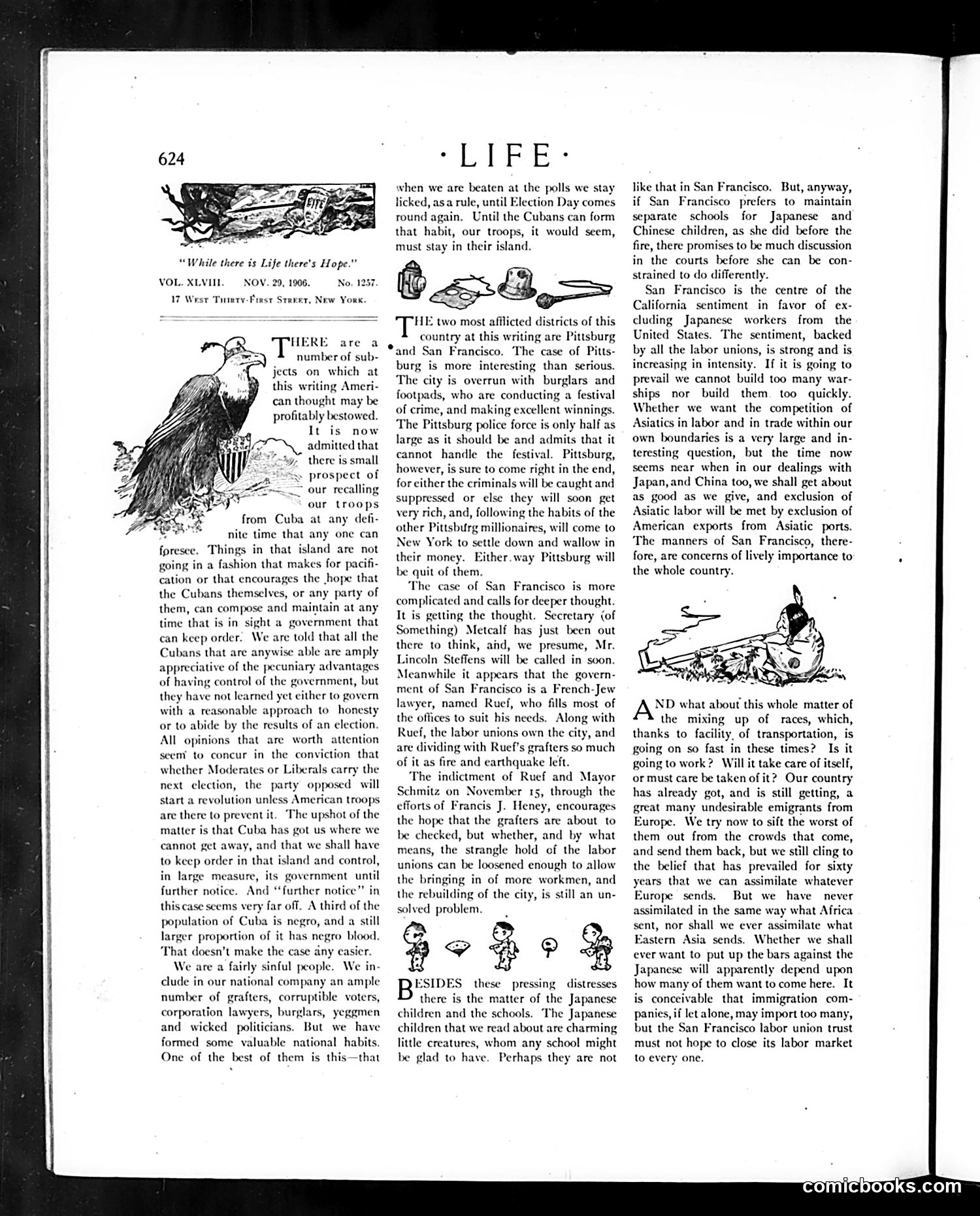
This page discusses two major political crises: the Pittsburg (sic) crime wave and San Francisco's Japanese exclusion movement following the 1906 earthquake. The **Pittsburg segment** satirizes civic disorder—burglars and criminals operating freely while the understaffed police force struggles to maintain control. The text suggests either criminals will be caught or they'll become wealthy enough to settle in New York, mocking both the city's inability to govern and criminals' predictable behavior. The **San Francisco section** addresses labor union opposition to Japanese immigration and school segregation. The satire criticizes how San Francisco's French-Jewish lawyer-mayor and labor unions exploit anti-Japanese sentiment, while warning that America risks its moral standing by discriminating against Asian workers—especially given America's historical failure to assimilate other immigrant groups justly. The cartoons (small illustrations visible) appear to reinforce these themes of civic disorder and ethnic conflict.
📄 Transcribed text from this page (OCR, searchable)
Machine-transcribed from the original scan — historical spelling and the odd misread are preserved.
“While there is Life there's Hope.” VOL. XLVII. 17 West NOV. 29, 1906. No. 12: mry-Finst Street, New York. HERE are a number of sub- jects on which at this writing Ameri- can thought may be profeably bestowed. s now oN. Bc dthat 2% there is small prospect of our recalling our troops from Cuba at any defi- nite time that any one can in that island are not going in a fashion that makes for pacifi- cation or that encourages the hope that the Cubans themselves, or any party of them, can compose and maintain at any time that is in sight a government that can keep order. We are told that all the Cubans that are anywise able are amply appreciative of the pecuniary advantages of having control of the government, but not learned yet either to govern with a reasonable approach to honesty or to abide by the results of an election. All opinions that are worth attention seem to concur in the conviction that whether Moderates or Liberals carry the next election, the party opposed will start a revolution unless American troops are there to prevent it. ‘The upshot of the matter is that Cuba has got us where we cannot get away, and that we shall have to keep order in that island and control, in large measure, its government until further notice. And ‘further notice” in this case scems very far off. A third of the population of Cuba is negro, and a still larger proportion of it has negro blood. ‘That doesn’t make the case any easier. We are a fairly sinful people. clude in our national company an ample number of grafters, corruptible voters, corporation lawy burglars, yeggmen and wicked politicians. But we have formed some valuable national habits. One of the best of them is this—that Ld FE when we are beaten at the polls we stay licked, asa rule, until Election Day comes round again. Until the Cubans can form that habit, our troops, it would seem, must stay in their island. ts 3,—> HE two most afflicted districts of this country at this writing are Pittsburg “and San Francisco. The case of Pitts- burg is more interesting than serious. The city is overrun with burglars and footpads, who are conducting a festival of crime, and making excellent winnings. The Pittsburg police force is only half as large as it should be and admits that it cannot handle the festival. Pittsburg, however, is sure to come right in the end, for cither the criminals will be caught and suppressed or else they will soon get very rich, and, following the habits of the other Pittsburg millionaires, will come to New York to settle down and wallow in their money. Either.way Pittsburg will be quit of them. ‘The case of San Francisco is more complicated and calls for deeper thought. It is getting the thought. Secretary (of Something) Metcalf has just been out there to think, and, we presume, Mr. Lincoln Steffens will be called in soon. Meanwhile it appears that the govern- ment of San Francisco is a French-Jew lawyer, named Ruef, who fills most of the offices to suit his needs. Along with Ruef, the labor unions own the city, and are dividing with Ruef's grafters so much of it as fire and earthquake left. The indictment of Ruef and Mayor Schmitz on November 15, through the efforts of Francis J. Heney, encourages the hope that the grafters are about to be checked, but whether, and by what means, the strangle hold of the labor unions can be loosened enough to allow the bringing in of more workmen, and the rebuilding of the city, is still an un- solved problem. a2 9° % IDES these pressing distresses Bin re is the matter of the Japanese children and the schools. The Japanese children that we read about are charming little creatures, whom any school might be glad to have. Perhaps they are not like that in San Francisco, But, anyway, if San Francisco prefers to maintain separate schools for Japanese and Chinese children, as she did before the fire, there promises to be much discussion in the courts before she can be con- strained to do differently. San Francisco is the centre of the California sentiment in favor of ex- cluding Japanese workers from the United States. The sentiment, backed by all the labor unions, is strong and is increasing in intensity. If it is going to prevail we cannot build too many war- ships nor build them too quickly. Whether we want the competition of Asiatics in labor and in trade within our own boundaries is a very large and in- teresting question, but the time now seems near when in our dealings with Japan, and China too, we shall get about as good as we give, and exclusion of Asiatic labor will be met by exclusion of American exports from Asiatic ports. The manners of San Francisco, there- fore, are concerns of lively importance to the whole country. ND what about this whole matter of the mixing up of races, which, thanks to facility, of transportation, is going on so fast in these times? Is it going to work? Will it take care of itself, or must care be taken of it? Our country has already got, and is still getting, a great many undesirable emigrants from Europe. We try now to sift the worst of them out from the crowds that come, and send them back, but we still cling to the belief that has prevailed for sixty years that we can assimilate whatever Europe sends. But we have never assimilated in the same way what Afri sent, nor shall we ever assimilate what Eastern Asia sends. Whether we shall ever want to put up the bars against the Japanese will apparently depend upon how many of them want to come here. It is conceivable that immigration com- panies, if let alone, may import too many, but the San Francisco labor union trust must not hope to close its labor market to every one. Comicbooks.com