
Life, 1906-11-29 · page 18 of 28
Life — November 29, 1906 — page 18: what you’re looking at
What you’re looking at
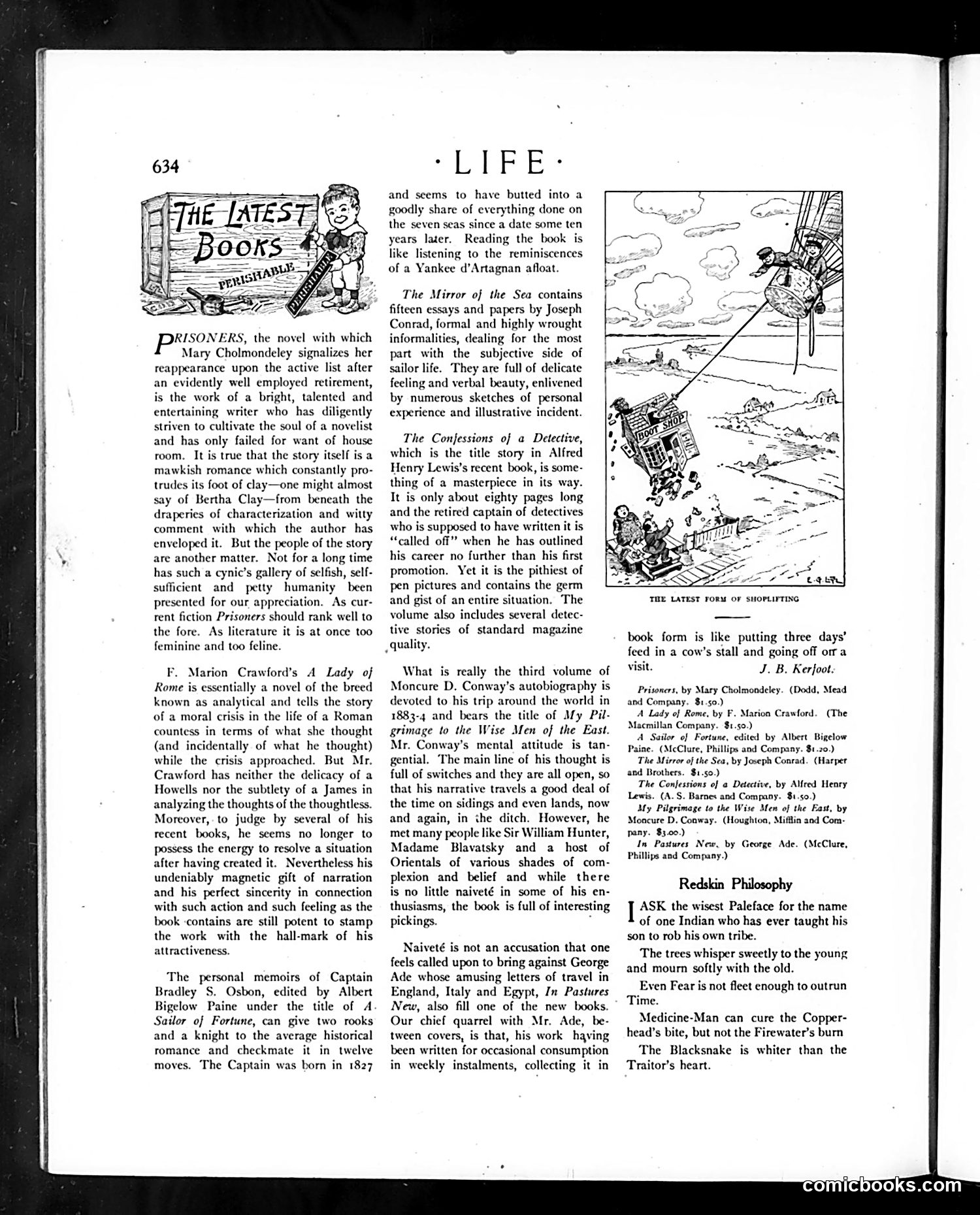
This page contains literary reviews of contemporary novels, not political cartoons. The small illustration labeled "THE LATEST FORM OF SHOPLIFTING" shows a figure being lowered by rope from a ship to steal from a house below—a humorous visual joke about creative theft methods. The reviews discuss new books by authors including Mary Cholmondeley (*Prisoners*), F. Marion Crawford (*A Lady of Rome*), Joseph Conrad (*The Mirror of the Sea*), and others. The critic praises characterization in some works while criticizing others for lacking subtlety or energy. A separate section titled "Redkin Philosophy" presents brief Native American proverbs or sayings. The page reflects early 20th-century literary criticism standards, emphasizing psychological realism, narrative sincerity, and refined prose style as markers of quality fiction.
📄 Transcribed text from this page (OCR, searchable)
Machine-transcribed from the original scan — historical spelling and the odd misread are preserved.
VERS, the novel with which Mary Cholmondeley signalizes her reappearance upon the active list after an evidently well employed retirement, is the work of a bright, talented and entertaining writer who has diligently striven to cultivate the soul of a novelist and has only failed for want of house room. It is true that the story itself is a mawkish romance which constantly pro- trudes its foot of clay—one might almost say of Bertha Clay—from beneath the draperies of characterization and witty comment with which the author has enveloped it. But the people of the story are another matter. Not for a long time has such a cynic’s gallery of selfish, self- sufficient and petty humanity been presented for our appreciation. As cur- rent fiction Prisoners should rank well to the fore. As literature it is at once too feminine and too feline. F. Marion Crawford’s A Lady oj Rome is essentially a novel of the breed known as analytical and tells the story of a moral crisis in the life of a Roman countess in terms of what she thought (and incidentally of what he thought) while the crisis approached. But Mr. Crawford has neither the delicacy of a Howells nor the subtlety of a James in analyzing the thoughts of the thoughtless. Moreover, to judge by several of his recent books, he scems no longer to possess the energy to resolve a situation after having created it. Nevertheless his undeniably magnetic gift of narration and his perfect sincerity in connection with such action and such feeling as the book -contains are still potent to stamp the work with the hall-mark of his attractiveness. The personal memoirs of Captain Bradley $. Osbon, edited by Albert Bigelow Paine under the title of A Sailor of Fortune, can give two rooks and a knight to the average historical romance and checkmate it in twelve moves. The Captain was born in 1827 “LUPE « and seems to have butted into a goodly share of everything done on the seven seas since a date some ten years later. Reading the book is like listening to the reminiscences of a Yankee d’Artagnan afloat. The Mirror of the Sea contains fifteen essays and papers by Joseph Conrad, formal and highly wrought informalities, dealing for the most part with the subjective side of sailor life. They are full of delicate feeling and verbal beauty, enlivened by numerous sketches of personal experience and illustrative incident. The Confessions of a Detective, which is the title story in Alfred Henry Lewis's recent book, is some- thing of a masterpiece in its way. It is only about eighty pages long and the retired captain of dete: who is supposed to have written it is “called off” when he has outlined his career no further than his first promotion. Yet it is the pithiest of pen pictures and contains the germ and gist of an entire situation. The volume also includes several detec- tive stories of standard magazine quality. What is really the third volume of Moncure D. Conway’s autobiography is devoted to his trip around the world in 1883-4 and bears the title of My Pil- grimage to the Wise Men of the East. Mr. Conway’s mental attitude is tan- gential. The main line of his thought is full of switches and they are all open, so that his narrative travels a good deal of the time on sidings and even lands, now and again, in the ditch. However, he met many people like Sir William Hunter, Madame Blavatsky and a host of Orientals of various shades of com- plexion and belief and while there is no little naiveté in some of his en- thusiasms, the book is full of interesting pickings. . Naiveté is not an accusation that one feels called upon to bring against George Ade whose amusing letters of travel in England, Italy and Egypt, In Pastures New, also fill one of the new books. Our chief quarrel with Mr. Ade, be- tween covers, is that, his work having been written for occasional consumption in weekly instalments, collecting it in THE LATEST FORM OF SHOPLIFTING book form is like putting three days’ feed in a cow’s stall and going off oa visit. J.B. Kerfoot: Prisoners, by Mary Cholmondeley. (Dodd, Mead and Company. $1.50.) A Lady of Rome, by F. Marion Crawford. Macmillan Company. $1.50.) A Sailor of Fortune, edited by Albert Bigelow Paine. (McClure, Phillips and Company. $1.20.) The Mirror of the Sea, by Joseph Conrad. (Harper and Brothers. $1.50.) The Confessions of a Detective, by Alfred Henry Lewis. (A.S. Barnes and Company. $1.0.) My Pilgrimage to the Wise Men of the East, by Moacure D. Conway. (Houghton, Mifttin and Com: pany. $3.00.) In Pastures New, by George Ade. (McClure, Phillips and Company.) Redskin Philosophy ASK the wisest Paleface for the name of one Indian who has ever taught his son to rob his own tribe. (The The trees whisper sweetly to the young and mourn softly with the old. Even Fear is not fleet enough to outrun Time. Medicine-Man can cure the Copper- head’s bite, but not the Firewater’s burn The Blacksnake is whiter than the Traitor’s heart.