
Life, 1906-11-29 · page 27 of 28
Life — November 29, 1906 — page 27: what you’re looking at
What you’re looking at
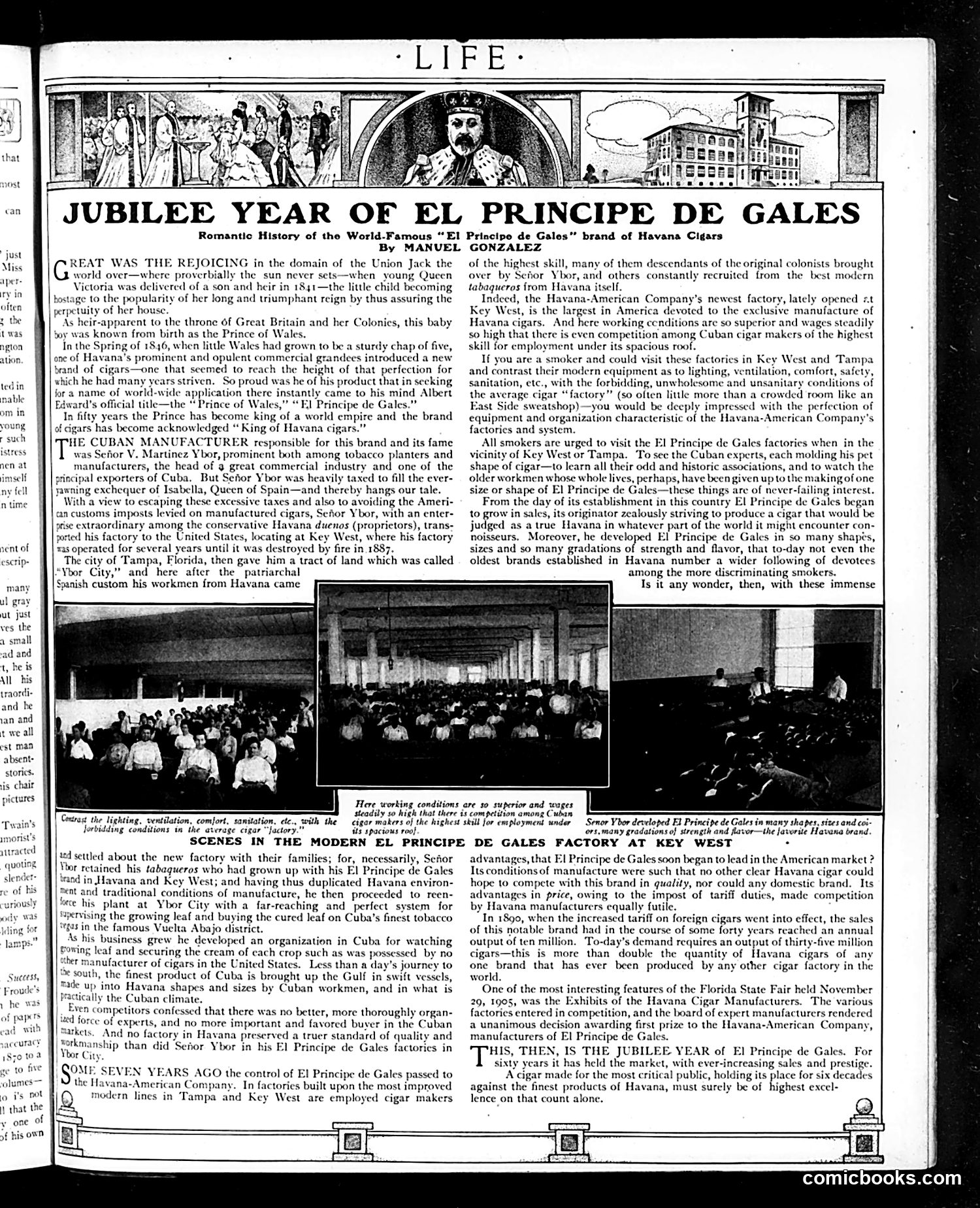
This is **advertising content**, not satire. The page promotes El Principe de Gales cigars through a romanticized historical narrative. The article traces the cigar brand's origin to 1841, when Cuban manufacturer Señor V. Martinez Ybor named it after Prince Albert Edward (future King Edward VII), whose birth that year made him heir to the British throne. The text claims the brand became the "King of Havana cigars." The narrative emphasizes Ybor's entrepreneurial migration: fleeing Spanish taxes and American tariffs, he relocated his factory from Cuba to Key West (1850s), then to Tampa's "Ybor City" (1880s). The accompanying photographs show modern factory floors with workers—presented as evidence of superior working conditions compared to typical cigar sweatshops. This is essentially a **branded origin story** designed to associate the product with prestige (royalty, quality craftsmanship, and progressive American manufacturing practices). Modern readers would recognize this as early 20th-century corporate mythmaking.
📄 Transcribed text from this page (OCR, searchable)
Machine-transcribed from the original scan — historical spelling and the odd misread are preserved.
ngton ation escrip- many al gray ut just t we all est maa nttracted quoting Suceess, Froudk's of papas cad with accuracy 0 i's m |) that the gael of his own a | ee Cd aay H, \, HABER aati hh intl elde far SS SSE) iracey, JUBILEE YEA REAT WAS THE REJOICING in the domain of the Union Jack the Geen over -where proverbially the sun never sets—when young Queen Victoria was delivered of a son and heir in 1841—the little child becoming tostage to the popularity of her long and triumphant reign by thus assuring the perpetuity of her house. As heir-apparent to the throne of Great Britain and her Colonies, this baby toy was known from birth as the Prince of Wales. In the Spring of 1846, when little Wales had grown to be a sturdy chap of five, one of Havana's prominent and opulent commercial grandes introduced a new brand of cigars—one that seemed to reach the height of that perfection for which he had many years striven. So proud was he of his product that in secking jor a name of world-wide application there instantly came to his mind Albert Edward's official title—the “Prince of Wales," “El Principe de Gale In fifty years the Prince has become king of a world empire and the brand of cigars has become acknowledged “King of Havana cigars.” HE CUBAN MANUFACTURER responsible for this brand and its fame was Schor V. Martinez Ybor, prominent both among tobacco planters and manufacturers, the head of 9 great commercial industry and one of the siincipal exporters of Cuba. But Seftor Ybor was heavily taxed to fill the ever- jawning exchequer of Isabella, Qucen of Spain—and thereby hangs our tale. With a view to escaping these excessive taxes and also to avoiding the Ameri- aan customs imposts levied on manufactured cigars, Seftor Ybor, with an enter- prise extraordinary among the conservative Havana duenos (proprietors), trans- prted his factory to the United States, locating at Key West, where his factory zas operated for several years until it was destroyed by fire in 1887. The city of Tampa, Florida, then gave him a tract of land which was called “Ybor City,” and here after the patriarchal Spanish custom his workmen from Havana came OF EL PRINCIPE DE GALES Romantic History of the World-Famous “El Principe de Gales” brand of Havana Cigars By MANUEL GONZALEZ of the highest skill, many of them descendants of the original colonists brought over by Senor Ybor, and others constantly recruited from the best modern tabaqueros from Havana itself. Indeed, the Havana-American Company’s newest factory, lately opened at Key West, is the largest in America devoted to the exclusive manufacture of Havana cigars. And here working cenditions are so superior and wages steadily so high that there is even competition among Cuban cigar makers of the highest 11 for employment under its spacious roof. If you are a smoker and could visit these factories in Key West and Tampa and contrast their modern equipment as to lighting, ventilation, comfort, safety on, etc., with the forbidding, unwholesome and unsanitary conditions ¢ average cigar “factory” (so often little more than a crowded room like an sweatshop)—you would be deeply impressed with the perfection of equipment and organization characteristic of the Havana-American Company’s factorics and system. All smokers are urged to visit the El Principe de Gales factories when in the vicinity of Key West or Tampa. To see the Cuban experts, each molding his pet shape of cigar—to learn all their odd and historic associations, and to watch the older workmen whose whole lives, perhaps, have been given up to the making of one size or shape of El Principe de Gales—these things are of never-failing interest. From the day of its establishment in this country El Principe de Gales began to grow in sales, its originator zealously striving to produce a cigar that would be judged as a true Havana in whatever part of the world it might encounter con- noisseurs. Moreover, he developed El Principe de Gales in so many shapes, sizes and so many gradations of strength and flavor, that to-day not even the oldest brands established in Havana number a wider following of devotees among the more discriminating smokers. Is it any wonder, then, with these immense Here working conditions are 10 superior and wages Contrast the lighting, ventilation, comfort, sanitation, etc.. with the lorbidding conditions tn the average cigar “factory. ils spactous roo}. ted settled about the new factory with their families; for, necessarily, Seior Voor retained his tabagueros who had grown up with his El Principe de Gales and in Havana and Key West; and having thus duplicated Havana environ- | ment and traditional conditions of manufacture, he then proceeded to reen- ‘ece his plant at Ybor City with a far-reaching and perfect system for rvising the growing leaf and buying the cured leaf on Cuba’s finest tobacco 435 in the famous Vuclta Abajo district. As his business grew he developed an organization in Cuba for watching owing leaf and securing the cream of cach crop such as was possessed by no her manufacturer of cigars in the United States. Less than a day's journey to Se south, the finest product of Cuba is brought up the Gulf in swift vessels, |fade up into Havana shapes and sizes by Cuban workmen, and in what is Pactically the Cuban climat Even competitors confessed that there was no better, more thoroughly organ- ued force of experts, and no more important and favored buyer in the Cuban kets. And no factory in Havana preserved a truer standard of quality and ‘erkmanship than did ‘Seior Ybor in his El Principe de Gales factories in ot City OME. SEVEN YEARS AGO the control of El Principe de Gales passed to the Havana-American Company. In factories built upon the most improved odern lines in Tampa and Key West are employed cigar makers steadily s0 high that there is competition among Cuban cigar makers of the haghest skill Jor employment under Senor Ybor developed F1 Principe de Gales in many shapes, sizes and coi ors,many gradations of strength and flavor—the javvrite Havana brand. SCENES IN THE MODERN EL PRINCIPE DE GALES FACTORY AT KEY WEST * advantages, that El Principe de Gales soon began to lead in the American market ? Its conditions of manufacture were such that no other clear Havana cigar could hope to compete with this brand in quality, nor could any domestic brand. Its advantages in price, owing to the impost of tariff duties, made competition by Havana manufacturers equally futile. In 1890, when the increased tariff on foreign cigars went into effect, the sales of this notable brand had in the course of some forty rs reached an annual output of ten million. ‘To-day’s demand requires an output of thirty-five million cigars—this is more than double the quantity of Havana cigars of any one brand that has ever been produced by any other cigar factory in the world. One of the most interesting features of the Florida State Fair held November 29, 1905, was the Exhibits of the Havana Cigar Manufacturers. The various factories entered in competition, and the board of expert manufacturers rendered a unanimous decision awarding first prize to the Havana-American Company, manufacturers of El Principe de Gales. HIS, THEN, IS THE JUBILEE YEAR of El Principe de Gales, For sixty years it has held the market, with ever-increasing sales and prestige. A cigar made for the most critical public, holding its place for six decades against the finest products of Havana, must surely be of highest excel- lence on that count alone. comicbooks.com