
A complete issue · 28 pages · 1906
Life — November 22, 1906
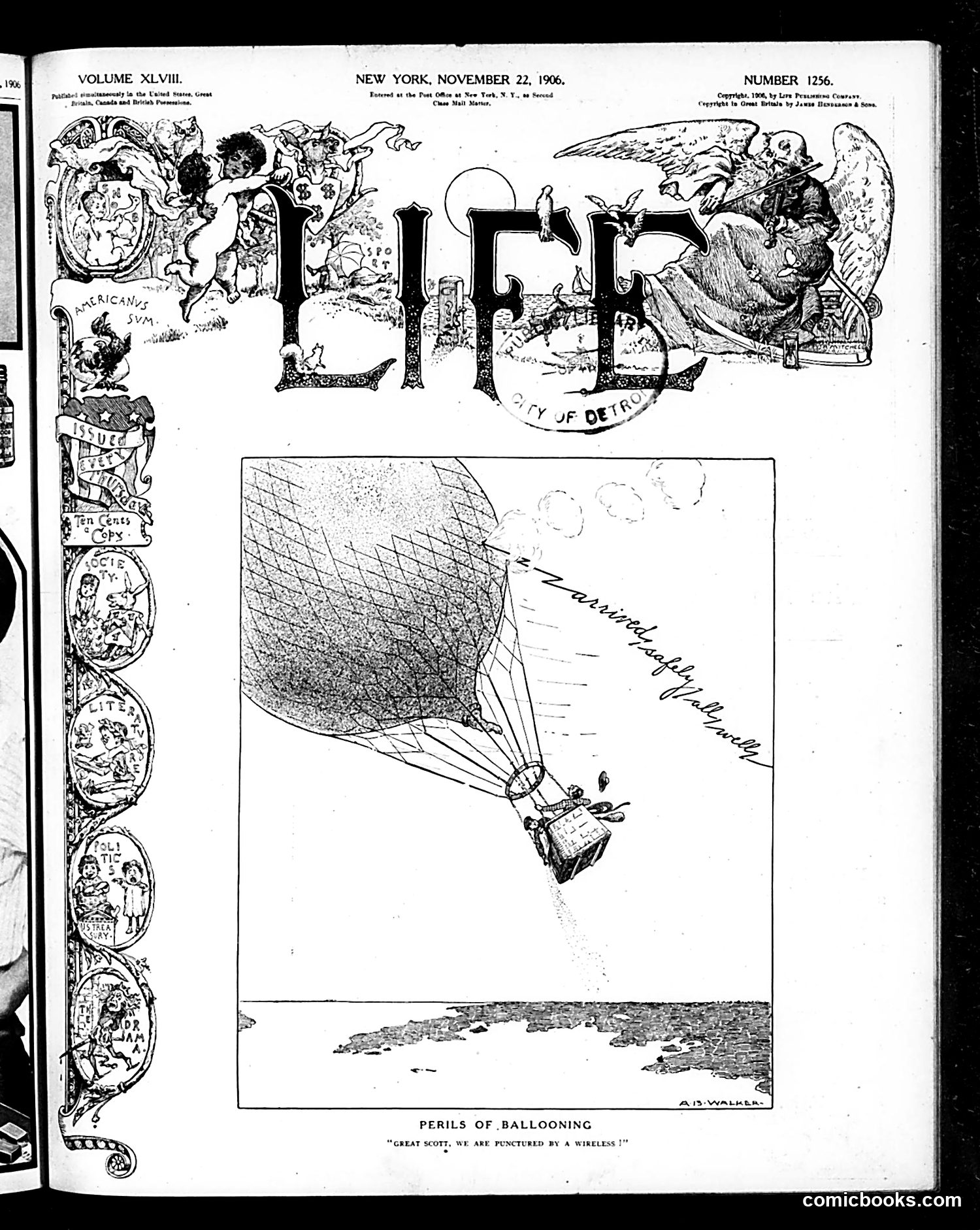
This satirical cartoon depicts a hot air balloon descending toward Detroit's cityscape, with the caption "Great Scott, we are punctured by a wireless!" The joke combines two contemporary technological anxieties: early aviation (balloons were cutting-edge travel) and Guglielmo Marconi's wireless telegraph technology, which was revolutionary but also generating public concern about invisible electromagnetic waves permeating the air. The cartoon humorously suggests that wireless signals have literally punctured the balloon—merging fear of new technology with the practical dangers of early flight. It's satirizing both public paranoia about wireless radiation and the inherent risks of experimental ballooning, presenting an absurd collision of modern marvels gone wrong.
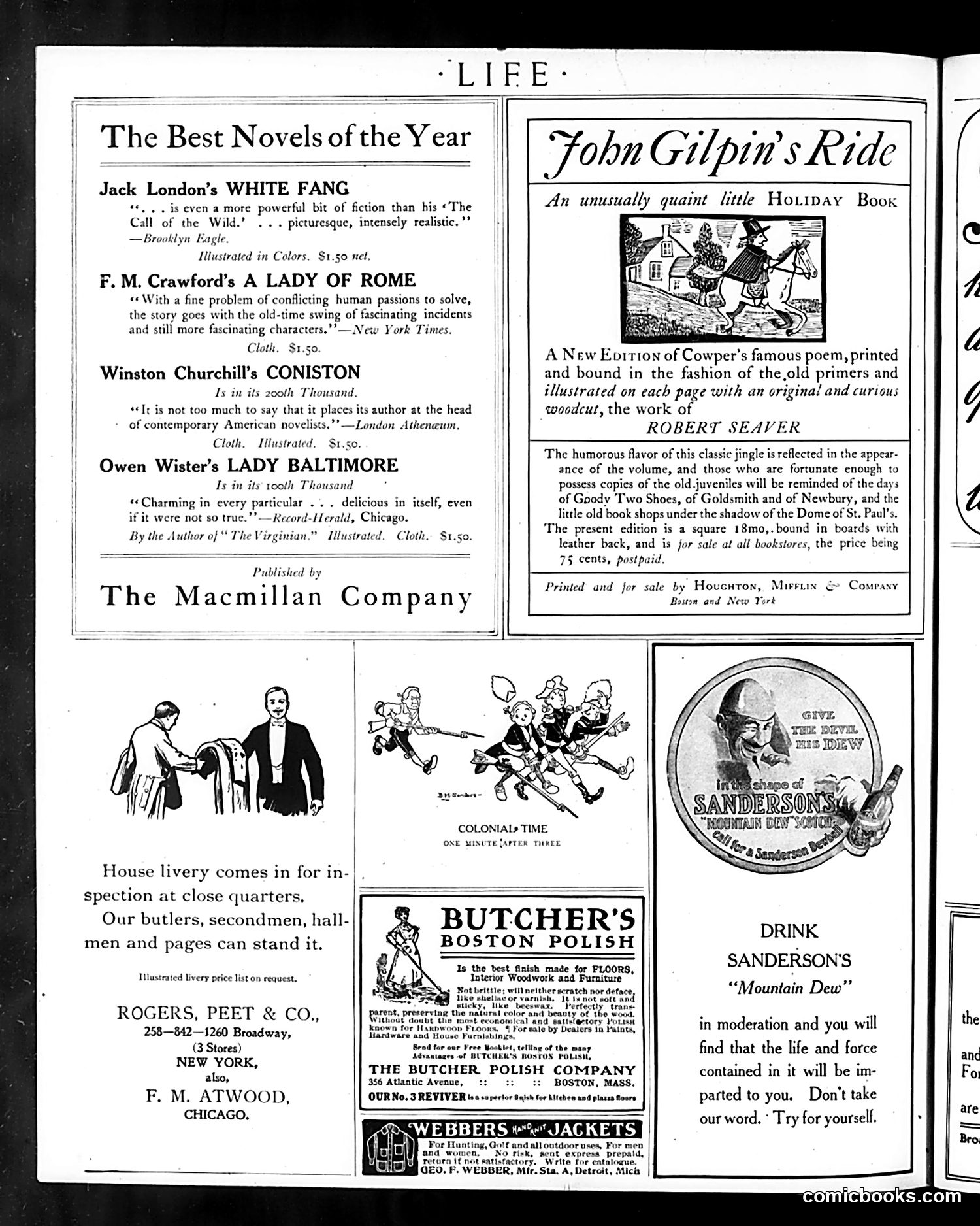
This page is primarily **advertising and book promotions** rather than satirical content. The top section reviews "The Best Novels of the Year" from Macmillan Company, promoting works by Jack London, F.M. Crawford, Winston Churchill, and Owen Wister. The one illustration shows two men in formal dress at what appears to be a house livery inspection—a mundane domestic scene with accompanying text about butler and household staff evaluations. This is straightforward editorial content, not satire. The remainder features product advertisements: Rogers Peet & Co. clothing, Butcher's Boston Polish, Sanderson's Mountain Dew, and Webber's Jackets. **No clear political satire or social commentary is evident** on this particular page—it's a standard magazine layout mixing literary reviews with commercial advertisements typical of early 20th-century publishing.
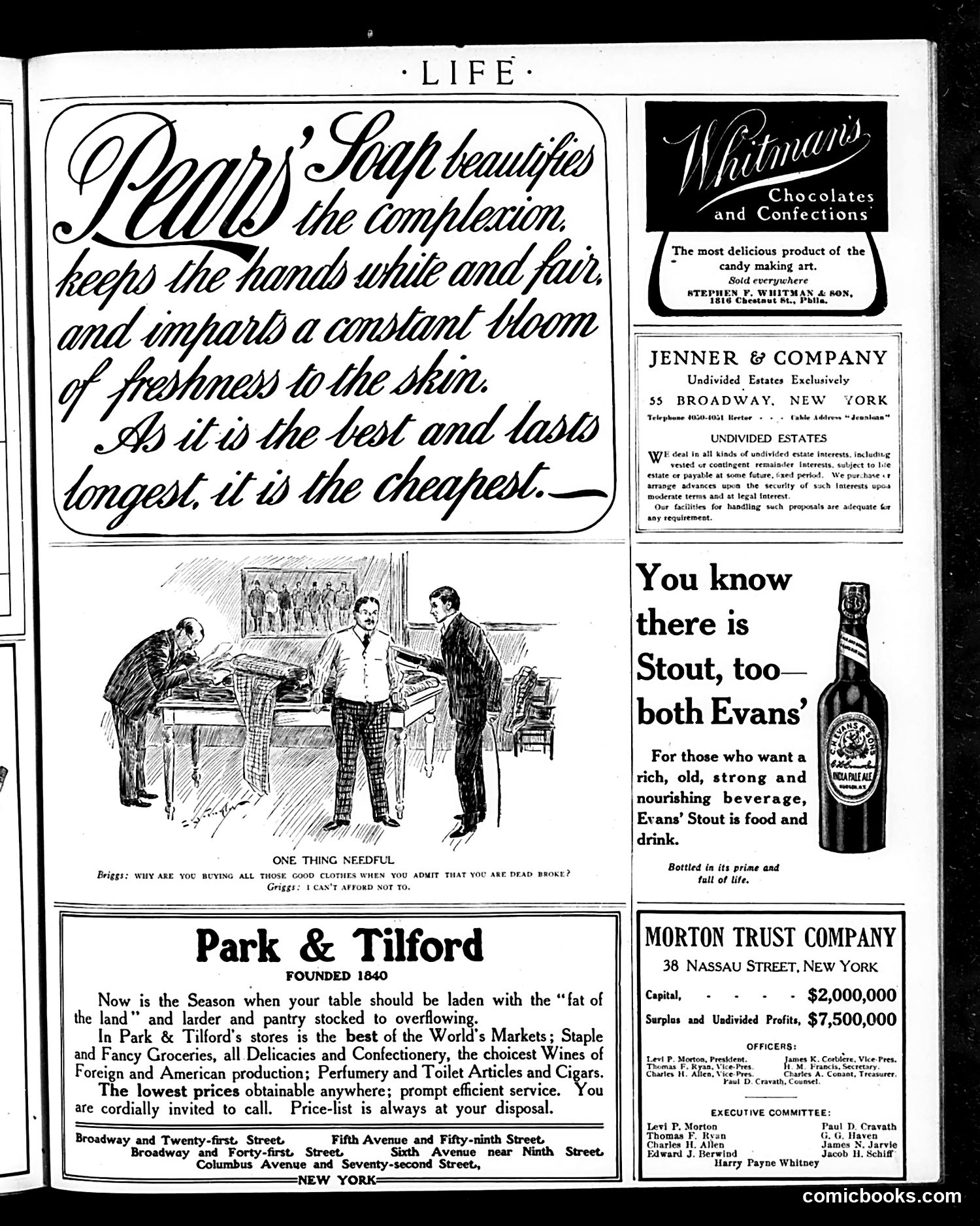
This page is primarily **advertisements** with one cartoon. The main satirical illustration, captioned "ONE THING NEEDFUL," depicts two well-dressed men confronting a third man about his expensive clothing. The caption dialogue reveals the joke: one man asks why the other buys fine clothes while admitting he's broke; the response is "I CAN'T AFFORD NOT TO." The satire targets **social pretense and conspicuous consumption**—the pressure to maintain appearances of wealth regardless of actual financial condition. This reflects early 20th-century concerns about class performance and the American obsession with status symbols. The surrounding ads (Pear's Soap, chocolates, estate services, Evans' Stout) reinforce the theme of aspirational consumer goods marketed to the upwardly mobile or financially anxious.
This is a **short story, not a political cartoon**. The piece is a narrative about Colonel Denby Grier awaiting a visitor in a valley town at the foot of a hill. The story describes the Colonel's peaceful evening, his family's gracious Southern hospitality, and later includes a discussion between characters about insurance and business practices—specifically mentioning Senator Dryden and concerns about life insurance companies. The text appears to be literary fiction exploring themes of Southern gentility, business ethics, and social change in early 20th-century America. There are no identifiable political cartoons or caricatures on this page—it is primarily text-based editorial content from *Life* magazine's November 22, 1909 issue.
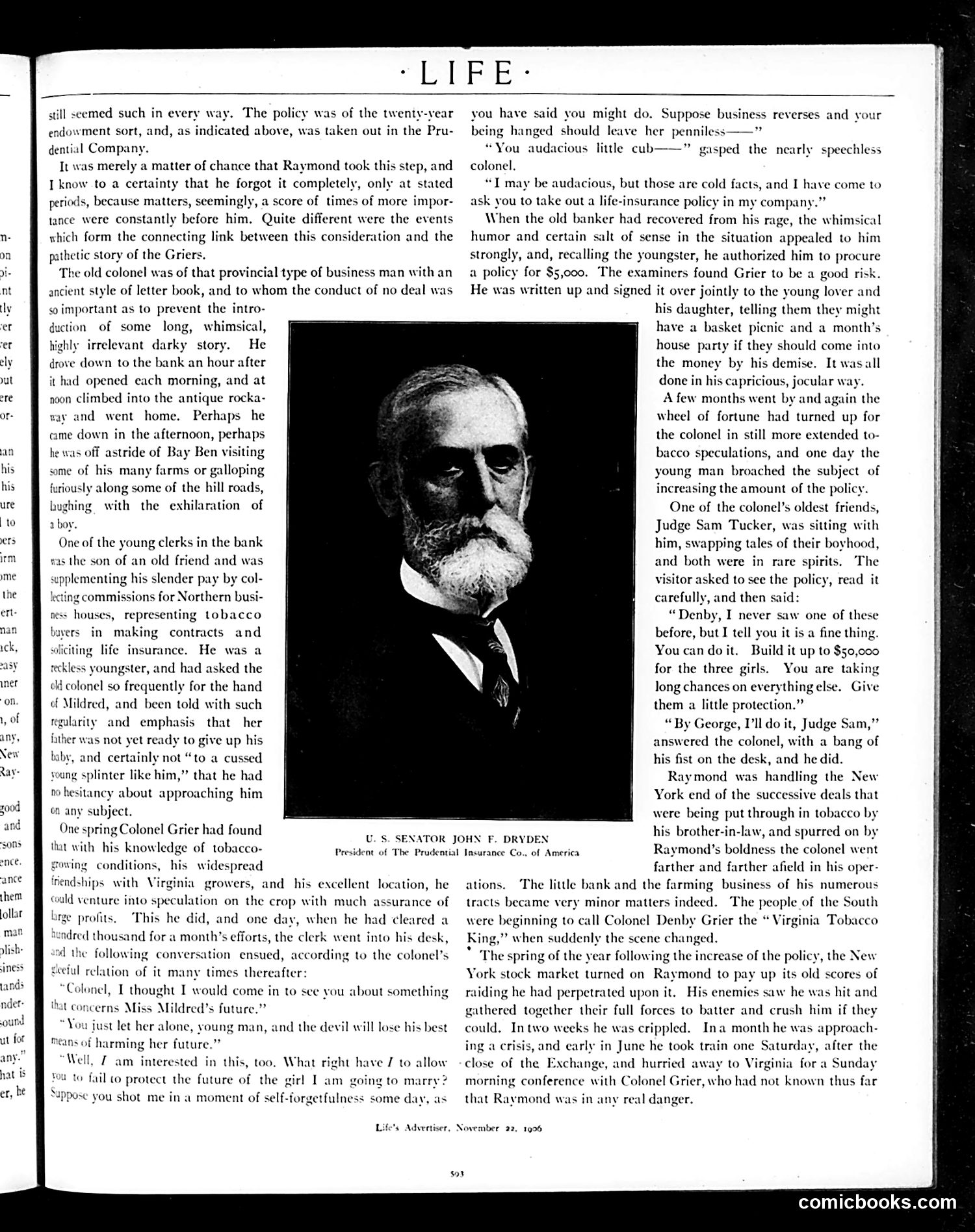
The page features a portrait photograph labeled "U.S. SENATOR JOHN F. DRYDEN, President of the Prudential Insurance Co. of America." The surrounding text is a narrative story about Colonel Grier and tobacco speculation, not directly related to the portrait. However, the inclusion of Dryden's image alongside insurance policy discussions appears deliberately juxtaposed—Dryden was simultaneously a U.S. Senator and president of a major insurance company, embodying the kind of concentrated corporate power and potential conflicts of interest that Progressive Era reformers criticized. The layout suggests satirical commentary on how wealthy industrialists held dual positions of political and commercial authority, a common critique of early 20th-century American capitalism.
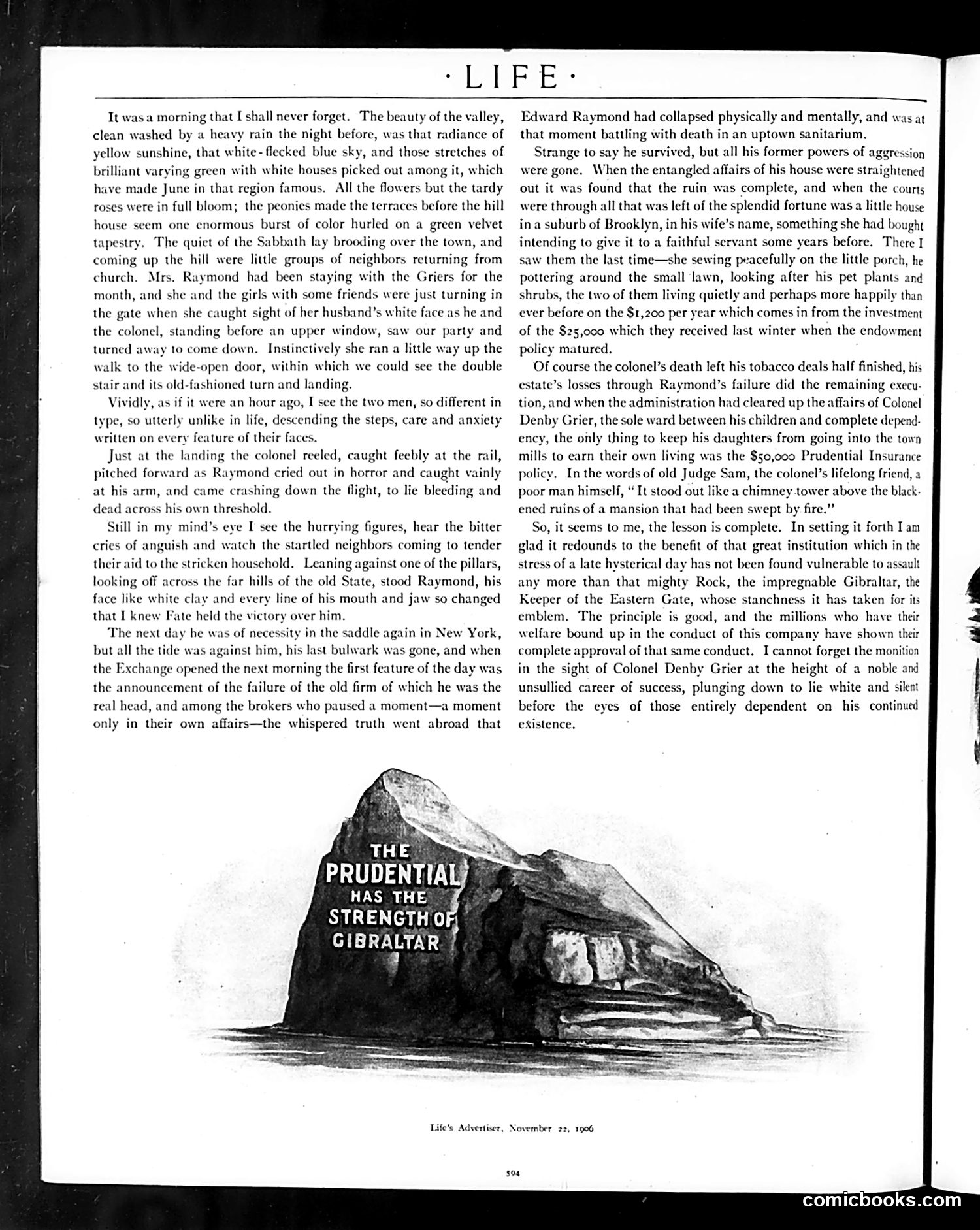
The page is primarily a narrative story about Colonel Edward Raymond's financial collapse and death. The text describes his fall from wealth to poverty in a Brooklyn suburb, his loss of a tobacco business, and his reliance on a $1,200 annual insurance policy. The advertisement at bottom features the Rock of Gibraltar with text reading "THE PRUDENTIAL HAS THE STRENGTH OF GIBRALTAR." This is a Prudential Insurance Company ad, strategically placed to reinforce the story's message about insurance providing security during life's catastrophes—creating a seamless editorial-advertising connection promoting insurance as financial protection against sudden ruin.
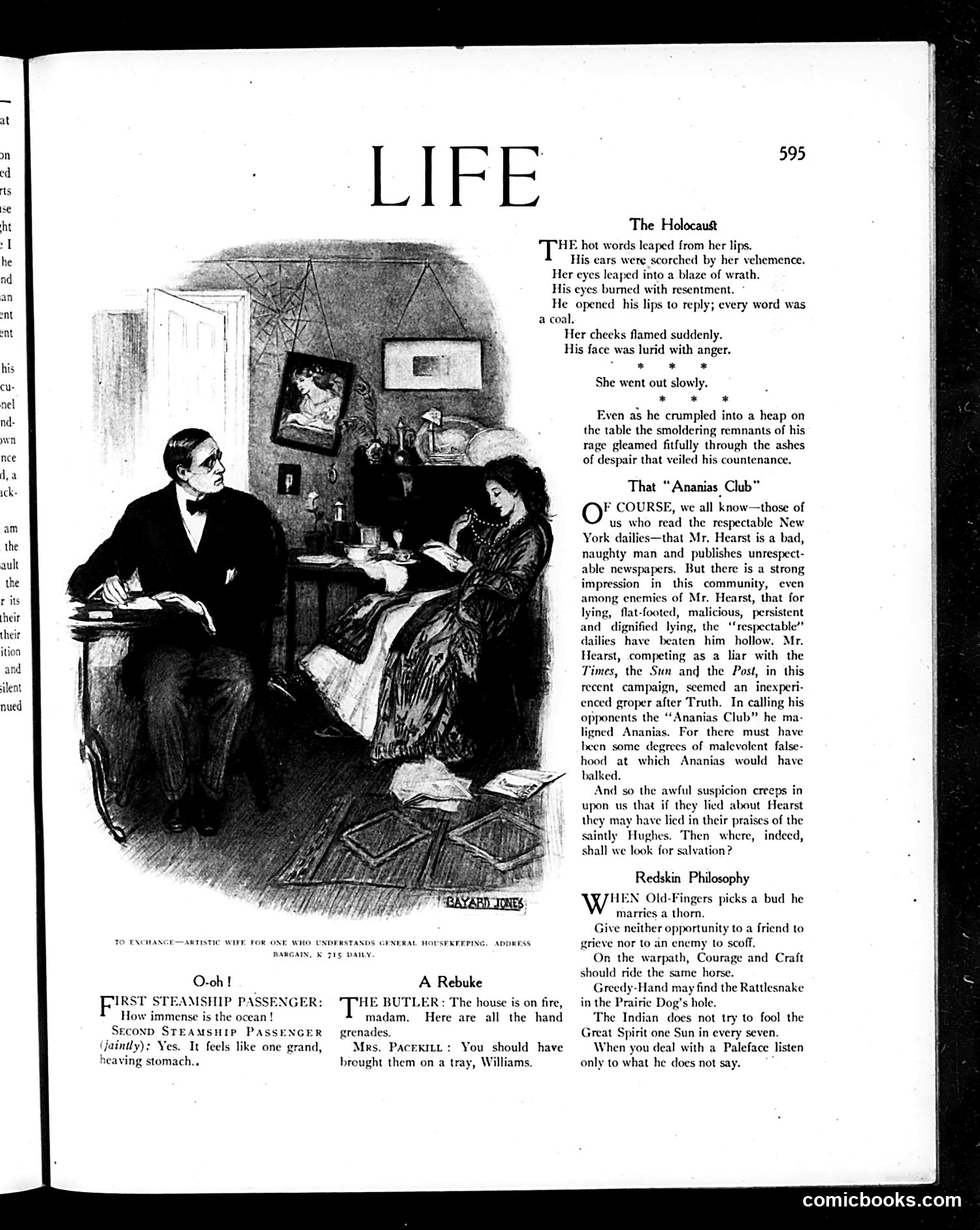
This page contains three separate satirical items from *Life* magazine: 1. **"The Holocaust"** (top): A poem about a heated domestic quarrel. The illustration shows a couple in conflict—the woman's anger is so intense it's described in violent, inflammatory language ("Her eyes leaped into a blaze of wrath"). The satire mocks domestic marital conflict by using apocalyptic language. 2. **"That 'Ananias Club'"** (middle): Political satire targeting Mr. Hearst, a newspaper publisher, accusing him and competing papers (the *Times*, *Sun*, *Post*) of dishonest reporting. "Ananias Club" references biblical lies. 3. **"Redskin Philosophy"** (bottom): Brief humorous verses about Old-Fingers picking a bud, offering folk-wisdom observations. The page satirizes marriage conflict, press dishonesty, and includes light humor.
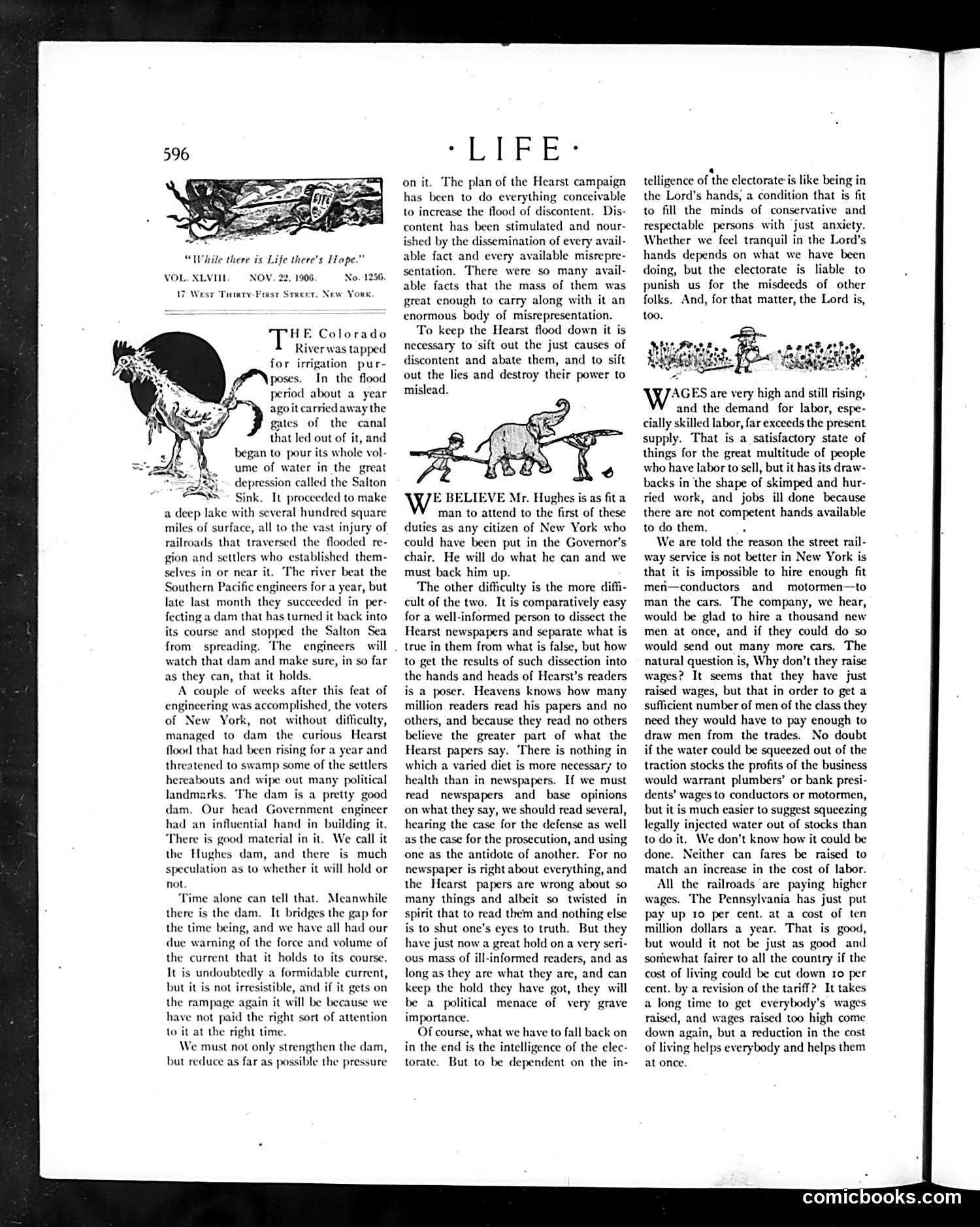
This page from *Life* magazine (November 22, 1906) features an editorial cartoon about the Colorado River and irrigation disputes. The illustration shows a rooster being strangled or held by what appears to be a large water canal or dam structure. The accompanying text discusses the Hearst newspaper campaign and debates about public discourse. The cartoon likely satirizes efforts to control the Colorado River for irrigation purposes, with the rooster symbolizing either disrupted agricultural interests or—more broadly—the difficulty of managing natural resources and political opposition. The editorial criticizes William Randolph Hearst's newspaper influence on public opinion, suggesting that newspapers spread misinformation that manipulates readers. The rooster may represent citizens or farmers caught in the struggle over water rights and development.
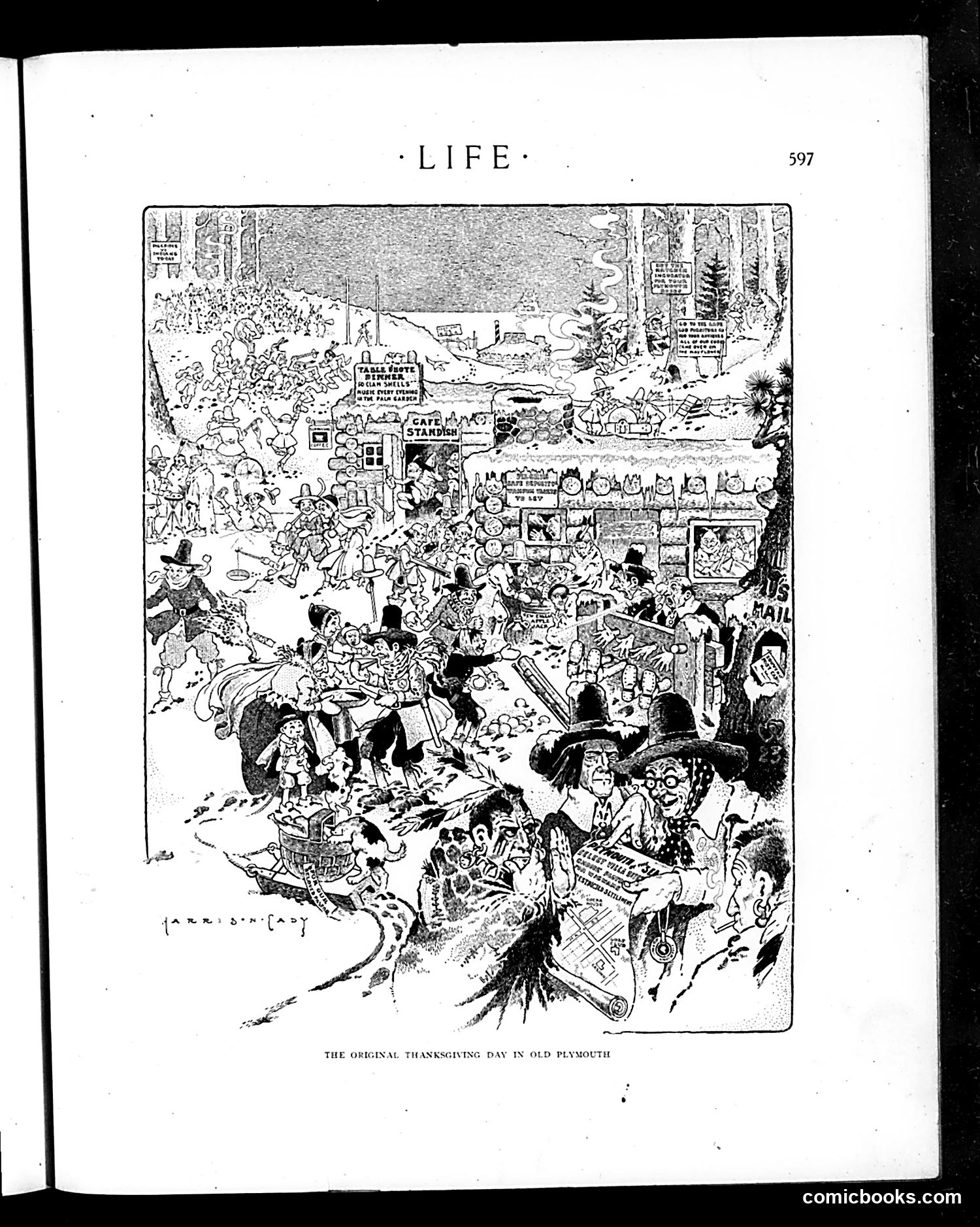
This satirical cartoon depicts the historical first Thanksgiving between Pilgrims and Native Americans, but reimagines it as a chaotic, crowded modern fair or carnival scene. The image is densely packed with numerous figures engaged in various activities—eating, trading, and entertainment—rather than a solemn historical gathering. The satire appears to mock how Americans sentimentalize or misrepresent the Thanksgiving origin story. By transforming the iconic peaceful meal into bustling commercial chaos, the cartoon suggests the holiday's actual history involves more disorder, commercialism, and cultural confusion than the idealized narrative typically taught. The crowded composition emphasizes excess and carnival-like atmosphere rather than dignified historical commemoration.
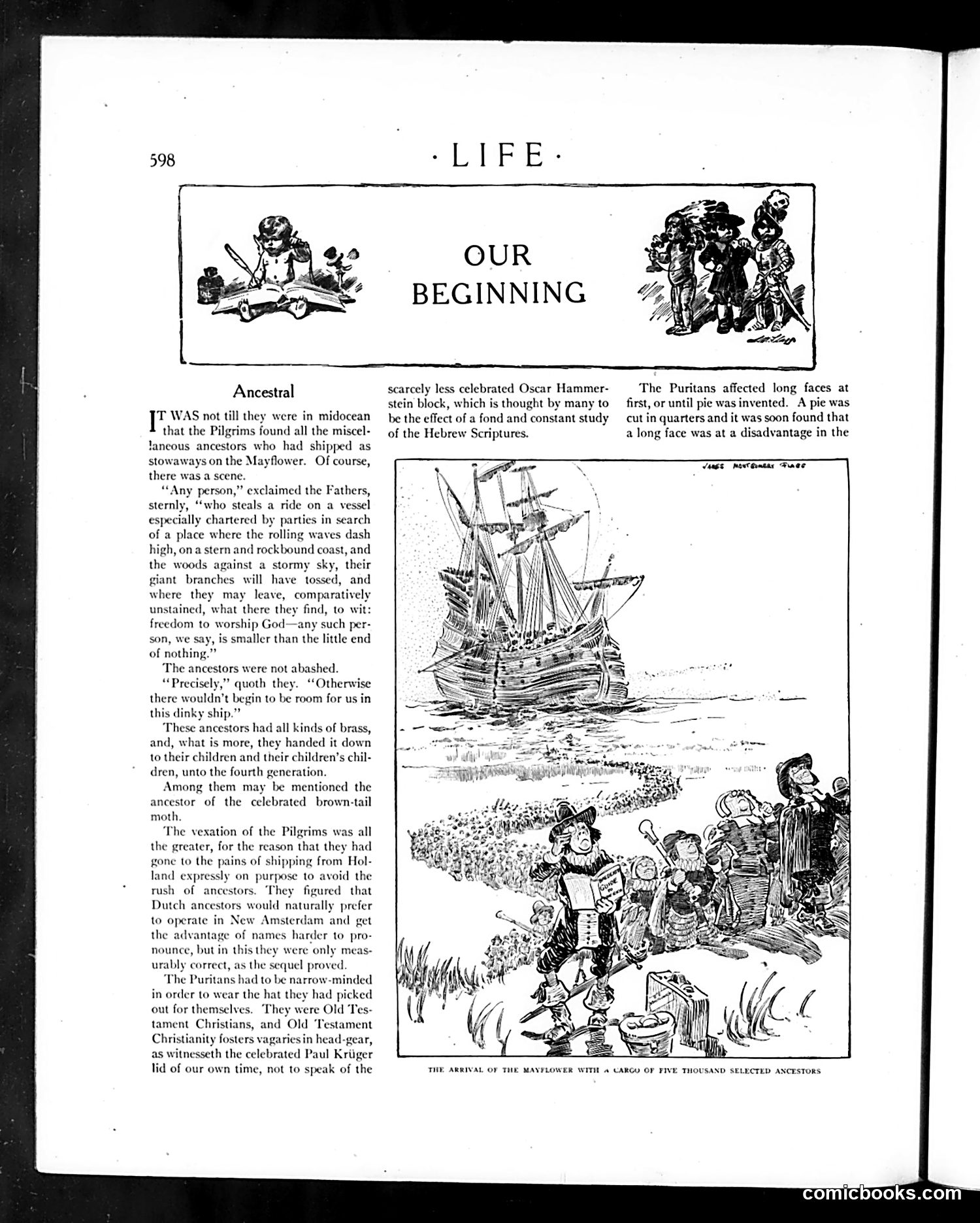
This page satirizes Puritan ancestors and their supposed moral superiority. The text mocks the Pilgrims' pretension to religious virtue while noting their actual ancestry included "all kinds of brass, and, what is more, they hanged it down to their children." The main illustration shows the Mayflower arriving with Pilgrims greeting the shore—a romanticized historical moment. However, the accompanying text undercuts this: it ridicules the Pilgrims' narrow-mindedness, their need to avoid Dutch ancestry for "harder to pronounce" names, and their religious rigidity (Old Testament Christians with "vagrancies in head-gear"). The satire suggests that Americans' celebrated Puritan heritage masks hypocrisy and inherited moral compromise, deflating the mythic status of the Pilgrims in American consciousness.
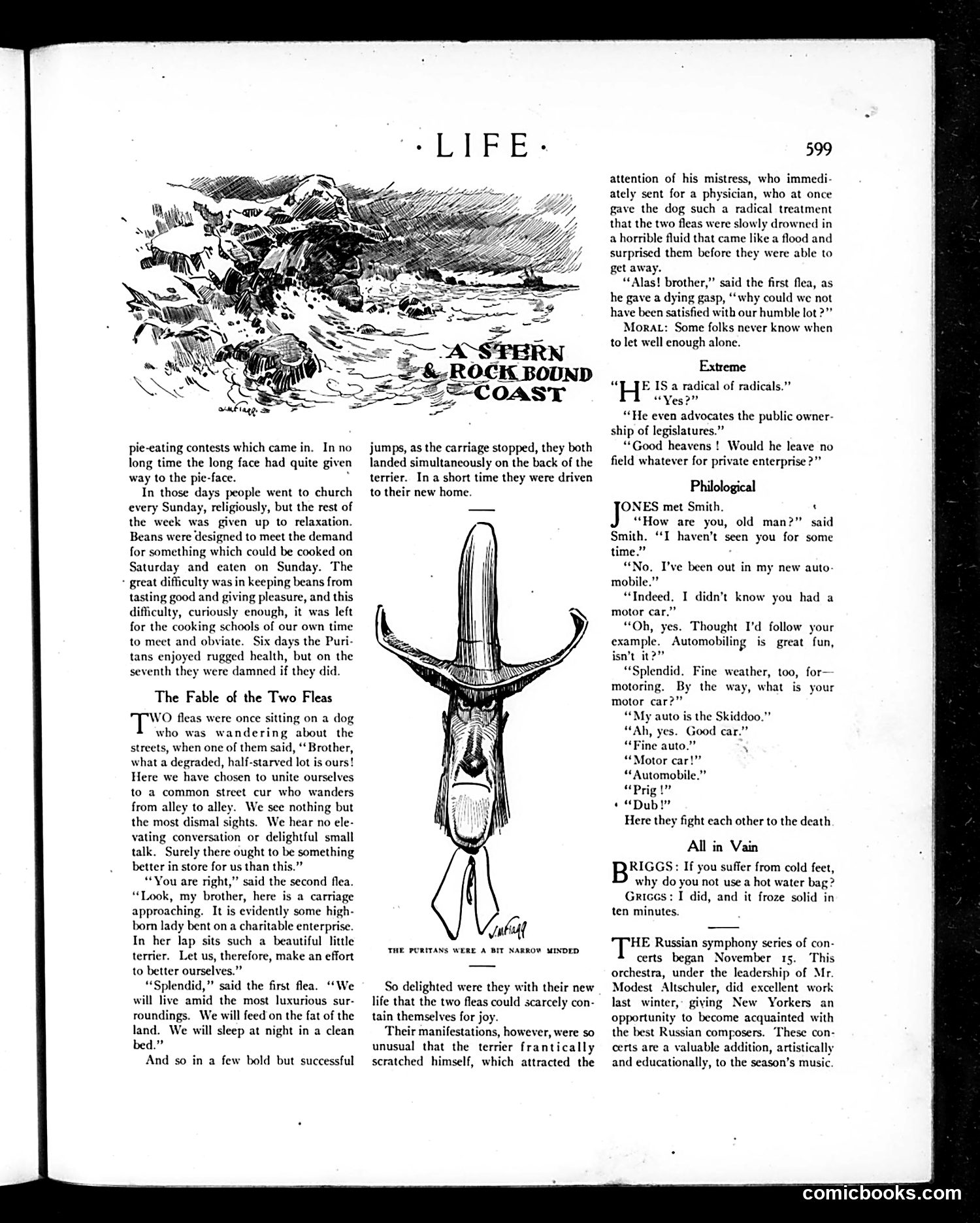
This page contains several short satirical pieces rather than a single cartoon. The main illustration shows an anchor labeled "THE PURITANS WERE A BIT NARROW MINDED," satirizing rigid moral attitudes. "The Fable of the Two Fleas" mocks Puritanical social constraints through an allegory where fleas debate whether to improve their circumstances. The satire critiques overly cautious, restrictive attitudes toward progress and social mobility. Below, "Philological" presents a comedic dialogue where Jones and Smith debate automobile terminology ("auto," "motor car," "automobile"), poking fun at Americans' obsession with new motorcar technology and its various nomenclatures—a contemporary status symbol and conversational preoccupation. The page reflects early 20th-century American anxieties about Puritanism, progress, and consumer culture.
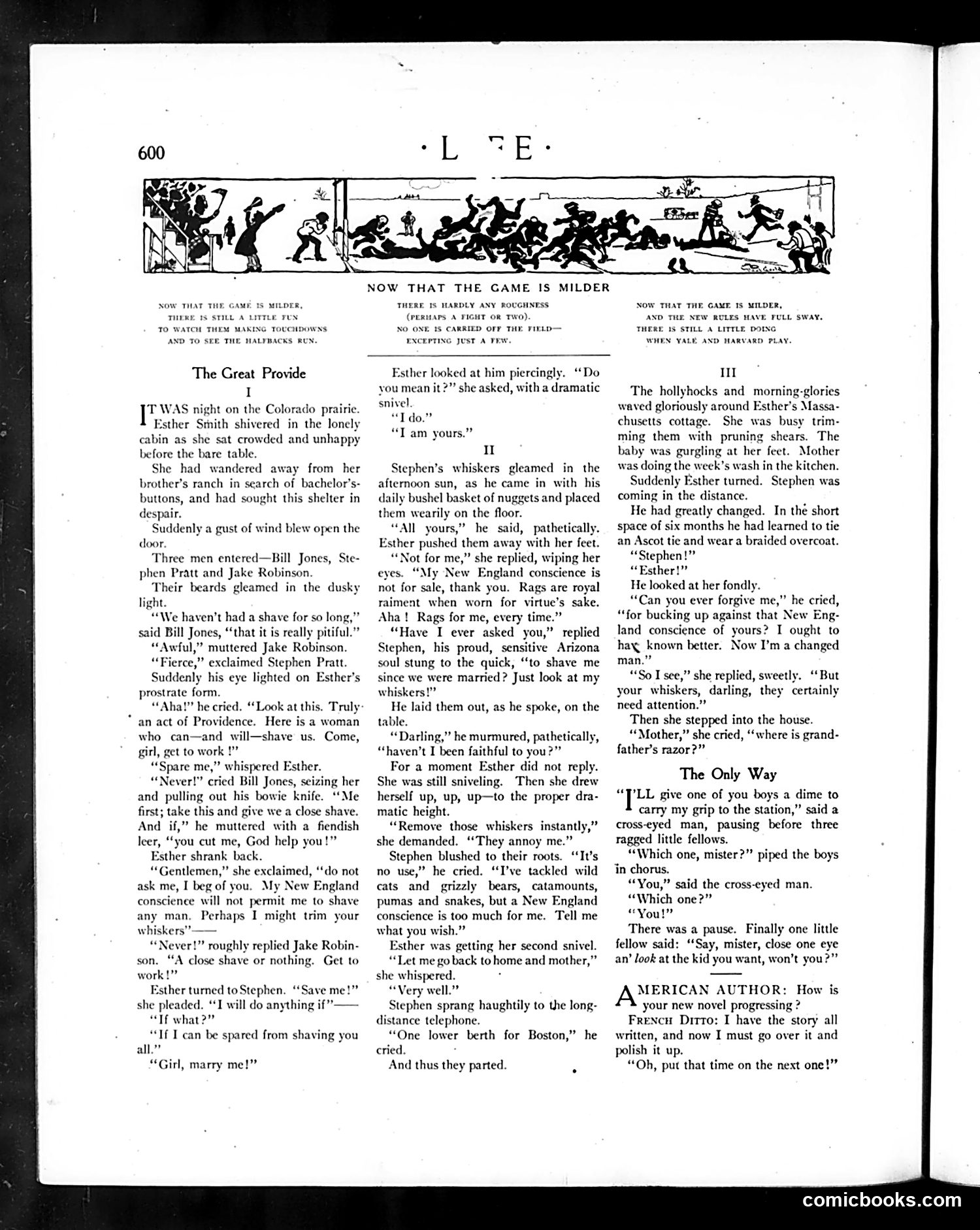
This page contains three prose fiction pieces rather than political cartoons. The header illustration shows a football game scene, accompanying text about college football ("NOW THAT THE GAME IS MILDER...WHEN YALE AND HARVARD PLAY"). The stories are: 1. **"The Great Provde"** - A romantic narrative set on the Colorado prairie involving Esther Smith and three men (Bill Jones, Stephen Pratt, Jake Robinson) 2. **"The Only Way"** - A brief anecdote about a cross-eyed man and boys at a train station 3. A dialogue between an American author and French editor about novel revision This is entertainment/literary content rather than satire. The only potentially satirical element is the author-editor exchange at bottom, poking gentle fun at the editorial revision process, but it's not political in nature.
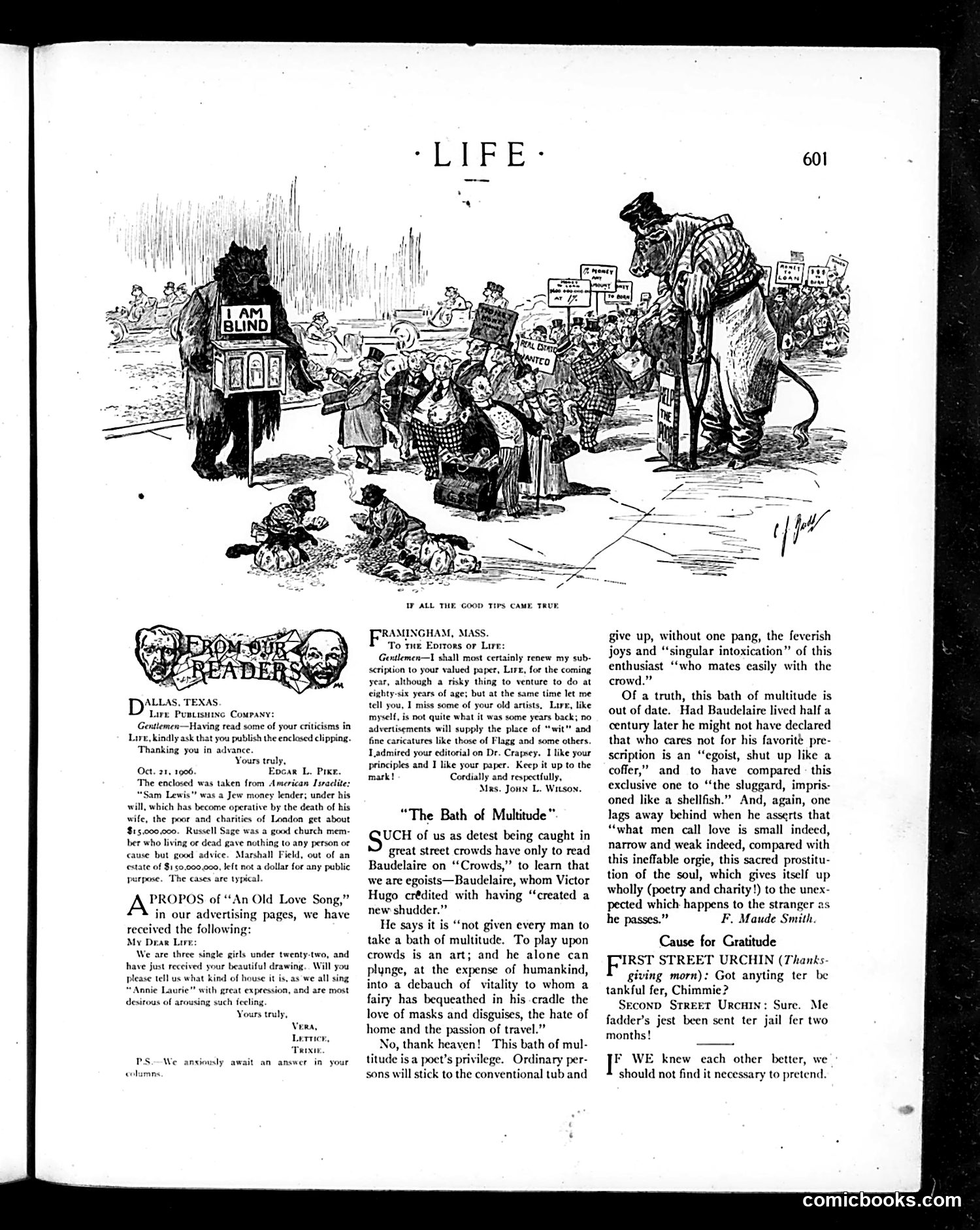
This cartoon satirizes the gap between advice-giving and reality. A figure labeled "I AM BLIND" (representing blindness to actual conditions) stands amid a crowd of well-meaning advisors offering various tips and solutions—visible on signs they carry. Meanwhile, at street level, children sit begging, and a tall figure operates what appears to be a street organ or similar apparatus. The satire suggests that while many people offer prescriptive advice about how to solve poverty and social ills, actual vulnerable people—especially children—remain neglected. The "blindness" is both literal (the sign) and metaphorical: society offers platitudes while ignoring tangible human suffering. This reflects Progressive Era criticism of charitable advice that substituted for actual material aid.
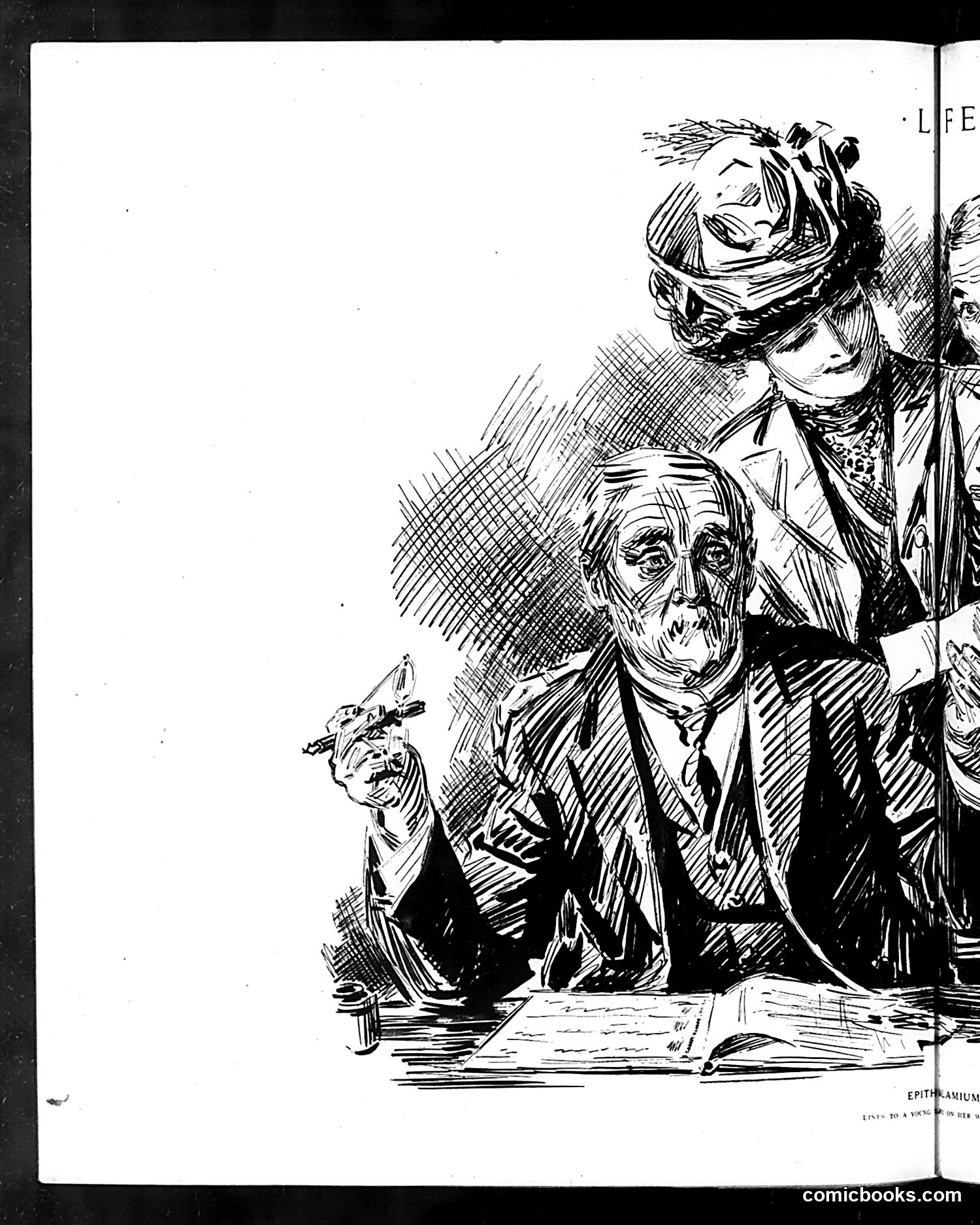
This appears to be a satirical illustration from *Life* magazine showing three figures in formal dress examining or reviewing documents on a table. The central figure is an older man with a stern expression holding what appears to be a cigar, flanked by two other well-dressed individuals behind him. The title "EPITHALAMIUM" (a poem celebrating a wedding) suggests satirical commentary on a formal or ceremonial occasion, likely political in nature. The figures' serious demeanor and the documents before them indicate this is mocking some official proceeding or agreement. Without clearer identifying features or additional context, I cannot definitively identify the specific figures or the precise historical event being satirized. The style and presentation suggest early-to-mid 20th century political satire, but the exact subject requires additional documentation to determine accurately.
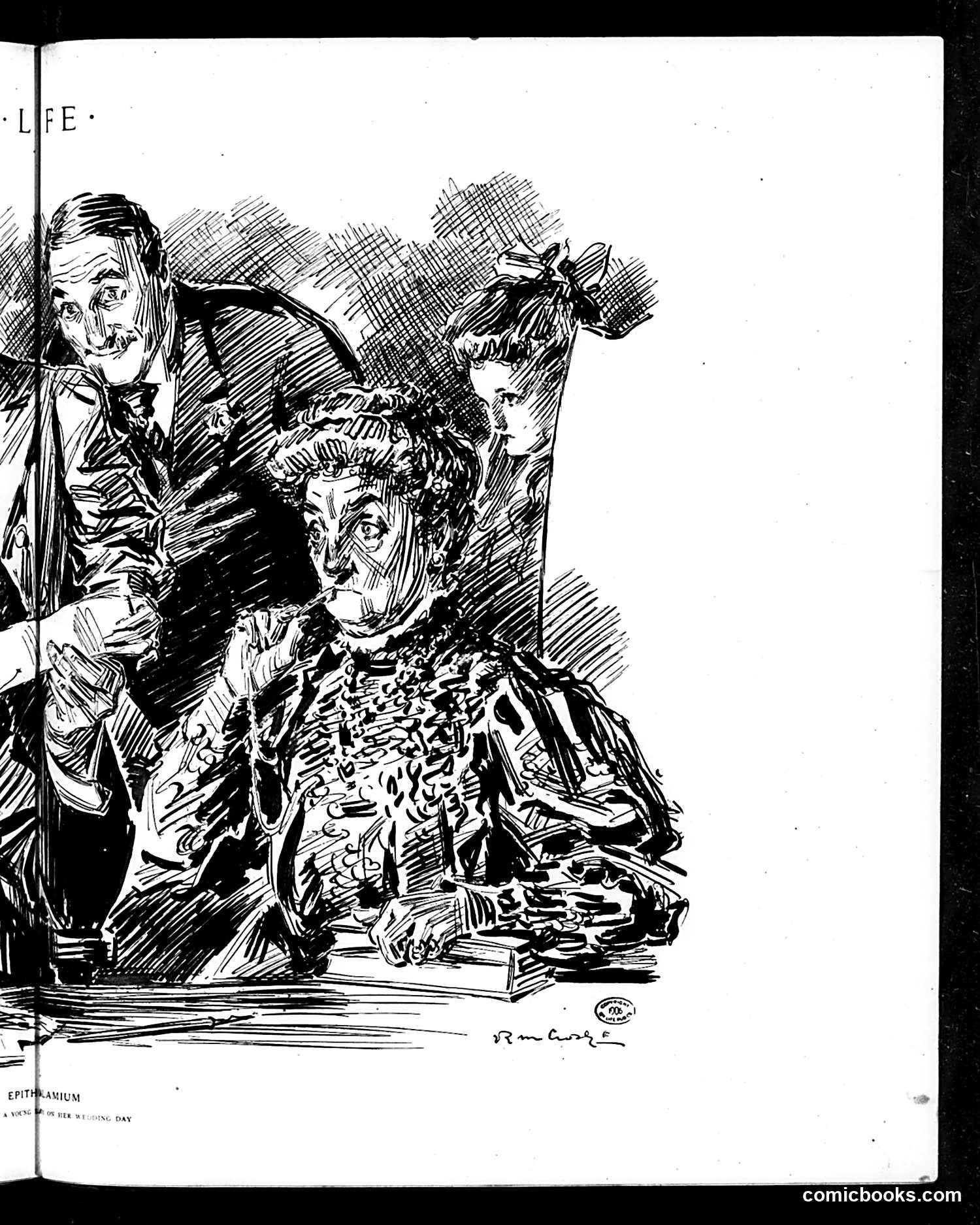
This appears to be a satirical illustration from *Life* magazine showing three figures in 18th-century dress gathered around a central seated woman in elaborate clothing and jewelry. The style suggests high-society satire, likely mocking aristocratic pretension or a specific social scandal. The word "EPITHALAMIUM" (a poem celebrating a wedding) in the caption suggests this cartoon comments on marriage, society, or possibly a controversial union. The woman's ornate dress and the men's formal attire indicate wealth and status, while the exaggerated line-work typical of *Life*'s satirical style implies criticism of these figures' vanity or behavior. Without clearer text or identifying the specific historical moment, the precise targets remain unclear, though the satire targets upper-class social dynamics.
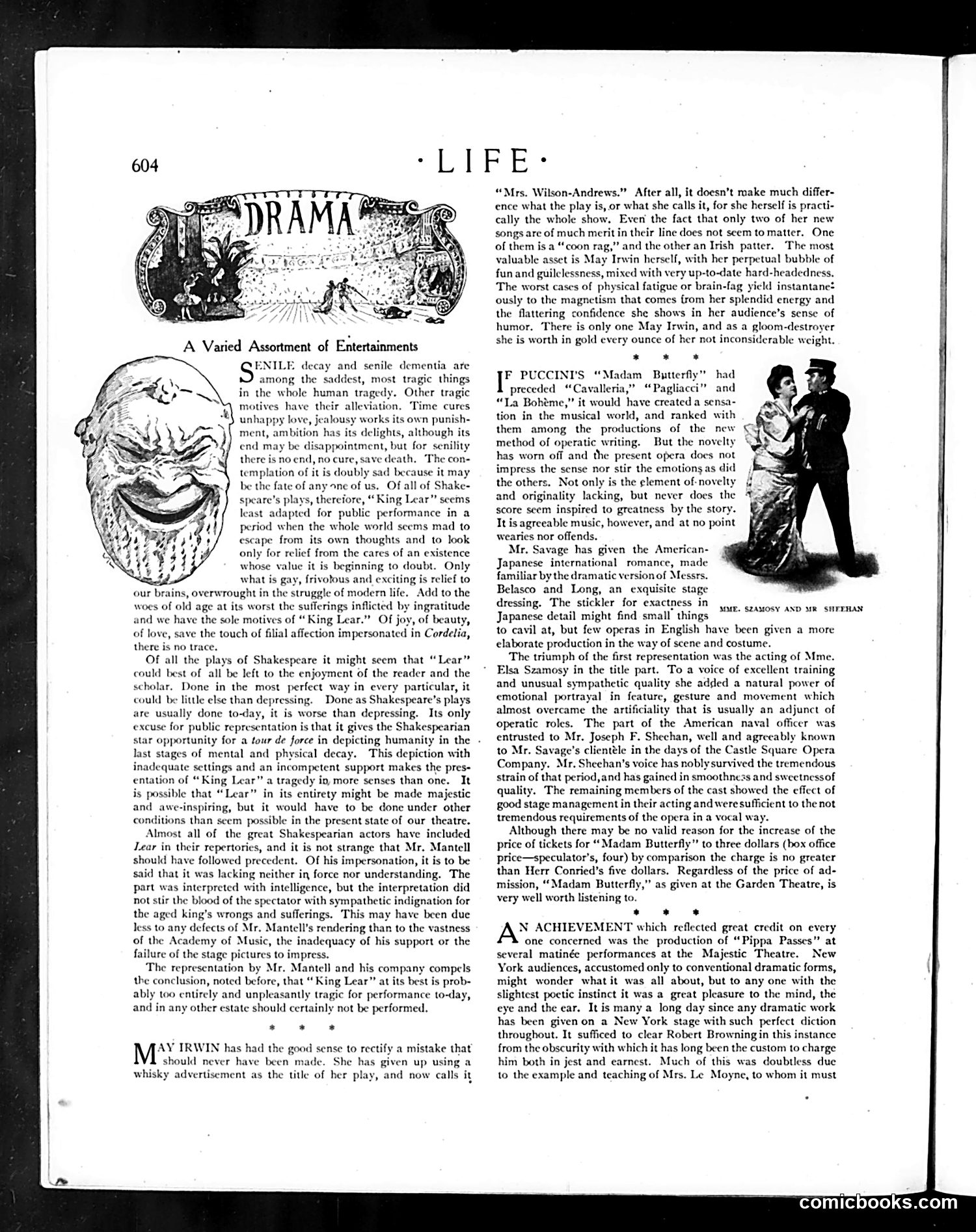
This page reviews theatrical productions, primarily focusing on a staging of Shakespeare's *King Lear* by actor Robert Mantell at the Academy of Music. The critic argues that *King Lear*—dealing with senility, ingratitude, and suffering—is unsuitable for modern audiences seeking entertainment and escape from life's anxieties. The review concludes Mantell's interpretation, while intelligent, fails to emotionally move spectators, partly due to inadequate staging and supporting cast at the Academy venue. The page also briefly praises May Irwin's comedy show "Mrs. Wilson-Andrews" (apparently retitled from a whisky advertisement), noting that Irwin herself—her charm, humor, and energy—*is* the entire production. A reference to her songs includes a "coon rag" (a period ragtime style), reflecting contemporary popular entertainment conventions. The underlying satire critiques both theatrical ambition and the gap between artistic merit and popular appeal.
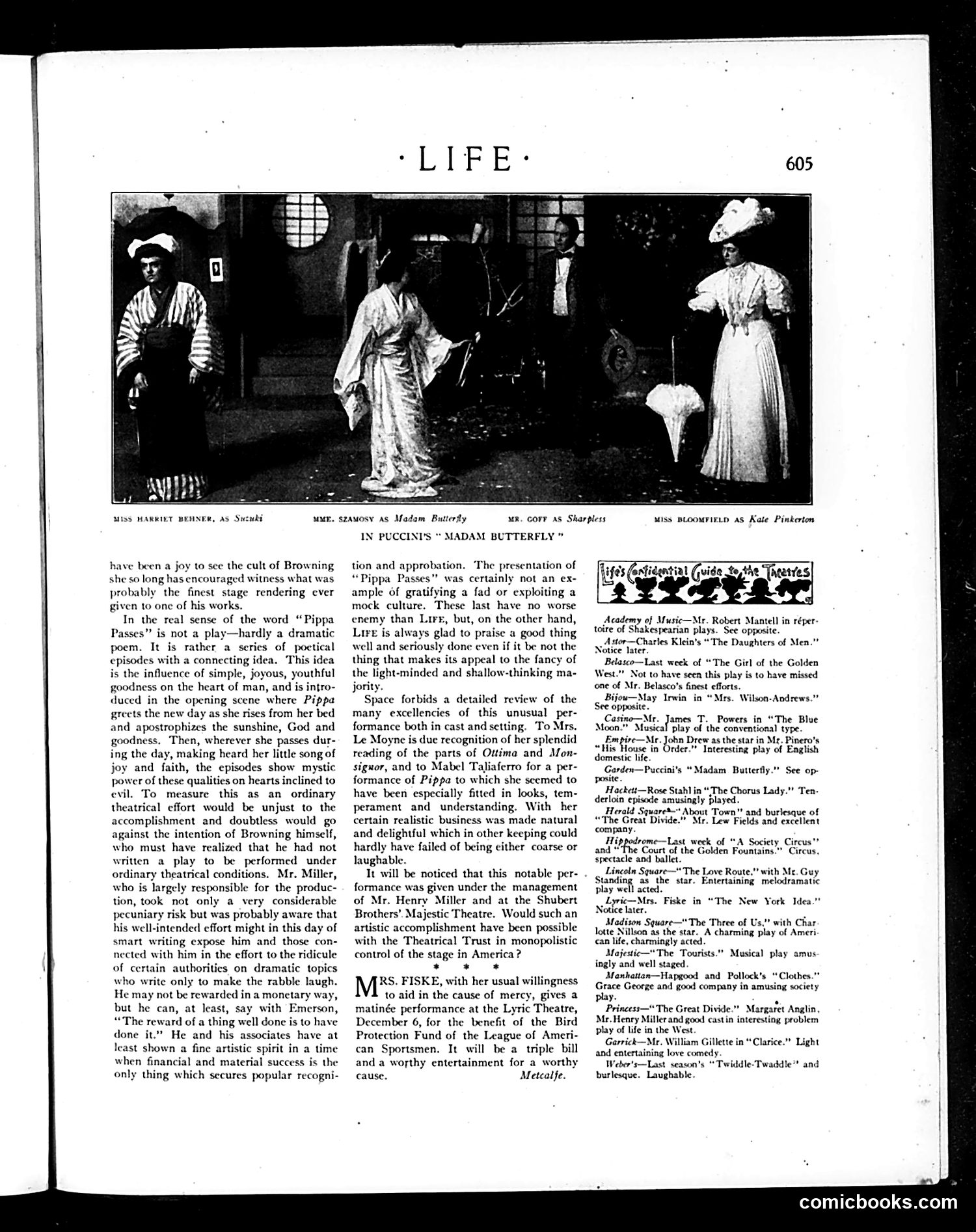
This page reviews theatrical productions, primarily Puccini's *Madam Butterfly* and a production of Browning's *Pippa Passes*. The top photograph shows four actors in costume from *Madam Butterfly*—identified as Miss Harriet Behner, Mme. Szamony, Mr. Cott, and Miss Bloomfield in their respective roles. The main text praises *Pippa Passes* as an artistic achievement despite its uncommercial nature, celebrating its cast (particularly Mabel Taliaferro) and Henry Miller's management at the Shubert Brothers' Majestic Theatre. The critic notably contrasts this with concern about the "Theatrical Trust"—a monopolistic control of American theater—questioning whether such artistic accomplishment could occur under that system. The page also mentions Mrs. Fiske's benefit matinée for the Bird Protection Fund, and lists other theatrical offerings. The overall tone emphasizes artistic merit over commercial appeal.
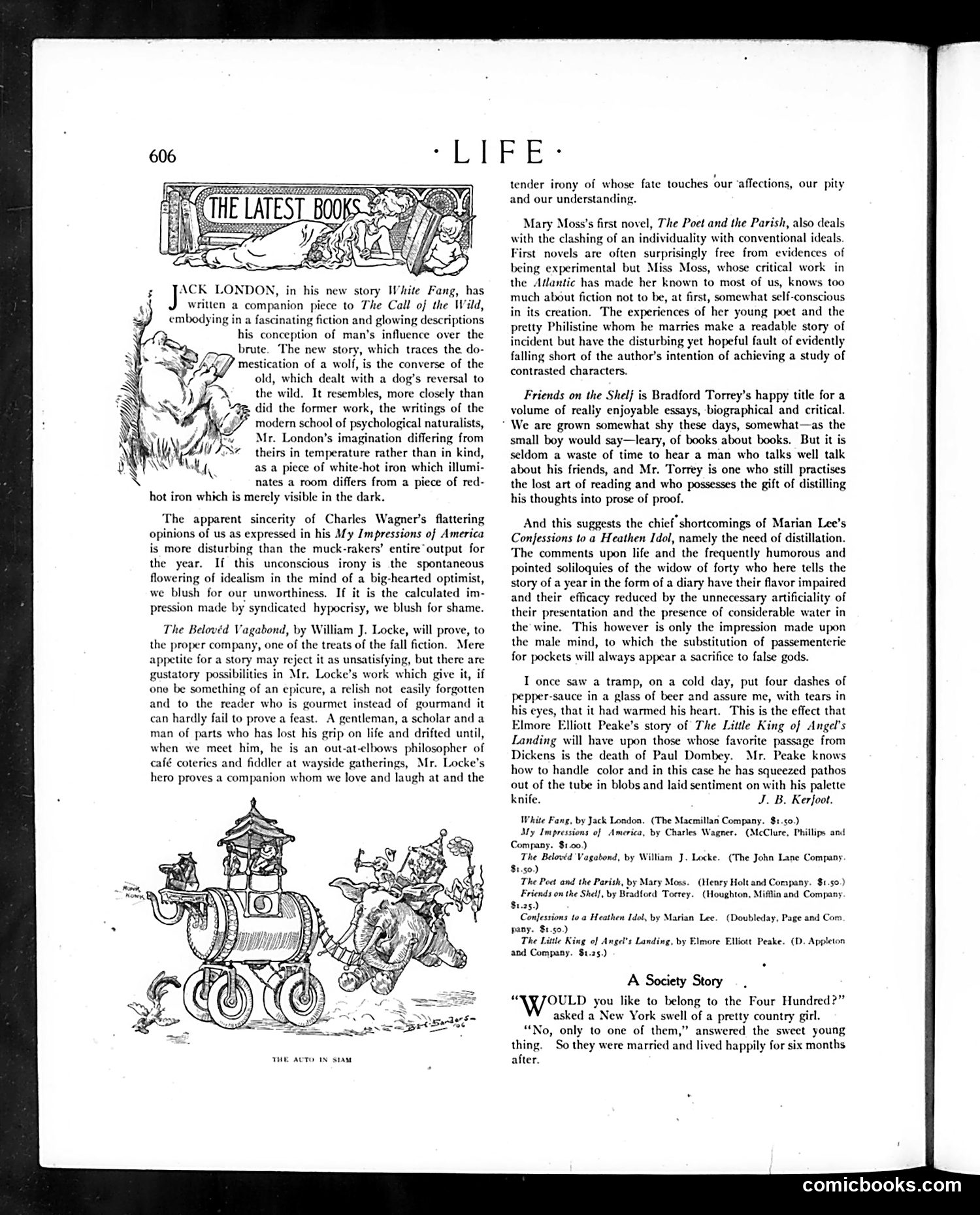
This page reviews recent fall fiction publications. The main illustration—"The Auto in Siam"—depicts an ornate mechanical contraption, likely satirizing Western technological excess or the absurdity of importing modern inventions to non-Western cultures. The detailed mechanical design suggests contemporary anxieties about industrialization. The book reviews discuss works by Jack London, Charles Wagner, William J. Locke, Mary Moss, Bradford Torrey, and Marian Lee. The critique of Wagner's *My Impressions of America* contains biting social commentary: Life suggests his flattering views of Americans represent either naive idealism (embarrassing) or calculated hypocrisy (shameful)—either way, unflattering to Americans' self-perception. The reviews employ sophisticated literary criticism typical of Life's educated readership, praising psychological naturalism while critiquing excessive artificiality in female authors' work. The patronizing comment about women sacrificing practical pockets for decorative trim reflects period gender attitudes.
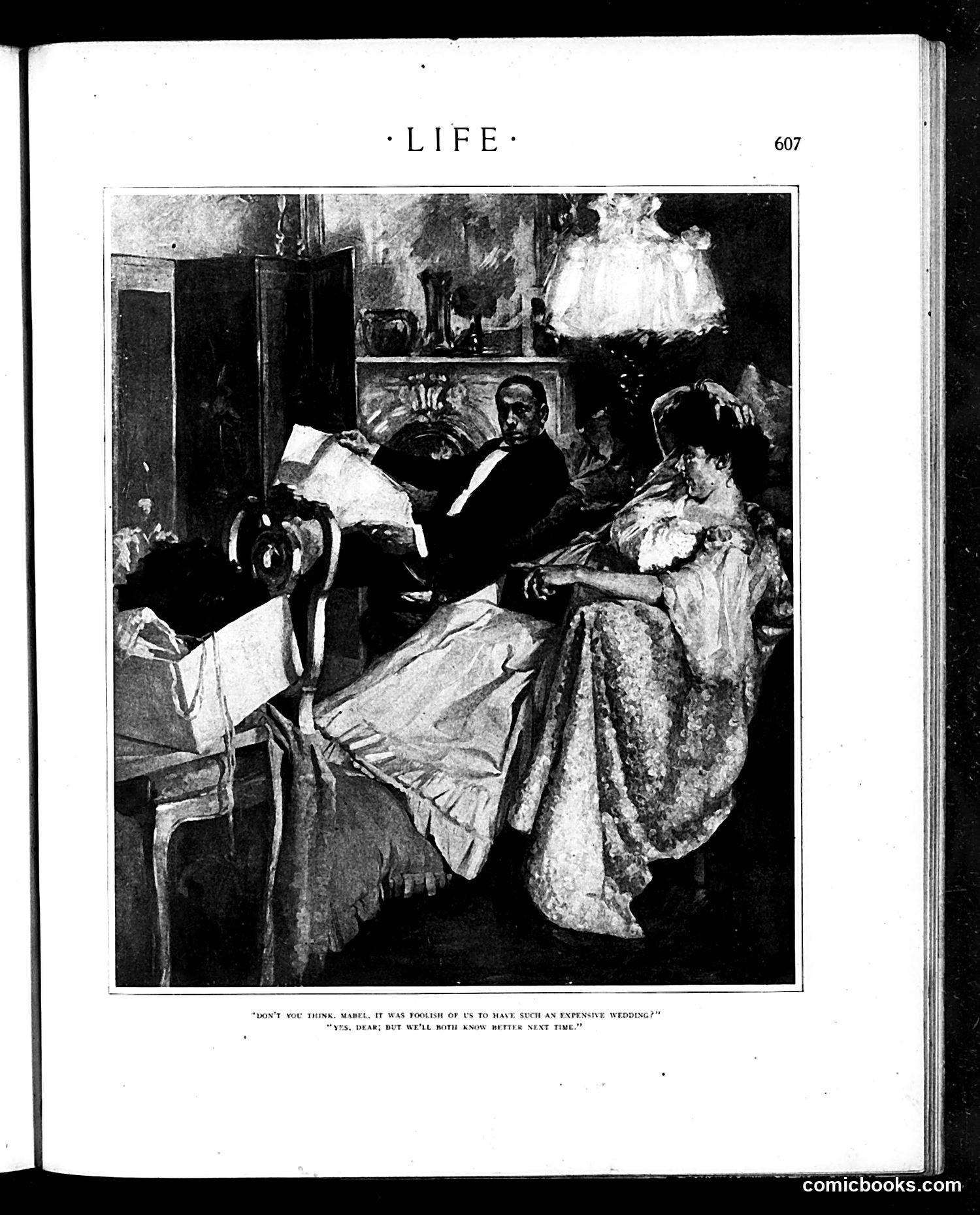
This is a domestic satire about post-wedding regret. A couple, apparently newlyweds, discusses their expensive wedding ceremony. The husband expresses doubt about the extravagant cost, and the wife agrees—but adds they'll "know better next time," implying she anticipates a future divorce and remarriage. The joke reflects early 20th-century anxieties about rising divorce rates and consumer spending. By having the wife casually reference a "next time," the cartoonist satirizes both marital instability among the wealthy and the cultural assumption that expensive weddings are wasteful. The opulent bedroom setting and formal attire reinforce that this couple has money but questionable priorities—a common target of *Life* magazine's satirical humor about upper-class excess.
This page from Life magazine (a satirical publication) contains multiple short humor pieces typical of early 20th-century American wit. **Main Content:** - **"A Rhyme of the Ruins"**: A humorous poem about San Francisco's 1906 earthquake destruction, written in the style of Kipling's "Mandalay." The speaker ironically prefers living in the ruins to relocating to Oakland. - **"Beyond the Pale"**: A James Whitcomb Riley anecdote where Riley tells a woman that author Chaucer "forever shuts him out of society" because he died several hundred years ago—mocking the woman's literary ignorance. - **"Had Heard of Them"**: A grocer's customer fears "repoussé eggs" (a cooking technique), misunderstanding newspaper food discussions as a scandal. - **Shrewd Scheme**: A porter negotiates payment to leave dust on a traveler rather than brush it off. The page demonstrates Life's formula: topical references (the 1906 earthquake), literary satire, and observational humor targeting urban American pretension and misunderstanding.
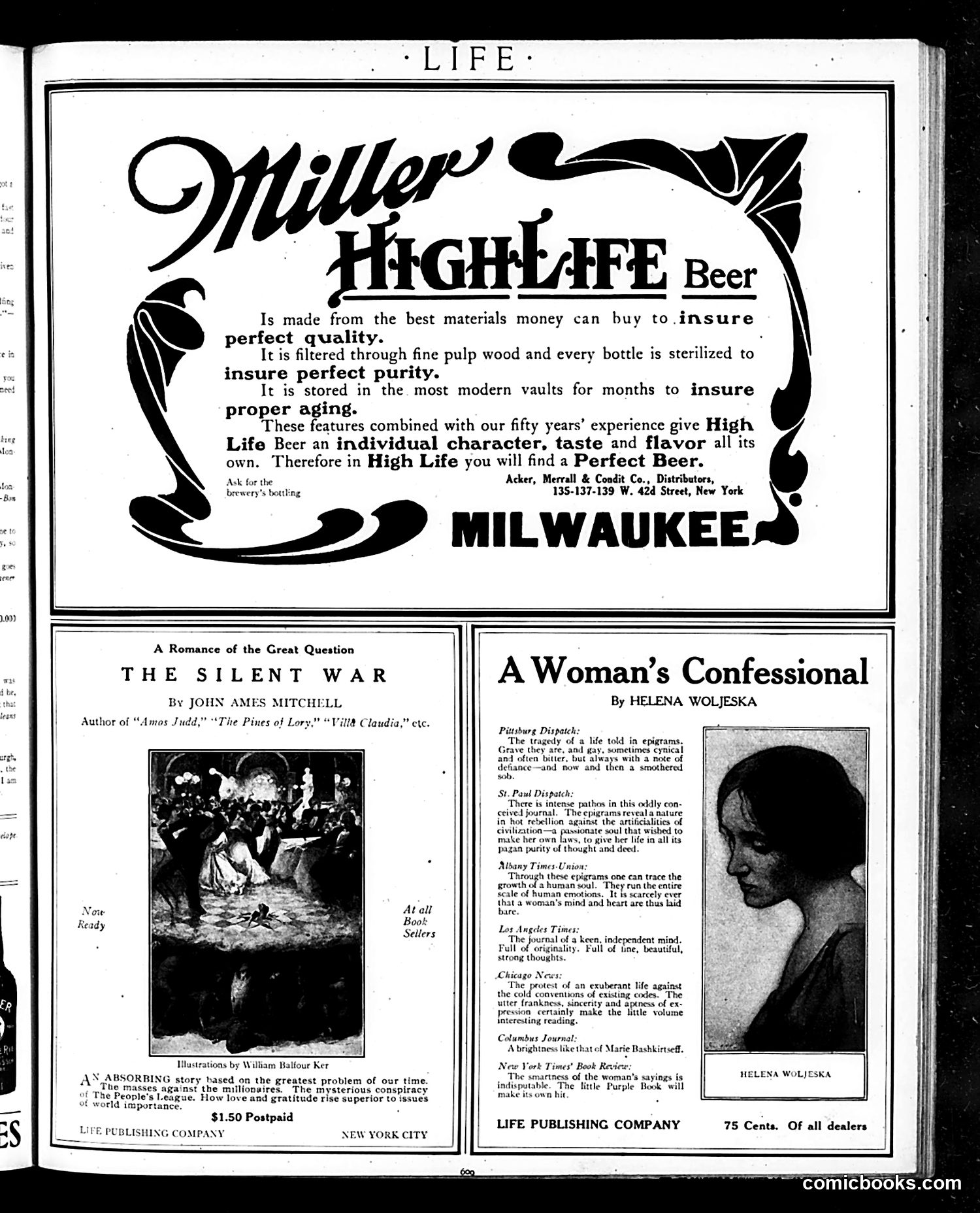
This is primarily an **advertising page** from Life magazine, not a satirical cartoon. The page contains: 1. **Miller High Life Beer advertisement** (top): A decorative Art Nouveau-style ad emphasizing the beer's quality through filtration, sterilization, and storage processes. Standard early 20th-century advertising rhetoric about product purity and craftsmanship. 2. **Two book advertisements** (bottom): - *The Silent War* by John Ames Mitchell, described as "A Romance of the Great Question" about "millionaires" and "mysterious conspiracy" - *A Woman's Confessional* by Helena Woljeska, presented as epigrams about a woman's inner life and rebellion against social conventions The reviews quoted suggest both books engage with contemporary social tensions—wealth/class conflict in one, women's independence and emotional authenticity in the other—but the page itself is selling products rather than satirizing them. There is no political cartoon visible on this page.
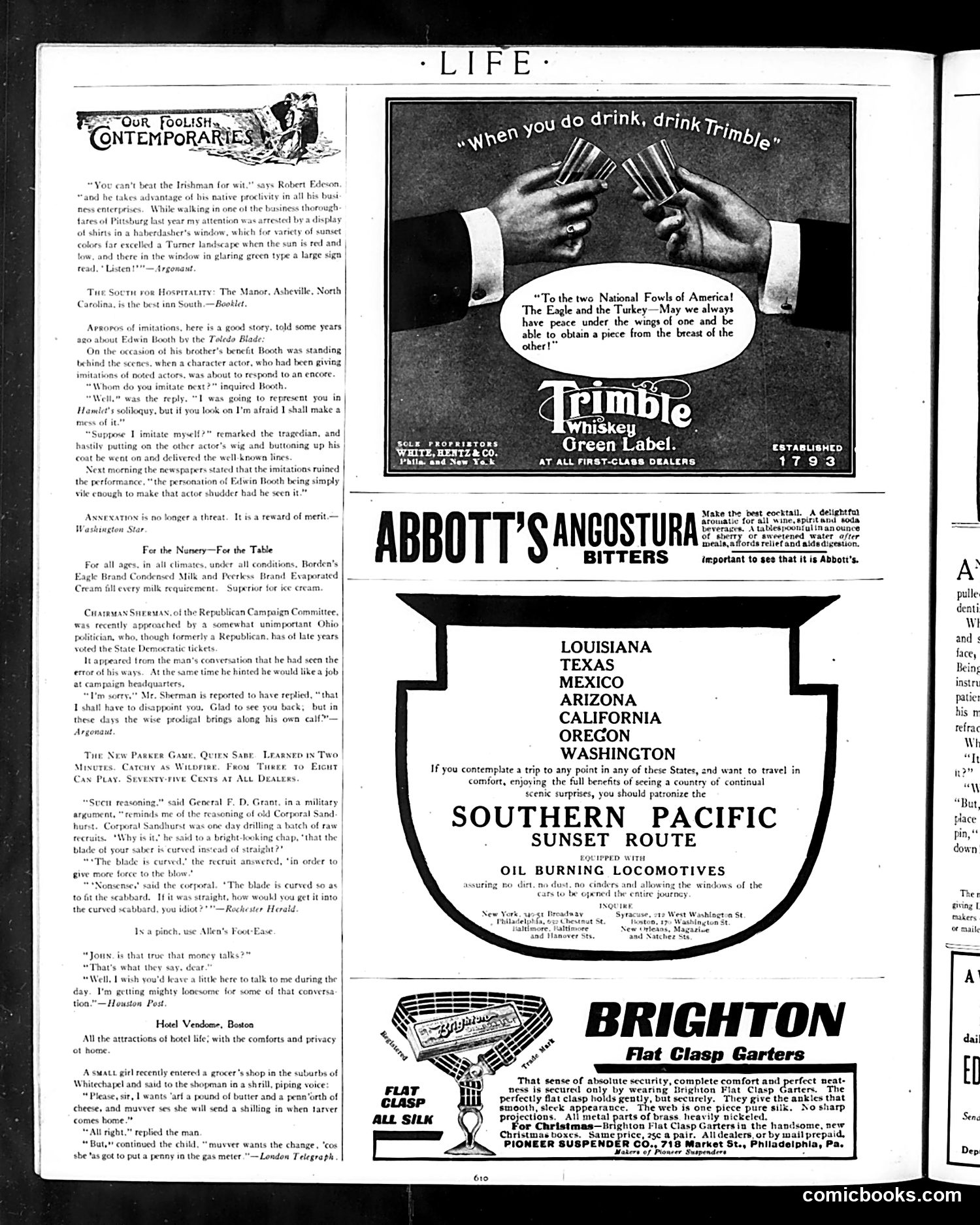
This page from *Life* magazine is primarily **advertising**, with only brief satirical snippets interspersed. The main content includes: **"Our Foolish Contemporaries"** — A column of short anecdotes mocking human folly. Notable: a story about Edwin Booth (famous 19th-century actor) who, when asked to impersonate another actor, warns he'll "make a mess of it"—satire on poor imitation. **Large advertisements** dominate the page: - **Trimble Whiskey** — features two hands toasting with the motto about eagles and turkeys (American patriotic imagery used to sell liquor) - **Abbott's Angostura Bitters** — medicinal alcohol - **Southern Pacific Railway** — promoting travel to western states via "Oil Burning Locomotives" - **Brighton Flat Clasp Garters** — men's hosiery The satire is mild—gentle mockery of pretension and foolishness. The alcohol ads are prominent, reflecting pre-Prohibition America. The railway ad emphasizes modern technology ("oil burning" locomotives). Overall, this reflects early 20th-century consumer culture and advertising conventions.
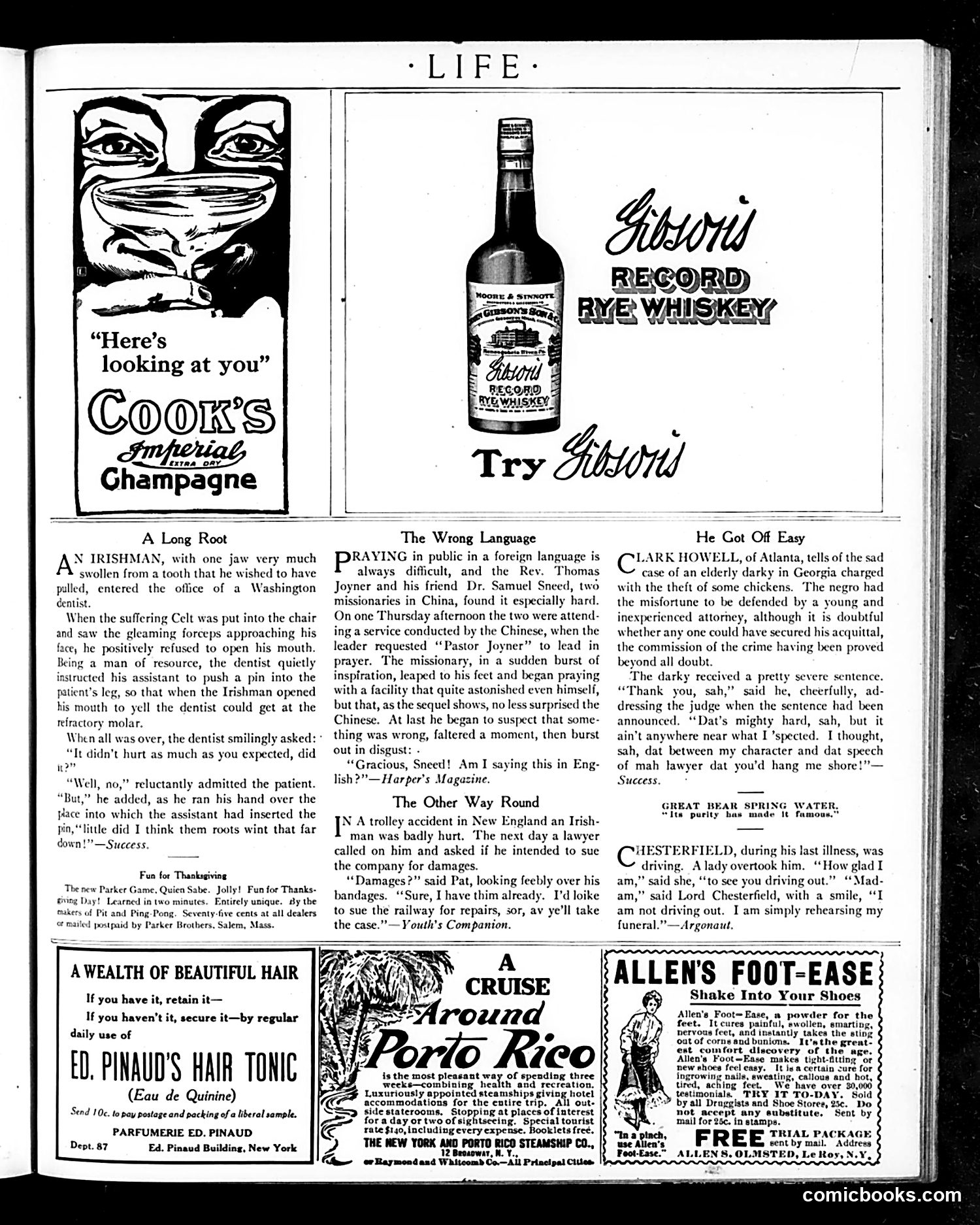
This page contains humorous anecdotes typical of early Life magazine's satirical humor, alongside period advertisements. **The Cartoons/Jokes:** The top left features Cook's Imperial Champagne advertisement with a crude caricatured face—a common advertising style of the era, though the exaggerated features reflect period aesthetic standards we'd find offensive today. **The Text Anecdotes** employ ethnic stereotypes common to early 20th-century American humor: - "A Long Root": An Irish immigrant's dental visit, playing on Irish dialect and cultural stereotypes - "The Wrong Language": Missionaries in China accidentally praying in the wrong language—gentle humor about religious work abroad - "The Other Way Round": An Irish accident victim's malapropism - References to "darky" dialect humor regarding a Black defendant **Context:** This represents Life's satirical approach using ethnic humor that was socially acceptable then but reflects prejudices we now recognize. The advertisements (hair tonic, foot powder, cruise line) are period-typical. The humor relies on stereotyped speech patterns and cultural misunderstandings—entertainment modes that depended on audiences' familiarity with (and often prejudice toward) immigrant and minority groups.
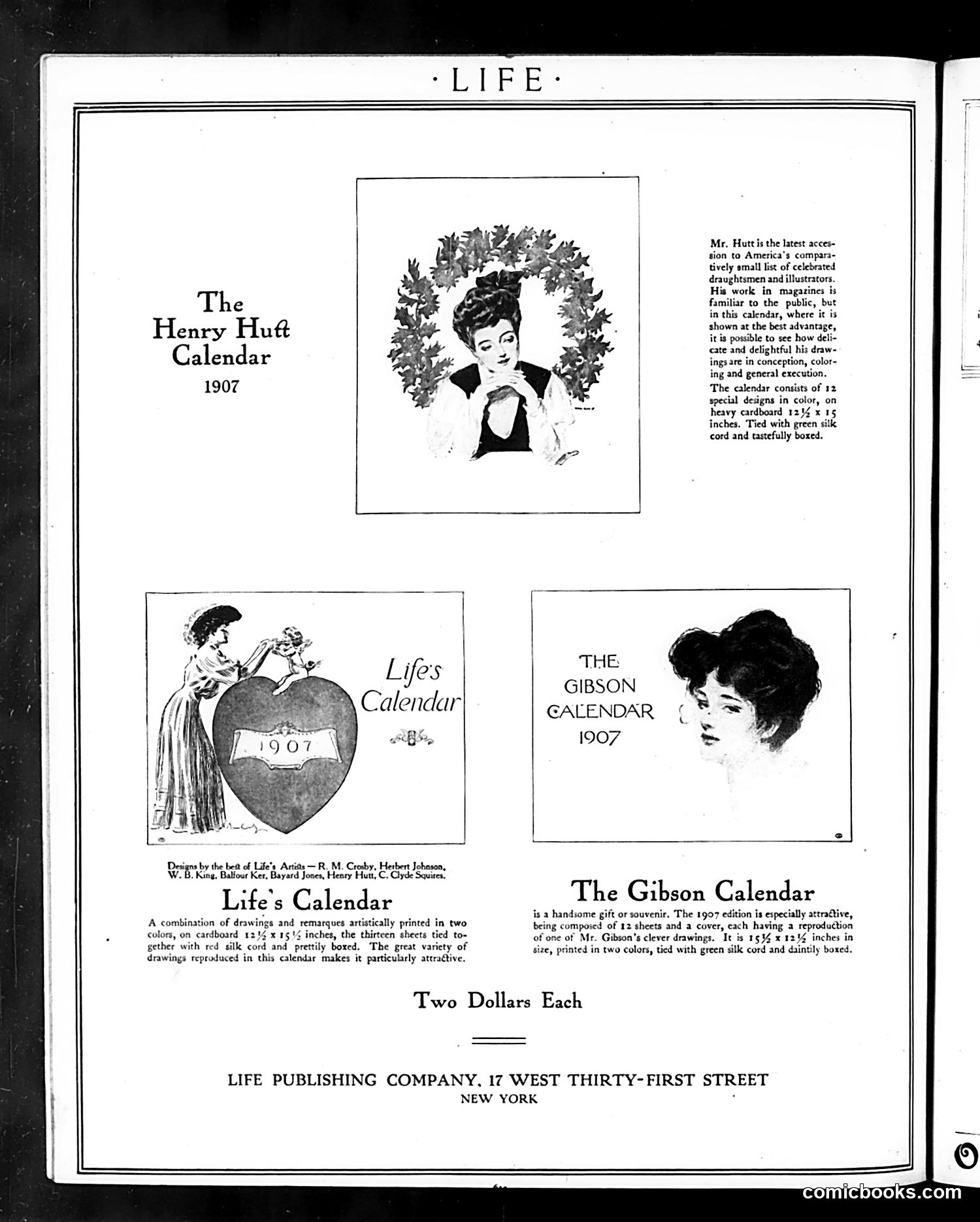
This is primarily an **advertising page** promoting three 1907 calendars from Life Publishing Company, not satirical content. The page features three calendar offerings: 1. **Henry Hutt Calendar** — featuring portrait illustrations by the celebrated artist Henry Hutt, showcasing his delicate drawing style in color 2. **Life's Calendar** — a compilation by multiple Life magazine artists (Crosby, Johnson, King, Ker, Jones, Hutt, and Squires), combining drawings and decorative elements ("remarques") 3. **The Gibson Calendar** — featuring Charles Dana Gibson's famous illustrations (likely his "Gibson Girl" aesthetic, though not explicitly stated here) All calendars are priced at **two dollars each** and were considered upscale gifts, printed in color on heavy cardboard, tied with silk cord, and boxed. **Context for modern readers:** This reflects 1907's status as a golden age for American illustration, when calendars featuring celebrated artists were premium gifts. The page emphasizes craftsmanship and artistic prestige as selling points.
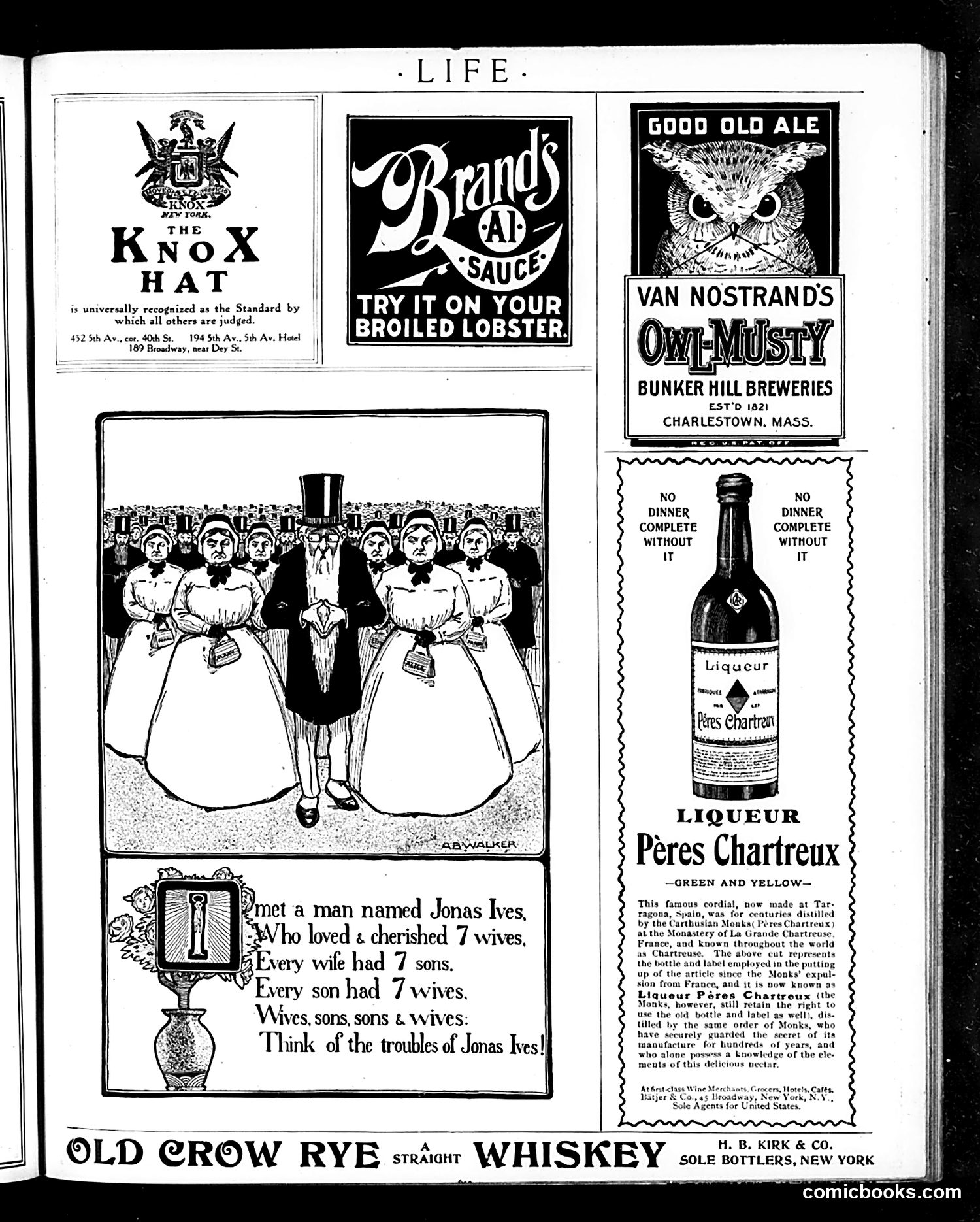
This is primarily an **advertising page** rather than political satire. The main content features a humorous narrative cartoon about "Jonas Ives," a man with 7 wives, each producing 7 sons, who each married 7 women—illustrating exponential family complexity as a joke about domestic chaos. The page is dominated by **product advertisements** typical of early 20th-century Life magazine: Knox Hat, Brand's Sauce, Van Nostrands' Owl-Musty beer, Péres Chartreux liqueur, and Old Crow Rye whiskey. These ads target affluent readers with premium goods. The Jonas Ives cartoon's sole purpose appears to be **entertainment and memorability**—creating a memorable numerical puzzle to stick in readers' minds, perhaps while they view the surrounding luxury product advertisements. There is no apparent political commentary or social satire visible in this particular page.
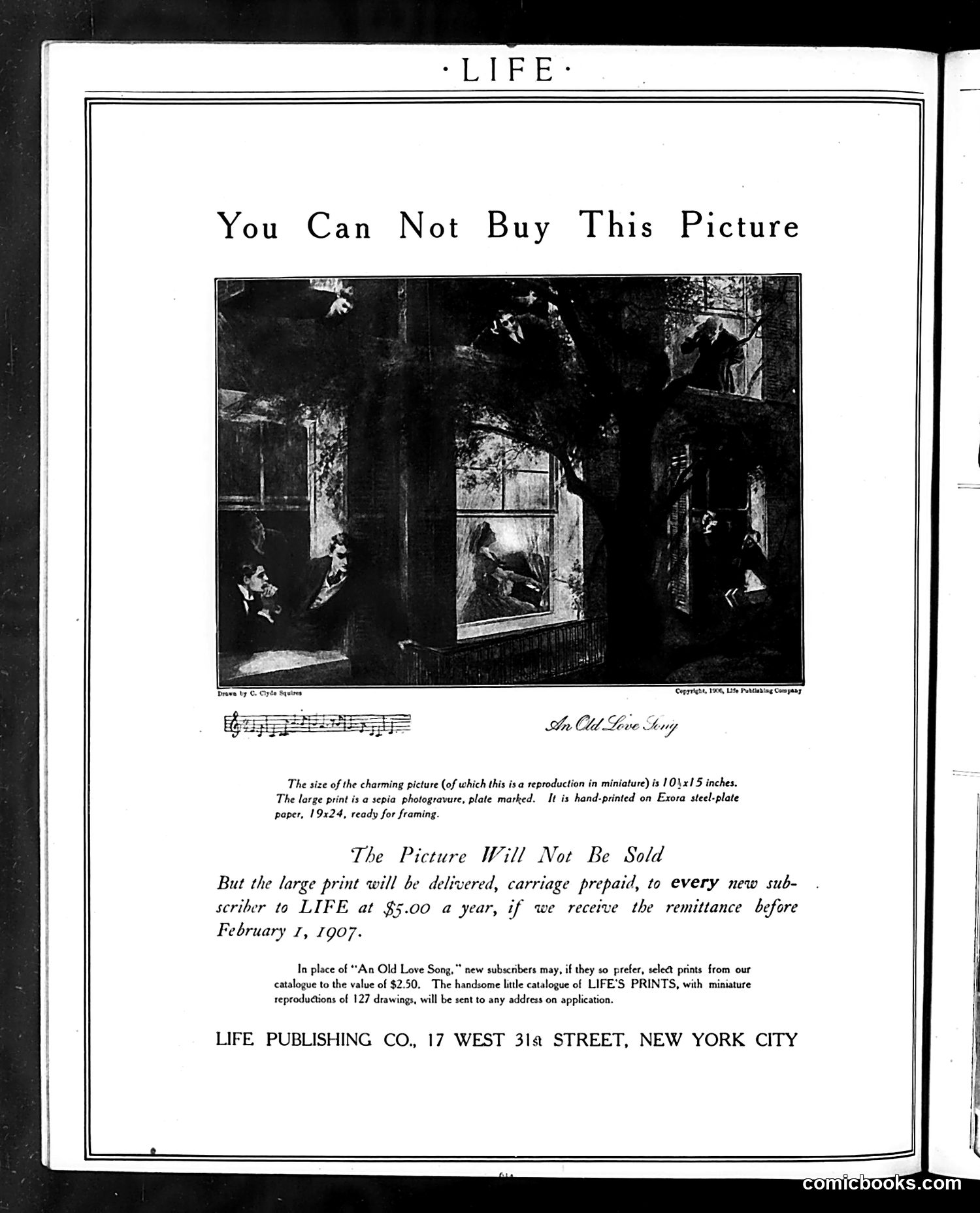
This is primarily **advertising**, not editorial content. Life Publishing Company is promoting a subscription incentive from 1907. The page features a sentimental illustration titled "An Old Love Song" (credited to C. Clyde Squires)—depicting figures in a moonlit street scene, apparently depicting romantic or nostalgic themes. The image itself contains no political satire or caricature. Instead, the text announces a marketing strategy: the full-size print (10×15 inches) cannot be purchased separately, but will be given free to new annual subscribers ($5) if they pay before February 1, 1907. Subscribers could alternatively choose different prints valued at $2.50 from Life's catalog of 127 drawings. This represents a common **early 20th-century publishing promotion**—using desirable artwork as a subscription incentive to build readership during a competitive magazine era.
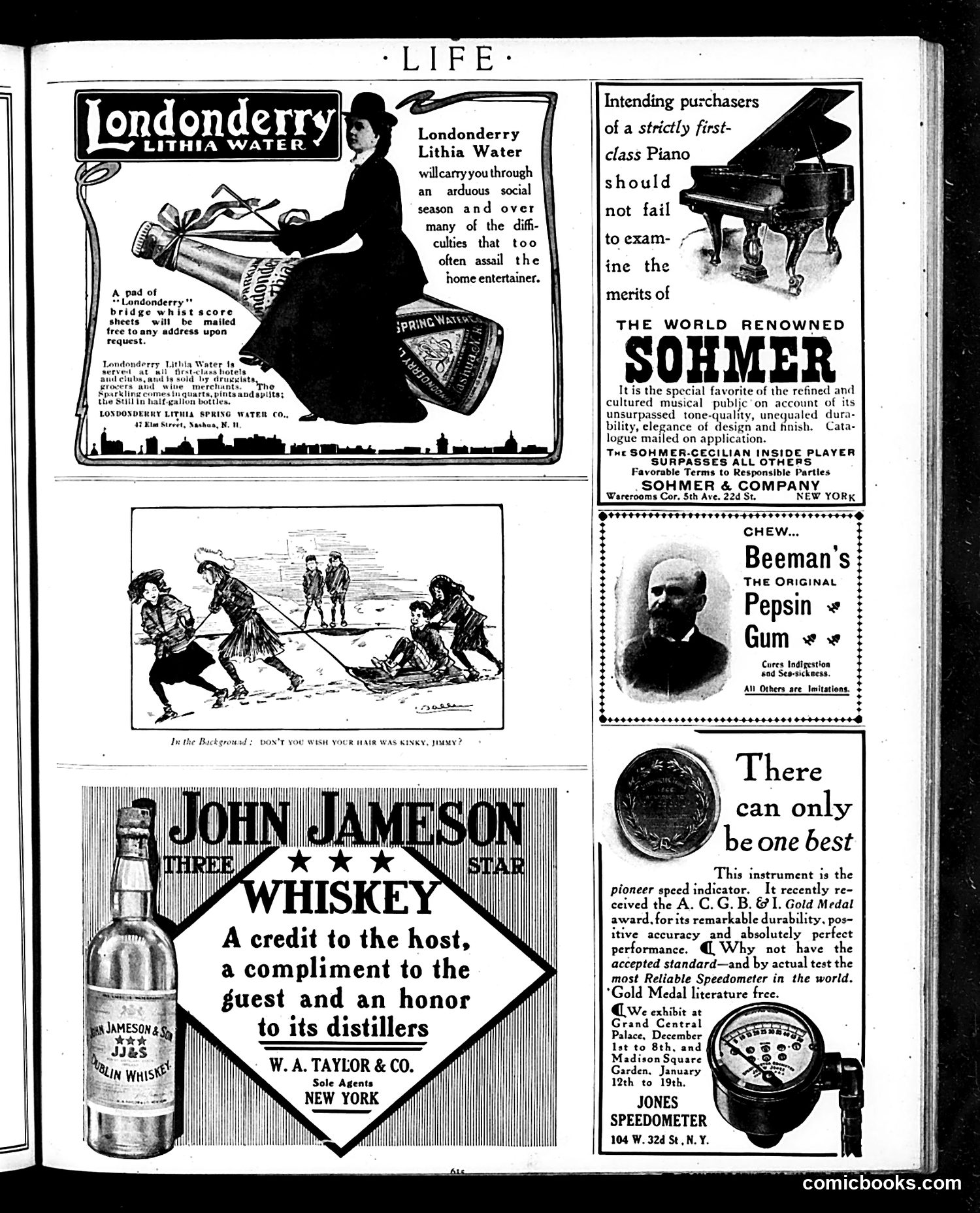
This page is primarily **advertising**, not editorial content or satire. It showcases luxury goods marketed to wealthy early 20th-century consumers. The ads include: - **Londonderry Lithia Water**: Positioned as essential for navigating the social season, suggesting that entertaining required fortification - **Sohmer Piano**: Marketed to "refined and cultured" buyers as a status symbol for serious musicians - **John Jameson Whiskey**: Framed as conferring honor on host and distillers alike - **Beeman's Pepsin Gum**: Claimed to cure indigestion and seasickness - **Jones Speedometer**: A technical instrument receiving a gold medal The lone cartoon (lower left) shows people playing hockey with caption "Don't you wish your hair was kinsey, Jimmy?"—likely a pun on a hair product, though the reference is unclear to modern readers. The page reflects **Gilded Age consumerism**: advertising luxury as moral refinement and scientific progress, targeting affluent readers through appeals to social status and health.
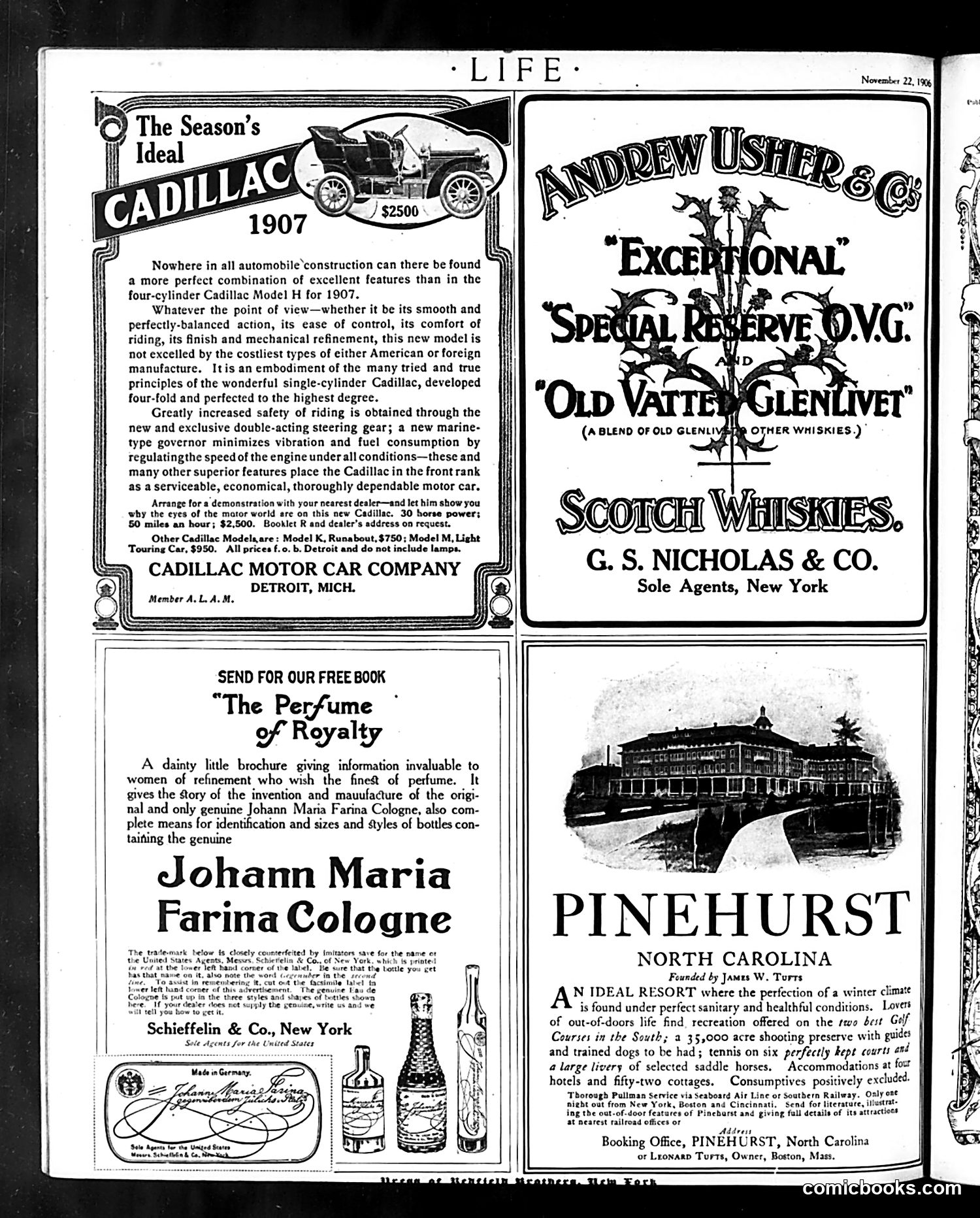
This is primarily a **advertisements page** rather than satirical content. It contains four luxury product ads targeting wealthy Americans: 1. **Cadillac Motor Car** (top left): Promotes the 1907 Model H four-cylinder automobile at $2,500—an enormous sum then—emphasizing mechanical refinement, safety features, and reliability. The ad appeals to affluent early-adopters of automobiles. 2. **Andrew Usher Scotch Whiskies** (top right): Markets premium imported Scottish whisky brands to the upper class, with "Old Vat" and "Special Reserve" as flagship products. 3. **Johann Maria Farina Cologne** (bottom left): Offers a free brochure about this luxury German perfume, emphasizing authenticity and refinement for "women of refinement." 4. **Pinehurst Resort** (bottom right): Advertises an exclusive North Carolina winter destination offering golf, hunting, horseback riding, and tennis—explicitly stating "Consumptives positively excluded," reflecting period attitudes toward tuberculosis patients. The page reflects **Gilded Age consumer culture** targeting the wealthy elite with imported luxury goods and exclusive leisure experiences.