
Life, 1906-11-22 · page 4 of 28
Life — November 22, 1906 — page 4: what you’re looking at
What you’re looking at
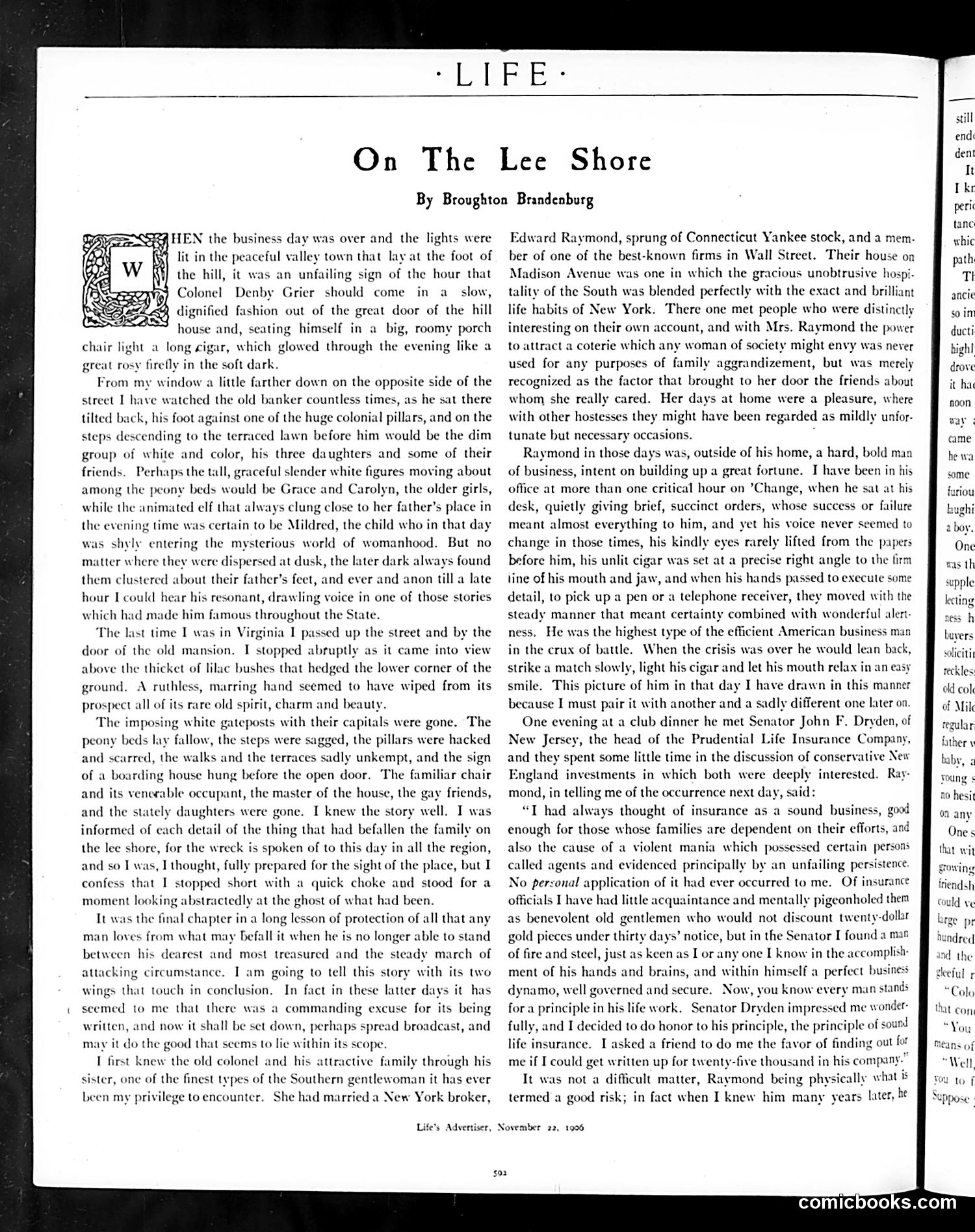
This is a **short story, not a political cartoon**. The piece is a narrative about Colonel Denby Grier awaiting a visitor in a valley town at the foot of a hill. The story describes the Colonel's peaceful evening, his family's gracious Southern hospitality, and later includes a discussion between characters about insurance and business practices—specifically mentioning Senator Dryden and concerns about life insurance companies. The text appears to be literary fiction exploring themes of Southern gentility, business ethics, and social change in early 20th-century America. There are no identifiable political cartoons or caricatures on this page—it is primarily text-based editorial content from *Life* magazine's November 22, 1909 issue.
📄 Transcribed text from this page (OCR, searchable)
Machine-transcribed from the original scan — historical spelling and the odd misread are preserved.
el FIE* On The Lee Shore By Broughton Brandenburg HEN the business day was over and the lights were lit in the peaceful valley town that lay at the foot of the hill, it was an unfailing sign of the hour that Colonel dignified fashion out of the great door of the hill Denby Grier should come in slow, house and, seating himself in a big, roomy porch chair light a long cigar, which glowed through the evening like a great rosy firefly in the soft dark. From my window a little farther down on the opposite side of the street I have watched the old banker countless times, as he sat there tilted back, his foot against one of the huge colonial pillars, and on the steps descending to the terraced lawn before him would be the dim group of white and color, his three daughters and some of their friends. Perhaps the tall, graceful slender white figures moving about among the peony beds would be Grace and Carolyn, the older girls, while the animated elf that always clung close to her father’s place in the evening time was certain to be Mildred, the child who in that day was shyly entering the mysterious world of womanhood. But no matter where they were dispersed at dusk, the later dark always found them clustered about their father’s feet, and ever and anon till a late hour I could hear his resonant, drawling voice in one of those stories which had made him famous throughout the State. The last time I was in Virginia I passed up the street and by the door of the old mansion. I stopped abruptly as it came into view above the thicket of lilac bushes that hedged the lower corner of the ground. A ruthless, marring hand seemed to have wiped from its prospect all of its rare old spirit, charm and beauty. The imposing white gateposts with their capitals were gone. ‘The peony beds lay fallow, the steps were sagged, the pillars were hacked and scarred, the walks and the terraces sadly unkempt, and the sign of a boarding house hung before the open door. The familiar chair and its venerable occupant, the master of the house, the gay friends, and the stately daughters were gone. I knew the story well. I was informed of each detail of the thing that had befallen the family on the lee shore, for the wreck is spoken of to this day in all the region, and so I was, I thought, fully prepared for the sight of the place, but I confess t I stopped short with a quick choke aud stood for a moment looking abstractedly at the ghost of what had been. It was the final chapter ina long lesson of protection of all that any man loves from what may befall it when he is no longer able to stand between his dearest and most treasured and the steady march of attacking circumstance. I am going to tell this story with its two wings that touch in conclusion. In fact in these latter days it has scemed to me that there was a commanding excuse for its being written, and now it shall be set down, perhaps spread broadcast, and may it do the good that seems to lie within its scope. I first knew the old colonel and his attractive family through his sister, one of the finest types of the Southern gentlewoman it has ever my privilege to encounter. She had married a New York broker, Life's Advertiser, Edward Raymond, sprung of Connecticut Yankee stock, and a mem- ber of one of the best-known firms in Wall Street. Their house on Madison Avenue was one in which the gracious unobtrusive hos lity of the South was blended perfectly with the exact and brilliant fe habits of New York. There one met people who were distinctly interesting on their own account, and with Mrs. Raymond the power to attract a coterie which any woman of society might envy was never used for any purposes of family aggrandizement, but was merely recognized as the factor that brought to her door the friends about whom she really cared. Her days at home were a pleasure, where with other hostesses they might have been regarded as mildly unjor- tunate but necessary occasions. Raymond in those days was, outside of his home, a hard, bold man of business, intent on building up a great fortune. T have been in his office at more than one critical hour on ’Change, when he sat at his desk, quietly giving brief, succinct orders, whose success or failure meant almost everything to him, and his voice ne emed to change in those times, his kindly eyes rarely lifted from the pape before him, his unlit cigar was set at a precise right angle to the firm tine of his mouth and jaw, and when his hands passed to execute some detail, to pick up a pen or a telephone receiver, they moved with the ady manner that meant certainty combined with wonderful alert- ness. He was the highest type of the efficient American business man in the crux of battle. When the crisis was over he would lean back, strike a match slowly, light his cigar and let his mouth relax in an easy smile. This picture of him in that day I have drawn in this manner because I must pair it with another and a sadly different one later on. One evening at a club dinner he met Senator John F. Dryden, of New Jersey, the head of the Prudential Life Insurance Company and they spent some little time in the discussion of conservative Ne' England investments in which both were deeply interested. Ray- mond, in telling me of the occurrence next day, said: “T had always thought of insurance as a sound busines enough for those whose families are dependent on their efforts, also the cause of a violent mania which possessed certain pe called agents and evidenced principally by an unfailing pe: ‘0 personal application of it had ever occurred to me. Of insurance officials I have had little acquaintance and mentally pigeonholed them as benevolent old gentlemen who would not discount twenty-dollat gold pieces under thirty days’ notice, but in the Senator I found a mat of fire and steel, just as keen as I or any one I know in the accomplish: ment of his hands and brains, and within himself a perfect business dynamo, well governed and secure. Now, you know every man stands good fora principle in his life work. Senator Dryden impressed me wondet- fully, and I decided to do honor to his principle, the principle of sound life insurance. I asked a friend to do me the favor of finding out f me if I could get written up for twenty-five thousand in his company: It was not a difficult matter, Raymond being physically what is termed a good risk; in fact when I knew him many years later, he November 22, 1996 so im ducti bight drove it ha noon cme on any One s that wit comicbooks.com