
Life, 1906-11-22 · page 8 of 28
Life — November 22, 1906 — page 8: what you’re looking at
What you’re looking at
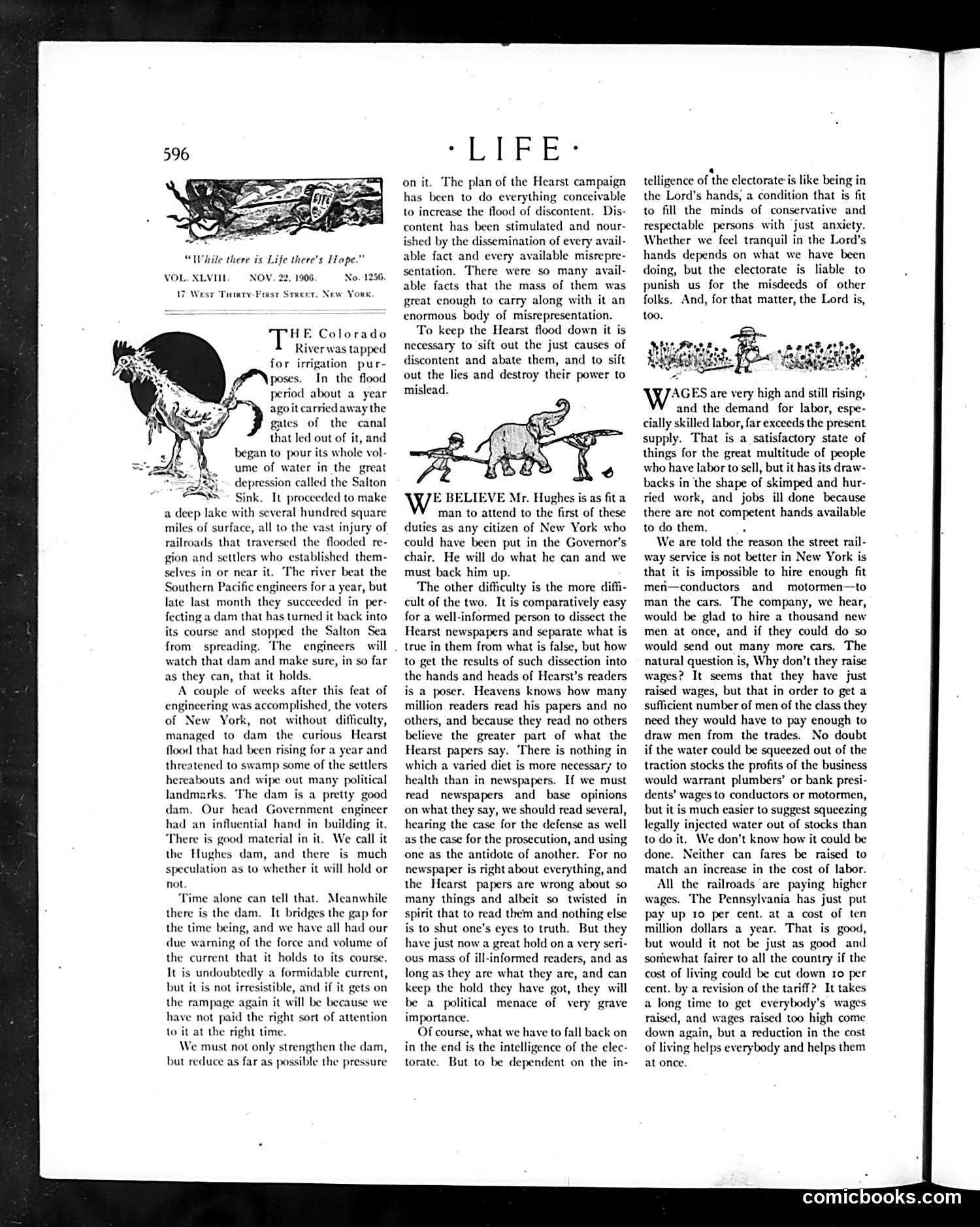
This page from *Life* magazine (November 22, 1906) features an editorial cartoon about the Colorado River and irrigation disputes. The illustration shows a rooster being strangled or held by what appears to be a large water canal or dam structure. The accompanying text discusses the Hearst newspaper campaign and debates about public discourse. The cartoon likely satirizes efforts to control the Colorado River for irrigation purposes, with the rooster symbolizing either disrupted agricultural interests or—more broadly—the difficulty of managing natural resources and political opposition. The editorial criticizes William Randolph Hearst's newspaper influence on public opinion, suggesting that newspapers spread misinformation that manipulates readers. The rooster may represent citizens or farmers caught in the struggle over water rights and development.
📄 Transcribed text from this page (OCR, searchable)
Machine-transcribed from the original scan — historical spelling and the odd misread are preserved.
“While there is Life there’s Hope.” VOL. XLVIIL. NOV. 22, 1906. No. 1256. 17 West Tuiaty-Fiest Steret, New Yorn. HE Colorado River was tapped for irrigation pur- poses. In the flood period about a year agoit carried away the gates of the canal that led out of it, and began to pour its whole vol- ume of water in the great ion called the Salton It proceeded to make with several hundred square surface, all to the vast injury of Js that traversed the flooded re- gion and settlers who established them- selves in or near it. The river beat the Southern Pacific engineers for a year, but late last month they succeeded in per- fecting a dam that turned it back into its course and stopped the Salton Sea from spreading. The engineers will watch that dam and make sure, in so far as they can, that it holds. A couple of weeks after this feat of engineering was accomplished, the voters of New York, not without difficulty, managed to dam the curious Hearst flood that had been rising for a year and threatened to swamp some of the settlers hereabouts and wipe out many political landmarks. The dam is a pretty good dam. Our head rnment engineer had an influential hand in building it. here is good material in it. We call it the Hughes dam, and there is much speculation as to whether it will hold or not. ‘Time alone can tell that. Meanwhile there is the dam. It bridges the gap for the time being, and we have all had our due warning of the force and volume of the current that it holds to its course. It is undoubtedly a formidable current, but it is not irresistible, and if it gets on the rampage again it will be because we have not paid the right sort of attention to it at the right time. We must not only strengthen the dam, but reduce as far as possible the pressure -LIFE: on it. The plan of the Hearst campaign has been to do everything conceivable to increase the flood of discontent. Dis- content has been stimulated and nour- ished by the dissemination of every avail- able fact and every available misrepre- sentation. There were so many avail- able facts that the mass of them was great cnough to carry along with it an enormous body of misrepresentation. To keep the Hearst flood down it is necessary to sift out the just causes of discontent and abate them, and to sift out the lies and destroy their power to mislead. BELIEVE Mr. Hughes is as fit a man to attend to the first of these duties as any citizen of New York who could have been put in the Governor’s chair. He will do what he can and we must back him up. The other difficulty is the more diffi- cult of the two. It is comparatively casy for a well-informed person to dissect the Hearst newspapers and separate what is truc in them from what is false, but how to get the results of such dissection into the hands and heads of Hearst’s readers is a poser. Heavens knows how many million readers read his papers and no others, and because they read no others believe the greater part of what the Hearst papers say. There is nothing in which a varied diet is more necessary to health than in newspapers. If we must read newspapers and base opinions on what they say, we should read several, hearing the case for the defense as well as the case for the prosecution, and using one as the antidote of another. For no newspaper is right about everything, and the Hearst papers are wrong about so many things and albeit so twisted in spirit that to read them and nothing else is to shut one’s eyes to truth. But they have just now a great hold on a very seri- ous mass of ill-informed readers, and as long as they are what they are, and can keep the hold they have got, they will be a political menace of very grave importance. Of course, what we have to fall back on in the end is the intelligence of the clec- torate. But to be dependent on the in- telligence of the clectorateis like being in the Lord’s hands, a condition that is fit to fill the minds of conservative and respectable persons with ‘just anxiety. Whether we feel tranquil in the Lord’s hands depends on what we have been doing, but the electorate is liable to punish us for the misdeeds of other folks. And, for that matter, the Lord is, ah aero’ Wises are very high and still rising, and the demand for labor, espe- cially skilled labor, far exceeds the present supply. That is a satisfactory state of things for the great multitude of people who have labor to sell, but it has its draw- backs in ‘the shape of skimped and hur- ried work, and jobs ill done because there are not competent hands available to do them. : We are told the reason the street rail- way service is not better in New York is that it is impossible to hire enough fit men—conductors and motormen—to man the cars. The company, we hear, would be glad to hire a thousand new men at once, and if they could do so would send out many more cars. The natural question is, Why don’t they raise wages? It seems that they have just raised wages, but that in order to get a sufficient number of men of the class they need they would have to pay enough to draw men from the trades. No doubt if the water could be squeezed out of the traction stocks the profits of the business would warrant plumbers’ or bank presi- dents’ wages to conductors or motormen, but it is much easier to suggest squeezing legally injected water out of stocks than to do it. We don’t know how it could be done. Neither can fares be raised to match an increase in the cost of labor. All the railroads ‘are paying higher wages. The Pennsylvania has just put pay up 10 per cent. at a cost of ten million dollars a year. That is good, but would it not be just as good and somewhat fairer to all the country if the cost of living could be cut down 10 per cent. by a revision of the tariff? It takes a long time to get everybody's wages raised, and wages raised too high come down again, but a reduction in the cost of living helps everybody and helps them at once. comicbooks.com