
Life, 1906-11-22 · page 5 of 28
Life — November 22, 1906 — page 5: what you’re looking at
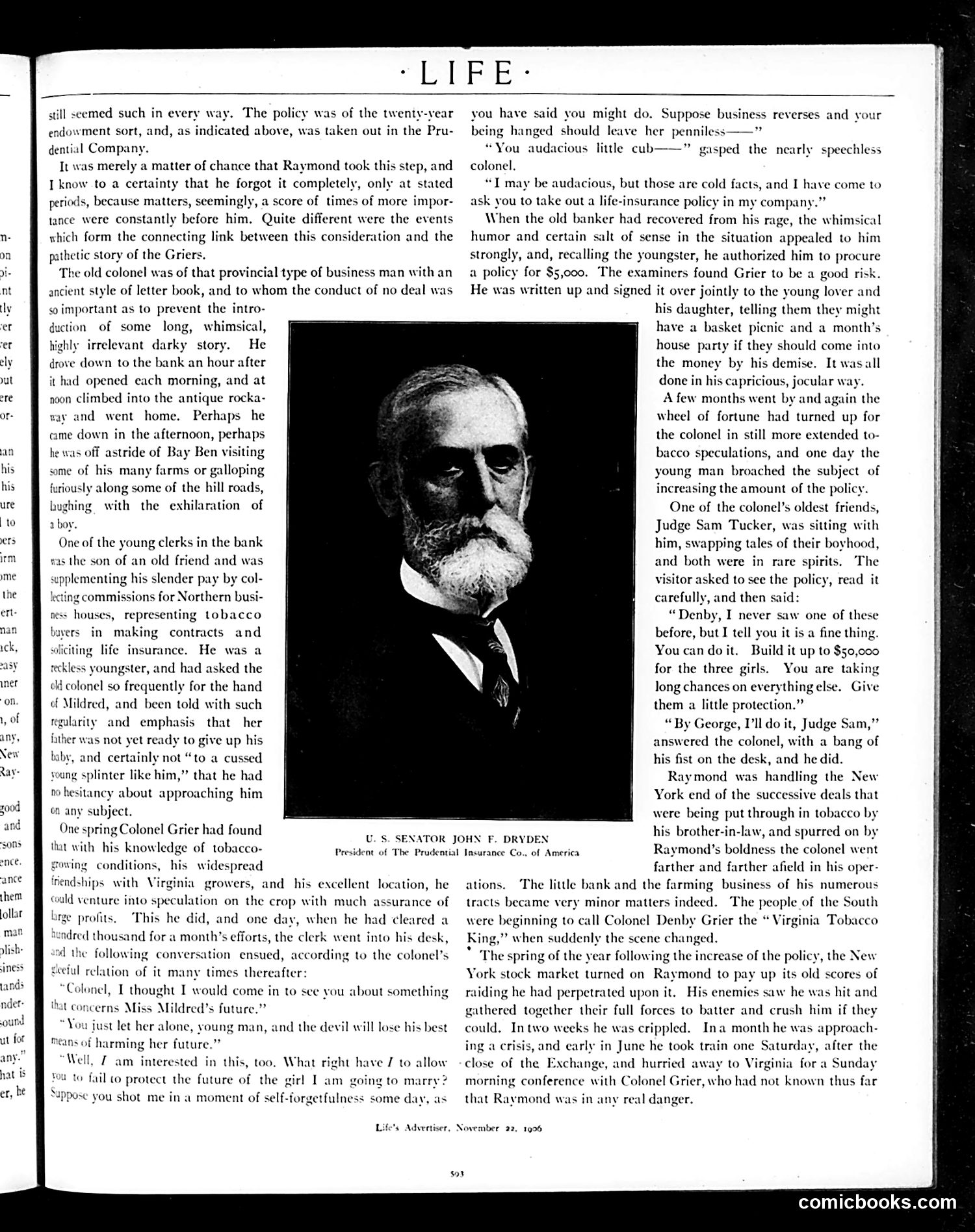
What you’re looking at
The page features a portrait photograph labeled "U.S. SENATOR JOHN F. DRYDEN, President of the Prudential Insurance Co. of America." The surrounding text is a narrative story about Colonel Grier and tobacco speculation, not directly related to the portrait. However, the inclusion of Dryden's image alongside insurance policy discussions appears deliberately juxtaposed—Dryden was simultaneously a U.S. Senator and president of a major insurance company, embodying the kind of concentrated corporate power and potential conflicts of interest that Progressive Era reformers criticized. The layout suggests satirical commentary on how wealthy industrialists held dual positions of political and commercial authority, a common critique of early 20th-century American capitalism.
📄 Transcribed text from this page (OCR, searchable)
Machine-transcribed from the original scan — historical spelling and the odd misread are preserved.
a FE: ill seemed such in every way. The policy was of the twenty-year endowment sort, and, as indicated above, was taken out in the Pru- dential Company. It was merely a matter of chance that Raymond took this step, and I know to a certainty that he forgot it completely, only at stated periods, because matters, seemingly, a score of times of more impor- tance were constantly before him. Quite different were the events which form the connecting link between this consideration and the pathetic story of the Griers The old colonel was of that provincial type of business man with an ancient style of letter book, and to whom the conduct of no deal was so important as to prevent the intro- ion of some long, whimsical, highly irrelevant darky story. He drove down to the bank an hour after it had opened cach morning, and at noon climbed into the antique rocka- vay and went home. Perhaps he came down in the afternoon, perhar he was off astride of Bay Ben visiting some of his many farms or galloping furiously along some of the hill roads, ing with the exhilaration of boy. One of the young clerks in the bank was the son of an old friend and was plementing his slender pay by col- ‘ing commissions for Northern busi- ness houses, representing tobacco bayers in making contracts and sdiciting life insurance. He was a reckless youngster, and had asked the old colonel so frequently for the hand of Mildred, and been told with such regularity and emphasis that her father was not yet ready to give up his laby, and certainly not “to a cussed young splinter like him,” that he had to hesitancy about approaching him on any subject. One spring Colonel Grier had found tht with his knowledge of tobacco- his ing conditions, widespread irendships with Virginia growers, and his excellent location, he could venture into speculation on the crop with much assurance of profits, them ollar This he did, and one day, when he had cleared a iundred thousand for a month’s efforts, the clerk went into his desk, od the following conversation ensued, according to the colonel’s ceeiul relation of it many times thereafter: “Colonel, I thought I would come in to see you about something that concerns Miss Mildred’s future.” “You just let her alone, young man, and the devil will lose his best means of harming her future.” Well, 7 am interested in this, too. What right have J to allow 1 to fail co protect the future of the girl Iam going to marry? “sppose you shot me in a moment of self-forgetfulness some day Life's Advertiser, U.S. SENATOR JOHN F. ‘ot of The Prudential Insurance Co you have said you might do. Suppose business reverses being hanged should leave her penniless ——” “You audacious little cub——” gasped the nearly speechless colonel. and your “T may be audacious, but those are cold facts, and I have come to k you to take out a life-insurance policy in my company.” When the old banker had recovered from his rage, the whimsical humor and certain salt of sense in the situation appealed to him strongly, and, recalling the youngster, he authorized him to procure a policy for $5,000. The examiners found Grier to be a good risk. as written up and signed it over jointly to the young lover and his daughter, telling them they might have a basket picnic and a month’s house party if they should come into the money by his demise. It was all done in his capricious, jocular way. A few months went by and again the wheel of fortune had turned up for the colonel in still more extended to- bacco speculations, and one day the young man broached the subject of increasing the amount of the policy One of the colonel’s oldest friends, Judge Sam Tucker, was sitting with him, swapping tales of their boyhood, and both were in rare spirits. The visitor asked to see the policy, read it carefully, and then said: “Denby, I never saw one of these before, but I tell you it is a fine thir You can doit. Build it up to $50,000 for the three girls. You are taking long chances on everything else. Give them a little protection.” “ By George, I'll do it, Judge Sam,” answered the colonel, with a bang of his fist on the desk, and he did. Raymond was handling the New York end of the successive deals that were being put through in tobacco by his brother-in-law, and spurred on by Raymond’s boldness the colonel went farther and farther afield in his oper- ations. ‘The little bank and the farming business of his numerous tracts became very minor matters indeed. The people of the South DRYDEN of America were beginning to call Colonel Denby Grier the “ Virginia Tobacco King,” when suddenly the scene changed. * The spring of the year following the increase of the policy, the New York stock market turned on Raymond to pay up its old scores of raiding he had perpetrated upon it. His enemies saw he was hit and gathered together their full forces to batter and crush him if they Ina month he was approach- turday, after the could. In two weeks he was crippled. ing a crisis, and early in June he took train one $ close of the Exchange, and hurried away to Virginia for a Sunday morning conference with Colonel Grier, who had not known thus far that Raymond was in any real danger. November 22, 1996 comicbooks.com