
Life, 1906-11-22 · page 18 of 28
Life — November 22, 1906 — page 18: what you’re looking at
What you’re looking at
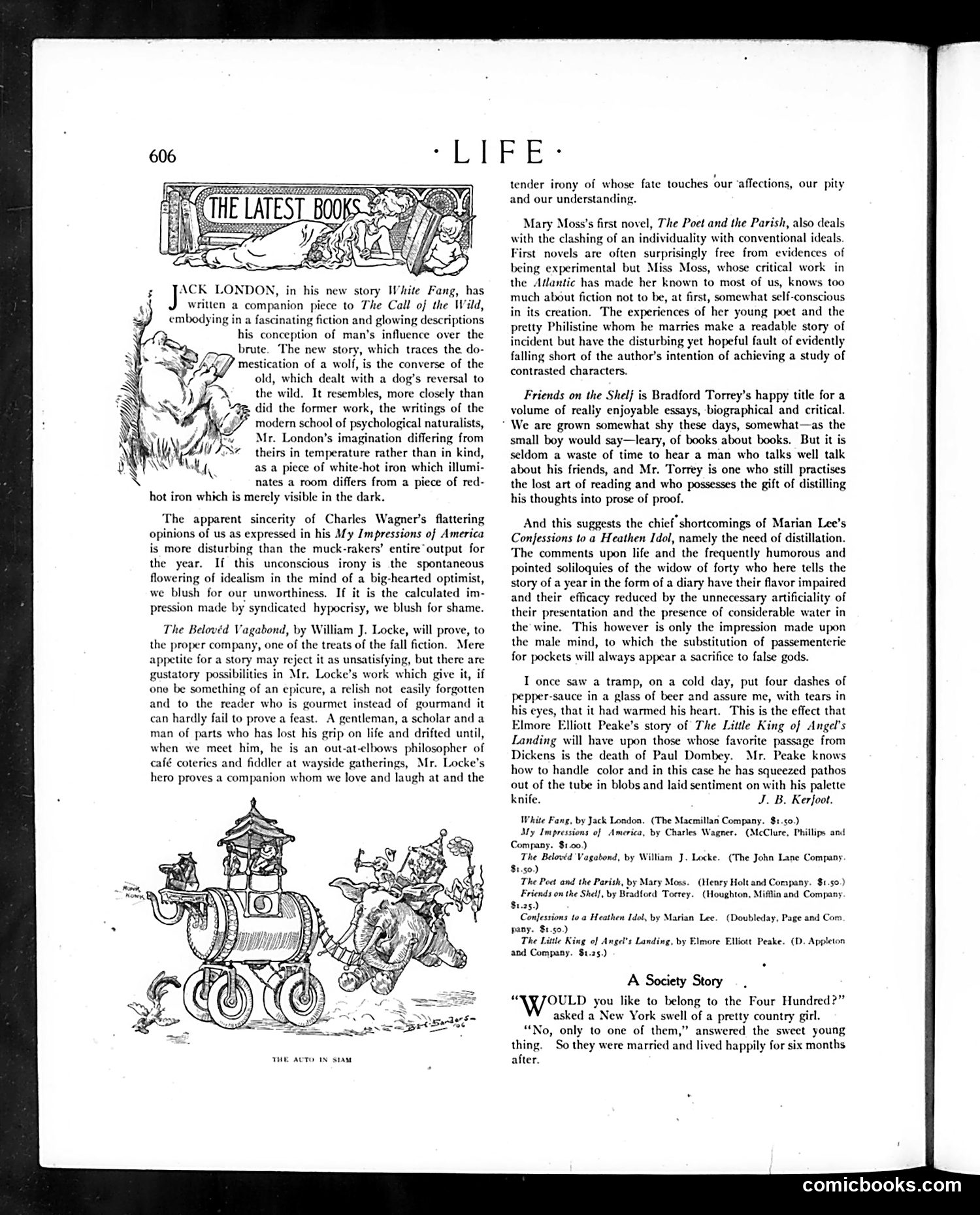
This page reviews recent fall fiction publications. The main illustration—"The Auto in Siam"—depicts an ornate mechanical contraption, likely satirizing Western technological excess or the absurdity of importing modern inventions to non-Western cultures. The detailed mechanical design suggests contemporary anxieties about industrialization. The book reviews discuss works by Jack London, Charles Wagner, William J. Locke, Mary Moss, Bradford Torrey, and Marian Lee. The critique of Wagner's *My Impressions of America* contains biting social commentary: Life suggests his flattering views of Americans represent either naive idealism (embarrassing) or calculated hypocrisy (shameful)—either way, unflattering to Americans' self-perception. The reviews employ sophisticated literary criticism typical of Life's educated readership, praising psychological naturalism while critiquing excessive artificiality in female authors' work. The patronizing comment about women sacrificing practical pockets for decorative trim reflects period gender attitudes.
📄 Transcribed text from this page (OCR, searchable)
Machine-transcribed from the original scan — historical spelling and the odd misread are preserved.
‘LIFE written a companion piece to The Call of the Wild, embodying in a fascinating fiction and glowing descriptions his conception of man’s influence over the brute. The new story, which traces the do- ue of a wolf, is the converse of the old, which dealt with a dog’s reversal to “the wild. It resembles, more closely than did the former work, the writings of the modern school of psychological naturalists, Mr. London’s imagination differing from theirs in temperature rather than in kind, as a piece of white-hot iron which illumi- nates a room differs from a piece of red- hot iron which is merely visible in the dark. The apparent sincerity of Charles Wagner's flattering opinions of us as expressed in his My Impressions of America is more disturbing than the muck-rakers’ entire“output for the year. If this unconscious irony is the spontancous flowering of idealism in the mind of a big-hearted optimist, we blush for our unworthiness. If it is the calculated im- pression made by syndicated hypocrisy, we blush for shame. The Belovéd Vagabond, by William J. Locke, will prove, to the proper company, one of the treats of the fall fiction. Mere appetite for a story may reject it as unsatisfying, but there are gustatory possibilities in Mr. Locke's work which give it, if one be something of an epicure, a relish not casily forgotten and to the reader who is gourmet instead of gourmand it can hardly fail to prove a feast. A gentleman, a scholar and a man of parts who has lost his grip on life and drifted until, when we meet him, he is an out-at-elbows philosopher of café coteries and fiddler at wayside gatherings, Mr. Locke's hero proves a companion whom we love and laugh at and the ALN Say aes= = sede Safe BEE THE AUTO IN staat tender irony of whose fate touches our ‘affections, our pity and our understanding. Mary Moss's first novel, The Poet and the Parish, also deals with the clashing of an individuality with conventional ideals. rst novels are often surprisingly free from evidences of being experimental but Miss Moss, whose critical work in the Adantic has made her known to most of us, knows too much about fiction not to be, at first, somewhat self-conscious in its creation. The experiences of her young poet and the pretty Philistine whom he marries make a readable story of incident but have the disturbing yet hopeful fault of evidently falling short of the author’s intention of achieving a study of contrasted characters. Friends on the Shelj is Bradford Torrey’s happy title for a volume of really enjoyable essays, biographical and critical. * We are grown somewhat shy these days, somewhat—as the small boy would say—leary, of books about books. But it is seldom a waste of time to hear a man who talks well talk about his friends, and Mr. Torrey is one who still practises the lost art of reading and who possesses the gift of distilling his thoughts into prose of proof. And this suggests the chief’ shortcomings of Marian Lee's Conjessions to a Heathen Idol, namely the need of distillation. The comments upon life and the frequently humorous and pointed soliloquies of the widow of forty who here tells the story of a year in the form of a diary have their flavor impaired and their efficacy reduced by the unnecessary artificiality of their presentation and the presence of considerable water in the wine. This however is only the impression made upon the male mind, to which the substitution of passementerie for pockets will always appear a sacrifice to false gods. T once saw a tramp, on a cold day, put four dashes of pepper-sauce in a glass of beer and assure me, with tears in his eyes, that it had warmed his heart. This is the effect that Elmore Elliott Peake’s story of The Little King of Angel’s Landing will have upon those whose favorite passage from Dickens is the death of Paul Dombey. Mr. Peake knows how to handle color and in this case he has squeezed pathos out of the tube in blobs and laid sentiment on with his palette knife. J. B. Kerjoot. White Fang, by Jack London. (The Macmillan Company. $1.50.) My Impressions of America, by Charles Wagner. (McClure, Phillips and Company. $1.00) The Belowid Vagabond, by William J. Locke. (The John Lane Company $1.50.) The Podt and the Parish, by Mary Moss. (Henry Holt and Company. $1.50.) Friends on the Shelf, by Bradford Torrey. (Houghton, Mifflin and Company $25.) Confessions to a Heathen Idot, by Marian Lee pany. $1.50.) The Little King of Angel's Landing, by Elmore Elliott Peake. (D. Appleton and Company. $1.25.) (Doubleday, Page and Com. A Society Story — . “Woutp you like to belong to the Four Hundred?” asked a New York swell of a pretty country girl. “No, only to one of them,” answered the sweet young thing. So they were married and lived happily for six months after. comicbooks.com