
Life, 1906-11-22 · page 16 of 28
Life — November 22, 1906 — page 16: what you’re looking at
What you’re looking at
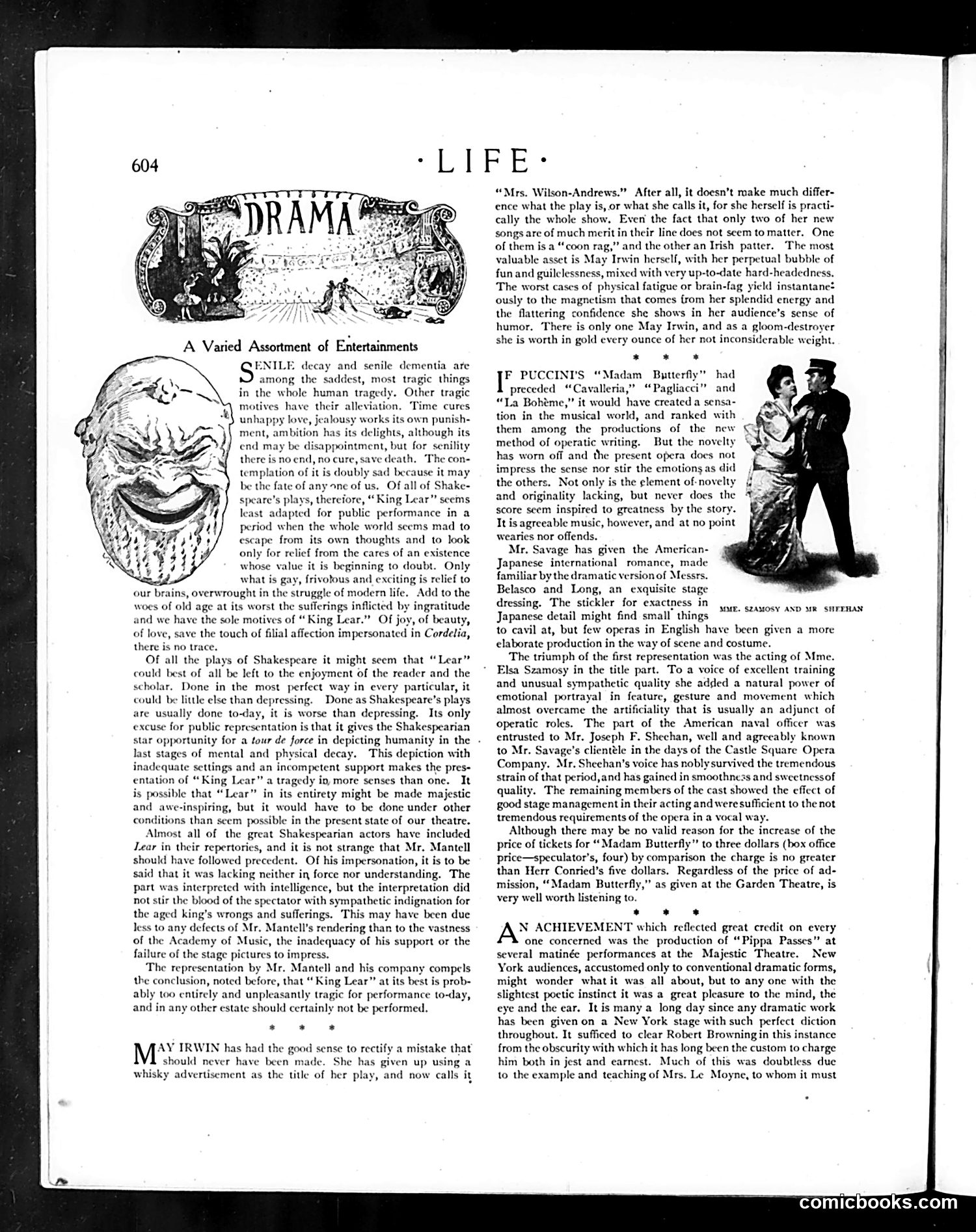
This page reviews theatrical productions, primarily focusing on a staging of Shakespeare's *King Lear* by actor Robert Mantell at the Academy of Music. The critic argues that *King Lear*—dealing with senility, ingratitude, and suffering—is unsuitable for modern audiences seeking entertainment and escape from life's anxieties. The review concludes Mantell's interpretation, while intelligent, fails to emotionally move spectators, partly due to inadequate staging and supporting cast at the Academy venue. The page also briefly praises May Irwin's comedy show "Mrs. Wilson-Andrews" (apparently retitled from a whisky advertisement), noting that Irwin herself—her charm, humor, and energy—*is* the entire production. A reference to her songs includes a "coon rag" (a period ragtime style), reflecting contemporary popular entertainment conventions. The underlying satire critiques both theatrical ambition and the gap between artistic merit and popular appeal.
📄 Transcribed text from this page (OCR, searchable)
Machine-transcribed from the original scan — historical spelling and the odd misread are preserved.
“LIFE A Varied Assortment of Entertainments ENILE decay and senile dementia ate among the saddest, most tragic things in the whole human tragedy. Other tragic motives have their alleviation, ‘Time cures unhappy love, jealousy works its own punish- ment, ambition has its delights, although its end may be disappointment, but for senility there is no end, no cure, save death, ‘The con templation of it is doubly sad because it may be the fate of any one of us. Of all of Shake speare’s plays, therefore, “King Lear” seems least adapted for public performance in a period when the whole world scems mad to escape from its own thoughts and to look only for relief from the cares of an existence whose value it is beginning to doubt. Only what is gay, frivolous and exciting is relief to our brains, overwrought in the struggle of modern life, Add to the woes of old age at its worst the sufferings inflicted by ingratitude and we have the sole motives of “King Lear.” Of joy, of beauty, of love, save the touch of filial affection impersonated in Cordelia, there is no trace. Of all the plays of Shakespeare it might seem that “Lear” could best of all be left to the enjoyment of the reader and the sch Done in the most perfect w: particular, could be little else than depressing. Done as Shakespeare's plays are usually done to-day, it is worse than depressing. Its only excuse for public representation is that it gives the Shakespearian star opportunity for a tour de force in depicting humanity in the - last stages of mental and physical decay. This depiction with inadequate settings and an incompetent support makes the pres- entation of “King Lear” a tragedy in, more senses than one. It is possible that “Lear” in its entirety might be made majestic and awe-inspiring, but it would have to be done under other conditions than seem possible in the present state of our theatre. Almost all of the great Shakespearian actors have included Zear in their repertories, and it is not strange that Mr. Mantell should have followed precedent. Of his impersonation, it is to be said that it was g neither in force nor understanding. The part was interpreted with intelligence, but the interpretation did not stir the blood of the spectator with sympathetic indignation for the aged king’s wrongs and sufferings. This may have been due less to any defects of Mr, Mantell’s rendering than to the vastness of the Academy of Music, the inadequacy of his support or the failure of the stage pictures to impress. The representation by Mr. Mantel] and his company compels the conclusion, noted before, that King Lear” at its best is prob- ably too entirely and unpleasantly tragic for performance to-day, and in any other estate should certainly not be performed. + 8 2 Y IRWIN has had the good sense to rectify a mistake that ould never have been made. She has given up using a whisky advertisement as the title of her p » and now calls it “Mrs. Wilson-Andrews.” After all, it doesn’t make much differ- ence what the play is, or what she calls it, for she herself is practi- cally the whole show, Even the fact that only two of her new songs are of much merit in their line does not seem to matter. One of them is a “coon rag,” and the other an Irish patter. The most valuable asset is May Irwin herself, with her perpetual bubble of fun and guilelessness, mixed with very up-to-date hard-headedness. The worst cases of physical fatigue or brain-fag yield instantane? ously to the magnetism that comes from her splendid energy and the flattering confidence she shows in her audience’s sense of humor. There is only one May Irwin, and as a gloom-destroyer she is worth in gold every ounce of her not inconsiderable weight. * * * F PUCCINI'S “Madam Butterfly” had preceded “Cavalleria,” “Pagliacci” and “La Bohéme,” it would have created a sensa- tion in the musical world, and ranked with them among the productions of the new method of operatic writing. But the novelty has worn off and the present opera docs not impress the sense nor stir the emotions as did the others. Not only is the glement of-novelty and originality lacking, but never does the score seem inspired to greatness by the story. It is agreeable music, however, and at no point wearies nor offends. ‘Mr, Savage has given the American- Japanese international romance, made familiar by the dramatic version of Messrs. Belasco and Long, an exquisite stage dressing. The stickler for exactness in Japanese detail might find small’ things to cavil at, but few operas in English have been given a more elaborate production in the way of scene and costume. The triumph of the first representation was the acting of Mme. Elsa Szamosy in the title part. To a voice of excellent training and unusual sympathetic quality she added a natural power of emotional portrayal in feature, gesture and movement which almost overcame the artificiality that is usually an adjunct of operatic roles. The part of the American naval officer was entrusted to Mr. Joseph F. Shechan, well and agreeably known to Mr. Savage's clientéle in the days of the Castle Square Opera Company. Mr. Sheehan's voice has nobly survived the tremendous strain of that period, and has gained in smoothness and sweetnessof quality. The remaining members of the cast showed the effect of good stage management in their acting and were sufficient to the not tremendous requirements of the opera in a vocal way. Although there may be no valid reason for the increase of the price of tickets for “Madam Butterfly” to three dollars (box office price—speculator’s, four) by comparison the charge is no greater than Herr Conried’s five dollars. Regardless of the price of ad- mission, “Madam Butterfly,” as given at the Garden Theatre, is very well worth listening to. + * & N ACHIEVEMENT which reflected great credit on every one concerned was the production of “Pippa Passes” at several matinée performances at the Majestic Theatre. New York audiences, accustomed only to conventional dramatic forms, might wonder what it was all about, but to any one with the slightest poetic instinct it was a great pleasure to the mind, the eye and the ear. It is many a long day since any dramatic work has been given on a New York stage with such perfect diction throughout. It sufficed to clear Robert Browning in this instance from the obscurity with which it has long been the custom to charge him both in jest and earnest. Much of this was doubtless due to the example and teaching of Mrs. Le Moyne, to whom it must comicbooks.com MME. SZAMOSY AND MIR SHFTHAN