
Life, 1906-11-22 · page 17 of 28
Life — November 22, 1906 — page 17: what you’re looking at
What you’re looking at
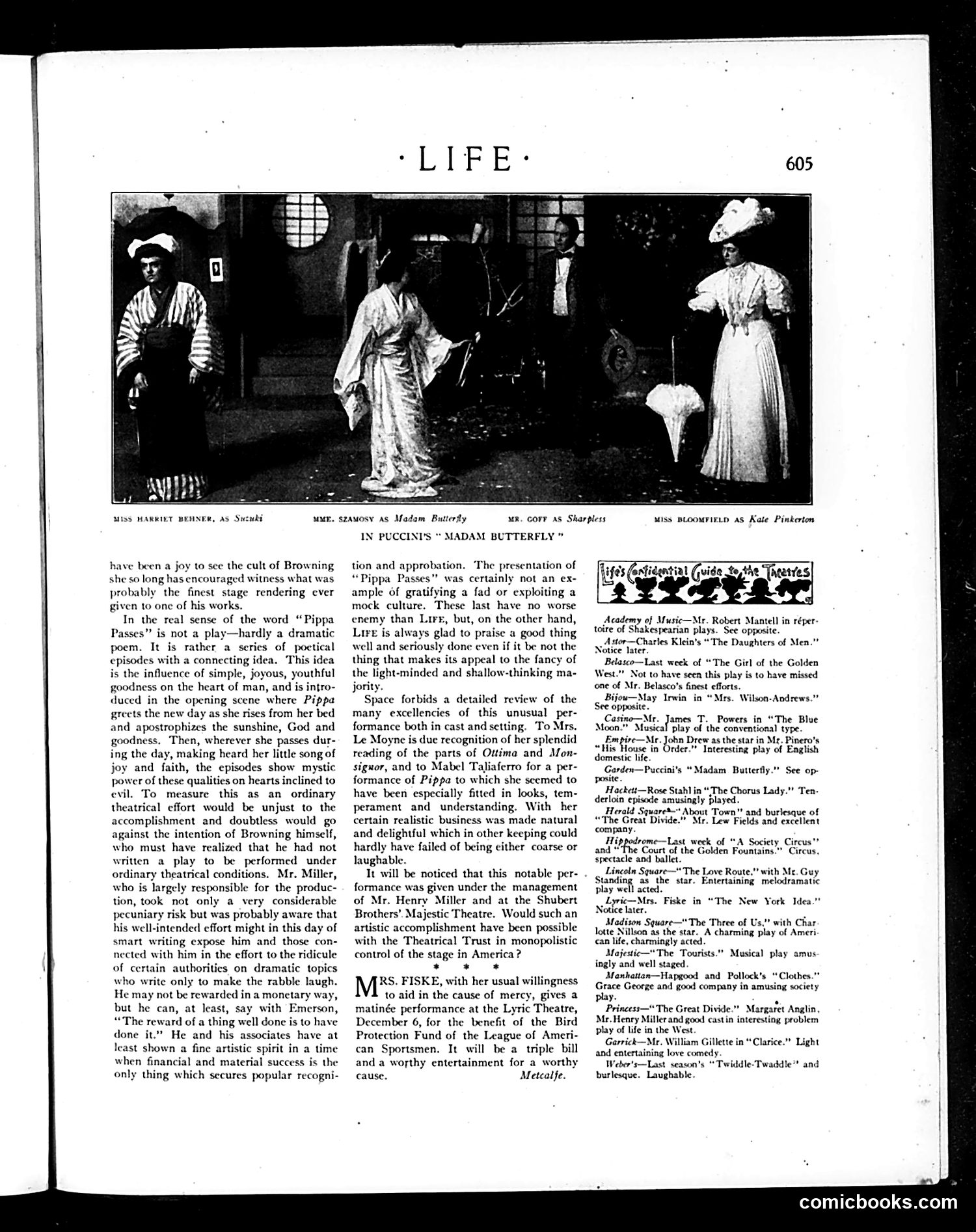
This page reviews theatrical productions, primarily Puccini's *Madam Butterfly* and a production of Browning's *Pippa Passes*. The top photograph shows four actors in costume from *Madam Butterfly*—identified as Miss Harriet Behner, Mme. Szamony, Mr. Cott, and Miss Bloomfield in their respective roles. The main text praises *Pippa Passes* as an artistic achievement despite its uncommercial nature, celebrating its cast (particularly Mabel Taliaferro) and Henry Miller's management at the Shubert Brothers' Majestic Theatre. The critic notably contrasts this with concern about the "Theatrical Trust"—a monopolistic control of American theater—questioning whether such artistic accomplishment could occur under that system. The page also mentions Mrs. Fiske's benefit matinée for the Bird Protection Fund, and lists other theatrical offerings. The overall tone emphasizes artistic merit over commercial appeal.
📄 Transcribed text from this page (OCR, searchable)
Machine-transcribed from the original scan — historical spelling and the odd misread are preserved.
MISS MARKIET BEHNER, aS Sachi have been a joy to see the cult of Browning she so long has encouraged witness what was bably the finest stage rendering ever given to one of his works. In the real sense of the word “Pippa Passes” is not a play—hardly a dramatic poem. It is rather a serics of poetical episodes with a connecting idea. ‘This idea is the influence of simple, joyous, youthful goodness on the heart of man, and is intro- duced in the opening scene where Pippa greets the new day as she rises from her bed and apostrophizes the sunshine, God and goodness, Then, wherever she passes dur- ing the day, making heard her little song of joy and faith, the episodes show mystic power of these qualities on hearts inclined to evil. To measure this as an ordinary theatrical effort would be unjust to the accomplishment and doubtless would go against the intention of Browning himself, who must have realized that he had not written a play to be performed under ordinary theatrical conditions. Mr. Miller, who is largely responsible for the produc- tion, took not only a very considerable iary risk but was probably aware that tended effort might in this day of smart writing expose him and tho: nected with him in the effort to the ridicule of certain authoritics on dramatic topics who write only to make the rabble laugh. He may not be rewarded ina monetary way, but he can, at least, say with Emerson, “The reward of a thing well done is to have done it.” He and his associates have at least shown a fine artistic spirit in a time when financial and material success is the only thing w! recogni- mame. szauosy As Madam Butterfly IN PUCCINI'S * MADAM BUTTERFLY ” tion and approbation. ‘The presentation of “Pippa Passes” was certainly not an ex- ample of gratifying a fad or exploiting a mock culture. These last have no worse enemy than Lire, but, on the other hand, glad to praise a good thing well and seriously done even if it be not the thing that makes its appeal to the fancy of the light-minded and shallow-thinking ma- jority, Space forbids a detailed review of the many excellencies of this unusual per- formance both in cast and setting. To Mrs. Le Moyne is due recognition of her splendid reading of the parts of Ottima and Mon- siguor, and to Mabel Taliaferro for a per- formance of Pippa to which she seemed to have been especially fitted in looks, tem- perament and understanding. With her certain realistic business was made natural and delightful which in other keeping could hardly have failed of being either coarse or laughable. It will be noticed that this notable per- formance was given under the management of Mr. Henry Miller and at the Shubert Brothers’. Majestic Theatre. Would such an artistic accomplishment have been possible with the Theatrical Trust in monopolistic control of the stage in America? * * & M FISKE, with her usual willingness to aid in the cause of mercy, gives a matinée performance at the Lyric Theatre, December 6, for the benefit of the Bird Protection Fund of the League of Ameri- can Sportsmen. It will be a triple bill and a worthy entertainment for a worthy cause. Metcalfe. MR. Corr As Sharpless hifes é Academy of Music—Mr. Robert Mantell in réper- toire of Shakespearian plays. See opposite. _ Astor—Charles Klein’s “The Daughters of Men."” Notice later. Belasco—Last week of “The Girl of the Golden West." Not to have seen this play is to have missed cone of Mr. Belasco’s finest efforts. Bijow—May Irwin in “Mrs. Wilson-Andrews.” Sce opposite. Casino—Mr. James T. Powers in “The Blue Moon.” Musical play of the conventional type. Em pire—Mr. John Drew as the star in Mr. Pinero's “His House in Order.” Interesting play of English domestic life. Garden—Puccini’s “Madam Butterfly posite. Hockett—Rose Stahl in “The Chorus Lady.”” Ten- derloin episode amusingly played. Herald Square*— About Town" and burlesque of “The Great Divide.” Mr. Lew Fields and excellent company. Hippodrome—Last week of “A Society Circus" and “The Court of the Golden Fountains.” Circus. spectacle and ballet. __ Lincoln Square—" The Love Route,” with Me. Guy Standing ‘as the star. Entertaining melodramatic play well acted. _Lyric—Mrs. Fiske in Notice later. Madison Square—"The Three of Us." with Char lotte Nillson as the star. A charming play of Ameri can life, charmingly acted. Majestic—"The Tourists." ingly and well staged Manhattan—Hapgood and Pollock's ‘*Clothes.”* Grace George and good company in amusing society lay . Princess—" The Great Divide.” Margaret Anglin, Mr. Henry Miller and good castin interesting problem play of life in the West. Garrick—Mr. William Gillette in “Clarice.” Light and entertaining love comedy. Weber's—Last season's “Twiddle-Twaddle” and burlesque. Laughable See op- “The New York Idea." Musical play amus comicbooks.com