
A complete issue · 24 pages · 1906
Life — October 25, 1906
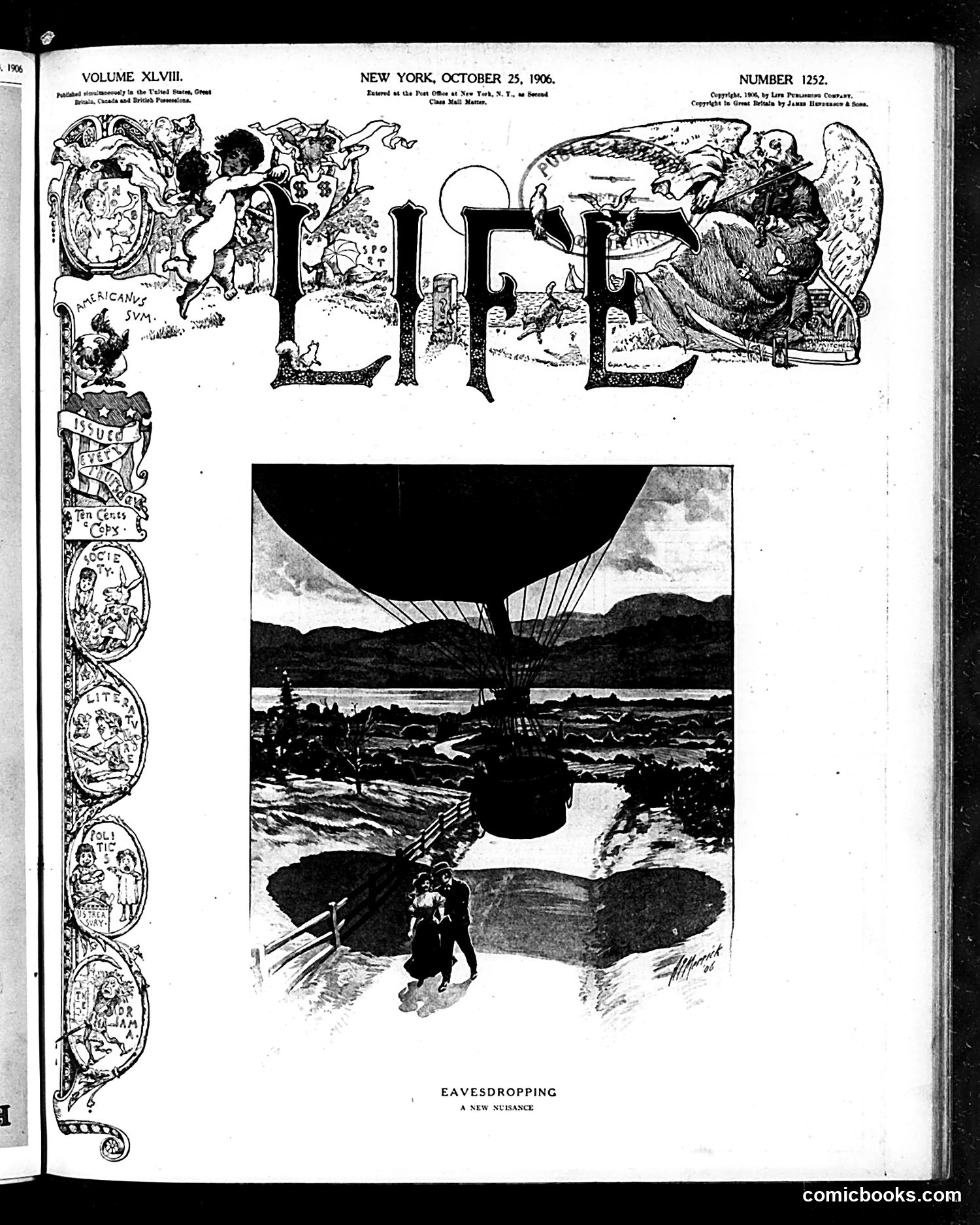
This 1906 *Life* magazine illustration satirizes the emerging problem of eavesdropping technology. The image shows a figure using what appears to be an early listening or surveillance device—possibly a telephone wire tap or similar apparatus—to intercept private conversations across a landscape. The caption frames this as "a new nuisance," suggesting contemporary anxiety about technological invasion of privacy. The illustration depicts the device's reach spanning across natural terrain, emphasizing how technology was dissolving traditional boundaries between public and private spaces. This reflects early-20th-century concerns about telephone technology enabling unauthorized surveillance—a surprisingly modern worry about privacy in an age of expanding communication infrastructure.
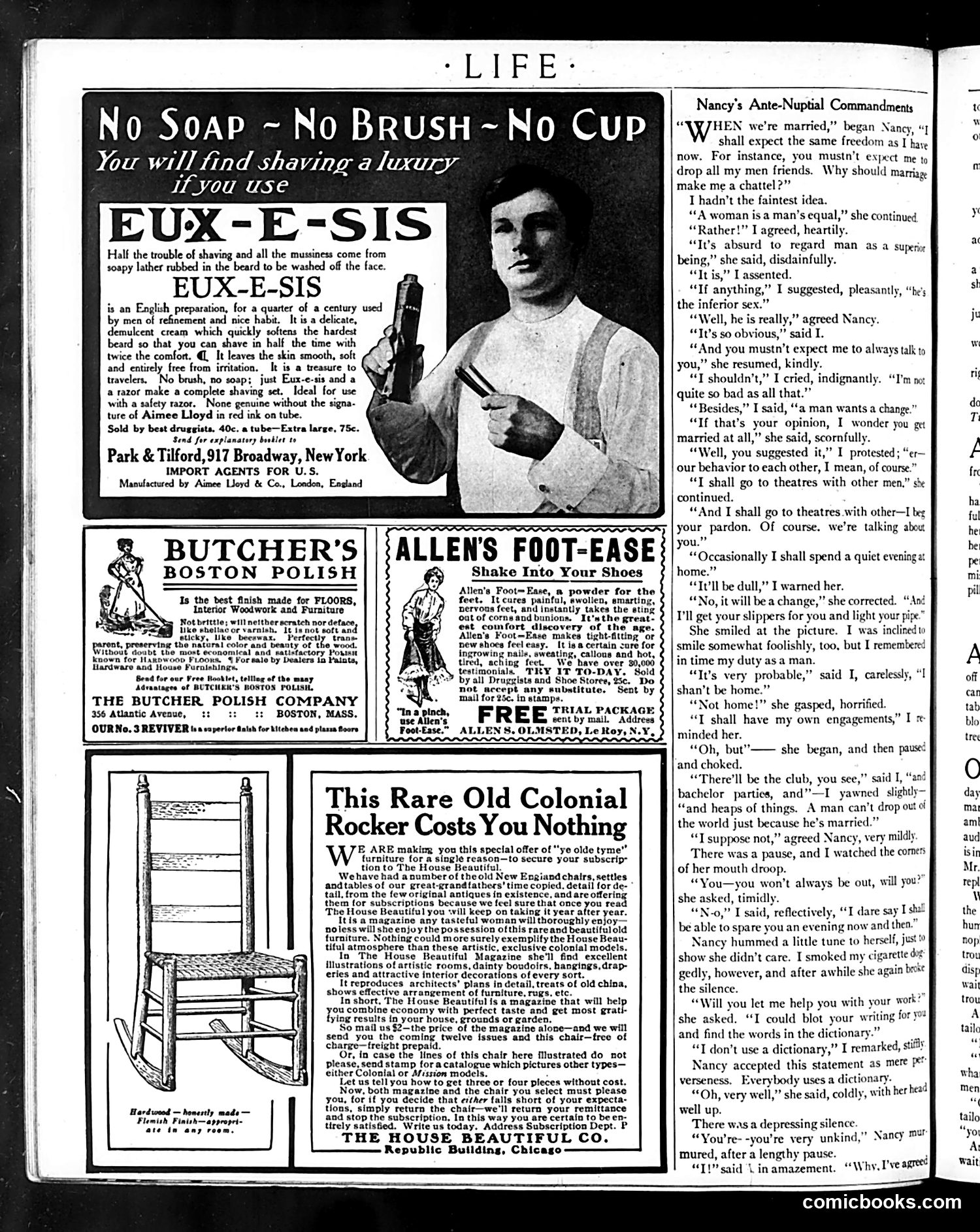
This page is primarily **advertising**, not political satire. The main content consists of three product advertisements: 1. **EUX-E-SIS** (top): A shaving product promising convenience without soap, brush, or cup—marketed to travelers and men seeking efficiency. 2. **Butcher's Boston Polish** (bottom left): A floor and furniture polish advertisement. 3. **Allen's Foot-Ease** (bottom center): A powder for foot comfort, positioned as relief from corns and bunions. 4. **The House Beautiful Colonial Rocker** (bottom right): Offering a free rocking chair to magazine subscribers. The right column contains what appears to be serialized fiction ("Nancy's Ante-Nuptial Commandments")—a domestic comedy about marital expectations. This represents typical early 20th-century *Life* magazine content: advertising-heavy, with lifestyle and domestic humor targeting middle-class readers.
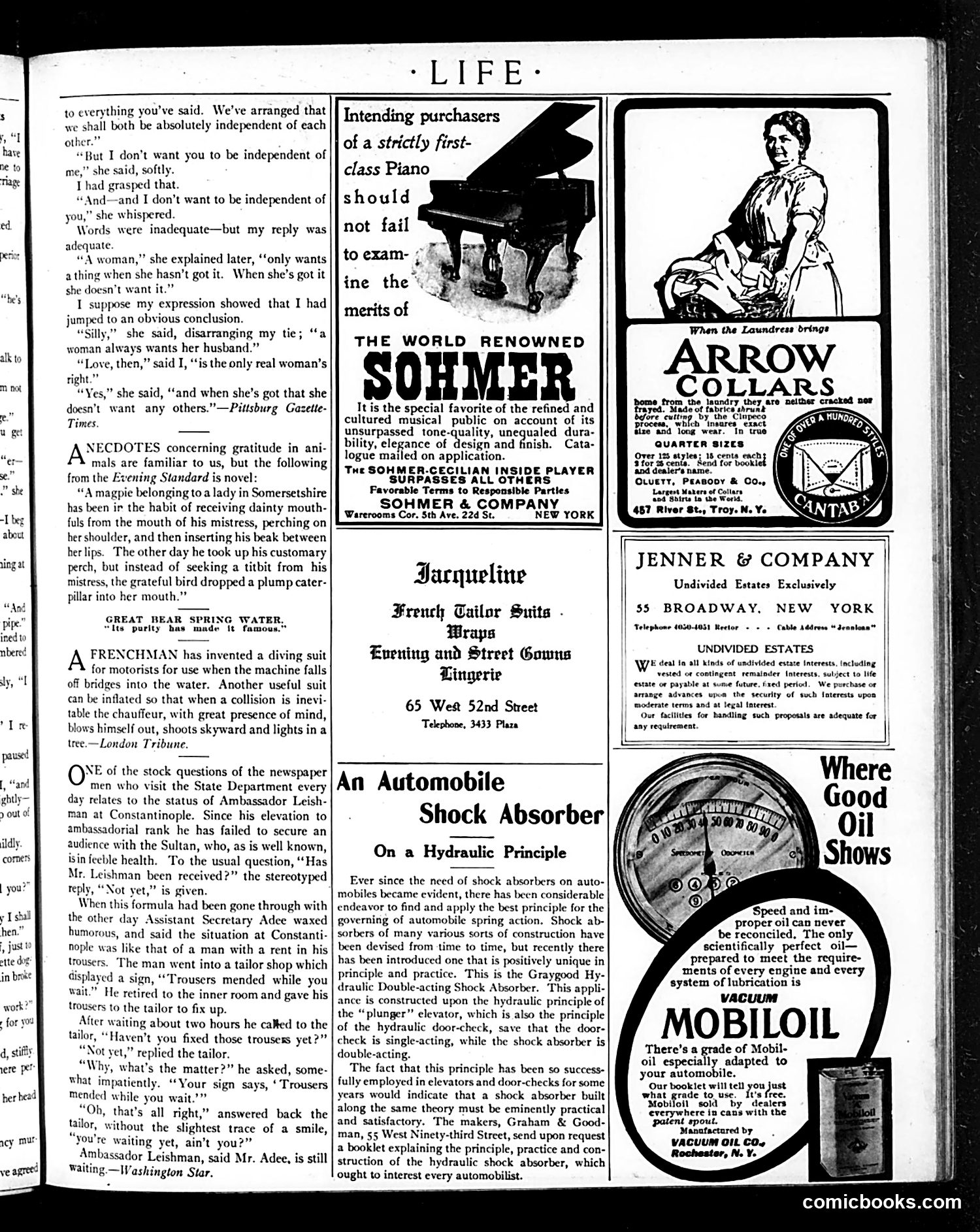
This page is primarily **advertising and commercial content** rather than political satire. The advertisements include: - **Sohmer Piano** - a high-end musical instrument marketed to "refined and cultured" audiences - **Arrow Collars** - a men's clothing brand - **Jacqueline French Tailor Suits** - women's fashion - **Jenner & Company** - real estate services - **Mobiloil** - automobile lubricant The only editorial content appears to be brief anecdotes about etiquette and an article explaining the hydraulic principle behind automobile shock absorbers—technical rather than satirical. There are **no identifiable political figures or social satire** on this page. It represents Life magazine functioning as a lifestyle publication for affluent readers, blending humor and advertising aimed at upper-class consumers.
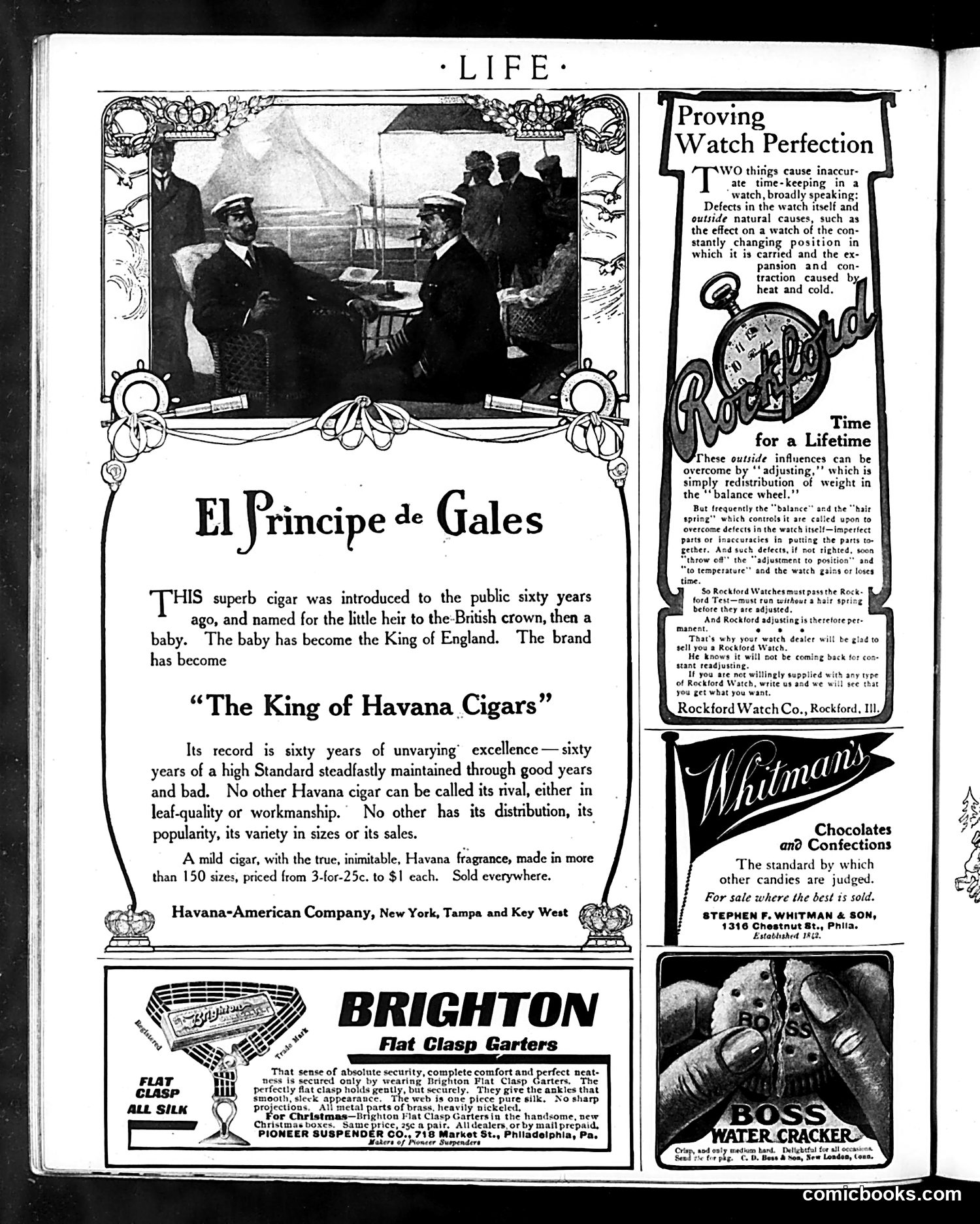
This page is **primarily advertising** with one historical reference. The main left-side advertisement for "El Principe de Gales" cigars contains a photograph showing what appears to be a formal diplomatic or royal occasion under a tent with multiple men in formal dress. The ad's text explains the cigar was "introduced to the public sixty years ago, and named for the little heir to the British crown, then a baby. The baby has become the King of England. The brand has become 'The King of Havana Cigars.'" This references a real historical figure—likely **Edward VII** (born 1841, crowned 1901)—using his childhood title to market cigars by connecting the product to British royal prestige. The remaining page content consists of advertisements for watches, chocolates, garters, and water crackers. There is no satirical cartoon present.
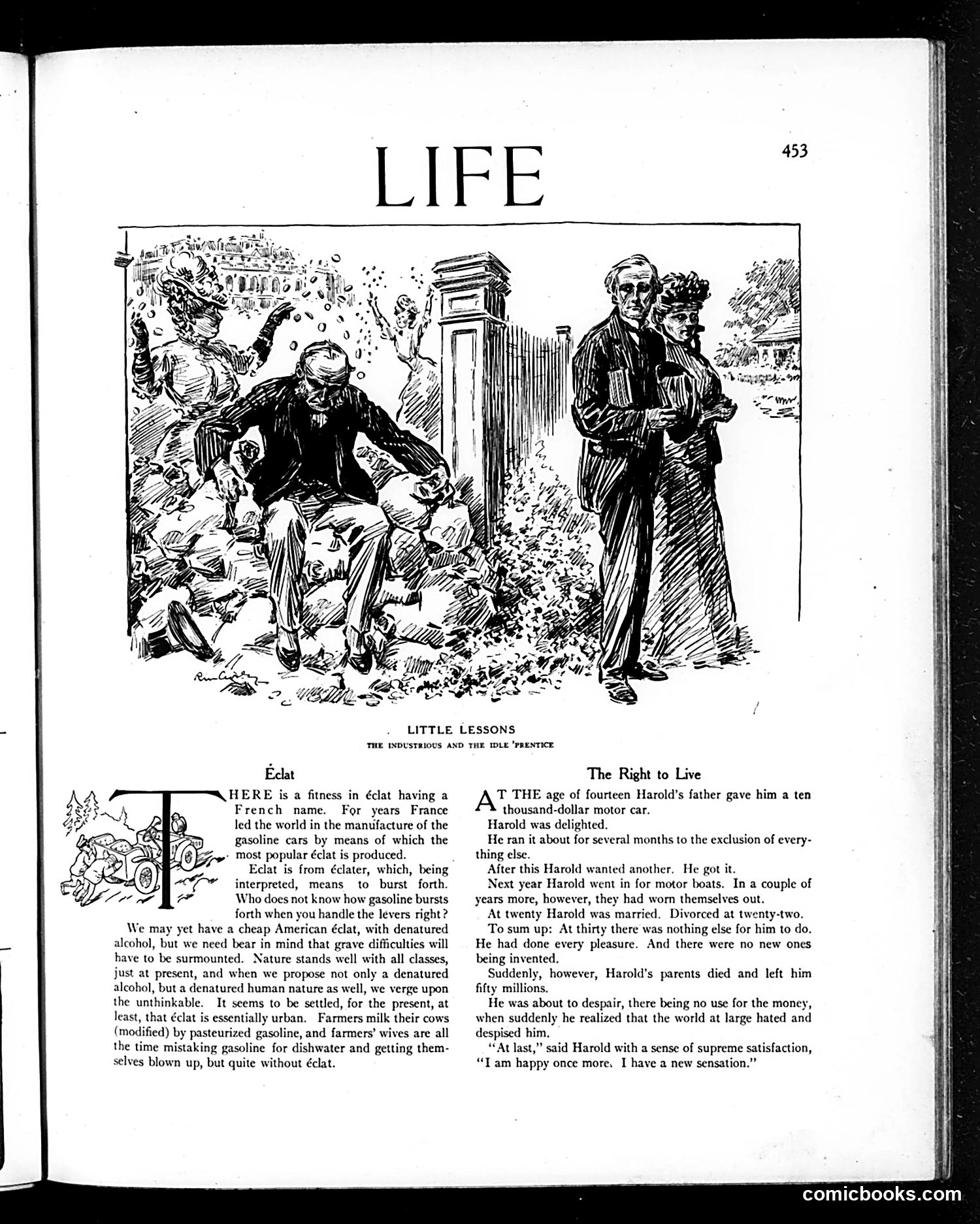
This page contains two satirical pieces about wealth and excess in early 20th-century America. **"Éclat"** (left) mocks the French term for "brilliance" by proposing an American version using denatured alcohol. The satire targets Prohibition-era America, where denatured (poisoned) alcohol was used industrially. The joke: wealthy Americans might resort to drinking this toxic substitute rather than abandon their lavish lifestyle—suggesting that maintaining appearances matters more than health or safety. **"The Right to Live"** (right) tells of Harold, a young wealthy man who inherits fifty million dollars after his parents die. Receiving everything he desires has made life meaningless until he realizes "the world at large hated and despised him." The satire critiques inherited wealth and idle rich youth, suggesting that unlimited privilege without purpose creates moral emptiness. Harold finds meaning only through the world's rejection of him. Both pieces critique American wealth inequality and excess.
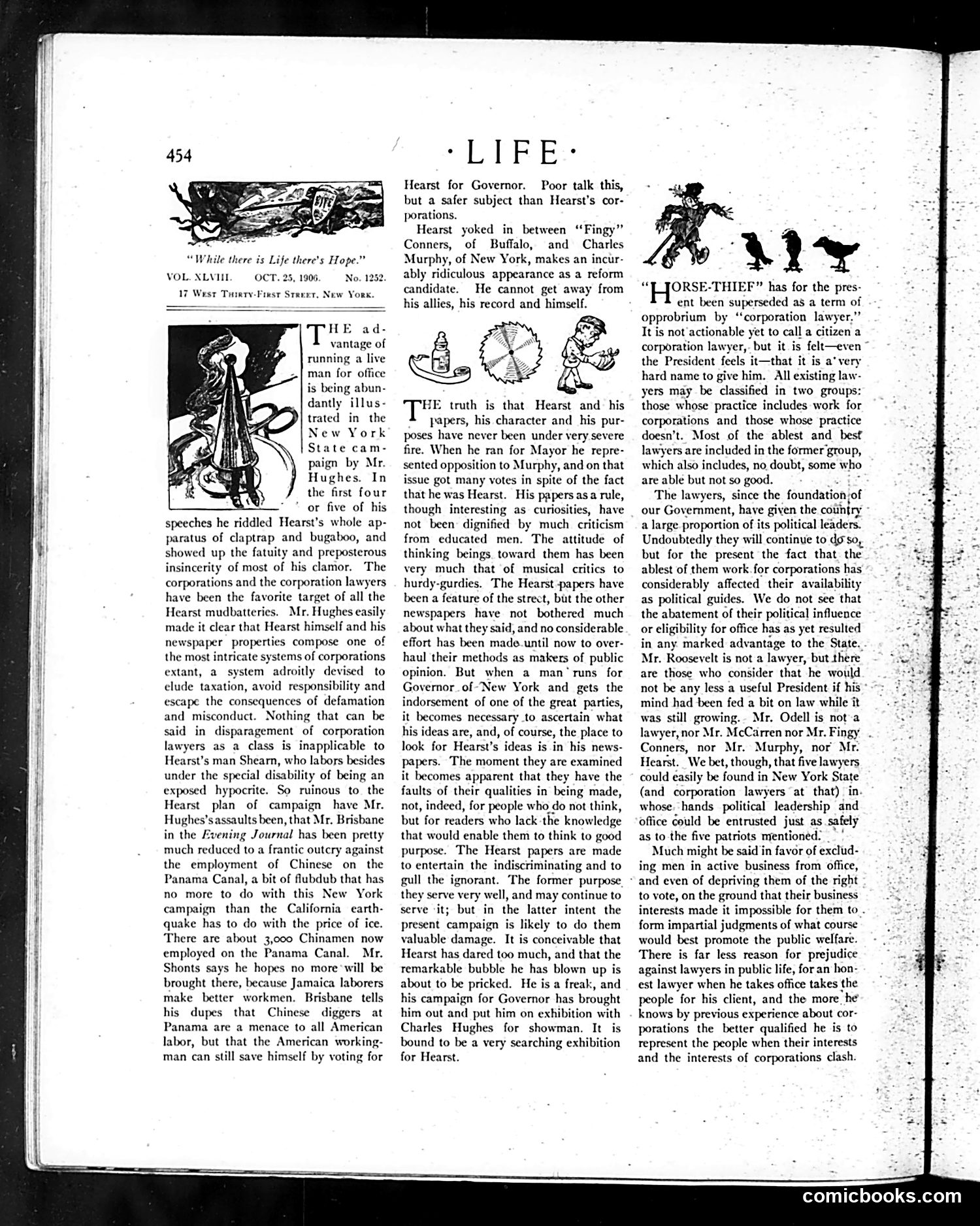
The main cartoon depicts a man running for New York City office, caricatured as a figure being chased or manipulated by corporate interests—symbolized by the mechanical/puppet-like imagery surrounding him. The accompanying article critiques **William Randolph Hearst's** political ambitions and his newspaper empire. Hearst ran for New York Governor in 1906 on a reform platform, but the text sarcastically notes his papers have been "the favorite target of all Hearst multimillionaires." The satire attacks the apparent contradiction: Hearst positions himself as an anti-corruption reformer while his papers have been used for corporate manipulation and attacks on political opponents. The cartoon and text together mock Hearst's credibility as a reform candidate given his papers' history of sensationalism and corporate entanglement.
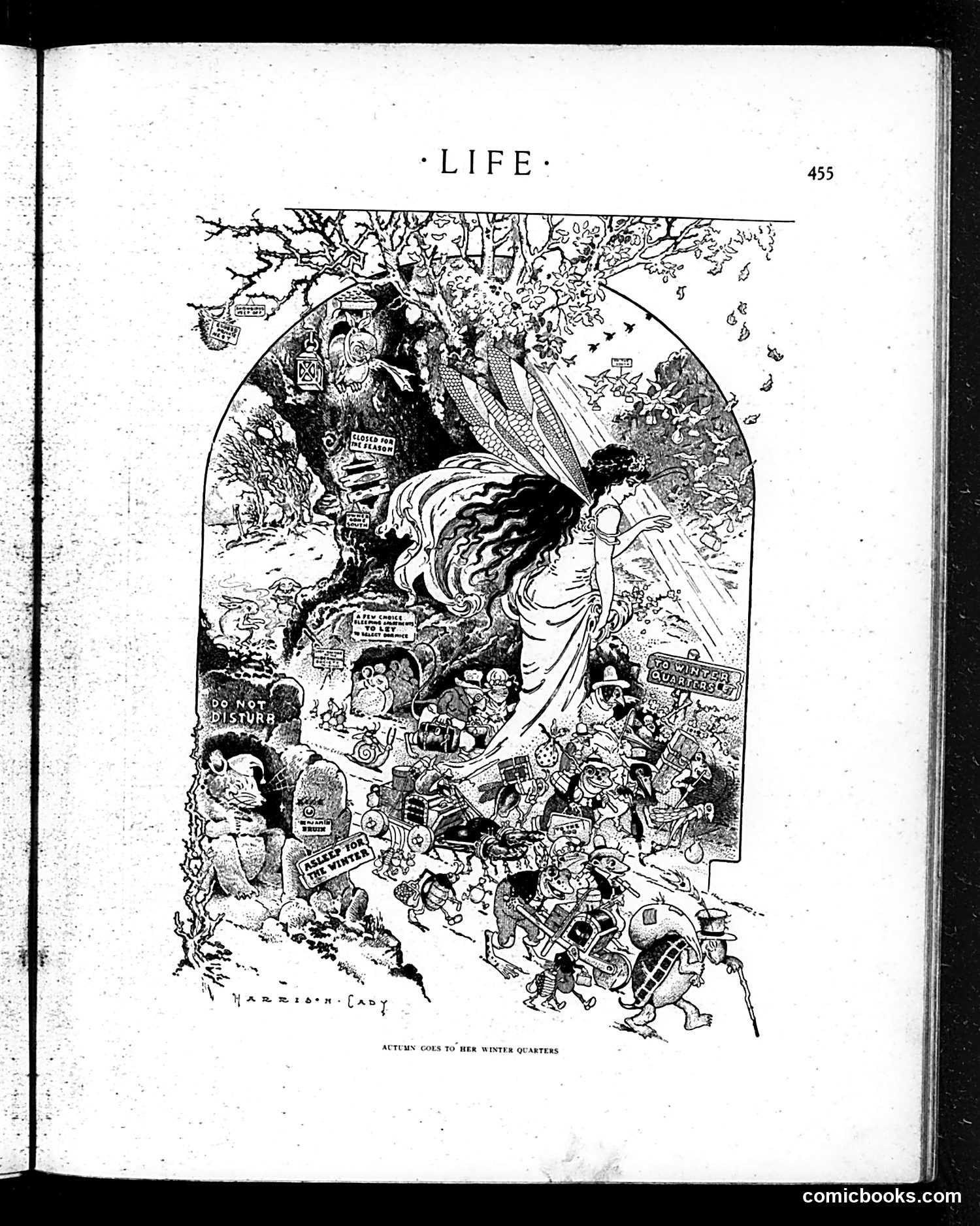
This is a detailed allegorical illustration titled "Autumn Goes to Her Winter Quarters," signed by Harrison Cady. The image depicts a large female figure (personifying Autumn) whose head and body are composed entirely of smaller vignettes showing various human activities and seasonal scenes. The cartoon employs a common satirical technique: using a female personification to represent the season while embedding commentary about contemporary life within her form. The dense, intricate detail suggests observations about how people spend autumn—activities, industries, and social customs associated with the season's transition. Without clearer OCR text or visible date markers, the specific political or social satire remains somewhat unclear, though the crowded composition typical of Life magazine's style suggests commentary on modern American seasonal life and commerce.
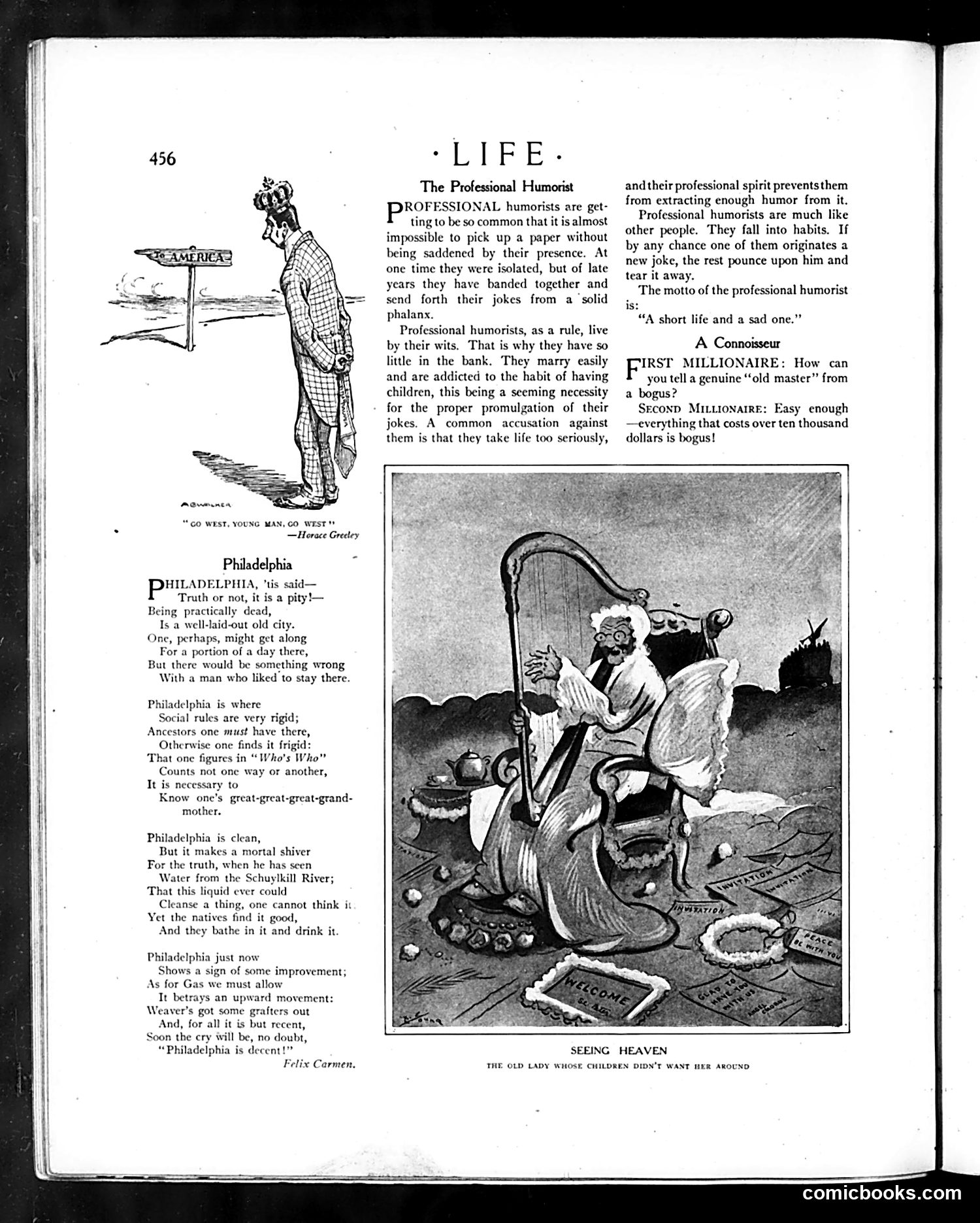
The page contains two distinct pieces: **"The Professional Humorist"** (text article) discusses comedians who earn their living through humor but paradoxically struggle financially due to overusing their wit in daily life, leaving nothing fresh for their professional work. **"Seeing Heaven"** (cartoon) depicts an elderly woman fishing, with the caption "The Old Lady Whose Children Didn't Want Her Around." The satire targets callous treatment of elderly parents—the implication being she's fishing (or waiting) for death as preferable to being unwanted by her own children. This reflects early 20th-century social anxieties about family obligation and abandonment of aging relatives. The accompanying "Philadelphia" poem by Felix Carmen is unrelated social commentary on that city.
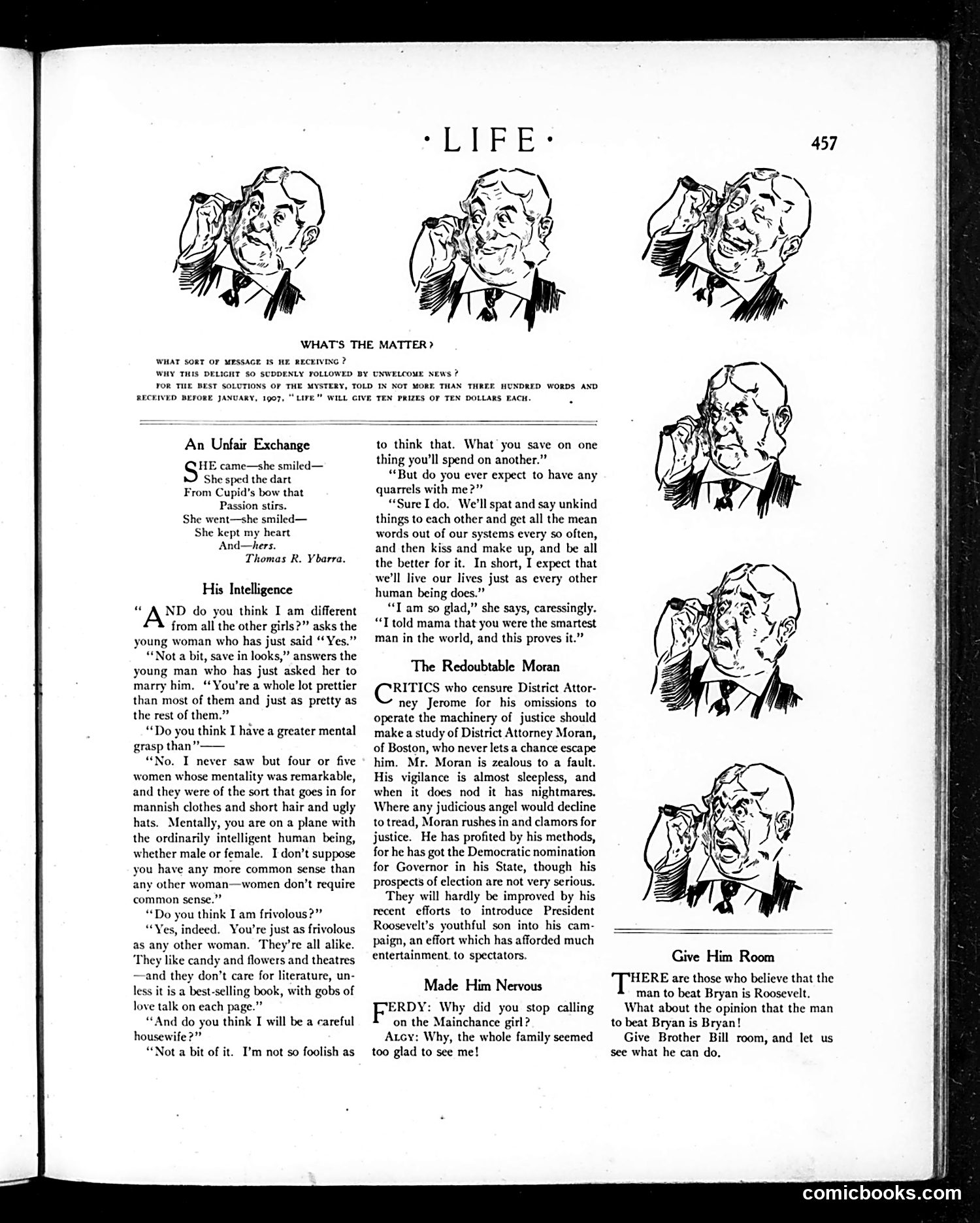
This page contains several short satirical pieces rather than a unified cartoon. The main content includes: **"What's the Matter?"** – A puzzle contest asking readers to identify what causes delight followed by unwelcome news, promising ten $10 prizes. **Three dialogue pieces** mock social interactions: - "An Unfair Exchange" – A woman criticizes her suitor - "His Intelligence" – A young woman questions a man's mental capacity compared to other women - "The Redoubtable Moran" – Praises District Attorney Moran of Boston for his zealous pursuit of justice, though noting his election prospects as governor are "not very serious" **"Made Him Nervous"** – A brief comedic exchange about calling on the "Mainchance girl" **"Give Him Room"** – References debate over whether Roosevelt or Bryan could "beat" the other, suggesting letting "Brother Bill" (Bryan) attempt leadership. The sketches on the right show various facial expressions, likely illustrating emotions discussed in the text.
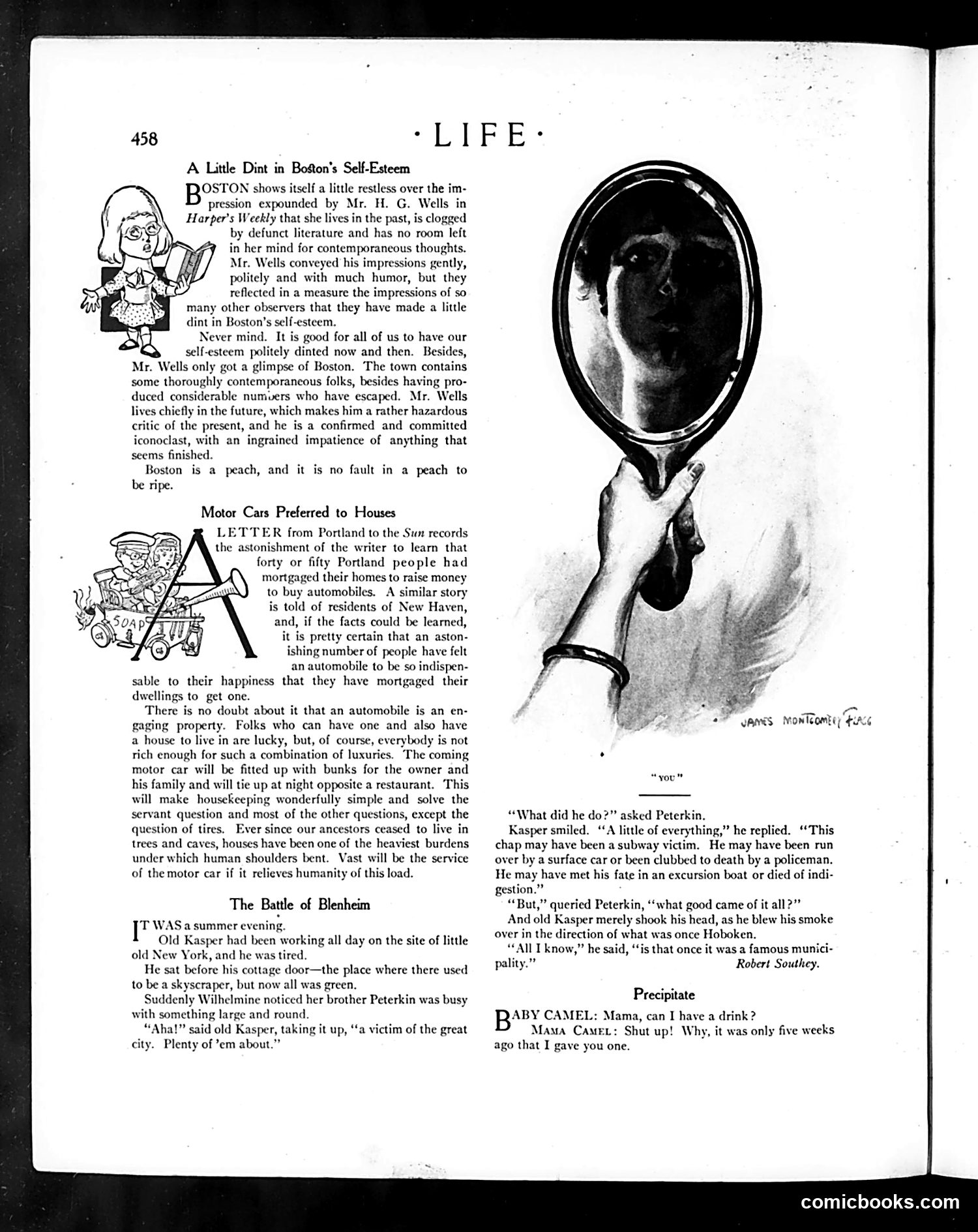
This page contains three separate pieces: 1. **"A Little Dint in Boston's Self-Esteem"** — A brief editorial response to H.G. Wells's criticism of Boston in *Harper's Weekly*, defending the city as containing contemporary thinkers despite Wells's unflattering impressions. 2. **"Motor Cars Preferred to Houses"** — A satirical article mocking the American obsession with automobiles, reporting that residents in Portland and New Haven have mortgaged their homes to buy cars. The accompanying cartoon depicts people choosing automobiles over stable housing—social commentary on misplaced consumer priorities and the emerging car culture. 3. **"The Battle of Blenheim"** and **"Precipitate"** — Short humorous dialogues featuring literary references and domestic comedy, unrelated to political content. The page primarily satirizes early 20th-century American materialism and automobile mania.
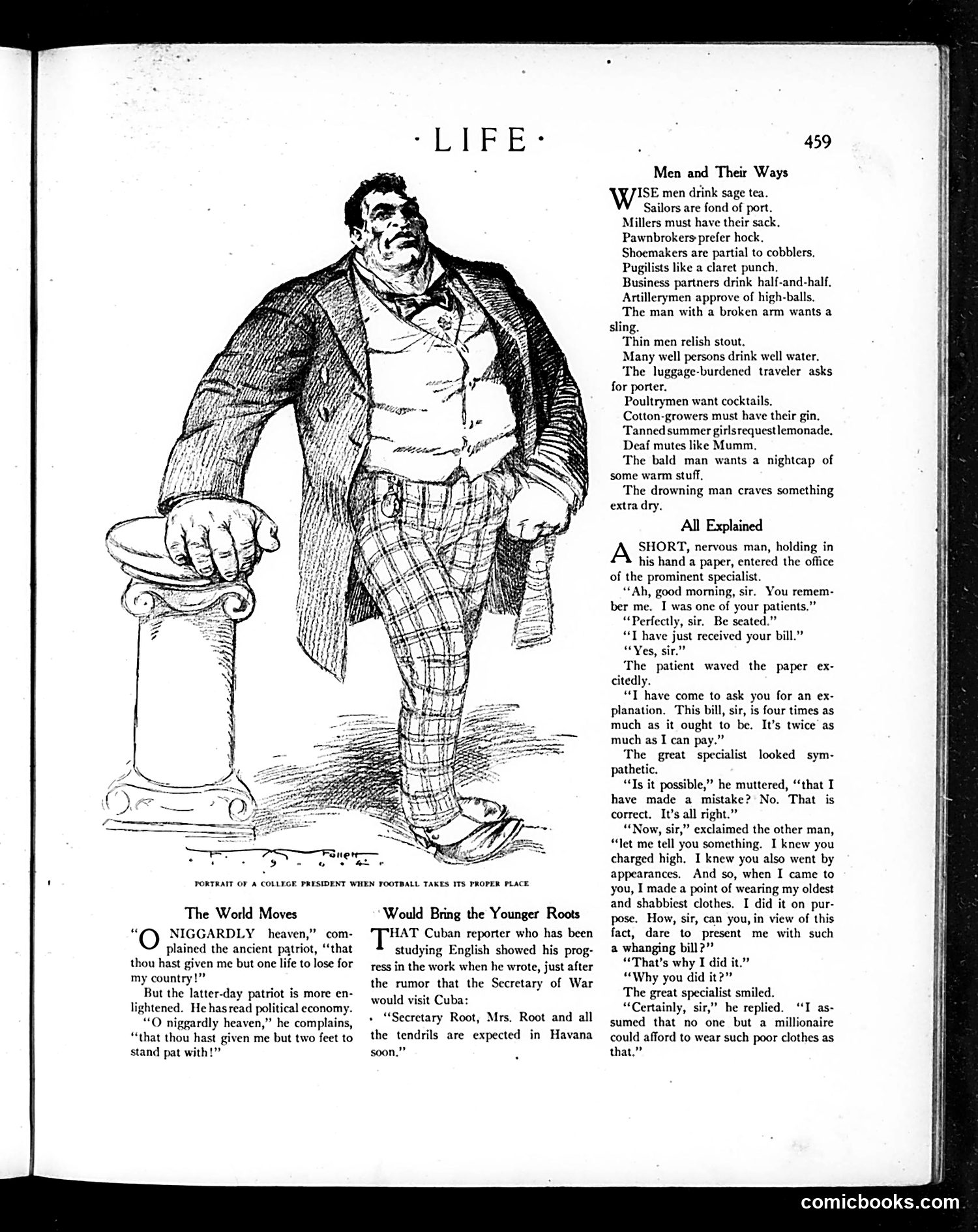
The main illustration satirizes college presidents, captioned "Portrait of a College President When Football Takes Its Proper Place." It depicts a rotund, well-dressed man holding a large beer mug, suggesting that when football loses importance at universities, college leaders would revert to indulgence and leisure rather than serious academic pursuits. The "Men and Their Ways" section offers humorous observations about different professions and their drinking preferences—sailors prefer port, millers want sack, businessmen drink half-and-half, etc. "All Explained" presents a dialogue between a nervous man and a prominent specialist about an inflated medical bill. The patient questions the charges; the specialist justifies them by claiming the patient dressed too shabbily, implying doctors charge more to wealthy-appearing clients. This satirizes medical profession dishonesty and class-based pricing practices.
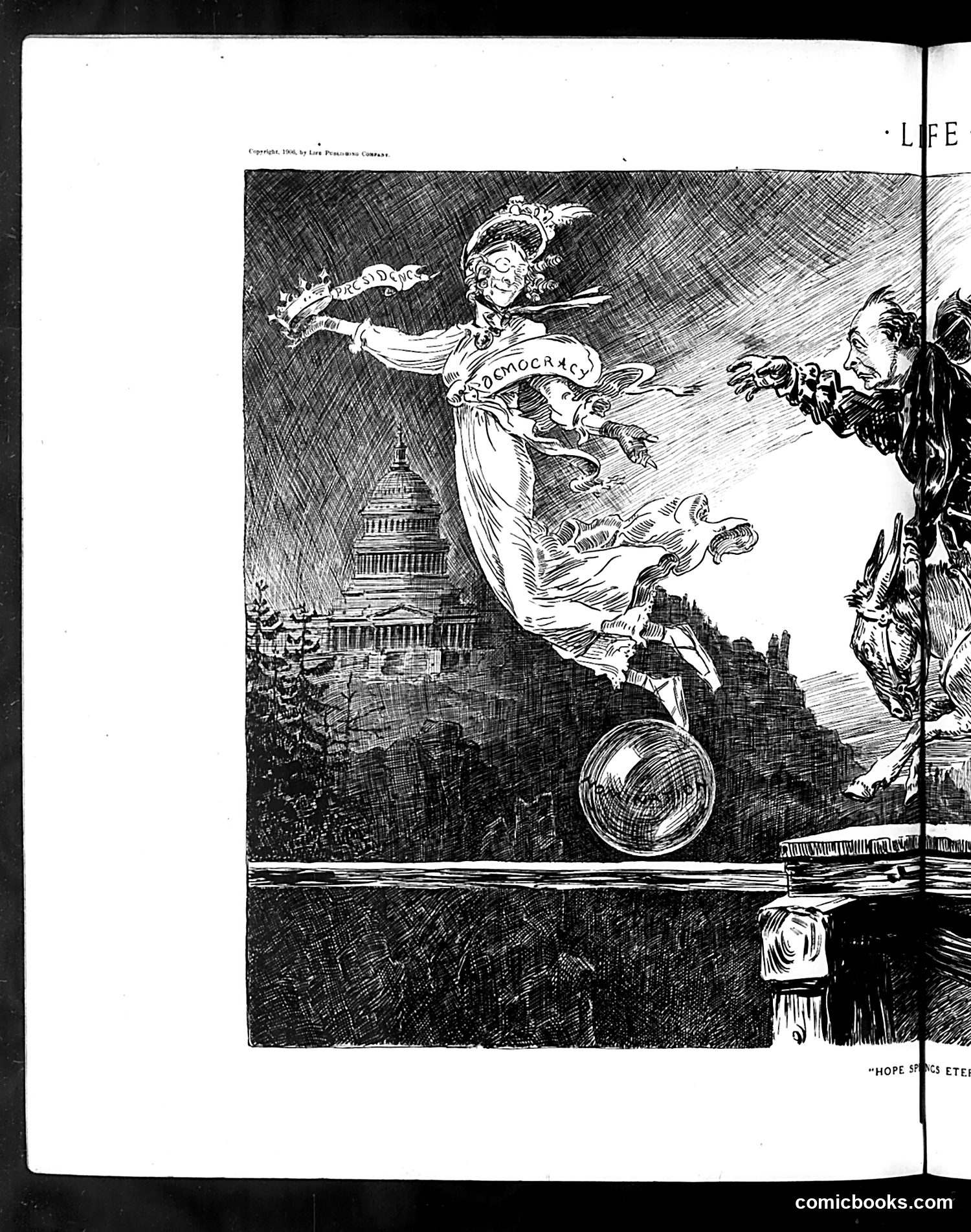
This political cartoon depicts **Democracy** as a classical female figure (wearing a sash labeled "DEMOCRACY") precariously balanced on a sphere above Washington's Capitol building. She appears to be juggling or struggling to maintain control of multiple serpents or threatening figures emerging from below. A demonic or antagonistic figure on the right side seems to represent a threat to democratic principles. The imagery suggests anxiety about democracy's stability and the forces—depicted as snake-like creatures—that threaten to undermine it. The precarious balancing act conveys that democratic governance is fragile and requires vigilant maintenance against internal or external threats. Without the magazine's date visible, the specific historical crisis referenced remains unclear, though the allegorical warning about democracy's vulnerability is evident.
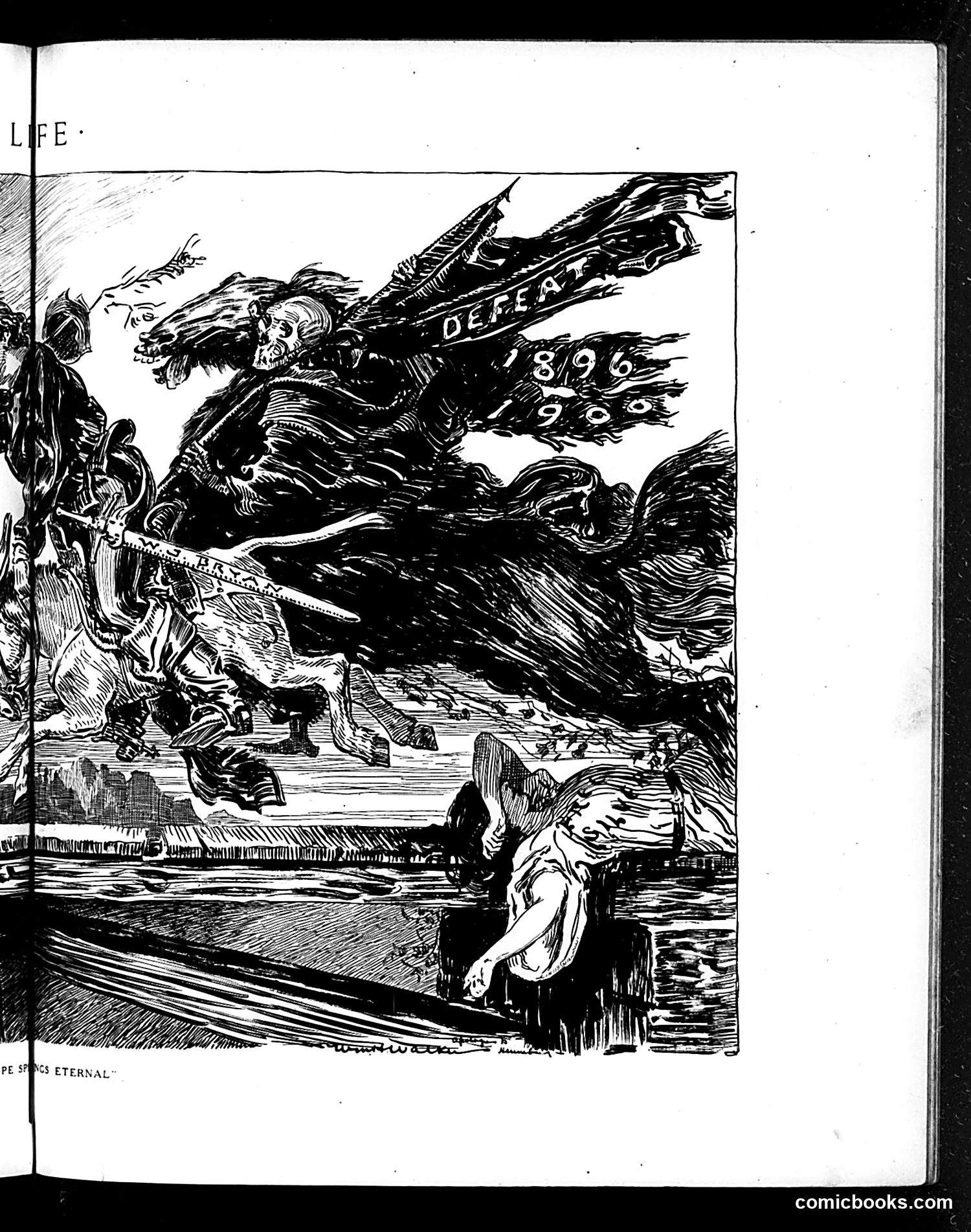
This appears to be a WWI-era satirical illustration from *Life* magazine. The central figure is labeled "DEFEAT" and is depicted as a dark, demonic or death-like creature wielding a sword and displaying the numbers "8/9/6" (likely representing casualty figures or a specific date). A woman in the foreground observes this scene of destruction and carnage, which includes dead bodies and ruined buildings. The caption fragment reads "PE SPRINGS ETERNAL," suggesting the full phrase is "Hope Springs Eternal." The cartoon's satire juxtaposes human hope against the grim reality of war's devastation. It critiques the disconnect between optimistic rhetoric and the actual horrors of combat, suggesting that hope persists despite overwhelming evidence of defeat and death on the battlefield.
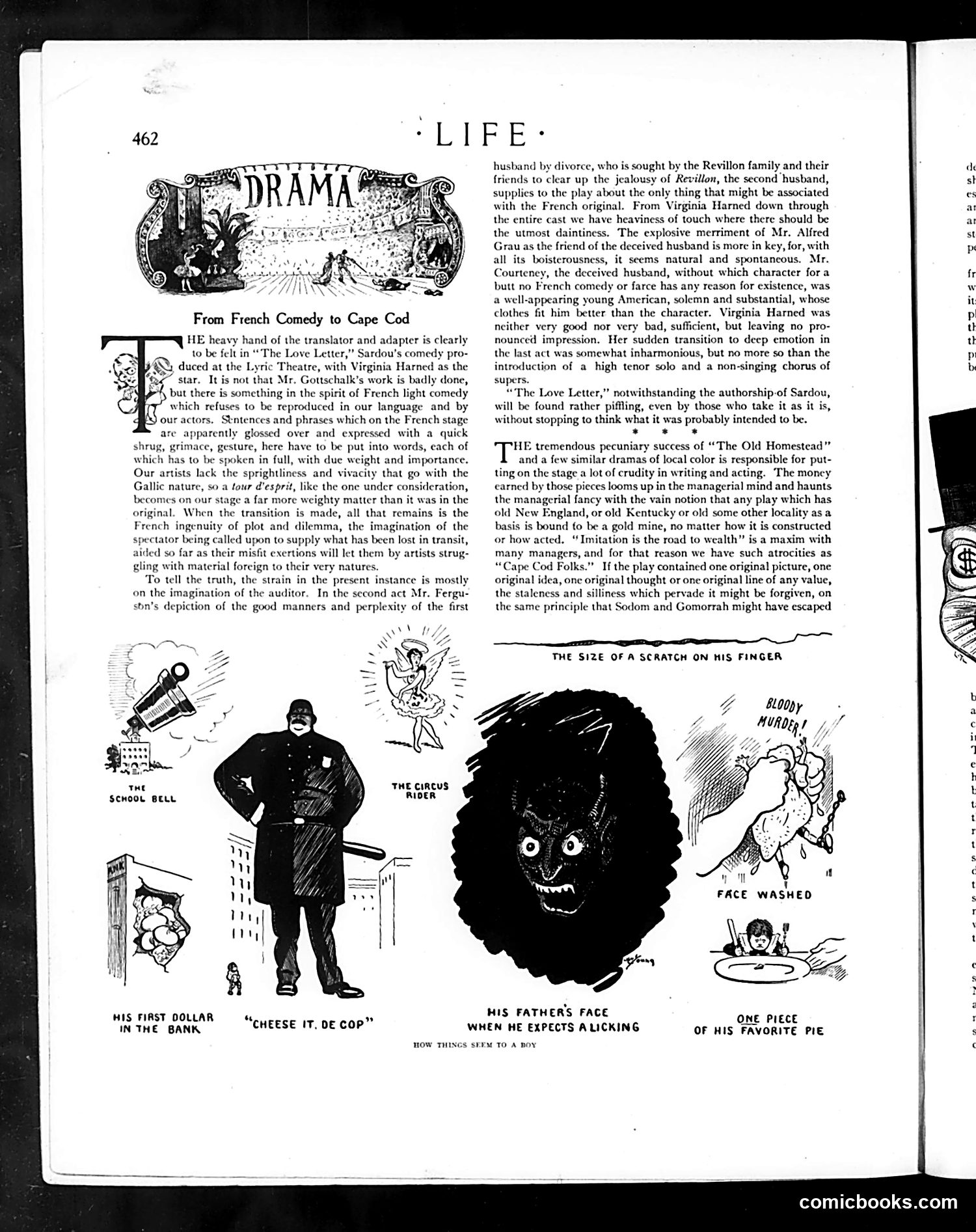
This page critiques two theatrical productions. The upper section reviews "The Love Letter," a French comedy adapted by Gottschalk starring Virginia Harned at the Lyric Theatre. The critic argues that French light comedy loses its essential charm in English translation—the quick wit and physical humor that work on French stages become ponderous when actors must speak every word explicitly. He notes the cast lacks the sprightliness needed; only Alfred Grau's boisterous performance succeeds. The lower section attacks "Cape Cod Folks," a play capitalizing on the success of "The Old Homestead" by exploiting regional settings. The critic condemns managers who assume any play with New England or Kentucky locale automatically succeeds, calling this imitation creatively bankrupt. The comic illustrations at bottom satirize boyish mishaps—a school bell accident, a police encounter, father's angry face, and pie consumption—presumably illustrating the play's content or the magazine's broader commentary on entertainment's lowest common denominators.
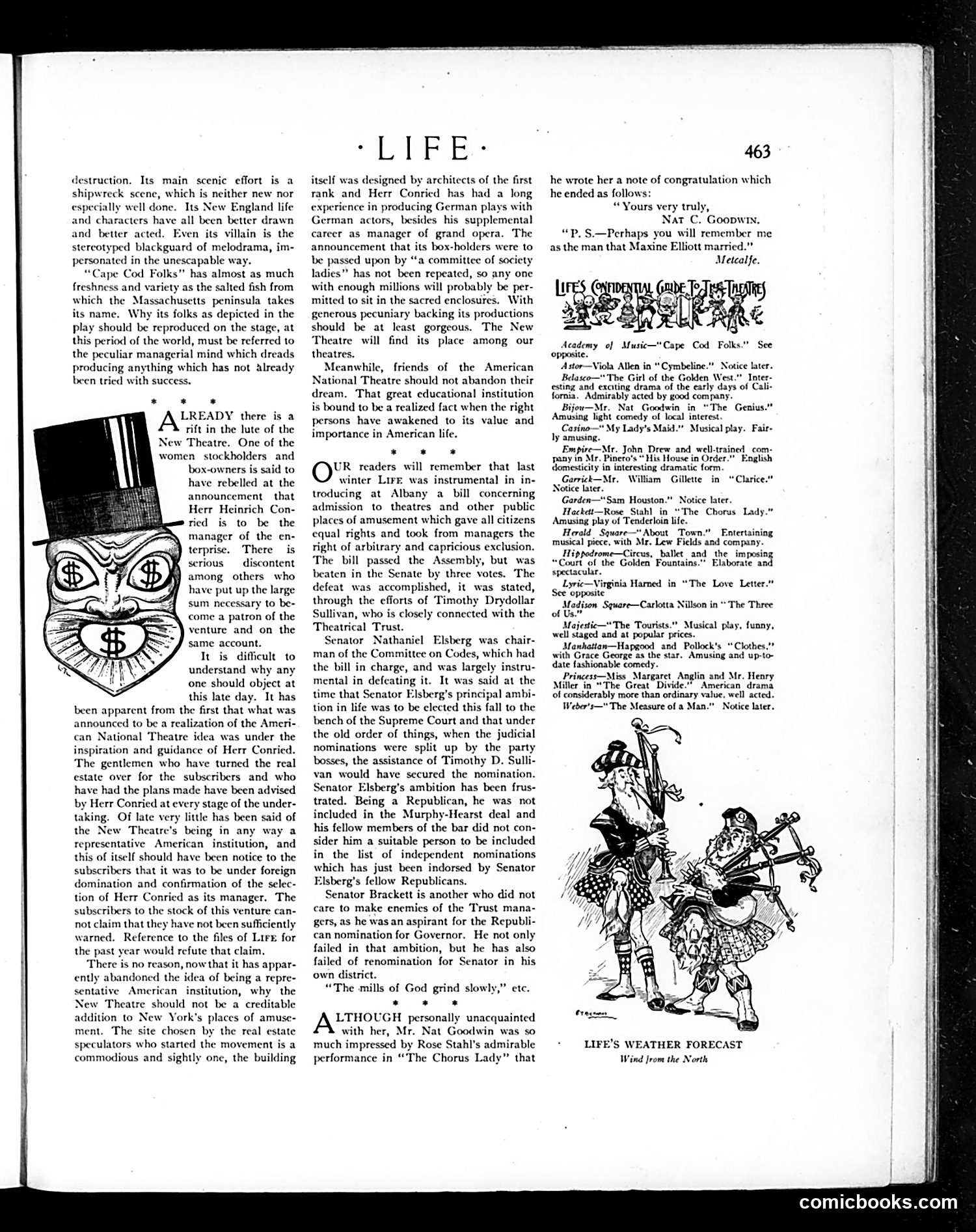
This page discusses the troubled founding of New York's "New Theatre," a venture intended as an American National Theatre but increasingly dominated by **Herr Heinrich Conried**, a German theatrical manager and opera impresario. The satire criticizes wealthy American patrons (including female stockholders) who funded this supposedly patriotic American institution, only to discover it was being controlled by a foreigner. Life mocks their surprise, noting the magazine had warned them repeatedly. The page also references a recent legislative victory: Life had championed a bill guaranteeing equal public access to theaters, eliminating managers' power to exclude citizens arbitrarily. Though it passed the Assembly, it failed in the Senate by three votes—allegedly through interference by **Timothy D. Sullivan**, a politically connected figure involved with theatrical trusts. The underlying complaint: wealthy institutions claiming American identity while operating under foreign control, and powerful interests blocking democratic access reforms.
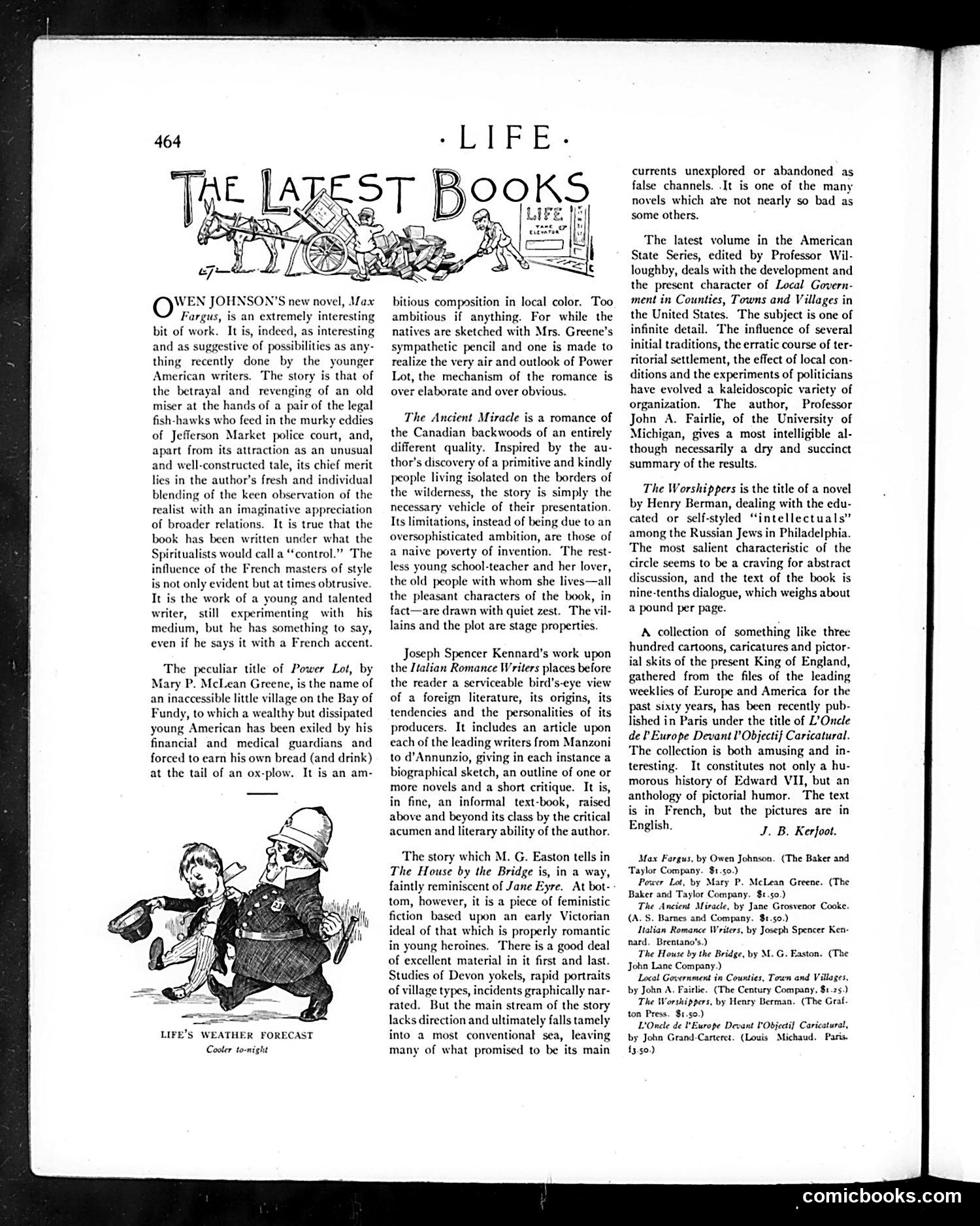
The cartoon titled "Life's Weather Forecast" (credited "Colder to-night") depicts two figures dressed in Victorian-era winter clothing caught in bad weather. The illustration appears to be a humorous commentary on unpredictable or deteriorating conditions—both meteorological and possibly social/political. The cartoon uses exaggerated clothing and poses to satirize how people bundle up against harsh elements. Without additional context identifying the specific figures, it likely functions as general social satire about human response to adversity or changing circumstances, which was Life magazine's typical approach. The page itself reviews recently published novels, suggesting this cartoon provides comic relief amid literary criticism. The "weather forecast" metaphor may allude to broader cultural or economic "storms" of the period, though the exact reference remains unclear without additional historical documentation.
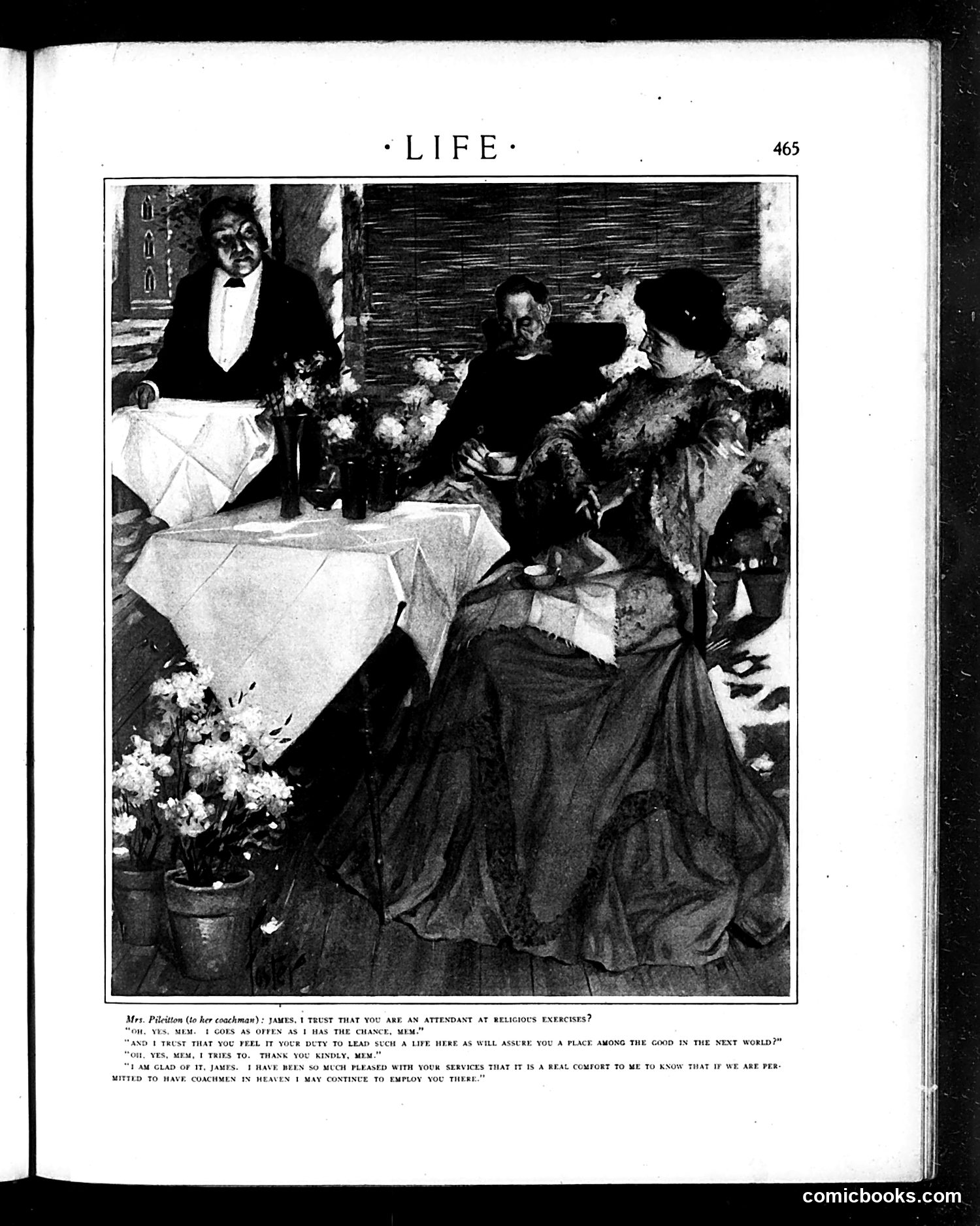
This satirical cartoon mocks the hypocrisy of wealthy Victorian employers regarding their servants' spiritual welfare. Mrs. Pilcitton, a wealthy woman, questions her coachman James about his religious devotion and moral conduct, ostensibly concerned for his salvation. The joke's sting lies in her final statement: she's pleased with his services *not* out of genuine care for his soul, but because she wants to ensure he'll be her servant in the afterlife as well. Her concern for his piety is entirely selfish—she views even heaven through the lens of maintaining her class hierarchy and personal convenience. This satirizes how the Victorian upper class used religious rhetoric to justify servitude while revealing their actual indifference to servants' spiritual lives. The humor exposes the gap between professed Christian charity and actual class-based exploitation.
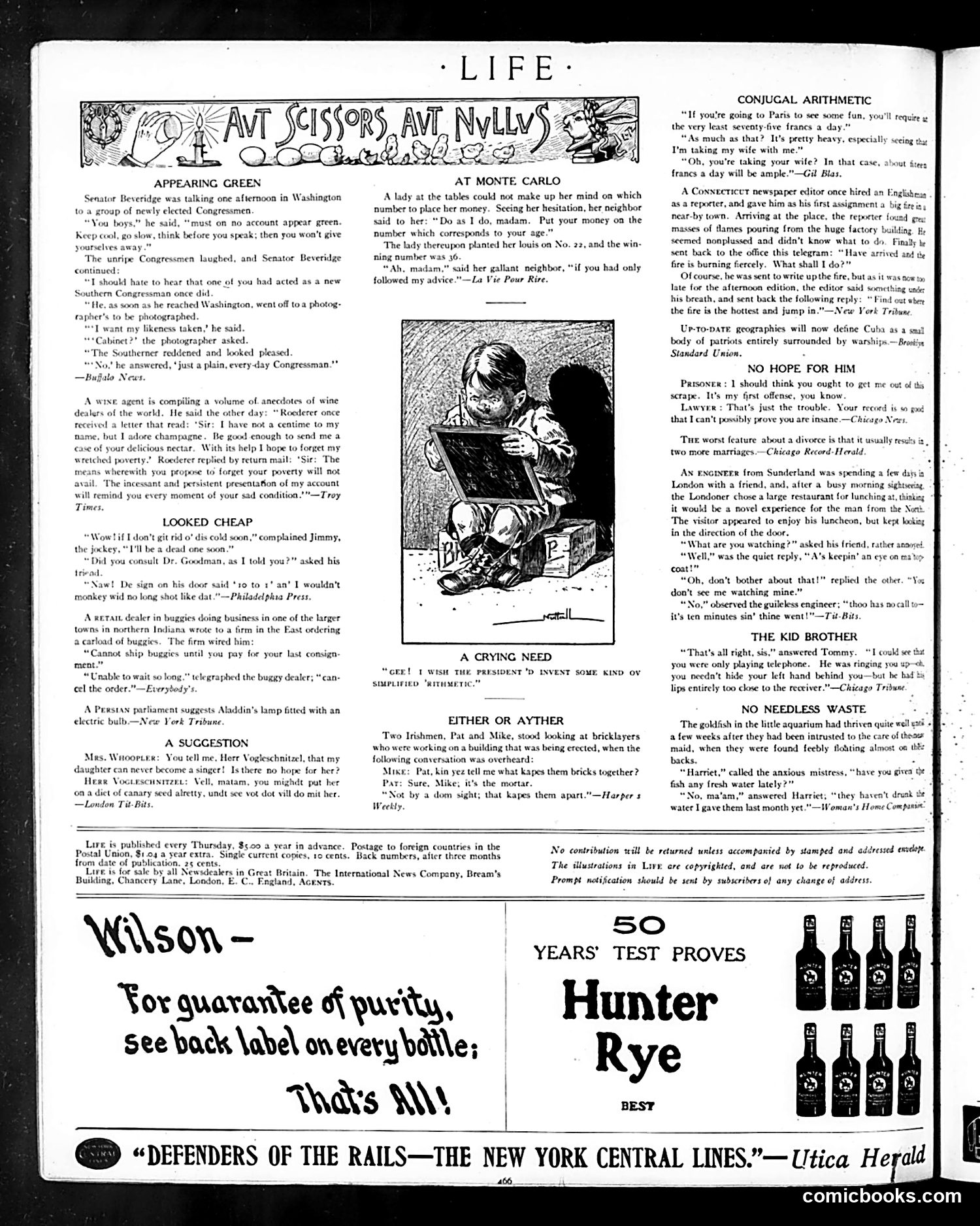
This page contains several short humorous anecdotes typical of early 20th-century American satire: **"Appearing Green"** mocks newly elected congressmen for appearing naive or inexperienced in Washington. **"At Monte Carlo"** jokes about a woman placing a bet on her age (22) at a gambling table, with the winning number being 36—implying she's older than she admits. **"Conjugal Arithmetic"** suggests that taking one's wife to Paris doubles expenses, but a wife reduces costs from 75 to 50 francs daily—a jab at marriage economics and wives' frugality. **"Either or Ayther"** presents an Irish joke about bricklayers debating whether mortar or something else holds bricks together—typical ethnic humor of the era. The cartoons satirize class pretensions, marital dynamics, aging vanity, and ethnic stereotypes common to period humor. The illustrations and brief anecdotes reflect Life's formula: witty social observation wrapped in accessible jokes for educated readers.
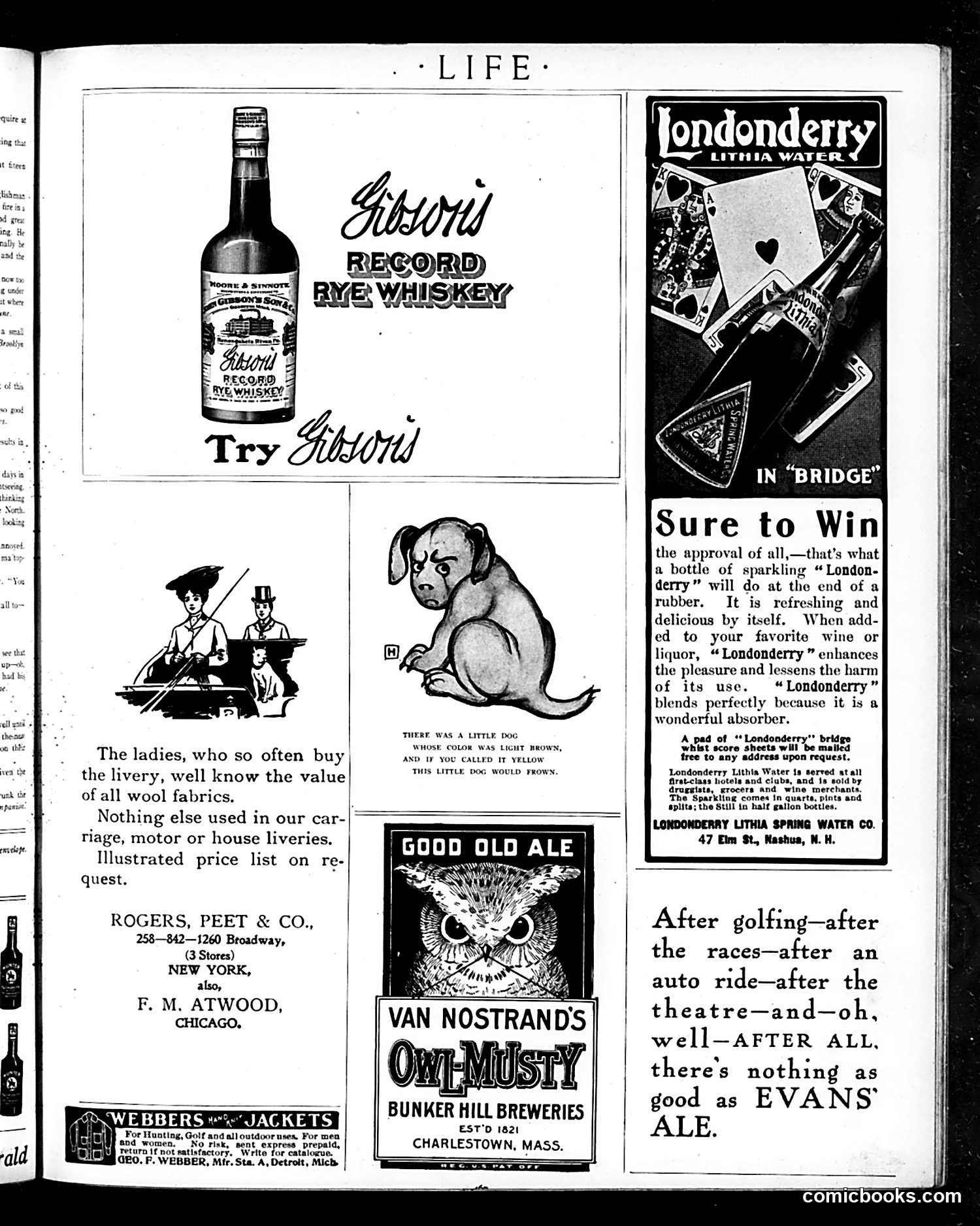
This is primarily an **advertising page** from an early 20th-century issue of Life magazine, not a political cartoon or satirical content. The page features multiple alcohol and beverage advertisements typical of the pre-Prohibition era, including: - **Alsoril Record Rye Whiskey** (top left) - **Londonderry Lithia Water** (right) — marketed as a mixer and digestive aid - **Van Nostrand's Owl Musty Ale** (center) from Bunker Hill Breweries - **Evans' Ale** (bottom right) There is one **whimsical illustration**: a small dog with accompanying verse about color perception ("There was a little dog / Whose color was light brown, / And if you called it yellow / This little dog would frown"), which appears purely decorative rather than satirical. The page also contains fabric/clothing advertisements (Rogers, Peet & Co.; Webber's Jackets). This represents standard commercial content from an era when Life functioned as both humor magazine and advertising vehicle.
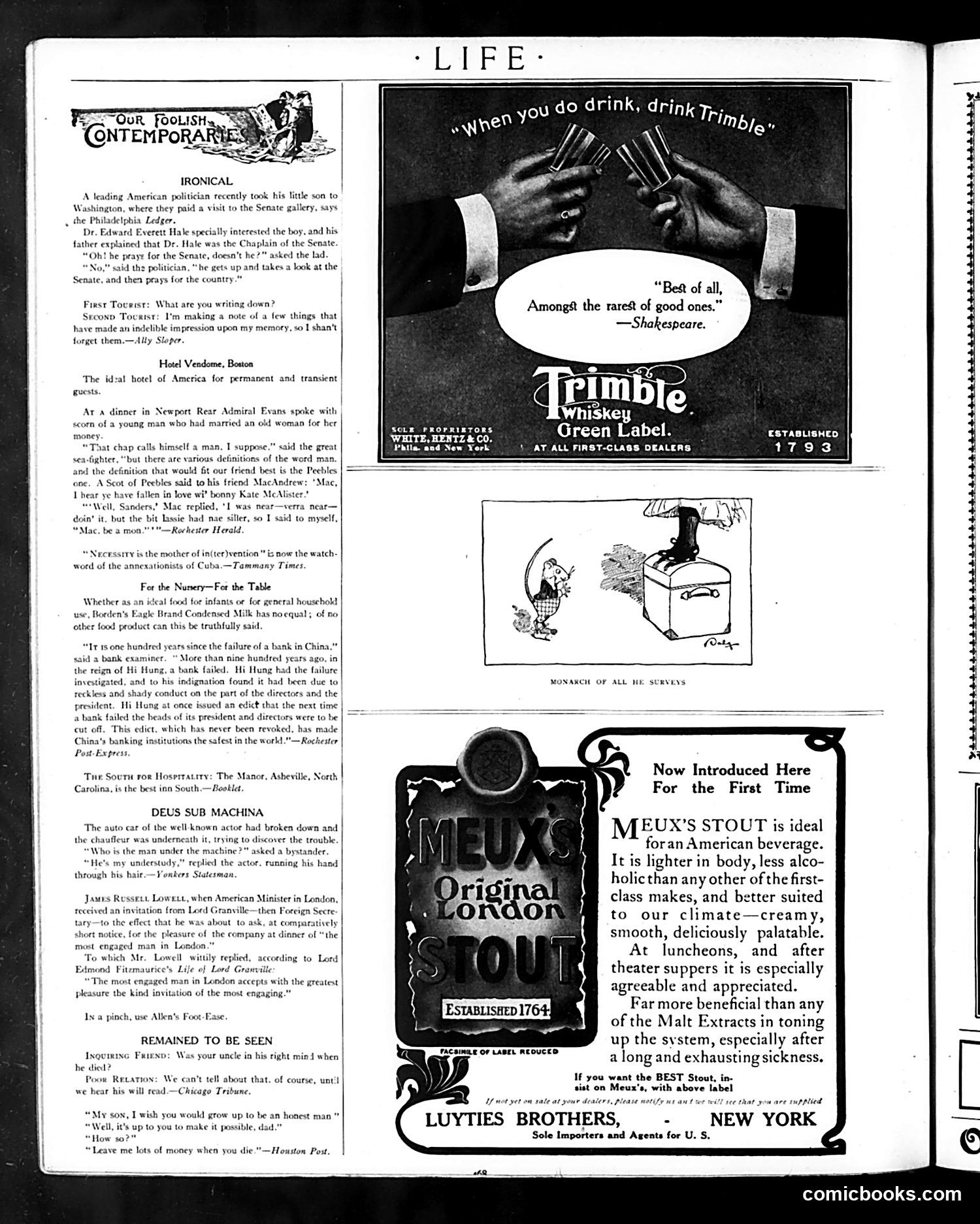
This page from *Life* magazine contains satirical short pieces and advertisements, primarily from the early 1900s. **"Our Foolish Contemporary" (top left)**: A politician takes his son to the Senate gallery. When told the chaplain prays for the Senate, the boy asks if he prays *for* them. The father replies the chaplain "gets up and takes a look at the Senate, and then prays for the country"—satirizing the Senate as so dysfunctional it requires divine intervention for the nation's welfare. **Other humor pieces**: Brief anecdotes mocking marriage for money, banking practices, and social pretension, typical of *Life*'s satirical format. **Cartoons**: Include a small illustration labeled "Monarch of All He Surveys" (appears to show someone surveying their domain) and various advertisements for whiskey and stout beer. The page is primarily **advertising-heavy**, with prominent ads for Trimble Whiskey and Meux's Stout dominating the right side. The satirical content serves mainly as filler between paid promotions.
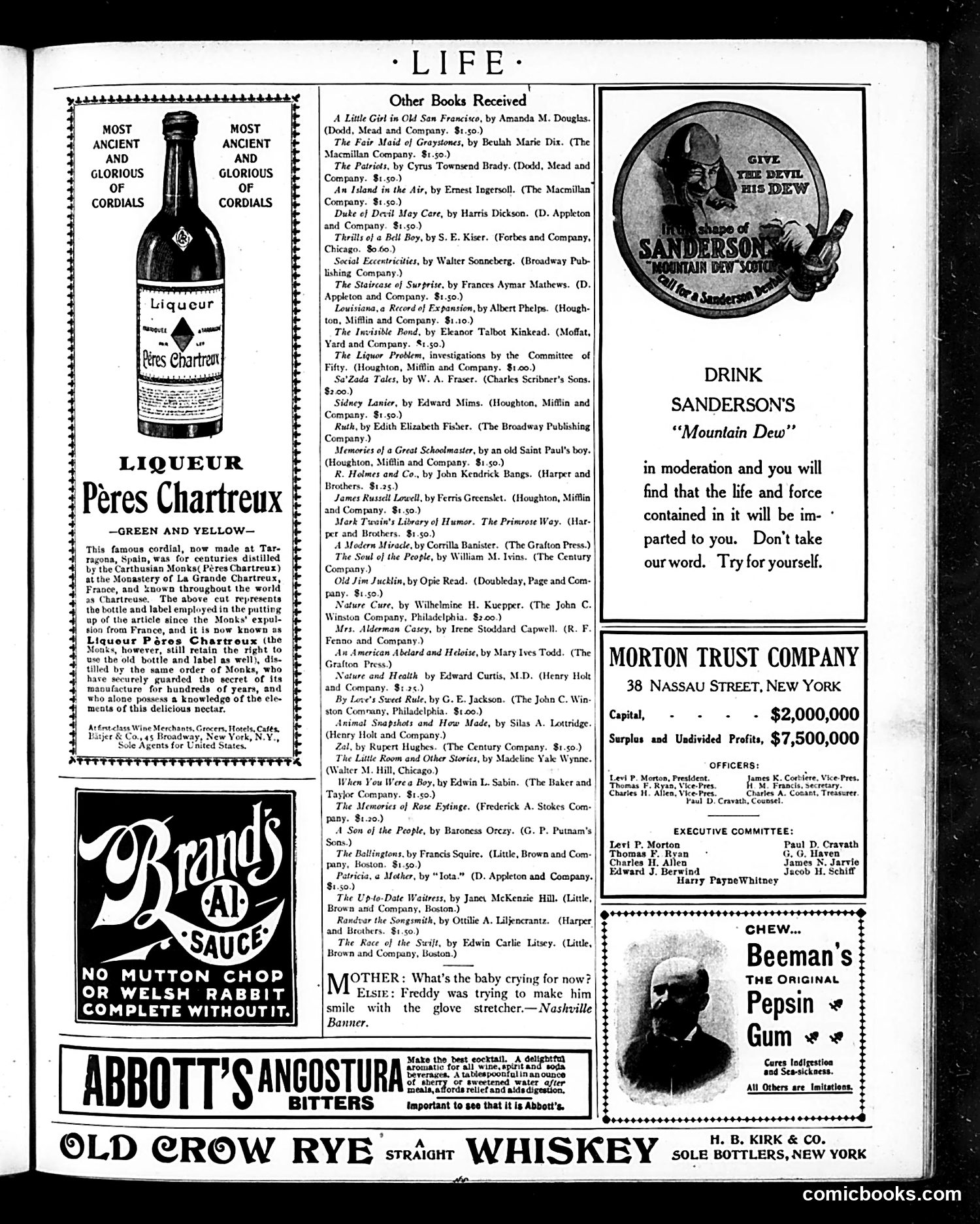
This page is primarily **advertising and book listings** rather than political satire. The main content consists of: **Left side:** Advertisements for liqueurs and condiments—Péres Chartreux (a cordial historically made by Carthusian monks in France), Brand's Sauce, Abbott's Bitters, and Old Crow Whiskey. These are straightforward product ads with no satirical intent. **Center:** A lengthy list of recently published books with titles, authors, and publishers—typical for a literary magazine of this era. **Right side:** More advertisements, including Sanderson's "Mountain Dew" whiskey and Beeman's Peppsin Gum. There are **no political cartoons or satirical commentary** visible on this page. The only potentially humorous element is the joke at the bottom attributed to the *Nashville Banner* about a baby and a glove stretcher, but this is a brief anecdote rather than visual satire. This appears to be a standard interior page from an early 20th-century magazine, mixing editorial content with revenue-generating advertisements.
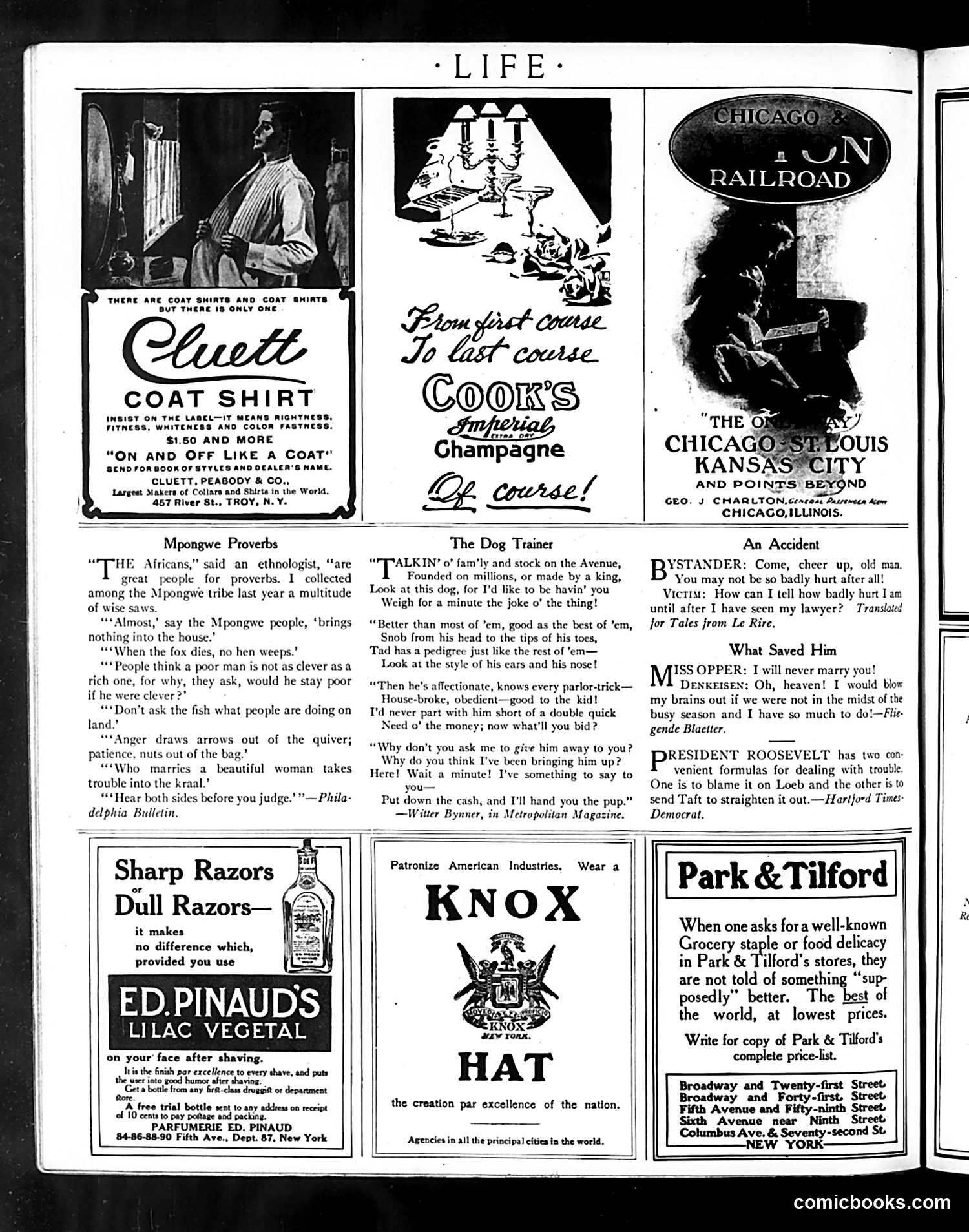
This page is primarily **advertising with satirical content interspersed**—typical of Life magazine's format. The top three ads feature branded products (Cluett coat shirts, Cook's champagne, Chicago & Alton Railroad), while the lower half contains short humorous pieces and additional advertisements. The satirical content includes: - **"Mpongwe Proverbs"**: Presents African wisdom sayings, presented as ethnological curiosities—reflecting early 20th-century attitudes toward non-Western cultures as exotic subjects for educated amusement. - **"The Dog Trainer"**: A dialect poem about selling a pedigreed dog, mocking the pretensions of wealthy Avenue residents obsessed with status symbols and bloodlines. - **Brief jokes** about a lawsuit-conscious accident victim and romantic complications—standard light humor of the era. - **Roosevelt reference**: A political jab suggesting President Roosevelt uses convenient excuses (blaming aide Loeb or sending Taft) to avoid responsibility—typical contemporary political criticism. The page reflects Life's role as a magazine for educated, upper-middle-class readers, mixing consumer advertising with gentle social satire.
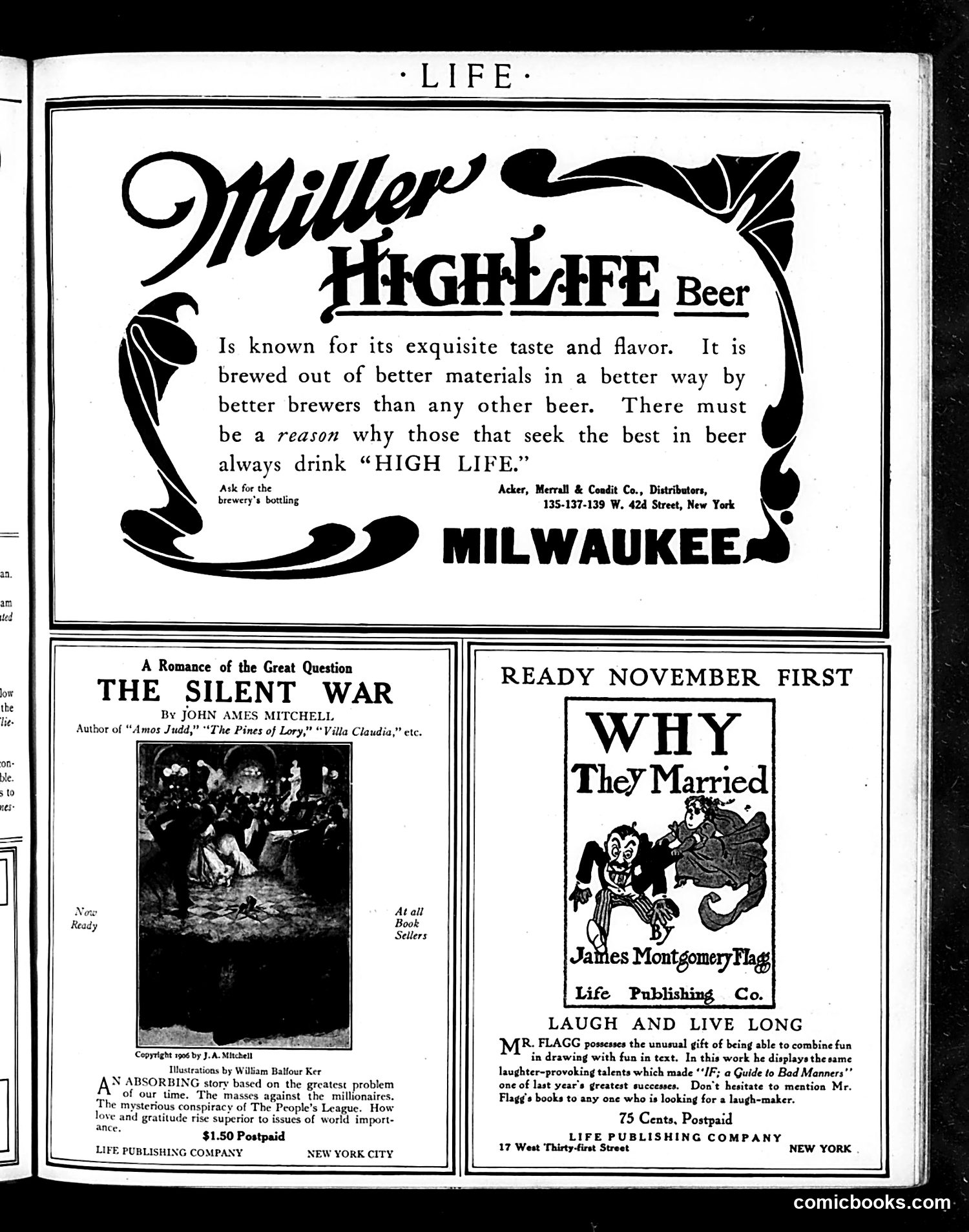
This page consists primarily of **advertisements and book promotions** rather than editorial cartoons. The main content includes: 1. **Miller High Life Beer ad** – A straightforward product advertisement emphasizing quality brewing. 2. **"The Silent War" book promotion** – A novel by John James Mitchell about class conflict ("the masses against the millionaires" and "The People's League conspiracy"). The dramatic illustration suggests a social or political confrontation. This reflects early 1900s anxieties about labor unrest and wealth inequality. 3. **"Why They Married" book ad** – A humorous title by James Montgomery Flagg, promoted as laugh-inducing entertainment for readers seeking "a laugh-maker." The page reflects *Life* magazine's dual role: satirical commentary through its editorial content (not visible here) and commercialized entertainment through ads targeting educated, urban readers interested in both social issues and light comedy.
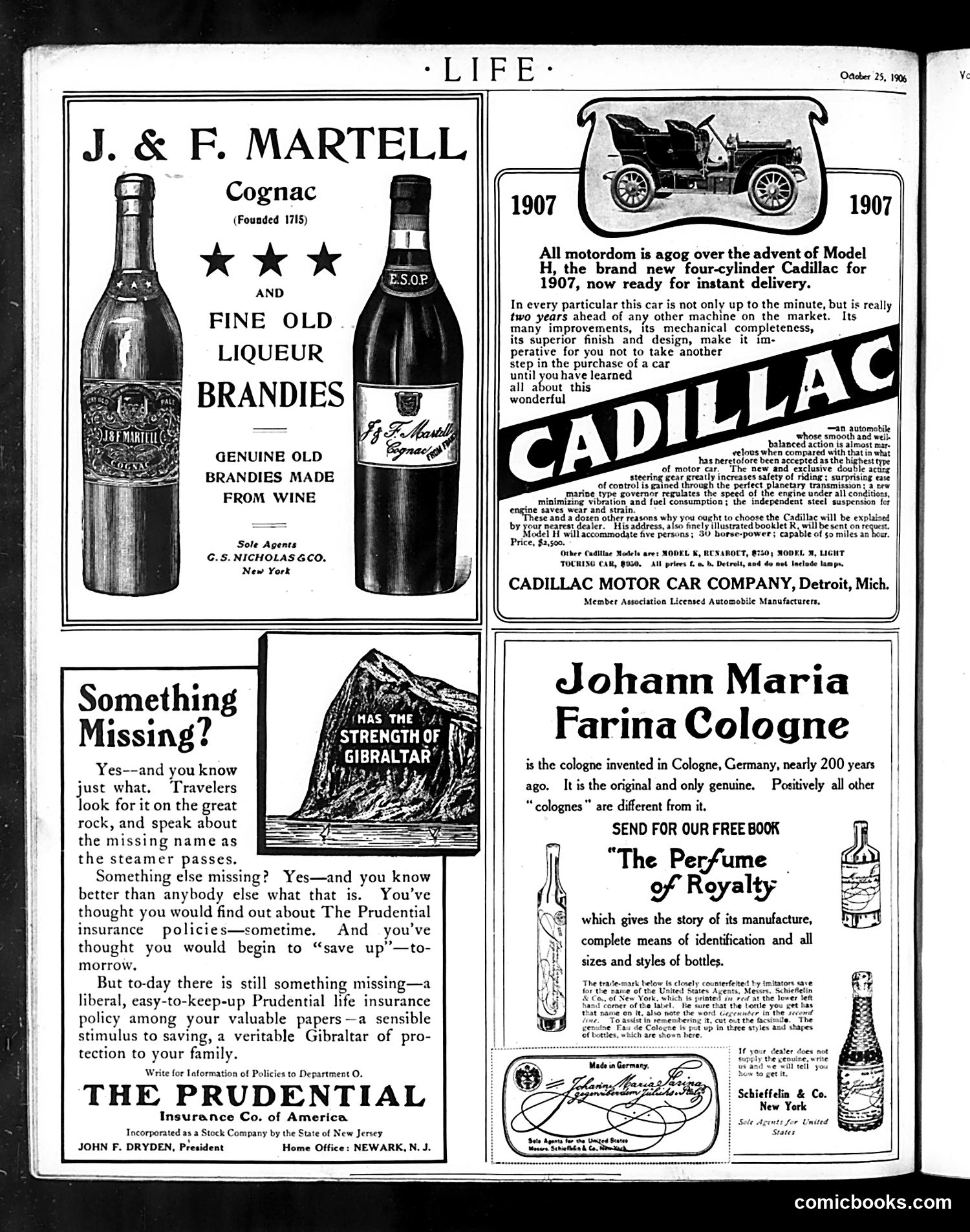
This is primarily an **advertising page** rather than satirical content. It contains four distinct ads from the era: 1. **J. & F. Martell Cognac** — A liquor advertisement emphasizing the brandy's age and quality, typical of luxury goods marketing to wealthy readers. 2. **Cadillac Model H automobile** — A detailed car advertisement touting the 1907 four-cylinder model as "two years ahead" of competitors, priced at $2,500. This reflects the early automotive industry's rapid innovation and the luxury car market's appeal to Life's affluent readership. 3. **Prudential Insurance** — A clever ad using the metaphor of the Rock of Gibraltar (missing from travelers' views) to suggest that readers are missing essential life insurance protection. This plays on common consumer psychology. 4. **Johann Maria Farina Cologne** — An advertisement claiming to be the "original and only genuine" cologne from Cologne, Germany, warning against counterfeits. The page reflects **early 1900s consumer culture**, targeting wealthy American readers with luxury goods and modern financial products.