
Life, 1906-10-25 · page 16 of 24
Life — October 25, 1906 — page 16: what you’re looking at
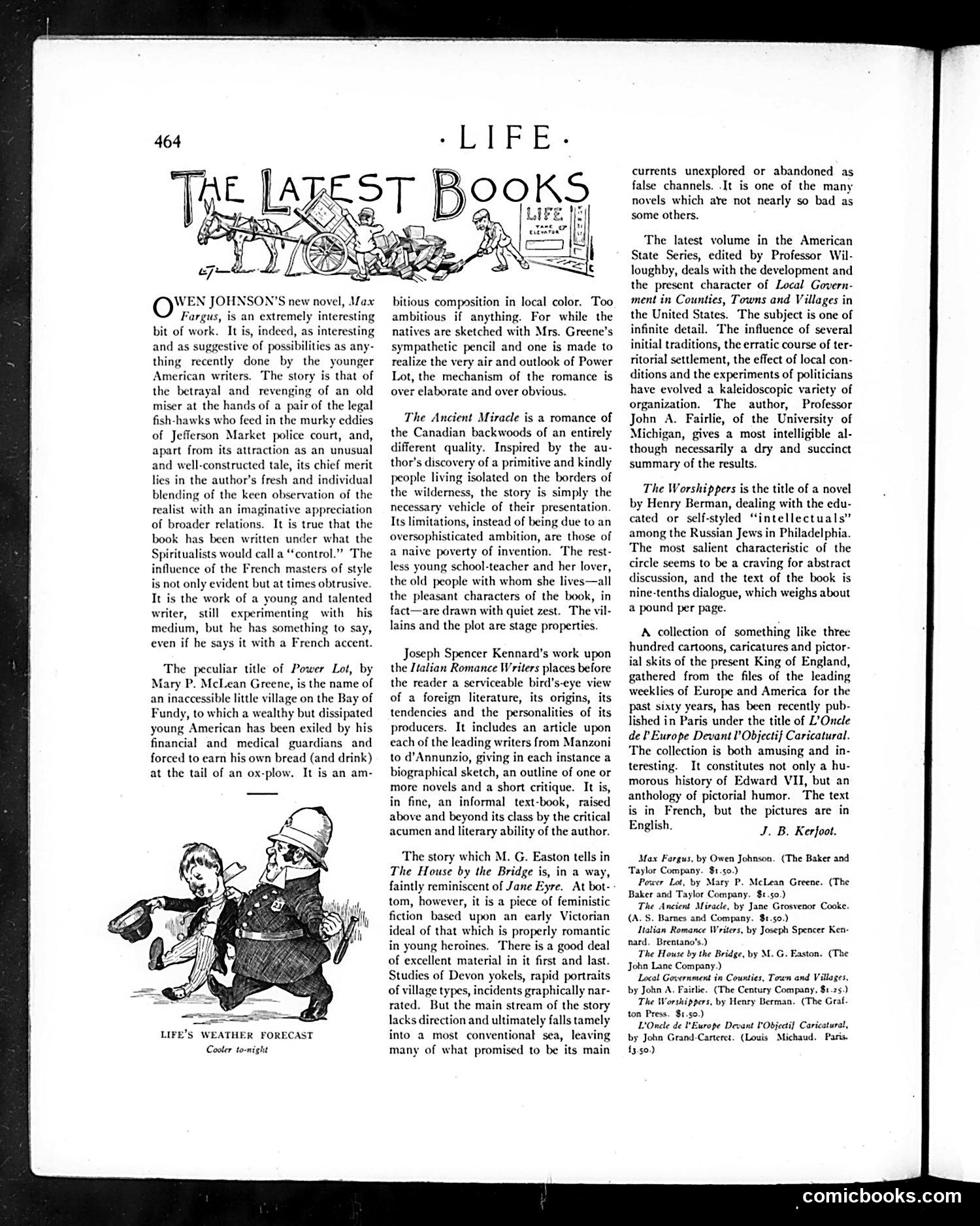
What you’re looking at
The cartoon titled "Life's Weather Forecast" (credited "Colder to-night") depicts two figures dressed in Victorian-era winter clothing caught in bad weather. The illustration appears to be a humorous commentary on unpredictable or deteriorating conditions—both meteorological and possibly social/political. The cartoon uses exaggerated clothing and poses to satirize how people bundle up against harsh elements. Without additional context identifying the specific figures, it likely functions as general social satire about human response to adversity or changing circumstances, which was Life magazine's typical approach. The page itself reviews recently published novels, suggesting this cartoon provides comic relief amid literary criticism. The "weather forecast" metaphor may allude to broader cultural or economic "storms" of the period, though the exact reference remains unclear without additional historical documentation.
📄 Transcribed text from this page (OCR, searchable)
Machine-transcribed from the original scan — historical spelling and the odd misread are preserved.
new novel, | remely inter bit of work. Itis, indeed, as interesting and as suggestive of possibilities as any- thing recently done by the younger American writers. The story is that of the betrayal and revenging of an old miser at the hands of a pair of the legal fish-hawks who feed in the murky eddies. of Jefferson Market police court, and, apart from its attraction as an unusual and well-constructed tale, its chief merit lies in the author’s fresh and individual blending of the keen observation of the realist with an imaginative appreciation of broader relations. It is true that the book has been written under what the Spiritualists would call a “control. influence of the French masters of sty! is not only evident but at times obtrusive. It is the work of a young and talented writer, still experimenting with his medium, but he has something to say, even if he says it with a French accent. The peculiar title of Power Lot, by Mary P. McLean Greene, is the name of an inaccessible little village on the Bay of Fundy, to which a wealthy but dissipated young American has been exiled by his financial and medical guardians and forced to earn his own bread (and drink) at the tail of an ox-plow, It is an am- Pvecrae bitious composition in local color. Too ambitious if anything. For while the natives are sketched with Mrs. Greene’s sympathetic pencil and one is made to realize the very air and outlook of Power Lot, the mechanism of the romance is over elaborate and over obvious. The Ancient Miracle is a romance of the Canadian backwoods of an entirely different quality. Inspired by the au- thor’s discovery of a primitive and kindly people living isolated on the borders of the wilderness, the story is simply the necessary vehicle of their presentation. Its limitations, instead of being due to an oversophis ied ambition, are those of a naive poverty of invention. The rest- less young school-teacher and her lover, the old people with whom she lives—all the pleasant characters of the book, in fact—are drawn with quiet zest. The vil- lains and the plot are stage properties. Joseph Spencer Kennard’s work upon the Italian Romance Writers places before the reader a serviceable bird’s-eye view of a foreign literature, its origins, its tendencies and the personalities of its producers. It includes an article upon each of the leading writers from Manzoni to d’Annunzio, giving in each instance a biographical sketch, an outline of one or more novels and a short critique. It is, in fine, an informal text-book, raised above and beyond its class by the critical acumen and literary ability of the author. The story which M. G. Easton tells in The House by the Bridge is, in a way, faintly reminiscent of Jane Eyre. At bot- tom, however, it is a piece of feministic fiction based upon an early Victorian ideal of that which is properly romantic in young heroines. There is a good deal of excellent material in it first and last. Studies of Devon yokels, rapid portraits of village types, incidents graphically nar- rated. But the main stream of the story lacks direction and ultimately falls tamely into a most conventional sea, leaving many of what promised to be its main currents unexplored or abandoned as false channels. .It is one of the many novels which ate not nearly so bad as some others. The latest volume in the American State Series, edited by Professor Wil- loughby, deals with the development and the present character of Local Govern- ment in Counties, Towns and Villages in the United States. The subject is one of infinite detail. The influence of several initial traditions, the erratic course of ter- ritorial settlement, the effect of local con- ditions and the experiments of politicians have evolved a kaleidoscopic variety of organization, The author, Professor John A. Fairlie, of the University of Michigan, gives a most intelligible al- though necessarily a dry and succinct summary of the results. The Worshippers is the title of a novel by Henry Berman, dealing with the edu- cated or self-styled “intellectuals” among the Russian Jews in Philadelphia. The most salient characteristic of the circle seems to be a craving for abstract discussion, and the text of the book is nine-tenths dialogue, which weighs about a pound per page. A collection of something like three hundred cartoons, caricatures and pictor- ial skits of the present King of England, gathered from the files of the leading weeklies of Europe and America for the past sixty years, has been recently pub- lished in Paris under the title of L’Oncle del’ Europe Devant Objectif Caricatural. The collection is both amusing and in- teresting. It constitutes not only a hu- morous history of Edward VII, but an anthology of pictorial humor. The text is in French, but the pictures are in English. J. B. Kerfoot. Max Fargus, by Owen Johnson. (The Baker and Taylor Company. $1.50.) Power Lot, by Mary P. McLean Greene. (The Baker and Taylor Company. $1.50.) The Ancient Miracle, by Jane Grosvenor Cooke. (A. S. Barnes and Company. $1.50.) Malian Romance Writers, by Joseph Spencer Ken- nard. Brentano's.) The House by the Bridge, by M.G. Easton. (The John Lane Company.) Local Government in Counties, Town and Villages, by John A. Fairlie. (The Century Company, $1.25.) The Worshippers, by Henry Berman. (The Graf. ton Press. $1.50.) L:Oncle de ! Europe Devant 'Objectif Caricatural, by John Grand-Carteret. (Louis Michaud. Paris. 13.50.) _comicbooks.com