
Life, 1906-10-25 · page 14 of 24
Life — October 25, 1906 — page 14: what you’re looking at
What you’re looking at
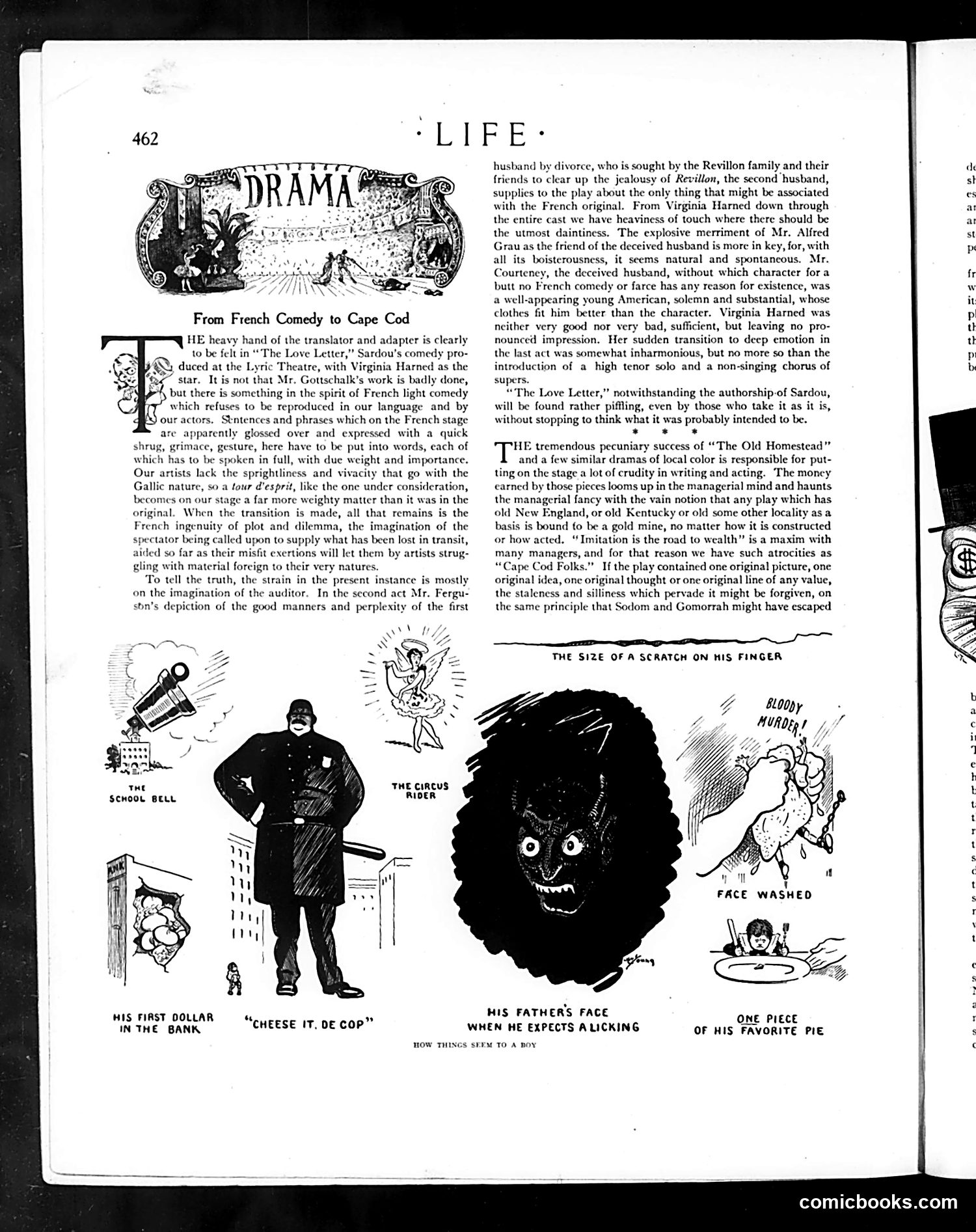
This page critiques two theatrical productions. The upper section reviews "The Love Letter," a French comedy adapted by Gottschalk starring Virginia Harned at the Lyric Theatre. The critic argues that French light comedy loses its essential charm in English translation—the quick wit and physical humor that work on French stages become ponderous when actors must speak every word explicitly. He notes the cast lacks the sprightliness needed; only Alfred Grau's boisterous performance succeeds. The lower section attacks "Cape Cod Folks," a play capitalizing on the success of "The Old Homestead" by exploiting regional settings. The critic condemns managers who assume any play with New England or Kentucky locale automatically succeeds, calling this imitation creatively bankrupt. The comic illustrations at bottom satirize boyish mishaps—a school bell accident, a police encounter, father's angry face, and pie consumption—presumably illustrating the play's content or the magazine's broader commentary on entertainment's lowest common denominators.
📄 Transcribed text from this page (OCR, searchable)
Machine-transcribed from the original scan — historical spelling and the odd misread are preserved.
‘LIFE: From French Comedy to Cape Cod HE heavy hand of the translator and adapter is clearly to be felt in “The Love Letter,” Sardou’s comedy pro- &Q, duced at the Lyric Theatre, with Virginia Harned as the ee star. It is not that Mr. Gottschalk’s work is badly done, 4, but there is something in the spirit of French light comedy which refuses to be reproduced in our language and by our actors, Stntences and phrases which on the French stage apparently glossed over and expressed with a quick shrug, grimace, gesture, here have to be put into words, cach of which has to be spoken in full, with due weight and importance. Our artists lack the sprightliness and vivacity that go with the Gallic nature, so a tour d'esprit, like the one under consideration, becomes on our stage a far more weighty matter than it was in the original. When the transition is made, all that remains is the French ingenuity of plot and dilemma, the imagination of the spectator being called upon to supply what has been lost in transit, aided so far as their misfit exertions will let them by artists strug- gling with material foreign to their very natures. To tell the truth, the strain in the present instance is mostly on the imagination of the auditor. In the second act Mr. Fergu- spn’s depiction of the good manners and perplexity of the first Scwoou BcLL HIS FIRST DOLLAR “ ” INTHE. BANK. CHEESE IT, 0€ COP husband by divorce, who is sought by the Revillon family and their friends to clear up the jealousy of Revillon, the second husband, supplies to the play about the only thing that might be associated with the French original. From Virginia Harned down through the entire cast we have heaviness of touch where there should be the utmost daintiness. The explosive merriment of Mr. Alfred Grauas the friend of the deceived husband is more in key, for, with all its boisterousness, it seems natural and spontancous. Mr. Courteney, the de -d husband, without which character for a butt no French comedy or farce has any reason for existence, was a well-appearing young American, solemn and substantial, whose clothes fit him better than the character. Virginia Harned was. neither very good nor very bad, sufficient, but leaving no pro- nounced impression. Her sudden transition to deep emotion in the last act was somewhat inharmonious, but no more so than the introduction of a high tenor solo and a non-singing chorus of supers. The Love Letter,” notwithstanding the authorship-of Sardou, will be found rather pifiling, even by those who take it as it is, without stopping to think what it was probably intended to be. * * * HE tremendous pecuniary success of ‘The Old Homestead” and a few similar dramas of local color is responsible for put- ting on the stage a lot of crudity in writing and acting. ‘The money earned by those pieces looms up in the managerial mind and haunts the managerial fancy with the vain notion that any play which has old New England, or old Kentucky or old some other locality as a basis is bound fo be a gold mine, no matter how it is constructed or how acted. “Imitation is the road to wealth” is a maxim with many managers, and for that reason we have such atrocities as “Cape Cod Folks.” If the play contained one original picture, one original idea, one original thought or one original line of any value, the staleness and silliness which pervade it might be forgiven, on the same principle that Sodom and Gomorrah might have escaped THE SIZE OF A SCRATCH ON HIS FINGER HIS FATHER'S FACE WHEN HE EXPECTS A LICKING ONE PIECE OF HIS FAVORITE PIE THINGS SEEM TO A nOY comicbooks.com