
Life, 1906-10-25 · page 15 of 24
Life — October 25, 1906 — page 15: what you’re looking at
What you’re looking at
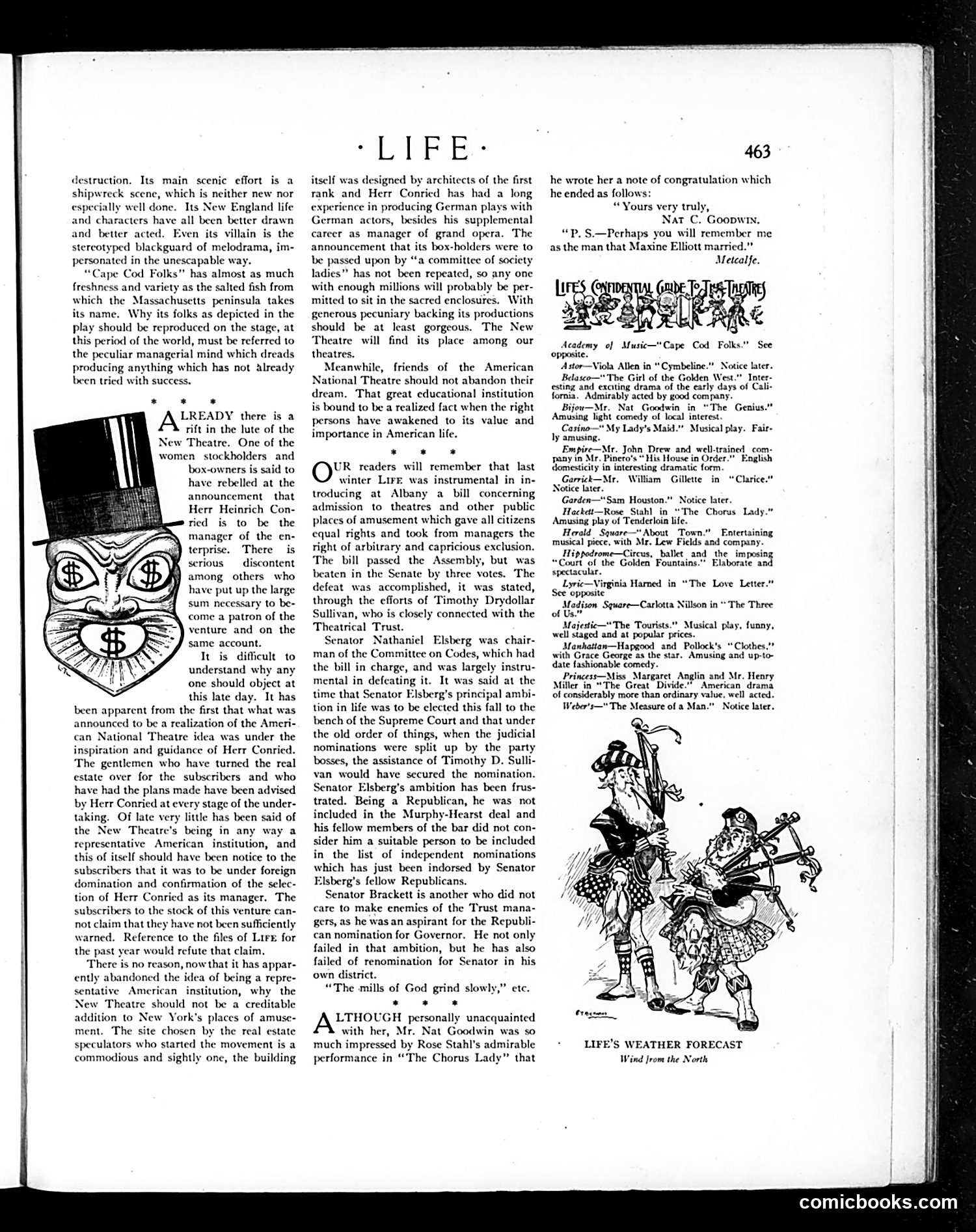
This page discusses the troubled founding of New York's "New Theatre," a venture intended as an American National Theatre but increasingly dominated by **Herr Heinrich Conried**, a German theatrical manager and opera impresario. The satire criticizes wealthy American patrons (including female stockholders) who funded this supposedly patriotic American institution, only to discover it was being controlled by a foreigner. Life mocks their surprise, noting the magazine had warned them repeatedly. The page also references a recent legislative victory: Life had championed a bill guaranteeing equal public access to theaters, eliminating managers' power to exclude citizens arbitrarily. Though it passed the Assembly, it failed in the Senate by three votes—allegedly through interference by **Timothy D. Sullivan**, a politically connected figure involved with theatrical trusts. The underlying complaint: wealthy institutions claiming American identity while operating under foreign control, and powerful interests blocking democratic access reforms.
📄 Transcribed text from this page (OCR, searchable)
Machine-transcribed from the original scan — historical spelling and the odd misread are preserved.
| | | destruction. Its main scenic effort is a shipwreck scene, which is neither new nor especially well done. Its gland life and characters have all been better drawn and better acted. Even its villain is the stereotyped blackguard of melodrama, im- personated in the unescapable way, “Cape Cod Folks" has almost as much freshness and variety as the salted fish from which the Massachusetts peninsula takes its name. Why its folks as depicted in the play should be reproduced on the stage, at this period of the world, must be referred to the peculiar managerial mind which dreads producing anything which has not already been tried with success. * * 6 LREADY there is a rift in the lute of the New Theatre. One of the women stockholders and box-owners is said to have rebelled at the announcement that Herr Heinrich Con- tied is to be the manager of the en- terprise. There is serious discontent among others who have put up the large sum necessary to be- come a patron of the venture and on the same account. It is difficult to understand why any one should object at this late day. It has been apparent from the first that what was announced to be a realization of the Ameri- can National Theatre idea was under the inspiration and guidance of Herr Conried. The gentlemen who have turned the real estate over for the subscribers and who have had the plans made have been advised by Herr Conried at every stage of the under- taking. Of late very little has been said of the New Theatre's being in any way a representative American institution, and this of itself should have been notice to the subscribers that it was to be under foreign domination and confirmation of the selec- tion of Herr Conried as its manager. The subscribers to the stock of this venture can- not claim that they have not been sufficiently warned. Reference to the files of Lire for the past year would refute that claim, ‘There is no reason, now that it has appar- y abandoned the idea of being a repre- sentative American institution, why the New Theatre should not be a creditable addition to New York's places of amuse- ment. The site chosen by the real estate speculators who started the movement is a commodious and sightly one, the building “EMF iE itself was designed by architects of the first rank and Herr Conricd has had a long experience in producing lays with German actors, besides his supplemental career as manager of grand opera. The announcement that its box-holders were to be passed upon by “a committee of society ladies” has not been repeated, so any one with cnough millions will probably be per- mitted to sit in the sacred enclosures. With gencrous pecuniary backing its productions should be at least gorgeous. The New Theatre will find its place among our theatres. Meanwhile, friends of the American ‘tional Theatre should not abandon their dream. That great educational institution is bound to be a realized fact when the right persons have awakened to its value and importance in American life. * 8 * UR readers will remember that last winter Lire was instrumental in in- troducing at Albany a. bill concerning admission to theatres and other public places of amusement which gave all citizens equal rights and took from managers the right of arbitrary and capricious exclusion. The bill passed the Assembly, but was beaten in the Senate by three votes. The defeat was accomplished, it was stated, through the efforts of Timothy Drydollar Sullivan, who is closely connected with the Theatrical Trust. Senator Nathaniel Elsberg was chair- man of the Committee on Codes, which had the bill in charge, and was largely instru- mental in defeating it. It said at the time that Senator Elsberg’s principal ambi- tion in life was to be elected this fall to the bench of the Supreme Court and that under the old order of things, when the judicial nominations were split up by the party bosses, the assistance of Timothy D. Sulli- van would have secured the nomination. Senator Elsberg’s ambition has been frus- trated. Being a Republican, he was not included in the Murphy-Hearst deal and his fellow members of the bar did not con- sider him a suitable person to be included in the list of independent nominations which has just been indorsed by Senator Elsberg’s fellow Republicans. Senator Brackett is another who did not care to make enemics of the Trust mana- gers, as he was an aspirant for the Republi- can nomination for Governor. He not only failed in that ambition, but he has also failed of renomination for Senator in his own district. “The mills of God grind slowly,” etc. * * * LTHOUGH personally unacquainted with her, Mr. Nat Goodwin was so much impressed by Rose Stahl’s admirable performance in “The Chorus Lady” that 463 he wrote her a note of congratulation which he ended as follows: “Yours very truly, Nat C. Goopwin. “P.$.—Perhaps you will remember me as the man that Maxine Elliott married.” Metcalfe. Academy of Music—Cape Cod Folks.” See opposite. Astor—Viola Allen in“ Cymbeline.”” Notice later. Belasco—" The Girl of the Golden West.” Inter- esting and exating drama of the early days of Cali- fornia. Admirably acted by good company. Bijow—Mr. Nat Goodwin in “The Genius.” Amusing light comedy of local interest. Casino—" My Lady's M Musical play. Fair ly amusing. Empire—Mr. John Drew and well-trained, com- pany in Mr. Pinero's " His House in Order.” English domesticity in interesting dramatic form. Garrick—Mr. William Gillette in “Clarice.” Notice later. Garden—"Sam Houston.” Notice later. Hackett—Rose Stahl in “The Chorus Lady.” Amusing play of Tenderloin life. Herald Square—" About Town.” Entertaining musical piece, with Mr. Lew Fields and company. Hippodrome—Circus, ballet_and the imposini “Court of the Golden’ Fountains.” Elaborate ani spectacular. Lyric—Virginia Harned in “The Love Letter." Sce ‘opposite or tadfien Stuare—Carlota Nillson in “The Three Mojestic—" The Tourists." Musical play, funny, well staged and at popular prices. Manhatten—Hapgood and Pollock's “Clothes."’ with Grace George as the star, Amusing and up-to- date fashionable comedy. Princess—Miss_ Margaret. Anglin and Mr. Henry Miller in “The Great Divide.” American’ drama of considerably more than ordinary value, well acted. Weber's—"The Measure of a Man.” Notice later. LIFE’S WEATHER FORECAST Wind Jrom the North Se rT 1 ras _/ comicbooks.com