
Life, 1906-10-25 · page 6 of 24
Life — October 25, 1906 — page 6: what you’re looking at
What you’re looking at
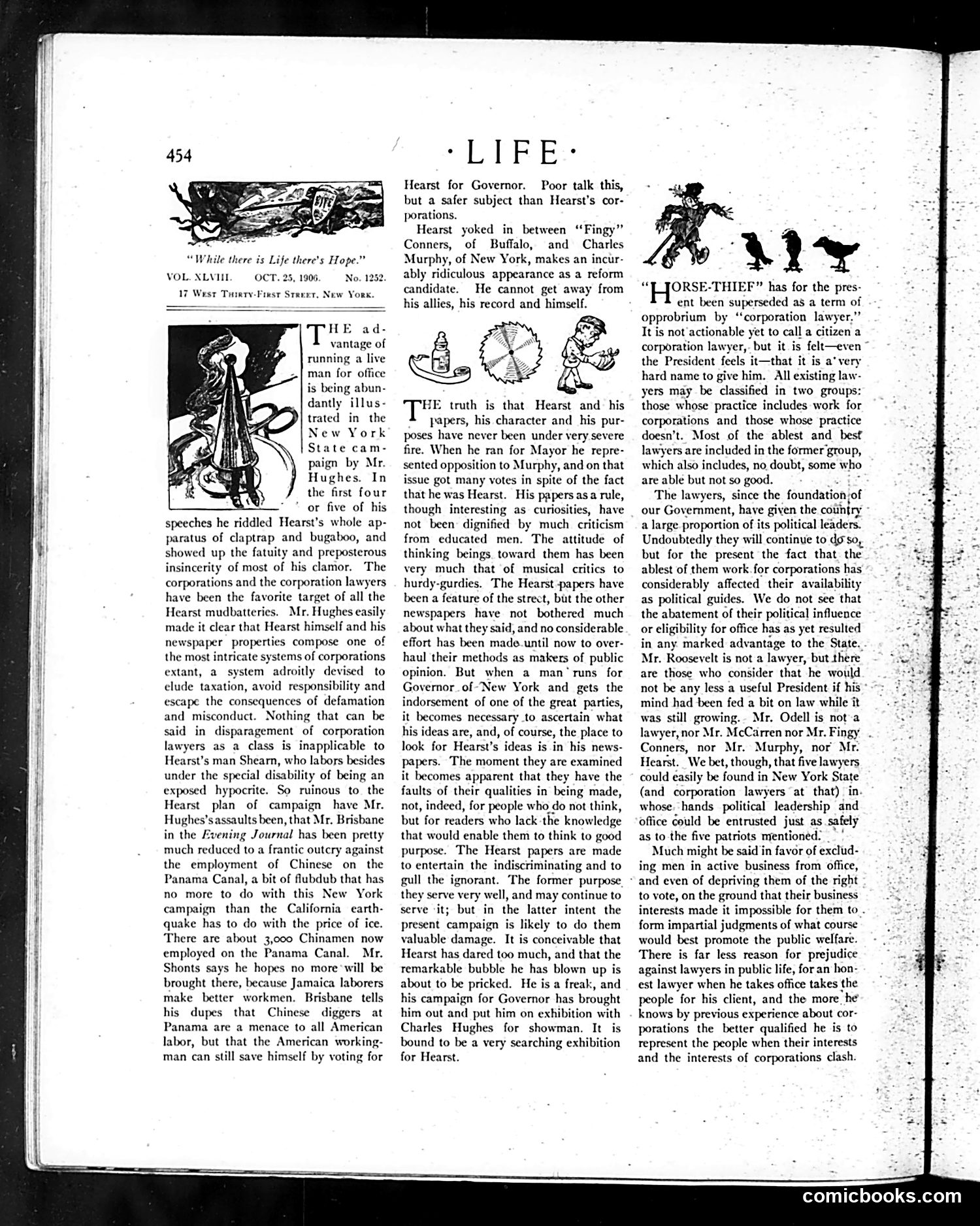
The main cartoon depicts a man running for New York City office, caricatured as a figure being chased or manipulated by corporate interests—symbolized by the mechanical/puppet-like imagery surrounding him. The accompanying article critiques **William Randolph Hearst's** political ambitions and his newspaper empire. Hearst ran for New York Governor in 1906 on a reform platform, but the text sarcastically notes his papers have been "the favorite target of all Hearst multimillionaires." The satire attacks the apparent contradiction: Hearst positions himself as an anti-corruption reformer while his papers have been used for corporate manipulation and attacks on political opponents. The cartoon and text together mock Hearst's credibility as a reform candidate given his papers' history of sensationalism and corporate entanglement.
📄 Transcribed text from this page (OCR, searchable)
Machine-transcribed from the original scan — historical spelling and the odd misread are preserved.
“While there is Life there's Hope.” VOL. XLVI OCT. 25, 1906. No. 1252, 17 West Tuaery-Frest Sterner, New Yor. HE ad- vantage of running a live man for office is being abun- dantly illus- trated in the New York State cam- paign by Mr. Hughes. In the first four * or five of his speeches he riddled Hearst’s whole ap- paratus of claptrap and bugaboo, and showed up the fatuity and preposterous insincerity of most of his clamor. The corporations and the corporation lawyers have been the favorite target of all the Hearst mudbatte! Mr. Hughes easily made it clear that Hearst himself and his newspaper properties compose one of the most intricate systems of corporations extant, a system adroitly devised to clude taxation, avoid responsibility and escape the consequences of defamation and misconduct. Nothing that can be said in disparagement of corporation lawyers as a class is inapplicable to Hearst’s man Shearn, who labors besides under the special disability of being an exposed hypocrite. So ruinous to the Hearst plan of campaign have Mr. Hughes’sassaults been, that Mr. Brisbane in the Evening Journal has been pretty much reduced to a frantic outcry against the employment of Chinese on the Panama Canal, a bit of flubdub that has no more to do with this New York campaign than the California earth- quake has to do with the price of ice. There are about 3,000 Chinamen now employed on the Panama Canal. Mr. Shonts says he hopes no more ‘will be brought there, because Jamaica laborers make better workmen. Brisbane tells his dupes that Chinese diggers at Panama are a menace to all American labor, but that the American working- man can still save himself by voting for LIFE Hearst for Governor. Poor talk this, but a safer subject than Hearst’s cor- porations. Hearst yoked in between “Fingy” Conners, of Buffalo, and Charles Murphy, of New York, makes an incur- ably ridiculous appearance as a reform candidate. He cannot get away from his allies, his record and himself. A) HE truth is that Hearst and his papers, his character and his pur- poses have never been under very severe fire. When he ran for Mayor he repre- sented opposition to Murphy, and on that issue got many votes in spite of the fact that he was Hearst. His papers asa rule, though interesting as curiosities, have not been: dignified by much criticism from educated men. The attitude of thinking beings. toward them has been very much that of musical critics to hurdy-gurdies. The Hearst papers have been a feature of the strect, but the other newspapers have not bothered much about what they said, and no considerable effort has been made-until now to over- haul their methods as makers of public opinion. But when a man‘ runs for Governor of-New York and gets the indorsement of one of the great parties, it becomes necessary to ascertain what his ideas are, and, of course, the place to look for Hearst’s ideas is in his news- papers. The moment they are examined it becomes apparent that they have the faults of their qualities in being made, not, indeed, for people who do not think, but for readers who lack the knowledge that would enable them to think to good purpose. The Hearst papers are made to entertain the indiscriminating and to gull the ignorant. ‘The former purpose. they very well, and may continue to serve ‘it; but in the latter intent the present campaign is likely to do them valuable damage. It is conceivable that Hearst has dared too much, and that the remarkable bubble he has blown up is about to be pricked. He is a freak, and his campaign for Governor has brought him out and put him on exhibition with Charles Hughes for showman. It is bound to be a very searching exhibition for Hearst. ORSE-THIEF” has for the pres- ent been superseded as a term of opprobrium by ‘‘corporation lawyer,”’ Tt is not actionable yet to call a citizen a corporation lawyer, but it is felt—even ~ the President feels it—that it is a‘ very hard name to give him. All existing law- yers may be classified in two groups: those whose practice includes work for corporations and those whose practice doesn’t. Most of the ablest and best lawyers are included in the former group, which also includes, no. doubt, some w! ho are able but not so good. The lawyers, since the foundation; of our Government, have given the country a large proportion of its political leaders. Undoubtedly they will continue to do'so, but for the present the fact that. the ablest of them work. for corporations has considerably affected their availability as political guides. We do not see that the abatement of their political influence or eligibility for office has as yet resulted in any marked advantage to the State. Mr. Roosevelt is not a lawyer, but there are those who consider that he would not be any less a useful President if his mind had been fed a bit on law while it was still growing. Mr. Odell is not a lawyer, nor Mr. McCarren nor Mr. Fingy Conners, nor Mr. Murphy, nor Mr. Hearst. We bet, though, that five lawyers could easily be found in New York State (and corporation lawyers at that) in whose. hands political leadership and office Gould be entrusted just as safely as to the five patriots mentioned? | Much might be said in favor of exclud- ing men in active business from office, ~ and even of depriving them of the right to vote, on the ground that their business interests made it impossible for them to . form impartial judgments of what course would best promote the public welfare. There is far less reason for prejudice against lawyers in public life, for an hon- est lawyer when he takes office takes the people for his client, and the more, he knows by previous experience about cor- porations the better qualified he is to represent the people when their interests and the interests of corporations clash. comicbooks.com