
Life, 1906-10-25 · page 10 of 24
Life — October 25, 1906 — page 10: what you’re looking at
What you’re looking at
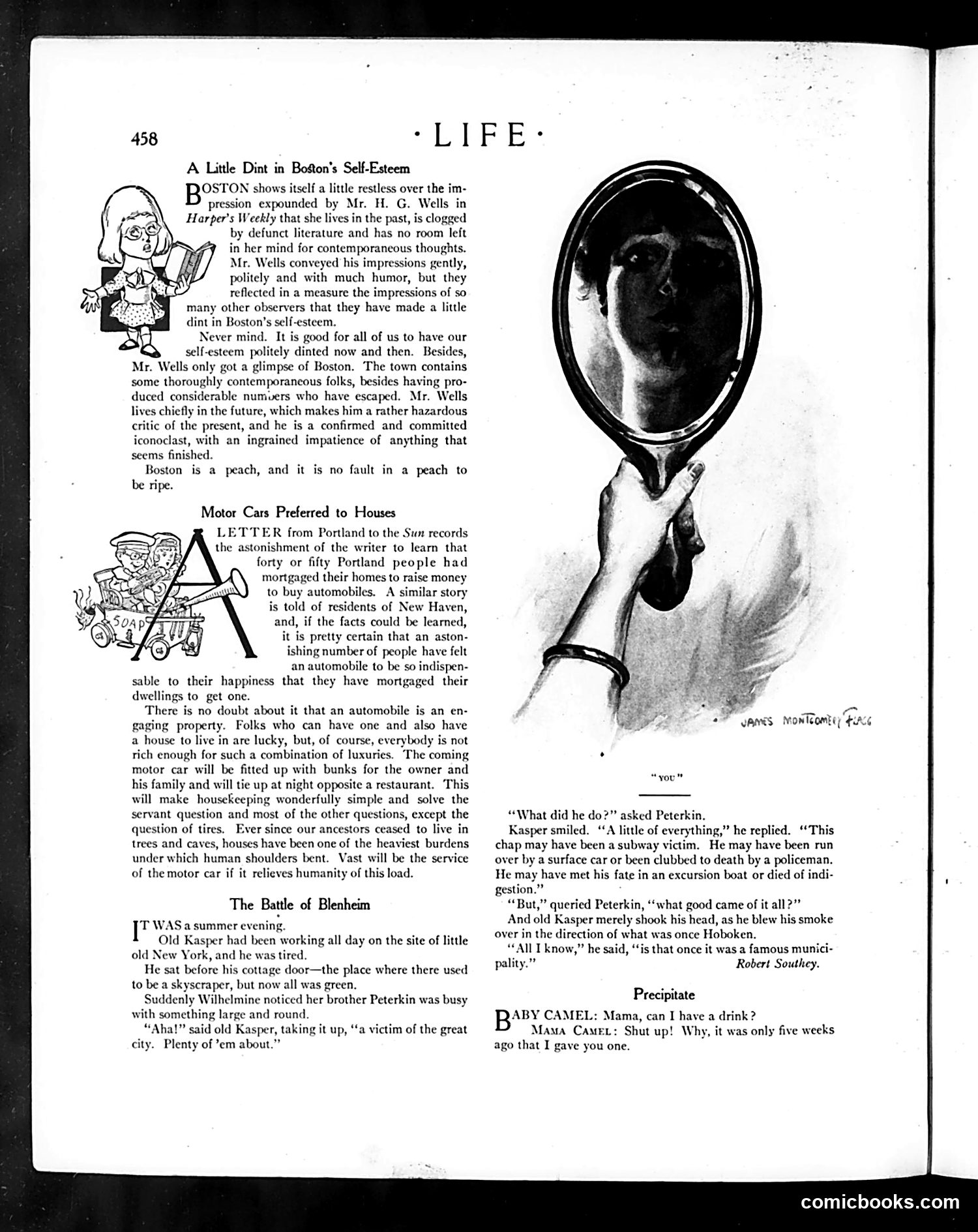
This page contains three separate pieces: 1. **"A Little Dint in Boston's Self-Esteem"** — A brief editorial response to H.G. Wells's criticism of Boston in *Harper's Weekly*, defending the city as containing contemporary thinkers despite Wells's unflattering impressions. 2. **"Motor Cars Preferred to Houses"** — A satirical article mocking the American obsession with automobiles, reporting that residents in Portland and New Haven have mortgaged their homes to buy cars. The accompanying cartoon depicts people choosing automobiles over stable housing—social commentary on misplaced consumer priorities and the emerging car culture. 3. **"The Battle of Blenheim"** and **"Precipitate"** — Short humorous dialogues featuring literary references and domestic comedy, unrelated to political content. The page primarily satirizes early 20th-century American materialism and automobile mania.
📄 Transcribed text from this page (OCR, searchable)
Machine-transcribed from the original scan — historical spelling and the odd misread are preserved.
2 LIFE A Little Dint in Boston's Self-Esteem OSTON shows itself a little restless over the im- pression expounded by Mr. H. G. Wells in Harper's Weekly that she lives in the past, is clogged by defunct literature and has no room left in her mind for contemporaneous thoughts. Mr. Wells conveyed his impressions gently, politely and with much humor, but they reflected in a measure the impressions of so many other observers that they have made a little dint in Boston’s self-esteem. Never mind. It is good for all of us to have our self-esteem politely dinted now and then. Besides, Mr. Wells only got a glimpse of Boston. The town contains some thoroughly contemporancous folks, besides having pro- duced considerable numvers who have escaped. Mr. Wells lives chiefly in the future, which makes him a rather hazardous critic of the present, and he is a confirmed and committed iconoclast, with an ingrained impatience of anything that seems finished. Boston is a peach, and it is no fault in a peach to be ripe. Motor Cars Preferred to Houses LETTER from Portland to the Sun records the astonishment of the writer to learn that forty or fifty Portland people had mortgaged their homes to raise money to buy automobiles. A similar story is told of residents of New Haven, and, if the facts could be learned, it is pretty certain that an aston- ishing number of people have felt an automobile to be so indispen- sable to their happiness that they have mortgaged their dwellings to get one. There is no doubt about it that an automobile is an en- gaging property. Folks who can have one and also have a house to live in are lucky, but, of course, everybody is not rich enough for such a combination of luxuries. The coming motor car will be fitted up with bunks for the owner and his family and will tie up at night opposite a restaurant. This will make housekeeping wonderfully simple and solve the servant question and most of the other questions, except the question of tires. Ever since our ancestors ed to live in trees and caves, houses have been one of the heaviest burdens under which human shoulders bent. Vast will be the service of the motor car if it relieves humanity of this load. The Battle of Blenheim T WAS a summer evening. Old Kasper had been working all day on the site of litle old New York, and he was tired. He sat before his cottage door—the place where there used to be a skyscraper, but now all was green. Suddenly Wilhelmine noticed her brother Peterkin was busy with something large and round. “Aha!” said old Kasper, taking it up, ‘a victim of the great city. Plenty of ’em about.” “you" “What did he do?” asked Peterkin. Kasper smiled. ‘A little of everything,” he replied. “This chap may have been a subway victim. He may have been run over by a surface car or been clubbed to death by a policeman. He may have met his fate in an excursion boat or died of indi- gestion.” “But,” queried Peterkin, “what good came of it all?” And old Kasper merely shook his head, as he blew his smoke over in the direction of what was once Hoboken. “All [know,” he said, ‘‘is that once it was a famous munici- pality.” Robert Southey. Precipitate BYY CAMEL: Mama, can I have a drink? Masa Case: Shut up! Why, it was only five weeks ago that I gave you one. comicbooks.com