
A complete issue · 24 pages · 1906
Life — September 13, 1906
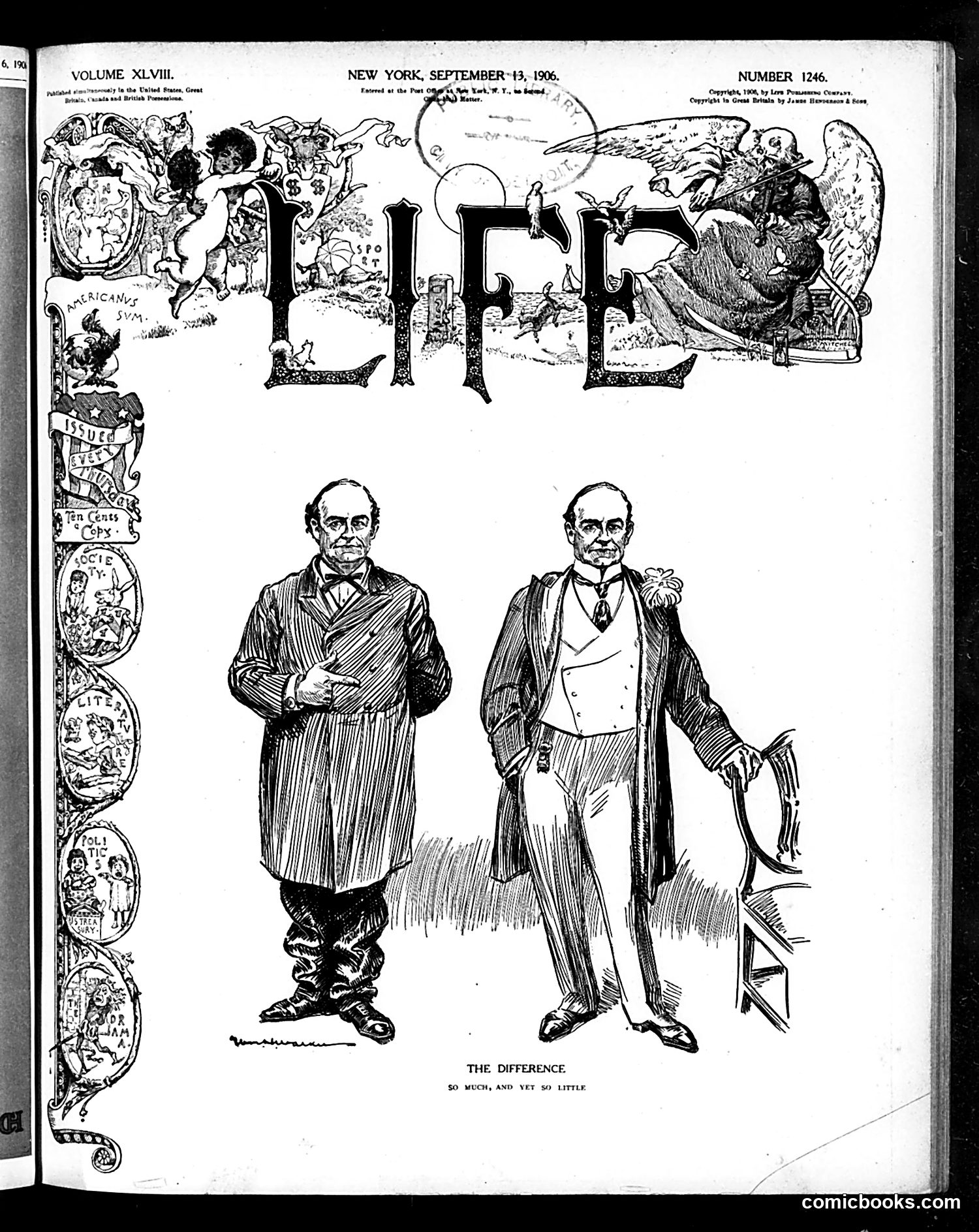
This satirical cartoon titled "The Difference: So Much, and Yet So Little" presents two gentlemen in formal dress standing side by side. The image appears to be political commentary contrasting two prominent figures of the era, likely from the Roosevelt administration or contemporary politics, though the specific identities are unclear from the image alone. The caption's paradoxical phrase—"so much, and yet so little"—suggests the cartoon mocks how these two men appear superficially different (their contrasting postures and dress styles) while actually being substantively similar in political position or ideology. The ornate decorative border and elaborate masthead design are characteristic of Life's high-quality satirical presentation during the Progressive Era.
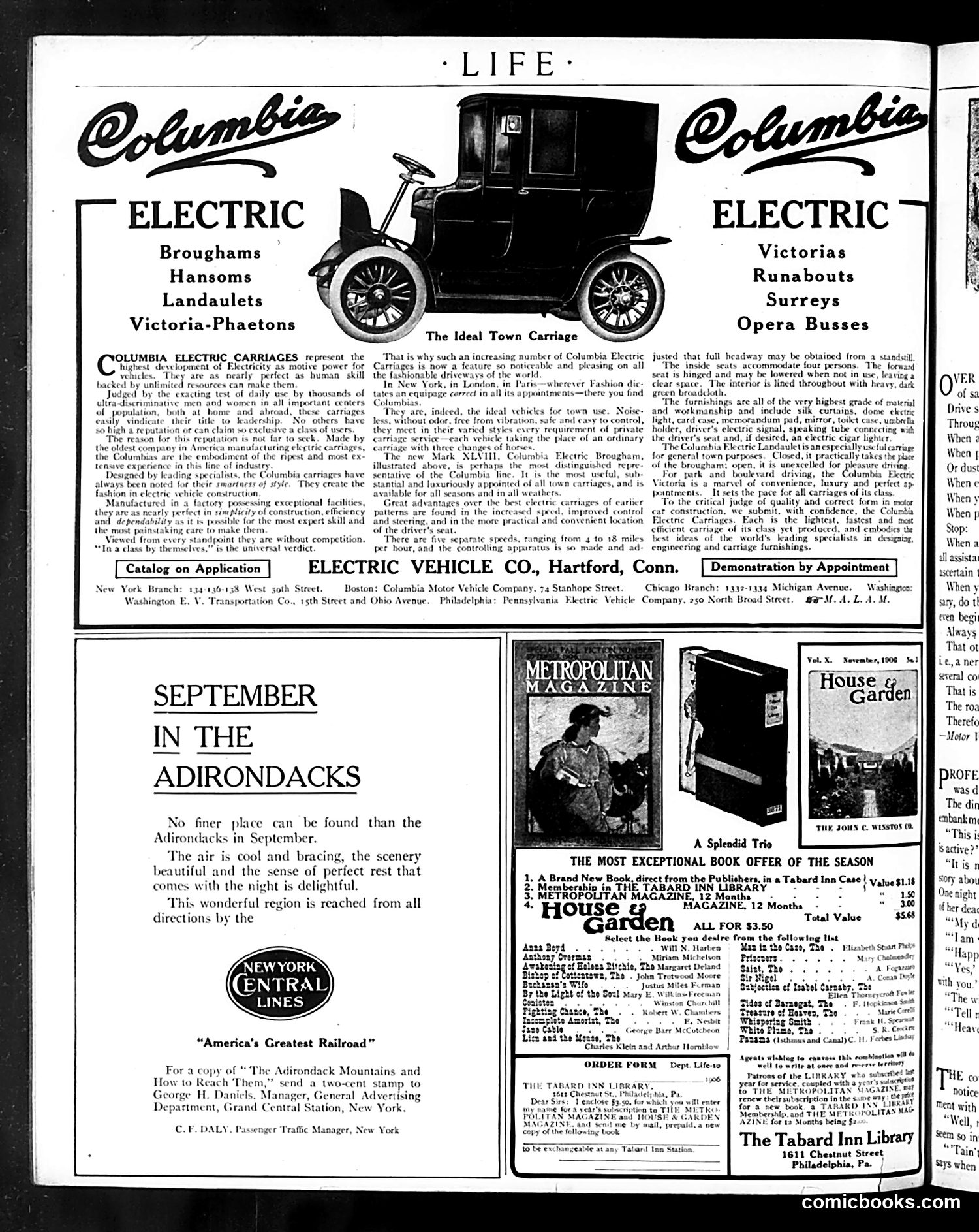
This page is primarily **advertising and promotional content**, not satire or political cartoons. The top half features a Columbia Electric Vehicles advertisement showcasing various electric carriage models (Broughams, Hansoms, Victorias, etc.). The text emphasizes reliability, style, and the vehicle's suitability for town use. Below are travel and consumer promotions: a New York Central Railroad advertisement for Adirondacks tourism, and a "Splendid Trio" book/magazine offer from the Tabard Inn Library featuring Metropolitan Magazine, a brand-new book, and House & Garden magazine. The page reflects early 1900s consumer culture—promoting emerging electric vehicle technology alongside leisure travel and reading material. There is no political satire or cartoon commentary present.
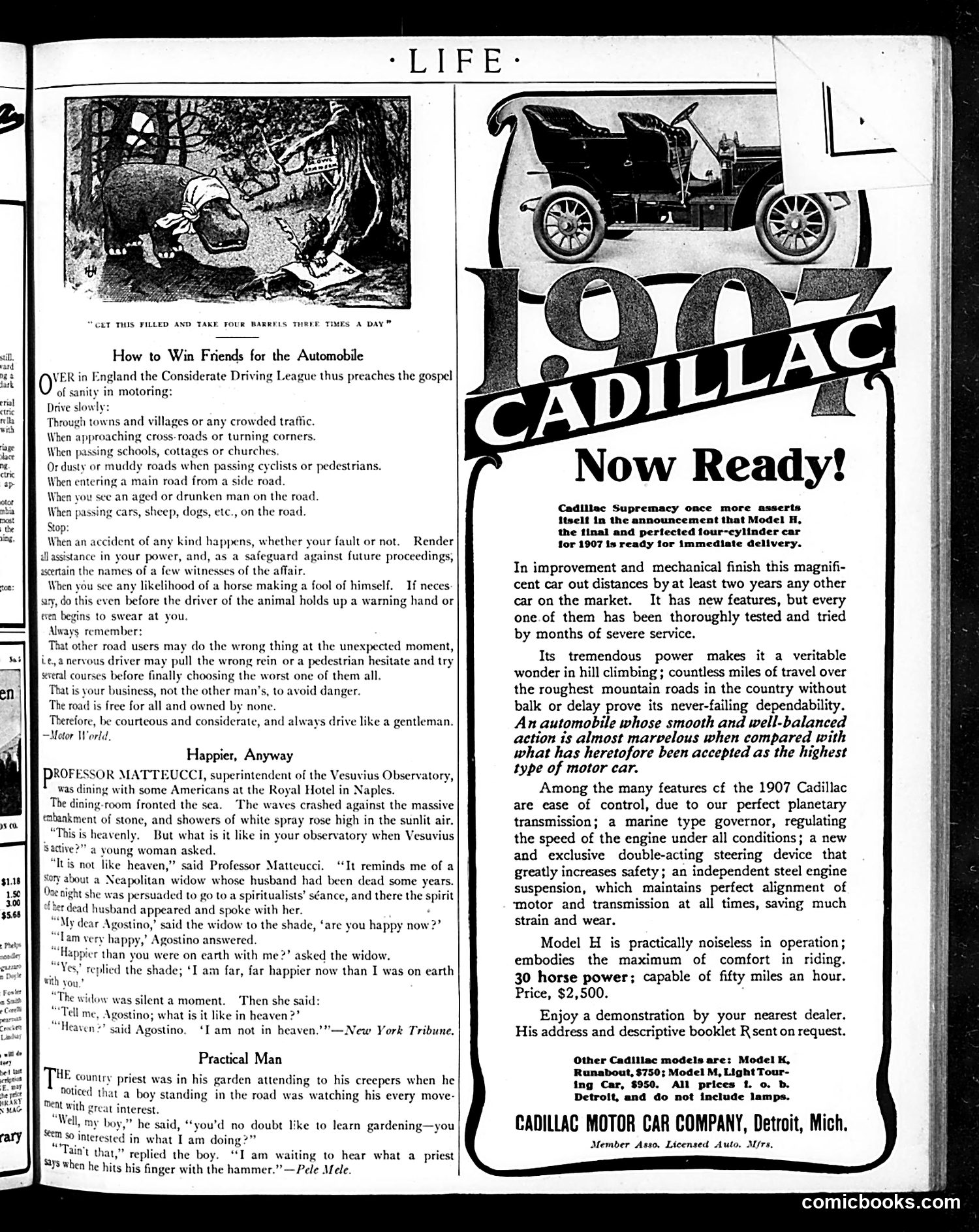
This magazine page contains primarily **advertising and advice columns rather than political satire**. **Left side:** "How to Win Friends for the Automobile" presents safe-driving guidelines from England's Considerate Driving League, followed by humorous anecdotes about a professor and a country priest—lighthearted social commentary unrelated to politics. **Right side:** A full-page **Cadillac advertisement** for the 1907 Model H, emphasizing its power, reliability, and smooth operation. It highlights 30 horsepower, 50 mph capability, and mechanical innovations like planetary transmission and marine-type governor. The page reflects early 1900s American consumer culture and automotive enthusiasm, with no evident political commentary or satire. The tone is promotional and gently comedic rather than satirical.
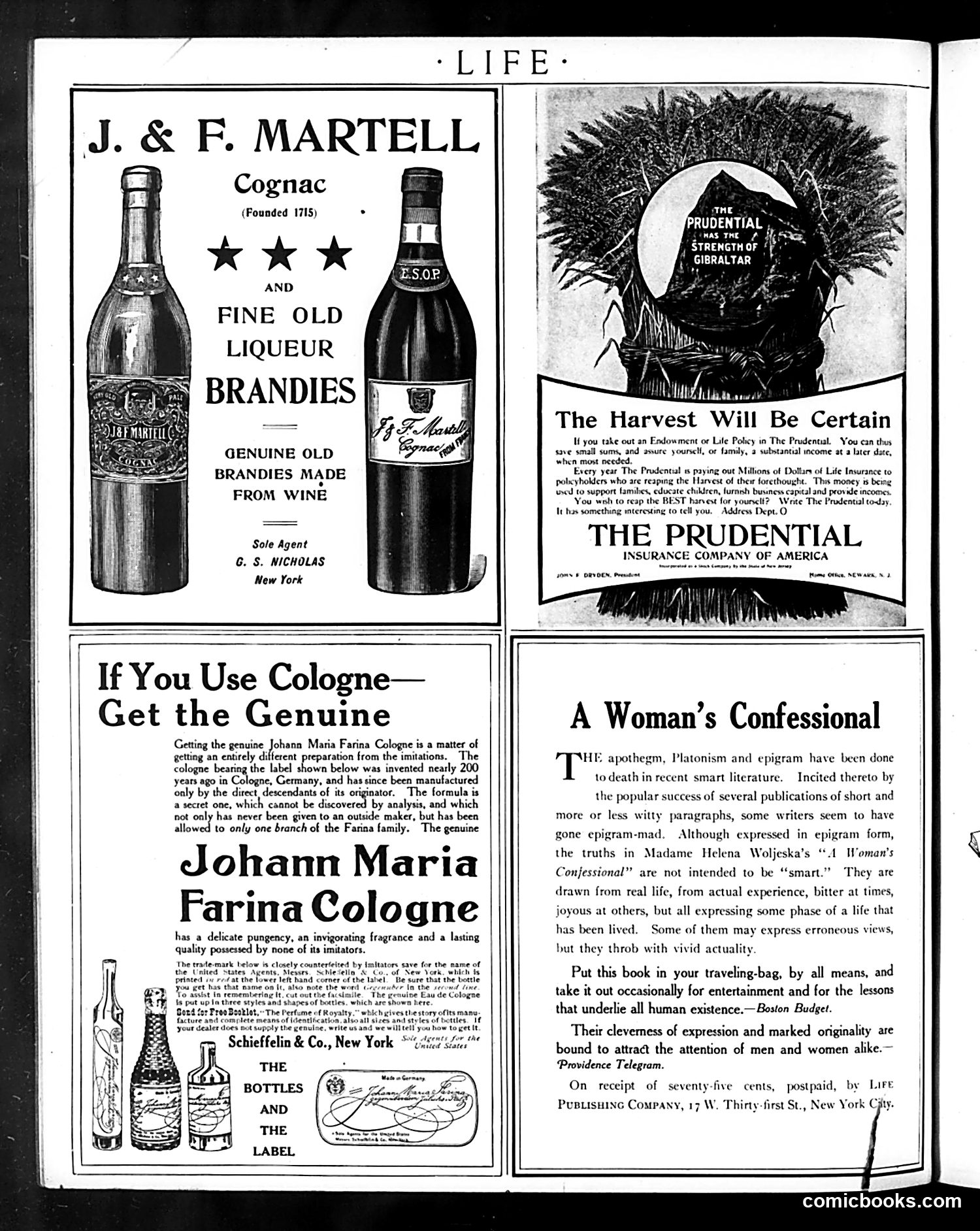
This page is **primarily advertising** with minimal satirical content. The ads include: - **J. & F. Martell Cognac** (founded 1715): promoting brandies, with sole agent G.S. Nicholas in New York - **Johann Maria Farina Cologne**: emphasizing authenticity against imitations, noting the formula is a "closely guarded secret" by the Farina family - **The Prudential Insurance Company**: a harvest-themed ad about financial security - **"A Woman's Confessional"**: a book review discussing witty literary epigrams by Madame Helena Woljeskaja The Prudential ad uses agricultural imagery (wheat sheaf) to suggest reliable growth and harvest—a common metaphor for insurance returns. The cologne ad emphasizes brand authenticity during an era of widespread counterfeiting. These are straightforward commercial messages rather than political satire.
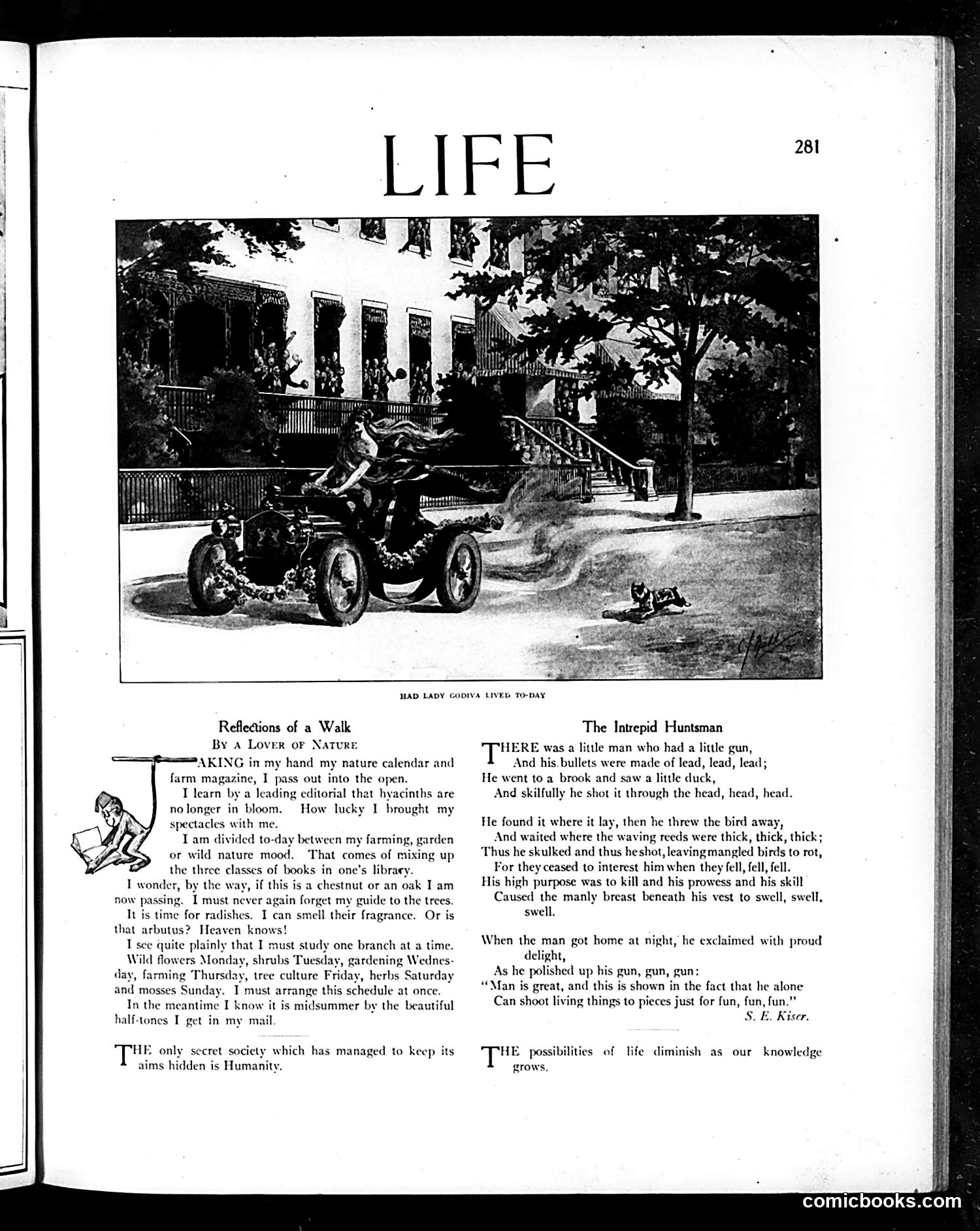
The page contains three distinct pieces of content: 1. **Top photograph**: Captioned "Had Lady Goings Lived To-Day," showing an early automobile on an estate grounds. This appears to be a nostalgic or humorous commentary on how historical figures might interact with modern technology. 2. **"Reflections of a Walk"**: A personal essay about seasonal nature study and reading, with an illustration of a contemplative figure. This is straightforward literary content, not satirical. 3. **"The Intrepid Huntsman"**: A humorous poem about a man shooting a duck, mocking his prideful boasting about killing wildlife. The satire targets masculine vanity and the triviality of shooting birds for sport. The page combines light humor with nature writing, typical of Life's eclectic editorial approach.
This page discusses William Jennings Bryan's political positions, particularly his stance on trusts and railroads. The cartoons satirize Bryan's proposed remedies for monopolies. The central cartoon depicts Bryan as a figure attempting to "gobble up" or control trusts and railroads through Federal ownership—a radical Progressive-era proposal. The satire suggests Bryan's solutions are crude or ineffective. The text criticizes Bryan's trust-busting platform as impractical, arguing his methods lack the sophistication of actual trust regulation. References to "Brother Bill" and detailed discussion of railroad ownership indicate this addresses Bryan's 1908 presidential candidacy and Democratic platform. The overall tone mocks Bryan's reformist ambitions as populist theater rather than serious policy—a common Life magazine critique of him during his multiple presidential campaigns.
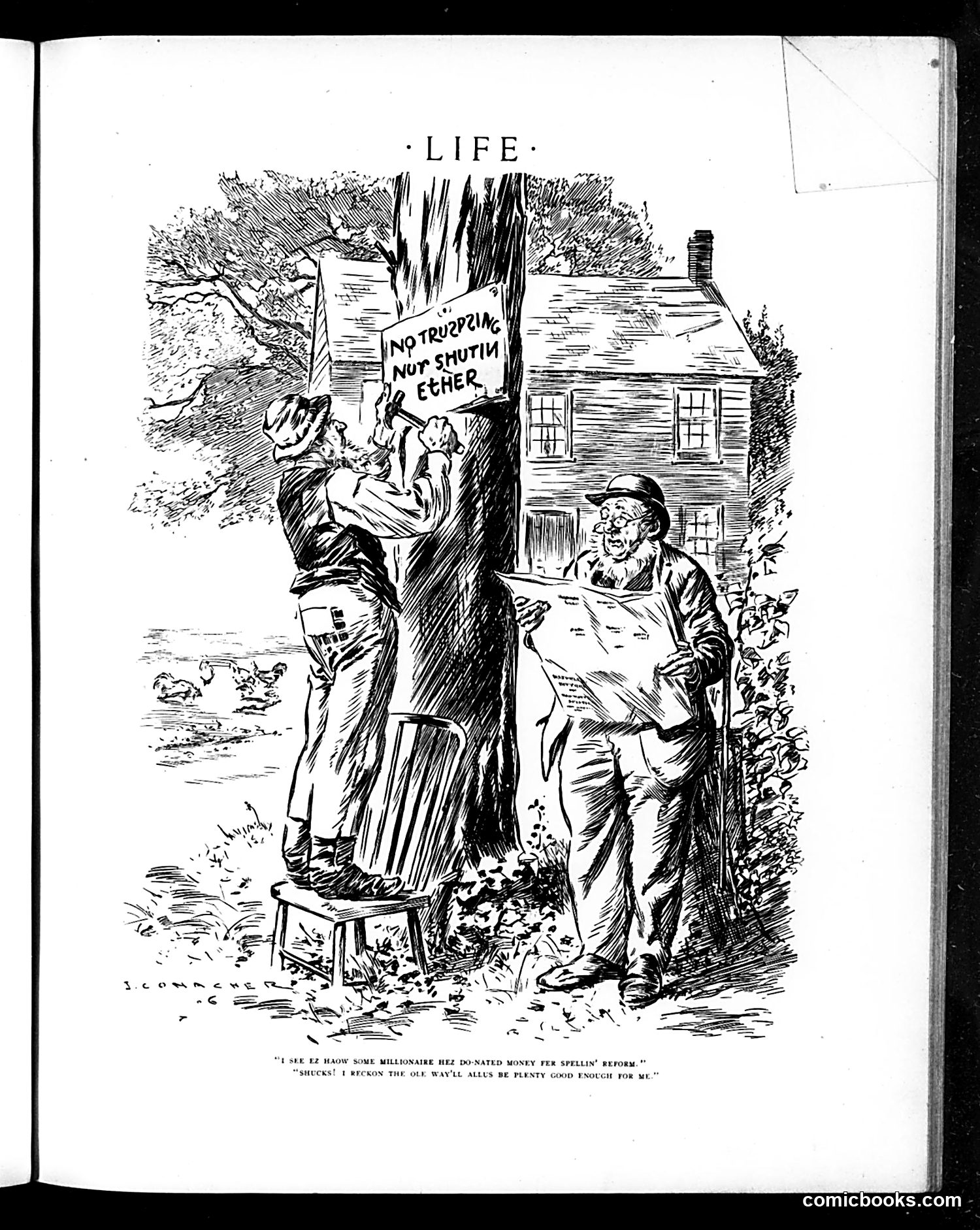
This Life magazine cartoon satirizes **wealth inequality and monopolistic practices** during the Gilded Age. A wealthy man (likely representing a railroad or industrial magnate) posts a sign on a tree reading "NO TRESPASSING NOR SHUTTIN EITHER," asserting control over public/natural resources. An older man with a cane appears to confront him, while a house sits in the background. The caption references "some millionaire" who "donated money fer spellin' reform" yet "reckons the ole wuther alles be plenty good enough for us"—mocking the hypocrisy of wealthy industrialists who funded cultural institutions while ruthlessly exploiting workers and appropriating public lands. The cartoon critiques how the ultra-rich used philanthropy for reputation-building while maintaining exploitative business practices.
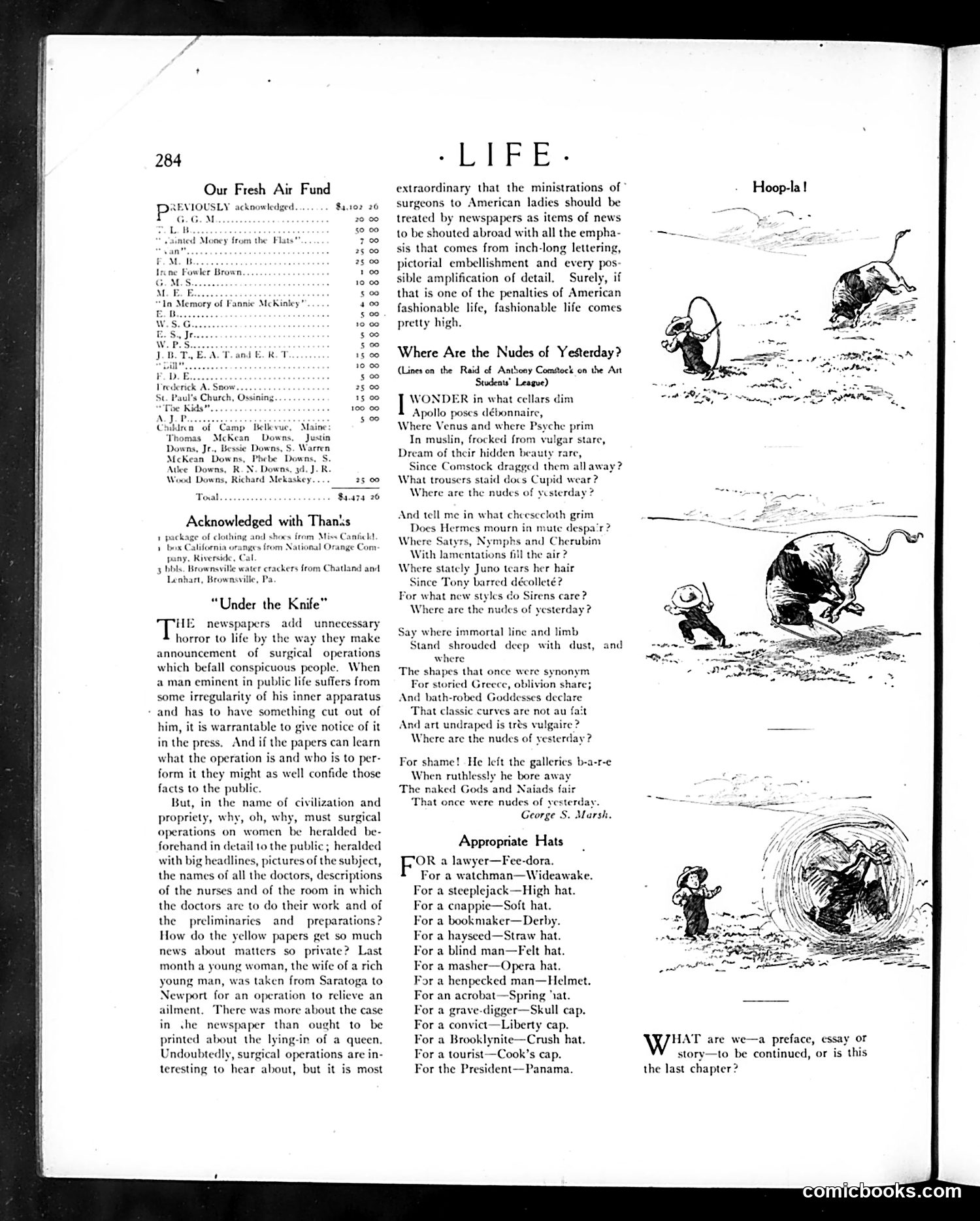
This page contains three distinct sections: **"Under the Knife"** critiques sensationalist newspaper coverage of surgery. The author argues that newspapers unnecessarily publicize surgical operations with lurid headlines and graphic details about doctors and nurses, treating private medical procedures as entertainment. The piece advocates for discretion and propriety in reporting healthcare matters. **"Where Are the Nudes of Yesterday?"** is a poem by George S. Marsh referencing classical and mythological nude figures (Venus, Psyche, Satyrs, Nymphs) and lamenting their disappearance from art, suggesting modern prudishness has replaced classical artistic traditions. **"Appropriate Hats"** is a humorous list matching occupations to hat styles (lawyer gets "Fee-dora," convict gets "Liberty cap"), a simple comedic format. The illustrations show figures in outdoor/working-class settings.
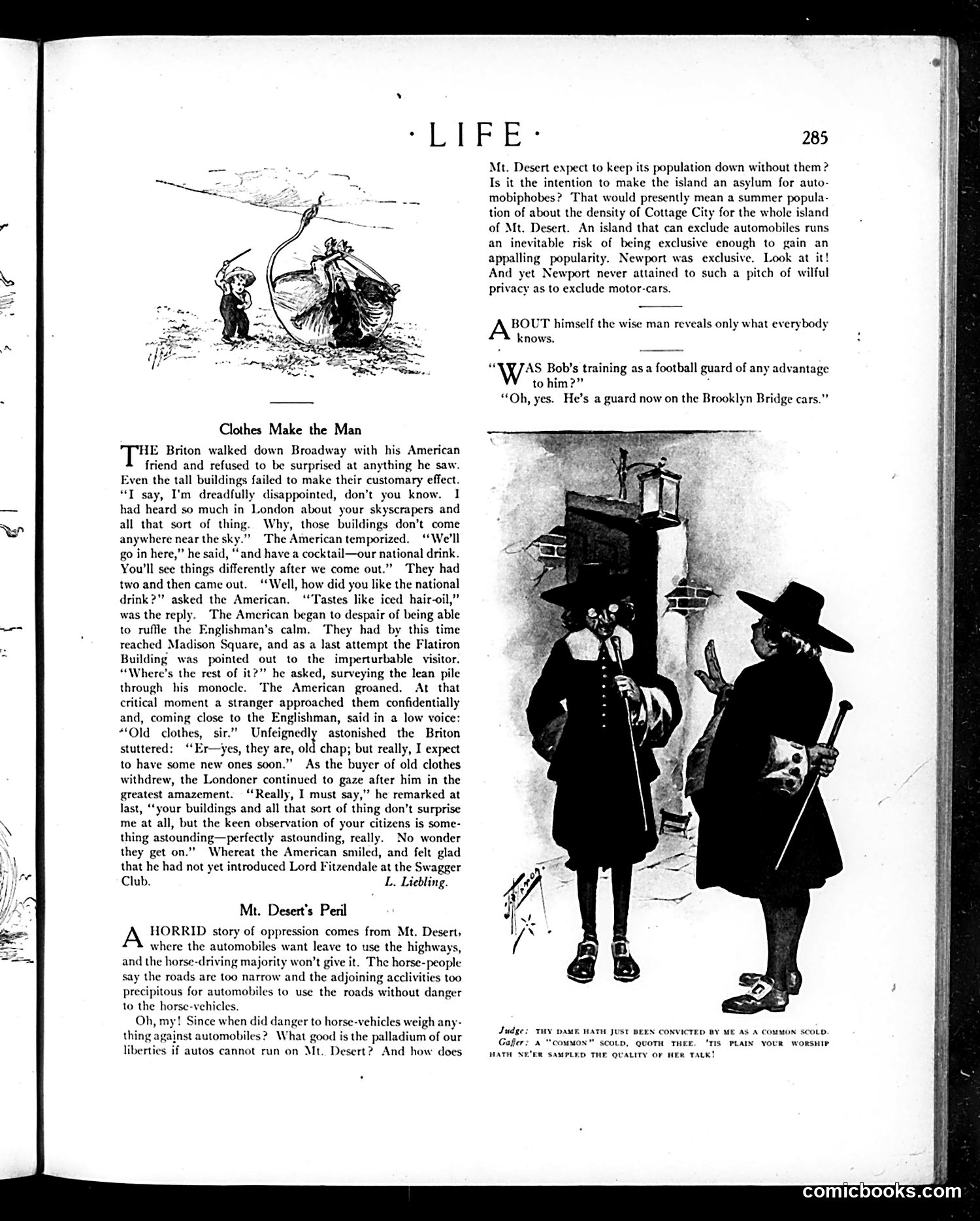
This page contains three satirical pieces satirizing American social pretensions and class anxieties circa early 20th century. **"Clothes Make the Man"** mocks an American's defensive boasting about skyscrapers to an unimpressed British visitor. The joke: the American compensates for inferiority about culture by touting commercial buildings, revealing shallow nationalism. **The illustration** shows a judge and "common scold"—a dated legal term for a woman publicly punished for gossiping. The satire appears to mock old-fashioned legal categories. **"Mt. Desert's Peril"** satirizes wealthy Mt. Desert residents' fear that automobiles threaten their exclusive retreat. The irony: they want exclusivity while preventing the "lower classes" from accessing the roads—exposing class-based hypocrisy about liberty and access. All three pieces critique American social pretension and class anxiety.
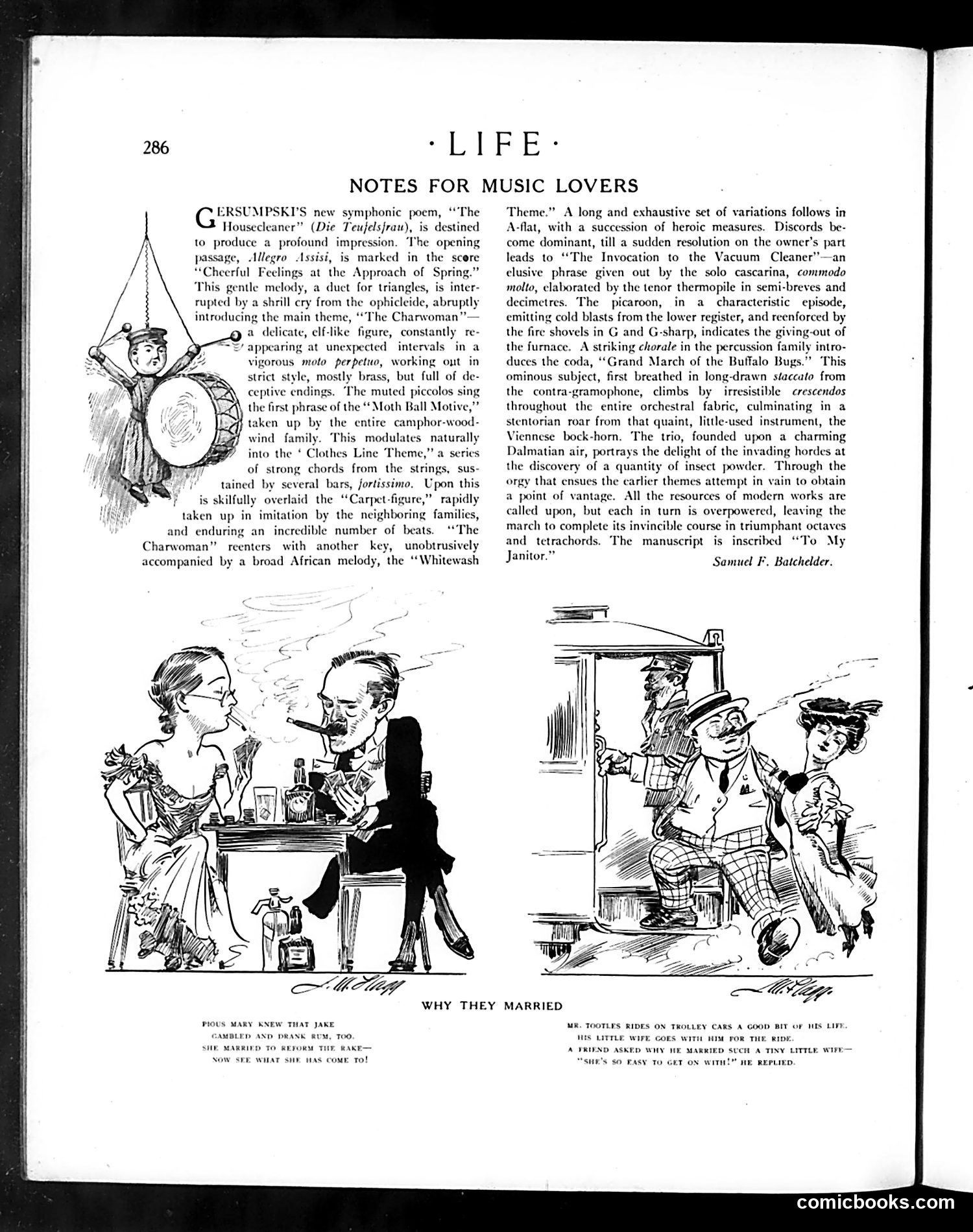
This page contains two separate elements: **Upper section**: A music review of Gershwin's symphonic poem "The Housekeeper" (*Die Teujelsjtran*), detailing its musical themes and structure. The review is credited to Samuel F. Batchelder. **Lower section**: Two cartoon panels titled "Why They Married," signed by the artist Cesare. The cartoons present satirical takes on marriage motivations: - **Left panel**: A couple at a table; the caption explains she married him because he "married to secure the rake—now she rules him with a crook!" - **Right panel**: Shows a man on trolley cars with his wife; the joke involves him riding trolleys as "a good bit of his life," with his wife easily joining for the ride. These cartoons mock marriage dynamics and gender relations through humor about control, compatibility, and daily routines.
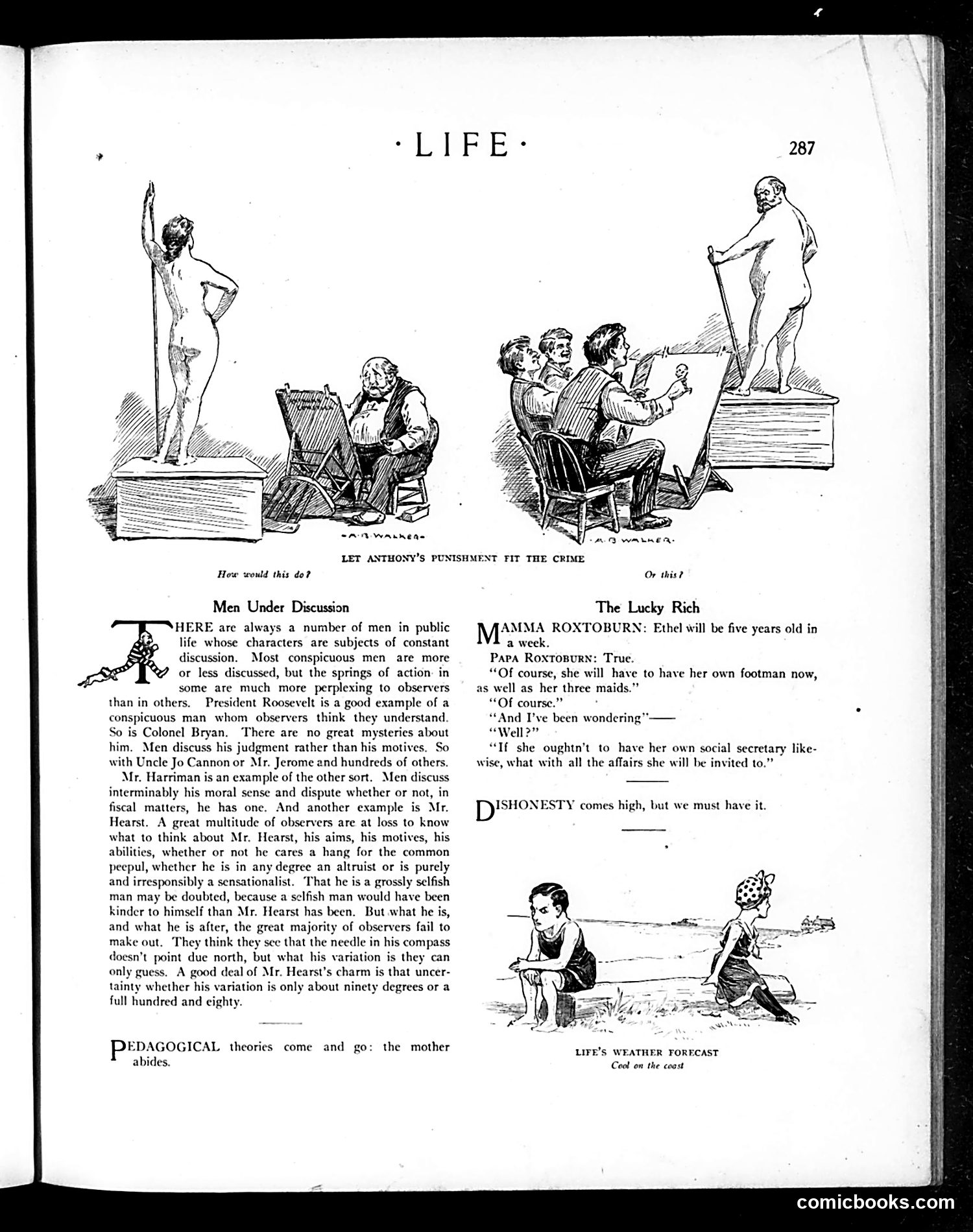
**Top cartoon**: "Let Anthony's Punishment Fit the Crime" depicts nude female models posing for art classes while clothed male observers debate whether this arrangement is appropriate. The satire concerns early 20th-century anxieties about life-drawing classes and moral propriety—specifically whether viewing nude models constituted indecency. **Text sections**: - "Men Under Discussion" discusses public figures like President Roosevelt and Colonel Bryan whose character and motives are constantly debated by observers. - "The Lucky Rich" presents dialogue about a wealthy family's daughter requiring servants and social secretaries. **Bottom cartoon**: "Life's Weather Forecast—Cool on the Coast" shows children at a beach, a lighthearted filler illustration. The page satirizes both moral squeamishness about artistic practice and society's obsession with scrutinizing public figures' private character.
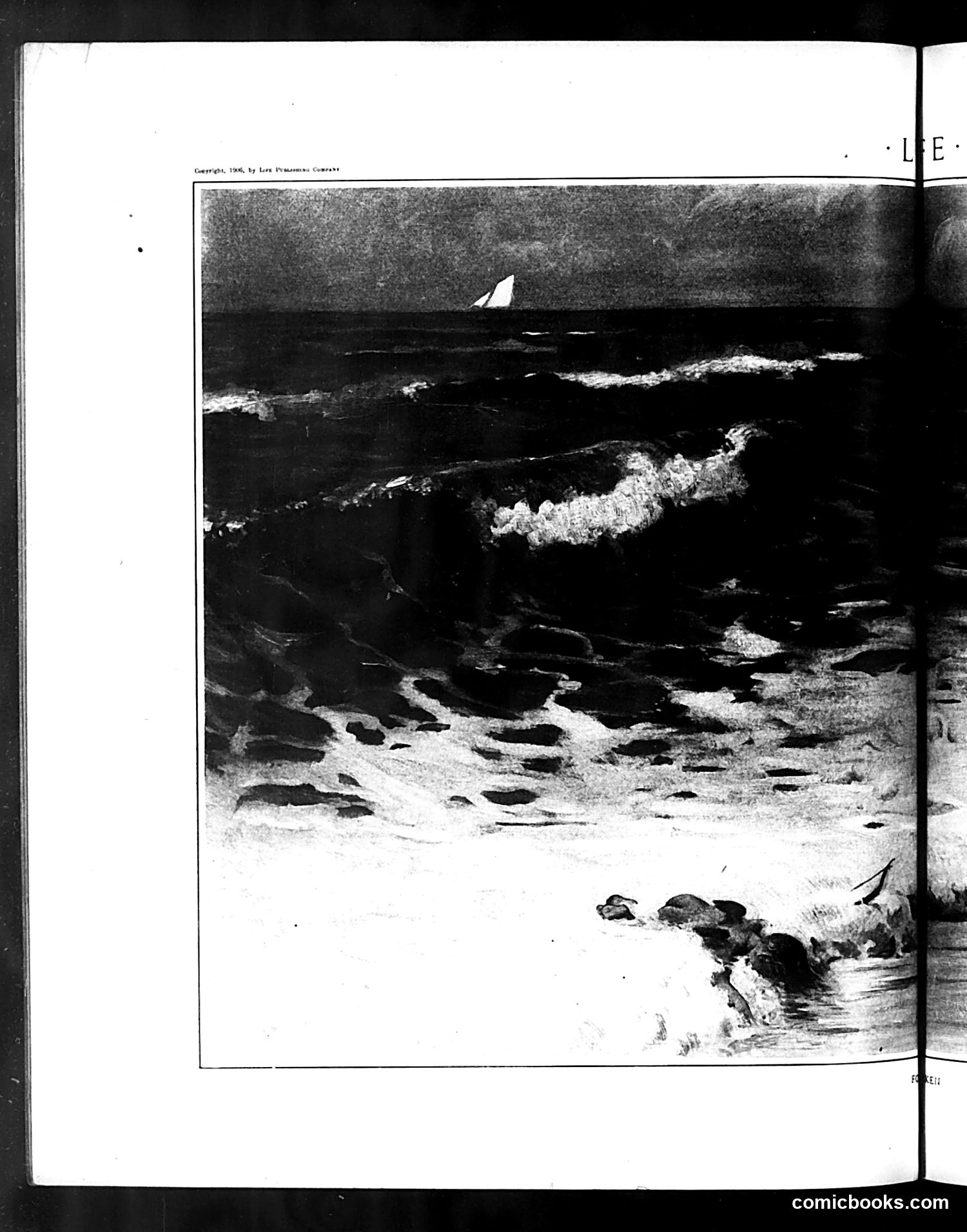
This page appears to be primarily a photograph rather than a political cartoon. It shows a black and white beach or coastal scene with waves, sandy shore, and rocks. A small sailboat is visible on the horizon. The image quality is grainy, typical of early-to-mid 20th century publication printing. The copyright notice at the top indicates this is from Life magazine (1906, by Life Publishing Company), suggesting this is a nature or leisure photograph rather than satirical content. Without visible text, captions, or cartoon elements on this particular page, I cannot identify specific political or social commentary. The page may be part of a larger article or simply a scenic illustration typical of Life's lifestyle content from that era.
I can see this is a black and white photograph from Life magazine showing a coastal landscape with a beach, water, rocks, and what appears to be vegetation or trees along the shoreline. The image quality is grainy, typical of early-to-mid 20th century printing. However, I cannot identify any political cartoons, caricatures, or satirical figures in this photograph. The OCR text provided contains no readable content to help contextualize the image's meaning or intent. Without visible satirical elements, identifiable figures, or accompanying explanatory text, I cannot determine what political or social commentary this photograph was meant to convey to Life's readers. The page appears to be primarily photographic documentation rather than editorial cartooning or satirical content.
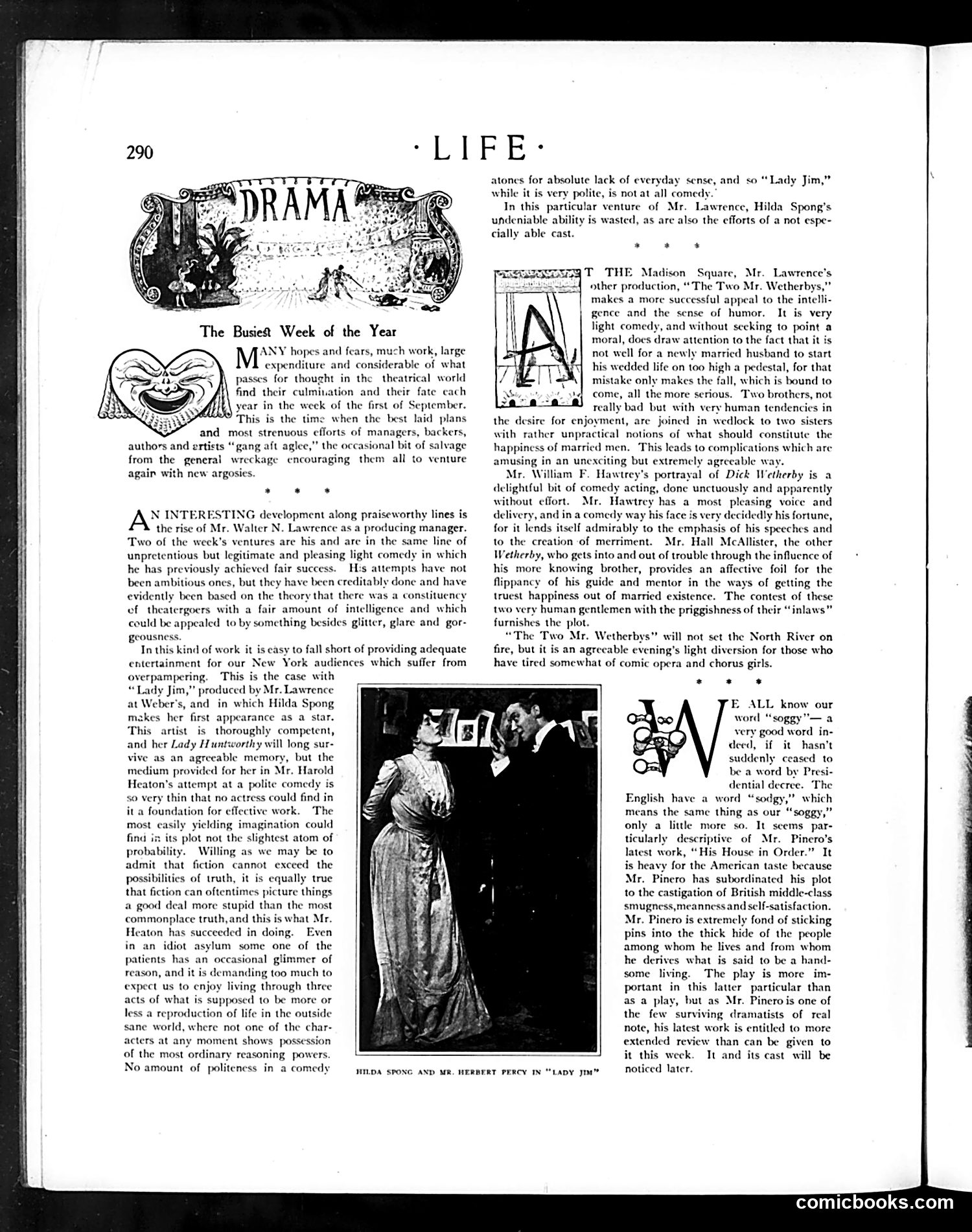
This is a theater review column covering Broadway's opening week (early September). The text discusses three contemporary plays, criticizing their quality and merit. **Key points:** - **"Lady Jim"** at Weber's, starring Hilda Spong in her starring debut, is dismissed as polite but devoid of genuine comedy. The actress is "thoroughly competent" but the material is too thin to support her talent. - **"The Two Mr Wetherbys"** at Madison Square is more successful—a light comedy about two brothers navigating marriage, featuring actors William F. Hawtrey and Hall McAllister. The plot involves newlyweds clashing with their wives' impractical expectations. - The reviewer argues that New York audiences are "overpampered" by spectacle, yet still deserve entertainment with wit and substance beyond "glitter, glare and gorgeousness." The column reflects early 1900s theater criticism standards: evaluating actors' performances, plot construction, and whether comedies offered genuine humor or mere politeness.
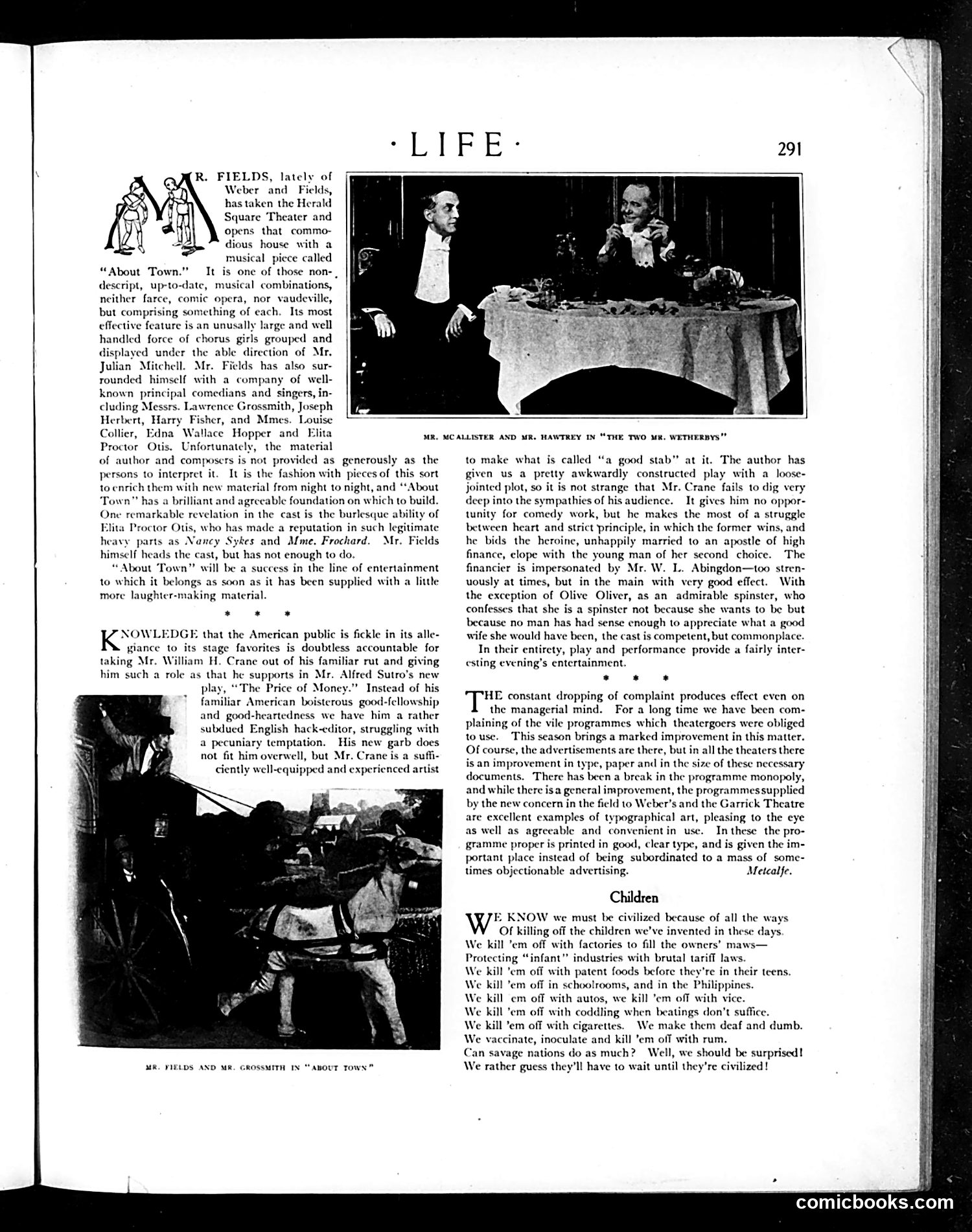
This page reviews three theatrical productions. **"About Town"** at Herald Square Theater stars W.C. Fields (noted comedian from the Weber and Fields duo) alongside established performers. The review praises the chorus girls and supporting cast but criticizes weak material, suggesting the show needs better comedic writing to succeed. **"The Price of Money"** features William H. Crane in an atypical role—a conflicted English newspaper editor rather than his familiar American comedic persona. The review finds the plot poorly constructed and Crane miscast, though he performs competently. **"The Two Mr. Wetherby's"** receives brief mention with a photographic still. The page also includes a satirical poem titled **"Children"** critiquing how modern society kills children's innocence through factories, schools, dangerous products, and vice—sardonically questioning when they'll become "civilized." The reviews exemplify Life's theatrical criticism style: detailed casting information, performance assessment, and frank judgments about material quality.
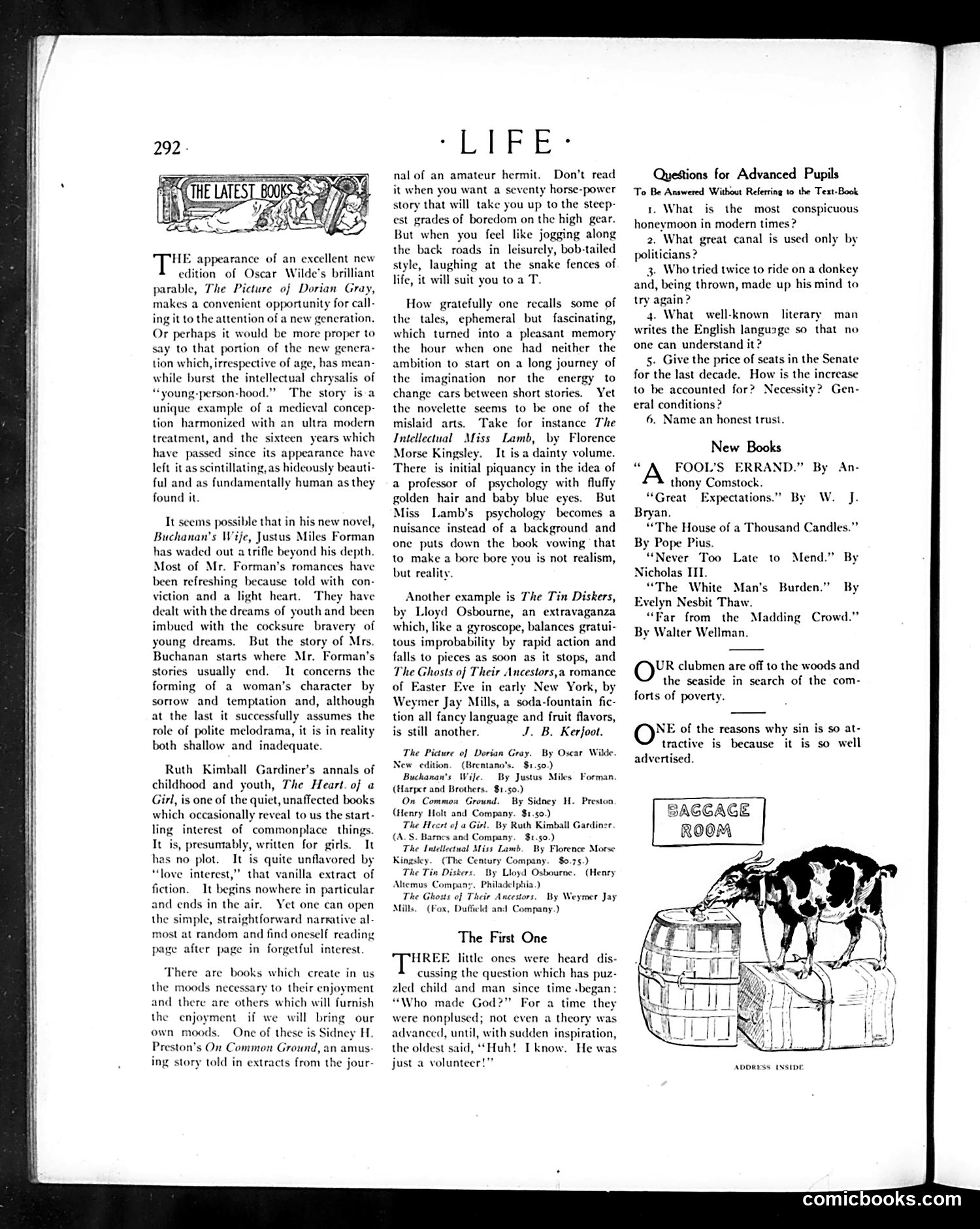
This page from *Life* magazine presents literary criticism rather than political cartoons. The main content reviews several contemporary novels, including a new edition of Oscar Wilde's *The Picture of Dorian Gray*. The critic praises Wilde's work as timeless—"scintillating" and "fundamentally human"—suggesting its themes remain relevant to a new generation. However, the reviewer is less generous with other contemporary fiction, dismissing several novelettes as shallow or poorly executed. The tone is sophisticated and somewhat condescending, particularly toward romances that rely on "love interest" as "vanilla extract of fiction." The small illustration labeled "Baggage Room" appears to be a humorous sketch about luggage, unrelated to the book reviews. This was typical *Life* content—mixing literary commentary with light humor for an educated, urbane readership interested in arts and letters.
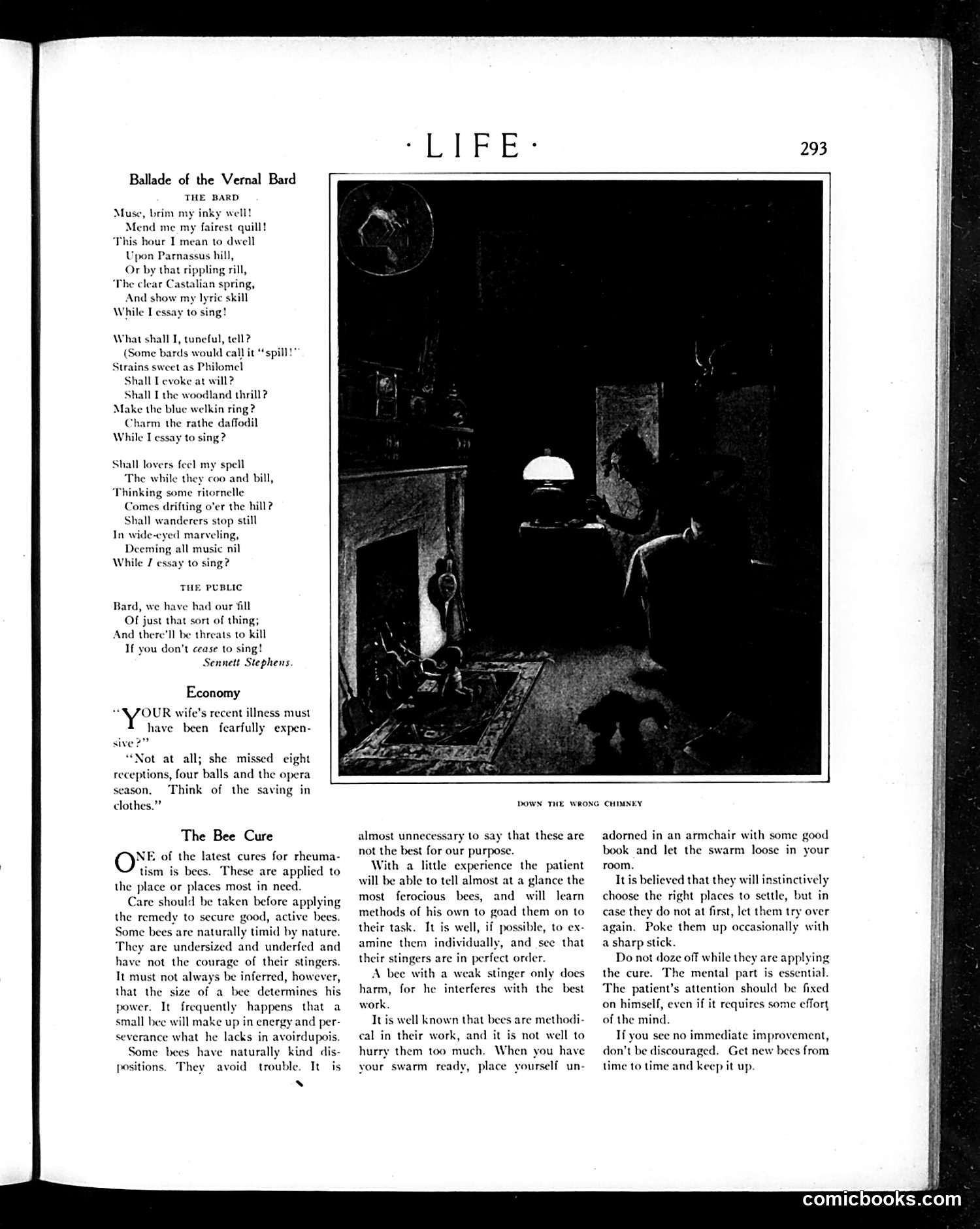
This page contains three satirical pieces typical of early 20th-century American humor: **"Ballade of the Vernal Bard"**: A poem mocking pretentious poets. A self-important bard asks grandiose questions about inspiring nature and love through his verse. The public's response is blunt: they're tired of such flowery poetry and threaten violence if he doesn't stop. The satire targets Romantic-era poetic conventions as tedious and out-of-touch. **"Economy"**: A brief joke about a wife's illness being financially beneficial because she missed social events (receptions, balls, opera), saving money on clothes. This satirizes upper-class priorities and the notion that women's social obligations constitute major household expenses. **"The Bee Cure"**: A mock-serious medical piece describing applying bees to rheumatic pain. Presented as practical advice, it humorously discusses selecting "ferocious" bees with strong stingers, proper bee placement, and patient attention—treating an absurd remedy with scientific language. This likely mocks contemporary alternative or folk medical practices. The page's central illustration ("Down the Wrong Chimney") remains unclear without additional context.
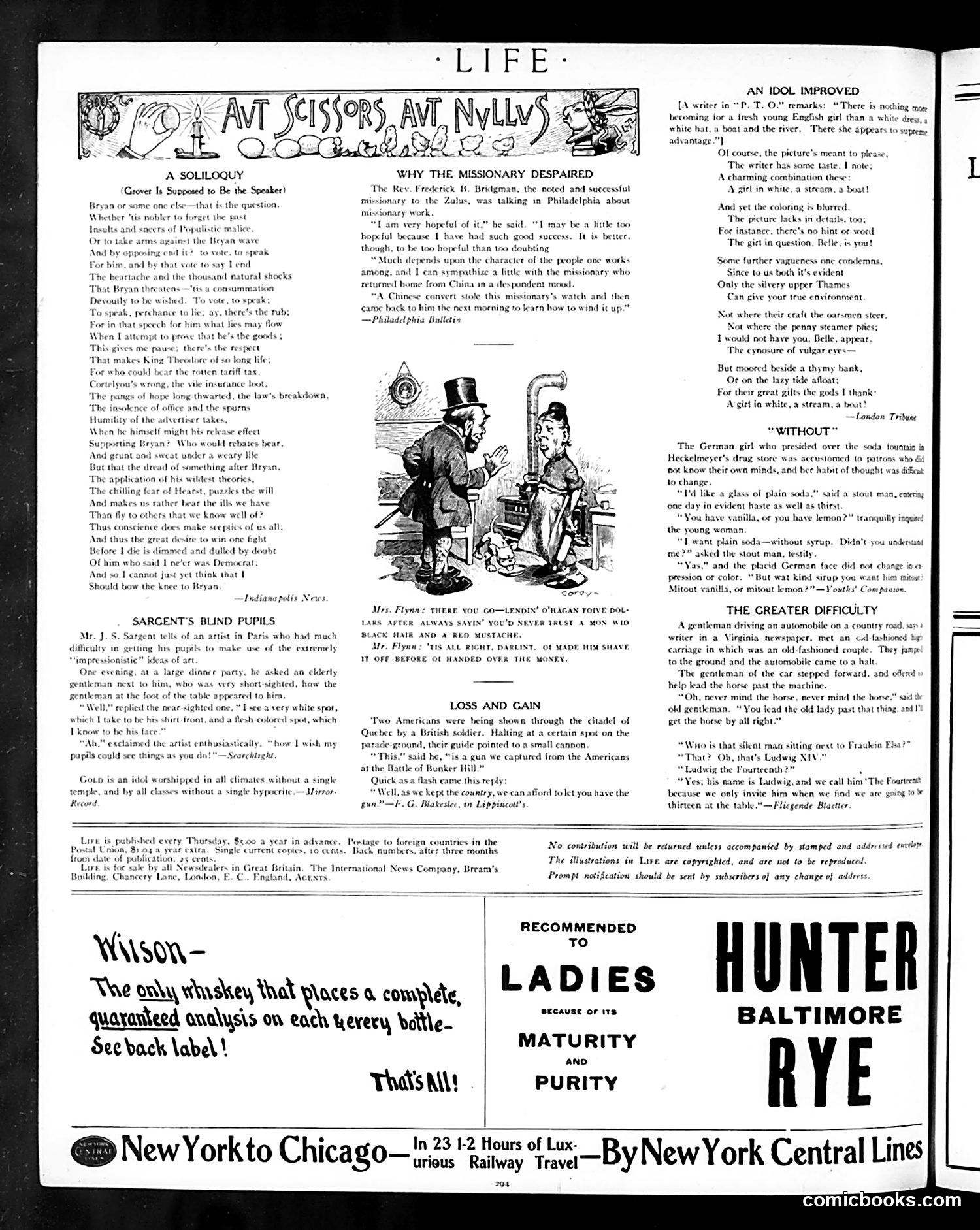
This page contains multiple satirical pieces mocking American political and social figures of the era (circa early 1900s, based on references). **"A Soliloquy"** parodies Shakespeare's *Hamlet*, replacing existential questions with commentary on William Jennings Bryan and contemporary political anxieties. The piece satirizes voters' paralysis over supporting Bryan, framing political indecision through the famous "to be or not to be" structure. References to "tariff tax," "insurance," and "Hearst" suggest debates over economic policy and media influence. **"Why the Missionary Despaired"** mocks Reverend Frederick I. Bridgman's missionary work among the Zulus, suggesting that despite good intentions, even converted natives revert to theft—a racist stereotype common to the era's "civilizing mission" rhetoric. **"Without"** depicts a German immigrant soda fountain attendant who frustrates a customer by offering flavored options when he wants plain soda, satirizing either immigrant miscommunication or business excess. The page reflects early 20th-century American anxieties: political uncertainty, colonial paternalism, and cultural friction from immigration.
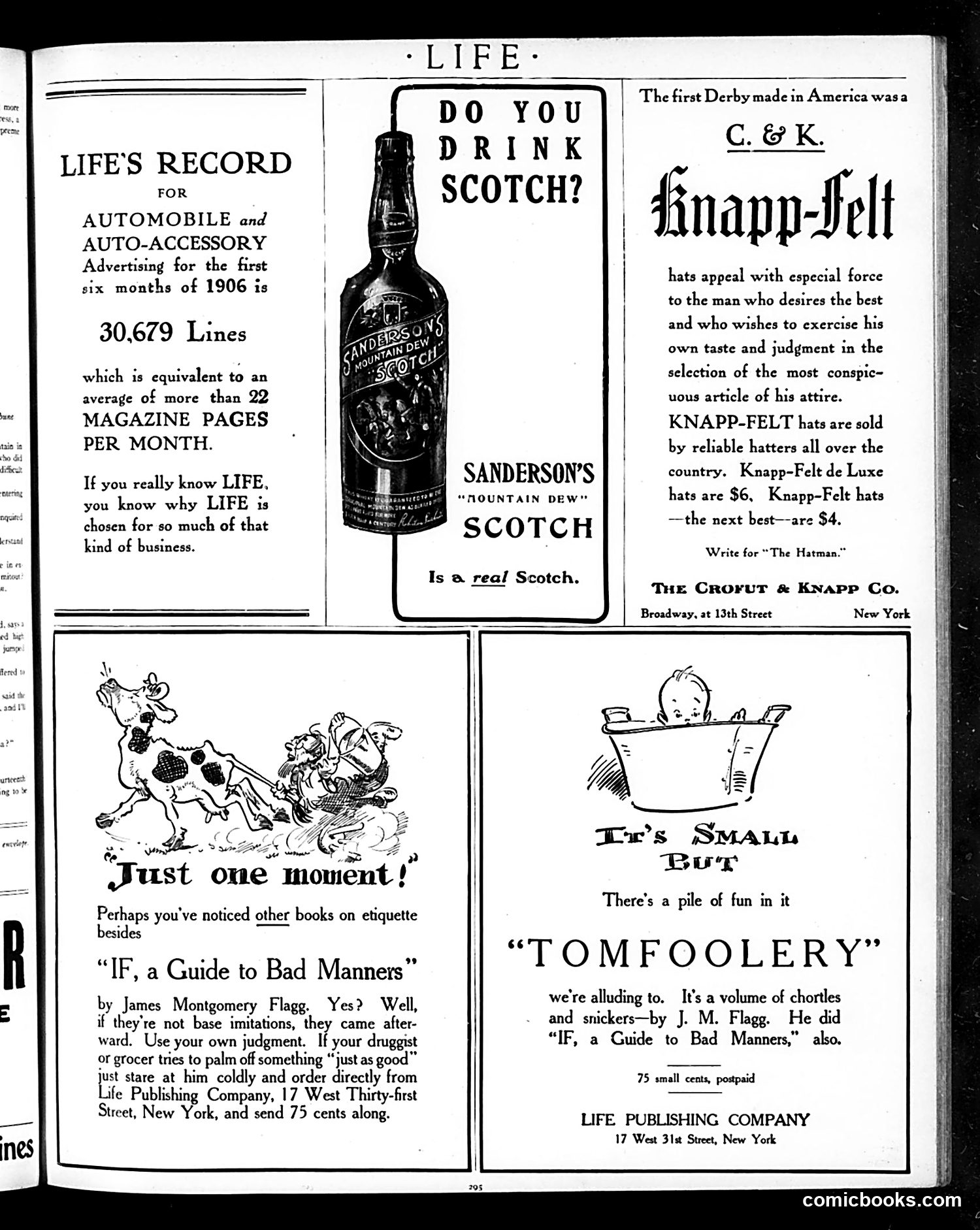
This is primarily an **advertising page** from Life magazine, circa 1906. The page contains: 1. **Life's self-promotion**: Boasting of 30,679 lines of automobile/accessory advertising in six months—demonstrating the magazine's reach to businesses. 2. **Scotch whisky ad**: Sanderson's "Mountain Dew" Scotch, asking "Do you drink Scotch?" This reflects the era's casual alcohol advertising in mainstream publications. 3. **Hat advertisement**: Knapp-Felt hats positioned as quality products for discerning gentlemen ($6 deluxe, $4 standard). 4. **Two cartoons promoting Life's own books**: - Left: "Just one moment!" — promoting "IF, a Guide to Bad Manners" by James Montgomery Flagg - Right: "It's Small But There's a Pile of Fun in It" — promoting "Tomfoolery," also by Flagg The page illustrates early 1900s magazine monetization through advertisements mixed with self-promotion, plus Flagg's popularity as both cartoonist and author of humorous etiquette guides.
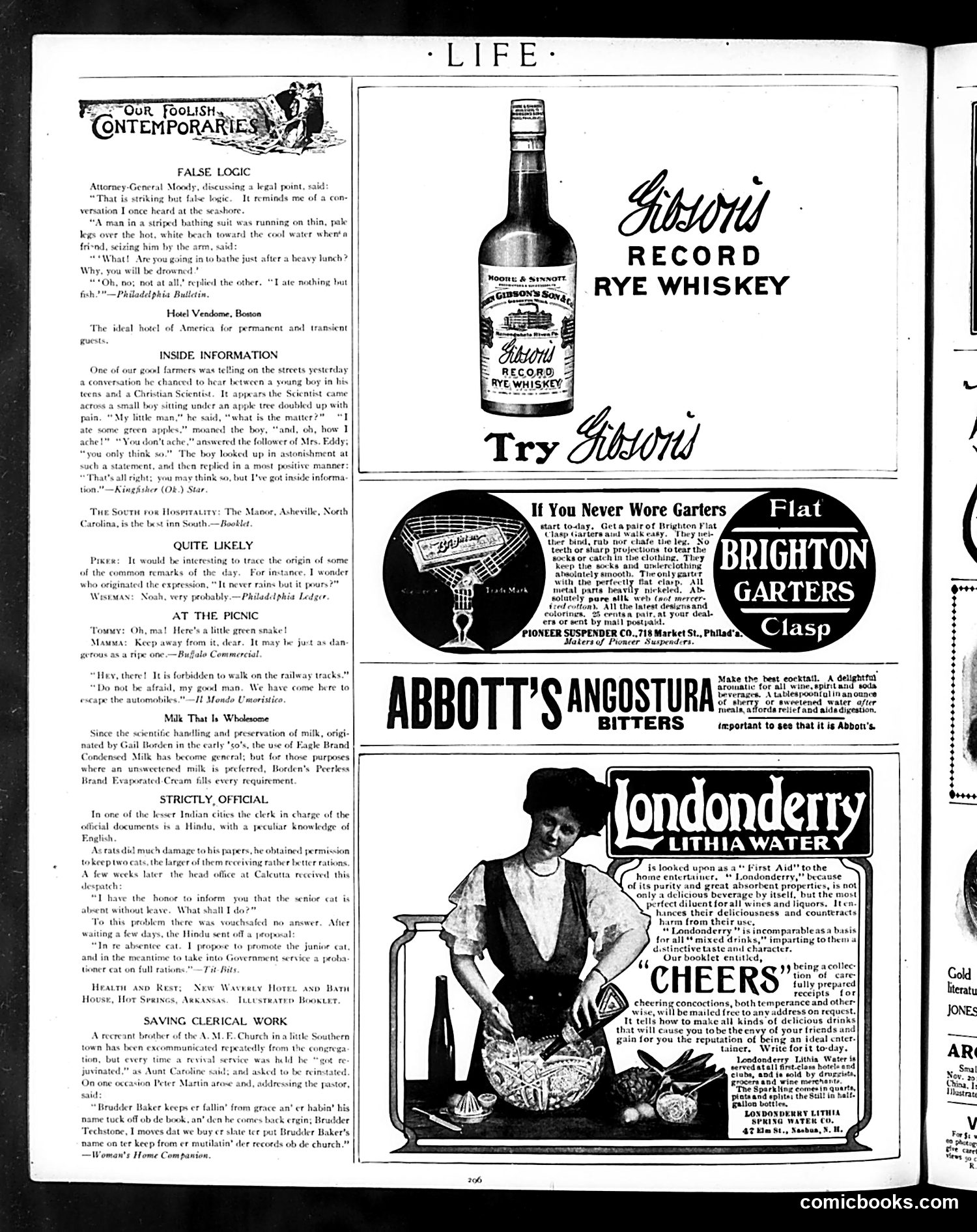
This is primarily an **advertising and humor page** from Life magazine, not a political cartoon. The page contains several satirical anecdotes mocking faulty logic and human folly, interspersed with period advertisements. The main humor pieces include: - **"False Logic"**: Attorney-General Moody discusses illogical reasoning using a seashore anecdote about someone eating before swimming - **"Inside Information"**: A Christian Scientist denies a boy's stomachache, claiming he merely "thinks" he's ill; the boy counters he has "inside information" suggesting real pain - **"Strictly, Official"**: A bureaucratic Hindu clerk in India writes formally requesting a slate to permanently record a repeatedly excommunicated churchman's name, avoiding repeated erasures The advertisements promote whiskey, garters, bitters, and lithia water—typical early 1900s products. The satire targets Victorian-era earnestness, bureaucratic absurdity, and pseudoscientific thinking (Christian Science), reflecting contemporary social anxieties rather than specific political events.
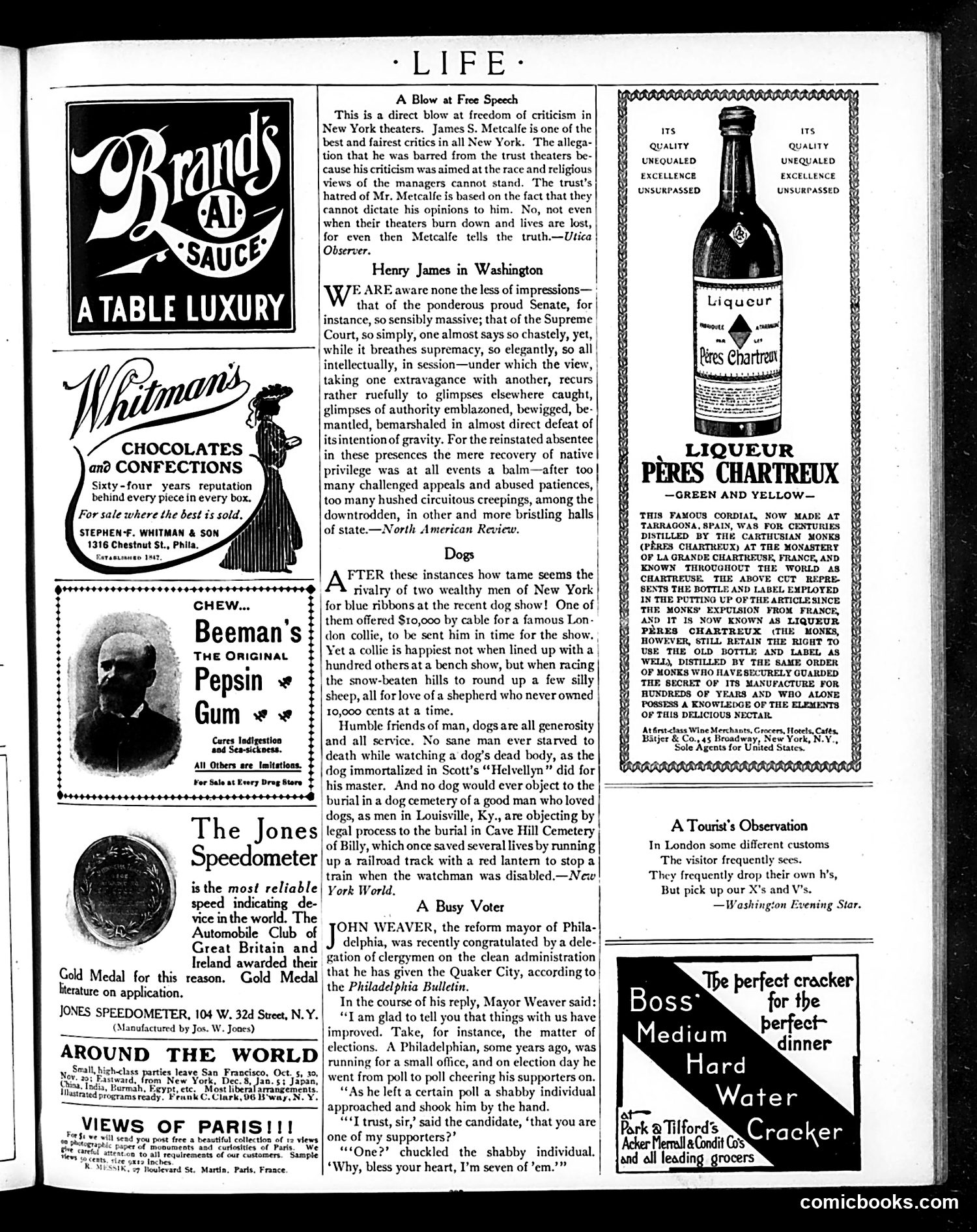
This page is primarily **advertisements** interspersed with brief **editorial commentary** on contemporary issues. The editorial pieces address: 1. **"A Blow at Free Speech"**: Criticizes New York theater trust for allegedly barring drama critic James S. Metcalfe from venues because his reviews targeted the managers' views, not their race or religion. Life defends press freedom. 2. **"Henry James in Washington"**: A literary excerpt praising the aesthetic dignity of the Senate and Supreme Court while gently mocking other governmental displays as overwrought. 3. **"Dogs"**: Satirizes wealthy New Yorkers competing for blue ribbons at dog shows, particularly one man's $10,000 cable offer for a London collie. Life contrasts this frivolous competition with dogs' genuine nobility and service. 4. **"A Busy Voter"**: Brief item about Philadelphia's reform mayor John Weaver receiving clergy congratulations for clean administration. The **advertisements** (Whitman's chocolates, Beeman's gum, Jones Speedometer) represent period consumer goods marketed as quality products.
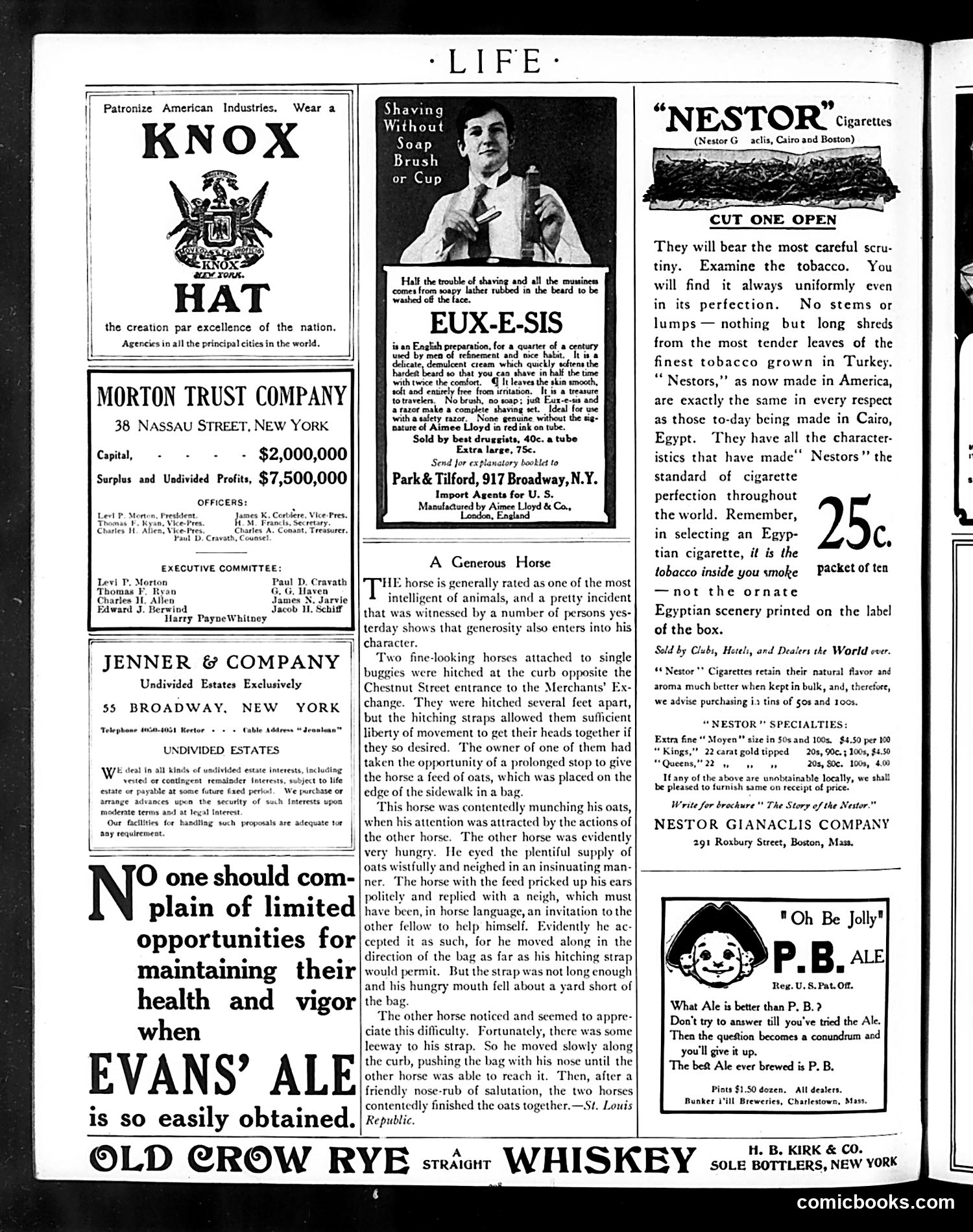
This page is primarily **advertising**, dominated by product promotions and corporate notices rather than editorial content or satire. The main narrative piece, "A Generous Horse," is a sentimental anecdote (not satire) describing two hitched horses—one sharing oats with the other through an act of apparent generosity. The story celebrates animal kindness as a human virtue, typical of early-20th-century moralistic journalism. The advertisements include: - **Knox Hat** — promoting American manufacturing - **Eaux-E-Sis** shaving cream — an English product - **Nestor Cigarettes** — Egyptian cigarettes "now made in America," emphasizing quality tobacco - **Evans' Ale** and **P.B. Ale** — beverages - Financial services (Morton Trust Company, Jenner & Company) There is **no political cartoon or satire visible** on this page. The content reflects early-1900s consumer culture and nationalist appeals to "patronize American industries," but presents no satirical commentary worthy of analysis.
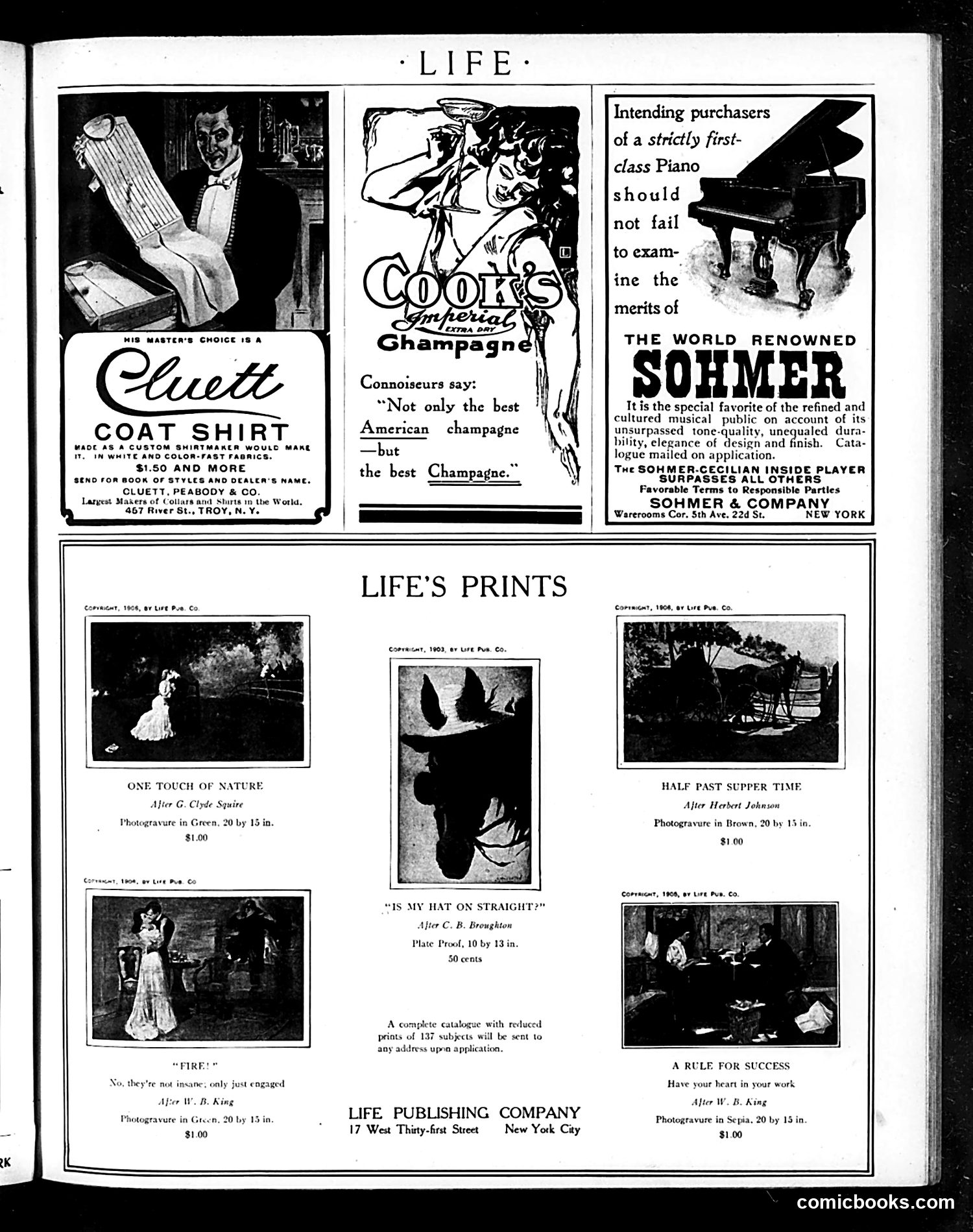
This is primarily an **advertising page** from Life magazine (circa 1908), not a satirical cartoon section. It features commercial advertisements for luxury goods interspersed with offerings from Life Publishing Company's print catalog. The **advertisements** promote: - Cluett brand coat shirts (emphasizing quality craftsmanship) - Cook's Imperial Champagne (claiming superiority over other American champagnes) - Sohmer pianos (marketed to "refined and cultured" audiences) The **"Life's Prints" section** offers photogravure reproductions of artworks by contemporary illustrators (G. Clyde Squire, W.B. King, C.B. Broughton, Herbert Johnson). Titles like "One Touch of Nature" and "A Rule for Success" suggest sentimental or moralistic genre scenes typical of early 20th-century popular art. The page reflects the magazine's business model: pairing high-end consumer advertising with art reproductions for affluent readers. No political satire or caricature appears here—it's a commercial product catalog.
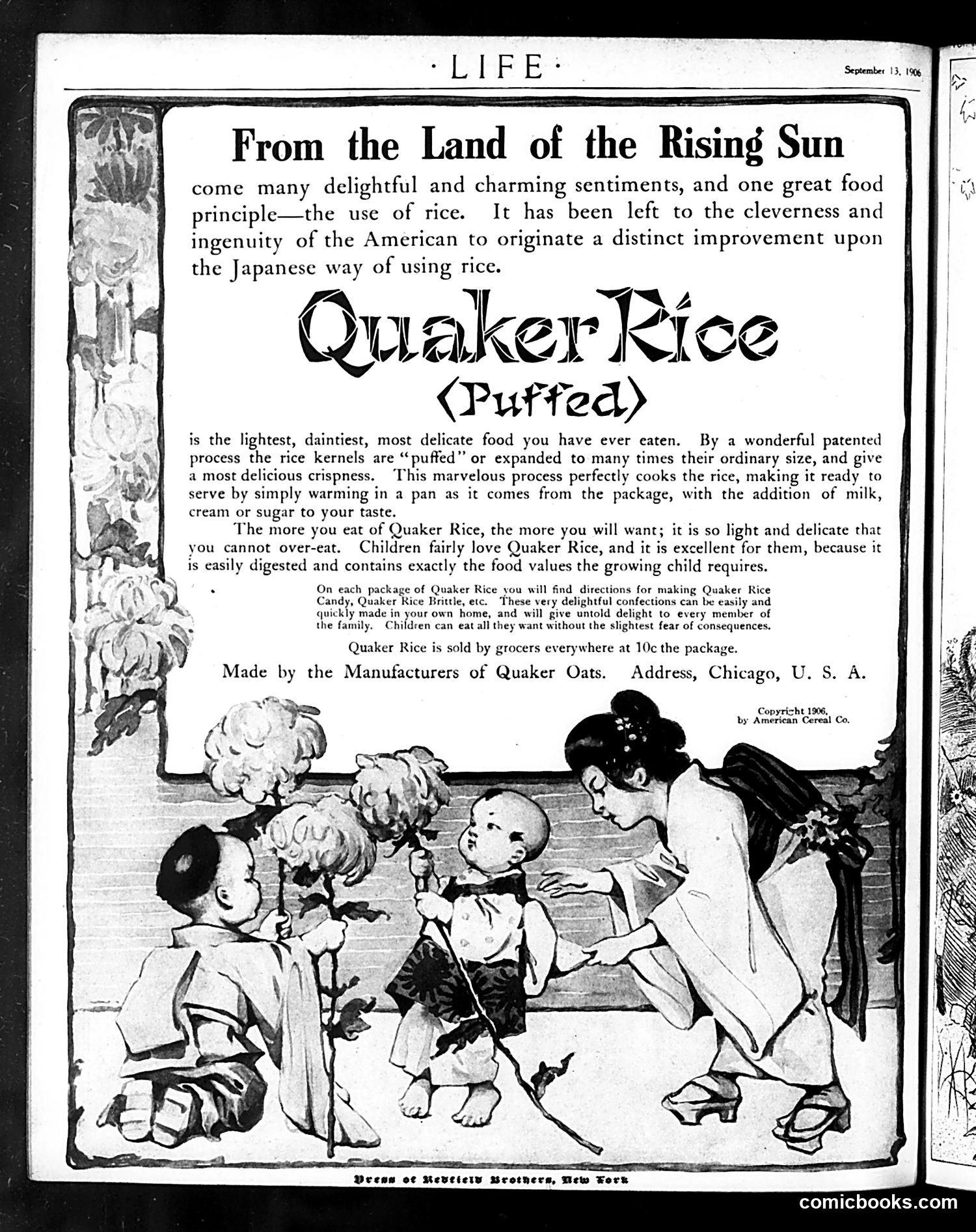
This is primarily a **cereal advertisement**, not political satire. It markets "Quaker Rice (Puffed)" by emphasizing American innovation improving upon Japanese tradition. The ad claims Americans have perfected Japanese rice-cooking methods through a patented puffing process. The illustration shows **children of East Asian appearance** enjoying the product with an adult woman, likely meant to evoke Japan while marketing to American consumers. The text appeals to parents by emphasizing the food's digestibility and nutrition for children. The framing—"From the Land of the Rising Sun" (Japan) improved by American "cleverness and ingenuity"—reflects early 1900s attitudes about Western superiority, presenting American commercial innovation as culturally elevating. The price point (10¢) and emphasis on simple home preparation targeted middle-class families. This is marketing strategy rather than satire.