
Life, 1906-09-13 · page 16 of 24
Life — September 13, 1906 — page 16: what you’re looking at
What you’re looking at
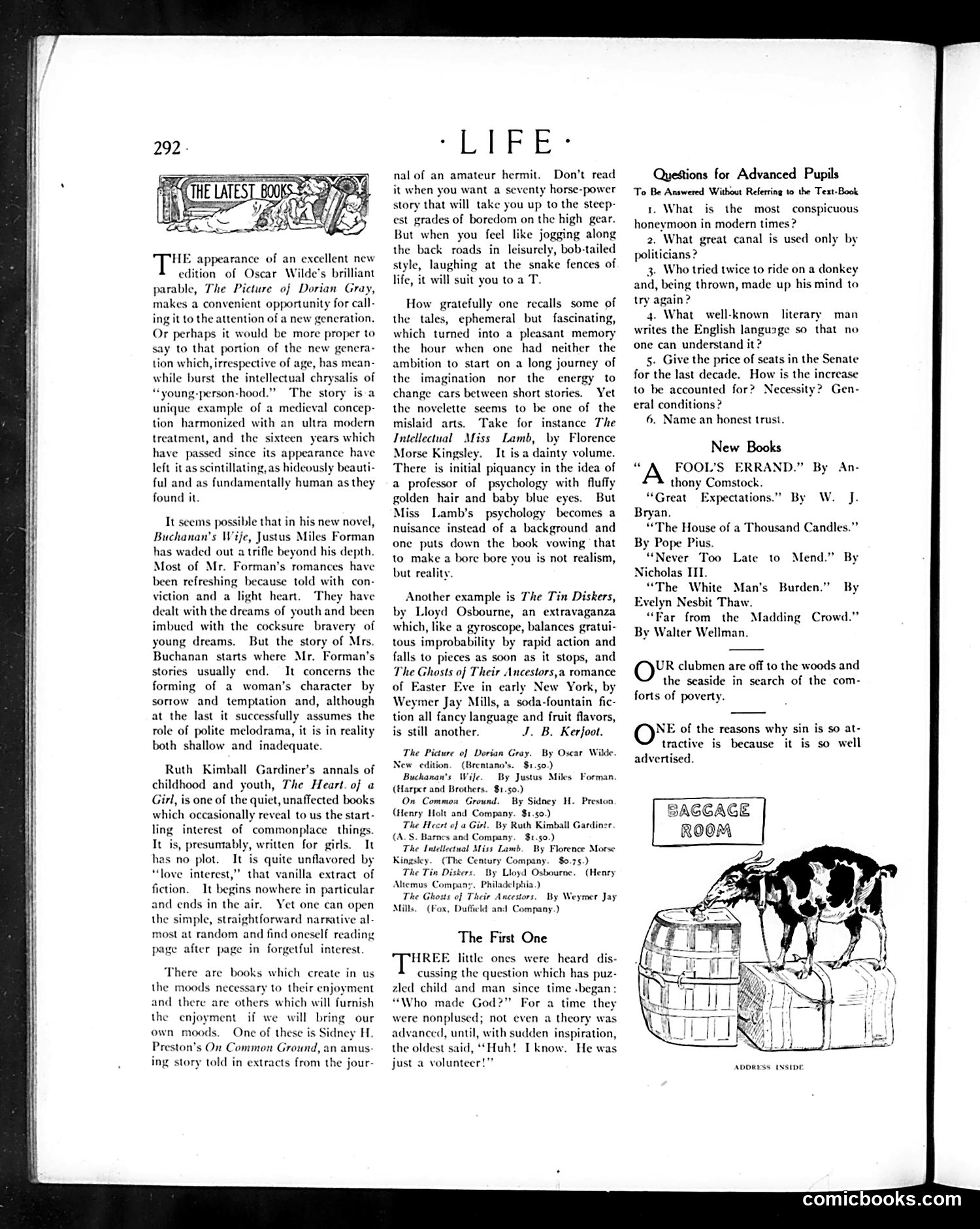
This page from *Life* magazine presents literary criticism rather than political cartoons. The main content reviews several contemporary novels, including a new edition of Oscar Wilde's *The Picture of Dorian Gray*. The critic praises Wilde's work as timeless—"scintillating" and "fundamentally human"—suggesting its themes remain relevant to a new generation. However, the reviewer is less generous with other contemporary fiction, dismissing several novelettes as shallow or poorly executed. The tone is sophisticated and somewhat condescending, particularly toward romances that rely on "love interest" as "vanilla extract of fiction." The small illustration labeled "Baggage Room" appears to be a humorous sketch about luggage, unrelated to the book reviews. This was typical *Life* content—mixing literary commentary with light humor for an educated, urbane readership interested in arts and letters.
📄 Transcribed text from this page (OCR, searchable)
Machine-transcribed from the original scan — historical spelling and the odd misread are preserved.
ion of Oscar Wilde’s brilliant parable, The Picture of Dorian Gray, makes a convenient opportunity for call- ing it to the attention of a new generation. Or perhaps it would be more proper to say to that portion of the new genera- tion which, irrespective of age, has mean- while burst the intellectual chrysalis of “young-person-hood.” The story is a unique example of a medieval concep- tion harmonized with an ultra modern treatment, and the een years which have pass i i ppearance have left it as scintillating, as hideously beauti- ful and as fundamentally human as they found it. It seems possible that in his new novel, Buchanan's Wife, Justus Miles Forman has waded out a trifle beyond his depth. Most of Mr. Forman’s romances have been refreshing because told with con- viction and a light heart. They have dealt with the dreams of youth and been imbued with the cocksure bravery of young dreams. But the story of Mrs. Buchanan starts where Mr. Forman’s stories usually end. It concerns the forming of a woman's character by sorrow and temptation and, although at the last it successfully assumes the role of polite melodrama, it is in reality both shallow and inadequate. Ruth Kimball Gardiner’s annals of childhood and youth, The Heart. oj a Girl, is one of the quiet, unaffected books which occasionally reveal to us the start- ling interest of commonplace things. It is, presumably, written for girls. It has no plot. It is quite unflavored by “love interest,” that vanilla extract of fiction. It begins nowhere in particular and ends in the air. Yet one can open the simple, straightforward narrative al- most at random and find oneself reading page after page in forgetful interest. There are books which create in us the moods necessary to their enjoyment and there are others which will furnish the enjoyment if we will bring our own moods. One of the idney H Preston’s On Common Ground, an amus ing story told in extracts from the jour- -LIFE- nal of an amateur hermit. Don’t read it when you want a seventy horse-power story that will take you up to the steep- est grades of boredom on the high gear. But when you feel like jogging along the back roads in leisurely, bob-tailed yle, laughing at the snake fences of life, it will suit you to a T. How gratefully one recalls some of the tales, ephemeral but fascinating, which turned into a pleasant memory the hour when one had neither the ambition to start on a long journey of the imagination nor the energy to change cars between short stori Yet the novelette seems to be one of the mislaid arts. Take for instance The Intellectual, Miss Lamb, by Florence Morse Kingsley. It is a dainty volume. There is initial piquancy in the idea of a professor of psychology with fluffy golden hair and baby bluc eyes. But Miss Lamb’s psychology becomes a nuisance instead of a background and one puts down the book vowing that to make a bore bore you is not realism, but reality. Another example is The Tin Diskers, by Lloyd Osbourne, an extravaganza which, like a gyroscope, balances gratui- tous improbability by rapid action and falls to pieces as soon as it stops, and The Ghosts oj Their Ancestors,a romance of Easter Eve in early New York, by Weymer Jay Mills, a soda-fountain fic- tion all fancy language and fruit flavors, is still another. J. B. Kerjoot. The Picture of Dorian Gray. By Oscar Wilde. New edition. (Brentano's. $1.50.) Buchanan's Wife. By Justus Miles Forman. (Harper and Brothers. $1.50.) On Commox Ground. By Sidney H. Preston (Henry Holt and Company. $1.50.) The Hecrt of a Girt. By Ruth Kimball Gardiner (A. S. Barnes and Company. $1.50.) By Florence Morse Company. $0.75.) Disters. By Lloyd Osbourne, (Henry Altemus Company. Philadelphia.) The Ghosts of Their Ancestors, By Weymet Jay Mills. (Fox, Duffield and Company.) The First One little ones were heard dis- ing the question which has puz- led child and man since time -began: “Who made God?” For a time th were nonplused; not even a theory was advanced, until, with sudden inspiration, the oldest said, “Huh! I know. He was. just a volunteer!"” QueStions for Advanced Pupils To Be Answered Without Referring to the Text-Book 1. What is the most conspicuous honeymoon in modern times? 2. What great canal is used only by politicians? 3. Who tried twice to ride on a donkey and, being thrown, made up his mind to try again? 4. What well-known literary = man writes the English language so that no one can understand it? 5. Give the price of seats in the Senate for the last decade. How is the increase to be accounted for? Necessity? eral conditions ? 6, Name an honest trust. New Books FOOL’S ERRAND.” By An- thony Comstock. Expectations.” By W. J. “Great Bryan. “The House of a Thousand Candles.” By Pope Pius “Never Too Nicholas III. “The White Man's Evelyn Nesbit Thaw. “Far from the Madding Crowd.” By Walter Wellman. Late to Mend.” By Burden.” By UR clubmen are off to the woods and the seaside in search of the com- forts of poverty. NE of the reasons why sin is so at- tractive is because it is so well advertised. SAGGAGE ROOM ADDRESS EYSIDE comicbooks.com