
Life, 1906-09-13 · page 15 of 24
Life — September 13, 1906 — page 15: what you’re looking at
What you’re looking at
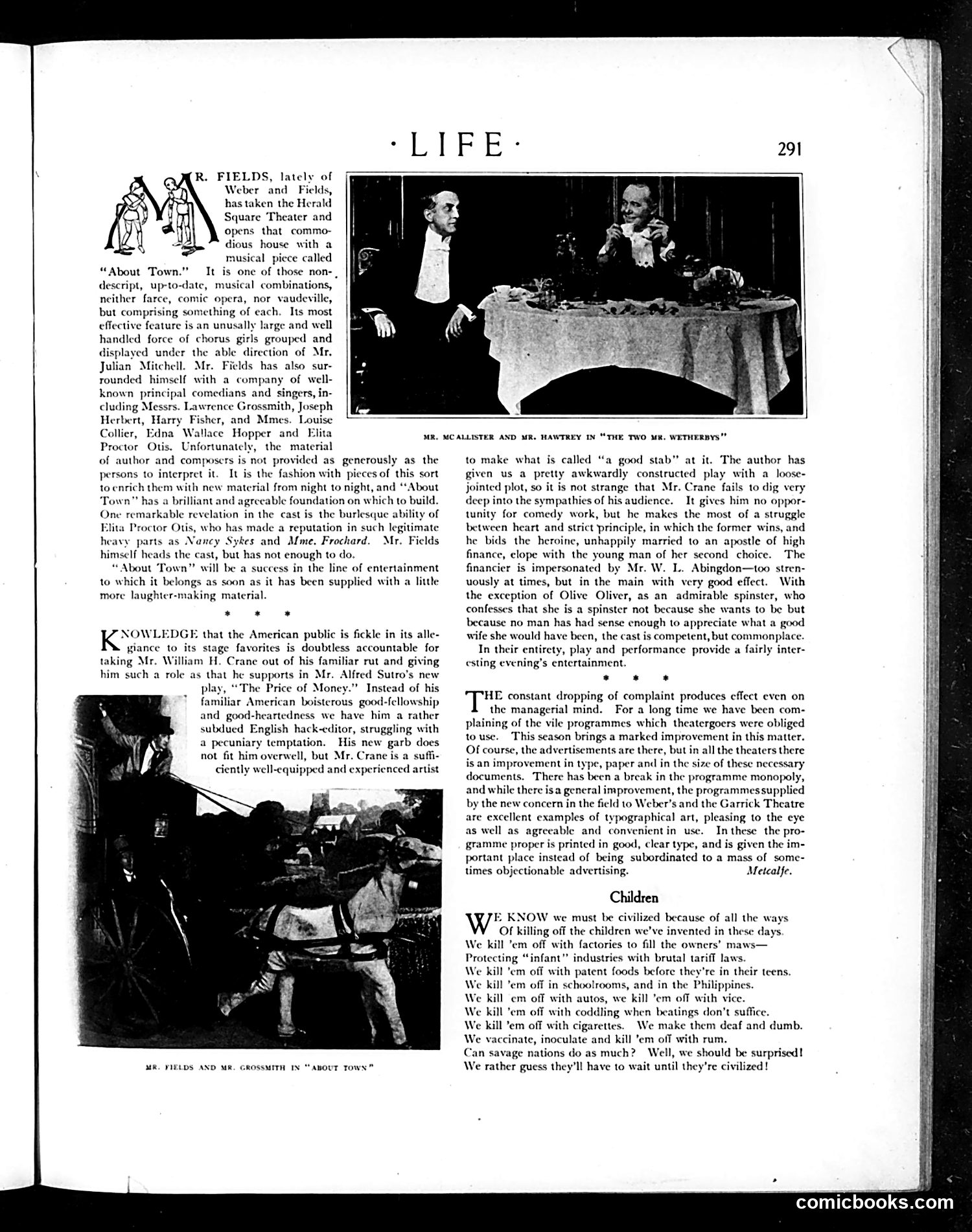
This page reviews three theatrical productions. **"About Town"** at Herald Square Theater stars W.C. Fields (noted comedian from the Weber and Fields duo) alongside established performers. The review praises the chorus girls and supporting cast but criticizes weak material, suggesting the show needs better comedic writing to succeed. **"The Price of Money"** features William H. Crane in an atypical role—a conflicted English newspaper editor rather than his familiar American comedic persona. The review finds the plot poorly constructed and Crane miscast, though he performs competently. **"The Two Mr. Wetherby's"** receives brief mention with a photographic still. The page also includes a satirical poem titled **"Children"** critiquing how modern society kills children's innocence through factories, schools, dangerous products, and vice—sardonically questioning when they'll become "civilized." The reviews exemplify Life's theatrical criticism style: detailed casting information, performance assessment, and frank judgments about material quality.
📄 Transcribed text from this page (OCR, searchable)
Machine-transcribed from the original scan — historical spelling and the odd misread are preserved.
R. FIELDS, lately of Weber and Fields, has taken the Herald Square Theater and opens that commo- dious house with a musical piece called “About Town.” It is one of those non- | descript, up-to-date, musical combinations, neither farce, comic opera, nor vaudeville, but comprising something of each. Its most effective feature is an unusally large and well handled force of chorus girls grouped and displayed under the able direction of Mr. Julian Mitchell. Mr. Fields has also sur- rounded himself with a company of well- known principal comedians and singers, in- cluding Messrs. Lawrence Grossmith, Joseph Herbert, Harry Fisher, and Mmes. Louise Collier, Edna’ Wallace Hopper and Elita Proctor Otis. Unfortunately, the material of author and composers is not provided as generously as. the persons to interpret it. It is the fashion with pieces of this sort to enrich them with new material from night to night, and “About “n” has a brilliant and agreeable foundation on which to build. One remarkable revelation in the cast is the burlesque ability of Elita Proctor Otis, who has made a reputation in such legitimate heavy parts as Nancy Sykes and Mme. Frochard. Mr. Fields himself heads the cast, but has not enough to do. “About Town” will be a success in the line of entertainment to which it belongs as soon as it has been supplied with a litte more laughter-making material. + 8 * NOWLEDGE that the American public is fickle in its alle- giance to its stage favorites is doubtless accountable for taking Mr. William H. Crane out of his familiar rut and giving him such a role as that he supports in Mr. Alfred Sutro’s new play, “The Price of Money.” Instead of his, familiar American boisterous good-fellowship and good-heartedness we have him a rather subdued English hack-cditor, struggling with a pecuniary temptation. His new garb docs not fit him overwell, but Mr. Crane is a suffi- ciently well-equipped and experienced artist MR. VIELDS AND MR. GROSSMITH IN “AnovT Tows” MR. MCALLISTER AND MR. HAWTREY IN “THE TWO MR. WETHERBYS"? to make what is called “a good stab” at it. The author has given us a pretty awkwardly constructed play with a loose- jointed plot, so it is not strange that Mr. Crane fails to dig very deep into the sympathies of his audience. It gives him no oppor- tunity for comedy work, but he makes the most of a struggle between heart and strict principle, in which the former wins, and he bids the heroine, unhappily married to an apostle of high finance, elope with the young man of her second choice. The financier is impersonated by Mr. W. L. Abingdon—too stren- uously at times, but in the main with very good effect. With the exception of Olive Oliver, as an admirable spinster, who confesses that she is a spinster not because she wants to be but because no man has had sense enough to appreciate what a good wife she would have been, the cast is competent, but commonplace. In their entirety, play and performance provide a fairly inter- esting evening’s entertainment. * 6 «& HE constant dropping of complaint produces effect even on the managerial mind. For a long time we have been com- plaining of the vile programmes which theatergoers were obliged to use. This season brings a marked improvement in this matter. Of course, the advertisements are there, but in all the theaters there is an improvement in type, paper and in the size of these necessary documents. There has been a break in the programme monopoly, and while there isa gencral improvement, the programmes supplied by the new concern in the field to Weber’s and the Garrick Theatre are excellent examples of typographical art, pleasing to the eye as well as agreeable and convenient in use. In these the pro- gramme proper is printed in good, clear type, and is given the im- portant place instead of being subordinated to a mass of some- times objectionable advertising. Metcalfe. Children KNOW we must be civilized because of all the w Of killing off the children we've invented in these days. We kill ‘em off with factories to fill the owners’ maws— Protecting “infant” industries with brutal tariff laws. We kill ‘em off with patent foods before they’re in their tcens. We kill 'em off in schoolrooms, and in the Philippine We kill em off with autos, we kill em off with vic We kill ‘em off with coddling when beatings don’t suffice. We kill ’em off with cigarettes. We make them deaf and dumb. We vaccinate, inoculate and kill "em off with rum, Can savage nations do as much? Well, we should be surprised! We rather guess they'll have to wait until they're civilized! comicbooks.com