
Life, 1906-09-13 · page 14 of 24
Life — September 13, 1906 — page 14: what you’re looking at
What you’re looking at
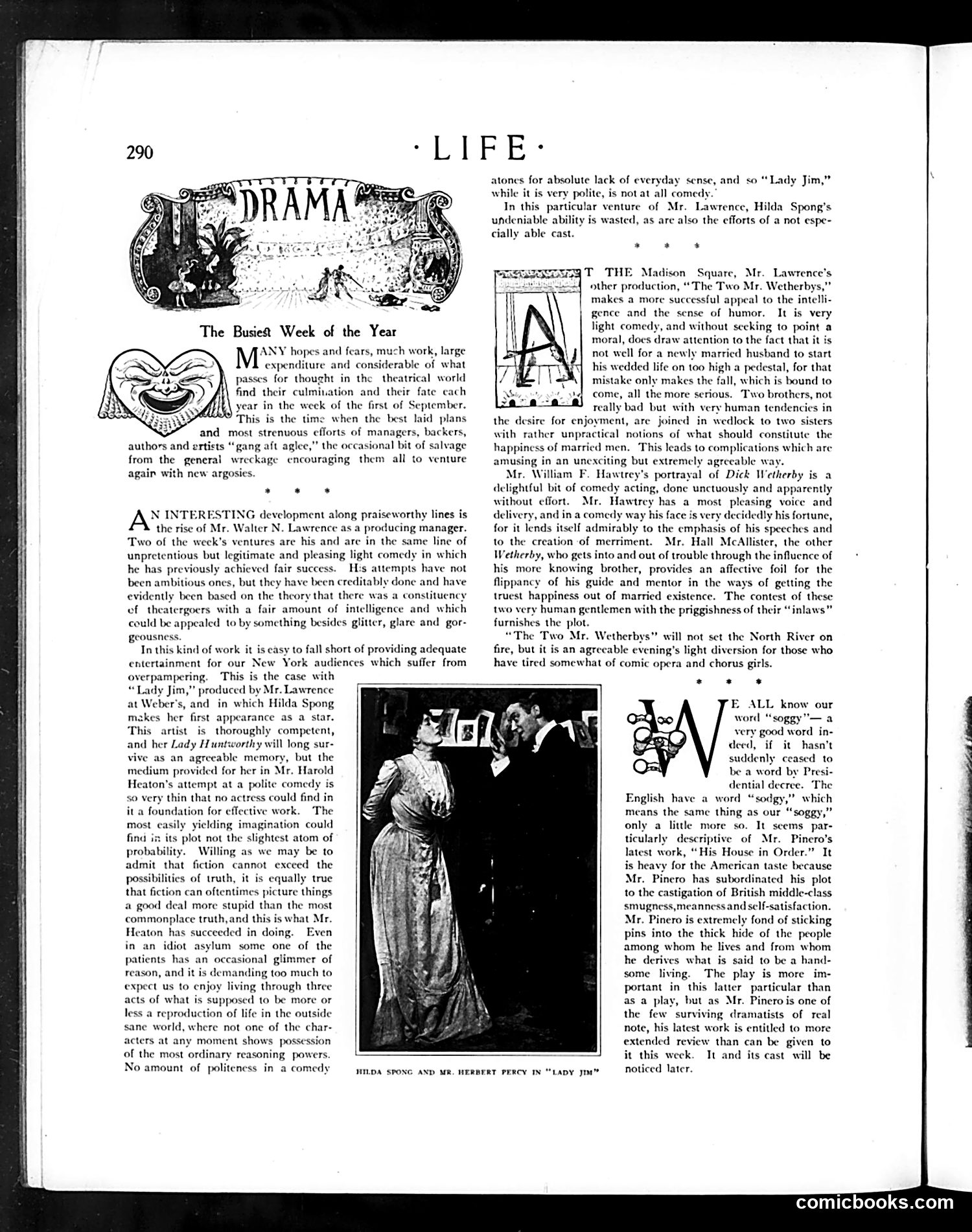
This is a theater review column covering Broadway's opening week (early September). The text discusses three contemporary plays, criticizing their quality and merit. **Key points:** - **"Lady Jim"** at Weber's, starring Hilda Spong in her starring debut, is dismissed as polite but devoid of genuine comedy. The actress is "thoroughly competent" but the material is too thin to support her talent. - **"The Two Mr Wetherbys"** at Madison Square is more successful—a light comedy about two brothers navigating marriage, featuring actors William F. Hawtrey and Hall McAllister. The plot involves newlyweds clashing with their wives' impractical expectations. - The reviewer argues that New York audiences are "overpampered" by spectacle, yet still deserve entertainment with wit and substance beyond "glitter, glare and gorgeousness." The column reflects early 1900s theater criticism standards: evaluating actors' performances, plot construction, and whether comedies offered genuine humor or mere politeness.
📄 Transcribed text from this page (OCR, searchable)
Machine-transcribed from the original scan — historical spelling and the odd misread are preserved.
‘LIPE« The Busiet Week of the Year ANY hopes and fears, much work, large expenditure and considerable of what passes for thought in the theatrical world find their culmiuation and their fate cach year in the week of the first of September. This is the time when the best laid plans and most strenuous efforts of managers, backers, authors and ertists “gang aft aglee,” the occasional bit of salvage from the general wreckage encouraging them all to venture again with new argosies. N INTERESTING development along praiseworthy lines is the rise of Mr. Walter N. Lawrence as a producing manager. Two of the week's ventures are his and are in the same line of unpretentious but legitimate and pleasing light comedy in which he has previously achieved fair success. His attempts have not been ambitious ones, but they have been creditably done and have evidently been based on the theory that there was a constituency of theatergoers with a fair amount of intelligence and which could be appealed to by something besides glitter, glare and_gor- geousne: In this kind of work it is easy to fall short of providing adequate entertainment for our New York audiences which suffer from overpampering. ‘This is the case with atones for absolute lack of everyday sense, and so Lady Jim,” while it is very polite, is not at all comedy. In this particular venture of Mr. Lawrence, Hilda Spong’ undeniable ability is wasted, as are also the efforts of a not espe- cially able cas SAREE T THE Madison Square, Mr. Lawrence's 2s] other production, “The Two Mr. Wetherbys,” makes a more successful appeal to the intelli gence and the sense of humor. It is very light comedy, and without secking to point a moral, docs draw attention to the fact that it is not well for a newly married husband to start his wedded life on too high a pedestal, for that mistake only makes the fall, which is bound to come, all the more serious. Two brothers, not really bad but with very human tendencies in the desire for enjoyment, are joined in wedlock to two sisters with rather unpractical notions of what should constitute the happiness of married men. This leads to complications which are amusing in an unexciting but extremely agreeable way. Mr. William F. Hawtrey’s portrayal of Dick Wetherby is a delightful bit of comedy acting, done unctuously and apparently without effort. Mr. Hawtrey has a most pleasing voice and delivery, and in a comedy way his face is very decidedly his fortune, for it lends itself admirably to the emphasis of his speeches and to the creation of merriment. Mr. Hall McAllister, the other Wetherby, who gets into and out of trouble through the influence of his more knowing brother, provides an affective foil for the flippancy of his guide and mentor in the ways of getting the truest happiness out of married existence. The contest of these two very human gentlemen with the priggishness of their “inlaws” furnishes the plot. “The Two Mr. Wetherbys” will not sct the North River on fire, but it is an agreeable evening’s light diversion for those who have tired somewhat of comic opera and chorus girls. e 8 6 “Lady Jim,” produced by Mr. Lawrence at Weber's, and in which Hilda Spong makes her first appearance as a star. This artist. is thoroughly competent, and her Lady Huntworthy will long sur- vive as an agreeable memory, but the medium provided for her in Mr. Harold Heaton’s attempt at a polite comedy is so very thin that no actress could find in it a foundation for effective work. The most casily yielding imagination could find iz its plot not the slightest atom of probability. Willing as we may be to admit that fiction cannot exceed the possibilities of truth, it is equally true that fiction can oftentimes picture things a good deal more stupid than the most commonplace truth, and this is what Mr. Heaton has succeeded in doing. Even in an idiot asylum some one of the patients has an occasional glimmer of reason, and it is demanding too much to expect us to enjoy living through three acts of what is supposed to be more or less a reproduction of life in the outside sane world, where not one of the char- acters at any moment shows possession E ALL know our word “soggy"— a very good word in- deed, if it hasn't suddenly ceased to be a word by Presi- dential decree. The English have a word “sodgy,” which means the same thing as our “soggy,” only a little more so. It seems par ticularly descriptive of Mr. Pinero’s latest work, “His House in Order.” It is heavy for the American taste because Mr. Pinero has subordinated his plot to the castigation of British middle-class smugness,meanness and self-satisfaction. Mr. Pinero is extremely fond of sticking pins into the thick hide of the people among whom he lives and from whom he deri what is said to be a hand- some living. The play is more im- portant in this latter particular than as a play, but as Mr. Pinero is one of the few surviving dramatists of real note, his latest work is entitled to more extended review than can be given to of the most ordinary reasoning powers. it this week. It and its cast will be noticed later. No amount of politencss in a comedy HILDA SPONG AND MR. HERBERT PERCY IN “LaDy yim’ comicbooks.com