
Life, 1906-09-13 · page 10 of 24
Life — September 13, 1906 — page 10: what you’re looking at
What you’re looking at
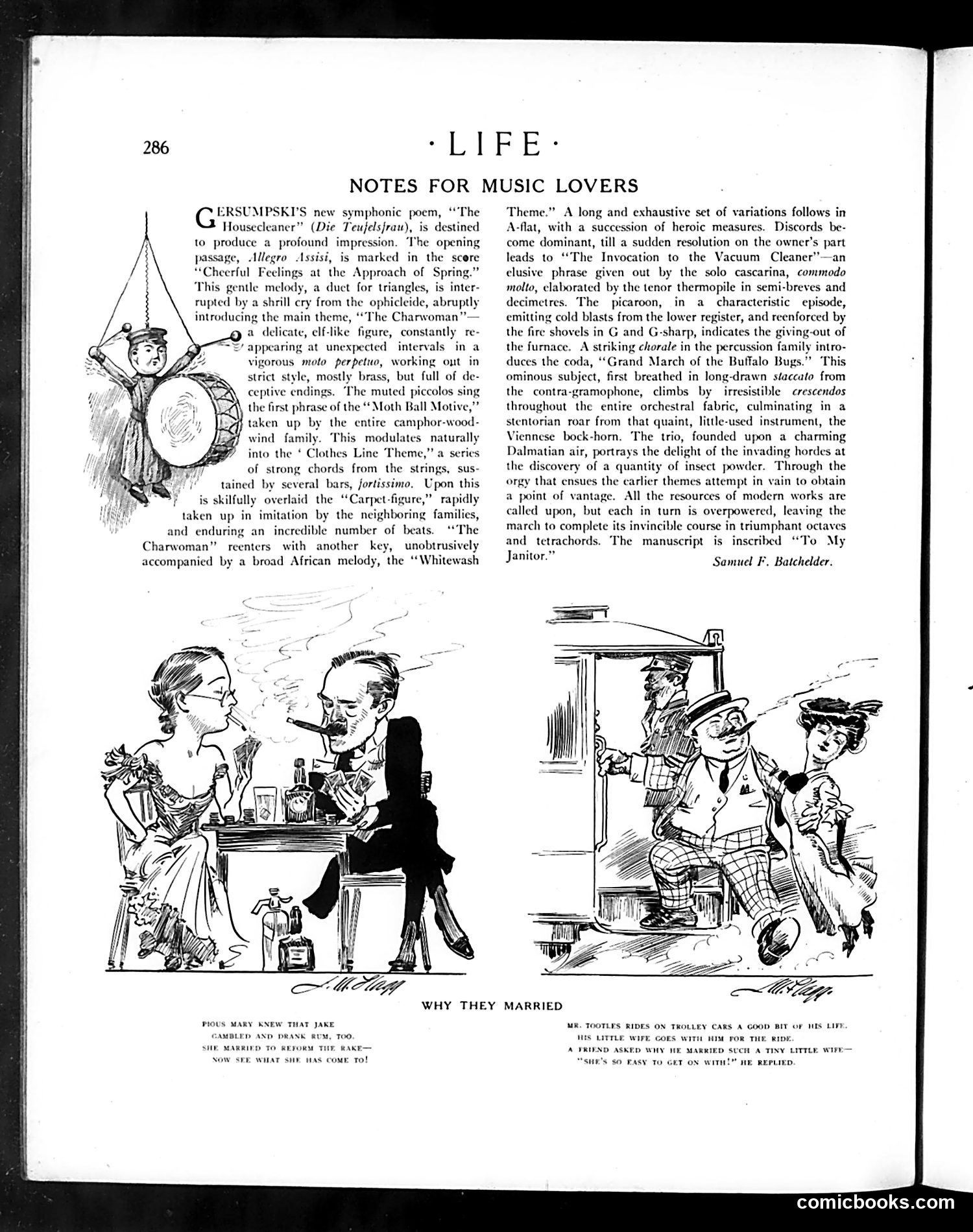
This page contains two separate elements: **Upper section**: A music review of Gershwin's symphonic poem "The Housekeeper" (*Die Teujelsjtran*), detailing its musical themes and structure. The review is credited to Samuel F. Batchelder. **Lower section**: Two cartoon panels titled "Why They Married," signed by the artist Cesare. The cartoons present satirical takes on marriage motivations: - **Left panel**: A couple at a table; the caption explains she married him because he "married to secure the rake—now she rules him with a crook!" - **Right panel**: Shows a man on trolley cars with his wife; the joke involves him riding trolleys as "a good bit of his life," with his wife easily joining for the ride. These cartoons mock marriage dynamics and gender relations through humor about control, compatibility, and daily routines.
📄 Transcribed text from this page (OCR, searchable)
Machine-transcribed from the original scan — historical spelling and the odd misread are preserved.
*LIFE~ NOTES FOR MUSIC LOVERS ” (Die Teujelsjrau), is desti to produce a profound impression. ‘The opening passage, Allegro Assisi, is marked in the “Cheerful Feelings at the Approach of This gentle melody, a duct for triangles, is inter- rupted by a shrill cry from the ophicleide, abruptly introducing the main theme, ‘The Charwoman”— delicate, elf-like figure, constantly re- ppearing at unexpected intervals in a vigorous moto perpetuo, working out in strict style, mostly brass, but full of de- ceptive endings. ‘The muted piccolos sing the first phrase of the “ Moth Ball Motive,” taken up by the entire camphor-wood- wind family. This modulates naturally into the ‘ Clothes Line Theme,” a series of strong chords from the strings, sus- tained by several bars, jortissimo. Upon this skilfully overlaid the “Carpet-figure,” rapidly taken up in imitation by the neighboring families, and enduring an incredible number of beats. ‘The Charwoman” reenters with another key, unobtrusively accompanied by a broad African melody, the ‘* Whitewash WHY THEY PIOUS MARY KNEW THAT JAKE CAMBLED AND DRANK UM, TOO. SHE MARRIND TO REFORM THE RAKE— NOW SHE WHAT SHE HAS CoME To! Theme.” A long and exhaustive set of variations follows in A-flat, with a succession of heroic measures. Discords be- come dominant, till a sudden resolution on the owner's part leads to “The Invocation to the Vacuum Cleaner’’—an elusive phrase given out by the solo cascarina, commodo molto, elaborated by the tenor thermopile in semi-breves and decimetres. The picaroon, in a characteristic episode, emitting cold blasts from the lower register, and reenforced by the fire shovels in G and G-sharp, indicates the giving-out of the furnace. A striking chorale in the percussion family intro- duces the coda, ‘Grand March of the Buffalo Bugs.” This ominous subject, first breathed in long-drawn staccato from the contra-gramophone, climbs by irresistible crescendos throughout the entire orchestral fabric, culminating in a stentorian roar from that quaint, little-used instrument, the Viennese bock-horn. The trio, founded upon a charming Dalmatian air, portrays the delight of the invading hordes at the di of a quantity of in: powder. Through the orgy that ensues the carlier themes attempt in vain to obtain a point of vantage. All the resources of modern works are called upon, but each in turn is overpowered, leaving the march to complete its invincible course in triumphant octaves and tetrachords. The manuscript is inscribed ‘o My Janitor.” Samuel F, Batchelder. MARRIED MR. TOOTLFS RIDES ON TROLLEY CARS A GOOD BIT OF VIS LIT? WIS LITTLE WIFE GOES WITH HM roR THE RIDE: A FRIEND ASKED WHY IE MARRIED SUCH A TINY LITTLE WIFE “SHE'S SO FASY TO GET ON WITH!" HE REPLIED. comicbooks.com