
Life, 1906-09-13 · page 6 of 24
Life — September 13, 1906 — page 6: what you’re looking at
What you’re looking at
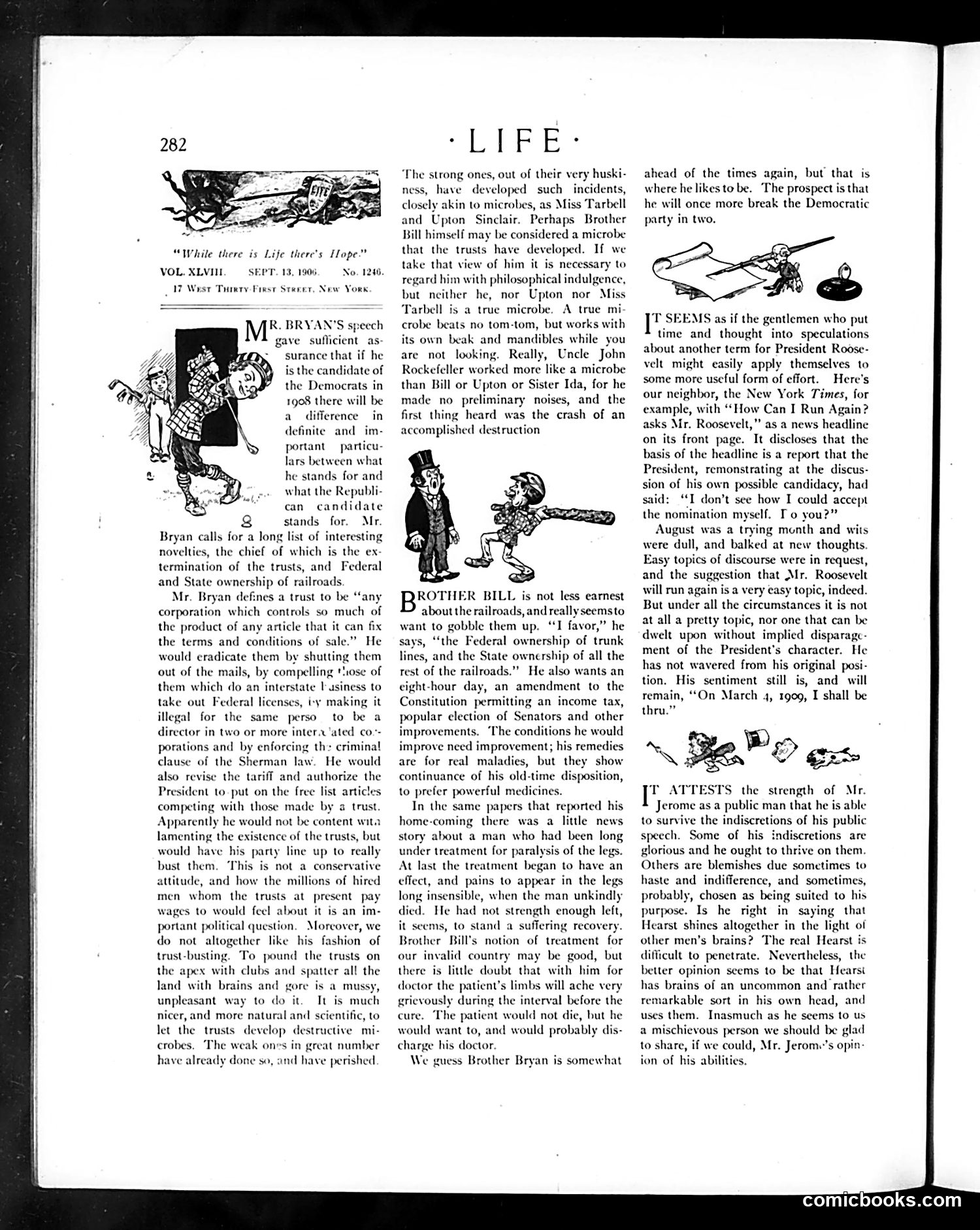
This page discusses William Jennings Bryan's political positions, particularly his stance on trusts and railroads. The cartoons satirize Bryan's proposed remedies for monopolies. The central cartoon depicts Bryan as a figure attempting to "gobble up" or control trusts and railroads through Federal ownership—a radical Progressive-era proposal. The satire suggests Bryan's solutions are crude or ineffective. The text criticizes Bryan's trust-busting platform as impractical, arguing his methods lack the sophistication of actual trust regulation. References to "Brother Bill" and detailed discussion of railroad ownership indicate this addresses Bryan's 1908 presidential candidacy and Democratic platform. The overall tone mocks Bryan's reformist ambitions as populist theater rather than serious policy—a common Life magazine critique of him during his multiple presidential campaigns.
📄 Transcribed text from this page (OCR, searchable)
Machine-transcribed from the original scan — historical spelling and the odd misread are preserved.
“While there is Life there's Hope.” VOL. XLVIII 17 West Turery Fiesr Sterner, New Yor. SEPT. 13, 1906 No. 1246. R. BRYAN’S sp gave suflicient as surance that if he is the candidate of the Democrats in 1908 there will be a difference in definite and im- portant particu- lars between what he stands for and what the Republi- can candidate stands for. Mr. Bryan calls for a long list of interesting novelties, the chief of which is the ex- termination of the trusts, and Federal and State ownership of railroads. Mr. Bryan defines a trust to be “any corporation which controls so much of the product of any article that it can fix the terms and conditions of sale.” He would eradicate them by shutting them out of the mails, by compelling tose of them which do an interstate | usiness to take out Federal licenses, by making it illegal for the same perso to be a director in two or more inter.x'ated co-- porations and by enforcing th: criminal clause of the Sherman law. He would also revise the tariff and authorize the President to. put on the free list artic competing with those made by a trust Apparently he would not be content wit lamenting the existence of the trusts, but would have his party line up to really bust them. This is not a conservative attitude, and how the millions of hired men whom the trusts at present pay wages to would feel about it is an im- portant political question. Moreover, we do not altogether like his fashion of trust-busting. To pound the trusts on the apex with clubs and spatter all the land with brains and yore is a mussy, unpleasant way to do it. It is much nicer, and more natural and scientific, to Jet the trusts develop destructive mi- crobes. The weak ones in great number have already done so, and have perished ‘LiFe ‘The strong ones, out of their very huski ness, have developed such incidents, closely akin to microbes, as Miss Tarbell and Upton Sinclair, Perhaps Brother Bill himself may be considered a microbe that the trusts have developed. If we take that view of him it is necessary to regard him with philosophical indulgence, but neither he, nor Upton nor Miss Tarbell is a true microbe. A true mi crobe beats no tom-tom, but works with its own beak and mandibles while you are not looking. Really, Uncle John Rockefeller worked more like a microbe than Bill or Upton or Sister Ida, for he made no preliminary noises, and the first thing heard was the crash of an accomplished destruction ROTHER BILL is not less earnest about the railroads, and really seemsto want to gobble them up. “I favor,” he “the Federal ownership of trunk lines, and the State ownership of all the rest of the railroads.”” He also wants an eight-hour day, an amendment to the Constitution permitting an income tax, popular election of Senators and other improvements. ‘The conditions he would improve need improvement; his remedies are for real maladies, but they continuance of his old-time disposition, to prefer powerful medicines. In the same papers that reported his home-coming there was a little news story about a man who had been long under treatment for paralysis of the leg: At last the treatment began to have an effect, and pains to appear in the legs long insensible, when the man unkindly died. He had not strength enough left, it seems, to stand a suffering recovery. Brother Bill's notion of treatment for our invalid country may be good, but there is little doubt that with him for doctor the patient’s limbs will ache very grievously during the interval before the cure. The patient would not die, but he would want to, and would probably dis- charge his doctor. We guess Brother Bryan is somewhat ahead of the times again, but that is where he likes to be. The prospect is that he will once more break the Democratic party in two, T SEEMS as if the gentlemen who put time and thought into speculations about another term for President Roose- velt' might easily apply themselves to some more useful form of effort. Here's our neighbor, the New York Times, for example, with “How Can I Run Again? asks Mr. Roosevelt,” as a news headline on its front page. It discloses that the basis of the headline is a report that the President, remonstrating at the discus- sion of his own possible candidacy, had “T don’t see how I could accept the nomination myself. To you?” August was a trying month and wits were dull, and balked at new thoughts. Easy topics of discourse were in request, and the suggestion that Mr. Roosevelt will run again is a very casy topic, indeed. But under all the circumstances it is not at all a pretty topic, nor one that can be dwelt upon without implied disparage- ment of the President's character. He has not wavered from his original posi- tion. His sentiment still is, and will remain, “On March 4, 1909, I shall be rS the strength of Mr. Jerome as a public man that he is able to survive the indiscretions of his public speech. Some of his indiscretions are glorious and he ought to thrive on them. Others are blemishes due sometimes to haste and indifference, and sometimes, probably, chosen as being suited to his purpose. Is he right in saying that Hearst shines altogether in the light of other men’s brains? The real Hearst is difficult to penetrate. Nevertheless, the better opinion seems to be that Hearst brains of an uncommon and rather remarkable sort in his own head, and uses them. Inasmuch as he seems to us a mischievous person we should be glad to share, if we could, Mr. Jerome's opin- ion of his abil comicbooks.com