
A complete issue · 40 pages · 1906
Life — September 6, 1906
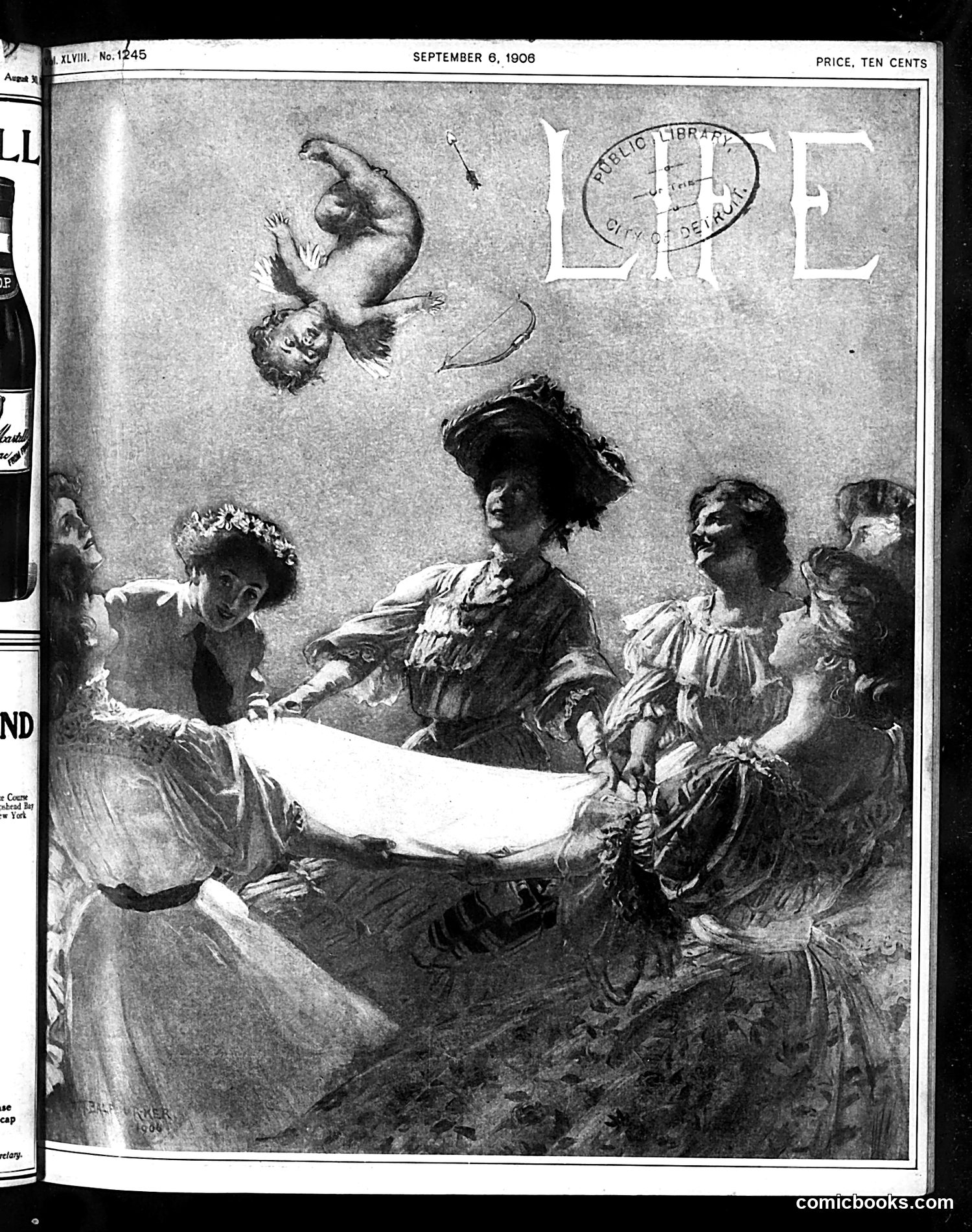
I can see this is the cover of *Life* magazine from September 6, 1906 (priced at ten cents). The illustration shows several women in Edwardian dress gathered around what appears to be a white cloth or garment they're examining together, with cherubs or putti floating above. However, without clear text identifying the specific figures or satirical subject, I cannot definitively explain what political or social commentary this represents. The scene suggests domestic activity—possibly related to fashion, needlework, or household matters—but the exact target of satire is unclear from the image alone. The OCR text provided doesn't include descriptive captions that would clarify the cartoon's meaning or reference contemporary 1906 events or figures.
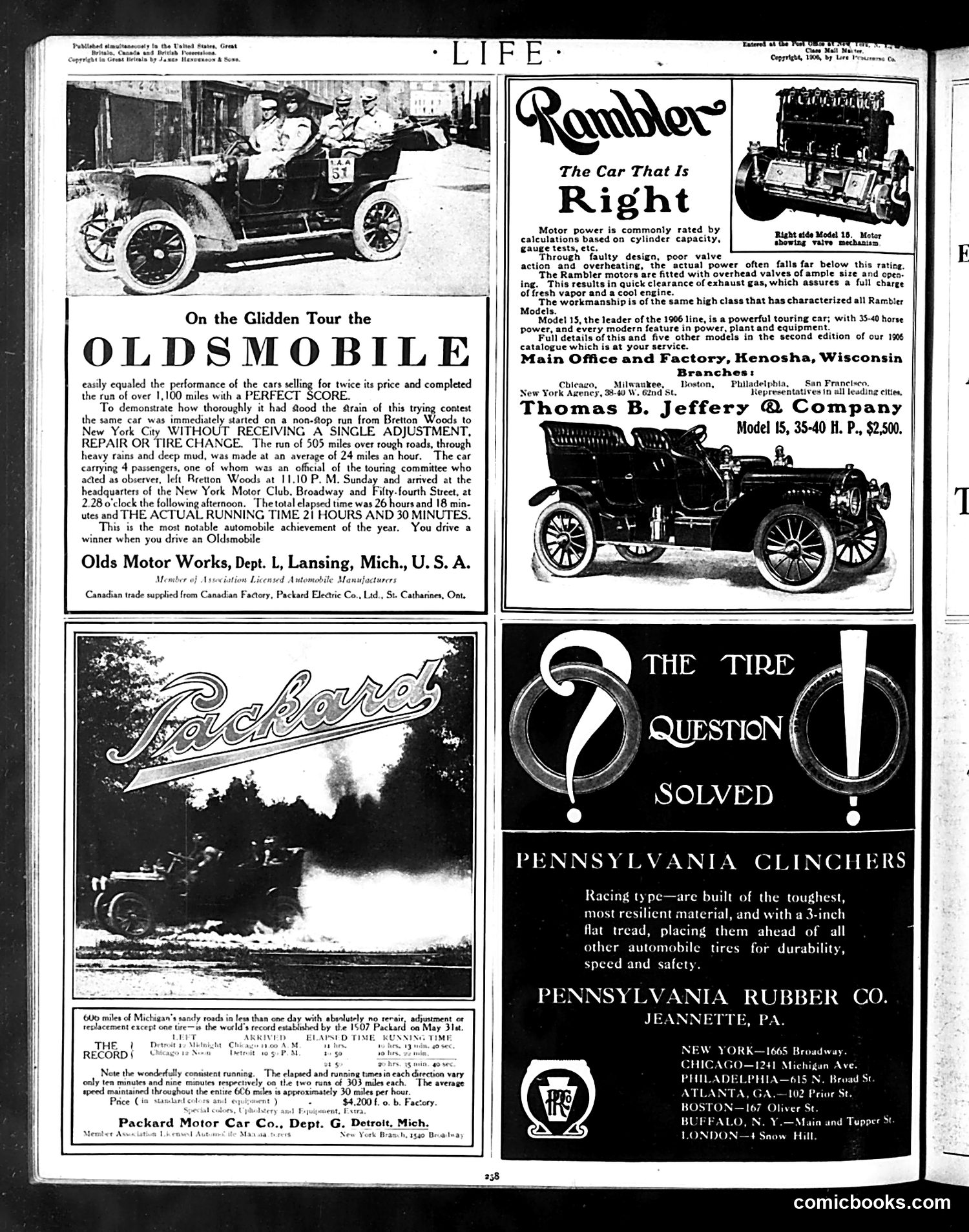
This page is **primarily advertising**, not satire or political commentary. It contains four automobile advertisements from circa 1906: 1. **Oldsmobile** - promoting a car's performance in a "Glidden Tour" reliability contest, emphasizing it ran 1,100 miles with a "perfect score" and "without receiving a single adjustment." 2. **Rambler** - highlighting motor power ratings and Model 15 specifications. 3. **Packard** - showing a car completing 640 miles of Michigan roads with "absolutely no error, adjustment or replacement." 4. **Pennsylvania Clinchers** (tires) - claiming superior durability and safety. The ads reflect early automotive marketing's focus on **reliability and endurance** as key selling points, since cars were still novel and untested technology. There is no political satire present on this page.
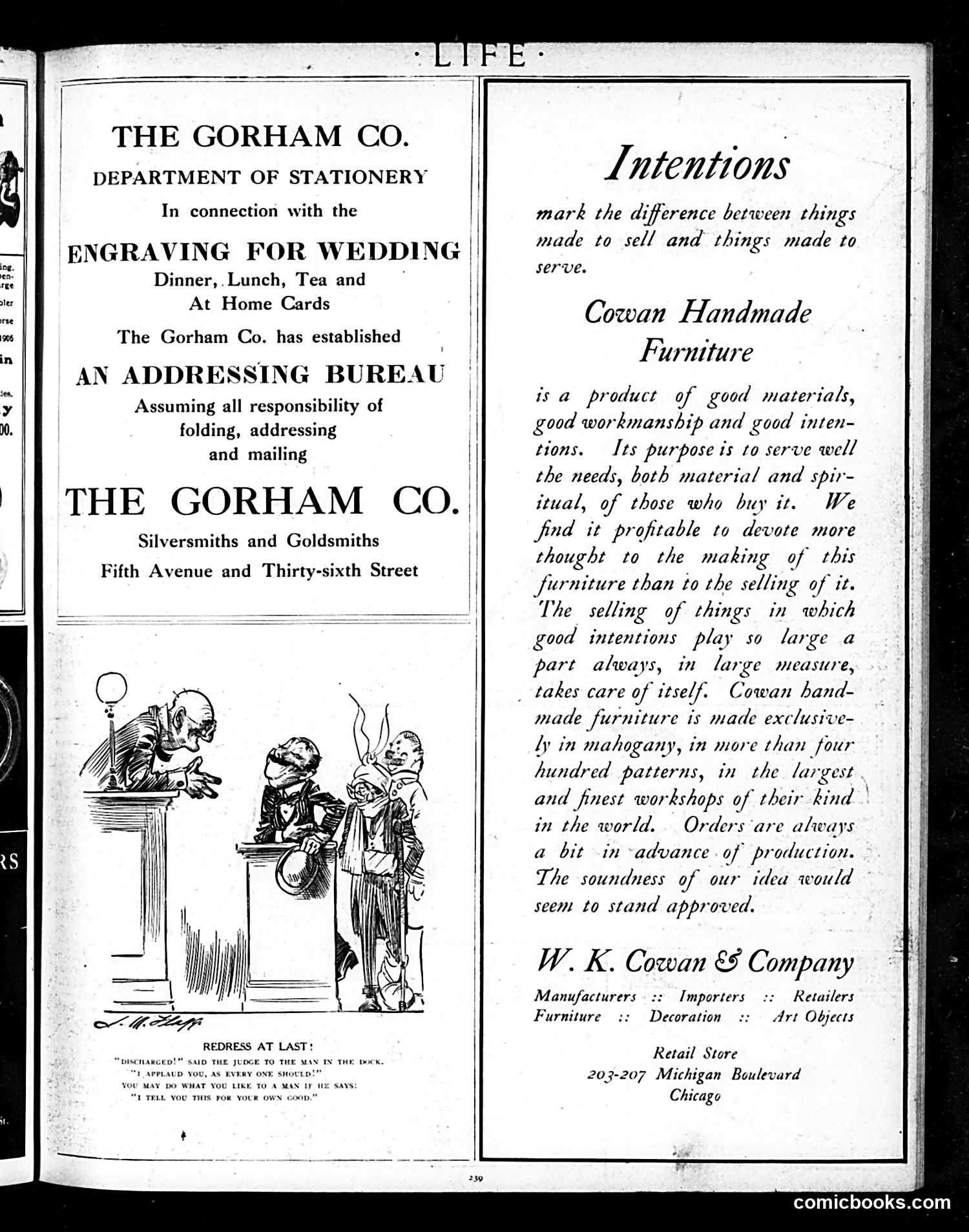
This page contains two advertisements with a cartoon illustration on the left side. **The Cartoon:** The sketch shows what appears to be a domestic dispute or complaint scene. An angry figure stands at a pedestal addressing two others (possibly a couple), with the caption "REDRESS AT LAST!" The quoted lines below—including "I DISCHARGED!" and "I APPLAUD YOU, AS EVERY ONE SHOULD!"—suggest commentary on marital grievances or household complaints. The figure appears to be some authority dispensing judgment. **The Advertisements:** The right side features W.K. Cowan & Company's furniture advertisement, emphasizing handmade quality and good intentions. The left advertises The Gorham Company's stationery and engraving services, plus an addressing bureau. Without more historical context about Life magazine's specific satirical targets during this period, the cartoon's precise reference remains unclear, though it appears to mock domestic complaint procedures or marital arbitration.
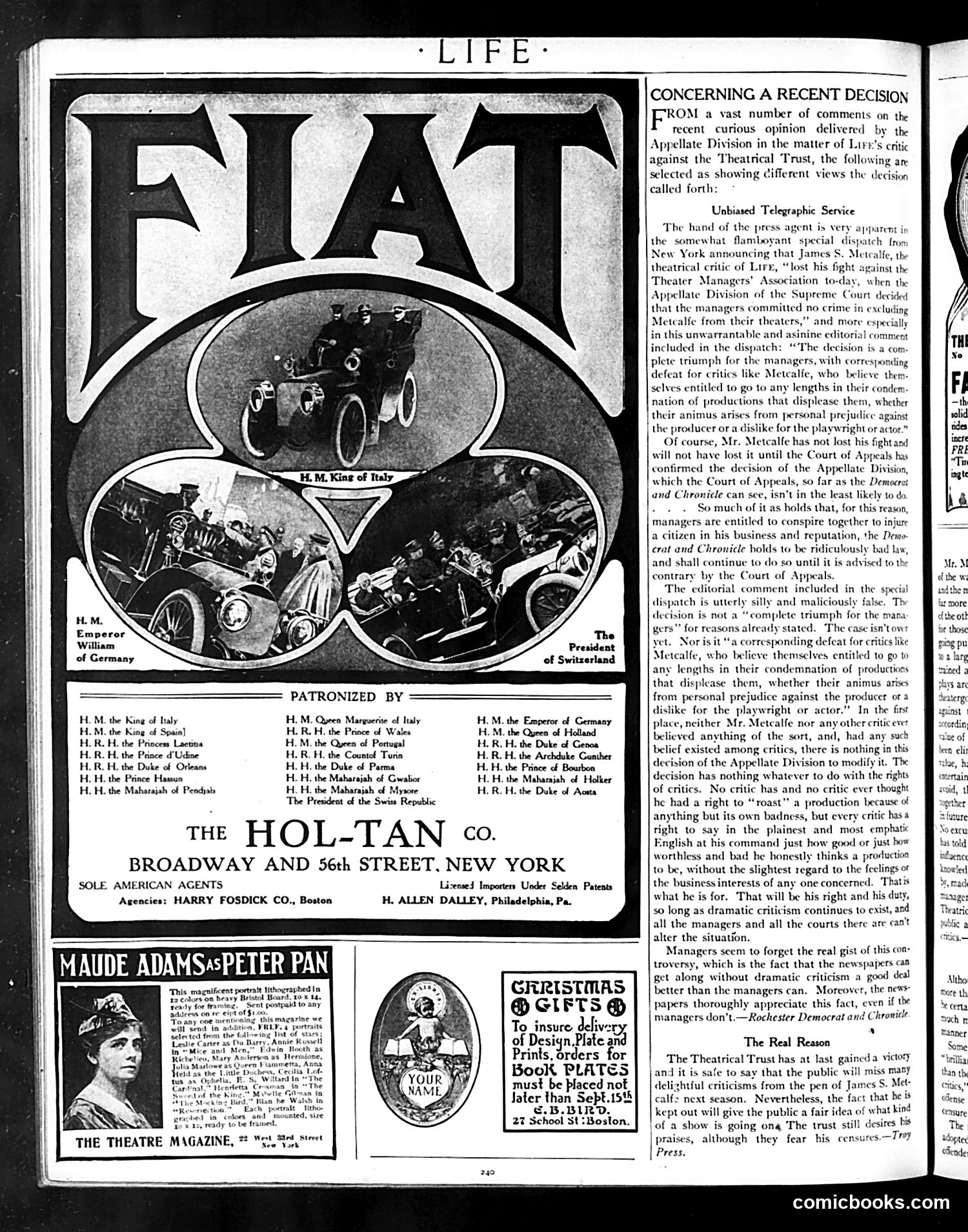
This page primarily contains **advertisements and theater notices** rather than satirical cartoons. The dominant ad features the "Hol-Tan Co." automobile company, patronized by various European royalty (King of Italy, Emperor of Germany, etc.)—a common advertising strategy of the era using royal endorsements for luxury goods. Below is an advertisement for "Maude Adams as Peter Pan" theatrical production, and a Christmas gift advertisement for decorative plates. The right column contains editorial commentary on a recent court decision regarding theatrical critic James S. Metcalfe and the Theater Managers' Association—a dispute about critics' rights to review productions. The text debates whether managers can exclude critics from theaters based on personal disagreement. This is primarily a **commercial page** rather than satirical commentary.
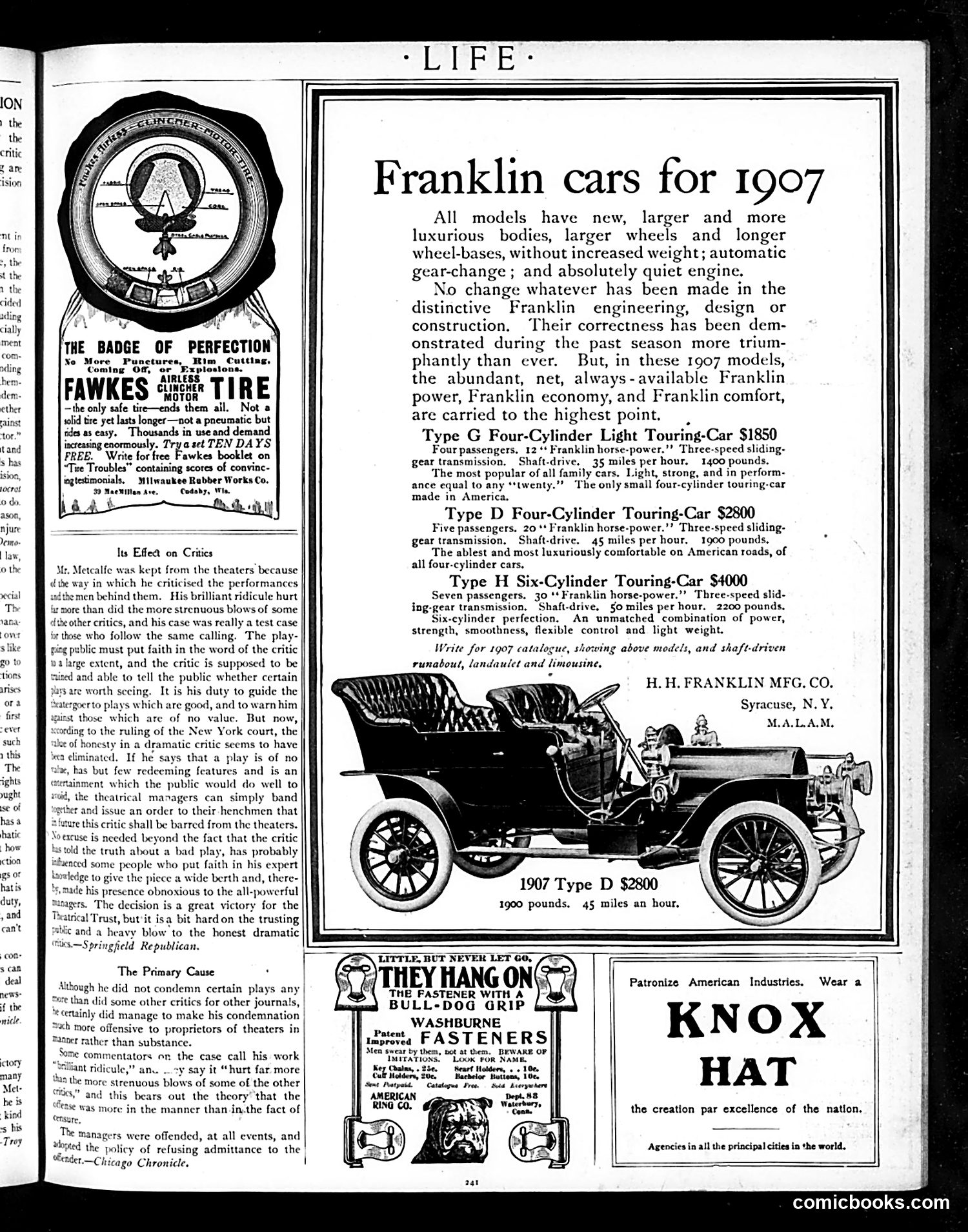
This page is primarily **advertising content**, not satire or political commentary. It features three ads: 1. **Fawkes Tires** (upper left): A humorous ad claiming their tires are "The Badge of Perfection" and will outlast competitors' products—standard early automotive advertising hyperbole. 2. **Franklin automobiles** (center): The main feature, showcasing three 1907 car models with technical specifications. Franklin emphasizes engineering quality and comfort, targeting affluent buyers. 3. **Smaller ads** (bottom): Bull-dog grip fasteners and Knox hats. The left column contains unrelated editorial content about theatrical criticism. There is **no political cartoon or satire** on this page—it represents typical Life magazine content from 1907: a mix of editorial pieces and luxury product advertising targeting the magazine's affluent readership.
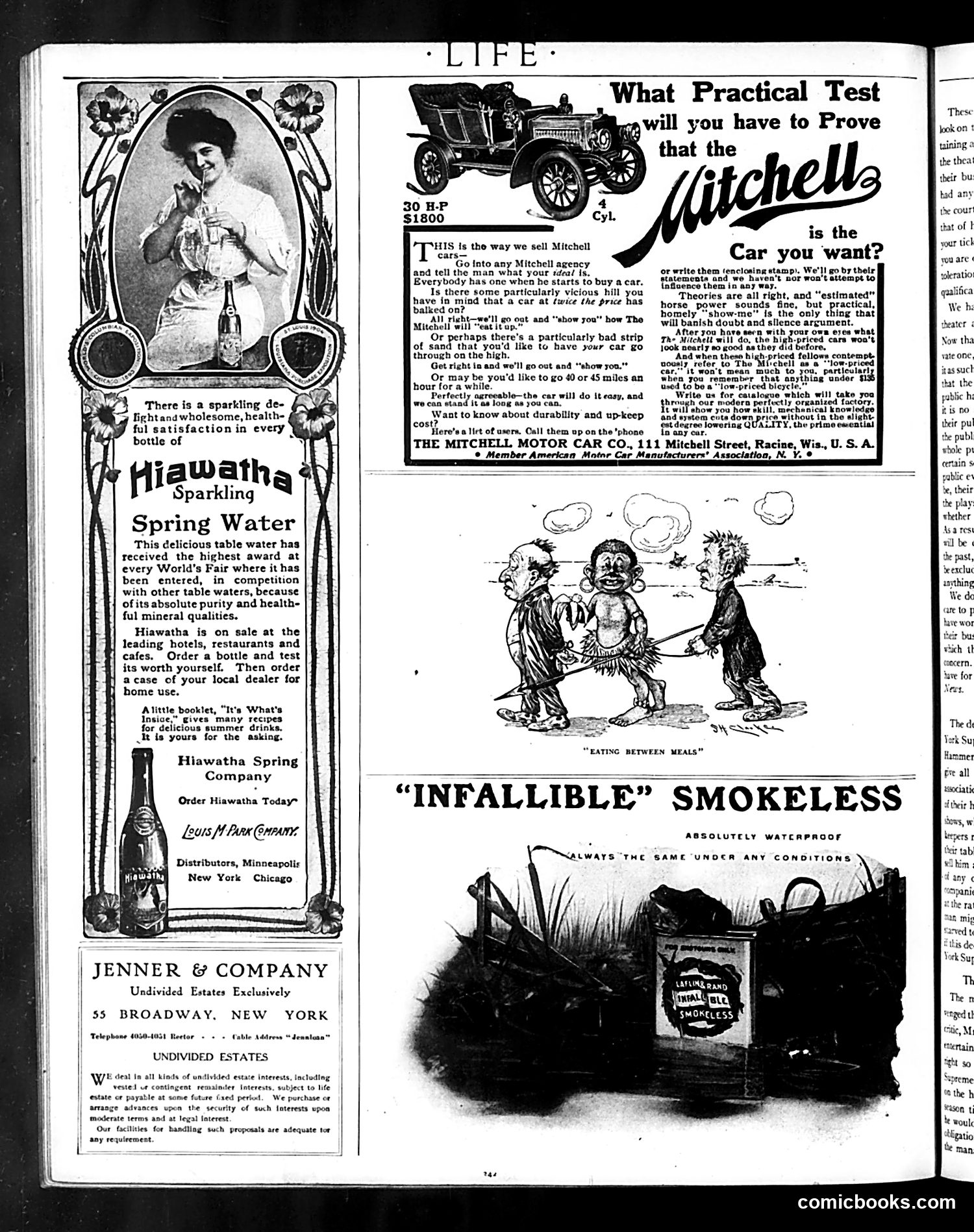
This page is primarily **advertising**, not satirical editorial content. The main advertisements are: 1. **Mitchell automobiles** (top right) - promoting their cars' reliability through practical testing 2. **Hiawatha Sparkling Spring Water** (left) - a mineral water product sold at hotels and restaurants 3. **Jenner & Company** (bottom left) - real estate services in New York 4. **"Infallible" Smokeless** (bottom right) - appears to be a firearm or ammunition product The only cartoon element is a small humorous sketch labeled "EATING BETWEEN MEALS" showing three caricatured figures sharing food—a generic joke with no apparent political content or historical reference. This is typical filler humor for the era. The page reflects early 20th-century consumer advertising and leisure culture.
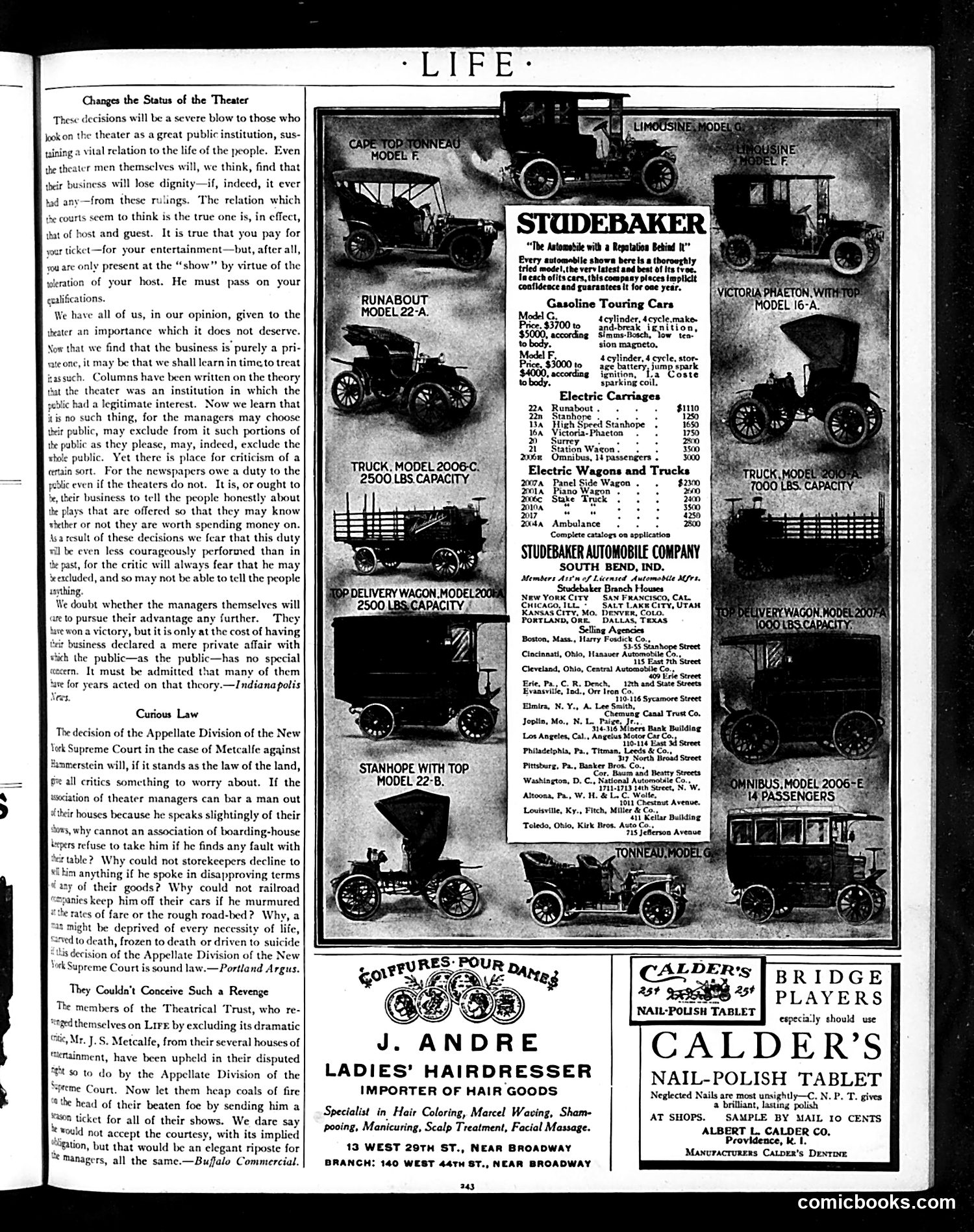
This page is **primarily advertising**, not satirical cartoons. It features Studebaker automobile advertisements displaying various vehicle models (runabout, truck, delivery wagon, omnibus, limousine, stanhope) with specifications and pricing. The left column contains editorial text about theater management and criticism, discussing institutional responsibility and a "Curious Law" regarding theatrical liability—appears to reference a court case but specific details aren't visible. Below the main ads are small advertisements for J. Andre (ladies' hairdresser) and Calder's Nail-Polish Tablet. The page reflects early 20th-century concerns about theater ethics and consumer goods marketing, but contains **no political cartoons or satirical imagery** to analyze for modern readers.
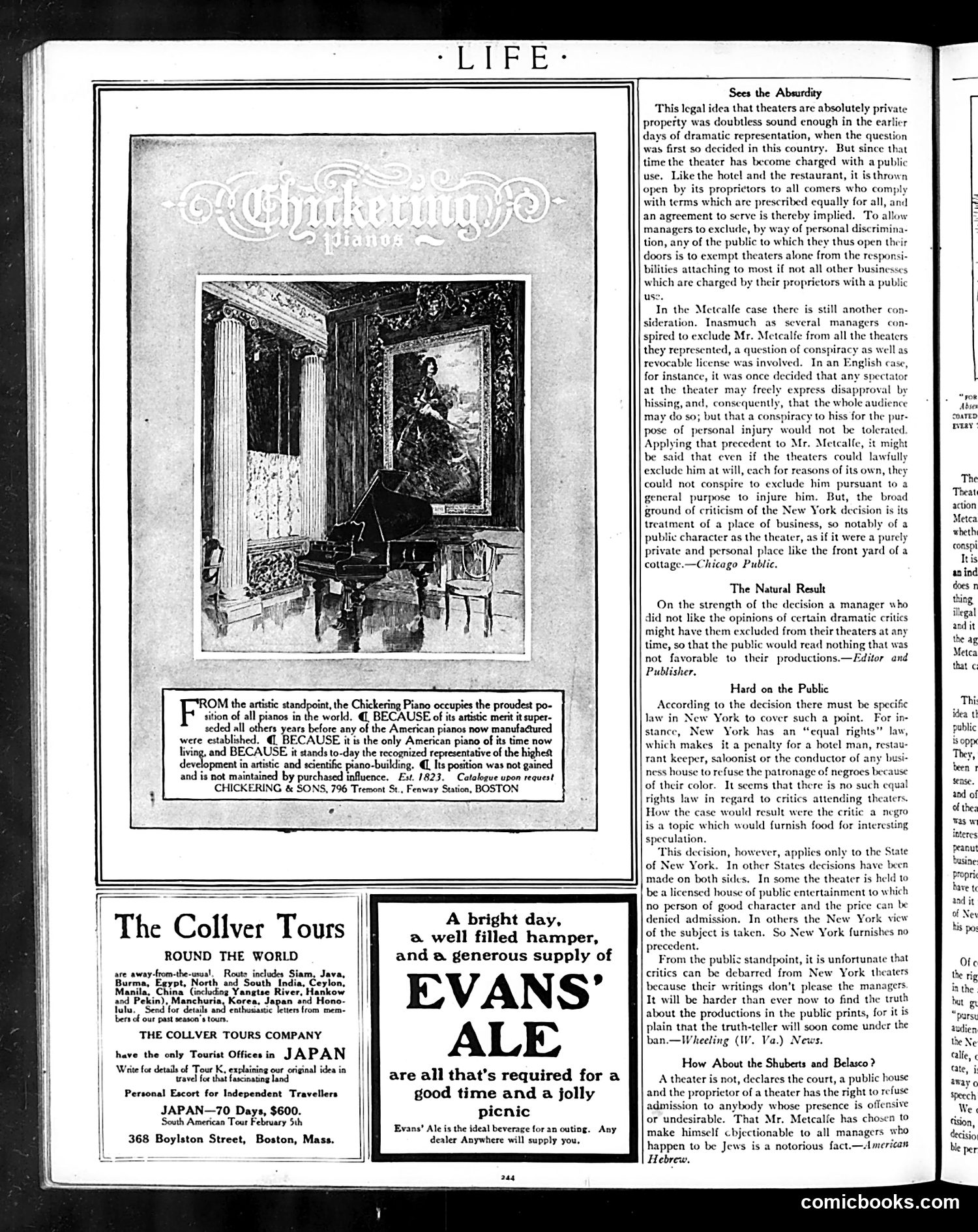
This page is primarily **advertising and editorial content** rather than political satire or comics. The main image shows a **Chickering Piano advertisement** featuring an interior scene with a woman at a piano. The accompanying text emphasizes the piano's American manufacturing heritage and artistic quality. Below are advertisements for **The Collver Tours** (around-the-world travel), **Evans' Ale** (beverage), and **Japan travel services**. The right column contains **legal commentary** discussing theater regulations—specifically whether theater managers can exclude patrons, referencing the "Metcalfe case" and New York law regarding "equal rights" and public accommodation. This appears to be a **historical trade publication page** mixing commerce with contemporary legal debate, not satirical political commentary.
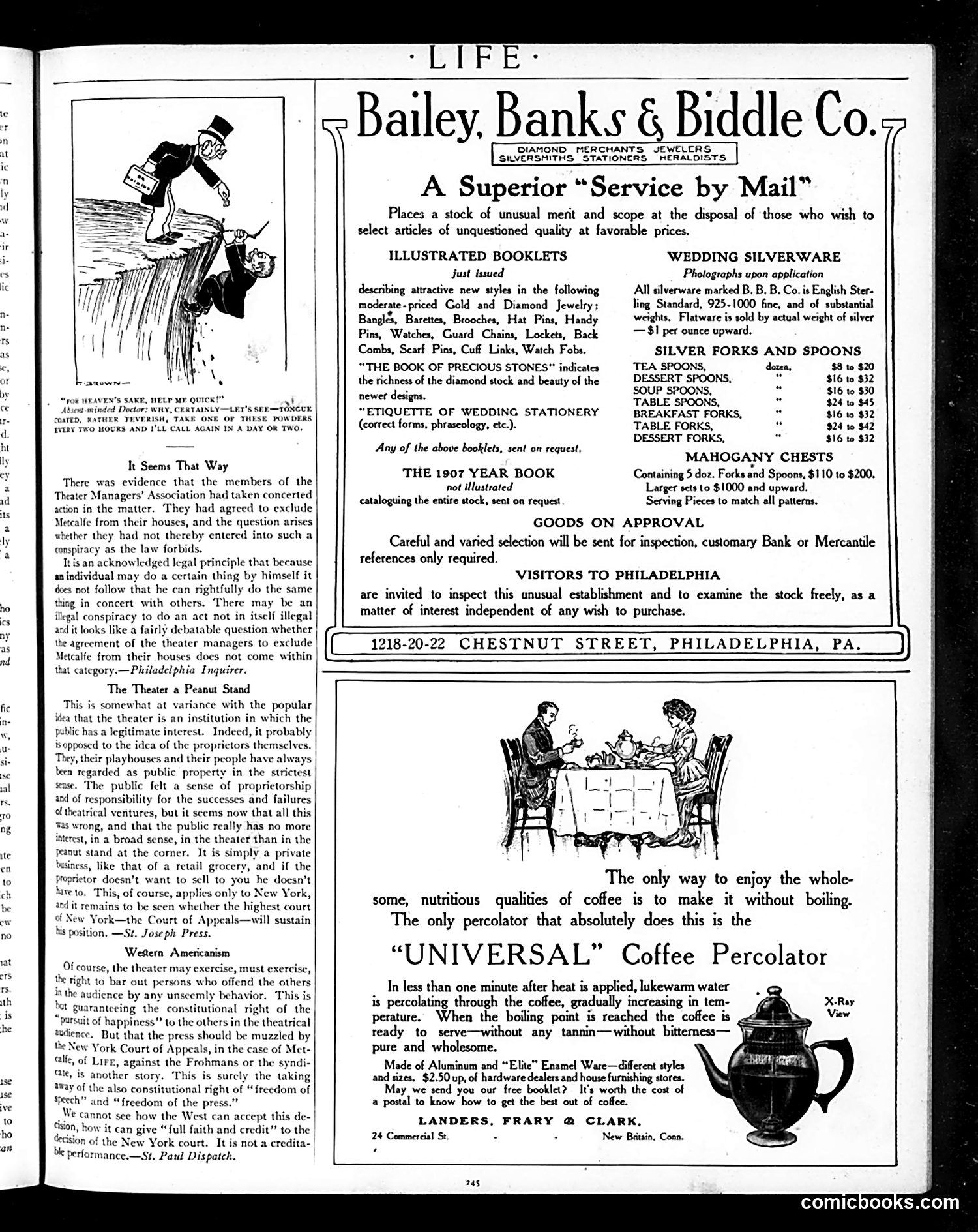
This page is primarily **advertising and articles**, not political satire. The main content includes: **Advertisements:** Bailey, Banks & Biddle Co. (jewelry/silverware) and Universal Coffee Percolator dominate the page with product listings and promotional text. **Articles:** Three short pieces appear on the left: - "It Seems That Way" — discusses theater managers excluding Maccabi (appears to reference a theater conspiracy issue) - "The Theater a Peanut Stand" — argues theaters are public institutions deserving public support - "Western Americanism" — discusses constitutional press freedoms The illustrations are decorative rather than satirical: a figure helping another climb, and a dinner table scene advertising the coffee percolator. This is a typical early-20th-century magazine page blending editorial content with advertising revenue.
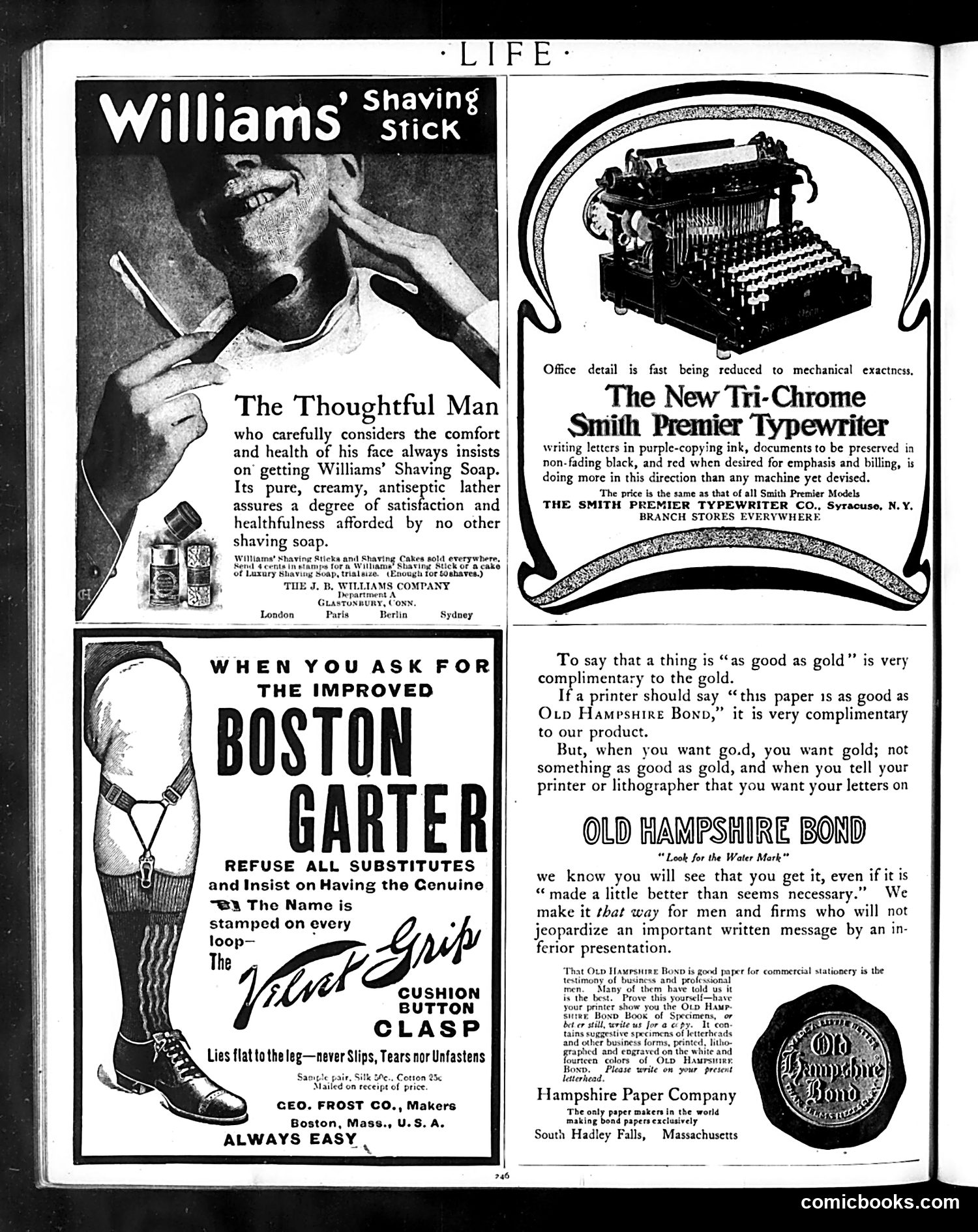
This page consists entirely of **period advertisements**, not editorial cartoons or satire. There are four product ads: 1. **Williams' Shaving Stick** — appeals to "the thoughtful man" concerned with facial comfort 2. **Smith Premier Typewriter** — emphasizes mechanical precision and multiple ink colors 3. **Boston Garter** — advertises men's garters with a cushioned button; the visual shows a leg/stocking and promises the product "never slips, tears or unfastens" 4. **Old Hampshire Bond paper** — targets printers and businesses, arguing their paper quality matches gold standard These are straightforward early-20th-century commercial advertisements with no political or satirical content. The page represents typical **Life magazine monetization** through product endorsements rather than humorous commentary.
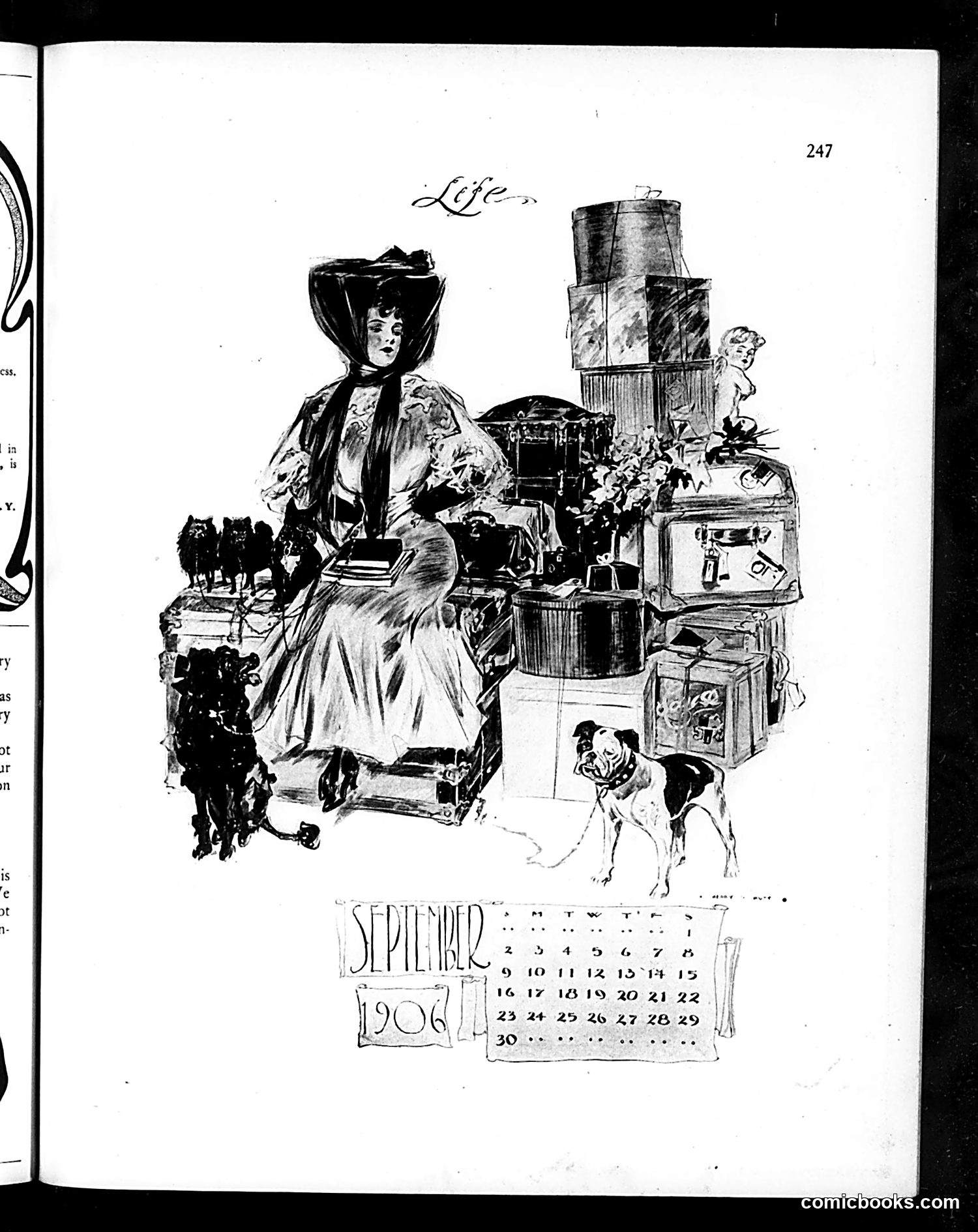
This is a calendar page for September 1906 from *Life* magazine, titled simply "Life" at the top. The illustration depicts an elegantly dressed woman surrounded by fashionable possessions and pets—including small dogs, stacked trunks, hatboxes, and various luxury goods—suggesting wealth and materialism. The satire appears to target the leisured upper-class lifestyle and consumer culture of the Edwardian era. The woman's elaborate outfit, the abundance of baggage and accessories, and the small animals suggest both frivolity and the demands of maintaining a fashionable appearance. The dog in the foreground adds a humorous touch, possibly commenting on the superficiality of high society. This reflects early 1900s social criticism of conspicuous consumption among the wealthy.
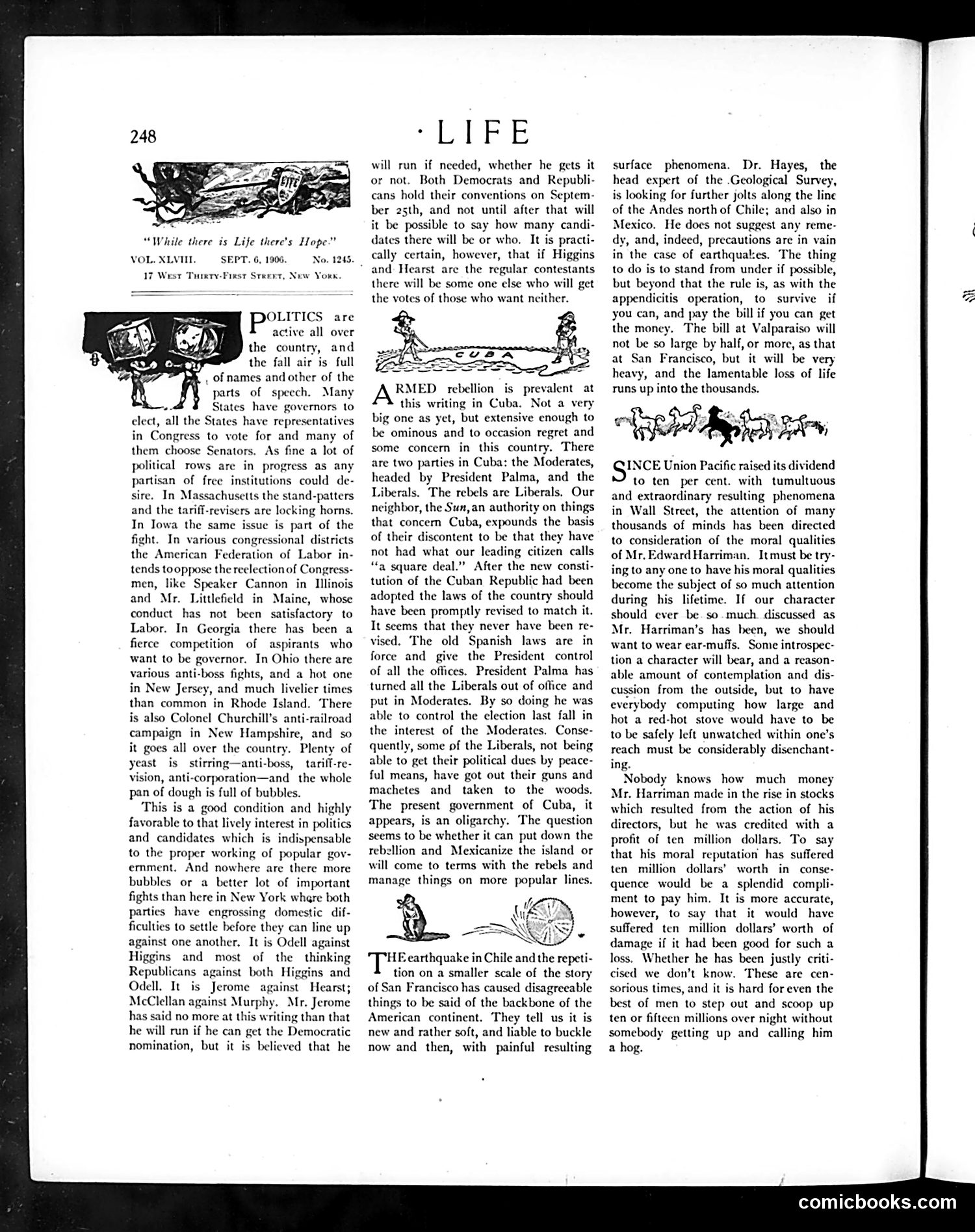
This page contains three distinct political commentaries. The opening section critiques domestic politics, particularly the contested elections involving Congressman Higgins and references to labor disputes in New York and New Jersey. The middle section discusses Cuba's political instability under President Palma, with competing Liberal and Moderate factions—one newspaper (the *Sun*) is cited as an authority defending the rebels' position. The final section addresses the 1906 Chile earthquake and its aftermath, sarcastically commenting on the moral reputation of Edward Harriman, a prominent railroad magnate. The text notes Harriman's ten-million-dollar stock profits, suggesting his ethical standing has suffered proportionally, though the satire questions whether even such loss truly impacts powerful industrialists.
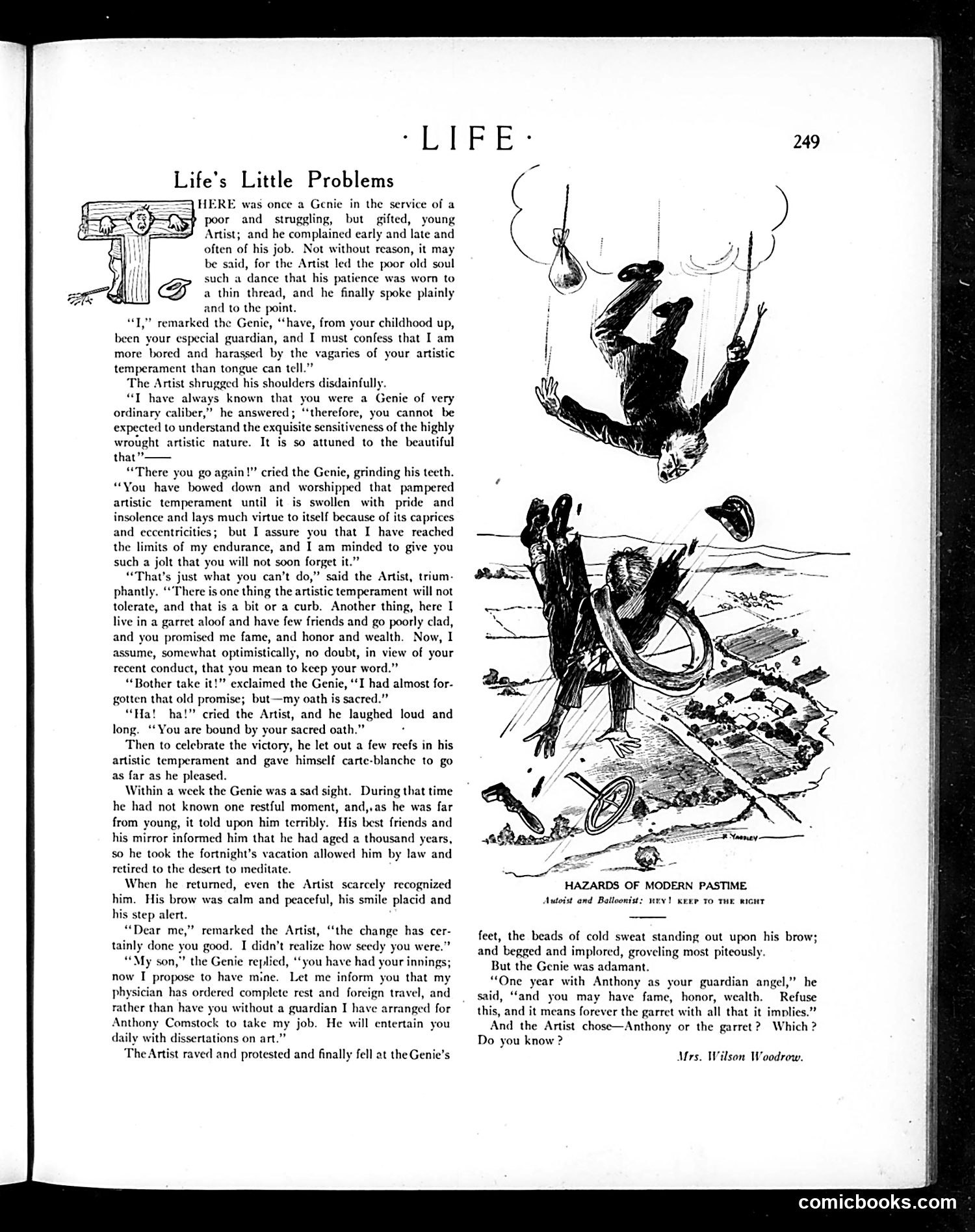
This page presents a satirical story about an Artist and a Genie, illustrated with a cartoon showing a man tumbling through the air surrounded by bicycles and other objects. The narrative mocks artistic temperament and entitlement. A Genie serves a struggling young artist but grows exhausted by his constant complaints about his "exquisite sensitiveness." When the artist finally makes a demand—claiming the Genie promised him "fame and honor and wealth"—the Genie retaliates by arranging for the artist to become a guardian for someone named Anthony Comstock, forcing him into servitude rather than artistic freedom. The cartoon's caption, "Hazards of Modern Pastime: Artist and Balloonist: Men! Keep to the Right," suggests the illustration satirizes early 20th-century recreational activities (possibly aviation or ballooning) and their dangers, though the exact connection to the story remains unclear.
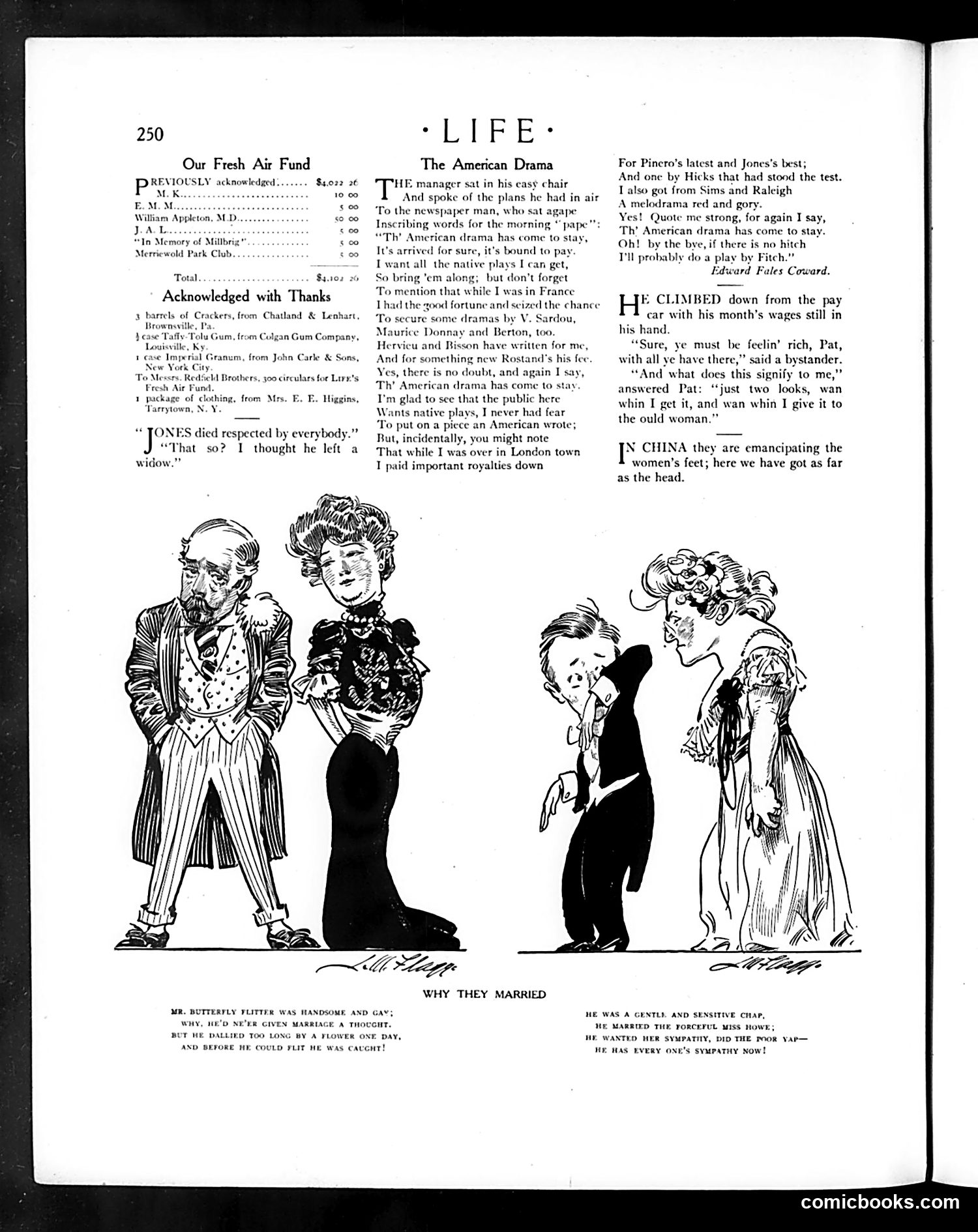
This page contains a satirical cartoon sequence titled "Why They Married," which uses insect and human couples to mock courtship and marriage motivations. The first panel depicts Mr. Butterfly Flitter—described as handsome and gay—who dallied too long near a flower and was caught, forced into marriage. This is a playful metaphor: men distracted by frivolous pleasures lose their freedom. The second panel shows a gentleman who married "the forceful Miss Howe" because he wanted her sympathy. The joke's punchline: he now has *everyone's* sympathy instead—implying his marriage to a domineering woman has made him pitiable. The cartoons satirize how people marry for superficial or self-defeating reasons: attraction, desperation, or false assumptions about what marriage provides. The anthropomorphized insects and the deadpan captions create humor by treating serious life decisions as absurdly inevitable consequences of momentary weakness or miscalculation.
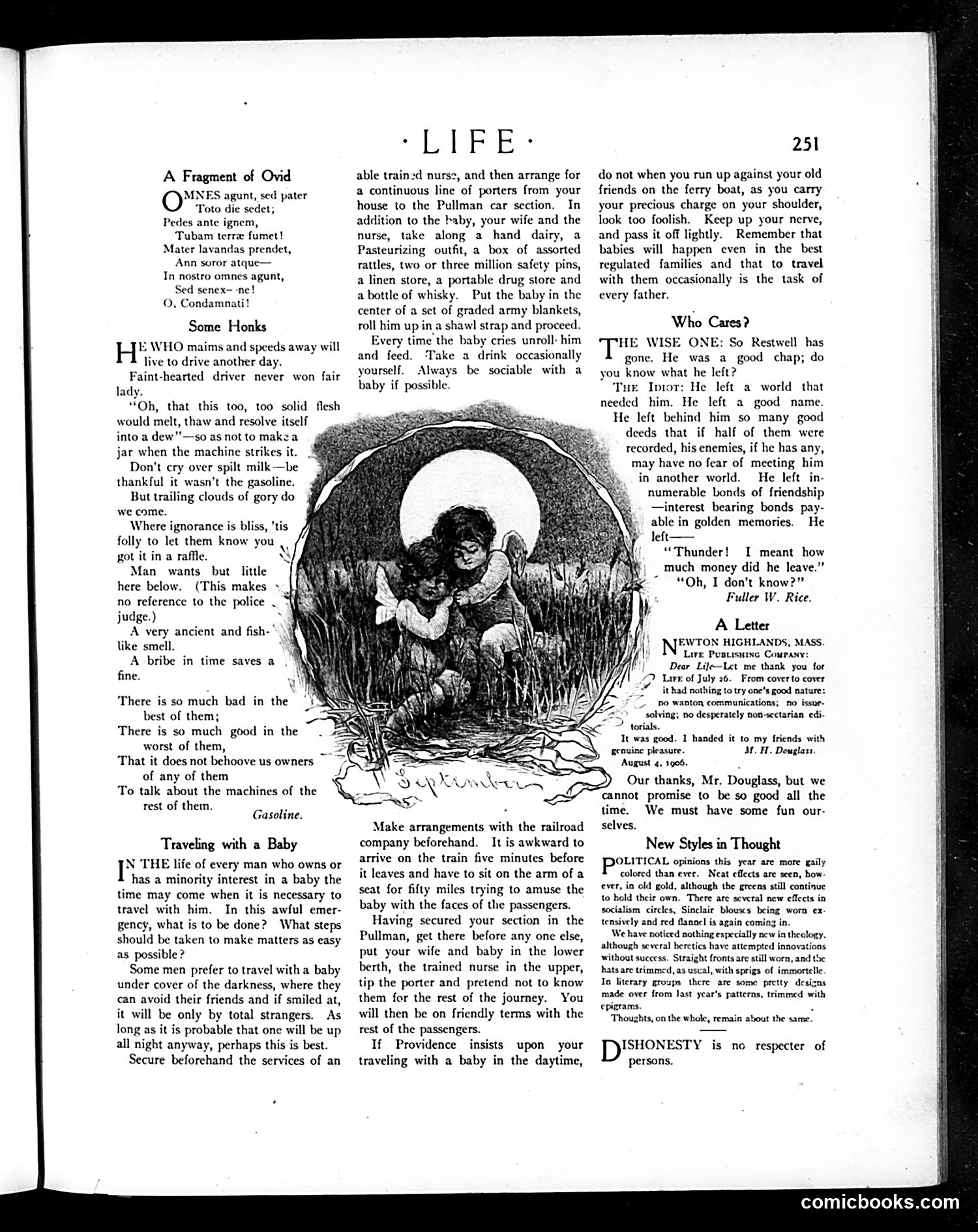
This page contains satirical commentary on early-20th-century American life, particularly automobile culture and social conventions. The **central illustration** depicts an angel cradling an infant, likely referencing mortality or divine protection—possibly illustrating themes from the literary excerpts above it. **"Some Honks"** is a collection of witty aphorisms mocking reckless drivers and automobile culture. Lines like "A bribe in time saves a fine" and "A very ancient and fish-like smell" suggest corruption among traffic enforcers and the unpleasant realities of early motoring. **"Traveling with a Baby"** offers tongue-in-cheek advice to fathers, satirizing both the absurd logistics of train travel with infants (requiring "two or three million safety pins") and parental anxiety. The humor lies in the contrast between over-preparation and the author's cynical suggestion to hide the baby from acquaintances. **"Who Cares?"** is a brief dialogue mocking hypocrisy: a "wise one" eulogizes the deceased poetically ("He left a good name"), but reveals his actual concern is money when pressing "how much money did he leave." Overall, the page satirizes American materialism, automotive culture, social pretense, and changing family dynamics of the era.
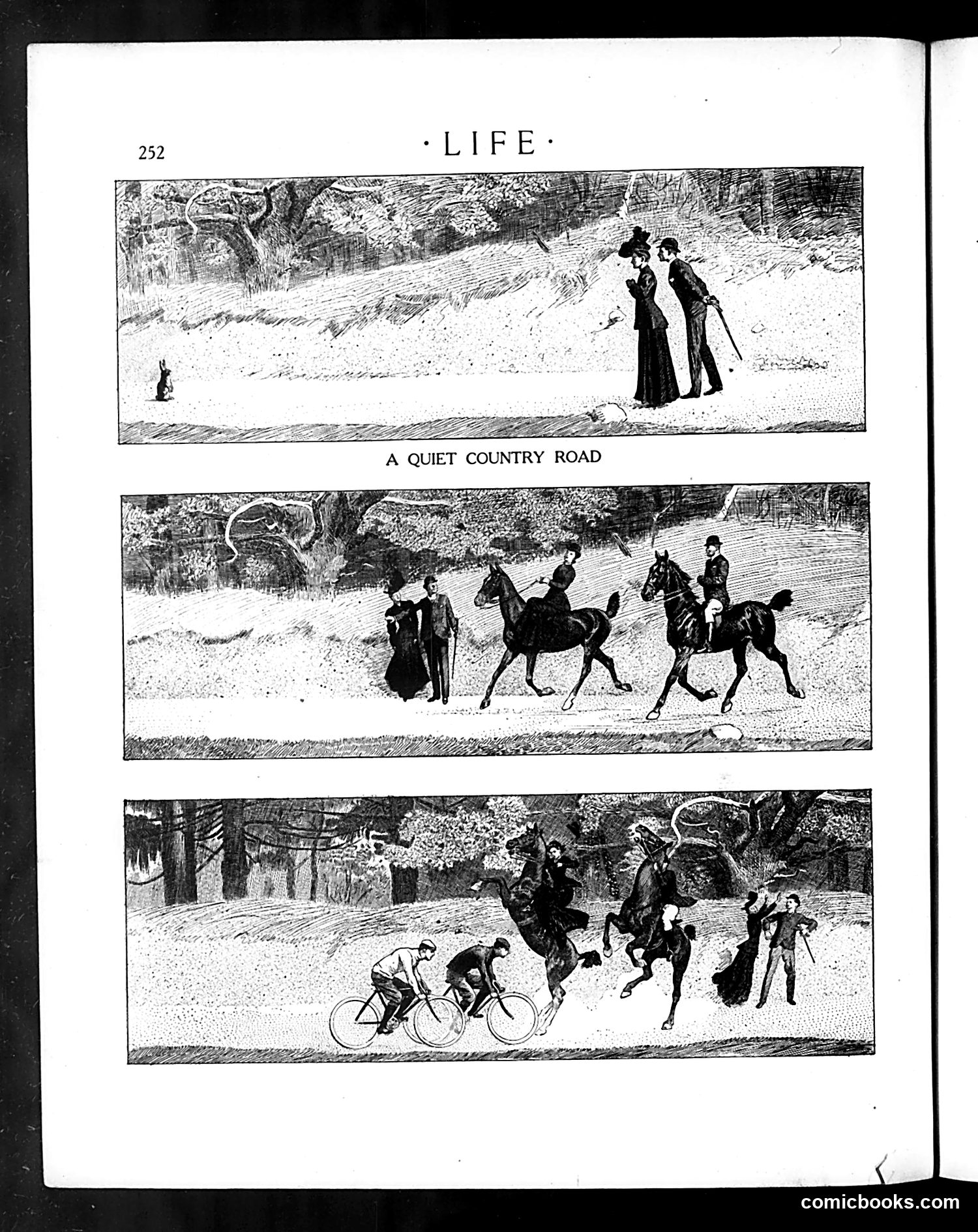
This three-panel comic depicts a peaceful country setting progressively disrupted by modern intrusions. The first panel shows an elegant couple enjoying solitude on a rural road. The second introduces horseback riders—suggesting traditional country life. The third panel shatters the "quiet" with cyclists racing through, creating chaos and noise. The satire critiques how bicycles (a relatively new technology at Life's publication period) were invading and destroying the tranquility of countryside spaces. The joke plays on the irony of seeking refuge in "quiet country" only to encounter the modern world's encroachments. It reflects early-20th-century anxieties about technology and progress disrupting traditional pastoral life—a common satirical theme in Life magazine.
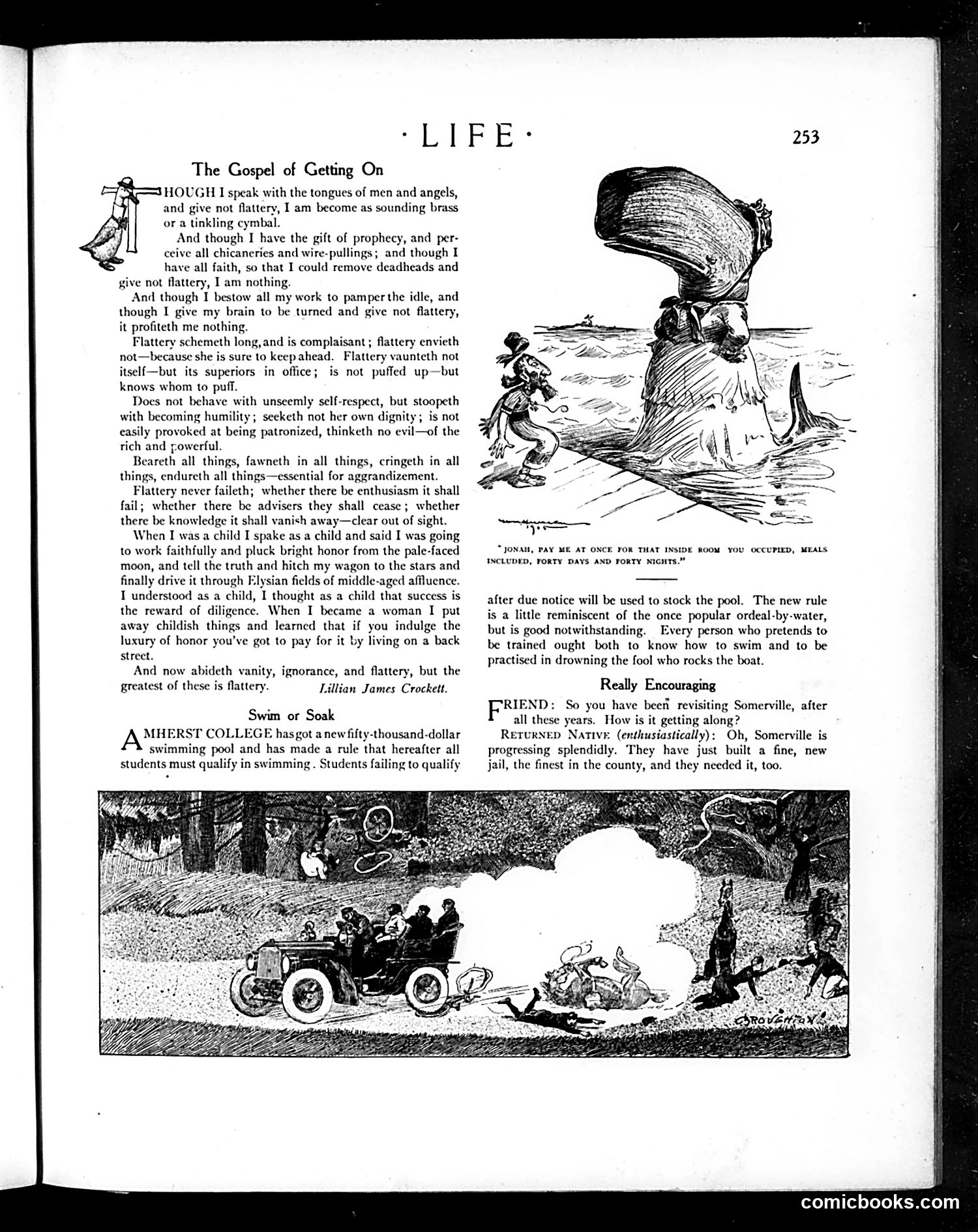
**"The Gospel of Getting On"** is a satirical essay by Lillian James Crockett that parodies Biblical language (echoing 1 Corinthians 13) to critique career advancement through flattery rather than merit. Written in mock-reverent tone, it argues that flattery—not honest work or integrity—is the true path to success in American business. The author describes how childhood ideals of honor and diligence must be abandoned; one must instead flatter superiors, suppress dignity, and compromise principles to prosper. The satire's point: American success culture rewards sycophancy over virtue. **"Swim or Soak"** jokes darkly about Amherst College's new swimming requirement, sarcastically suggesting students who can't swim will be "used to stock the pool"—a grim reference to water ordeals in medieval justice systems. **"Really Encouraging"** is a brief joke about small-town progress: a returned native boasts that Somerville's main achievement is building "a fine, new jail," implying the town's only growth is criminal.
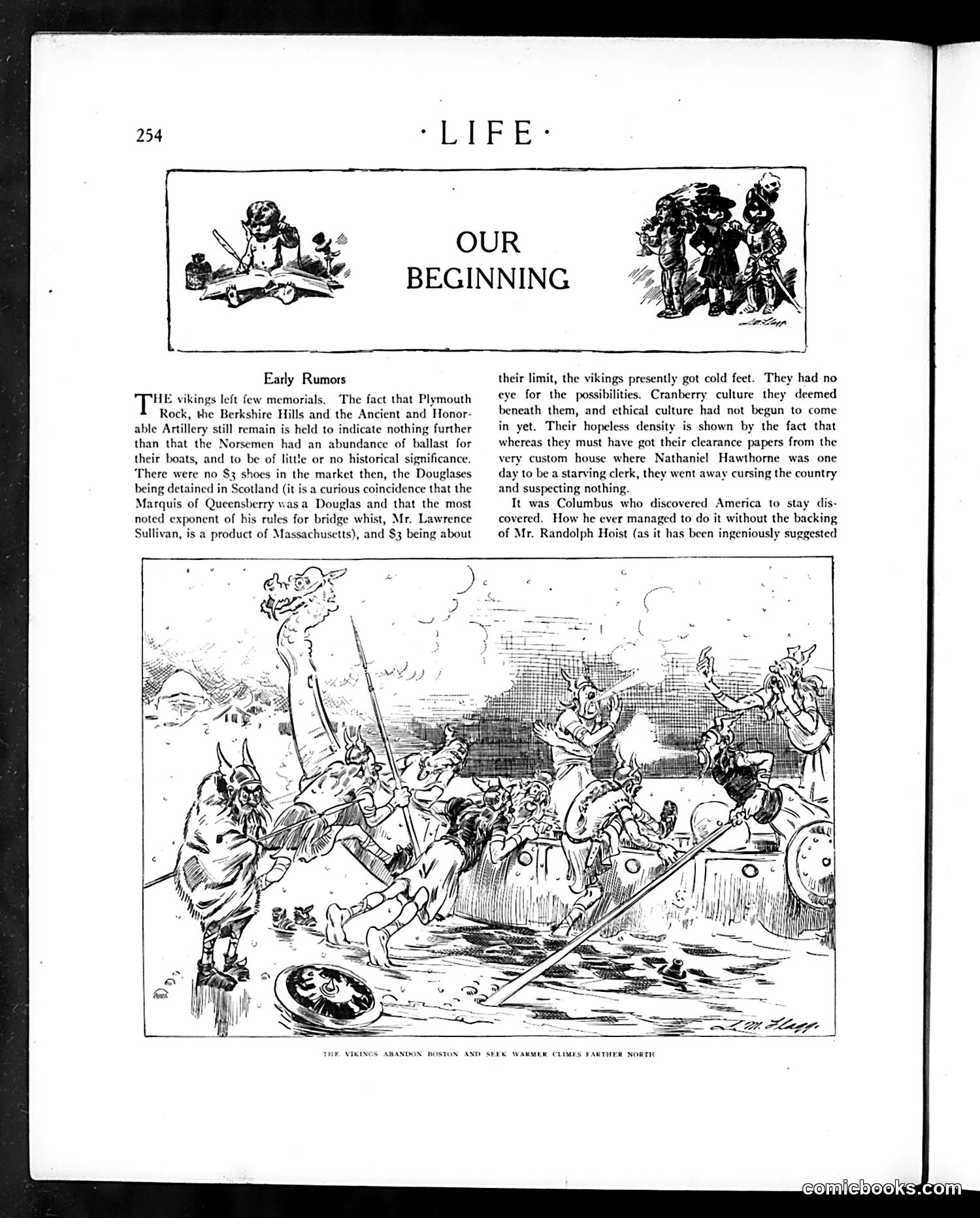
This satirical piece mocks early American history by playfully debunking the Vikings' arrival in North America. The cartoon depicts Vikings abandoning Boston, seeking warmer climates farther north—an absurdist joke inverting geography. The text humorously dismisses Vikings as lacking vision: they found Plymouth Rock and New England uninviting, deeming cranberry cultivation and "ethical culture" beneath them. The satire critiques both the Vikings' supposed incompetence and Americans' reverence for colonial "origins." References to contemporary figures—Randolph Hoist (appears to be a banker/financier) and Lawrence Sullivan (a bridge expert and Massachusetts native)—suggest that American success required modern capitalist backing, not historical accident. The piece lampoons nationalist mythology by suggesting Columbus, not Vikings, "discovered America to stay discovered," implying discovery itself requires proper financial sponsorship and publicity.
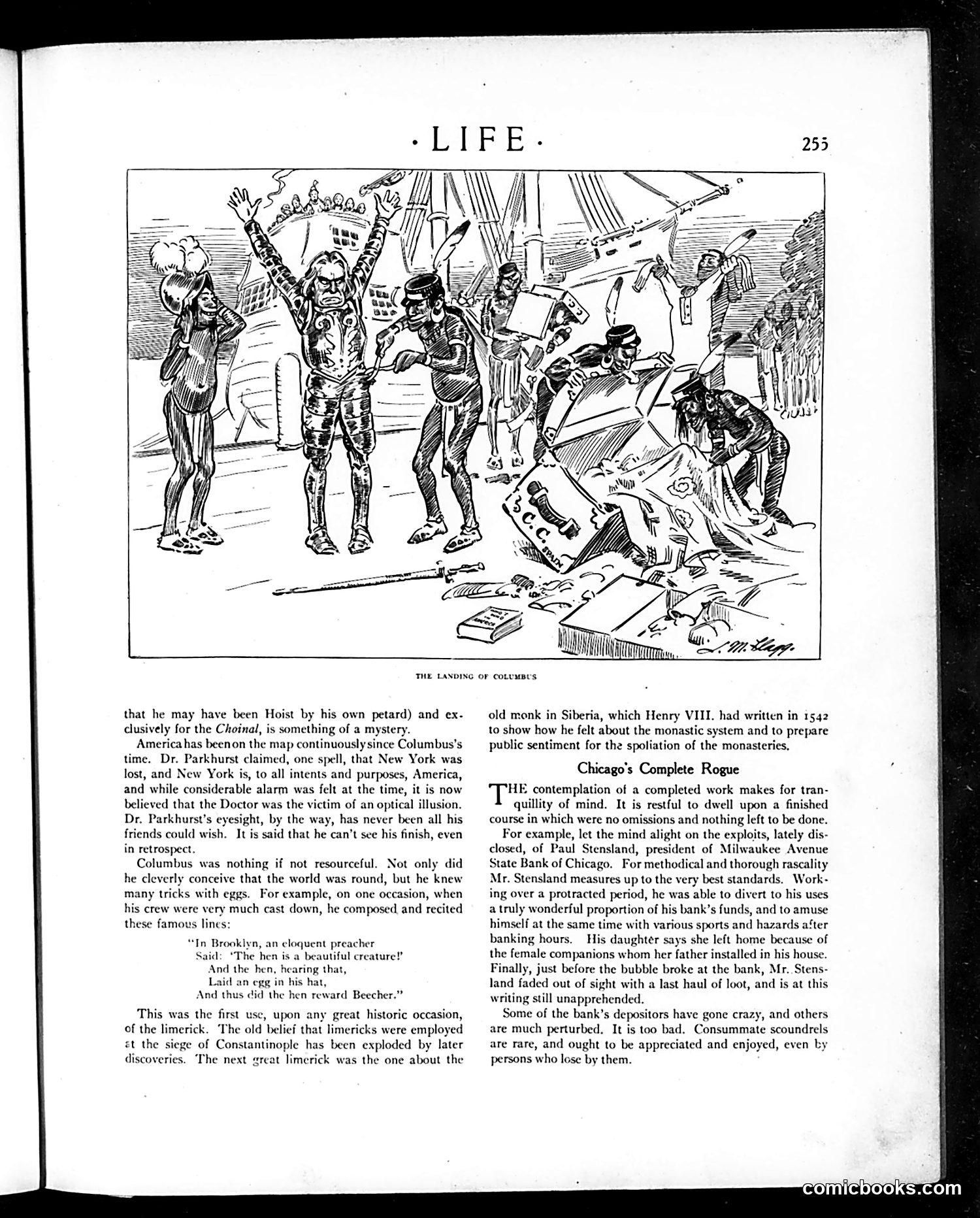
The cartoon depicts Columbus's arrival, but the accompanying text uses it as a springboard for satirical commentary on contemporary figures and events, not Columbus himself. The piece mocks **Dr. Parkhurst**, a real reform figure, claiming he once believed New York was "lost" (an optical illusion), with jabs at his poor eyesight. It then satirizes the **limerick** as Columbus's invention, attributing one to him mocking Brooklyn preacher **Henry Ward Beecher**. The second section shifts to **Paul Stensland**, president of Milwaukee Avenue State Bank in Chicago, whose recent embezzlement scandal had shocked the city. Life's satire here is biting: it "praises" Stensland's "thorough rascality" and "methodical" theft of depositors' funds, noting he absconded with the money and remains at large. The dark humor suggests that while such complete criminals are rare, they're almost admirable for their competence—a sharp critique of both his crimes and the scandal's impact.
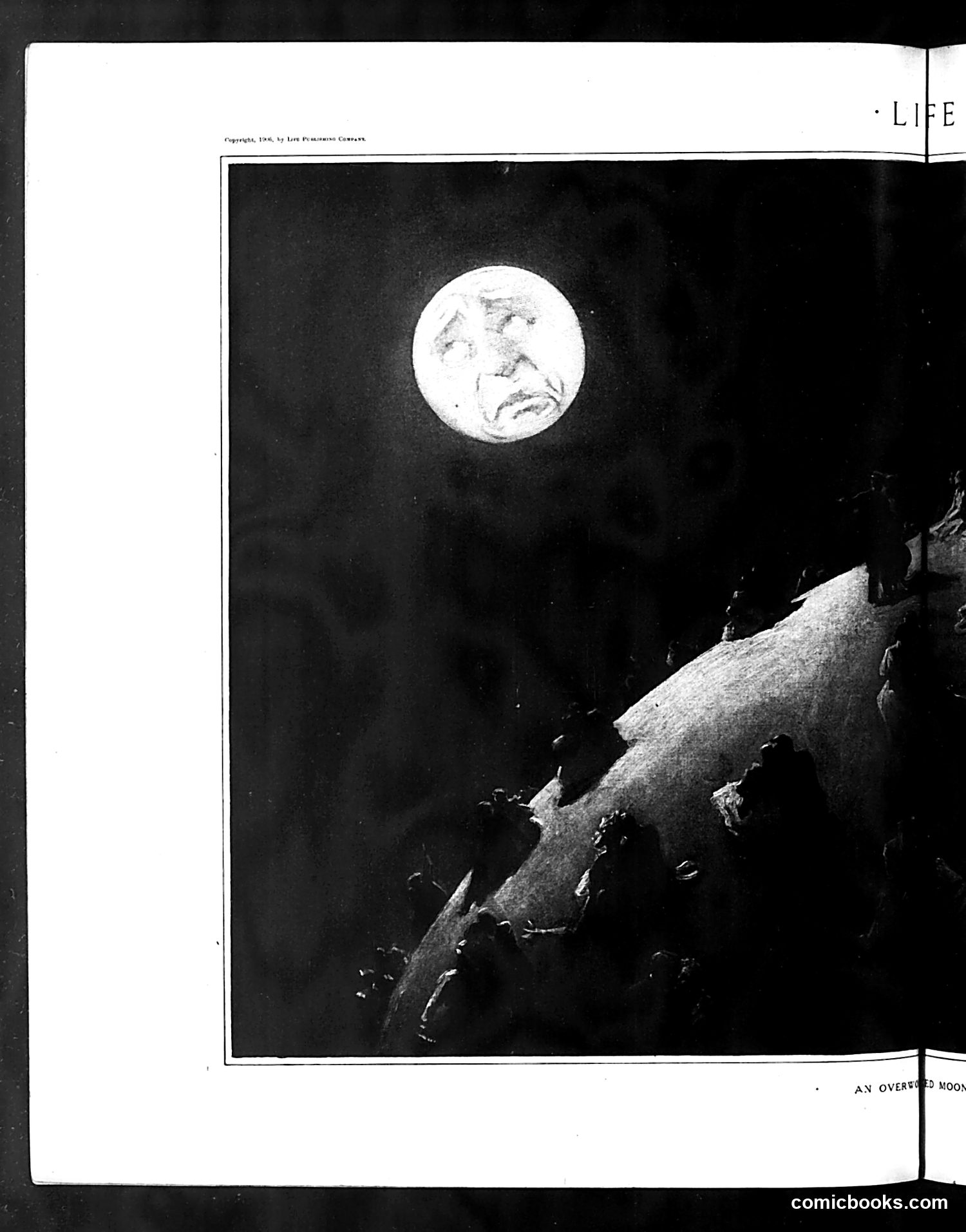
This appears to be a satirical illustration from *Life* magazine showing a man's face depicted within or as the moon itself, set against a dark night sky. A gnarled, bare tree branch extends upward from the lower right. The caption reads "AN OVERCAST MOON," suggesting the face obscures or clouds the moon's appearance. Without additional context on the page (publication date, artist name, or accompanying article text), I cannot definitively identify the specific political figure or event being satirized. The imagery suggests commentary on someone's influence or prominence overshadowing natural order—a common satirical technique—but the exact target and point of critique remain unclear from this image alone.
This appears to be a page from *Life* magazine titled "LIFE" at the top, with a dramatic black and white illustration below. The image shows silhouetted figures gathered around what appear to be boats or ships against a dark background, with atmospheric lighting creating an eerie, theatrical quality. The caption reads "VERSOED MOON" (possibly "REVERSED MOON"), though the meaning is unclear without additional context. The composition suggests a scene of departure, arrival, or gathering—possibly depicting immigration, refugees, or travelers. The stark contrast and shadowy figures evoke mood and drama rather than specific identifiable individuals. Without clearer text or additional publication context, the precise satirical or political point remains difficult to determine with certainty.
This page collects brief satirical items mocking American institutions and figures. Key targets include: **Insurance companies**: Mocked for charging high premiums while making policyholders fight to collect claims—a genuine Progressive-era complaint about corporate malfeasance. **William Jennings Bryan**: Referenced for his constant political office-seeking beyond the presidency. **Anthony Comstock**: The famous vice-suppression crusader, satirized as using "morality" as cover for self-aggrandizement ("Society for the Salary of Anthony"). **Theodore Roosevelt and his administration**: The "naval review in Oyster Bay" and reference to "Pa's rich" mock Roosevelt's lavish spending as president. **Leonard Wood and Paul Morton**: Insurance company executives being groomed for higher office—satirizing corporate-political connections. The page's tone reflects early 1900s Progressive skepticism toward corporate power, political corruption, and hypocrisy among elites. The humor is pointed but assumes readers' familiarity with contemporary figures and scandals.
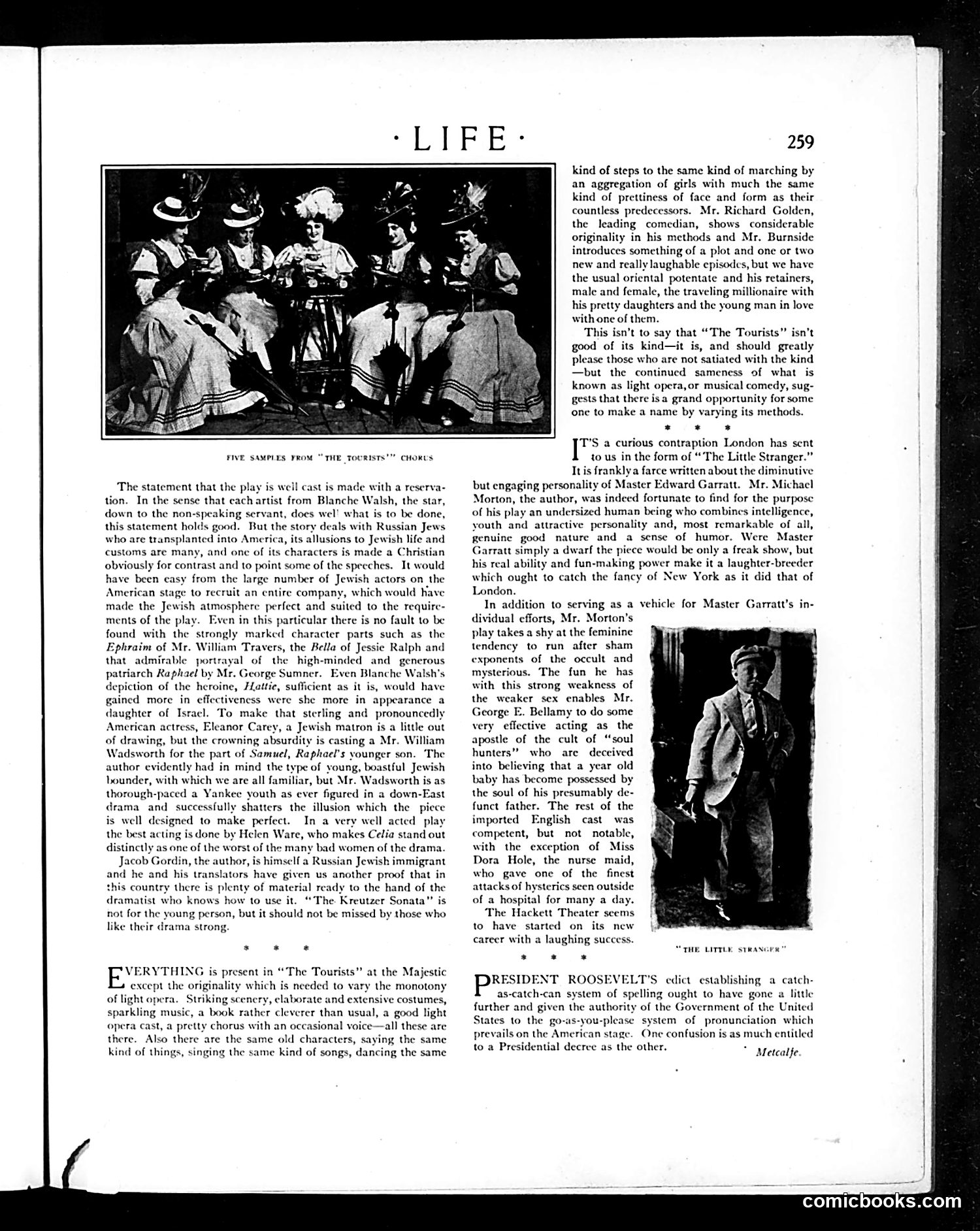
This page reviews a light opera called "The Tourists" at the Majestic Theatre. The photograph shows the chorus line from the show. The critic praises the **cast and production values** (scenery, costumes, music) but criticizes the **formulaic plot**: it features the standard operetta characters — an Oriental potentate, traveling millionaires with daughters, a young romantic lead — repeated endlessly with "the same kind of prettiness" and dance routines. The review also faults the **casting choices for authenticity**. Since the story involves Russian Jewish immigrants in America, the critic argues the producers should have hired Jewish actors throughout for proper atmosphere. Instead, they cast non-Jewish actors (notably William Wadsworth as the young Jewish man Samuel), which "shatters the illusion" the play attempts to create. The point: spectacle cannot substitute for originality. Someone could gain fame by actually **varying light opera's tired formulas** rather than repeating them mechanically.
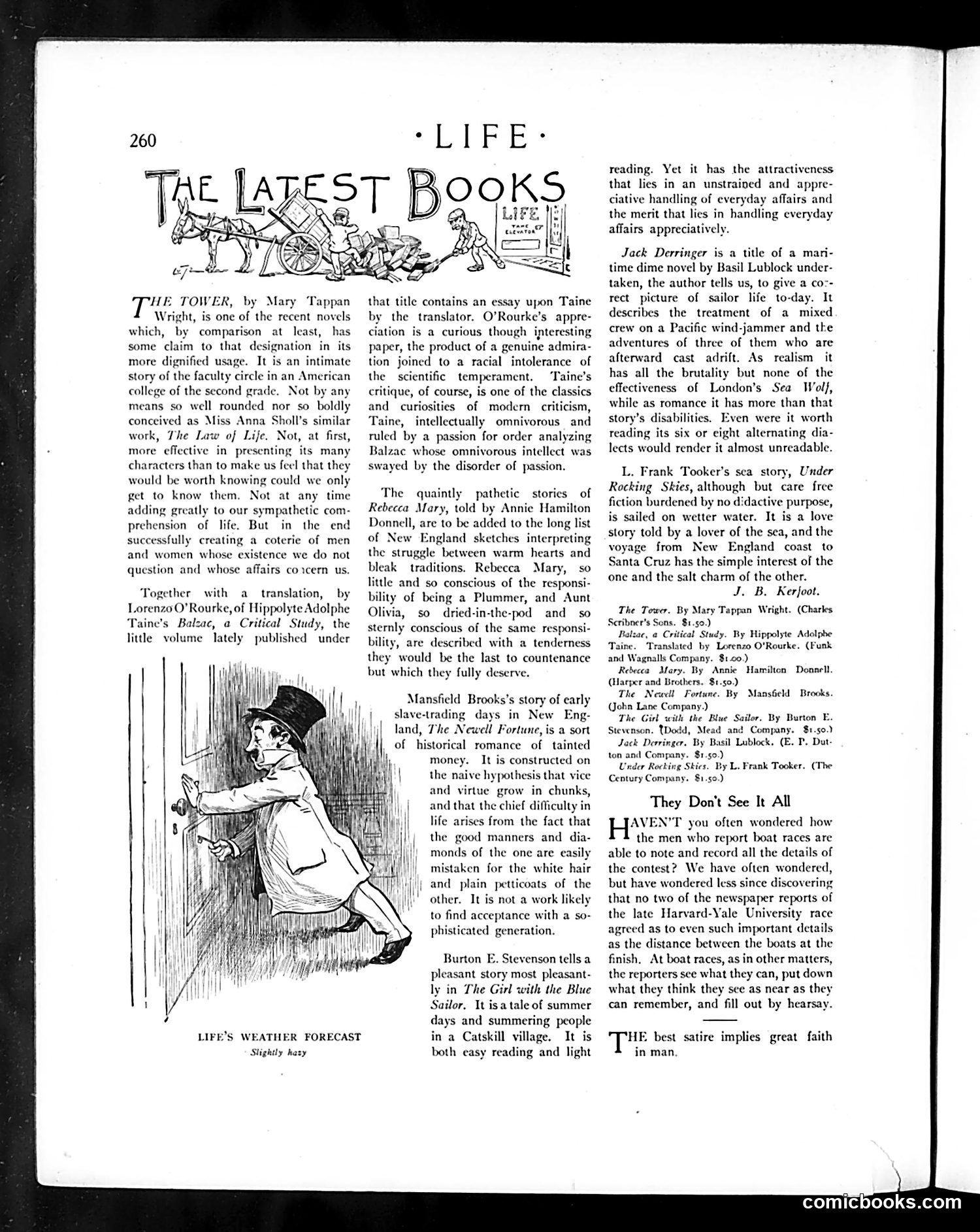
This page is primarily a book review section with one small cartoon titled "Life's Weather Forecast—Slightly hazy." The cartoon depicts a woman in early 1900s dress looking out a window with a somewhat dazed or bemused expression. The caption "Slightly hazy" appears to be gentle satire about a woman's mental state—likely poking fun at female sentimentality or romantic daydreaming, a common stereotype in period humor. The cartoon is deliberately slight and the joke understated. It's visual shorthand for a woman lost in thought or reverie, with the weather metaphor serving as a euphemistic joke about her confused mental state. This type of gentle domestic humor about women was typical of Life magazine's satirical content during this era.
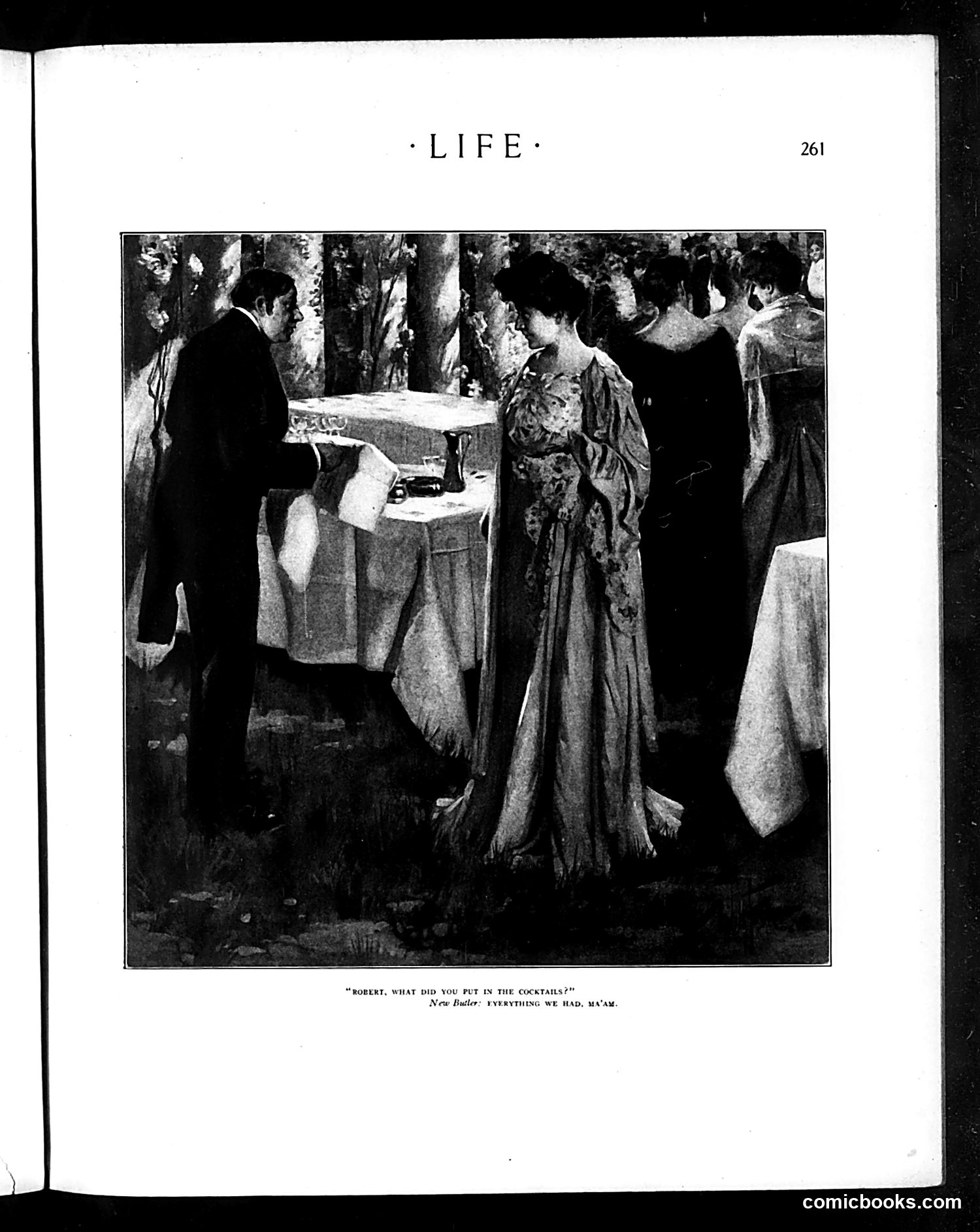
This is a single-panel cartoon depicting a social gathering, likely from the Prohibition era (based on the cocktail reference and the era's satirical magazine conventions). The joke centers on a newly hired butler who, when asked what ingredients he used in the cocktails, responds that he put in "everything we had." The humor suggests the butler—unfamiliar with proper cocktail-making or possibly taking the request literally—has created an absurd concoction by indiscriminately mixing available household items rather than appropriate spirits and mixers. The satire comments on either servant incompetence or the desperation of finding drinkable cocktails during Prohibition, when quality ingredients were scarce and amateur mixing was common. The well-dressed guests' reaction implies surprise or dismay at this culinary disaster.
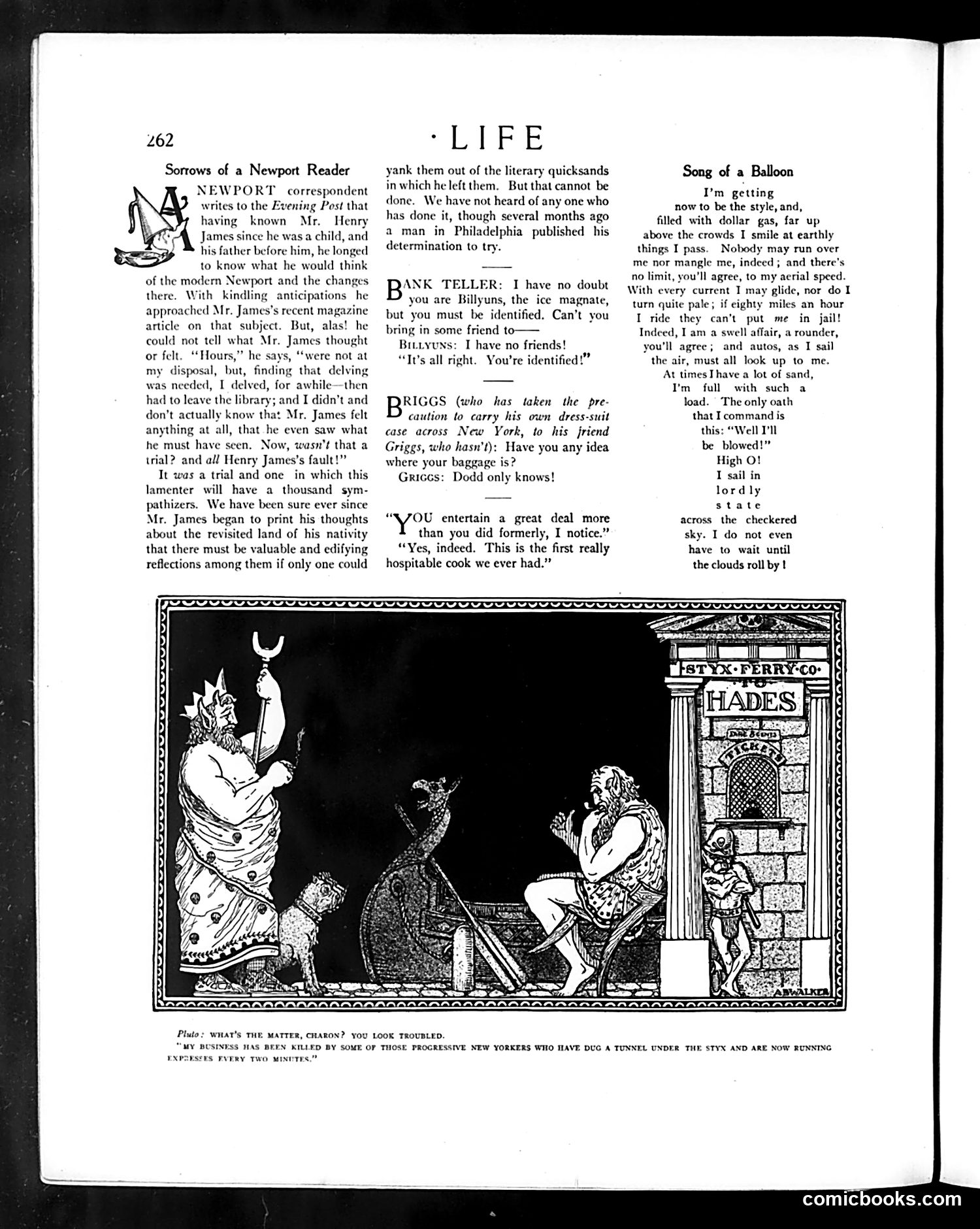
This *Life* magazine page contains several satirical pieces mocking contemporary society: **"Sorrows of a Newport Reader"**: Satirizes Henry James's notoriously obscure, dense prose style. A Newport resident complains he couldn't understand James's magazine article about revisiting America despite hours of effort—a joke about James's impenetrable writing that requires exhausting labor to parse. **Bar/Social Sketches**: Brief comedic dialogues mocking the wealthy and pretentious (an ice magnate claiming to have no friends; someone worried about lost baggage). **"Pluto and Charon" Cartoon**: References Greek mythology but updates it with modern satire—Charon (the ferryman of the dead) complains that "progressive New Yorkers" have disrupted his ancient business by tunneling under the River Styx and running frequent transport services. This likely mocks subway expansion or modern infrastructure disrupting tradition. **"Song of a Balloon"**: Light verse celebrating hot air balloons as fashionable entertainment while joking they're immune to traffic laws and accidents. The overall tone mocks intellectual pretension, wealth, and modern progress disrupting traditional ways.
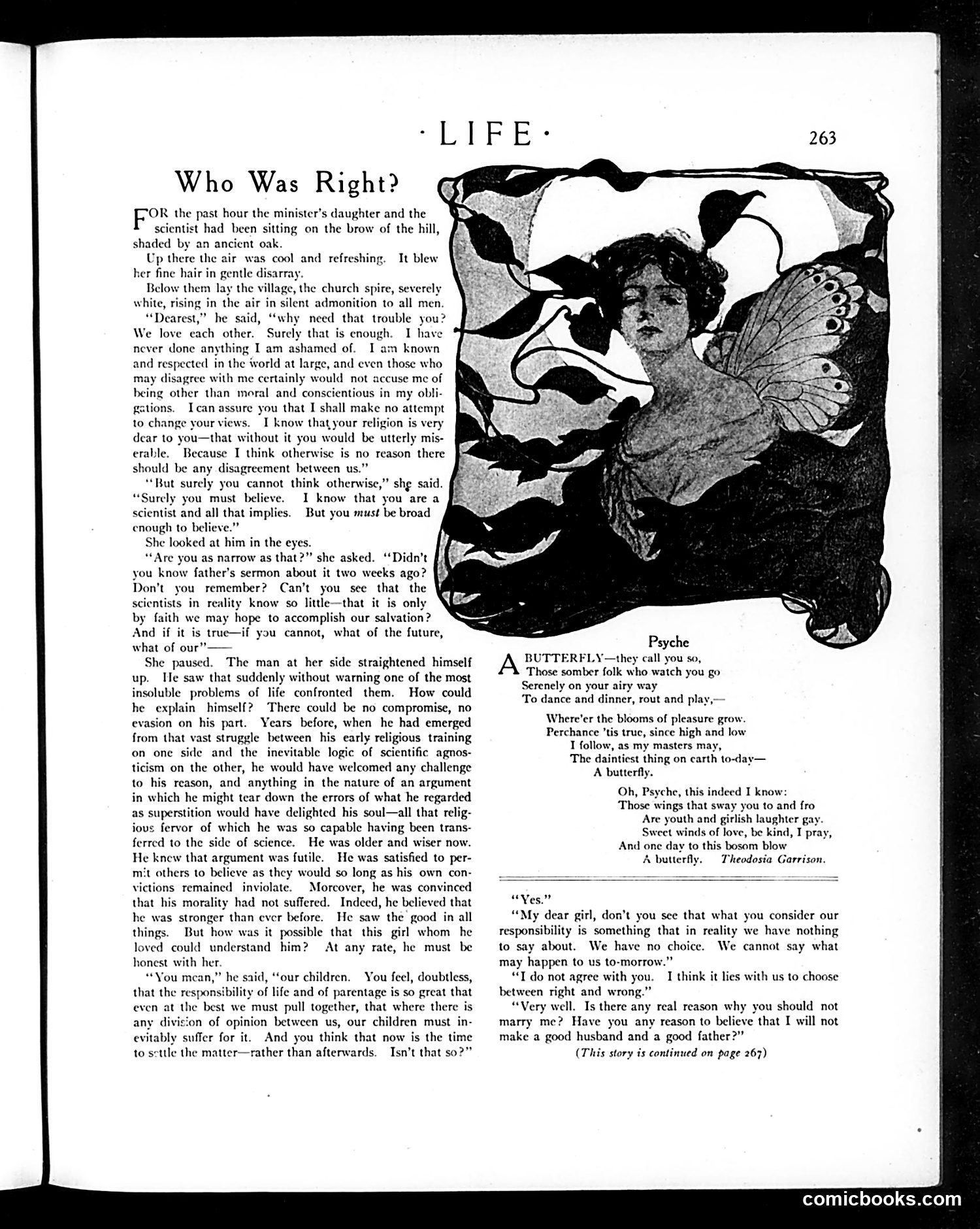
This page presents a **domestic drama about religion versus science**—a major cultural conflict of the early 20th century. The story depicts a scientist proposing to a minister's daughter. She demands he share her Christian faith; he, having abandoned religion through scientific reasoning, refuses compromise. The tension is irreconcilable: she fears their children will suffer spiritually if raised by an atheist father. The **satire targets both positions**. The scientist claims moral superiority through reason alone, yet patronizingly insists he won't "change her views"—revealing his arrogance. She demands he "be broad enough to believe," which is absurdly contradictory. The accompanying poem "Butterfly" (by Theodosia Garrison) offers whimsical escape from this serious debate, suggesting life's pleasures transcend ideology. The illustration shows two figures in intimate conversation overlooking a village church—visually emphasizing the conflict between romantic love and institutional religion that cannot be easily reconciled.
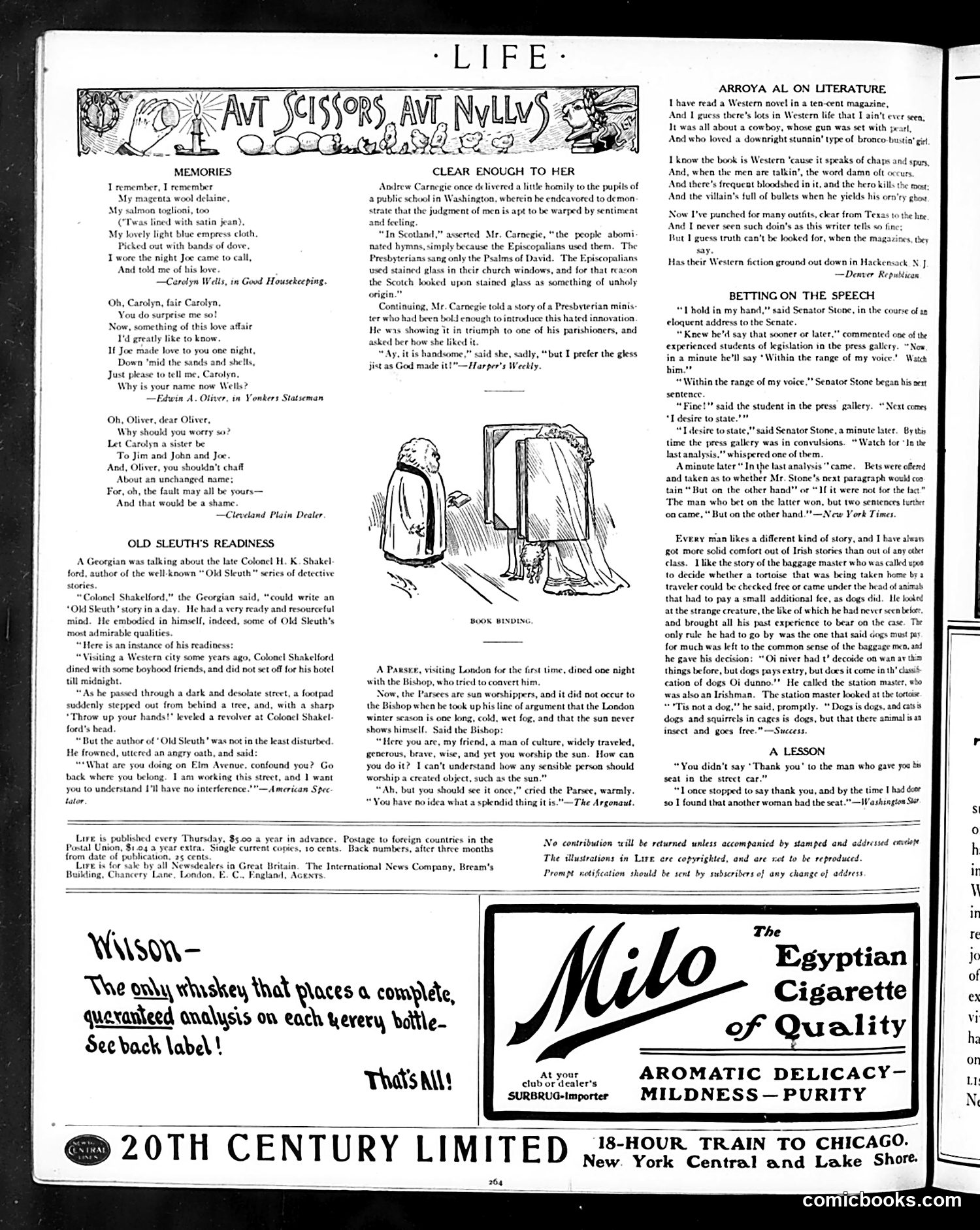
This page from *Life* magazine contains humorous literary pieces rather than political cartoons. The content includes: **"Memories"** — A playful poetry exchange mocking sentimental Victorian verse about a woman's romantic past, with satirical comebacks questioning why her name changed after romance. **"Old Sleuth's Readiness"** — An anecdote about Colonel Shakelford, author of the "Old Sleuth" detective series, showcasing his quick thinking when confronted by a mugger. The joke relies on the author's familiarity to readers. **"Clear Enough to Her"** — Andrew Carnegie tells a story about Scottish religious prejudice against stained glass, then recounts an anecdote where a Parsee sun-worshipper's argument is undercut by London's perpetually cloudy weather—the humor deriving from ironic circumstances. **"Book Binding"** and **"A Lesson"** — Brief humorous anecdotes. The satire targets Victorian sentimentality, literary pretension, and religious rigidity. The advertisements (Wilson whiskey, Milo cigarettes, trains) suggest this was aimed at educated, affluent readers.
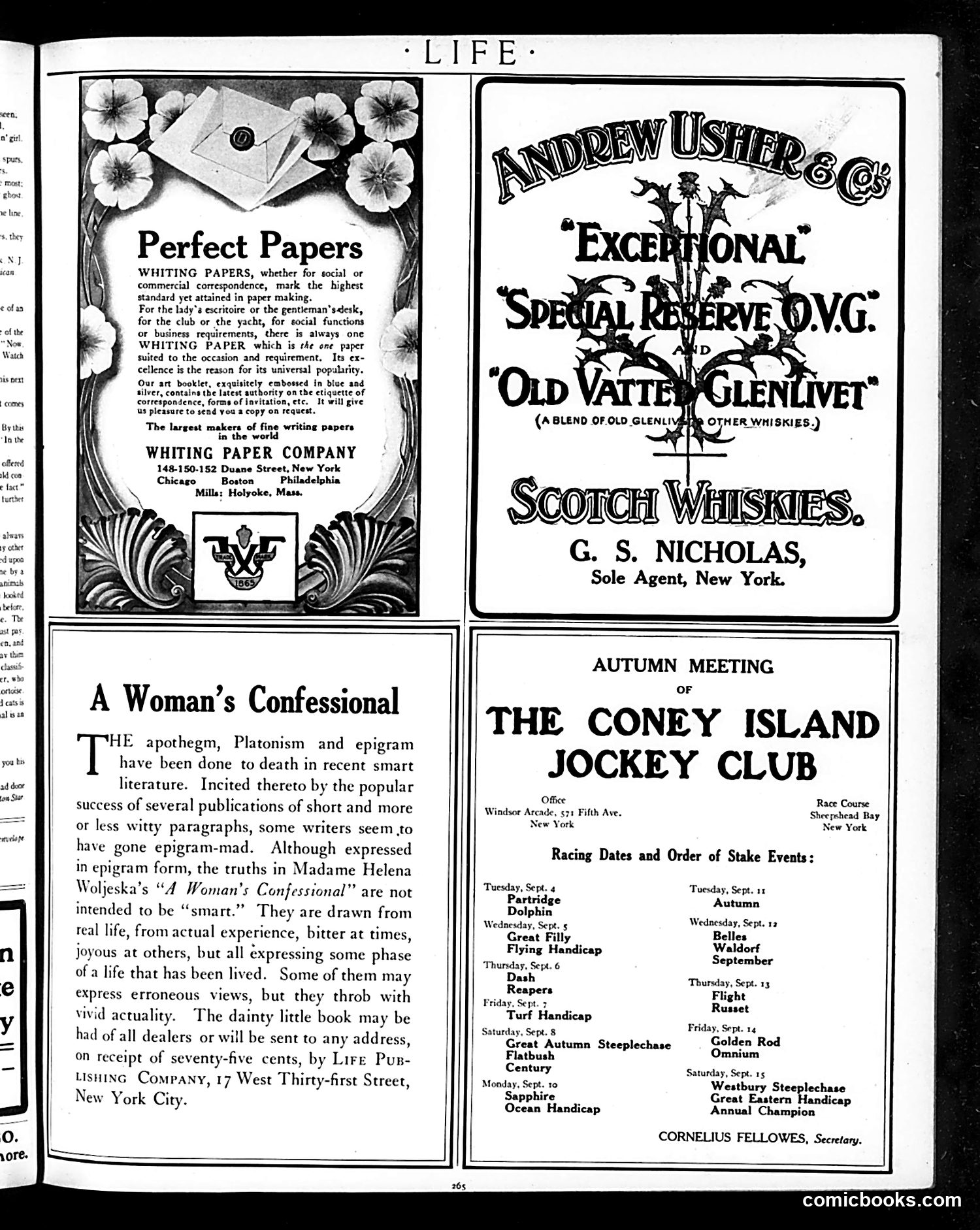
This page is primarily **advertising and announcements**, not political satire or cartoons. The page contains: 1. **Perfect Papers advertisement** (top left): A decorative ad for Whiting Paper Company promoting fine writing papers for social correspondence, with ornamental floral borders. 2. **Andrew Usher whisky advertisement** (top right): An ornate ad for Scottish whisky brands, with G.S. Nicholas listed as the sole New York agent. 3. **"A Woman's Confessional"** (bottom left): A brief article discussing Madame Helena Woljeska's book of confessional writings—short, witty pieces drawn from real life experiences. The piece defends the confessional form as genuine rather than merely clever. 4. **Coney Island Jockey Club announcement** (bottom right): Details about an autumn horse-racing meeting, listing racing dates and stake events at Sheepshead Bay. The page reflects early 20th-century magazine content: mixed advertising, literary discussion, and social announcements targeting affluent readers interested in fine stationery, spirits, literature, and horse racing.
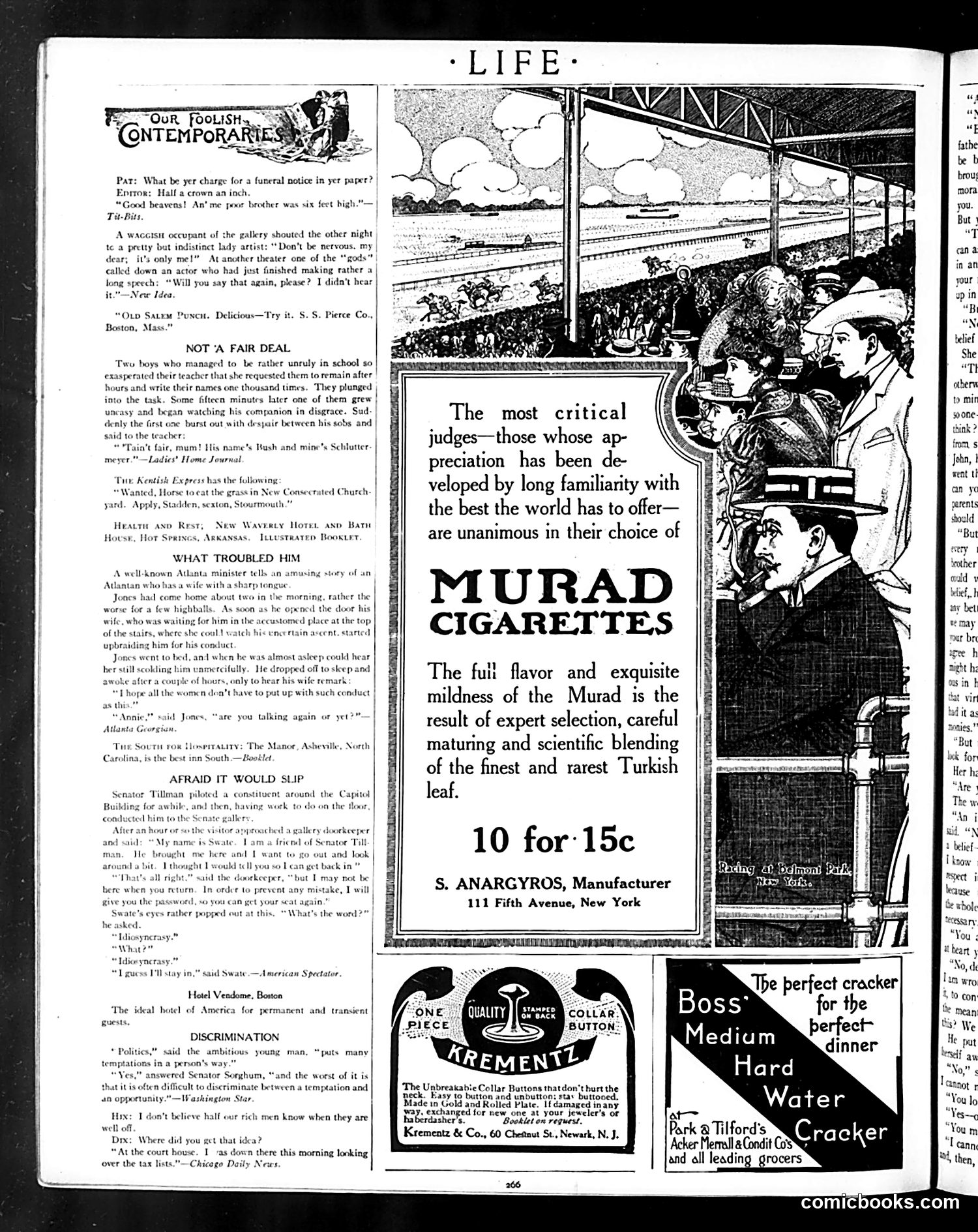
This page is primarily **advertising and humor snippets** rather than political cartoons. The content consists of: **Humorous anecdotes** ("Our Foolish Contemporaries"): Brief jokes about everyday situations—a funeral notice pricing joke, an actor mishearing, two schoolboys with unequal punishments (one named "Hush," the other "Schlutter," making the punishment unfair based on name length). **Advertisements dominate the right side**: Murad cigarettes (emphasizing "Turkish leaf" and quality for discriminating judges), Krementz collar buttons, and Boss crackers. The page appears to be from an early 20th-century issue of *Life* magazine, which combined satirical commentary on contemporary foibles with commercial advertising. The "foolish contemporaries" section mocks ordinary people's minor absurdities rather than targeting specific political figures or events. No identifiable political figures or references appear on this page.
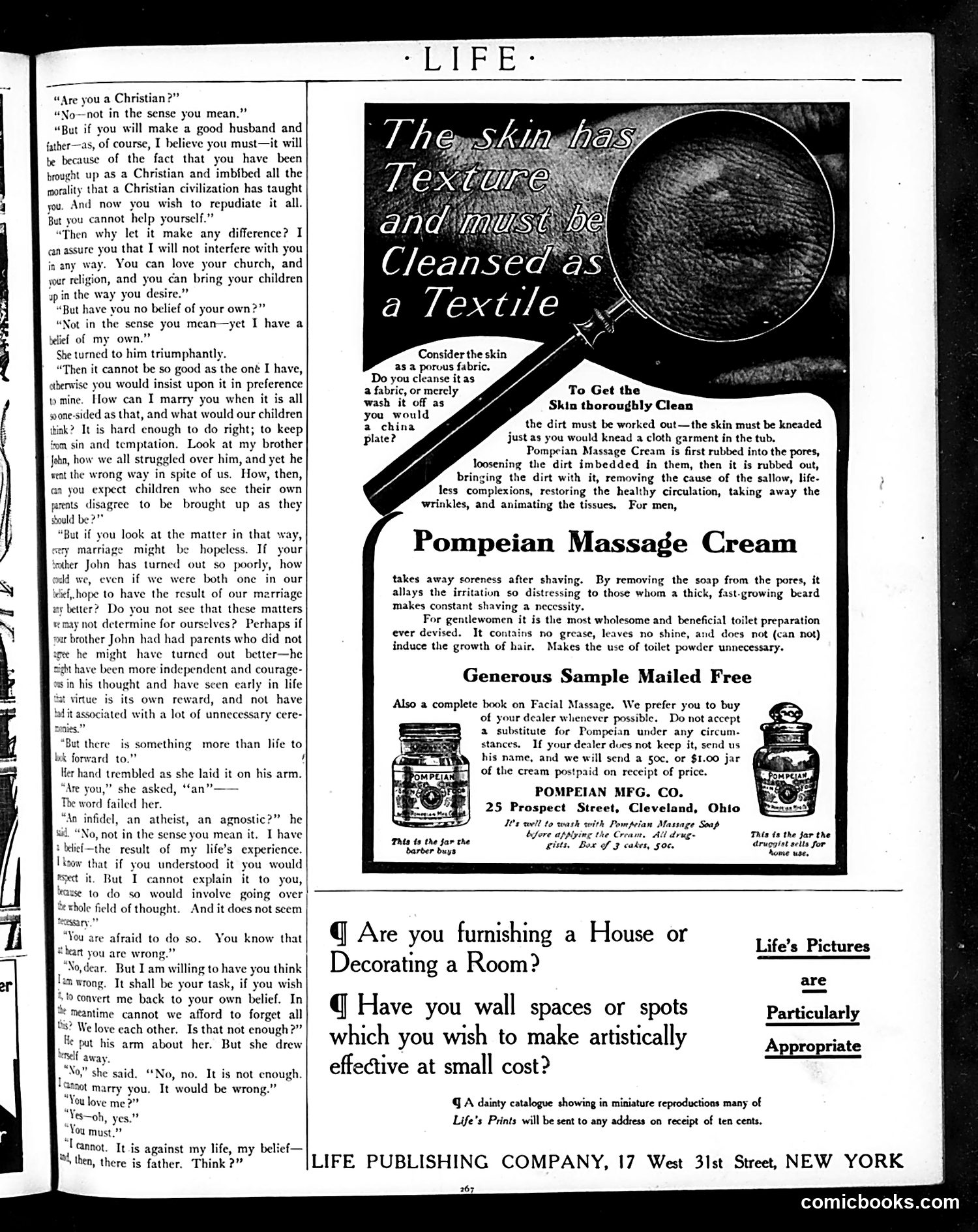
**The Narrative (Left Column):** This page contains a dialogue between a man and woman discussing marriage and religious belief. The man identifies as non-religious ("infidel, atheist, agnostic")—though he claims to hold personal beliefs from life experience. The woman, raised Christian, argues she cannot marry him because their fundamental values conflict, particularly regarding raising children. She insists shared religious conviction is essential for marriage stability, citing her brother John's moral failures as evidence of how parental disagreement harms offspring. **The Satire:** The piece satirizes turn-of-the-century religious anxiety and courtship conventions. It mocks rigid Christian doctrine by showing how strict adherence to faith actually prevents marriage, while also gently ridiculing the non-believer's evasiveness about his actual philosophy. **The Advertising:** The majority of the page comprises a Pompeian Massage Cream advertisement using pseudo-scientific language about skin as "porous fabric" requiring special cleansing—typical early 20th-century marketing that treated cosmetics as quasi-medical necessities.
This page presents a serious dramatic dialogue—not a political cartoon—from what appears to be a serialized short story in *Life* magazine. The scene depicts a conflict between a young man and a clergyman (Ruth's father) regarding the man's desire to marry Ruth. The tension centers on religious faith: Ruth is troubled that her suitor is not an orthodox Christian, and the young man seeks to explain his position directly to her father. The young man's "side" is agnostic rationalism—he believes in "practical morality" and character-building through training rather than prayer, rejects miracles and scriptural authority, and admits uncertainty about the afterlife. He argues a good life doesn't require religious doctrine. The clergyman listens without immediate judgment, though his facial expressions suggest internal struggle with this challenge to his faith. The satire here is subtle: the story appears to critique both rigid religious orthodoxy and the young man's confident rationalism, presenting them as competing worldviews in early 20th-century American life. The dramatic tension reflects contemporary anxieties about faith, modernity, and marriage.
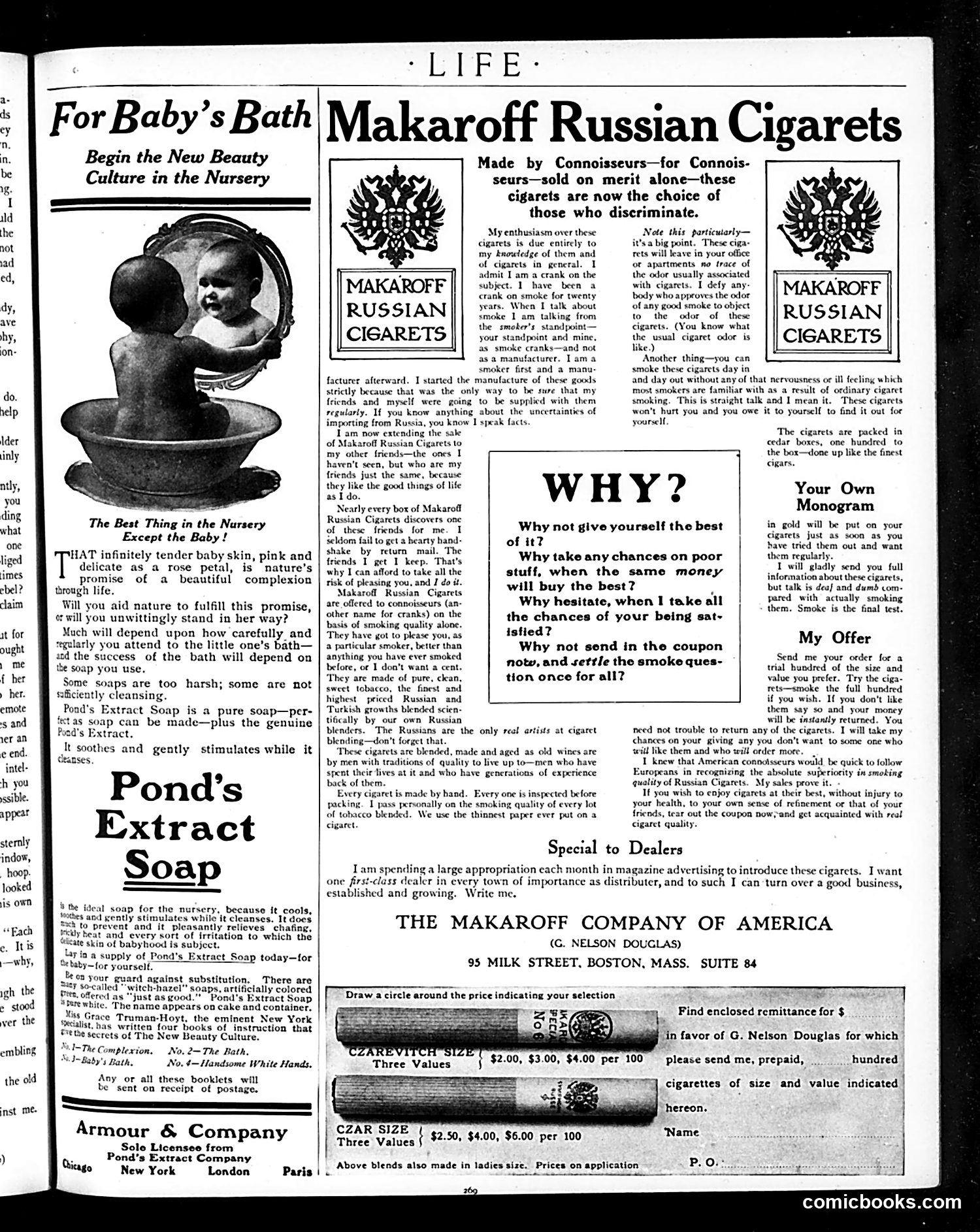
This page contains two distinct advertisements with no political satire. **Left side:** Pond's Extract Soap ad targeting mothers, emphasizing gentle baby skincare. The image shows an infant's face in profile. This reflects early 20th-century marketing appealing to maternal anxieties about proper childcare and "beauty culture"—a popular wellness trend of the era. **Right side:** Makaroff Russian Cigarets advertisement. A manufacturer personally vouches for his product's superior quality, lack of odor, and smoothness compared to ordinary cigarets. He claims to have started manufacturing specifically to guarantee supply to discriminating friends. The ad includes a mail-order coupon for trial sizes. **Historical context:** This reflects pre-tobacco-regulation advertising when health claims were standard. "Russian" branding conveyed exoticism and prestige. The casual endorsement style mimics modern influencer marketing but predates that concept by decades.
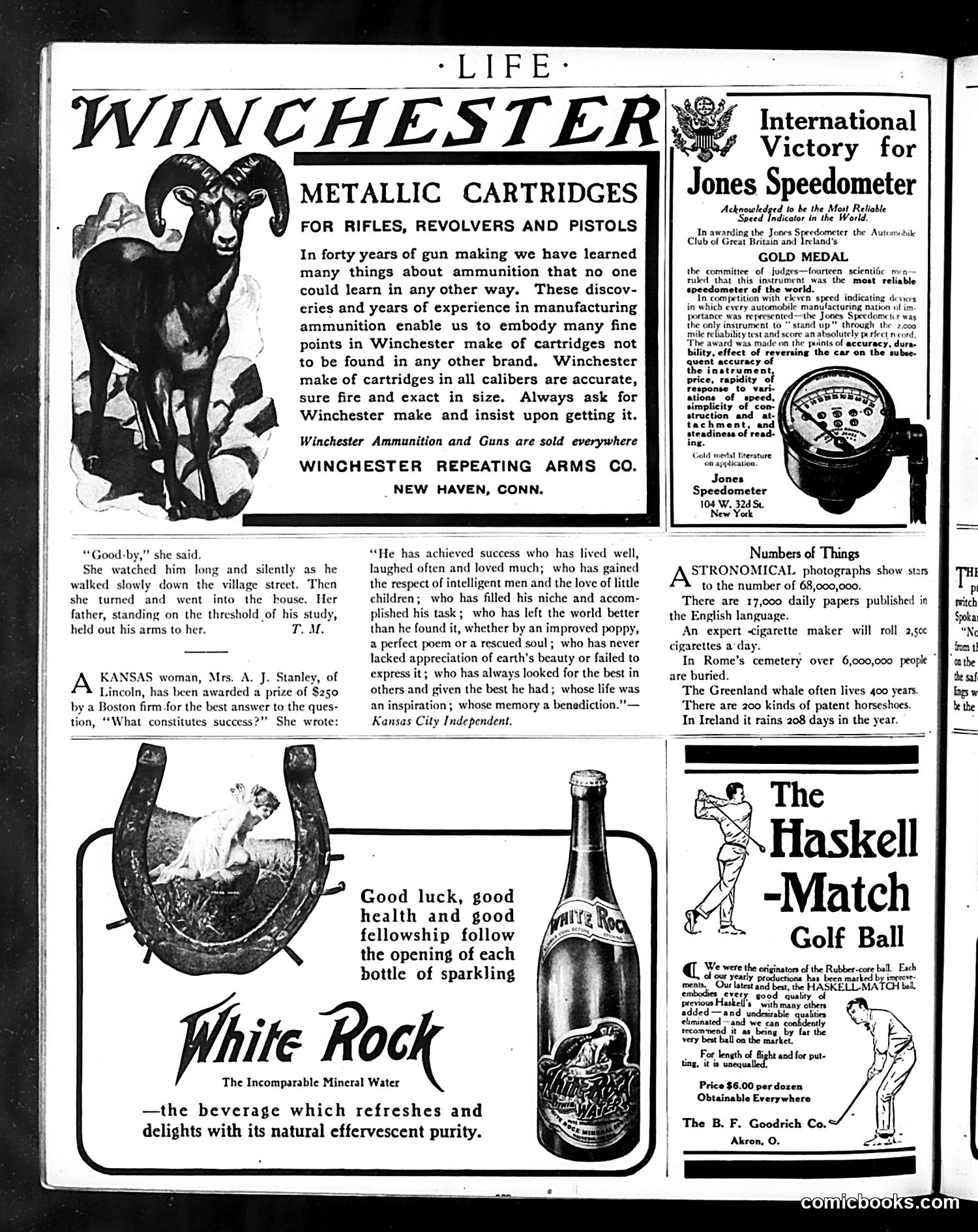
This is primarily an advertising page from Life magazine. There is minimal editorial content or satire. **Notable features:** The **Winchester cartridge ad** (top left) features a large ram's head image—Winchester's brand mascot—emphasizing the company's ammunition reliability from "forty years of gun making." A small **narrative vignette** ("Good-by," she said...) appears to be sentimental fiction filler, followed by a brief mention of a Kansas woman who won a contest answering "What constitutes success?"—ordinary human interest, not satirical. The remaining space is filled with product advertisements: **White Rock mineral water**, **Jones Speedometer** (claiming international recognition), random factual trivia ("Numbers of Things"), **Haskell-Match golf balls**, and **B.F. Goodrich**. This reflects Life's early function as part lifestyle magazine, part advertising vehicle. There is no discernible political cartoon or satire on this particular page.
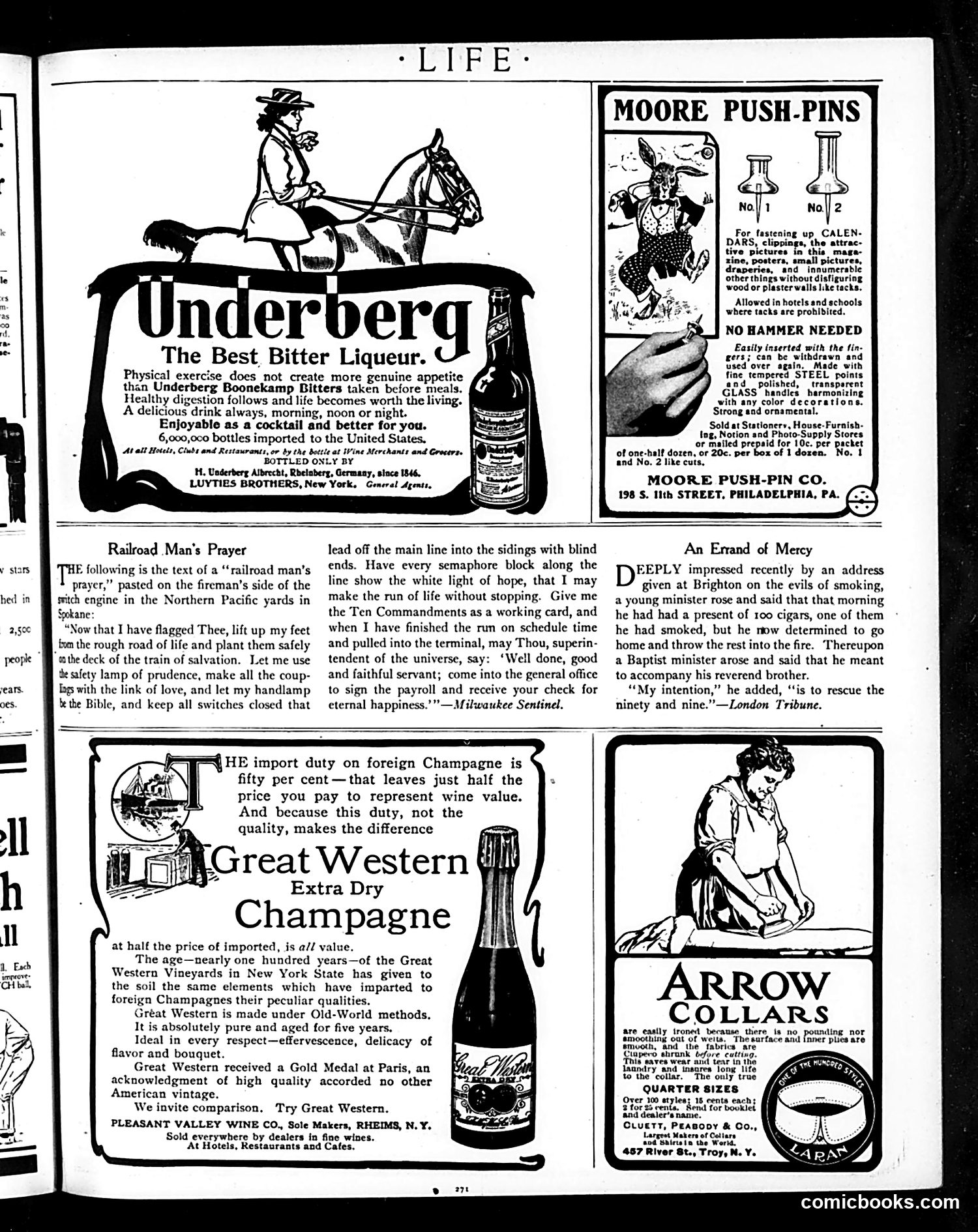
This page is primarily **advertisements** with two brief humorous anecdotes. The **Underberg ad** promotes German digestive bitters as appetite stimulant; the **Moore Push-Pins ad** sells glass-headed pins for hanging items without damaging walls. The **two jokes** are: 1. **"Railroad Man's Prayer"**: A railroad worker's prayer that uses railroad terminology metaphorically—flagging, switches, safety lamps, terminals—to describe Christian salvation. The humor lies in the extended metaphor equating train operation with spiritual journey, ending with God as railroad superintendent approving his work. 2. **"An Errand of Mercy"**: Two ministers compete in virtue—one vows to discard 100 gifted cigars to avoid smoking's evils; the other claims he'll "rescue" the ninety-nine remaining cigars. The satire mocks self-righteous posturing: the second minister's claim to moral superiority is undercut by his transparent excuse to smoke most of the cigars himself. Both anecdotes target hypocrisy and sanctimoniousness common to the era.
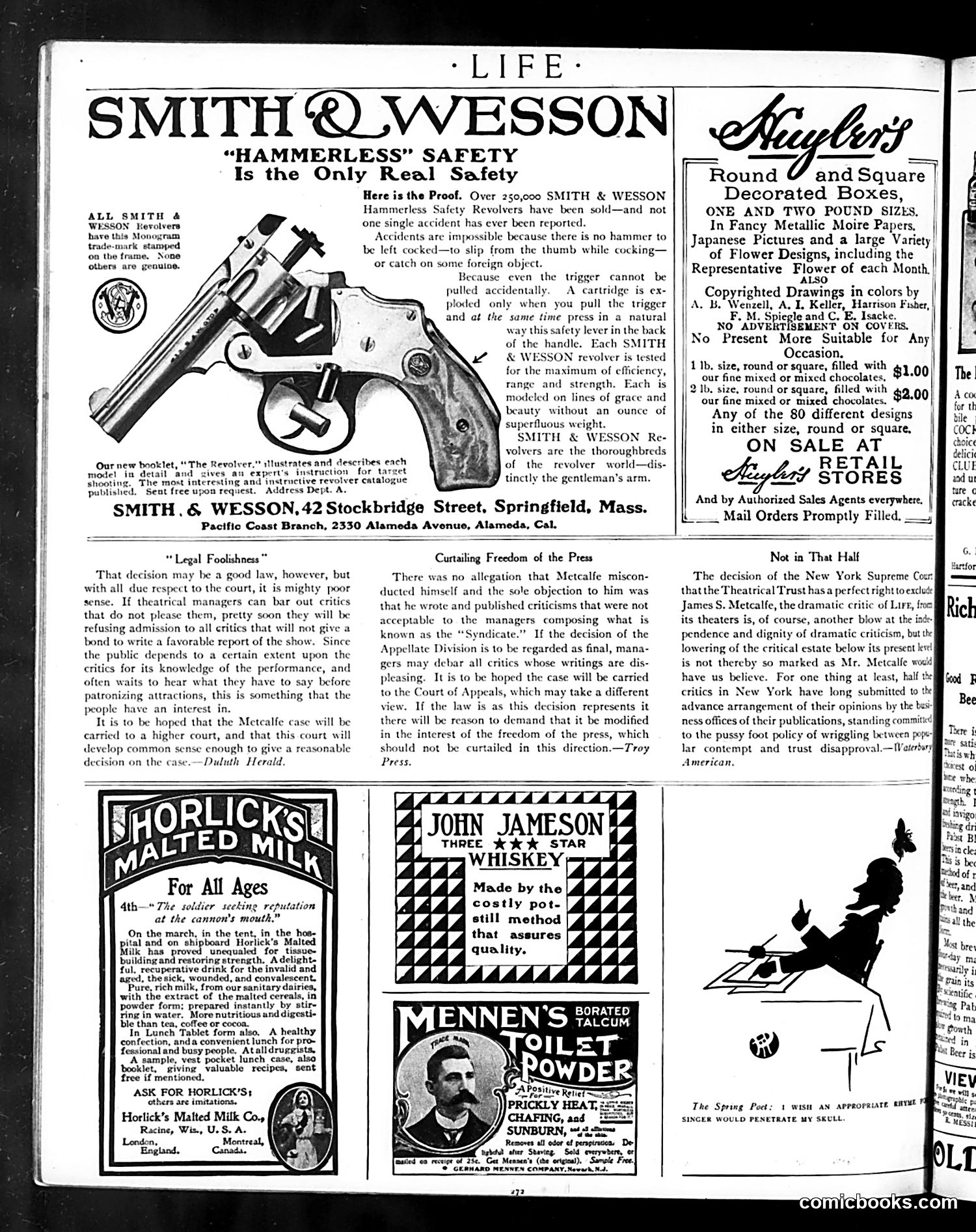
This page contains primarily **advertisements** rather than political satire. The featured content is commercial: **Smith & Wesson Advertisement (top):** Markets their "hammerless" revolver to American consumers, emphasizing safety features. The claim of 250,000 sold with "not one single accident" attempts to build consumer confidence in the firearm's design. **Other Advertisements:** Include Aylor's decorated chocolates, Horlick's Malted Milk, John Jameson whiskey, and Mennen's toilet powder. **Accompanying Editorial:** Three brief opinion pieces address "Legal Foolishness" and "Curtailing Freedom of the Press"—discussing a court case where theater manager James S. Metcalfe was barred from reviewing shows. The editorials critique this decision as harmful to press freedom and public interest. **The Satirical Cartoon:** A small illustration depicts a man being kicked, captioned "The Sponge Poet," but lacks sufficient context to determine its specific meaning or subject. Overall, this is a **commercial and news page** rather than primarily satirical content. The page reflects early 20th-century American advertising and press freedom debates.
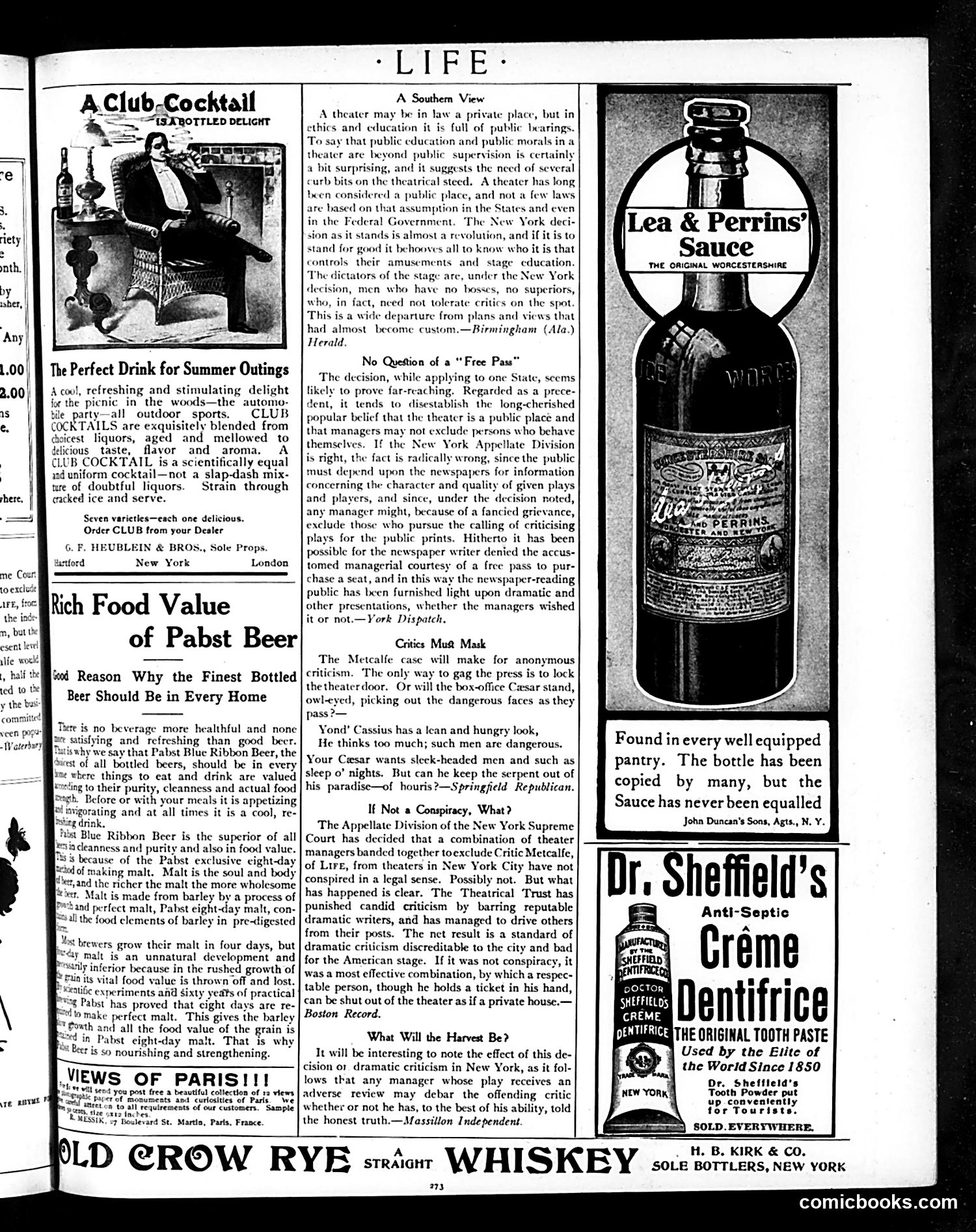
This page is primarily **advertising** for alcoholic beverages and consumer products, with brief editorial commentary on theatrical management. The main visual element is an illustration for "A Club-Cocktail" showing a well-dressed man enjoying a drink—typical 1910s-era advertising celebrating cocktails as sophisticated refreshment for leisure activities. The editorial section discusses a **New York court decision** allowing theater managers to exclude theater critics from performances without providing free passes. The commentary criticizes this ruling, arguing that theaters—while technically private businesses—serve public functions and that managers shouldn't be able to exclude critics without consequences. The piece expresses concern that managers could punish critics for unfavorable reviews by denying them access. Other ads promote Pabst Beer (emphasizing nutritional value), Lea & Perrin's Sauce, and Dr. Sheffield's toothpaste. The "Southern View" heading suggests this reflects regional newspaper commentary on the theatrical management debate.
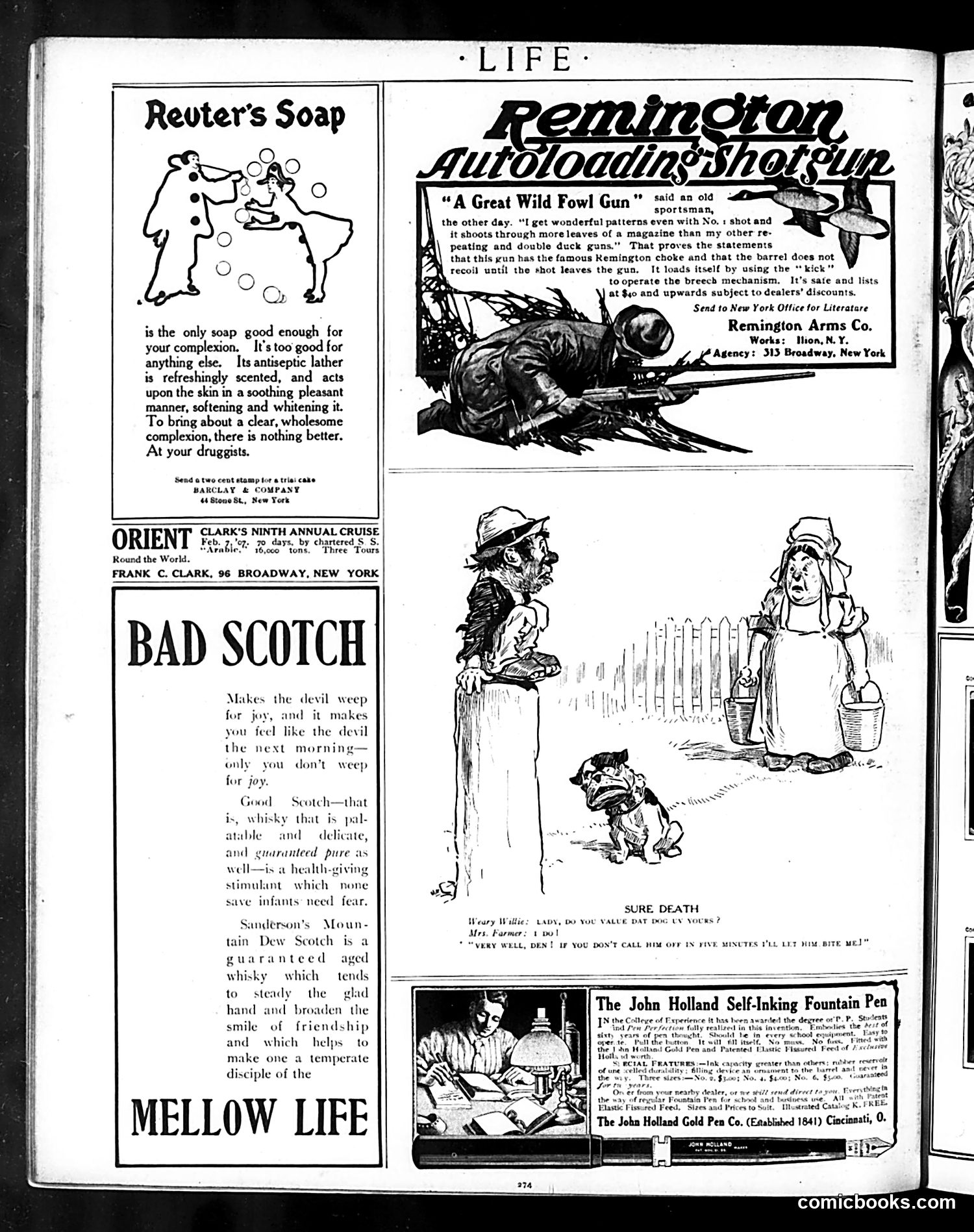
This page is primarily **advertising**, not editorial content or political satire. The ads promote consumer goods typical of the early 20th century: - **Reuter's Soap**: Claims to improve complexion through antiseptic properties - **Remington Shotgun**: Markets a "wild fowl gun" with innovative self-loading mechanism - **Orient cruise**: Frank C. Clark's world tour offering - **Bad Scotch/Mellow Life whisky**: Contrasts poor quality ("devil weep") with quality Sanderson's Mountain Dew Scotch, positioning alcohol as a "health-giving stimulant" - **John Holland Fountain Pen**: Self-inking writing instrument The single cartoon ("Sure Death") shows comic characters—appearing to be tramps or working-class figures—in a humorous domestic scene about dog ownership. **Notable to modern readers**: The whisky ad's casual health claims and the era's acceptance of alcohol marketing reflect pre-Prohibition attitudes. The ads themselves constitute the page's content rather than satirizing external events.
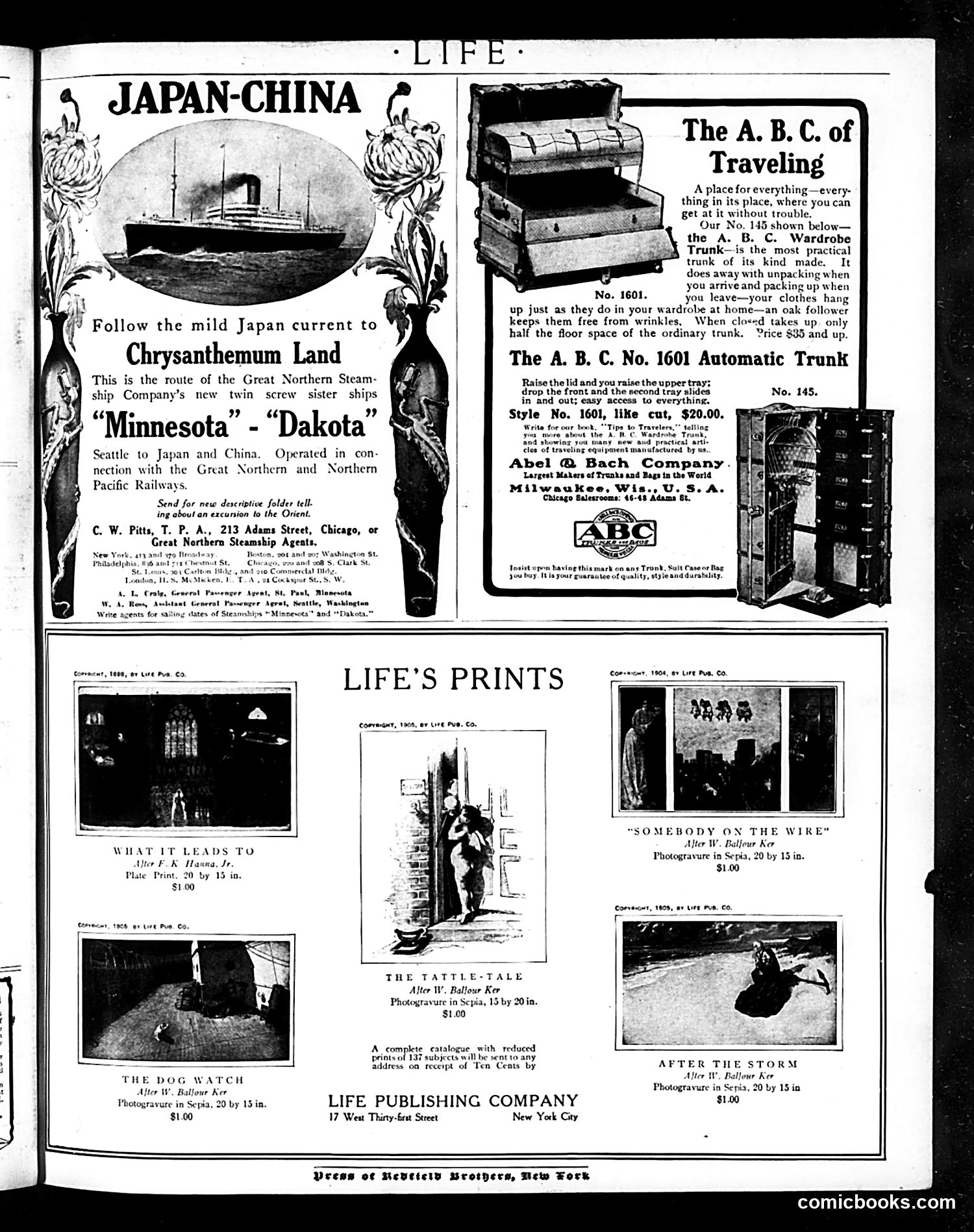
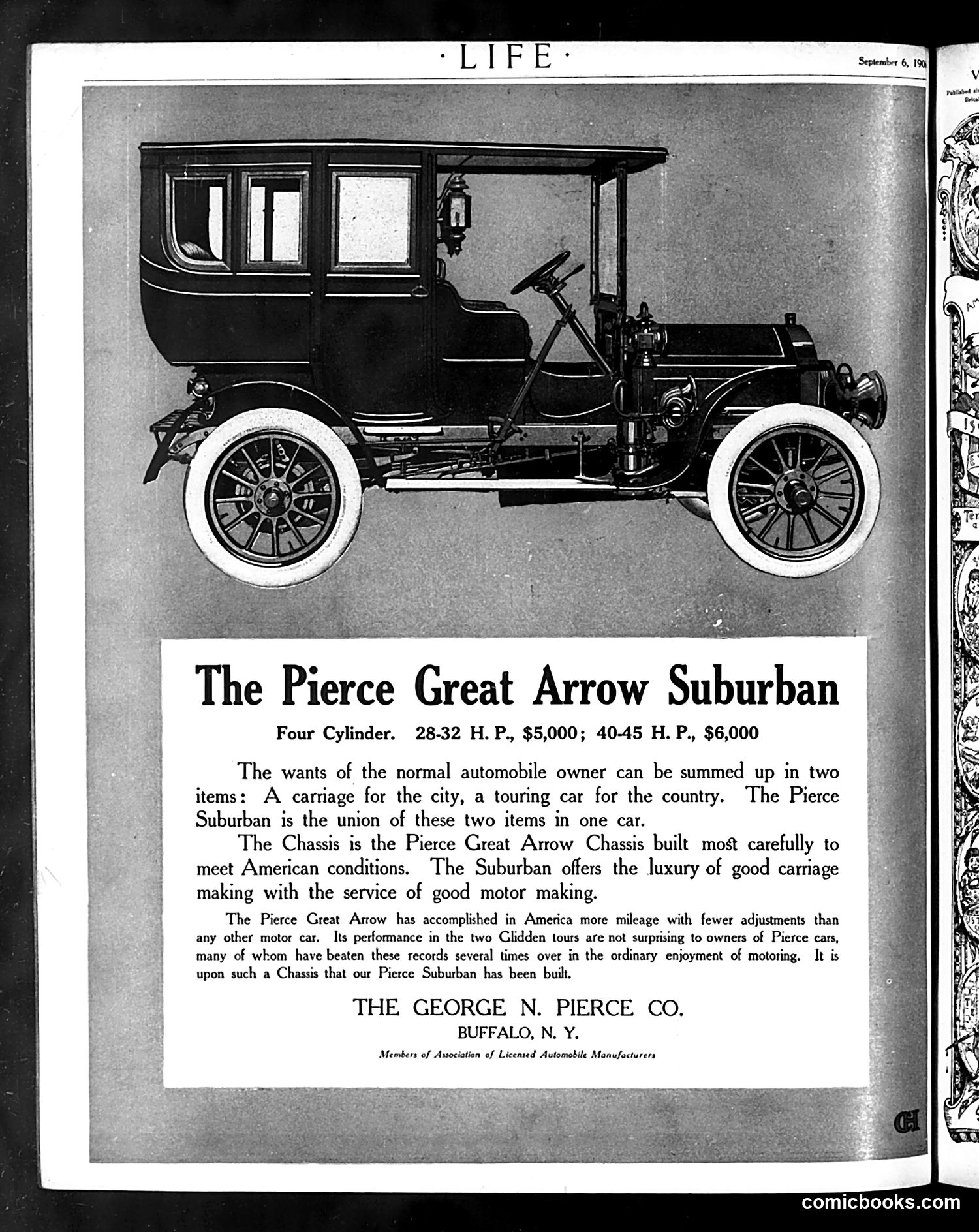
This page is **not a cartoon or satire**—it's a straightforward automobile advertisement from Life magazine (September 6, 1903). The Pierce Great Arrow Suburban is presented as a luxury vehicle combining city carriage comfort with country touring capability, priced at $5,000-$6,000 (substantial sums in 1903). The advertisement emphasizes the car's reliability, citing its performance in the Glidden Tours (early automotive reliability competitions). It appeals to wealthy consumers seeking dual functionality in a single vehicle. The only visual element is a technical side-view illustration of the car itself, showing its enclosed cabin and mechanical components. There is no political satire, caricature, or joke—Life magazine in this era was primarily a publication of illustrated humor and commentary, but this particular page is purely commercial advertising from the George N. Pierce Company of Buffalo, New York.