
Life, 1906-09-06 · page 27 of 40
Life — September 6, 1906 — page 27: what you’re looking at
What you’re looking at
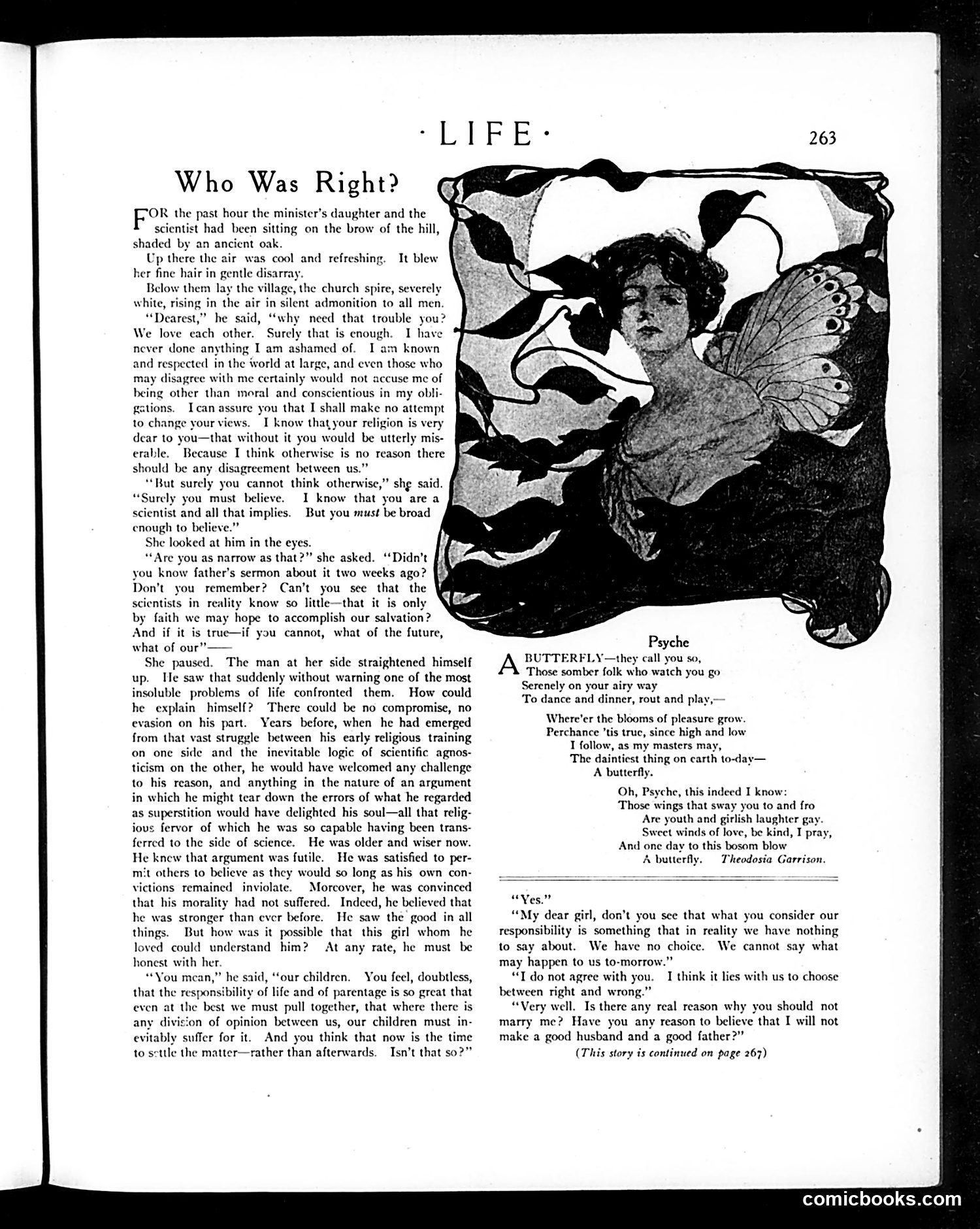
This page presents a **domestic drama about religion versus science**—a major cultural conflict of the early 20th century. The story depicts a scientist proposing to a minister's daughter. She demands he share her Christian faith; he, having abandoned religion through scientific reasoning, refuses compromise. The tension is irreconcilable: she fears their children will suffer spiritually if raised by an atheist father. The **satire targets both positions**. The scientist claims moral superiority through reason alone, yet patronizingly insists he won't "change her views"—revealing his arrogance. She demands he "be broad enough to believe," which is absurdly contradictory. The accompanying poem "Butterfly" (by Theodosia Garrison) offers whimsical escape from this serious debate, suggesting life's pleasures transcend ideology. The illustration shows two figures in intimate conversation overlooking a village church—visually emphasizing the conflict between romantic love and institutional religion that cannot be easily reconciled.
📄 Transcribed text from this page (OCR, searchable)
Machine-transcribed from the original scan — historical spelling and the odd misread are preserved.
Who Was Right? ‘OR the past hour the minister’s daughter and the scientist had been sitting on the brow of the hill, shaded by an ancient oak. Up there the air was cool and refreshing. her fine hair in gentle disarray. Below them lay the village, the church spire, severely white, rising in the air in silent admonition to all men. “Dearest,” he said, “why need that trouble you? We love each other. Surely that is enough. I have never done anything I am ashamed of. I am known and respected in the world at large, and even those who disagree with me certainly would not accuse me of being other than moral and conscientious in my obli- gations. Ican assure you that I shall make no attempt to change your views. “I know that your religion is very dear to you—that without it you would be utterly mis- erable. Because I think otherwise is no reason there should be any disagreement between us.” “But surely you cannot think otherwise,” shg said. “Surely you must believe. I know that you are a scientist and all that implies. But you must be broad cnough to believe.” She looked at him in the eyes. “Are you as narrow as that?” she asked. ‘‘Didn’t you know father’s sermon about it two weeks ago? Don’t you remember? Can’t you see that the scientists in reality know so little—that it is only by faith we may hope to accomplish our salvation? And if it is true—if you cannot, what of the future, what of our”—— She paused. The man at her side straightened himself up. He saw that suddenly without warning one of the most insoluble problems of life confronted them. How could he explain himself? There could be no compromise, no evasion on his part. Years before, when he had emerged from that vast struggle between his early religious training on one side and the inevitable logic of scientific agnos- ticism on the other, he would have welcomed any challenge to his reason, and anything in the nature of an argument in which he might tear down the errors of what he regarded as superstition would have delighted his soul—all that relig- jovs fervor of which he was so capable having been trans- ferred to the side of science. He was older and wiser now. He knew that argument was futile. He was satisfied to per- t others to believe as they would so long as his own con- vietions remained inviolate. Morcover, he was convinced that his morality had not suffered. Indeed, he believed that he was stronger than ever before. He saw the good in all things. But how was it possible that this girl whom he loved could understand him? At any rate, he must be honest with her. “You mean,” he said, ‘‘our children. You feel, doubtless, that the responsibility of life and of parentage is so great that even at the best we must pull together, that where there is any division of opinion between us, our children must in- evitably suffer for it. And you think that now is the time to settle the matter—rather than afterwards. Isn’t that so?” Tt blew BUTTERFLY—they call you so, Those somber folk who watch you go Serenely on your airy way To dance and dinner, rout and play, Where'er the blooms of pleasure grow. Perchance ’tis true, since high and low I follow, as my masters may, The daintiest thing on carth to-day— A butterfly. Oh, Psyche, this indeed I know: Those wings that sway you to and fro Are youth and girlish laughter gay. Sweet winds of love, be kind, I pray And one day to this bosom blow A butterfly, — Theodosia Garrison. “Yes.” “My dear girl, don’t you see that what you consider our responsibility is something that in reality we have nothing to say about. We have no choice. We cannot say what may happen to us to-morrow.” “T do not agree with you. I think it lies with us to choose between right and wrong.” “Very well. Is there any real reason why you should not marry me? Have you any reason to believe that I will not make a good husband and a good father?” (This story is continued on page 267) comicbooks.com