
Life, 1906-09-06 · page 32 of 40
Life — September 6, 1906 — page 32: what you’re looking at
What you’re looking at
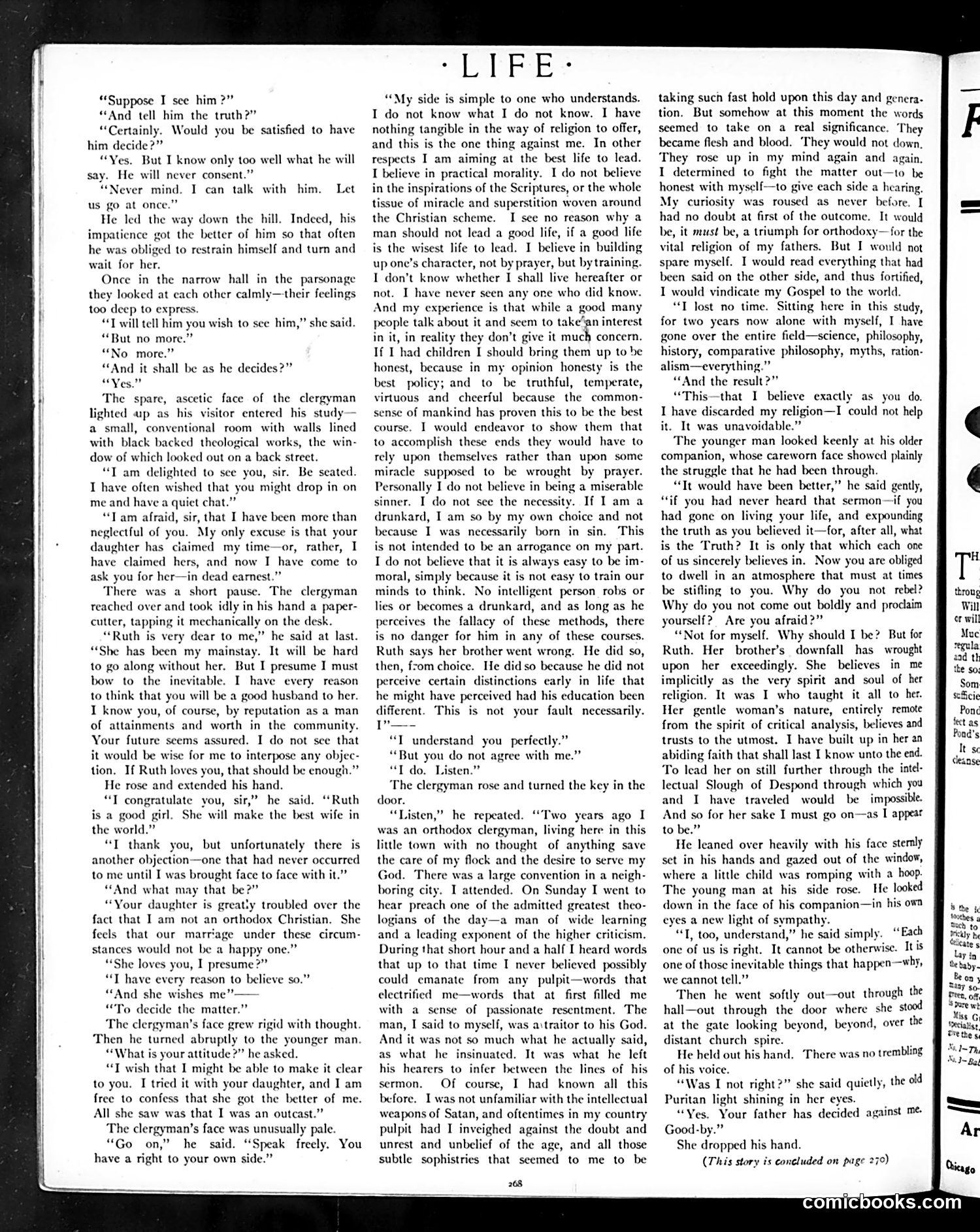
This page presents a serious dramatic dialogue—not a political cartoon—from what appears to be a serialized short story in *Life* magazine. The scene depicts a conflict between a young man and a clergyman (Ruth's father) regarding the man's desire to marry Ruth. The tension centers on religious faith: Ruth is troubled that her suitor is not an orthodox Christian, and the young man seeks to explain his position directly to her father. The young man's "side" is agnostic rationalism—he believes in "practical morality" and character-building through training rather than prayer, rejects miracles and scriptural authority, and admits uncertainty about the afterlife. He argues a good life doesn't require religious doctrine. The clergyman listens without immediate judgment, though his facial expressions suggest internal struggle with this challenge to his faith. The satire here is subtle: the story appears to critique both rigid religious orthodoxy and the young man's confident rationalism, presenting them as competing worldviews in early 20th-century American life. The dramatic tension reflects contemporary anxieties about faith, modernity, and marriage.
📄 Transcribed text from this page (OCR, searchable)
Machine-transcribed from the original scan — historical spelling and the odd misread are preserved.
“Suppose I see him ?” “And tell him the truth?” “Certainly. Would you be satisfied to have him decide?” “Yes, But I know only too well what he will He will never consent.” ever mind. I can talk with us go at once.” He led the way down the hill. Indeed, his impatience got the better of him so that often he was obliged to restrain himself and turn and wait for her. Once in the narrow hall in the parso: they looked at each other calmly—their f too deep to express. “T will tell him you wish to sce him,” she said. “But no more.” “No more.” “And it shall be as he decides?” “Yes.” The spare, ascetic face of the clergyman lighted ap as his visitor entered his study— a small, conventional room with walls lined with black backed theological works, the win- dow of which looked out on a back street. “Tam delighted to sce you, sir. Be seated T have often wished that you might drop in on me and have a quiet chat.” “Tam afraid, sir, that I have been more than neglectful of you. My only excuse is that your daughter has ciaimed my time—or, rather, I have claimed hers, and now I have come to ask you for her—in dead earnest.” There was a short pause. The clergyman reached over and took idly in his hand a paper- cutter, tapping it mechanically on the desk. “Ruth is very dear to me,” he said at last. “She has been’ my mainstay. It will be hard to go along without her. But I presume I must bow to the inevitable. I have every reason to think that you will be a good husband to her. I know you, of course, by reputation as a man of attainments and worth in the community. Your future seems assured. I do not see that it would be wise for me to interpose any obje tion. If Ruth loves you, that should be enough He rose and extended his hand. “T congratulate you, sir,” he said. ‘Ruth is a good girl. She will make the best wife in the world.” “T thank you, but unfortunately there is another objection—one that had never occurred to me until I was brought face to face with it.” “And what may that be?” “Your daughter is greatty troubled over the fact that I am not an orthodox Christian. She feels that our marriage under these circum- stances would not be a happy one.” “She loves you, I presume?” “T have every reason to believe sc “And she wishes me”— “To decide the matter.” The clergyman’s face grew rigid with thought Then he turned abruptly to the younger man. “What is your attitude?” he asked. “T wish that I might be able to m it clear to you. I tried it with your daughter, and I am free to confess that she got the better of me. All she saw was that I was an outcast.” ‘The clergyman’s face was unusually pale. “Go on,” he said. “Speak freely. You have a right to your own side.” Let him. ga bel bi Je “My side is simple to one who understands. I do not know what I do not know. I have nothing tangible in the way of religion to offer, and this is the one thing against me. In other respects I am aiming at the best life to lead. I believe in practical morality. I do not belie in the inspirations of the Scriptures, or the whole tissue of miracle and superstition woven around the Christian scheme. I see no reason why a man should not lead a good life, if a good life is the wisest life to lead. I believe in building up one’s character, not by prayer, but by training. I don’t know whether I shall live hereafter or not. I have never seen any one who did kno And my experience is that while a good many people talk about it and seem to eee interest in it, in reality they don’t give it much concern. If I had children I should bring them up to be honest, because in my opinion honesty is the best. policy; and to be truthful, temperate, virtuous and cheerful because the common- sense of mankind has proven this to be the best course. I would endeavor to show them that to accomplish these ends they would have to y upon themselves rather than upon some miracle supposed to be wrought by prayer. Personally I do not believe in being a miserable sinner. I do not see the necessity. If I am a drunkard, I am so by my own choice and not because I was necessarily born in sin. This is not intended to be an arrogance on my part. I do not believe that it is always easy to be im- moral, simply because it is not easy to train our minds to think. No intelligent person robs or lies or becomes a drunkard, and as long as he perceives the fallacy of these methods, there is no danger for him in any of these courses. Ruth says her brother went wrong. He did so, then, fzom choice. He did so because he did not perceive certain distinctions carly in life that he might have perceived had his education been different. This is not your fault necessarily. I"—- “T understand you perfectly.” “But you do not agree with me.” “TI do. Listen The clergyman rose and turned the key in the door. “Listen,” he repeated. “Two years ago I was an orthodox clergyman, living here in this little town with no thought of anything save the care of my flock and the desire to serve my God. There was a large convention in a neigh- boring city. I attended. On Sunday I went to hear preach one of the admitted greatest theo- logians of the day—a man of wide learning and a leading exponent of the higher criticism, During that short hour and a half I heard words that up to that time I never believed possibly could emanate from any pulpit—words that electrified me—words that at first filled me with a se of passionate resentment. The man, I said to myself, was a\traitor to his God. And it was not so much what he actually said, as what he insinuated. It was what he left s hearers to infer between the lines of hi: sermon. Of course, I had known all this before. I was not unfamiliar with the intellectual weapons of Satan, and oftentimes in my country pulpit had I inveighed against the doubt and unrest and unbelief of the age, and all those subtle sophistries that seemed to me to be 268 taking such fast hold upon this day and genera- tion. But somehow at this moment the words seemed to on a real significance. They became flesh and blood. They would not down, They rose up in my mind again and again, I determined to fight the matter out—to be honest with myself—to give each side a hearing. My curiosity was roused as never before. I had no doubt at first of the outcome. It would be, it must be, a triumph for orthodoxy—for the vital religion of my fathers. But I would not spare myself. I would read everything that had been said on the other side, and thus fortified, I would vindicate my Gospel to the world. “T lost no time. Sitting here in this study, for two years now alone with myself, T have gone over the entire field—science, philosophy, history, comparative philosophy, myths, ration- alism—everything. “And the result?” “This—that I believe exactly as you do. I have discarded my religion—I could not help it. It was unavoidable.” The younger man looked keenly at his older companion, whose careworn face showed plainly the struggle that he had been through. “Tt would have been better,” he said gently, “if you had never heard that sermon—if you had gone on living your life, and expounding the truth as you believed it—for, after all, what is the Truth? It is only that which each one of us sincerely believes in. Now you are obliged to dwell in an atmosphere that must at times be st ig to you. Why do you not rebel? Why do you not come out boldly and proclaim yourself? Are you afraid?” “Not for myself. Why should I be? But for Ruth. Her brothe downfall has wrought upon her exceedingly. She believes in me implicitly as the very spirit and soul of her religion. It was I who taught it all to her. Her gentle woman’s nature, entirely remote from the spirit of critical analysis, believes and trusts to the utmost. I have built up in her an abiding faith that shall last I know unto the end. To lead her on still further through the inte- lectual Slough of Despond through which you and I have traveled would be impossible. And so for her sake I must go on—as I appeat to be.” He leaned over heavily with his face steraly set in his hands and gazed out of the window, where a little child was romping with a hoop. The young man at his side rose. He looked down in the face of his companion—in his own eyes a new light of sympathy. “T, too, understand,” he said simply. “Each one of us is right. It cannot be otherwise. Itis one of those inevitable things that happen—why, we cannot tell.” Then he went softly out—out through the hall—out through the door where she stood at the gate looking beyond, beyond, over the distant church spire. F He held out his hand. ‘There was no trembling of his voice. “Was I not right?” she said quietly, the old Puritan light shining in her eyes. “Yes. Your father has decided against me Good-by.” She dropped his hand. (This story is concluded on page 27°) Ccomicbooks.com