
Life, 1906-09-06 · page 24 of 40
Life — September 6, 1906 — page 24: what you’re looking at
What you’re looking at
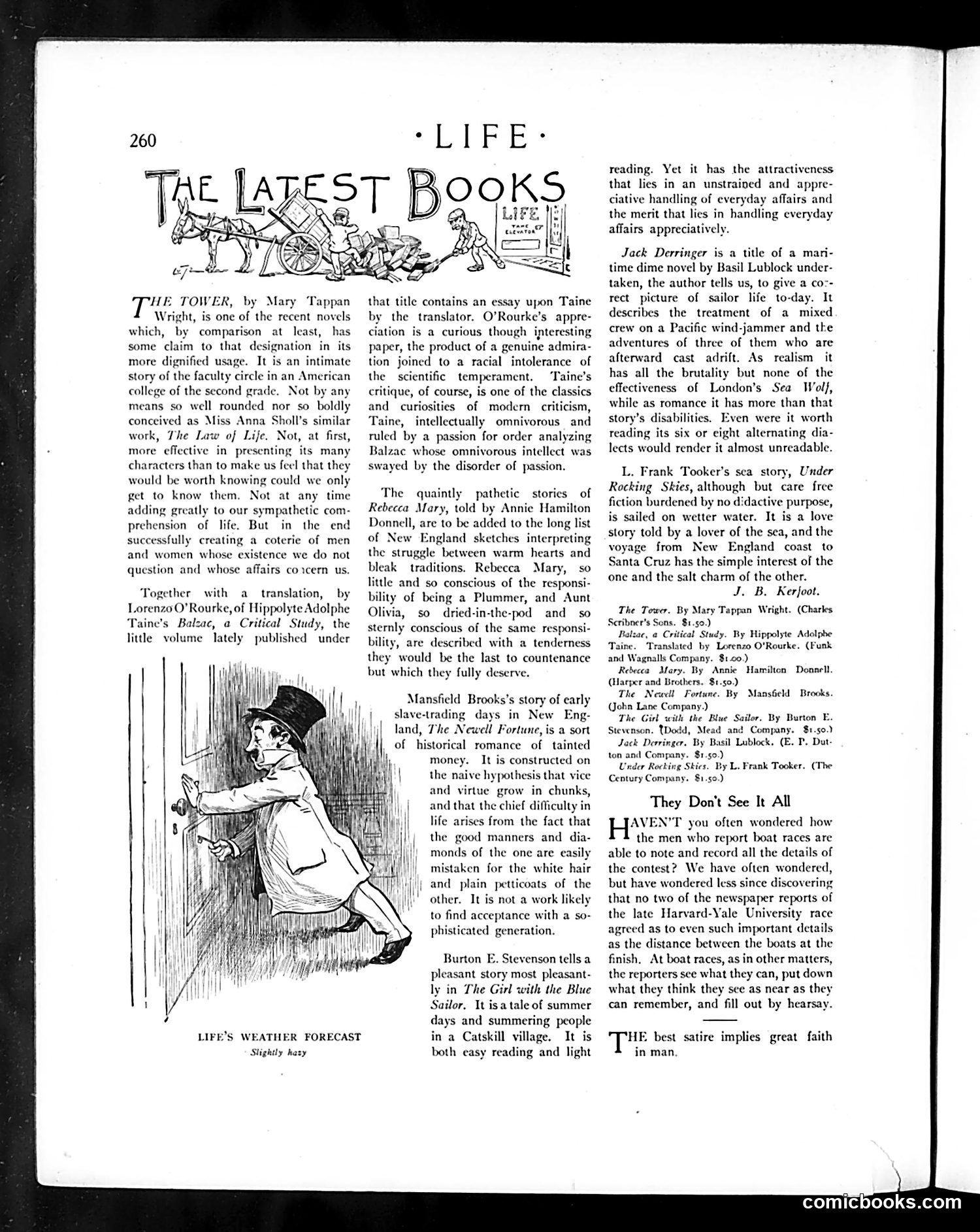
This page is primarily a book review section with one small cartoon titled "Life's Weather Forecast—Slightly hazy." The cartoon depicts a woman in early 1900s dress looking out a window with a somewhat dazed or bemused expression. The caption "Slightly hazy" appears to be gentle satire about a woman's mental state—likely poking fun at female sentimentality or romantic daydreaming, a common stereotype in period humor. The cartoon is deliberately slight and the joke understated. It's visual shorthand for a woman lost in thought or reverie, with the weather metaphor serving as a euphemistic joke about her confused mental state. This type of gentle domestic humor about women was typical of Life magazine's satirical content during this era.
📄 Transcribed text from this page (OCR, searchable)
Machine-transcribed from the original scan — historical spelling and the odd misread are preserved.
HE TOWER, by Mary Tappan Wright, is one of the recent novels which, by comparison at least, has some claim to that designation in its more dignified usage. It is an intimate story of the faculty circle in an American college of the second grade. Not by any means so well rounded nor so boldly conceived as Miss Anna Sholl’s similar work, The Law of Lije. Not, at first, more effective in presenting its many characters than to make us feel that they would be worth knowing could we only get to know them. Not at any time adding greatly to our sympathetic com- prehension of life. But in the end successfully creating a coterie of men and women whose existence we do not question and whose affairs concern us. Together with a translation, by Lorenzo0’Rourke, of Hippolyte Adolphe Taine’s Balzac, a Critical Study, the little volume lately published “under LIFE’S WEATHER FORECAST Slightly hasy that title contains an essay upon Taine by the translator. O'Rourke's appre- ciation is a curious though interesting paper, the product of a genuine admira- tion joined to a racial intolerance of the scientific temperament. Taine’s critique, of course, is one of the classics and curiosities of modern criticism, Taine, intellectually omnivorous and ruled by a passion for order analyzing Balzac whose omnivorous intellect was d by the disorder of passion. The quaintly pathetic stories of Rebecca Mary, told by Annie Hamilton Donnell, are to be added to the long list of New England sketches interpreting the struggle between warm hearts and bleak traditions. Rebecca Mary, so little and so conscious of the responsi- bility of being a Plummer, and Aunt Olivia, so dried-in-the-pod and so sternly conscious of the same responsi bility, are described with a tenderness they would be the last to countenance but which they fully deserve. Mansfield Brooks's story of carly slave-trading days in New Eng- land, The Newell Fortune, is a sort of historical romance of tainted If money. It is constructed on the naive hypothesis that vice and virtue grow in chunks, and that the chief difficulty in life arises from the fact that the good manners and dia- monds of the one are easily mistaken for the white hair and _ plain petticoats of the other. It is not a work likely to find acceptance with a so- phisticated generation. Burton E. Stevenson tells a pleasant story most pleasant- ly in The Girl with the Blue Sailor, It isatale of summer days and summering people in a Catskill village. It is both easy reading and light reading. Yet it has the attractiveness that lies in an unstrained and appre- ciative handling of everyday affairs and the merit that lies in handling everyday affairs appreciatively. Jack Derringer is a title of a mari- time dime novel by Basil Lublock under- taken, the author tells us, to give a cor rect picture of sailor life to-day. It describes the treatment of a mixed crew on a Pacific wind-jammer and tke adventures of three of them who are afterward cast adrift. As realism it has all the brutality but none of the effectiveness of London’s Sea Wolf, while as romance it has more than that story’s disabilities. Even were it worth reading its six or eight alternating dia- lects would render it almost unreadable. L. Frank Tooker’s sea story, Under Rocking Skies, although but care free fiction burdened by no didactive purpose, is sailed on wetter water. It is a love story told by a lover of the sea, and the voyage from New England coast to Santa Cruz has the simple interest of the one and the salt charm of the other. J. B. Kerjoot. The Tower. By Mary Tappan Wright. (Charles Scribner's Sons. $1.50.) Balzac, @ Critical Study. By Hippolyte Adolphe T. ‘Translated by Lorenzo O'Rourke. (Funk and Wagnalls Company. $1.00.) Rebecea Mary. By Annie Hamilton Donnell (Harper and Brothers. $1.50.) The Newell Fortune. By John Lane Company.) The Girl with the Blue Sailor. By Burton E. Stevenson. tDodd, Mead and Company. $1.50.) Jack Derringer. By Basil Lublock. (E. P. Dut ton and Company. $1.50.) Under Rocking Skies. By L. Frank Tooker. (The Century Company. $1.50.) They Don't See It All AVEN’T you often wondered how the men who report boat races are able to note and record all the details of the contest? We have often wondered, but have wondered less since discovering that no two of the newspaper reports of the late Harvard-Yale University race agreed as to even such important details as the distance between the boats at the finish. At boat races, as in other matters, the reporters sce what they can, put down what they think they see as near as they can remember, and fill out by hearsay. Mansfeld Brooks. HE best satire implies great faith in man, comicbooks.com